LS Staging

Tag: content marketing

  • Weekend Digital Media Round- AI Is Collapsing the Shopping Funnel, The Precision Payoff, Privacy UX as the New Personalization: How Trust Builds Customer Loyalty & More….

    Weekend Digital Media Round- AI Is Collapsing the Shopping Funnel, The Precision Payoff, Privacy UX as the New Personalization: How Trust Builds Customer Loyalty & More….

    1.AI Is Collapsing the Shopping Funnel

    AI is compressing the entire shopping journey into a few seconds, shifting customer research and decision‑making into AI-driven prompts and distributed channels. As a result, checkout becomes the only moment where brands can still influence relevance, offers, and revenue. SMBs now need strong product, payments, and data infrastructure to adapt and win in this new distributed commerce model. [Source: INC.]

    2. The Precision Payoff

    Personalised advertising is shifting from single big ideas to adaptive campaigns that use real-time data to deliver hundreds of tailored variations. Brands like Bajaj Finserv and Britannia are seeing higher engagement, better conversions, and improved ROI—though success depends heavily on high‑quality first‑party data and disciplined execution. When applied strategically, personalisation boosts efficiency by reducing wasted spend rather than increasing budgets. [Source: ET Brand Equity ]

    3. Privacy UX as the New Personalization: How Trust Builds Customer Loyalty

    Brands are shifting from surveillance-style personalization to privacy‑first engagement as consumers increasingly reject hidden data tracking. Transparency, consent, and clear value exchange now drive stronger trust, loyalty, and long-term customer relationships. Companies that prioritize privacy build more resilient data ecosystems and outperform on reputation, engagement, and lifetime value. [Source: CMS Wire]

    4. How to use AI for SEO without losing your brand voice

    AI can streamline data-heavy SEO tasks, but relying on it without a strong brand voice leads to generic, forgettable content. The key is letting AI handle structure and scale while humans shape tone, identity, and emotional connection. Brands that blend AI efficiency with clear human-led strategy will stay distinctive and competitive. [Source: Search Engine Land]

    5. When a 30-second clip overtakes a 60-minute conversation

    Altman’s viral 30‑second AI analogy sparked discomfort online, but the full hour-long conversation showed a more nuanced, human‑centred perspective. He highlighted the difference between technical explanations and human value, stressing that empathy, connection, and lived experience remain uniquely human. The episode ultimately reflected how fragile public trust in AI communication has become in a world dominated by short clips. [Source: Marketing Mind]

    6. Content marketing in an AI era: From SEO volume to brand fame

    Content marketing is shifting as AI answers most informational queries directly, making traditional SEO-driven traffic far less effective. To stand out, brands must prioritize distinctiveness, original research, strong distribution, and fame-building over high-volume content. Success now depends on creating memorable, signal-rich work that earns attention rather than relying on being discovered through search. [Source: Search Engine Land]

    7. The Top Challenges Facing CMOs in 2026

    Marketing leaders in 2026 are navigating tougher privacy rules, shrinking data visibility, economic pressure and rising expectations around AI. CMOs must justify budgets continuously, rebuild measurement models and manage AI responsibly while keeping brands visible in an increasingly fragmented digital landscape. The role has expanded beyond marketing into enterprise-wide growth leadership. [Source: CMS Wire]

    8. The Evolution Of UI/UX Design And The AI Impact

    UI/UX design has evolved from static layouts to data‑driven, behavior‑focused experiences, and AI is now reshaping that evolution. Conversational interfaces are reducing the need for traditional navigation, shifting design priorities toward intent interpretation, human‑AI interaction, and ethical personalization. While user flows simplify, building effective AI-driven systems requires deeper collaboration across design, engineering and data teams. [Source: Forbes]

    9. Why you’re no longer marketing to a person, but to an ‘assemblage’

    Modern consumers behave as shifting “assemblages,” influenced by group chats, algorithms, communities, and AI assistants rather than acting as isolated individuals. Robert Kozinets argues that marketers must rethink loyalty, identity, and engagement in an age where digital culture and AI deeply shape decisions. The future of marketing lies in understanding these networked behaviors instead of targeting a single person. [Source: The Drum]

    10. Your Customer Signals Aren’t the Problem. Your Operating Model Is.

    Real‑time customer signals are abundant, but most companies fail to act on them due to weak operational models, fragmented identity, and unclear decision ownership. Success comes from building a strong operational layer—identity resolution, orchestration, activation and governance—to turn insights into timely, consistent actions. AI accelerates decision-making but demands strict guardrails, human oversight and outcome‑based measurement to maintain trust and drive real business impact. [Source: CMS Wire]


  • The Role of Content Marketing in building brand awareness in India

    The Role of Content Marketing in building brand awareness in India

    Did you know the average Indian spends nearly 10 hours a day consuming digital content? With such immense engagement, businesses and individuals have a tremendous opportunity to promote their ideas, products, and services. Content marketing has become a crucial element in modern strategies, enabling brands to foster connections, build loyalty, and achieve measurable results. In India’s highly competitive market, brand awareness is vital—it shapes how consumers perceive and engage with businesses. Through content marketing, brands can position themselves as leaders, gaining trust and building lasting relationships with their audiences.

    To harness the power of content marketing, it’s essential to explore its various forms. Digital content marketing includes blogs, articles, and web pages designed to drive traffic and enhance search engine rankings. By providing valuable insights, these formats attract organic visitors and build credibility. Social media content marketing utilizes platforms like Instagram, LinkedIn, and Facebook to share eye-catching visuals, videos, and live streams, engaging a wide audience. Blogging enables brands to dive deep into specific topics, establishing themselves as thought leaders. Meanwhile, podcasting creates a conversational platform for discussing industry trends, offering a more personal connection to audiences who prefer audio content. Lastly, video marketing taps into the growing consumer preference for dynamic visual content, making it an effective way to showcase products, services, or brand stories.

    All these forms come together to create a robust strategy that connects businesses with their target audience across multiple platforms, boosting visibility and influence.

    At its core, content marketing is about educating audiences. By consistently sharing valuable, informative, and engaging content, brands position themselves as industry authorities. Informed consumers are more likely to form emotional connections with a brand, leading to long-term loyalty. Additionally, high-quality content fosters emotional ties that go beyond simple transactions. When content resonates with an audience—whether it’s inspiring, educational, or entertaining—it creates positive associations with the brand, turning occasional viewers into loyal advocates.

    Content marketing not only builds emotional connections but also enhances search engine optimization (SEO). By producing keyword-rich content that addresses the audience’s needs, brands can improve their ranking on search engine results pages (SERPs), driving organic traffic and enhancing brand visibility. Social media platforms further amplify this reach, allowing businesses to share compelling posts, videos, and live streams that encourage interaction and boost engagement.

    A particularly powerful tool within content marketing is user-generated content (UGC). When customers share their experiences with a brand, it serves as authentic social proof, fostering trust and credibility. UGC not only increases visibility but also strengthens a brand’s reputation by showcasing real-life interactions and satisfied customers.

    The benefits of content marketing are extensive. Trust and credibility are among its most significant advantages. According to the Content Marketing Institute, 96% of consumers find brand content trustworthy if it’s valuable, and 70% prefer learning about companies through articles rather than ads. Content marketing also significantly boosts visibility. Research shows it generates three times more leads than traditional marketing while costing 62% less. Engaging social media content can receive up to 94% more views and 150% more shares compared to purely promotional posts.

    SEO-driven content is crucial for generating organic traffic. Websites with blogs generate 55% more traffic than those without, and BrightEdge research indicates that organic search contributes to 53% of all website traffic. High-quality, SEO-optimized content is vital for increasing a brand’s visibility and search engine rankings. Moreover, LinkedIn reports that 74% of B2B buyers and 62% of B2C consumers find thought leadership content useful when making decisions, highlighting another benefit of content marketing: audience engagement.

    However, content marketing in India comes with its own set of challenges. While 64% of Indian marketers recognize its importance, 85% struggle to align content with business objectives. Budget constraints, especially for small and medium enterprises (SMEs), pose a challenge as they often lack the resources to compete with larger brands that invest heavily in content creation. Moreover, India faces a shortage of skilled content marketers, particularly in SEO and storytelling, limiting the effectiveness of content marketing campaigns. The oversaturation of digital content also requires brands to use more creative and innovative approaches to stand out.

    Despite these challenges, the future of content marketing in India looks promising. Video content is set to dominate, with businesses increasingly leveraging short-form videos, live streams, and interactive formats to capture consumer attention. Personalization will also take center stage as artificial intelligence (AI) and machine learning allow brands to deliver customized content experiences based on individual consumer behavior, deepening connections with their audiences.

    AI-driven strategies are transforming the way businesses create and distribute content. By using AI to analyze data and optimize content for peak performance, brands can remain ahead of the curve in today’s fast-paced digital environment.

    As India embraces digital transformation, content marketing will play an even more critical role in building brand awareness. Through video marketing, personalization, and AI-powered strategies, businesses can forge stronger connections with their audiences and foster greater loyalty. In today’s competitive landscape, content marketing is not just a choice—it’s an essential strategy for brands looking to thrive and stand out.

  • Weekend Digital Media Round-Up: Meta Announces Instagram Explore Home Ads Placement, Google Play streamlines policies around kids, Meta Launches New Sports Experience in VR & More….

    Weekend Digital Media Round-Up: Meta Announces Instagram Explore Home Ads Placement, Google Play streamlines policies around kids, Meta Launches New Sports Experience in VR & More….

    1.Meta Announces Instagram Explore Home Ads Placement Via Marketing API

    Meta formally announced the ‘Instagram Explore home’ Ads Placements via the Instagram Marketing API which allows marketers to run ads on the Instagram Explore home page. [Source: Search Engine Journal]

    2. Google Play Makes a Series Of Changes For Apps Designed For Kids

    Google Play has rolled out a series of changes to various programs and policies linked to Android apps that are designed for kids. [Source: Digital Information World]

    3. Meta Launches New Sports Experience in VR Which Could Help to Spark Interest in the Metaverse

    Meta has announced the launch of XTADIUM on Meta Quest, which will enable Meta VR users to experience sports in a more immersive, engaging way. [Source: Social Media Today]

    4. G2 launches Market Intelligence dashboard

    G2, the software and services review site, has launched G2 Market Intelligence, an interactive dashboard giving software vendors increased visibility into the data G2 gathers about in-market software purchasers. [Source: MarTech]

    5. Google launches new search, shopping and maps features

    Google has announced a boatload of new search features across Google Search, Google Lens, Shopping and Maps all aimed at bringing search to more users in more helpful ways. [Source: Search Engine Land]

    6. Meta Releases ‘Galactica’ AI System Which Can Produce Academic Papers Based on Simple Prompts

    Meta has launched a demo version of its new ‘Galactica’ language model for scientific papers, which is able to summarize academic literature, solve math problems, generate Wiki articles, and more. [Source: Social Media Today]

    7. Meta Launches Campaign To Support Small Business Shopping

    Meta is kicking off a marketing campaign to encourage customers to assist small to medium-sized companies (SMBs) throughout the vacation purchasing season. [Source: Search Engine Journal]

    8. Google Adds New Search Tools for the Holidays, Including AR Try-On Tools and Map Overlays

    Google’s adding some new Search enhancements for the holidays, in order to help businesses maximize interest in the peak shopping season. [Source: Social Media Today]

    9. WhatsApp Always Bless its Users by Introducing New Features For Them To Enjoy

    WhatsApp has rolled out many new features for its users. The most fascinating ones are polls and communities, and viewable profile pictures within a group chat. [Source: Digital Information World]

    10. LinkedIn Launches New ‘Brand Safety Hub’ to Manage Audience Network Placements

    LinkedIn has launched a new Brand Safety hub for its Audience Network ads, which will enable advertisers to find out more information about LinkedIn’s partner platforms. [Source: Social Media Today]


  • Weekend Digital Media Round-Up: Google’s Four New Features, Meta Launches JioMart for WhatsApp, Tweets Can Now be Edited & More…

    Weekend Digital Media Round-Up: Google’s Four New Features, Meta Launches JioMart for WhatsApp, Tweets Can Now be Edited & More…

    1.Google announces 4 new Shopping campaign features

    Merchants and advertisers can now add additional information and attributes to their shopping campaigns, including expected delivery dates. [Source: Search Engine Land]

    2. Meta Launches New ‘JioMart’ eCommerce Store for WhatsApp Users in India

    Meta is putting its $6 billion stake in Indian internet provider Reliance Jio to work, via a new eCommerce integration for WhatsApp, called ‘JioMart’, which will enable Indian WhatsApp users to browse and shop within the WhatsApp UI. [Social Media Today]

    3. Tweet Editing is Here, with Live Testing Now Active in the App

    Twitter has today launched the first stage of live testing for what’s arguably the most requested social media platform addition of all-time – the capacity to edit a tweet after posting. [Source: Social Media Today]

    4. Google Ads Enables Custom Conversion Values For Store Visits

    Businesses using Google Ads to drive in-store visits now have more control over smart bidding with the ability to set custom conversion value rules. [Source: Search Engine Journal]

    5.YouTube Adds Metrics To Main App, + New Way To Manage Livestreams

    YouTube creators can now monitor more metrics in the main app and manage livestreams from one convenient location. [Source: Search Engine Journal]

    6.Instagram Launches New Tools to Help Refine Content Recommendations

    Instagram is leaning onto extra AI-fueled suggestions, which it says have elevated engagement considerably since being built-in into consumer feeds. [Source: Social Media Today]

    7. Snapchat Launches New ‘Dual’ Camera Option, Similar to BeReal

    Snapchat’s New ‘Dual’ Camera will help to create content using their front and back-facing cameras simultaneously. Snap is looking to push the functionality beyond situational selfies, and more towards participatory, creative trends. [Source: Social Media Today]

    8. Twitter Launches Live Test of the Option to Pin a Tweet Reply

    Tweet reply pinning will enable users to highlight a specific reply to their tweet via the three dots menu on a response. You’ll then be able to keep that reply at the top of the thread, maximizing exposure for that specific interaction. [Source: Social Media Today]

    9. Messenger Adds ‘Group Invite Links’ to Streamline Group Chat Connection

    Messenger has added a new feature called ’Group Invite Links’, which, as it sounds, gives group admins the capacity to quickly and easily invite people to Messenger group chats. [Source: Social Media Today]

    10.Reddit Acquires Audience Research Provider ‘Spiketrap’ to Help Evolve its Ad Targeting Tools

    Reddit’s continues to refine its ad targeting and optimization tools, this time via the acquisition of ’audience contextualization company’ Spiketrap. [Source: Social Media Today]

  • 4 Things Marketers and Video Creators Should Know About YouTube’s Automatic Video Chapters

    4 Things Marketers and Video Creators Should Know About YouTube’s Automatic Video Chapters

    YouTube introduced video chapters for mobile devices in 2020. The feature allowed creators to manually divide a video into sections with individual preview, context, and info. This year, it has launched AI-generated automatic video chapters for eligible videos.

    As these automatically created chapters are a source of metadata for search, it can be a critical addition to any effective YouTube SEO strategy. Here are 4 things that marketers and video creators should know about automatic video chapters-

    1. What is the New Automatic Video Chapter Featgoofure on YouTube?

    YouTube has been experimenting with automatic video chapters since the launch of manual chapters in 2020. Recently, it has rolled out this feature for eligible videos on its mobile platform.

    If the channel has not already created manual chapters, the new feature will use Artificial Intelligence (AI) to identify significant moments of the video to break them down into chapters. As these chapters have individual info and context, they are being used as a source of metadata by YouTube’s search algorithm. In other words, it can also impact the ranking of your videos.

    2. What Videos are Eligible for Automated Chapters?

    Currently, YouTube has only rolled out this feature for eligible new uploads on its mobile platform. With time, it will be rolled out for more videos based on when they were uploaded. However, there is no clarity regarding the eligibility criteria. There is no information from YouTube regarding what makes a video eligible or ineligible for this new feature.

    Moreover, YouTube has also mentioned that it is possible for eligible videos to not have automatically-generated chapters if there are no suitable chapters in the video.

    3. Why Should Marketers and Creators Be Concerned About Automatic Chapters?

    As mentioned above, the feature uses AI to detect significant moments in a video automatically. As AI is not always perfect, it can misinterpret a section of a video. The chapters are a source of metadata, and the misinterpreted sections can impact the results that are displayed when someone enters a query on YouTube.

    So, if you don’t manually add chapters to your videos by adding timestamps to the video description, YouTube might generate the chapters automatically, and it can impact the ranking of your video.

    4. How To Fix Incorrect Automated Video Chapters?

    If YouTube has automatically generated sections for your video, you can check the same to ensure that all the sections are interpreted correctly. If not, you can always fix the error by manually adding the chapters. Manual chapters override the automated ones.

    Alternatively, it is also possible to opt out of this feature if you don’t need chapters in your videos. You can do this for specific videos or the entire channel. For specific videos, it can be done during the upload process. For channel, you can opt-out of automatic chapters by logging in to YouTube Studio and navigating to Upload Defaults -> Advanced Settings -> Auto Chapters On/Off.

    Using Video Chapters to Boost YouTube Rankings

    Adding chapters to the videos can be an effective addition to your YouTube SEO strategy. The new automatic chapters feature from the platform can help save time while uploading videos as it eliminates the need to enter the chapters manually.

    But as the chapters can impact video rankings, it’d be wise to cross-check the sections if they have been created automatically for your videos. Alternatively, you also have the option to add manual chapters and avoid any interpretation errors that could negatively impact video rankings.

  • Upgrade Your Content Marketing Strategy with Content Experience

    Upgrade Your Content Marketing Strategy with Content Experience

    ‘Content is king’ is a phrase that every digital marketer and brand manager might have read umpteen times. But do you know that this phrase was introduced by Bill Gates?

    In 1996, the Founder of Microsoft wrote an essay titled ‘Content is King’ where he talked about the internet being the future marketplace for content. It has been more than two decades since then, and we can all agree that this prophecy turned out true in every way possible. 

    Content is now at the heart of each of our digital marketing initiative. But while content probably will always be the king, it also goes through innovations and upgrades like all the other aspects of the digital landscape.

    ‘Content experience’ is the new buzzword in the content marketing industry. What is content experience? How can it boost your content strategy? Have a look-

    What is Content Experience?

    Modern consumers now live in a digital world that is ruled by the likes of Netflix and Spotify. These digital platforms take pride in their ability to provide personalized content experiences to their users. Once consumers get the taste of this personalization, they then expect the same from every platform or brand they deal with. In a nutshell, this is what content experience is all about. 

    It is the process of contextualizing and personalizing your content to better match the wants, needs, likes, and dislikes of the audience. No matter how a particular individual experiences or engages with your brand, there should be a level of uniformity and personalization.

    From website content, social media posts, newsletters, videos to even packaging instructions, every possible way in which any kind of content is consumed should be part of the overall content experience.

    How Does Content Experience Help?

    Here are some of the ways in which content experience can boost your content strategy-

    • Improved SEO Reach

    Over the years, Google has upgraded its search algorithm in a way that it can now provide accurate answers to actual conversational user queries and not only technical keywords. Furthermore, increased usage of voice assistance has significantly contributed to this progress. With content experience, your brand could have a voice that is relatable to your target audience.

    In other words, your content would be able to answer conversational queries of the audience, ultimately resulting in higher search engine rankings. Improved SEO reach and higher search engine ranking can also convert into more website traffic and sales.

    • Better Brand Authority

    Gone are the days when basic product demos were adequate to encourage people to buy your products or services. B2C and B2B consumers now prefer purchasing products that have plenty of information available about them on the internet. For instance, according to a report on Inc.com, 91% of the people regularly or occasionally read online reviews.

    If someone wanting to purchase your product or service is unable to find your reviews on the internet, it is very much possible that you might end up losing the customer to a competitor who does. In other words, content experience helps your brand build authority and have valuable information available on the internet, which is now vital for the consumers.

    • Improved ROI

    Last but not least, content experience can also make a world of difference to your bottom line. According to an E-Consultancy report, 80% of the companies that implemented personalization reported improved sales volume.

    Another research by Clickz suggests that companies that use advanced personalization report returns of up to $20 for every $1 they spend. These stats clearly emphasize the vital role that content experience can have on your bottom line. If done correctly, this content marketing strategy can significantly boost your business growth.

    Content Experience- The New Way to Market Content Online

    Modern consumers want to be informed, entertained, and engaged. In simple words, they now look for an experience that can make their purchase journey rewarding and delightful. Providing content experience is a strategy that checks all the right boxes when it comes to satisfying modern consumers.

    With personalization only expected to get more important for consumers in the future, this can be the right time for marketers and brands to start working on a content experience strategy as it could deliver lasting results.

  • The Rise of Video Marketing in the Digital Era

    The Rise of Video Marketing in the Digital Era

    Video content was already growing in popularity in the last few years. But the pandemic imposed lockdown, which forced people to remain indoors, has surged video content consumption to unprecedented levels.

    According to a Nielsen study, home-bound consumers have led to an increase of 60% in the amount of video content watched globally. And this surge is not temporary. While the consumption will not grow at the same rate in the post-COVID world, video content still has a bright future. As per a CISCO study, online videos will make up more than 82% of all the internet traffic by 2022.

    The unexpected rise of video content has encouraged marketing teams across the world to integrate video marketing into their digital strategies. But what makes video content such an effective marketing medium? Take a look-

    1. Video Content is the New King

    Humans are visual creatures. Multimedia content, especially in the video format, are easily digestible, convenient, and highly informative too. According to a Google study, almost 50% of the people in the 18-34 age bracket would instantly watch a video from their favourite YouTuber as soon as it is posted.

    As video content is only expected to get more popular in the future, this can be the right time to add video content marketing to your digital strategy.

    2. Videos Offer High Brand Recall

    No matter what form of marketing you prefer, brand recall or recognition is one of the primary motives. As compared to text-based content, video content can sometimes deliver significantly higher brand recall. According to an Insivia report, viewers can retain up to 95% of the message when they watch it in a video. But only 10% of the message is retained when conveyed through text.

    While text-based online marketing has its role, too, with regard to brand recall and recognition, video content delivers considerably better results.

    3. Videos Get More Shares

    If pictures speak louder than words, videos can amplify the message to a thousand times more. In many cases, videos are more impactful than text or image-based content. If viewers are affected by something they watch, the chances of them sharing the content are high too. And with video content, the chances are astonishingly high.

    According to a report on SmallBizTrends, videos can generate more than 12 times the shares than text and images combined. As social shares have become crucial for enhancing brand reach, it is through video content that brands have higher chances of reaching more people.

    Adding Video Marketing to Your Digital Marketing Mix

    Several reasons make video content vital for the digital marketing future. With video content consumption at an all-time high, this can be an excellent opportunity for brands to jump on the bandwagon and use video content in an effective and creative manner to promote their products and services.

    The expert assistance of a reputed digital marketing company could be of essence in the process. Work with digital marketing professionals to create a video marketing strategy that is capable of grabbing the attention of your target consumers.

  • Are Keywords Still Relevant to SEO in 2020?

    Are Keywords Still Relevant to SEO in 2020?

    Around 2010 when SEO was still in its infancy, keywords were thought to be the Holy Grail for acing search rankings. Spreading keywords across the articles, including meta description, title tags, and H1, was considered to be an effective strategy by most marketers. And it did deliver results, albeit for a short while.

    When Google introduced Panda, the update focused on promoting pages and sites that offered real value to the users. Ones stuffed with keywords or low on quality were demoted.

    So, have keywords lost their relevancy over the years? In 2020, how should a digital marketer or content creator deal with keywords? Getting back to the basics and understanding what SEO content is could offer a big piece of this keywords puzzle.

    How has the Definition of Search Engine Optimized Content Evolved?

    Just like the search algorithms, the definition of many of the SEO-related terms has changed over the years.

    For instance, around 2010-2012, SEO content used to be defined as content that is optimized for search engines. But with Google focusing more and more on helping users find relevant answers to their queries, this definition is not applicable anymore.

    Now, a more relevant definition of SEO content is one that best answers the query of the users. If your content is able to answer user queries, Google will automatically rank it higher.

    So, rather than creating content that best satisfies the search algorithms, a better strategy now is to create content that offers real value and answers to the users.

    Are Keywords Not Useful Then?

    No, keywords are still crucial. After all, they lie right at the foundation of how search engines work. But the manner in which they should be used has evolved.

    As compared to a piece of content that is stuffed with keywords in the best possible manner, content that answers user query and also has keywords will mostly rank higher. The focus should be on answering user query and using keywords, in full or in parts, as naturally as possible.

    For instance, let us consider a query “How many different types of bones in a human body?”

    The top result for this query could be something like, “There are five different types of bones in the human body.”

    So, the top result here is not just stuffed with a keyword but features keyword along with providing the correct answer to the query. While creating content, it is essential to remember that the search engine is only a medium to reach the audience.

    The final goal is always reaching the audience and not how to best impress the search engine algorithms.

    The Way Ahead for Keywords in SEO

    Keywords always were and probably will always be an important component in SEO. But the good old practice of stuffing content with keywords doesn’t work anymore.

    Google has always wanted to answer user queries in the best way possible. But rather than only focusing on the keywords to rank pages, it now also considers the quality and end-goal of the content that it is ranking.

    In 2020, only the content that is able to answer the intent of the user question most comprehensively, and features relevant keywords, could now be considered SEO content that is eligible for higher rankings.

  • Content Accuracy is Not Yet a Google Ranking Factor

    Content Accuracy is Not Yet a Google Ranking Factor

    Content accuracy has always been a point of contention among SEO experts, webmasters and content strategists. While some firmly believe that content accuracy plays a role in determining page rankings, others are on the opposite side of the camp, stating that accuracy is not a ranking factor.

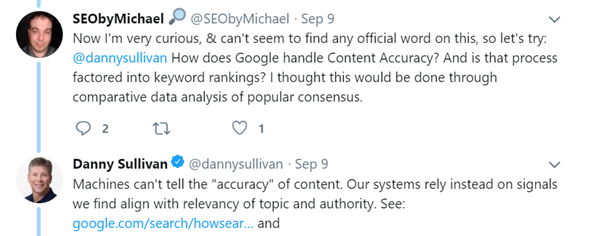
    Recently, this debate cropped up again on Twitter. Danny Sullivan, a veteran journalist who founded Search Engine Land and later joined Alphabet in 2017 as a public liaison for search, was posed this query.

    One of Sullivan’s Twitter followers asked him the following question, “How does Google handle content accuracy?” In response, Sullivan tweeted from his personal account saying that Google’s machines are not yet sophisticated to identify the accuracy of the content. Rather, their machines and algorithms rely on signals for topic relevance and authority, to decide the ranking of the content.

    Here’s the Twitter reply from Danny Sullivan:

    Image via Twitter

    Content Authority not be confused with Popularity

    In continuation with the conversation on Twitter, Sullivan was further asked whether content authority meant content popularity. He responded, saying that content authority should not be mistaken for popularity, as popularity will have no place for new queries that constitute nearly 15% of Google’s daily search volume. Also, content popularity is too simple a signal, and Google doesn’t rely on it to rank web pages.

    The Emphasis on Content Authority by Google

    In April 2017, Google announced the launch of Project Owl to improve the quality of search results. This project stressed more on authoritative content that enjoyed better ranking. Additionally, this project allowed users to send their feedback to Google regarding its auto-complete search suggestions and the featured snipped answers that were listed on the first page of search engine rankings.

    This was Google’s first step to combat the spread of fake news and misinformation on the internet. In November of 2017, Google, along with Facebook, Twitter, and Bing, agreed to use the trust indicators of The Trust Project to aid the prevention of spreading of misinformation and fake news.

    Earlier this month, Google updated its Search Quality Rater Guidelines with an aim to vet out news sources as well as creators of YMYL (Your Money Your Life) content. These guidelines have been modified to allow raters to provide content that has the potential to spread hate, the lowest ratings.

    The Debate Continues on Twitter

    Sullivan’s reply sparked plenty of replies with some users disagreeing with his answer and some agreeing to it. Some stated that today, machine learning tools could assign levels of accuracy to content. Machine learning can assess the accuracy of almost all content that doesn’t relate to personal experience.

    However, others thanked Sullivan for clarifying the issue that content accuracy is not a ranking factor as of now.

    What’s the Takeaway?

    There’s no doubt that content accuracy plays a crucial role in determining its impact on the end-user. However, content accuracy is not one of the top Google ranking factors. Page authority and relevance are likely the top two signals that Google’s algorithms use to rank content.

  • Writing for Search Engine Bots Vs. Writing for People – Which Approach Works in 2019?

    Writing for Search Engine Bots Vs. Writing for People – Which Approach Works in 2019?

    When it comes to content writing, there are two distinct approaches to take. One – write for search engine bots, filling your content with keywords. Two – write for your readers, offering them value, while making your content click-worthy and share-worthy.

    Both these strategies have a common goal – to boost the visibility of the content and to pull in more traffic. But, which of these two approaches work? Find out here.

    The End of the Black and White Hat Techniques

    For years, SEO specialists and digital marketers have been trying to win the attention and favor of search engines by employing various techniques commonly known as white hat and black hat strategies.

    Simply put, black hat was for those who aimed for quick results, by using not-so-scrupulous techniques like hidden texts, keyword stuffing, content spamming, link farming and so on. On the other hand, white hat played by the rules of search engines, meaning results took longer to materialize. Effective keyword usage, internal linking, generating relevant backlinks were some of the popular white hat strategies.

    While white hat strategies are more ethical, the point here is that search engines have come a long way and have seen significant evolutions. The complicated Google algorithms of today penalize both black hat and white hat strategies. That is because Google doesn’t want to be manipulated anymore. When you employ these strategies, you are likely to get your site to lose its ranking or even de-indexed.

    Focus on Your Audience

    Content marketing today is all about the end readers. As a content writer, you need to ensure that you are providing your audience with value, giving them what they are looking for. You need to ensure that your audience connects with your content. It’s no longer, just about satisfying search engine bots to boost your rankings.

    It’s all about high-quality, well-written relevant content that appeals to the end reader.

    What about Search Bots?

    Search engines today have highly-sophisticated algorithms that use advanced technologies like machine learning, AI and more. This means Google and all other search engines can easily identify well-written high-quality content that provides users with the relevant information, from content that was written to trick search bots.

    It’s no longer about keyword stuffing to pull in the attention of search bots. It’s all about high-quality content that offers value to readers, thereby winning the attention of search bots and ranking higher. To put it in a nutshell, if you write good content that satisfies your target audience, Google will reward you. The reverse (content written for search bots) isn’t true.

    What Qualifies as Good Content for Google?

    Check out Search Quality Evaluate Guidelines published by Google to find out what qualifies as good content, from Google’s point of view. This document is the Bible for content writers. It gives you a clear idea of how Google’s bots evaluate and rank different contents. It doesn’t just point out what is good content but also explains why content is considered bad.

    Here are some pointers that help you create Good High-Quality Content:

    • Start by defining the purpose of your content. Identify the focus topic, your target audience and the intent (what you wish to achieve).
    • Do your research. Before, you start writing spend time analyzing the topic, understand what is it about and then give your opinions/views on it.
    • Edit and use correct grammar. Use the right punctuations, grammar and try to keep the content to the topic.
    • Make it informational, educational and relevant. You need to ensure that your content satisfies the purpose. Does it provide readers with the relevant info? Does it answer their questions?
    • Always cite sources. Remember that statistics are just a string of numbers if you don’t have the relevant sources to support it. Make sure to cite the sources.

    As you can see, you can easily satisfy both your readers and search engine bots with high-quality, relevant, and engaging content. This is certainly the approach to take for content writing in 2019.