LS Staging

Tag: Social Media Optimisation

  • Weekend Digital Media Round-up:  Google’s Cloud AutoML, WhatsApp officially launches profiles for businesses, Facebook’s Watch Party and more..

    Weekend Digital Media Round-up: Google’s Cloud AutoML, WhatsApp officially launches profiles for businesses, Facebook’s Watch Party and more..


    1. Google to make artificial intelligence accessible to every business

    Google on Wednesday unveiled ‘Cloud AutoML‘’, which is aimed at helping businesses go beyond limitations of machine-learning expertise and start building their own high-quality custom models using advanced techniques provided by the Internet giant. [Source: The Hindu]

    1. Facebook’s Testing a New Communal Video Viewing Option for Groups

    Facebook’s new ‘Watch Party’ option enables Group admins to share public video clips with their members, and for those viewers to then comment and discuss the content in real-time. [Source: Social Media Today]

    1. Snapchat Is Making App Install Ads More Targeted With Deep Links

    Snapchat’s ad-tech pipes are getting a little deeper. For advertisers that run ads that promote app installs (by prompting users to swipe on the screen to download an app), brands can now deep link their campaigns that prompt consumers to re-engage with specific features of the app. [Source: Adweek]

    1. The Google Speed Update: Page speed will become a ranking factor in mobile search

    Google announced a new ranking algorithm designed for mobile search. The company is calling it the “Speed Update,” and it will only impact a small percentage of queries. Only pages that “deliver the slowest experience to users” will be impacted by this update, the company says. [Source: Search Engine Land]

    1. Google My Business Now Allows You To Post Videos

    Google has been testing a video upload feature to be added to My Business to enhance it and allow business owners to showcase their products better. Google My Business team finally made that feature available to business owners, and it can be accessed through their My Business dashboard. [Source: Logicserve Digital]

    1. WhatsApp officially launches app, profiles for businesses

    Four months after WhatsApp announced that it would introduce tools for businesses, on Thursday the Facebook-owned messaging service officially rolled out business-specific profiles and a mobile app for marketers to manage their WhatsApp accounts. [Source: Marketing Land]

    1. Internet Of Things And Blockchain – The Intersection Of Success

    The Internet Of Things aka IoT has been advancing at a quick pace in the recent years. IoT utilises the millions of objects connected over the net, and facilitates information passing and evolves over time, learning each and every second. Blockchain, on the other hand, makes it possible to record each and everything that has been communicated between objects, at that instant, and make the information available to everyone present in the Blockchain network. [Source: Logicserve Digital]

    1. Google’s tighter ad rules for YouTube ‘don’t go far enough’

    Google is making big changes to the ad rules on YouTube as it looks to clean up the site amid ongoing issues for marketers around brand safety. The update means YouTube will impose stricter criteria on the types of videos that can generate ad revenue and introduce a new review process for ‘Google Preferred’, its premium content. [Source: Marketing Week]

    1. LinkedIn’s Putting Renewed Focus on Groups, with New Tools and Options

    LinkedIn is putting an increased emphasis on groups. It will be adding some new Group features including new navigation & notification options, videos. [Source: Social Media Today]

    1. Adobe’s Newest Labs Project Can Track In-Store Customers in Real Time

    Adobe Labs new technology can track live foot traffic in a store and break down shoppers into a variety of data segments (through Adobe Analytics) like people who spend a lot of money, the type of products they buy (organic, gourmet, sweet tooth) and more. [Source: Adweek]

  • Weekend Digital Media Round-up: Google’s new Search Console features, Facebook’s Smart Home Device, AdSense’s ad balance optimization tool and more..

    Weekend Digital Media Round-up: Google’s new Search Console features, Facebook’s Smart Home Device, AdSense’s ad balance optimization tool and more..


    1. Google to roll out new Search Console features in coming weeks

    Google announced that it will be making the new Google Search Console available to everyone in the coming weeks. Specifically, verified users in Google Search Console will be able to access the new Search Performance, Index Coverage, AMP status and Job posting reports. The new Search Console reports provide “more transparency into Google’s indexing, stateful two-way communications between Google and website owners to help resolve issues faster, and a responsive user-interface.” [Source: Search Engine Land]

    1. Facebook Is Reportedly Set to Launch its Own Smart Home Device Later This Year

    Facebook could soon become a more prominent presence in your everyday life, with reports suggesting that The Social Network’s looking to launch a new voice-activated, video calling device which you could place in your home, keeping you linked into the platform at all times. The new device is to be called ‘Portal’, and will compete with existing home speaker-type devices already gaining momentum – most notably the Amazon Echo Show. [Source: Social Media Today]

    1. AdSense rolls out ad balance optimization tool for publishers

    Google AdSense has announced two new Experiments features to give publishers a deeper understanding of how certain factors affect their users and advertising earnings. The two new features are ‘Ad Session Length’ and ‘Ad Balance Tool’. [Source: Marketing Land]

    1. Facebook shutters digital assistant ‘M’ and readies video ‘Portal’

    Facebook is shuttering its digital assistant, “M.” At the same time, the company is preparing to launch its rumored touch-screen video device named “Portal.” It will compete with Echo Show and Google-powered new “smart displays.” [Source: MARTECH TODAY]

    1. Google PageSpeed Insights now uses real data from Chrome browser users

    Google announced that the PageSpeed Insights tool has been updated to use data from the Chrome user experience report, which means the tool is using metrics from “real-world Chrome users who experience popular destinations on the web.” The pagespeed tool now shows you how fast your pages load based on real user data, which is an important metric for user satisfaction. [Source: Search Engine Land]

    1. Facebook is testing a city-specific section of its app to elevate local news and events

    In an effort to up its signal to noise ratio, Facebook may go local. The company is testing a new area of its app called “Today In,” a mix of city-specific events, announcements and local news. [Source: TechCrunch]

    1. Unpartial – The AI-Powered Chrome Extension To Spot Fake News

    This week, an AI company called Recognant has released an extension for Chrome that informs users if the news they are viewing on the browser is fake. The AI tool is said to have a function which tests the ‘trustworthiness’ of an article or a story. [Source: Logicserve Digital]

    1. Google is introducing a new Smart Display platform

    If Google’s gigantic “Hey Google” CES 2018 booth hasn’t convinced you that it is deadly serious about stopping Alexa’s path toward owning the smart speaker space, how about this: it’s announcing that the following companies are making speakers that include the Assistant: Altec Lansing, Anker Innovations, Bang & Olufsen, Braven, iHome, JBL, Jensen, LG, Lenovo, Klipsch, Knit Audio, Memorex, RIVA Audio, SōLIS, and Sony. Four of those names in particular are more interesting — JBL, Lenovo, LG, and Sony — because they’re producing Google Assistant speakers with something new: a screen. Google says these speakers will be available in the summer. [Source: The Verge]

    1. Facebook Announces Coming News Feed Changes Which Will Reduce the Reach of Page Posts

    The Social Network, Facebook, has confirmed that they’ll be making concerted moves to show users more posts from people they know – and fewer posts from Pages. The aim of these changes is to ensure that the time people spend on Facebook is ‘well spent’. [Source: Social Media Today]

    1. Google is sunsetting AdWords Review extensions

    Google has announced that Review extensions will stop showing this month and will be deleted entirely in AdWords accounts in February. Advertisers that ran Review extensions and want to keep their historical data will need to export it in AdWords this month. That data can be found in both the new and old AdWords interfaces. [Source: Search Engine Land]

  • Facebook’s video ads’ watch time – how it works across different formats

    Facebook’s video ads’ watch time – how it works across different formats

    Social networking giant Facebook believes that different ads have different values based on the context under which it is played. The tech team at Facebook says that an ad experience is not just a single experience, but a variety of unique and different experiences.

    How was this determined?

    Facebook goes so far as to provide charts to show how many people watch ads and how the ads’ watch times fluctuate according to its environment. However, Facebook does not provide the exact facts and figures with the charts, which don’t make them absolutely conclusive. The data provided, however, is Facebook’s internal data and contains most of the information from this source. There is some information from YouTube and some other companies who place ads on their products, such as Instagram, and Spotify, which makes this data more reliable in terms of data authenticity.

    Usually, companies placing ads on their videos and products evaluate the ad quality based on how many people completed the ad or how many people watched more percentage of the ad which was placed. This is called completion rate, and companies usually use this to judge an ad’s ability to keep the audience engaged. However, at Facebook, the ad’s quality is determined by exactly how many seconds the ad was viewed by a person before skipping it, and then using all the collected data to determine how many people watched the ad up to the same second.

    What does the data show?

    Facebook has started placing ads on videos pretty recently, and they mostly have two types of ads, pre-roll ads, and mid-roll ads. Pre-roll ads are non-skippable and are needed to be completed by the user in order to continue watching the video. Mid-roll ads are longer, skippable ads, which are usually fifteen seconds long, and can be skipped after five seconds.

    After collecting all the data on the number of people who completed pre-roll ads and the people who completed mid-roll ads, Facebook observed that majority of people skipped mid-roll ads after five to six seconds, which meant that most of the people on the social network had around six-second attention span toward the ads.

    This data primarily meant that in-stream ads put up by Facebook mostly ended up being watched for six seconds, in case of pre-roll and mid-roll ads, both.

    Data depiction made easy with charts

    Facebook released various charts depicting how their ads have fared over time. The charts mainly consisted of standalone ads which Facebook inserted in people’s news feed, skippable and non-skippable ads placed in-stream, story ads added in people’s Instagram stories, and Live TV ads which were embedded in live streams.

    The charts indicate that Facebook’s pre-roll ads, which are the non-skippable ads, perform better than any other type of ad provided by Facebook. This basically suggests that brands can redirect all the money they have put in other kinds of ads and put them into placing pre-roll ads on Facebook.

    Why the need for this exercise?

    Facebook says they want investors to look at the time for which their ads are being viewed, and invest more money into it, rather than getting caught up in comparing completion rates and deciding where to invest more money for ads.

    With these stats and charts, Facebook tries to make sense of the value of tying up experiences to an ad and how it delivers value to a brand.

  • Weekend Digital Media Round-up: Google’s new AI, Facebook’s WhatsApp feature, Snapchat’s new feature to share content outside app and more..

    Weekend Digital Media Round-up: Google’s new AI, Facebook’s WhatsApp feature, Snapchat’s new feature to share content outside app and more..


    1. Google’s new artificial intelligence talks like you, me and everyone

    In a major step towards its “AI first” dream, Google has developed a text-to-speech artificial intelligence (AI) system that will confuse you with its human-like articulation.  [Source: The Economic Times]

    1. Facebook’s WhatsApp feature will help lure more advertisers

    FACEBOOK’S latest move in hoping to attract more advertisers to its platforms is the addition of a “Click to WhatsApp” option for Facebook ads. The move follows the “Click to Messenger” option introduced in November 2016 and Instagram’s “Click to Messenger”, added in last May. [Source: Tech Wire Asia]

    1. Alibaba’s UC browser beating Google Chrome in Indian mobile market

    The Alibaba-owned UC browser is winning the war for mobile users in India and Indonesia. Relying on StatCounter data, The Wall Street Journal is reporting that it’s beating Google’s Chrome in these large developing markets. [Source: Marketing Land]

    1. Ad buyers prefer Instagram to Snapchat—and Snap’s stock is taking a nosedive

    A new report from Cowen analyst John Blackledge has some bad news for Snap. He interviewed 50 ad buyers and found that they overwhelmingly preferred Instagram to Snapchat. [Source: Fast Company]

    1. Snapchat Wants To Expand Snaps’ Exposure With A Feature To Share Content Outside The App

    With the idea of spreading snaps everywhere, Snapchat is trying to launch “Stories Everywhere” option in their platform. The social media platform wants to provide content that can last longer than just a few hours. Stories Everywhere would allow the snaps to appear on websites and applications outside the native Snapchat app. [Source: Logicserve Digital]

    1. Google Chrome Built-In Ad Blocker to Go Live on February 15th

    In June of 2017, Google announced that they would be introducing an ad blocker for the Chrome web browser in an effort to filter ads violating industry standards. Now, we have a sense of when: February 15, 2018. [Source: DMN]

    1. Facebook beats YouTube and TV as best place to launch new ad campaign in survey of ad buyers

    Facebook will chip away at Google’s dominance in digital advertising thanks to the growth of Instagram and video ads, according to a new research note from Cowen. [Source: CNBC]

    1. Instagram tests letting users post Stories directly to WhatsApp

    Last October, Facebook extended the usage (and flexibility) of Instagram Stories — the Snapchat-like feature that lets you patch together photos and videos into a slide show — by making it easy to directly post a Story to Facebook. Now Facebook is looking at how to bring WhatsApp into the fold. [Source: TechCrunch]

    1. Snapchat ads could get a lot more like YouTube ads

    Snapchat might be going the way of YouTube. The messaging and camera app, which has been wary of forcing ads on its audience, is seriously considering whether to subject viewers to three seconds of advertisements before giving them the option to skip the commercial break, Ad Age reported (paywall), citing advertisers and media players familiar with the company’s plans. [Source: Quartz]

    1. New Facebook News Feed Algorithm Updates You Need to Know

    To keep your interest and attention, Facebook’s always tweaking its News Feed algorithm to ensure that users are served the most engaging and relevant material possible. Usually these updates are good for the overall user experience, but they can also cause significant headaches for marketers, and there were two that were recently announced which marketers need to be aware of if they want to make the most of the already dwindling organic reach. [Source: Social Media Today]

    Expert Opinion:

    1. Giving a good consumer experience on Mobile – a must for Brands

    We know that mobile phones have become an essential part of our lives and how the new-age consumers are utilizing it for fulfilling their needs. On one side, consumers are increasingly using their mobile phones to seek information about a brand, interact with it and maybe even buy their product online and on the other side consumers are spoilt for choices.

    In such a scenario, it has become imperative for brands to focus on providing consumers a seamless and positive mobile customer experience in order to thrive in this disruptive environment.

    Here are a few ways marketers can work on improving mobile consumer experience:

    – Create compatible designs for various platforms

    Various mobile handsets have different operating systems and functional capabilities. It is important to create your designs that render perfectly and uniformly across platforms & devices, thus avoiding any dissonance amongst users and creating a strong foundation for a great user experience.

    – Simple, friendly onboarding experience

    Different studies have indicated that on the mobile a user takes not more than 8 seconds to decide if he wants to engage with the content/brand.  In this scenario if a brand wants to really connect with their users, they must have a very simple and interactive onboarding experience. This is where the customers will get to know the brand and can develop affinity and preference for it.

    – Understand user personas and their context for interactions

    In addition to focusing on design tools, a brand should give context a priority; they should understand the customers, their profiles, buyer personas and the context for their interactions. This can help a brand deliver memorable experiences to the customers.

    – Be interactive

    A Brand should be able to engage with the visitors, gain their attention and develop interest among them. Interactive customer experiences are a great way to build long-term relationship with consumers and marketers should build their websites/ apps based on anticipated user behaviors and thought out actions.

    – Navigation and accessibility

    Ease of navigation and easier accessibility to useful information is crucial to deliver a positive mobile consumer experience. A brand should understand the general usage pattern on mobile devices and the way users navigate across the small mobile screen. It will then be able to place important action buttons and showcase relevant information that the users are likely to look for.

    Brands should also ensure there is an option for a search box/icon so that it becomes easier for users to look for what they need without having to browse through multiple pages. Complicated navigation can tend to take your users away from your website/ app and on the other hand, a good website/app with relevant information and simple navigation pattern is sure to leave the users feel good about the brand.

    – Testing and alterations

    It is of paramount importance to regularly test the mobile customer journey and make any changes/ alterations wherever required basis the observations and customer feedback. This will ensure the customers have a fulfilling mobile experience every time they approach the brand on mobile.

    Looking at the way mobile phones are taking over every aspect of our day-to-day lives, there is a need for brands to focus their efforts on providing a great and immersive user experience to the consumers through their mobile app/ site. This can make a lot of difference in a consumer’s brand preference and loyalty.

    Anurag Gupta, CEO at SVG Media Pvt. Ltd

  • Snapchat Wants To Expand Snaps’ Exposure With A Feature To Share Content Outside the App

    Snapchat Wants To Expand Snaps’ Exposure With A Feature To Share Content Outside the App

    Snapchat has been undergoing significant changes to become more and more relevant to what the market needs. According to reports, there is another interesting change coming in Snapchat.

    With the idea of spreading snaps everywhere, Snapchat is trying to launch “Stories Everywhere” option in their platform. The social media platform wants to provide content that can last longer than just a few hours. Though the option called “Memories” is already there, Stories Everywhere would allow the snaps to appear on websites and applications outside the native Snapchat app.

    Snap content shareable on other platforms

    With the new sharing option, Snapchat wants to enhance the exposure of the snap content and let it be discovered by people who aren’t a part of the Snapchat ecosystem. The users would get the ability to share their snaps on their own app or website. With this move, the company wants to increase the reach and improve their revenues.

    The sharable Snaps would allow the creators to have them forever. The content won’t just disappear after a few hours of creation. This comprehensive presence will give more visibility to Snapchat. More ways would become available for the users to come to Snapchat from other platforms.

    Benefits for brands and influencers

    Snapchat has always been questioned by the brands, companies, and influencers regarding the disappearance of the content. The businesses put a lot of effort into their Snap content pieces. But they all last for only a few hours.

    Snapchat has answered these questions by providing ‘Memories’ option that allows the creators to repost their Snaps. Now, with the new ‘Stories everywhere’ option, Snapchat would improve the abilities of the businesses to promote their content. So, it would not be wrong to say that this feature is going to drive positive results for brands and influencers.

    A step further away from the core idea

    The core idea of Snapchat was the disappearing content. But the social media platform has understood the requirement of everlasting content requirement. That is why the company launched the Memories option a year ago. The reposting of the Snaps allows users to have their content available for a longer time.

    The ‘Stories Everywhere’ would allow users to make the content existing outside Snapchat too. It is one step away from the core idea of the social media platform. But it would definitely be for the best. As the feature will help all sorts of users to promote and exist, more users will come to the platform.

    Other platforms shifting towards everlasting content

    It is not just Snapchat; other platforms have understood the importance of everlasting content. Instagram is also moving away from the temporary content with new features.

    Social media is not just about the general users anymore. The influencers and brands have become an important part, and are giving business to social media platforms.

    It is going to be interesting to see how ‘Stories Everywhere’ changes Snapchat for companies and websites. The content creation will definitely obtain a growth for sure. More brands would include Snapchat in their social media and content strategy.

  • Weekend Digital Media Round-up: Google Tez partners with Xiaomi, Instagram’s Recommended posts, LinkedIn’s new messaging experience and more..

    Weekend Digital Media Round-up: Google Tez partners with Xiaomi, Instagram’s Recommended posts, LinkedIn’s new messaging experience and more..


    1. Google Tez takes another leap to dominate Indian digital payments with Xiaomi partnership

    It seems like India is Google’s favorite testing ground. One of the latest India-first product Google is betting and committing heavily on is its mobile payment app Google Tez. A new chapter to this ongoing ‘great Indian experiment’ was added by a partnership with India’s most popular smartphone brand Xiaomi. The partnership will see Xiaomi introducing a new payment service on its e-commerce platform powered by Google Tez which will help users to make cashless transactions on Mi.com website and the Mi store app. [Source: PCMag India]

    1. On Facebook, viral reach for branded-content ads eclipses standard ads

    If brands want to attract extra attention for their ads on Facebook, they may be better off paying a publisher or influencer to produce a branded-content post through their Pages and paying to promote that post as an ad instead of a post published to the brand’s own Page. [Source: Marketing Land]

    1. Instagram will now add ‘Recommended’ posts to your feed

    Instagram’s feed will now show users recommended posts – a change that earlier this month was spotted while in testing, and has since quietly gone live. The feature will suggest posts for you based on those that have been liked by other accounts you follow. [Source: TechCrunch]

    1. Google image search results tests new related searches box

    Google is testing a new “related searches” box in the mobile version of the Google Image search results page. [Source: Search Engine Land]

    1. Netflix, WhatsApp may join hands to send content recommendations to users

    WhatsApp and Netflix are expected to join hands to send content recommendations to users very soon. With this move, Netflix basically wants its users to be updated with all its services and also try them out, in turn enhance user experience. [Source: India Today]

    1. Online Video Ad Spend Grew 36%, Finds IAB Revenue Report

    It’s a good time for online video ad sales. According to the IAB Internet Advertising Revenue Report for the first half of 2017, total online video ad sales (which include desktop and mobile) grew to $5.2 billion, up 36 percent over the same period in 2016. [Source: Onlinevideo.net]

    1. This LinkedIn feature replaces face-to-face prospecting

    LinkedIn’s new messaging experience essentially replaces the need for face-to-face networking. Because of your ability to instantly scan someone’s profile, see conversation starters (where someone lives, works, went to school, etc.) and then engage in a real-time, one-on-one conversation, you can now chat up prospects at a scale like never before. [Source: The Business Journals]

    1. Using AdWords API to export to third-party ad networks will remain OK as Google keeps terms it adopted in FTC settlement

    Though the part of Google’s antitrust settlement with the Federal Trade Commission that had them allow exports of AdWords data through its API expires, the company announced that Google will keep the AdWords API terms and conditions as they are currently. [Source: Search Engine Land]

    1. Amazon is planning a push into digital advertising in 2018, challenging Google and Facebook

    Amazon is expanding advertising efforts in 2018, especially on its search and video products. It also has plans to increase advertising sales off its platform, including partnering with third-party technology companies to sell partnered TV and mobile ads. [Source: CNBC]

    1. Google again showing third-party reviews in local results

    Google is integrating third-party reviews into the Knowledge Graph for hotels. It apparently has been happening since 2016 and is entirely opt-in for the provider. Google works directly with the third-party review source (e.g., TripAdvisor) to integrate the content. [Source: Search Engine Land]

    Expert Opinion:

    1. Build a positive brand image through mobile moments

    In today’s age, speed and relevance are crucial for customer satisfaction. The popularity of smartphones and access to internet has made it even more critical to deliver right messages to the right users instantly and correctly. People these days have higher expectations from brands on mobile. During the customer journey on mobile, there are a lot of smaller moments that make the users pull out their mobile devices to look for what they need immediately. These moments, also known as mobile moments, are crucial for marketers to offer unique solutions to the customers when they need it, and the way they need it. Mobile moments are a great way for engaging users and creating a win-win situation for both users and brands.

    Here are some ways you can use mobile moments to build your brand image.

    – Be Fast

    People who have a negative brand experience on mobile are less likely to purchase from that brand in the future. One of the most common complaints of users is the speed of the brand destination. Consumers don’t like it when sites load slowly, and are more likely to move on rather than wait for the details to load. As per a report published by Google, 53% of mobile page visits are abandoned if the pages take longer than 2 seconds to load. Marketers should make speed a priority to deliver a positive experience. And also, ensure that the design and navigation is simple so that people can find what they are looking for quickly.

    – Be Helpful

    Constantly endeavor to better understand your customers and deliver brand experiences that enable solutions rather than just distribution of brand information. Users who find mobile experiences helpful are more likely to repurchase from that particular brand. Make an effort to help your consumers. It can either be fast & friendly customer service or a simple functionality to quickly check if the items are in stock, etc. Aim to understand consumer behavior and anticipate their needs, and use this to offer products/ solutions that are useful to them.

    – Be Relevant

    Data as they say is the new oil. By constantly analysing your own data as well as adopting a data-led marketing approach you will be able to tailor your brand messaging a lot better for your audience. Not only will this drive greater efficiency in your marketing investments, but also enable better engagement with your audience. Mobile data, both first party as well as through trusted third-party sources, gives deep insight into consumer trends and behaviours which further drive the ability to build delightful and personalised mobile experiences. And the more relevant you are, the more brand love you will be able to generate.

    Today’s consumers are more aware and want to be in control of the content they consume. Brands that do not make them feel empowered could be damaging their relationship with them in the long run. When it comes to mobile, brands need to be more proactive. Be it speed, assistance, relevance or any other aspect, users should be made to feel as if they are in control of every step in their journey. This is surely a big secret for a positive brand experience these days.

    Nadeesh Ramachandran, Vice President – Sales, Vserv

  • Facebook to Count Only Viewable Impressions for Pages’ Organic Post Reach

    Facebook to Count Only Viewable Impressions for Pages’ Organic Post Reach

    Over a year ago, Facebook revealed its intent to change the way organic reach is being calculated for Pages’ posts. The social media giant shared its plans to change the organic reach metric and only count impressions based on the number of times it appears on a person’s screen. Simply put, the company revealed in November 2016 about shifting to viewable impressions for organic posts, the same way it does for sponsored posts.

    The algorithm change that was proposed by Facebook last year would result in a substantial drop in organic reach of posts. This decline cannot just be attributed to the change in algorithm alone. The volume of content published on the website is huge enough to make visibility highly competitive. Moreover, it is company’s deliberate attempt only to show content that is relevant to the user.

    Fast forward one year, Facebook is already in its trial phase and experimenting with removal of non-promoted posts out of its news feed. This new system is being tried out in six countries, and they have already noted a drastic drop in organic reach. While the big companies may sail through this full-size change, the smaller ones that rely on Facebook and other social media channels for promotion will struggle to stay afloat.

    Facebook’s News Feed Algorithm – How Does It Work?

    The news feed algorithm was first introduced in 2006. The posts were displayed on a feed based on a ranking system that was obtained by evaluating several parameters. This basic algorithm became more and more sophisticated over the years and started factoring the time it was posted and the people interacting with it. However, this algorithm was also ditched by Facebook in 2011 for a more complicated system that incorporated machine learning.

    Today, it is this algorithm that displays the feed and decides the ranking of your posts. The current system takes user preference into account and displays feed based on your interaction with the posts. At the same time, for marketers, Facebook ranks live videos and fresh video content higher in the news feed. Facebook’s objective is to finally reach an algorithm that delivers news feed with content matching user needs individually.

    Tackling Decreasing Organic Reach

    Now that you know how Facebook works at the backend, it is now time to consider how to deal with the decline in organic page reach.

    Here are some tips to help you stay on top of your game in the face of ever-changing Facebook strategies:

    • Marketers have to post their content more wisely. Rather than using untargeted publishing, choose intelligently and publish selectively, geared towards the right target audience. The idea is to generate engagement and interaction from each post.
    • Encourage your followers to engage with your posts so that they can see more of them on their feed. This could be as simple as a call to action in the end or requesting your readers to like and comment/share each post.
    • Don’t underestimate the power of high-quality video content. Videos on Facebook gain much more attention and credence by the algorithm, giving you instant access to more eyeballs as opposed to paying for sponsored content.
    • Use Facebook Live whenever possible. The more you broadcast, the more organic reach you will gain. Keep your followers involved in whatever you are doing by sharing live videos of the process.
    • Create valuable content on channels that you own completely, such as websites and blogs. Facebook should be secondary means to promote your content outside of your network of organic followers.

    The way things are progressing with Facebook and other social media channels, it is only a matter of time when organic reach will be practically zero. It is better to start honing your advertising skills while you can still enjoy the best of both worlds!

  • Weekend Digital Media Round-up: Google Lens, Twitter’s broadened AMP support, Instagram’s Stories Highlight on profile pages and more..

    Weekend Digital Media Round-up: Google Lens, Twitter’s broadened AMP support, Instagram’s Stories Highlight on profile pages and more..


    1. Google Lens an impressive start for ‘visual search’

    Google Lens has gone live or is about to on Pixel phones in the US, the UK, Australia, Canada, India and Singapore (in English). Currently, Lens can read text (e.g., business cards), identify buildings and landmarks (sometimes), provide information on artwork, books and movies (from a poster) and scan barcodes. It can also identify products (much of the time) and capture and keep (in Google Keep) handwritten notes, though it doesn’t turn them into text. [Source: Search Engine Land]

    1. Facebook Looks to Prompt More Personal Sharing as Conversations Switch to Messaging Apps

    It seems that Facebook’s still looking for ways to address its ‘context collapse’, the decline in personal sharing on the platform which has been in effect over the last few years. [Source: Social Media Today]

    1. Instagram now lets brands feature Stories Highlights on their profile pages

    Instagram is giving brands a new reason to invest in producing higher-quality Stories. Brands and all other Instagram users can now showcase collections of their old Instagram Stories on their profile pages. [Source: Marketing Land]

    1. Twitter broadens its AMP support to include analytics

    Twitter is broadening its support of AMP (accelerated mobile pages) to include article analytics. According to the announcement, when Twitter loads an AMP version of an article, it will now ping the original article URL to record the view, in addition to passing the query arguments from the original article redirect into the AMP run-time. This will allow publishers to receive the data using the amp-analytics component. [Source: Search Engine Land]

    1. Google officially increases length of snippets in search results

    Google has confirmed that it has made a change to the way it displays snippets in search results. Over the past week or so, many have been noticing that the snippets were longer than what’s typically been shown. [Source: Search Engine Land]

    1. Ad spending to grow at 8.4% in 2018 in India: Zenith report

    Advertisement spending in India is expected to grow 8.4% in 2018, led by growth in television ads, Publicis Groupe-run media agency Zenith forecasted. The estimated growth rate for 2018 is about three percentage points lower than the 11.2% forecast for 2017, when ad spending was estimated to touch Rs54,344 crore. [Source: Mint]

    1. Apple launches ‘set it and forget it’ Search Ads Basic for the App Store

    Apple says it will bring more installs with less effort “at a predictable cost.” That’s how the company is pitching its new Search Ads Basic offering. [Source: Search Engine Land]

    1. Pinterest Adds New Facebook Messenger Integrations to Boost Exposure and Usage

    Pinterest is looking to piggyback on the popularity of Facebook Messenger in order to boost growth, adding two new tools which will enable greater Pinterest functionality within Messenger threads. [Source: Social Media Today]

    1. Google testing an answers carousel within the search results snippets

    Google has started testing and potentially rolling out a new feature in search that shows a carousel with a list of answers directly within the search results snippets. It shows the main search result snippet, and below it, it shows a carousel of answers picked from the content on the page the snippet is linking to. [Source: Search Engine Land]

    1. Report: YouTube set to raise ad prices on premium ad inventory

    Even as it has hit several brand safety bumps over the past year, YouTube is poised to raise prices on premium ad inventory in the coming year. [Source: Marketing Land]

    Expert Opinion:

    1. Why investing in Artificial Intelligence for Your Marketing efforts is the way to go

    Artificial Intelligence and Machine Learning are revolutionizing the marketing world. Many brands are already taking advantage of this technology and utilizing it in innovative ways to boost the impact of their marketing activities. According to a survey by The Boston Consulting Group, 85% of executives believe that AI will allow their companies to obtain or sustain a competitive advantage.


    Some of the benefits offered by this unique technology are:

    – Efficiently process and analyse the huge chunk of data available with marketers and gain useful insights for the same that can be used for future marketing plans

    –  Analyse customer profiles and provide insights that can be used to optimize customer value

    – Figure out effective ways to interact and engage with the audience

    – Time saving

    – Improved productivity

    AI is surely helping marketers profoundly by streamlining their processes and functions. Marketers can make the most out of this technology by accessing the right set of data, use the insights considering their business objectives and keep on improving the processes on an on-going basis. AI has the power to transform the overall success of a brand, if used correctly. Brands that adapt to the newer technologies like AI & machine learning, invest in them and use them intelligently are sure to succeed and sustain in the new-age marketing era.

    Pariekshit Maadishetti, Managing Director, Grid Logic Group

  • Snapchat launches two new ad formats

    Snapchat launches two new ad formats

    Snapchat business users are in for a treat with the recent changes made to Snapchat’s self-serve ad platform. With two new ad formats, the objective is to enhance the stickiness of the platform and derive maximum engagement for the users.

    What has changed on Snapchat?

    The current ad serving was accomplished through 3 methods on Snapchat

    1 – Short videos that followed the last clip in a Story

    2 – Ads were placed in the Discover content

    3 – Sponsored Lenses that marketed a brand or product

    Now, marketers will see two more options to serve ads on this platform

    1 – AR based Trial ads

    2 – Promoted Stories

    An in-depth look at the two new ad formats

    Let’s take a detailed look at the two new ad formats:

    1. AR Based Trial Ads

    Here brands can augment real-world scenery with their own product. This is somewhat similar to the platform’s World Lenses. Users can resize the object placed inside a real-world image. They can also edit the colour and pin them to a particular spot on the image. Once this is done, they can move the entire image (along with the object) to see how it will look and feel from different angles.

    BMW is one the key example utilising this new ad format to showcase its latest car model – the X2. The car model can be placed in a real-world scenario to give you a realistic view of how the car looks in an area familiar to you.

    2. Promoted Stories

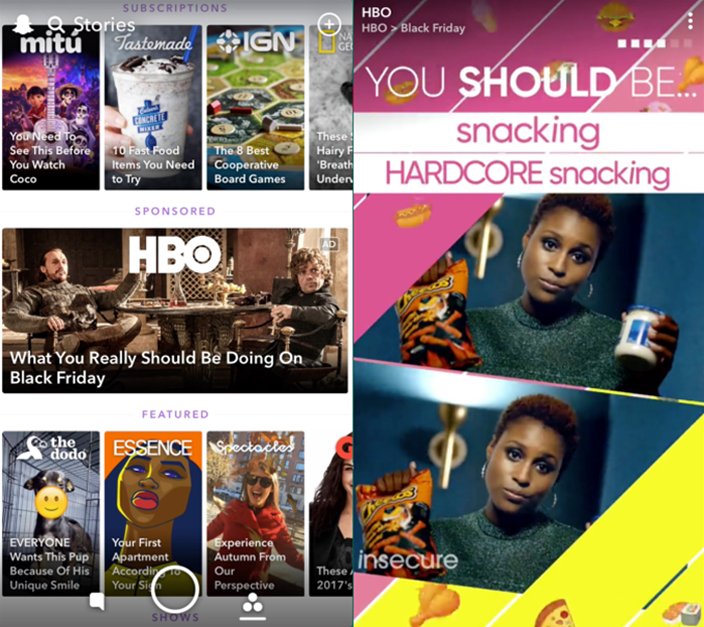
    With this option, advertisers can craft and deploy detailed ads that focus on a specific problem within a brand. They can add upto 10 photos or videos and function like a routine Snapchat Story. The new sponsored stories will appear with a ‘sponsored’ tag above the preview pane. The stories are displayed on the ‘stories’ screen to users within a particular geographic location.

    As opposed to a single Snap ad in between the different content, this new ad format promotes better visibility and hence better engagement with users who view the ad. Naturally, this new ad format will hold unique appeal for prominent brands who want to ensure a broader coverage of their marketing messages to the Snapchat audience.

    Why has this change come about now?

    Snapchat is trying to revive its fortunes with an overall disappointing 3rd quarter earnings. It is banking on the self-serve ad formats within the platform to turn things around. Maybe this explains why it has gone ahead with these two new ad formats. Clearly, the focus is allowing more and more marketers to use the platform, grow engagement with their users and thus win over business users to be loyal customers for the platform.

    Snapchat is facing mounting pressure from competitors like Instagram to increase its user base and platform revenues. With new acquisitions hard to come by, it is banking on its existing users to grow its revenues. Here Snapchat will have to tread a fine line – of generating enough ad revenues but not at the cost of a great user experience to its users.

  • Weekend Digital Media Round-up: Google’s #SmallThanks Hub, Facebook’s VR experiences, Twitter’s Bookmarks feature and more..

    Weekend Digital Media Round-up: Google’s #SmallThanks Hub, Facebook’s VR experiences, Twitter’s Bookmarks feature and more..


    1. Google’s new #SmallThanks Hub automatically creates digital & printed marketing assets for SMBs

    In a move to help SMBs — as well as drive up its verified business listings — Google has launched #SmallThanks Hub, an online resource that creates customized digital marketing content and printed materials based on Google reviews. [Source: Search Engine Land]

    1. Facebook debuts web-based VR experiences within standard News Feed

    People can now enter virtual reality through their traditional Facebook News Feeds. The social network has debuted examples of brands that have developed VR apps that people can interact with through Facebook’s standard site and mobile apps. Facebook has labeled these VR-enabled posts as “360 experiences.” [Source: Marketing Land]

    1. Twitter is now testing Bookmarks, its save for later feature

    Twitter is testing a new feature called Bookmarks, which allows users to privately save tweets for later. [Source: The Verge]

    1. Google beefs up mobile shopping results for the holidays, adds more product info & buying guides

    Google is beefing up its mobile shopping experience to prepare for the holidays, now showing buying guides for broad categories like “sewing machine” and “coffee grinder” searches and adding more product-related information for specific product searches. [Source: Search Engine Land]

    1. Forget WhatsApp, Facebook Messenger now has TWO major advantages

    WhatsApp might be the world’s biggest messaging service but it may have just been overshadowed by Facebook Messenger. WhatsApp is getting some major competition from Facebook Messenger as the service reveals new 4K photo sharing and peer-to-peer money transfers. [Source: Daily Express]

    1. Twitter Moments – A Look At The Recent Changes

    Twitter Moments is all set to get a refreshing new look. The company is currently trying to move away from the horizontal listings of curated topics on common themes like Sports, Entertainment, and News. [Source: Logicserve Digital]

    1. Facebook, Google, Bing and Twitter join The Trust Project to help users combat fake news

    Facebook, Google, Bing and Twitter have all agreed to be part of a non-partisan effort called The Trust project which is aimed at enlightening users about the difference between reliable journalism and fake news. [Source: The Drum]

    1. Google AdWords Editor updates to support budget type option for video ads & more

    Google has rolled out version 12.2 of the AdWords Editor. It brings a nice number of new features including Gmail asset-based ads, full support for promotion and video extensions and a new budget-type option for video ads. [Source: Search Engine Land]

    1. Pinterest adds custom QR-like codes for businesses, more shoppable pins

    Pinterest rolled out several new features designed to make it easier for people to find products to purchase through its platform, from QR-like codes for brands to append to product packaging to an influx of shoppable pins to its first mashup of visual and text search. [Source: Marketing Land]

    1. Facebook Is Testing Yet Another Copycat Snapchat Feature

    Facebook has copied so many features from Snapchat now that it’s gone beyond a joke. But hey, here’s another one to add to the list. Facebook Messenger now includes a Snapchat-style “streak” feature. [Source: Fortune]

    Expert Opinion:

    1. Focus on Customer Lifetime Value for long-term success

    In the fast-paced digital space, it has become critical for brands to think beyond short-term gains and instead focus on maximizing the Customer Lifetime Value (CLV).

    Simply put, CLV is the prediction of the net profit attributed to the entire future relationship with a customer. It means, how much money one can actually make from a client not just from ‘a particular transaction’ but from a series of experiences we are able to provide over time. New age marketers are increasingly seen moving from immediate returns on ad spends to long-term, company-wide growth to measure the success of their campaigns. One of the key areas focused on by them is prioritizing CLV.

    While this sounds easy and the focus on this type of an approach is growing, a lot of factors make it challenging to evaluate CLV. Customer journey has been transforming over time; it is split across multiple platforms & devices, and also from online to offline and vice-versa. Brands need to figure out how to tackle the problem areas and design a way to calculate the lifetime value. And like Pareto’s Principle, that specifies an unequal relationship between inputs and outputs, recent customer lifecycle studies suggest that 80% of your results will come from 20% of your efforts.

    Some of the key benefits of CLV are:

    • Improved marketing that focusses on your customer
    • Saves time and money as you do not waste any efforts on the customers less likely to convert
    • Encourages brands to use multiple marketing approaches
    • Helps in better customer profiling and segmentation
    • Boosts brand loyalty

    Focusing on CLV not only helps the brands reach out to their most valuable customers but also to build better relationships with them. Various tools are available these days that can analyze the insights from the data available and deliver customized messages and experiences to the users. This also helps marketers in designing effective communication strategies for new and existing customers. Also, consumers are now preferring experiences from brands, so brand loyalty is not the only way to retain consumers. Customers that relate to a brand basis the experience they offer are more likely to help you continue climbing up the ladder.

    Brands should focus on understanding their audience and the best approach to communicate with them. It is essential to reach out to the right set of consumers that can provide the most value. Brands that drive CLV for the right audience are sure to achieve long-term success in today’s dynamic environment.

    Here is a “Fast Four” – Practical strategies to help improve your CLV:

    • Focus on building a long-term relationship – remember it’s not just about that one click, transaction or view
    • Brand Loyalty will remain important – however, the service experience will play a key role in retaining the client
    • Look for opportunities to up-sell and cross-sell – it’s far easier to get an existing customer to buy more than a new acquisition
    • Use multiple touch points to deliver superior customer service – the client is not just there for you to reach when he comes to you. There are more than enough opportunities to engage with him in his own backyard

    Balaji Vaidyanathan, Deputy Head – Marketing, Franklin Templeton Investments