LS Staging

Tag: Social Media Optimisation

  • Why are Marketers Enthusiastic about Facebook’s New Ad Tools?

    Why are Marketers Enthusiastic about Facebook’s New Ad Tools?

    Finding itself in the eye of controversy all so often, Facebook recently launched a new tool. This tool allows anyone to view the ads being run by any Facebook Page at any given time. The motive behind this new tool is to establish transparency. This is a consequence of the storm Facebook found itself facing a couple of years back. The social media platform was accused of being tampered by foreign operatives. This lead to the outcome of the 2016 US Presidential Election being influenced, is what the authorities had to say.

    Marketers’ perspectives are now considered

    Facebook, in an attempt to shed light onto a crevice which was rather left in the dark, has brought about a tool that gives access to watching ad spaces better. This is the first time ever where users and marketers have complete access to the full insight of a Page and what they are promoting across their channels. This is revolutionary stuff, especially when it comes from a platform where ads are in surplus.

    So, how can one access these “dark posts” across Facebook?

    Owing to these new ad tools, accessing ad listing is now simple.

    In order to view a page’s active ads, you would have to click on the menu option in the left-hand function bar titled “info and ads.”

    You would thereon be taken to browse through all the ads the page is running at the given time. This does not end just here.  In case you need to get more specific data out of it, you can filter it as per region. This would tell you which ads are running in each of the regions.

    But how is all this a good thing to marketers?

    Here’s how.

    1. You get insights into your competitor’s Facebook ad strategy

    One way to excel in today’s world is to know what path your competition is on. And Facebook just handed you the key to open your competitor’s money-making formula. So far, it was just a game of predicting what is it that your competitor is doing and formulating your strategy based on that. Now, you get to have concrete backing and your strategies are no more a guessing game.

    1. It allows you to be inspired with sheer brilliance

    Creativity relies on inspiration. Ads get pretty monochrome if made from uninspired ideas. However, this does not entitle you to plagiarise ideas. It just means that you now have the ability to get a shift in perspective. This helps you think out of the box, which is how you get to mindblowing ideas, sooner or later.

    1. Helps in building your audiences’ trust

    In a competitive era, knowing what your competition is doing right helps. But knowing what they are not doing all that right is gold. This is when you can drop by and show your commonly targeted audiences about the ways how you are better. However, you need to be careful with this as even your competition can view your strategy. Not just that, even your audiences can peek into your ad strategy. So you need to be playing by the rules.

    1. Your metrics will remain untouched

    This is a concern a lot of companies had that if your competitor can so easily view your strategy, can they tamper with it? The answer is no. They will not be able to make any changes or interact, in any way, with your advertisement.

    Factoring in the endless insights it provides, marketers look forward to a whole different ball game in the years to come, in terms of digital and social media marketing.

  • Plan Events and Projects Better with New Collaboration Tools on Pinterest

    Plan Events and Projects Better with New Collaboration Tools on Pinterest

    Pinterest, the visual discovery social media platform, has been rolling out a slew of changes to its user interface for quite some time now. Some instances include the facility to save pins quickly with the help of the long press, and the feature to categorise pins into meaningful sections. In the face of stiff competition, these moves are stamping its growing authority on the social media landscape.

    One more exciting addition is the new collaboration tools introduced by Pinterest. As per a recently released news item, the company has expanded the functionality and efficacy of its group-based activity feature through these collaboration tools. The tools are launched on the platform’s group boards; the facility allows users to have conversations with other members of the board with the help of the new group activity feed.

    What are the new changes?

    With the new group collaboration tools, users are now able to keep better track of new Pins added to the group. They can also be updated about new member activity. You can bring in other Pins into the group by sharing conversations about these specific pins which will be in turn, shared with all group members. Users can initiate discussion threads and conversations with the help of the Likes and @mentions. Since this action is happening within the group the conversation around it will be restricted to just the group and non-group members will not have access to the same on their feeds.

    The working is similar to Facebook’s group facility. Just like that feature, Pinterest group boards now allows members to add posts, comment, and like on the posts.

    Why the need for these changes?

    Pinterest felt that there are a lot of users who may want to use group boards to plan parties, events, or collaborate on projects. In response to the requests from such users, Pinterest has made these additions. With these updates, it aims to enhance the quality of interactions that happen on the site. There are many conversations that pinners don’t want their full network to have access to. They would require just a select group of members (family, chosen friends, or office colleagues) for the same.

    From a business perspective, there might be not much in terms of value that emanates from these new collaboration tools. However staunch supporters of well-known brands may go ahead and create their own closed group to share stories and happenings around the brand. If your brand is pre-dominantly on Pinterest then it would make perfect sense to invest the time and efforts to set up the group and manage conversations happening within it.

    The effect of the changes brought about by Pinterest is starting to bear dividends. As per recent market research reports, Pinterest’s following is growing at a better rate than competitor platforms like Snapchat and Twitter. This shows that from a user acceptance point of view these changes are adopted very well by the users, which in turn, explains the better engagement levels enjoyed by the platform.

  • Facebook Makes it Possible to Tag Paid Partnerships on Posts

    Facebook Makes it Possible to Tag Paid Partnerships on Posts

    Facebook has been rolling out a lot of measures recently to tidy up its tarnished image over data breach and privacy concerns. After launching an info label to tag political posts, it has now expanded the scope of this facility beyond politics. It now does the same for promotional content that appears on pages of well-known agencies and firms or influencer pages.

    What is the new update?

    Branded content always has much higher credibility than regular unverified content. This is why channels like Wired are now being paid by brands to promote posts on their pages. Users will now be able to identify such promotional branded content with this info label. This, in turn, will elevate the level of trust they have on such posts and will lead to better volumes of sharing and interaction around it.

    While there is no official confirmation yet from the social media giant, this change was spotted by a Facebook user and shared on his Twitter handle. As per his smartphone screen view, we see a post from Capital One (the Virginia, US-based bank holding company specializing in credit cards, auto loans, banking and savings products) that has a post about the impact of Social Security numbers published on WIRED – the digital magazine focusing on technology in the society. The post heading reads as ‘WIRED with Capital One’ and has an info label ‘About the partnership’. When we click on the ‘i’ label for more information, we see another message drop down. This message says that Capital One has compensated WIRED to share this post. It further states that branded content lets creators partner with brands in order to promote their products or services.

    An expansion of the political ad labeling initiative?

    Users would remember that Facebook had earlier rolled out similar info labels in October 2017 for political ads. This helps users to identify which posts are promoted by politically affiliated entities or by the parties themselves. This also meant that only authorised advertisers will be able to run political ads and that too after appropriately labelling them as a ‘Political Ad’. The move is aimed to eliminate any chances of abuse of political issues and topics by non-political affiliated groups. As per Facebook, this stipulation is applicable to anyone that wants to show “issue ads”.

    Does it help?

    The move to let users identify a branded partnership goes a long way in removing the fear of mistrust and privacy concerns. The move also aligns on-going improvements in the branded content tags introduced back in 2016. As more and more brands and influencers look to collaborate with one another, the onus is on Facebook to let users know about such branded (paid) partnerships. The addition of the ‘about the partnership’ label is a move in this direction, as users can now easily identify such arrangements and prevent mistrust or confusion from seeping in.

    What is your take on this new info label? Do you think it will impact brand fortunes in any way? Do write to us and let us know your comments in the box below.

  • Pinterest Adds Fifth Specialty to its Pinterest Marketing Partners Program

    Pinterest Adds Fifth Specialty to its Pinterest Marketing Partners Program


    Pinterest has been making multiple moves to enable better ad serving and higher ROI from its social media platform. Taking one more step towards this aspect, the platform added a new specialty within its PMP (Pinterest Marketing Partners) program. Right now there are five specialties that marketers can choose from:

    1. Advertising
    2. Content Marketing
    3. Audiences
    4. Measurement
    5. The newly launched ‘Creative’ specialty

    In addition, it has taken its tally of total PMPs within all specialties to 51. There are two new ones added this week

    1. Hootsuite (for content marketing PMP)
    2. Smartly (for advertising PMP)

    The following “Creative PMPs” are now supported in Pinterest

    1. The Online Studio
    2. Popular Pays
    3. QuickFrame
    4. Social Native
    5. Shutterstock Custom
    6. Vidsy
    7. Vidmob

    The main aim of the new specialty is simple. It uses these applications to create stunning Pins that aid in the brand recall value and customer engagement objectives of a company. These partners can be leveraged to create pins that stand out from the crowd and attract higher visibility which in turn, improves the ROI from the social media platform.

    With this development, companies can spruce up their branding efforts by getting access to numerous copywriters, videographers, graphic designers, and content creators.  In turn, they can build brand engagement solutions on Pinterest that achieves the twin goal of better insight generation along with high degree of creativity in the ads served to its target market.

    What does it mean for PMP partners?

    Regarding the choice of PMP partners chosen for ‘Creative’, Pinterest believes that these partners know which creative medium works best for the target users of this platform. They also know how to add an extra layer of ‘authentic’ when brands connect with their users on Pinterest.

    For the PMP partners, this update comes as a positive sign for them. Pinterest is a visual discovery medium and it makes total sense for creative agencies to sign up on its PMP platform. This way, they can harness their creative talent to drive engagement and ad performance on the image content platform. The PMPs will give advertisers access to as many as 10,000 creative content creators, and this will be sure to boost the brand stickiness on the platform.

    Why the need for another PMP category?

    It is estimated that nearly 90 per cent of weekly Pinterest regulars (at least one pin on their wall) use the platform for making purchase decisions. Additionally, as much as 78 per cent of users find the content on the platform useful. This signals a world of opportunity for marketers to leverage. Hence it might explain the addition of the ‘Creative’ category to its list of existing PMPs. Also, this is one of the last remaining categories needed by advertisers to make their branding messages truly resonate with the users on the platform.

    How are you going to utilise the Creative PMP for your Pinterest marketing campaign? Do write to us and let us know your views.

  • Facebook rolls out 3D posts and here’s all you need to know about it

    Facebook rolls out 3D posts and here’s all you need to know about it


    Facebook has emerged as one of the leading platforms for effective business marketing today. This popular social media platform gives ample reasons to promote, popularise, and sell your brand. That’s not all; content consumption and user experiences have got new connotations with FB’s recent developments. The platform has always come up with innovative ideas when it comes to introducing new marketing concepts.

    Even a few years back, users couldn’t imagine the emergence of immersive, real-life, and three-dimensional promotional approaches. However, FB seems to have made a paradigm shift with some of the notable discoveries in this regard.

    Introducing 3D posts

    With FB rolling out features like text-oriented status updates, relatable videos, memes, FB Live, and FB Immersive Canvas, the arrival of something more significant was much awaited.

    Here’s the good news for users, FB followers, fanatics, social media enthusiasts, and brand owners. The platform has added a new member to its suite of immersive features, and that’s known as FB 3D posts. If you wish to take interactions to an entirely new level, this particular feature will give you ample opportunities to do so.

    Things to know

    Before you start working with the feature or develop an acquaintance with it, knowing about its functionalities and features will be crucial. With the arrival of 3D posts, individuals can view a product and interact with it from all the sides. Users can start interacting with the product in ‘Facebook News Feed’ by clicking and dragging the image.

    Quite naturally, some of the well-known and market-leading brands are leveraging this particular feature to the tee. Since they are figuring out ways and means to make their content attractive as well as appealing to target consumers, 3D posts can be highly beneficial to them.

    Identifying the functionalities

    The emergence and introduction of this latest innovation took place on 20th February, when FB announced its support for 3D posts through the industry-specific glTF 2.0 format. It is this particular format that enhances functionality thus allowing artists to create high-quality three-dimensional posts with advanced textures, lighting, and unique rendering.

    One can also share their 3D posts through graph API. Developers can integrate the 3D sharing feature into an application, thus helping individuals share captivating, immersive, and realistic posts with a single click.

    The marketing point of view

    Whether it’s a bunch of snapshots clicked with a camera or a product for the target audiences, this particular feature rolled out by FB will bring everything to life. Sharing immersive experiences has become easier, and quite a few business marketers are striving hard to make the most of it.

    We are living in a world where AR and VR have become integral parts of one’s life. People are always looking for realistic experiences and there’s no denying that they are thirsty for immersive viewing. With 3D posts, marketers and product developers have the chance to present their items in a never-seen-before way. Quite naturally, that will accelerate their bottom lines and take the venture ahead of the growth curve.

  • Major Facebook Update – Trending Section on the Platform is Now Discontinued

    Major Facebook Update – Trending Section on the Platform is Now Discontinued


    Facebook has been lately introducing many changes on the platform. One trending story in this wave change is about the ‘Trending News’ section which will be discontinued soon. This is said to happen because of the poor performance of Trending News section. This section has seemingly garnered less than 1.5% clicks to publishers, on an average.

    The Trending Section is scrapped and along with it all the third-party integrations that relied on the Trends API. According to the research conducted by Facebook, people found it to be not that useful overall. The company said that the content in the Trending topics section accounted for fewer clicks. This, in turn, has made it a redundant space for a platform so huge where every inch of space matters.

    Alex Hardiman, Facebook’s head of News Products reached out to the masses regarding the scrapping of Trending News section. He did it through Facebook’s news blog. This is what he had to say, “We’ve seen that the way people consume news on Facebook is changing to be mobile and increasingly through news video. So we’re exploring new ways to help people stay informed. This is done with timely, breaking news that matters to them. At the same time, we ensure the news they see is from trustworthy and quality source.”

    Will there be a replacement?

    Scrapping the Trending News section means that there is now a distinct vacant spot. Therefore, what would come instead is a valid question one could get. As mentioned by Alex Hardiman, the site is now “exploring” new ways to present news to the masses. This might be a nod in the direction of “Breaking News”, which would be a label indicating news headlines. Facebook is also in the process of testing a “Today In” section. This would enable the users to pull up the latest breaking news from local publishers, organisations and officials. This would put you in a complete awareness zone regarding all that is occurring around you.

    Facebook is also referencing to a dedicated section for Video News coverage to replace this section. This is where people would be able to view news coverage and watch daily news. They can update themselves with the latest happenings, with access to exclusive video coverage.

    Why the need for the change?

    The Trending Section has been on the site since 2014. Users were able to discover happenings with the latest news across the world. It spanned various news sections like Entertainment, Politics, Sports, etc.

    In 2016, however, the platform was accused of curating news, which was seen as politically biased. This “biased approach” was said to govern the news presented to users. This, in turn, was altering the mindsets of people. They were led to believe things through desired perspectives instead of giving them an overview and letting them base self-opinions.  This had resulted in the removal of descriptions of news and only the headlines started showing up.

    Come 2018, and the Trending section encounters a whip of change. How effective would this update be is something we will find out in the months to come.

  • Weekend Digital Media Round-up: Google Trends get new features, Facebook’s new influencer marketing platform, Twitter’s expanded programmatic offerings and more..

    Weekend Digital Media Round-up: Google Trends get new features, Facebook’s new influencer marketing platform, Twitter’s expanded programmatic offerings and more..

    1. Google Trends gets updated with new features and design elements

    Google Trends has updated its feature set and design to provide a simpler navigation and more ways to explore data and stories around one of the world’s biggest journalistic datasets. The purpose of the new design is to help journalists build stories around data they can find in this tool. [Source: Search Engine Land]

    1. Facebook’s Coming Up With A New Influencer Platform To Expand Collaboration Options

    The market is brimming with influencers these days. Sensing the immense scope in this, Facebook – known for foreseeing trends sooner than others – is now trying to come up with new ways to attract more influencers to its network. [Source: Logicserve Digital]

    1. Twitter looking to expand its programmatic offerings with Timeline Ad network pilot program

    Twitter has started recruiting publishers to take part in a pilot programmatic ad network that will place ads in Twitter Timelines embedded in publishers’ sites. [Source: Marketing Land]

    1. Facebook and Twitter announce stricter political ad guidelines ahead of midterms

    Facebook and Twitter are clamping down on political ads ahead of the 2018 midterm elections in an effort to close loopholes that were exploited during the 2016 presidential campaign. [Source: CNBC]

    1. Microsoft acquires Semantic Machines, signaling a deeper move into ‘conversational AI’

    With the recent acquisition of Semantic Machines, Microsoft is bolstering its commitment to conversational artificial intelligence (AI). With this move, Microsoft underscores its dedication to being on the leading edge of conversational AI and commitment to Cortana, its struggling-for-market-recognition voice assistant product, and other conversational products and platforms. [Source: MARTECH TODAY]

    1. Facebook’s latest on fake news, misinformation campaigns & user privacy

    Facebook published three separate announcements covering its current efforts to stop the spread of fake news, fight misinformation campaigns and protect user safety. The overlap between these three issues has been a focus for Facebook since the company announced in March that it had suspended Cambridge Analytica for exploiting user data. [Source: Marketing Land]

    1. Gmail Adds New Tagging Options to Streamline Email Composition

    If you use Gmail – which you probably do, considering the email option has more than a billion active users – you might be interested in the app’s latest update, and specifically, some of the new functionalities they’ve added in. [Source: Social Media Today]

    1. Instagram Tests New Tools to Help Users Track Time and Usage In-App

    Instagram is testing two new features that will keep users informed of how much time they’re spending in the app, helping to improve mental wellbeing and eliminate some of the FOMO that’s come with the introduction of the Instagram algorithm. [Source: Social Media Today]

    1. New Advances Could Point to the Future of LinkedIn’s Digital Assistant Tools

    Back in 2016, LinkedIn showcased a range of then coming new features, including their LinkedIn ‘Inbot’ personal assistant tool, which, when synched with your calendar, would be able to automatically arrange meeting times for you. Thus far, we’ve not seen any real progress on this front, but this week, we may have been given a hint of where LinkedIn’s digital assistant tools are headed, with Microsoft showcasing its advanced ‘Xiaoice’ digital assistant tool which is currently in use in China. [Source: Social Media Today]

    1. Facebook Updates Two-Factor Authentication Options to Improve Account Security

    Facebook is adding new measures to improve account security, with additional two-factor authentication options now available to all users. [Source: Social Media Today]

  • Facebook’s coming up with a new influencer platform to expand collaboration options

    Facebook’s coming up with a new influencer platform to expand collaboration options


    The market is brimming with influencers these days. Sensing the immense scope in this, Facebook – known for foreseeing trends sooner than others – is now trying to come up with new ways to attract more influencers to its network. This is primarily luring for Video publishers, but a platform for influencers would be welcomed warmly nonetheless.

    The most influential social media platform is now working on ways to create a new influencer marketplace platform, which aims at enabling brands to find the right influencers based on their brand specifications and requirements. This not only gives influencers a broader arena to be noticed by businesses across the world but also makes it easier for brands to hunt for influencers. They would then arrange for deals that will benefit both, the influencer and the brand. It would be quite a win-win situation.

    The platform has definite targeting details on a panel that is placed on the left side of the screen. It is here that you can target the audience you would want to reach. This targeting can be narrowed down on the basis of location, age, gender, education and various other filters. Once you have mentioned what chunk of audience you intend to target, the dashboard will work its magic and provide you with a list of registered influencers whose audiences match to those that you have mentioned. That is not all as it would also display the specific engagement of the influencer with their audiences and give you the follower statistics for each of the influencer. You then have the ability to get in touch with the influencer and perhaps strike a deal with them.

    The progress on this frontier is steady, and it is still in the test mode. But once it is up and running, the process of this platform would only make it easier for brands to expand their social media presence through marketing, or influencer marketing to be more precise. This has come in really handy to businesses as the News Feed changes in the current algorithm of Facebook reduced the reach of Page Content.

    Though the making of this platform is still in the testing mode, there remains a lot to be explored about the efficiency of this platform. It is speculated that this platform will most likely partner with Facebook’s Creator App which was launched last year. This would be done to list registered influencers who are willing to collaborate with brands. However, it is still not very clear whether Facebook would be verifying the influencers list to avoid potential authenticity concerns.

    This is seemingly a very logical move by Facebook as it hasn’t really provided any distinct way for influencers/creators to make money on the social media platform. Though they have options like Live Stream Tipping and ad breaks while watching videos, they aren’t as creator-centric as YouTube where they can make money.

    The nature of this platform is quite akin to Facebook Watch – which was their attempt to channel YouTube videos on the platform. However, they have reduced the outlay of this because they intend to invest into building a more self-sustaining content system via revenue ad-sharing.

  • Use Facebook’s Machine Learning For Ad Campaigns The Right Way

    Use Facebook’s Machine Learning For Ad Campaigns The Right Way


    Any good marketer would corroborate the fact that data is the lifeblood of any marketing campaign. By collecting the right data at the right time, fine-tuning the campaign for better efficacy is easily possible. With Facebook, the potential is enormously high simply because of the staggering amount of data it has at its disposal.

    Irrespective of the recent data usage scandals engulfing the social media giant, the fact remains that it sits on a vast treasure trove of user data that simply needs to be harnessed by smart marketers. And what better way to do that than the social media platform’s in-house machine learning algorithms?

    Going beyond the norms

    It is interesting to note that just targeting efficiently shouldn’t be the end game of data at FB’s disposal. As a smart marketer, you can also use this extensive data to optimise your automation options. In turn, this helps to run more effective Facebook ad campaigns.

    Here’s how you can go about it with machine learning:

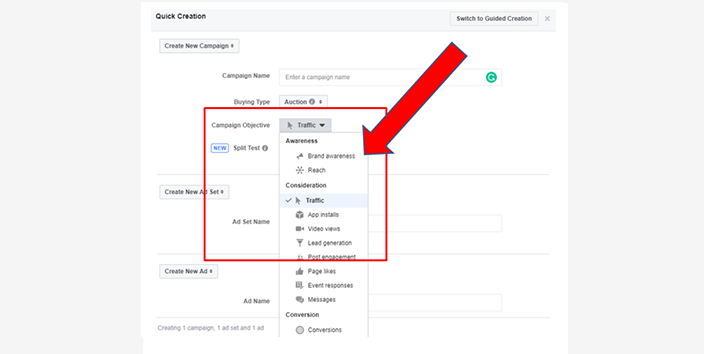
    1. Set the objective

    Rather than spreading yourself thin and ineffective with multiple objectives in a single campaign, Facebook does it the better way. It asks you to set a singular objective per campaign.

    ‘Awareness’, ‘consideration’, ‘conversion’ – these are some of the broad categories you get to choose from when you create a new campaign on FB.

    With proper selection, you inform the machine learning algorithm which set of audience should it present the ads to.  For example, it will place ads in front of those who are more likely to complete viewing a video, in case your campaign objective is set to ‘video views’

    2. Get the placement right

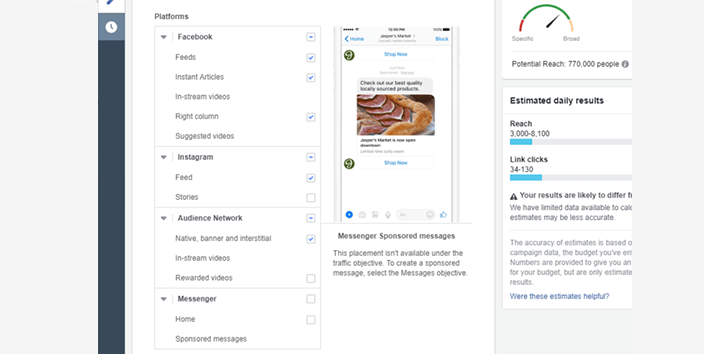
    You can optimise placements by looking to target multiple channels. In addition to the hugely popular Facebook platform, you can also pick Instagram and Messenger to expand your ads outreach (and thus improve its likelihood to perform better).

    You can explore these channels as additional inventory to use along with Facebook and Audience Network. The algorithm computes the cost per thousand impressions (CPM) and serves the ad to that channel where the CPM is the lowest, thereby improving ROI substantially.

    However make sure to utilise it judiciously, though. When you create a new campaign, you can select all placements for the ads. Later on, depending on the success rates, you can add or drop individual placements as per its performance.

    3. Optimise ad delivery

    You can also select various options from the ‘Optimisation and delivery’ menu. Be it website conversions or placing ads to those people who are most likely to load the landing page by clicking on the ad link,  there are quite a few optimisation choices presented to you in this menu. Keep testing with different selections and see which option gives you the maximum bang for your advertising dollars.

    Facebook machine learning power has proven its mettle with many successful ad campaigns. With these factors, you manage to improve the success rate of your FB ad campaign with a smart utilisation of machine learning.

  • How can brands use the new Pinterest profile design update to their best advantage

    How can brands use the new Pinterest profile design update to their best advantage


    Over the previous year, Pinterest has been adding more highlights for brands to emerge in search lists. Bringing back hashtags enables clients to discover pins quickly and they’ve worked out a gigantic new choice with visual hunt. As per Pinterest, individuals now accomplish more than 600 million visual hunts each month across Lens, their program growth and the visual pursuit tools inside Pins.

    Featured Boards is an excellent method to get your clients to a collection of pins without a moment’s delay yet now and again you need the customer focused on only a couple to build the mindfulness around a particular campaign.

    Recently, Pinterest has upgraded profile pages for clients and brands by displaying their best pins as a header picture. While this gives a cleaner client encounter over the stage and profile page itself, there’s additionally a simple method to make use of this update.

    Here are a few tips and tricks to make your Pinterest profile eye-catching and compelling:

    1. Integrate save buttons

    If you need individuals to be decisive, they need to do it fast. This can be done by the integration of a save button. Now for users who don’t have the traditional Pinterest button, they can click on save and Pin the content to the site. This is expected to multiply the amount of content that can be pinned to the site and thus improve engagement.

    1. Strategic Pinning

    It is recommended to pin a piece of content at least once a day. In the US, evenings and weekends are favourite times for pinning, so you need to plan the pinnings in such a way that it coincides with these timings. If there is a big post, you can split it up into meaningful and exciting smaller chunks and spread the pinning across the entire week, rather than doing it all in one day.

    1. Spotlight on stunning visuals

    Pinterest is an exceedingly visual platform. It is no wonder that quality visuals go a long way in evoking engagement and possible conversions. Your photographs ought to be sharp and sufficiently bright. Don’t have time to click impressive original photos? Then make use of free stock photography websites to improve your site’s visual appeal.

    1. Keywords still matter

    You are already aware that Pinterest is an image-centric platform. But the fact remains that phenomenal visuals alone are insufficient to guarantee engagement with the audience. Capitalize on the description field to tell your viewers in detail about the click and its purpose. Try to incorporate your most vital keywords to enable your Pins to show up in the search.

    Pinterest is making huge steps to their stage to be more brand-friendly while at the same time helping the consumer get to what they’re intrigued by, quicker than ever. If you haven’t been taking advantage of everything Pinterest brings to the table your business, don’t worry. With the improved look and feel that the platform brings about, now might be the best time to begin making the most of this platform.