LS Staging

Tag: Social Media Marketing

  • Weekend Digital Media Round-up: Google’s New Design for Call-Only Ads, Facebook’s New Types of Interactive Ads, Snapchat’s expanded ad length & more…

    Weekend Digital Media Round-up: Google’s New Design for Call-Only Ads, Facebook’s New Types of Interactive Ads, Snapchat’s expanded ad length & more…

    1. Google Ads Changes the Design of Call-Only Ads

    Google is rolling out a new look for call-only ads which is said to help drive higher quality leads. The updated layout for call-only ads displays the business’s phone number at the top, while business name and headline is now placed below the phone number in smaller text. [Source: Search Engine Journal]

    2. Facebook Rolls Out New Types of Interactive Mobile Ads

    Facebook is giving advertisers access to new types of interactive ads, including AR ads and video poll ads. One of the ways in which the company is helping advertisers embrace this trend is through introducing video poll ads. [Source: Search Engine Journal]

    3. Snapchat Expands Ad Length Limits, Announces New Ad Formats

    Snapchat announced a range of new ad and content updates designed to maximize audience attention and provide advanced options for marketers. The company is now looking to allow ads of up to three minutes in length in selected formats, up from the 10-second limit which has been the core threshold on the platform. [Source: Social Media Today]

    4. Facebook to Officially Start Hiding Like Counts on Posts

    Facebook will begin hiding like counts on posts in a test that begins September 27th in Australia. Given how the company is treating like counts on Instagram, this test could very well expand to other countries. [Source: Search Engine Journal]

    5. Google Adds New Video Campaign Options, Including Home Screen Ads on YouTube

    Google is launching some new options to help marketers better manage their video ad campaigns and reach consumers where they’re most active. The company is adding new TrueView ads in the YouTube Home feed, a tremendous opportunity for any advertiser looking to drive more, high value conversions. [Source: Social Media Today]

    6. Pinterest’s New ‘Shop the Look’ Ads Can Feature Multiple Products in a Single Ad

    Pinterest is introducing a new format for ‘Shop the Look’ ads which allows retailers to feature multiple products in one ad. ‘Shop the Look’ ads are inspired by Pinterest’s organic pins of the same name and allow advertisers take up to 25 items in one image. [Source: Search Engine Journal]

    7. Google Ads Introduces Improved Keyword Recommendations

    Google Ads is updating optimization scores by improving the relevancy and quality of keyword recommendations. The panel will only suggest recommended keywords if they’re estimated to drive additional traffic beyond existing keywords. [Source: Search Engine Journal]

    8. Google Ads Lets Users Set Up Conversion Tracking During Campaign Creation

    Google Ads is now letting users set up conversion tracking during the campaign creation process. Now, users can save time and ensure conversion tracking is set up immediately with an extra step added to the campaign creation process. [Source: Search Engine Journal]

    9. Twitter Launches ‘Twitter Next’ Strategy Team to Help Brands Maximize their Tweet Campaigns

    Twitter’s looking to provide more assistance to brands looking to maximize their on-platform efforts with the launch of ‘Twitter Next’, a new, strategic arm of Twitter Marketing which will provide a range of insights and advice to selected business partners. [Source: Social Media Today]

    10. Google Ads Smart Bidding Now Supports Store Visits Optimization

    Google is giving advertisers the ability to test incorporating store visits into their smart bidding strategies for select search and shopping campaigns. This is accomplished by enabling the campaign-level conversion setting. [Source: Search Engine Journal]

  • Weekend Digital Media Round-up: Google’s Integrated Payments & Jobs App, Facebook’s New Tools for Video Marketers, Pinterest’s Lens Update and More…

    Weekend Digital Media Round-up: Google’s Integrated Payments & Jobs App, Facebook’s New Tools for Video Marketers, Pinterest’s Lens Update and More…

    1. Google unveils integrated payments and jobs app

    Google has initiated a host of measures aimed at strengthening its presence in the country, including an integrated payments and jobs app and the launching of an artificial intelligence (AI) research lab in Bengaluru. [Source: Mint]

    2. Facebook video marketers get new tools, metrics for Live, Watch Parties, Creator Studio

    Facebook is releasing new features and metrics for its Live API, Watch Parties and within its Creator Studio, all of which can be used by marketers to advance their video efforts. The features include “Rehearsals” via Facebook’s Live API, Live video editing and streaming updates, Creator Studio adds Instagram and IGTV features and many more. [Source: Marketing Land]

    3. Pinterest Announces Lens Updates, Releases New Stats on Visual Search

    Pinterest has announced some upgrades to Lens, while also releasing some new stats on visual search usage on the platform. The company’s new option will enable users to save the images of the objects they capture through Lens, rather than merely using them as a search template. [Source: Social Media Today]

    4. Google Officially Adds Timestamps to Videos in Search Results

    Google is officially rolling out timestamps for YouTube videos in search results. This feature is designed to help people when the content they’re searching for is contained within a video. [Source: Search Engine Journal]

    5. YouTube Adds New ‘Masthead’ Ad Option for TV-Connected Viewers

    YouTube has announced that its adding TV screen-specific targeting to its prominent Masthead ads, which will show up first thing when a user opens their YouTube TV app. [Source: Social Media Today]

    6. Instagram Posts Can Now Be Scheduled in Advance Through Facebook

    Instagram posts can now be scheduled to publish at a later time through Facebook’s Creator Studio. This functionality is available to all business accounts and also extends to IGTV videos. Instagram posts and IGTV videos can both be scheduled up to six months in advance. [Source: Search Engine Journal]

    7. Search Ads 360 rolls out auction-time bidding for Google Search campaigns

    Google Search Ads 360, the enterprise-level search management piece of Google Marketing Platform that enables advertisers and agencies to manage campaigns across multiple search engines, has added auction-bidding for bids on Google Search. [Source: Search Engine Land]

    8. Google Search Console Adds a New Type of Structured Data Report

    Google has added one more type of structured data to its growing list of structured data reports in Search Console. Those who are using dataset structured data on their website will find the new report under the Enhancements sections. [Source: Search Engine Journal]
    9. Google beefs up mobile app insights with new AdMob API

    Google’s AdMob is upgrading its reporting and analytics for mobile publishers and developers. The company is rolling out a new API, which will provide publishers with more accurate insights into user behavior, ad performance and revenue. [Source: Marketing Land]

    10. Microsoft Advertising’s product, similar audiences now available to more advertisers

    Microsoft Advertising is continuing to invest in audience targeting products. Two audience solutions are now in open beta mode as said by the company. Product audiences is aimed at converting past site visitors, while similar audiences can help advertisers reach more new customers. [Source: Search Engine Land]

  • Few Tips for Creating Story Ads that Convert

    Few Tips for Creating Story Ads that Convert

    Why Story Ads Matter?

    It’s more than two years since Instagram launched story ads and nearly one year since Facebook launched its version of story ads. According to Instagram, out of the 500 million Instagram accounts that use stories, one in three most-viewed stories belong to brands. And, one in five brand stories receives a direct message from viewers.

    In April of this year, Mark Zuckerberg revealed that over three million advertisers were using Stories Ads on Facebook, Messenger, and Instagram.

    How are Story Ads different from Regular Newsfeed Ads?

    As the name implies, Instagram Story Ads are part of Instagram Stories – they can be found on top of the News Feed and are full-screen content. When a user clicks on a story ad, the ad occupies the full screen, and by swiping next, the user can watch a steady stream of content – one story after another.

    On the other regular newsfeed ads look similar to Instagram posts. They occupy only a portion of the screen, and users can like, comment on it as usual.

    The biggest click factor of story ads is that advertisers can link within the ad – meaning viewers can click on these links and be taken directly to a landing page, product page, or lead form.

    Secrets of Creating Highly Effective Story Ads that Convert

    #1: Multiple Tests aid in Ad Optimization

    The best way for advertisers to judge the pulse of the audience is by running multiple tests. Even small changes like the placement of the logo, colour scheme of the ad, or the copy can lead to huge wins.

    Jose Sanchez, the head of Smartly.io, believes that brands must take a test-and-learn approach. By changing the various parameters of the ad like – pacing, colour schemes, content, length – advertisers will be able to arrive at the right ad structure that clicks with their target audience.

    #2: Interactive Ads click with the Audience

    Story ads are highly interactive. Brands can include polls, questions, and other interactive options right on the ad. This incentivizes the users to swipe up on the ads and see what it has to offer.

    #3: Carousels provide Audience with in-depth Information

    Carousel video story ads are well suited for both Facebook and Instagram story ads. Carousels are a great way to provide your target audience with in-depth information about the brand/product and increase airtime.

    Advertisers can also link a different landing page for each card on the carousel. Akvile DeFazio, of the social media agency AKvertise, recommends using a maximum of three to five cards, as users are impatient to see too many options.

    #4: Short and Crisp Messages work the Best 

    Instagram stories ads come with a “Sponsored” label that appears in the top, right corner. Advertisers have to work on grabbing the attention of the audience before they realize that what they are watching is an ad and swipe away. To grab the attention of the audience instantly, the core message of the ad should be simple, short, and to the point.

    #5: A Powerful CTA

    Advertisers recommend including a strong CTA by offering a limited deal, an exclusive offer, etc. This encourages viewers to swipe up and arrive at the landing page.

    Stories are Here to Stay

    In just two years of its launch, the number of users using stories has shot up to 500 million. A vast majority of the audience has moved from the News Feed to Stories, and advertisers have to revise their marketing strategy to give the audience more of what they like – the Story Ads.

  • Weekend Digital Media Round-up: Google Ad’s Automated Bidding Solutions, Facebook’s New Shopping Ads, Adobe’s New Customer Journey Analytics & More…

    Weekend Digital Media Round-up: Google Ad’s Automated Bidding Solutions, Facebook’s New Shopping Ads, Adobe’s New Customer Journey Analytics & More…

    1. Google Ads Offers More Choices for Automated Bidding Strategies

    Google Ads is expanding its automated bidding solutions by giving advertisers three more options to choose from. The new choices include a new way to pay for campaigns, expanded support for non-guaranteed deals and the ability to manage automated bidding at the insertion order level. [Source: Search Engine Journal]

    2. Facebook Tests New In-App Shopping Ads for Both Facebook and Instagram

    Facebook is testing out two new shopping ad options, both of which are aimed at streamlining the path to purchase, and keeping users in-app, as opposed to filtering them off to other websites. [Source: Social Media Today]

    3. Adobe adds Customer Journey Analytics, designed to be accessible to all marketers

    Adobe has released Customer Journey Analytics as part of its Adobe Analytics platform. The new analytics offering is powered by Adobe Experience Platform and is touted as an easy-to-use, interactive analytics interface that enables “anyone in an organization” to work with data, not just data scientists. [Source: Marketing Land]

    4. Microsoft opens responsive search ads beta to all advertisers

    All advertisers can now start testing responsive search ads in their Microsoft Advertising accounts. With responsive search ads (RSAs), first introduced by Google last year, the ad systems automatically serve up a combination of headlines and descriptions provided by the advertiser. [Source: Search Engine Land]

    5. YouTube Launches New, Dedicated Fashion and Style Content Hub

    YouTube is rolling out YouTube.com/Fashion, a single destination for style content on YouTube. With fashion and beauty content seeing significant increase in viewership across its platform, it makes sense for YouTube to give beauty and style videos their own dedicated focus, in order to better showcase what exactly it has on offer. [Source: Social Media Today]

    6. Microsoft Advertising Now Identifies Negative Keyword Conflicts in Shopping Campaigns

    Microsoft’s product negative keyword conflicts report shows shopping campaign advertisers which product ads are being blocked by negative keywords. The report also identifies the level at which the conflict arose, which is defined as the conflict level. [Source: Search Engine Journal]

    7. Facebook changes how it handles user location data settings in response to Android, iOS updates

    Facebook is updating how its user location settings work. Both Android and iOS are rolling out new features to give users more control over how they manage their location settings at the device level and within the individual apps being used on a device. In response, the company is changing how users manage their location data within the Facebook app. [Source: Marketing Land]

    8. Instagram Is Reportedly Working on a New Tool Which Replicates TikTok’s Key Features

    Instagram is once again replicating a competitors’ features, this time with TikTok in the firing line. It may seem a little cheap, a little tacky even to be so blatantly copying your competition. But it clearly works. [Source: Social Media Today]

    9. Google Will Now Treat Meta Robots Nofollow as a Hint

    Google Webmaster Trends Analyst Gary Illyes tweeted that Google is officially changing support for Meta Robots Nofollow. Google now treats the meta robots nofollow as a hint, similar to the behavior to the recently updated nofollow link attribute. [Source: Search Engine Journal]

    10. Facebook Adds New Tools for Public Figures, Including Multi-Contributor Stories and Product Tags

    Facebook has announced a new set of updates for public figures and they provide an interesting glimpse as to where we might see Facebook Stories, in particular, headed in the near future. [Source: Social Media Today]

  • Weekend Digital Media Round-up: Google’s changed GMB listings, Facebook’s ‘Like’ Button Removal, YouTube’s Change in Data Collection and More…

    Weekend Digital Media Round-up: Google’s changed GMB listings, Facebook’s ‘Like’ Button Removal, YouTube’s Change in Data Collection and More…

    1. Google Makes Changes to GMB Listings With Distance-Based Service Areas

    Google is going to automatically apply changes to Google My Business listings with distance-based service areas. Managers of Google My Business listings affected by this change will have the opportunity to review these updates after logging into their account. [Source: Search Engine Journal]

    2. Facebook Might Follow Instagram By Removing Like Counts

    Facebook may take a page out of its own playbook by removing like counts, similar to what’s being tested on Instagram. The screenshots shared by Wong indicate that Facebook’s hidden likes will work the same way. [Source: Search Engine Journal]

    3. YouTube Announces Changes to Data Collection and Ad Targeting on Videos Aimed at Children

    YouTube has announced a range of new measures to better protect children using its platform, reducing data collection on content aimed at kids, and the capacity for advertisers to target young viewers through ads on such content. [Source: Social Media Today]

    4. Google Introduces New Structured Data for Movie Carousels

    Google is rolling out a new type of structured data to help movies appear in new dedicated movie carousels. In order for a movie to be eligible to display in a carousel, only the title of the movie and an accompanying image need to be defined using structured data. [Source: Search Engine Journal]

    5. LinkedIn Launches New Course on Building a LinkedIn Presence and Utilizing its Ad Tools

    LinkedIn has launched a new course designed to educate people on how to make best use of the platform for brand-building and marketing, covering all aspects of LinkedIn’s on-platform tools. [Source: Social Media Today]

    6. Google Search Console Makes it Easier to Verify Domain Properties

    Google is working with domain name registrars to automate the process of verifying domain properties in Search Console. Domain properties were introduced to Search Console this year as a way of providing site owners with a complete view of their data. [Source: Search Engine Journal]

    7. YouTube Outlines its Improving Efforts to Remove Inappropriate Content

    YouTube has provided a specific update on the first element listed – removing inappropriate content, and how it’s been working to improve its efforts on this front. [Source: Social Media Today]

    8. Google launches an open-source version of its differential privacy library

    Google has released an open-source version of the differential privacy library it uses to power some of its own core products. Developers will be able to take this library and build their own tools that can work with aggregate data without revealing personally identifiable information either inside or outside their companies. [Source: Tech Crunch]

    9. Facebook Begins Rolling Out Updated Desktop Layout

    Facebook has now started rolling out the new experience to users, with a prompt notifying them of the change. The new layout aims to make it easier to navigate to your favorite elements, with tabs along the top of the screen, and a more compressed view. [Source: Social Media Today]

    10. Facebook Updates Face Recognition Permissions to Provide More Control

    Facebook has announced that it is removing its current ‘tag suggestions’ setting, which relates to the prompts it generates based on people it can identify in an uploaded image and improving its face recognition permissions, enabling users to opt-out of the process with one click. [Source: Social Media Today]

  • Weekend Digital Media Round-up: Google Ad’s New Bidding Strategies, Instagram’s New Messaging App, Facebook’s Playable Ads Preview Tool and More…

    Weekend Digital Media Round-up: Google Ad’s New Bidding Strategies, Instagram’s New Messaging App, Facebook’s Playable Ads Preview Tool and More…

    1. Google Ads Introduces Seasonality Adjustments for Smart Bidding

    Google Ads is rolling out seasonality adjustments for smart bidding for search and display campaigns. Smart bidding strategies set bids automatically to help advertisers improve the performance of their Google Ads campaigns. [Source: Search Engine Journal]

    2. Instagram is Developing a Separate Messaging App Called ‘Threads’

    After shutting down its standalone messaging app ‘Direct’ earlier this year, Instagram is reportedly working on a new iteration of the same. Instagram’s latest weapon on this front is a new messaging app called ‘Threads’ which will look to focus on building stronger, more constant connection between smaller, enclosed groups. [Source: Social Media Today]

    3. Facebook launches tool to test, preview Playable Ads

    Facebook has launched a Playable Ads Preview tool for mobile app developers that will let them test and validate Playable Ads before they create a mobile app ad campaign around it. The tool checks to see if the Playable Ad files meet Facebook’s specifications and if the call-to-action is implemented correctly. [Source: Marketing Land]

    4. Instagram is Doubling Down on Stories Ads

    Instagram is literally doubling down on stories ads in a test that will show back-to-back ads to some users. The company is simply gathering feedback for now, and the focus of the app will remain on the user experience. [Source: Search Engine Journal]

    5. Facebook introduces new policies for political, social issue ads ahead of 2020 elections

    Facebook has updated its ad policies for political advertisers and anyone running electoral or social issue ads. The new policies, which include new disclaimer requirements for political advertisers and updates to the company’s list of social issue topics in the U.S. [Source: Marketing Land]

    6. LinkedIn Launches New Insights Hub to Provide Additional Audience Insights

    LinkedIn has launched a new element of its ‘Success Hub’ marketing data and insights platform, which aims to provide additional information on specific audiences and verticals, in order to help better inform marketing decisions and understanding. [Source: Social Media Today]

    7. Twitter Tests New, Larger Image Tweet Carousel Ad Format

    Twitter began testing a new carousel ad format for app install campaigns, which would give advertisers the capacity to add multiple, larger images to their collections. [Source: Social Media Today]

    8. Facebook Makes Changes to Housing, Employment, and Credit Ads

    Facebook is requiring that advertisers use a new process when buying ads related to housing, employment, and credit. These special ad categories have now restricted targeting options in Ads Manager. [Source: Search Engine Journal]

    9. YouTube CEO Outlines the Platforms “Four R’s” Content Policy to Uphold its Policies

    YouTube CEO Susan Wojcicki has re-stated the company’s commitment to enforcing platform rules, and rewarding creators, via a key set of tenets that it’s using to improve its processes. [Source: Social Media Today]

    10. Facebook’s Testing a New Screen-Sharing Option for Messenger

    Facebook is testing a new Messenger video option which would enable you to share your phone screen in a Messenger chat, as opposed to using the camera. [Source: Social Media Today]

  • Weekend Digital Media Round-up: Google Ad’s Smart Bidding Strategy, Facebook’s ‘Off-Facebook Activity Tool’, Twitter’s New Video Ad Bidding and More…

    Weekend Digital Media Round-up: Google Ad’s Smart Bidding Strategy, Facebook’s ‘Off-Facebook Activity Tool’, Twitter’s New Video Ad Bidding and More…

    1. Google rolls out maximize conversion value smart bidding strategy

    Google Ads’ new smart bidding strategy is lined up. Maximize conversion value is now available in all Search campaigns which aims to optimize for the greatest conversion value within budget. [Source: Search Engine Land]

    2. Facebook’s ‘Off-Facebook Activity Tool’ disconnects user ad targeting data from profiles, doesn’t delete it

    Facebook is rolling out an Off-Facebook Activity tool that allows users to see a summary of the apps and websites that have shared their user data with Facebook and gives them the opportunity to clear the information from their Facebook accounts. [Source: Marketing Land]

    3. Twitter Launches 6-Second Video Ad Bidding, Providing New Options for Video Marketers

    Twitter is launching a new video ad option in the form of 6-second video ad bidding, which will see advertisers only charged if and when their video ad is in view for six seconds. [Source: Social Media Today]

    4. Google AdSense, AdMob rolling out system updates for preventing ad spend on invalid traffic

    Google is making system updates to fight invalid traffic and suspicious activity on its ad networks, the company announced on Wednesday. It will also give AdSense and AdMob publishers more information when ad serving is restricted as a result of these new measures. [Source: MarTech Today]

    5. Google Ads Lets Users Add Filters to the Overview Page

    Google Ads is introducing filters to the Overview page. The Overview page is the first place users land on after logging in. That means everyone interacts with this page at some point while using Google Ads. [Source: Search Engine Journal]

    6. Facebook Looks to Launch WhatsApp Payments in Indonesia

    Facebook clarified that India was not part of its initial rollout plan, which may be due to concerns around cryptocurrency from Indian regulators. WhatsApp is now also in talks with multiple Indonesian digital payment firms over plans to offer WhatsApp Pay in that market. [Source: Social Media Today]

    7. Google Search Console Shows New Image Search Data for AMP Pages

    Google has started to show data in Search Console related to a new image search feature introduced last month. Data will be tracked for images that appear on AMP pages and interacted with via Google’s new ‘swipe to visit’ feature, which is exclusive to AMP. [Source: Search Engine Journal]

    8. Google’s lightweight Go search app is now available worldwide

    Google has started the global rollout of its lightweight Go search app. As well as being designed to work on low-powered devices, the app also has a few features that the company says are designed for the needs of emerging markets. [Source: The Verge]

    9. Google Ads to remove accelerated ad delivery option next month

    Google Ads announced a coming change to ad delivery options. The accelerated delivery option will be removed and standard delivery will be the only option for Search and Shopping campaigns, as well as for campaigns with shared budgets. [Source: Search Engine Land]

    10. Google announces three big changes for developers on Google Play Store

    Google has made some silent changes for publishing new Android app on the Google Play store. The company has made it mandatory that all new Android apps would need at least three days for approval. The other two new changes will make it difficult for developers to have an accurate launch date for new games or future apps. [Source: The Times of India]

  • Weekend Digital Media Round-up: Google Search Console’s additional structured data in Report, Facebook’s New Ad Units, Instagram’s Spark Tool & More…

    Weekend Digital Media Round-up: Google Search Console’s additional structured data in Report, Facebook’s New Ad Units, Instagram’s Spark Tool & More…

    1. Google Search Console Now Reports on More Types of Structured Data

    Google is adding three more types of structured data to the rich results report in Search Console. Now, owners of e-commerce sites can use Search Console to easily check if Google can read all of their product markup. [Source: Search Engine Journal]

    2. Facebook to launch two new ad units; movie reminder and movie showtime

    Facebook is launching two new ad units named movie reminder ads and movie showtime ads which aims to help movie studios promote their latest releases. With movie reminder ads, when people see an ad for a film in their News Feed, they can now tap on the ‘Interested’ button to receive a reminder in their Facebook notifications when the movie hits theatres. [Source: ET Brand Equity]

    3. Instagram Opens AR Filter Creation Tools to All Users

    Instagram is once again following the lead of Snapchat by opening up its Spark AR filter creation platform to all users, while also introducing a new library of user-created visual tools. [Source: Social Media Today]

    4. Google to Remove Average Position Metric in Google Ads from 30th September 2019

    Google had announced that the company is planning to retire the average position metric from the Google Ads platform. In a recent post published by the search engine giant, the company has now revealed the deadline for the removal of this metric which is 30th September 2019. [Source: Logicserve Digital]

    5. Twitter Discusses Coming Features, Including Topic-Based Streams and Searchable DMs

    Twitter rolls out new tweaks and updates designed to boost usage. The platform is also looking at some larger-scale initiatives designed to help users – particularly new ones – find more relevant tweet content. [Source: Social Media Today]

    6. LinkedIn Expands Content Curation and Sharing Options in Sales Navigator

    LinkedIn continues to add more ways to utilize its data insights, this time through a new integration between its Sales Navigator platform and its employee advocacy system ‘Elevate’. [Source: Social Media Today]

    7. Instagram is Working on Layouts for Stories, New Boomerangs, More

    Instagram has been found testing several upgrades to stories that include a layout mode, new boomerangs, and redesigned icons. The new types of boomerangs give users 5 more options to choose from and the new layout mode for stories works similar to Instagram’s Layouts app. [Source: Search Engine Journal]

    8. Twitter Announces Removal of Third-Party Data Sources from Ad Targeting Options

    Twitter has confirmed that it will remove third-party data options from its ad targeting process, following Facebook’s lead in distancing itself from outside data sets, and the methods in which such may have been collected. [Source: Social Media Today]

    9. LinkedIn launches Audience Engagement Insights with addition of 5 new marketing partners

    LinkedIn is launching a new Audience Engagement Insights category as part of its marketing partner program and adding five new third-party analytics platforms that integrate with the LinkedIn Audience Engagement API: Amobee, Annalect, Hootsuite, Ogilvy and Sprinklr. [Source: MarTech Today]

    10. Facebook’s Testing New Third-Party VOD Subscription Partnerships to Boost its Video Offerings

    Facebook is working on a new, TV-connected video device, which would not only enable consumers to view Facebook Watch content on their home TV screens, but would also enable streamlined connection to third-party VOD providers, like Netflix and Disney – the latter of which will soon launch its own digital subscription offering. [Source: Social Media Today]

  • Should my Business Worry about Libra, the new cryptocurrency from Facebook?

    Should my Business Worry about Libra, the new cryptocurrency from Facebook?

    After months of speculations, last week, Facebook announced that the social media giant would lift the curtains on “Libra,” a brand-new cryptocurrency, sometime in 2020. Facebook announced that Calibra is a newly formed subsidiary to the parent company and aims to provide seamless and secure financial services by using the Libra network.

    Calibra and Libra: A Quick Explanation

    While Libra is a digital currency, it doesn’t have much in common with Bitcoin, the original cryptocurrency. The value of Bitcoin is basically because of its scarcity, and though it has been around for nearly a decade, it’s still considered a niche currency, not used for daily, everyday payments.

    Libra, is like Bitcoin, in that it will be tied into a blockchain (this blockchain is currently under development by Facebook). The similarities end there. Unlike Bitcoin, you cannot mine Libra. Instead, you must pay for it and purchase it.

    Facebook believes that Libra will become the global currency standard, like the popular currencies USD, GBP, and EUR.

    Coming to the all-important question: how will the value of Libra be determined, since it doesn’t have real-world assets like a country backing it?

    This is where things turn interesting. The value of Libra will be guaranteed by real assets provided by the partners that buy into Facebook-cofounded Libra association. Facebook has managed to rope in industry biggies, including venture capitalists, tech companies, and non-profit associations.

    eBay, Lyft, Spotify, Uber, Union Square Ventures, PayPal, Visa, and Mastercard are some of the top names in the association. You can find more about the founding members of the Libra Association in the whitepaper published by Libra. The company will have its headquarters in Geneva, Switzerland.

    What does this mean for Regular Users?

    Will it bite the dust like that time when Facebook was trying developing nations to use its platform for all their internet access by offering them free internet? Or will Libra become the first-ever digital currency to go mainstream?

    While that needs to be seen, Facebook’s goal here is to make Libra the go-to currency for transferring funds to friends and family in other countries and to make it the number one payment option for both online and offline purchases.

    Initially, Facebook will offer Libra as part of WhatsApp and Facebook Messenger, with plans to move it into a stand-alone app, later.

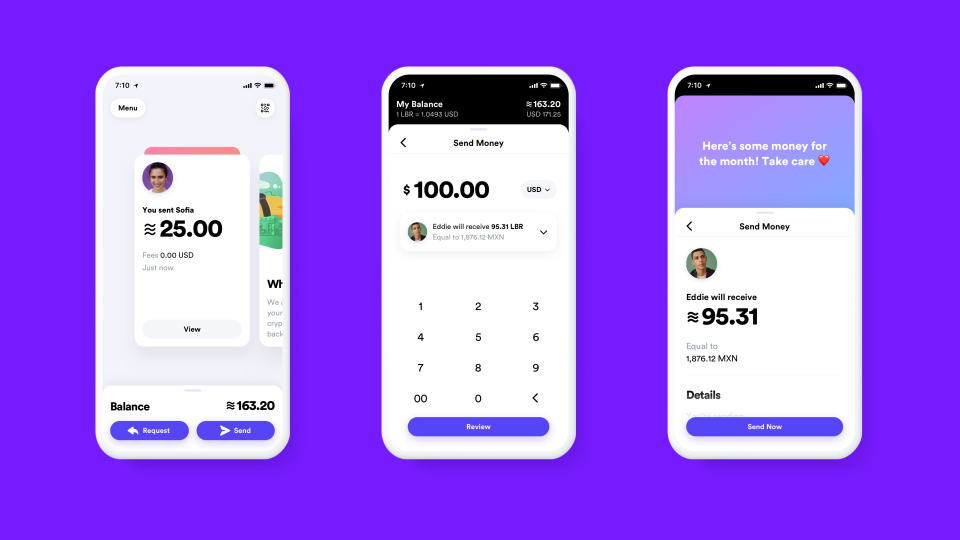
    This is where Calibra comes into the picture. Calibra is a digital wallet that will help users to save, spend, and send Libra. Initially, you can use the Calibra wallet to send and receive money instantly to anyone with a smartphone. Later Facebook plans to extend the functionality of Calibra to provide financial services for small businesses like paying bills, etc.

    sneak peek into Calibra’s interface, courtesy of Facebook.

    Calibra will use anti-fraud, and verification processes used by all leading credit cards, and provide live support to people who misplace their smartphone. Calibra even promises refunds if you lose your Libra because of fraudulent activities. Calibra will also value user privacy and will not share financial data with Facebook or other third-parties.

    Facebook claims that they are still a long way from launching Calibra. Interested users can sign up here to join the newsletter to be the first to receive information about the progress of Calibra and Libra.

    How will Libra and Calibra impact Businesses that sell via/on Facebook?

    Industry experts believe that entrepreneurs using Facebook pages for information about their products will not be impacted much. However, if you sell goods via Facebook, then you would have to make changes to include Libra as one of the payment currencies.

    However, since Facebook has an enormous reach, at least a few of your customers will be using the new crypto coin. Hence, it makes sense to include it in your payments page.

    When should you start making changes to include Libra?

    No hurries. Facebook is still in the process of development, and nothing has been confirmed yet. So, businesses need not panic and spend the interim time reading up on the merits and drawbacks of this brand-new venture from Facebook.

  • Facebook Ads are Getting Smarter: Here’s What Marketers Must Do to Thrive

    Facebook Ads are Getting Smarter: Here’s What Marketers Must Do to Thrive

    Facebook is a critical marketing channel for businesses of all sizes and across industries. With nearly 2.38 billion active users (stats for the first quarter of 2019), Facebook offers great opportunities for businesses to target current and potential customers.

    When done the right way, Facebook ads help businesses boost brand awareness, launch new products and services, sell more, and increase revenue. However, advertising on Facebook is not exactly what it may seem. Today, Facebook ads have grown smarter, and there’s a need for smarter paid ad strategies to meet your advertising objectives. Read on to know about what has changed and what you can do about it.

    What has Changed?

    There’s no denying the fact that Facebook feed has become oversaturated with ads. Similar ads are served to the same users, meaning brands lose out on their effectiveness and attention-grabbing abilities. Not to forget, the organic reach of the posts and ads on Facebook have taken a hit, thanks to recent algorithm changes.

    This means, today, most marketers on Facebook are forced to invest in paid campaigns or abandon the platform altogether. Despite the declining popularity of Facebook, the social media network managed to generate a whopping $16.6 billion in advertising revenue for the last quarter of 2018, which is a 30% increase compared to the previous year.

    This clearly shows that Facebook advertising is not dead as speculated. Rather what has changed is that Facebook ads have gotten smarter, and it is high time that marketers revised their advertising strategies on Facebook. In the cluttered social-media landscape of today, it’s essential that brands integrate robust paid strategies along with high-quality content generation to be successful.

    Shifting Advertising Goals – The Need of the Hour for Facebook Marketers

    According to Susan Wenograd, the Vice President of Marketing Strategy of Aimclear, for brands to thrive in the new era of social media advertising, there is a pressing need to revise the campaign goals. She believes that brands must re-examine their objectives and understand that conversion is just a part of the bigger picture.

    Brands must shift their focus away from CPA (Cost per Acquisition – Conversion) to CPM (Cost per thousand Impressions). Marketers must concentrate on building a more engaged and more qualified audience pool, to get the best ROI from their ad spends.

    It’s not just about picking the low-hanging fruit, but, brands must enhance their Facebook ad strategies to build qualified leads that improve brand awareness. Once advertisers have this data, they can use it for retargeting. Brands must build remarketing pools so that they can convert leads on all stages of the purchase funnel, helping them generate more revenue.

    Brands that can measure and understand user triggers are the ones that will be sustainable in the long run. Furthermore, brands must leverage cross-channel data to improve retargeting opportunities. Utilizing UTM parameters, tagging structures are some ways to streamline and segment data across channels.

    Not to Forget Quality Content

    All the above-discussed strategies may not yield the desired results, if the marketers do not have a high-quality content to back it up. With the social media landscape rapidly evolving, audiences demand high-quality, optimized content. Simply put, brands need to adapt to smarter Facebook ads with efficient strategies and high-quality creative content if they want to survive in the evolving social landscape of Facebook and Instagram paid ads.