LS Staging

Tag: Search Engine Optimisation

  • Don’t be baffled by BERT: Here’s what Brands should know about this Latest Google Algorithm Update

    Don’t be baffled by BERT: Here’s what Brands should know about this Latest Google Algorithm Update

    In October 2019, Google announced a search algorithm update known as BERT that helps the search engine improve the contextual understanding of queries. While Google is known for making frequent updates to its search algorithm, BERT gained prominence as it was estimated that nearly 10% of all search queries would be impacted by it.

    What is BERT all about? 

    BERT is the acronym for Bidirectional Encoder Representations from Transformers. Let’s understand what BERT is with real-world examples. This update helps Google better understand the context of the search query, rather than just relying on keywords.

    Let’s say, a searcher uses the query “visa for travel to the USA from India.” Before BERT, the results could include visa instructions for travelers from the USA to India. It’s the opposite of what the searcher is looking for. It’s because Google used to focus only on the keywords: visa + travel + USA + India.

    With the BERT update, the results are more relevant as the search engine accounts for prepositions like “to” “from” “for” to better understand user intent.

    Google’s Pandu Nayak, the Vice President of search, explains the reason behind this update in a blog post. He states that though Google has improved understanding language complexities over the years, there were plenty of times when the search engine failed to get the context right, especially for conversational and complex queries. With the BERT update, the search engine is better able to decipher natural language questions that are becoming more relevant in this era of voice search.

    BERT Update: The Key Takeaways for Brands, Marketers and SEO Strategists 

    Traditionally search, and SEO strategies were based on keywords. While the relevancy of keywords hasn’t gone away entirely, there are a few tweaks to be done in light of this update.

    • The primary objective of this update is to provide users with relevant and high-quality search results. To meet this objective, brands must focus on developing excellent content that is authoritative, informational, and relevant to the end-user.
    • Long-tailed keywords that use connector terms and hierarchies gain more prominence. Additionally, long-tailed keywords make the content more relevant to natural queries used by voice searchers.
    • While keywords lose a bit of their relevancy, note that a large percentage of the search remains unaffected by this change. Marketers don’t have to do away with keyword-based strategies for now. Instead, marketers can monitor incoming search referral traffic and make changes based on search volume differences.
    • Developing localized content in native languages (instead of translating from English to another language or vice versa) has a better impact on SEO.

    Finally, marketers have to keep in mind; whether it’s BERT or any other algorithm updates from Google, the best SEO strategy is always the same – providing valuable and high-quality content that is relevant to what your audience is searching.


  • The Future of SEO in 2020 & Beyond: What’s Changing and What Remains the Same?

    The Future of SEO in 2020 & Beyond: What’s Changing and What Remains the Same?

    The year-end is a great time to introspect and innovate. Not just in our personal lives but also our professional lives. As the end of 2019 draws close, it’s time to revise and revamp your SEO strategies, and prepare for 2020 and beyond.

    Here, in this post, we offer insights into what we think the future of SEO holds and what needs to be done to stay relevant.

     SEO is rapidly Evolving 

    It’s no secret that SEO is fast changing. Techniques that work today can disappear overnight. Google and other search engines are changing the rules of the game rapidly, and the biggest challenge is that you can no longer rely on Google to learn the rules.

    Popular SEO techniques of yesteryears like – keyword volume, link building has become less relevant. Today, to stay ahead of the SEO race, marketers must focus on creativity, cross-collaboration, and innovativeness to design successful and sustainable SEO strategies.

    SEO is not just about increasing page ranks on Google and other search engines. It has evolved to encompass all media operations while driving organic traffic to websites. It’s no more about getting people to your site. It’s about getting them to stay – therein lies the real challenge.

    What’s the Reason behind SEO’s Paradigm Shift? 

    It’s difficult to pinpoint a single cause. Instead, it’s a result of several changes like modern technology, changes in the way users consume content online, the interconnectivity of SEO across platforms, digital marketing, and more.

    To phrase it in a nutshell, the brand must deliver what the searcher is looking. The digital message and image of a brand must resonate with the intent and mindset of the user. Meeting these requirements helps a brand build a sustainable SEO strategy, which works in the long-run.

    What does this all mean for SEO Professionals? 

    Simply put, an SEO expert must be able to deliver the right content to the right user at the right time. 

    Brands that get the right message across to users are the ones that stand tall in today’s hyper-competitive SEO arena. The future of SEO is not about targeting the right keywords or focusing on building relevant links. It’s about understanding user intent. SEO experts have to transform from technologists to psychologists who understand what the user is searching for, can empathize with the user, and better understand their behaviour.

    SEO professionals must have a clear understanding of their target audience – learn the differences between different segments of customers, understand customer intent and behaviour, to create compelling customer journeys that engage and hook in the audience.

    Blueprint for SEO Professionals for 2020 and Beyond

    Here are a few strategies that SEO pros need to work on to stay relevant in the future:

    • Brands need to build a strong message and awareness to get customers to visit the site. Understand consumer needs and wants, their intents, what drives them, and their values. Deliver a complete package – a robust website, quality branding, and useful content – to win loyal customers and build brand equity.
    • Expect a reduction in text-based search and increase in voice and keyboard-less searches. SEO experts have to adapt their content to create creative campaigns that work with new technologies like AI and voice-based searches.
    • The user is at the centre of all online marketing campaigns, and SEO strategies have to be personalized to connect and engage with different sets of target audiences.
    • SEO strategies that think like a machine, but understand human emotions are the future. SEO experts have to cater to both Google’s intelligent bots and savvy end-user.
    • Certain aspects of SEO never fall out of favour like – trust-building by brands and delivering the best experience to the end-user.

    To wrap up, SEO experts have to look beyond search engine rankings and focus on:

    • Conveying a bigger brand story that connects with human emotions and is sincere
    • Inspire new generations of audiences
    • Make companies look humanized in an increasingly mechanized and automated world

    As audiences mature, SEO experts have to transform their fundamental perspectives to create sustainable brands that not only drive traffic but win customer trust and loyalty.

  • Content Accuracy is Not Yet a Google Ranking Factor

    Content Accuracy is Not Yet a Google Ranking Factor

    Content accuracy has always been a point of contention among SEO experts, webmasters and content strategists. While some firmly believe that content accuracy plays a role in determining page rankings, others are on the opposite side of the camp, stating that accuracy is not a ranking factor.

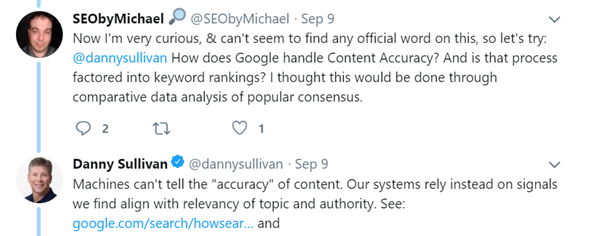
    Recently, this debate cropped up again on Twitter. Danny Sullivan, a veteran journalist who founded Search Engine Land and later joined Alphabet in 2017 as a public liaison for search, was posed this query.

    One of Sullivan’s Twitter followers asked him the following question, “How does Google handle content accuracy?” In response, Sullivan tweeted from his personal account saying that Google’s machines are not yet sophisticated to identify the accuracy of the content. Rather, their machines and algorithms rely on signals for topic relevance and authority, to decide the ranking of the content.

    Here’s the Twitter reply from Danny Sullivan:

    Image via Twitter

    Content Authority not be confused with Popularity

    In continuation with the conversation on Twitter, Sullivan was further asked whether content authority meant content popularity. He responded, saying that content authority should not be mistaken for popularity, as popularity will have no place for new queries that constitute nearly 15% of Google’s daily search volume. Also, content popularity is too simple a signal, and Google doesn’t rely on it to rank web pages.

    The Emphasis on Content Authority by Google

    In April 2017, Google announced the launch of Project Owl to improve the quality of search results. This project stressed more on authoritative content that enjoyed better ranking. Additionally, this project allowed users to send their feedback to Google regarding its auto-complete search suggestions and the featured snipped answers that were listed on the first page of search engine rankings.

    This was Google’s first step to combat the spread of fake news and misinformation on the internet. In November of 2017, Google, along with Facebook, Twitter, and Bing, agreed to use the trust indicators of The Trust Project to aid the prevention of spreading of misinformation and fake news.

    Earlier this month, Google updated its Search Quality Rater Guidelines with an aim to vet out news sources as well as creators of YMYL (Your Money Your Life) content. These guidelines have been modified to allow raters to provide content that has the potential to spread hate, the lowest ratings.

    The Debate Continues on Twitter

    Sullivan’s reply sparked plenty of replies with some users disagreeing with his answer and some agreeing to it. Some stated that today, machine learning tools could assign levels of accuracy to content. Machine learning can assess the accuracy of almost all content that doesn’t relate to personal experience.

    However, others thanked Sullivan for clarifying the issue that content accuracy is not a ranking factor as of now.

    What’s the Takeaway?

    There’s no doubt that content accuracy plays a crucial role in determining its impact on the end-user. However, content accuracy is not one of the top Google ranking factors. Page authority and relevance are likely the top two signals that Google’s algorithms use to rank content.

  • Moving up the Digital Arch with Integrated Digital Marketing focused on Customer-Centricity

    Moving up the Digital Arch with Integrated Digital Marketing focused on Customer-Centricity

    The new-age connected consumers are faced with a choice explosion. What does this mean for digital marketers? To give more choices to the consumer or improve the consumer’s choosing experience?

    As a brand, if you are looking to win the big share of the customer-base pie, it’s essential that you take an integrated digital marketing approach one that encompasses technology, creativity, data and analytics in digital advertising to create successful customer experiences.

    Here’s why you can no longer afford to ignore Customer Experience Management:

    Here are a few reasons why your brand is losing out on ROI as well as credibility by having a lackluster single-channel digital marketing strategy:

    • The Evolution of the Modern Consumer

    With increasing internet penetration in India, online buyers are rapidly increasing. m-Commerce is growing at an exponential pace especially the m-wallets transactions. They are aware of the marketing and advertising efforts of brands, and they no longer trust traditional advertising – especially from big corporations and celebrities. However, they trust brands that are organic, authentic, and honest.

    This means, your content, SEO, and other marketing efforts have to work together to create authoritative, authentic, and engaging content.

    • Customers trust other Customers

    Do you know whom your customers trust the best? Other users of your product. The growth of influencer marketing can be attributed to this.

    You need to work on digital marketing efforts that lead to the generation of customer reviews, social shares, and other user-generated content to build brand credibility and trust. Organic shares of your brand’s content increase engagement because your potential customers see other users interacting with your brand and are likely to follow suit.

    • Multi-device Multi-channel Lifestyles

    This is increasingly true for customers across generations. Your brand needs to develop a multi-channel, integrated marketing approach if you want to reach out to customers who effortlessly straddle more than one channel across multiple devices.

    According to data revealed by SalesForce, it was found that an average customer goes through 6 to 8 touchpoints, before they make a purchasing decision. This makes it crucial that your brand develops a unified, integrated digital marketing approach that focuses on customer experience. It’s time that your brand shifts its focus from CRM to CXM.

    Customer-Centricity – Easier Said than Done

    Though brands have been trying to shift to a customer-centric approach for nearly two decades now, the CMO states that only 14% of marketers believe that customer-centricity is what sets them apart.

    Why do most businesses fail to figure out customer-centricity? This is because the volume, variety, and velocity of customer data are challenging for businesses to handle. While some companies don’t have the tools and technology to divide customers into segments, others lack in targeting customers with the right personalized communications.

    Another huge barrier is lack of customer-centric culture at businesses. Most companies remain focused on sales, products, or services. The customer-centricity approach is only restricted to certain operations like marketing.

    Businesses can move to a customer-centric approach with data-driven marketing. To provide your customers with the best experience, you need to gain access to customer insights. Enterprises realize that customer-centric strategies, along with an integrated digital marketing approach are the best way forward.

    By gathering and analyzing customer data and tailoring your marketing efforts to focus on customer experience, you can surge ahead outpacing your competitors and build a brand that stands tall among your target audience.

    Logicserve Digital is a new-age digital marketing and digital consulting company with offices spanning across India. They have enabled leading brands to navigate through the new-world digital marketing challenges by driving communications across multichannel platforms and devices. Their in-depth knowledge, expertise and innovative ideas have helped brands to leap forward in digital ecosphere. With the right mix of data and optimum use of technology, Logicserve has created success stories for brands across varied sectors.

  • Google Assistant Receives Rich Text, Handy Tools and Other Snippets

    Google Assistant Receives Rich Text, Handy Tools and Other Snippets

    Google recently announced via a blog post that it’s releasing a new update for Google Assistant on android mobiles. The latest update will add variety to the information provided by the Assistant offering better visual responses and answers in the form of “rich text” for queries.

    Since Google introduced the Assistant in 2016, the search giant has been providing constant updates to the digital assistant – adding features, functionalities and improving visual appearance.

    What’s new?

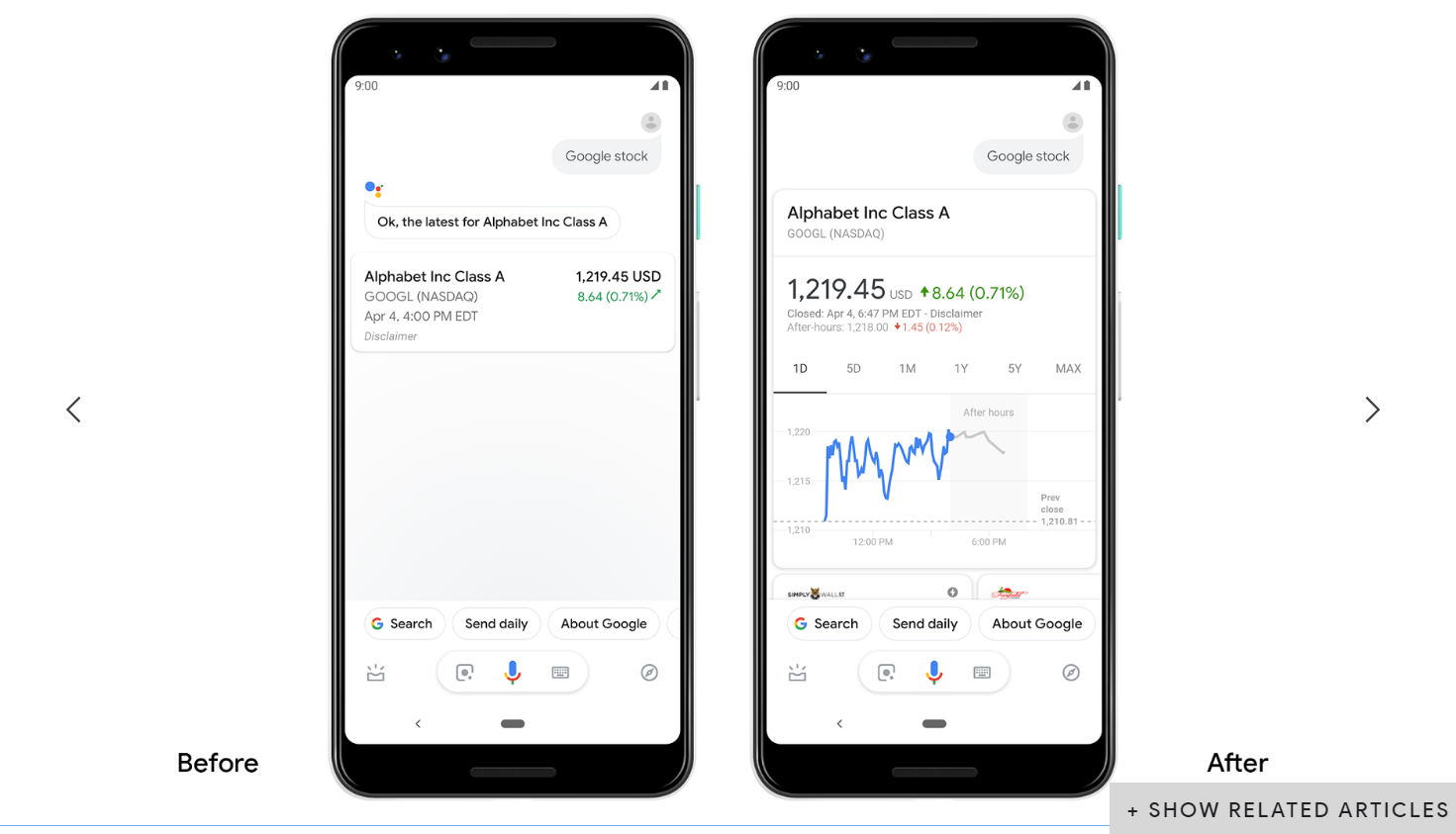
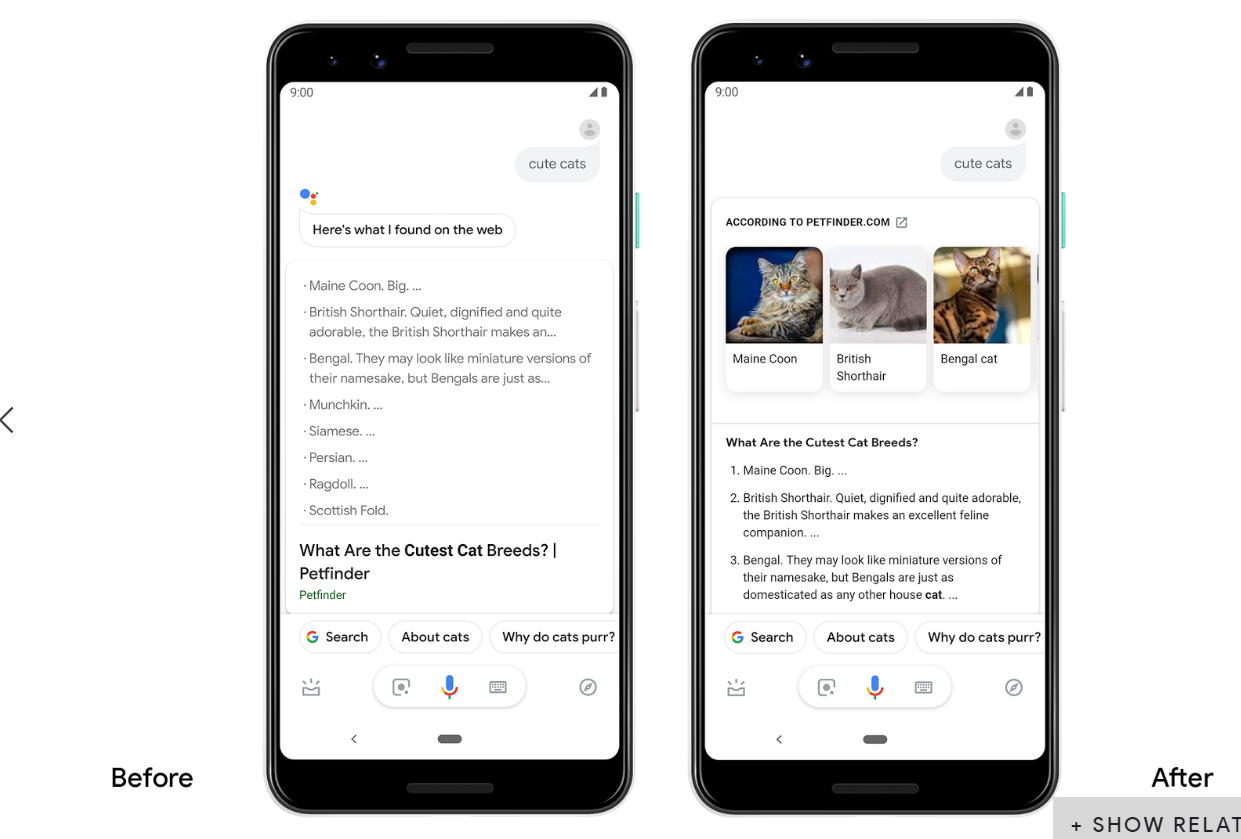
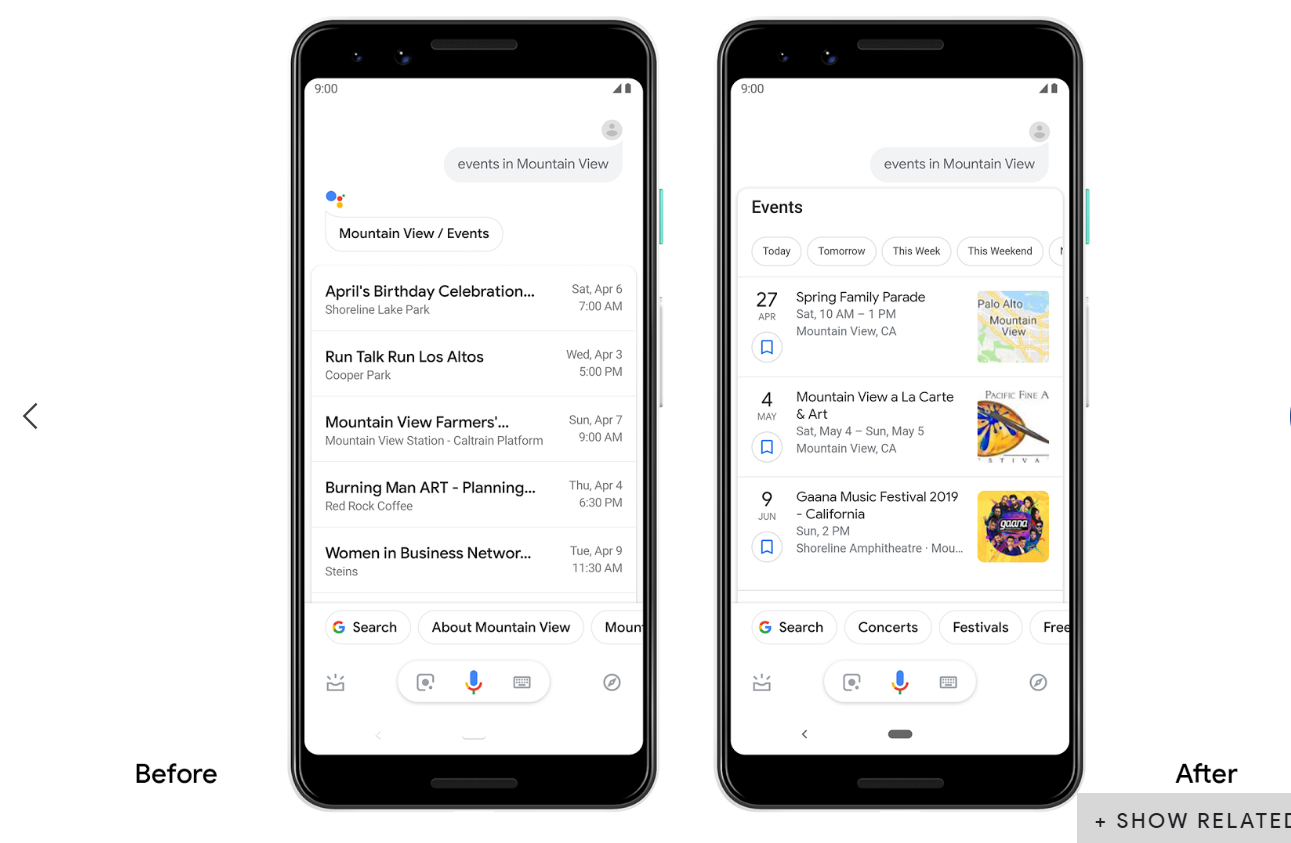
    The latest Google Assistant update includes response cards that present vital information that users are looking for in an easy-to-read format.

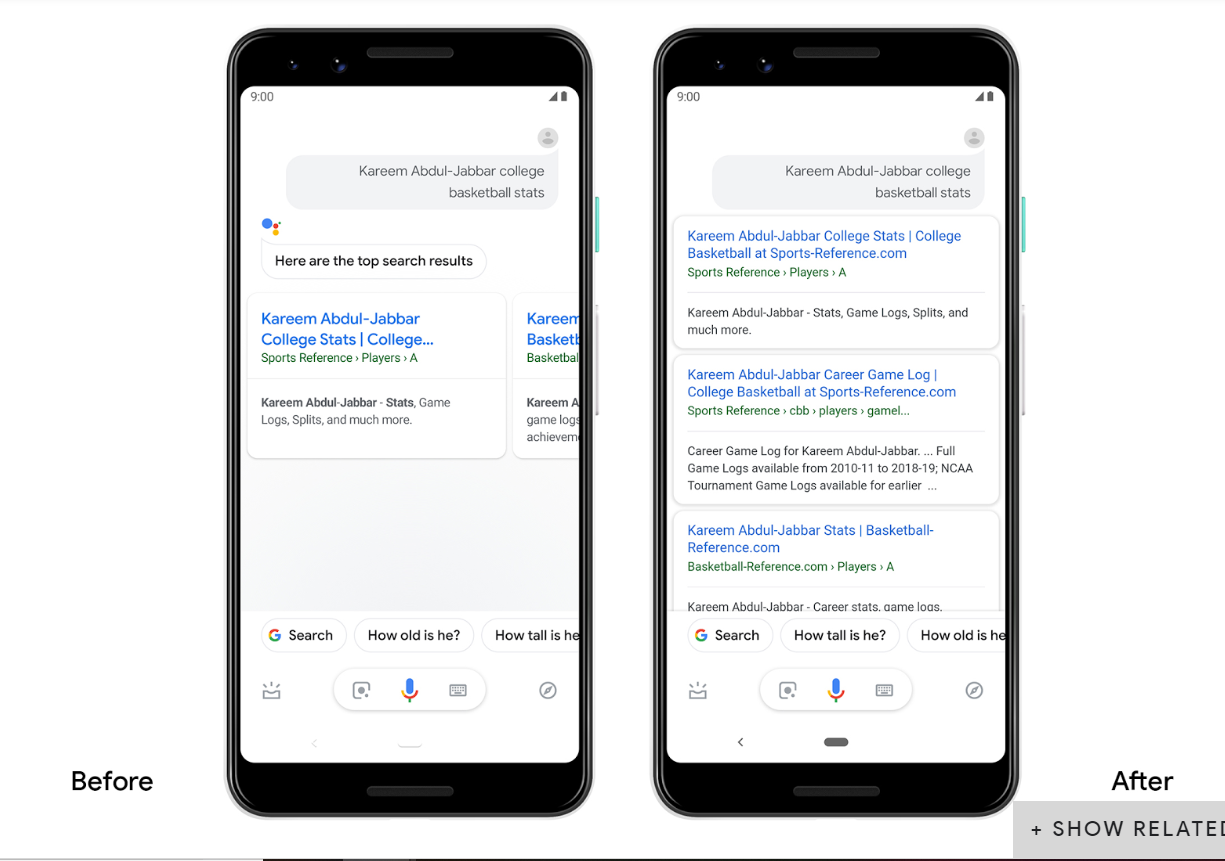
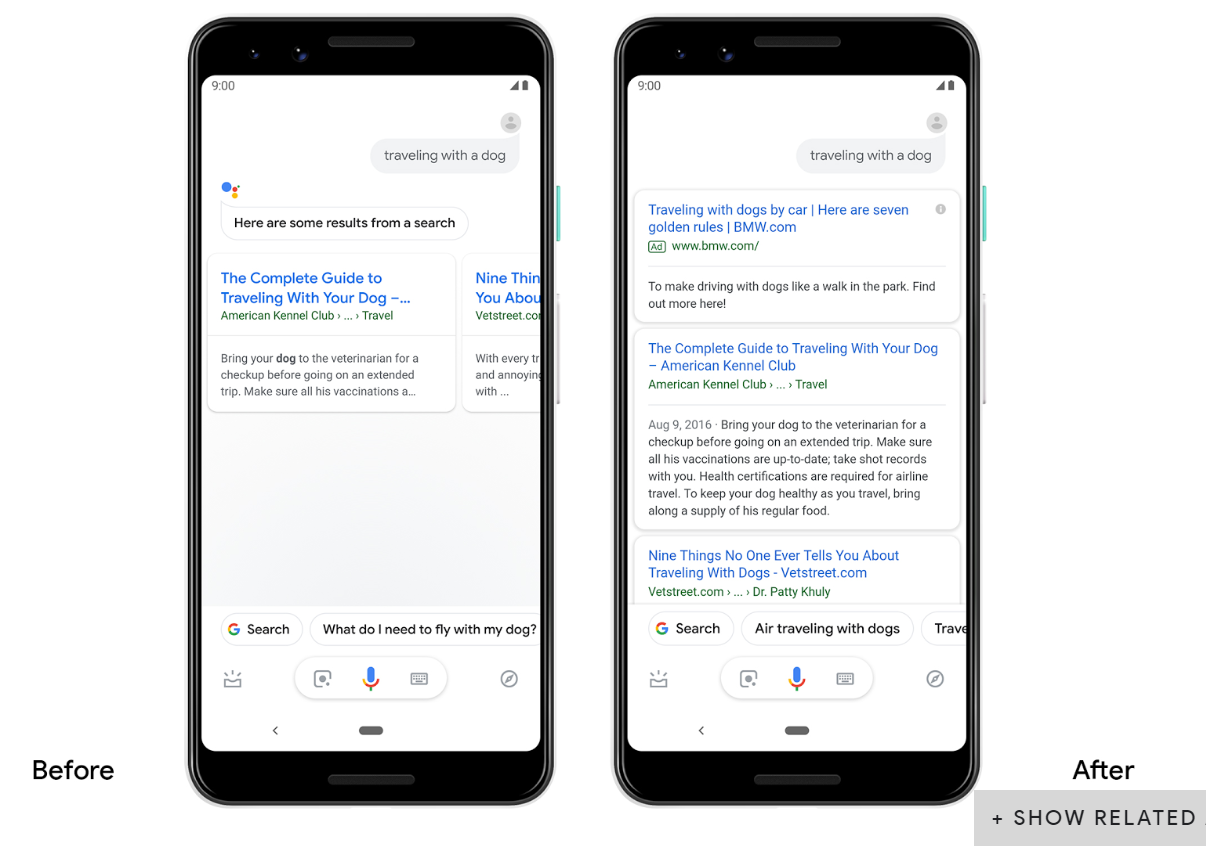
    Look at the before and after Images for some queries:

    As you can see, the new update provides a new interface for specific categories like events. Events now include saving buttons and thumbnails for each event. For categories like stock prices, the latest update provides a detailed stock price chart, along with other enhanced content.

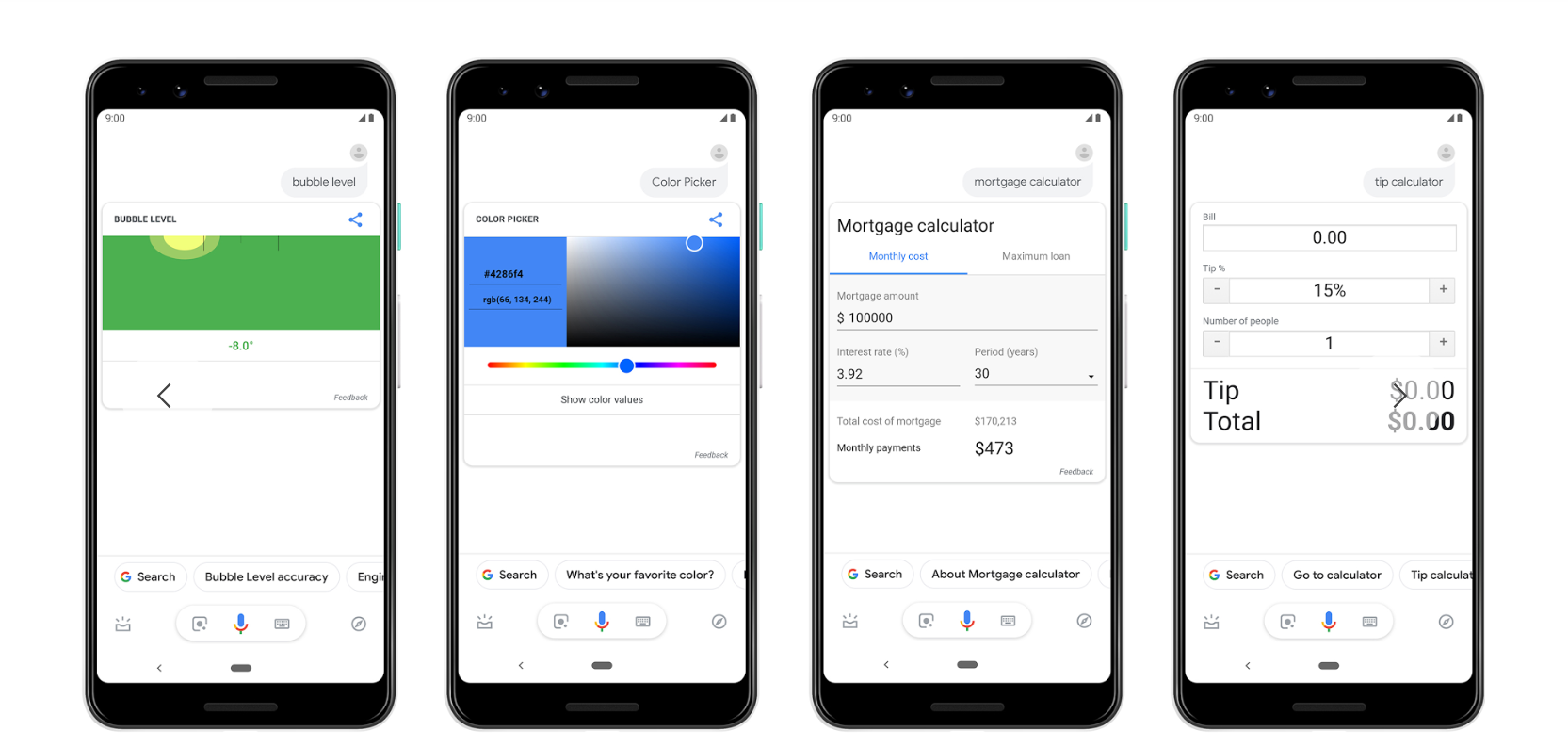
    Apart from the new visual interface for specific categories, the update also provides several handy tools like the metronome music pacer, tip calculator and bubble level as part of the Assistant’s interface.

    Additionally, for some queries, the response at the top includes links to a variety of related sources across the web, helping you learn more about the topic. Earlier, the Assistant only displayed the top result. Now, you can see the full set of search results as you would see on a desktop. Additionally, the Assistant may also include relevant ads that you would see on the Google Search app.

    This latest update is available on all Android phones, thereby helping users get enhanced search results.

    Why this update matters?

    This latest update with its variety of content is part of the search giant’s initiative to add functionality to the Assistant and to harmonise results offered by the Assistant and general Google mobile search results.

    According to stats revealed by MarketingLand, Google Assistant is now available on more than a billion devices worldwide. And, with an increasing number of users using Google Assistant to help them with their daily tasks, these latest functionalities are sure to appeal to users.

    Digital marketing experts predict that as significant percentage of search queries migrate from Google search to the Assistant, Google will work on monetising this space and brands will vie for space in this premium real-estate on users’ smartphones.

    Recently Google started test runs of local ads in Google Assistant results. As of now, the results shown by Google Assistant are ad-free. However, with more search queries migrating to the Assistant, Google will start working on monetising the results shown by the Assistant. And, adding functionalities is the first step.

    Is this update available for all?

    Yes, you can expect to see rich text in your Google Assistant. Try out this feature by searching for queries like, “Why is the grass green?” “Events in Orange County” using the Google Assistant on your Android smartphone.


    [Images via Google Blog]


  • Google Opens up Access to Google Merchant Center Results for Non-AdWords Retailers in the US

    Google Opens up Access to Google Merchant Center Results for Non-AdWords Retailers in the US

    With nearly 40000 searches every second, Google is indeed the most popular search engine. When users search for products using Google, the search engine generally displays sponsored content (Google Ads) above the organic search results.

    Image via Google

    To get your products displayed in the coveted Shopping Display Panel, e-commerce websites are required to upload their product data to the Google Merchant Center (GMC). Google recently announced that it’s making a few changes to the GMC. Here, in this post, you can find all about these recent changes.

    What’s New?

    The information available in Shopping Ads is now accessible to all e-commerce retailers for free. E-commerce sellers can now directly submit the information to Google. They no longer have to add schema markup to their site for doing the same.

    What’s Google Merchant Center (GMC)?

    GMC aka Google Merchant Center is a central dashboard where online e-commerce sellers can upload their product and store data, so that Google searchers can access the latest information about your products, directly on their search results page.

    The biggest benefit of the GMC was that all information displayed on it was updated in real-time so that users get accurate information during searches.

    Earlier, the data from the GMC was primarily to the benefit of Google AdWords users and not available to other e-commerce sellers. Online retailers had to use the schema markup of their sites to display the relevant information along with the right product images. The information displayed on the Shopping Display Panel included product price, availability, user ratings and more.

    How does the Latest Update Impact You?

    Recently, Google announced that it’s opening up the GMC for all online retailers, irrespective of whether they use AdWords or not. This works to the benefit of online retailers who are non-AdWords users. You can submit your product data to Google in real-time, thereby making your products eligible to be viewed in organic and image search results on Google.

    This is an excellent news for online retailers as it gives them better control over how their products are displayed on Google search results. Google further stated that products displayed on the Google shopping ads panel would be ranked based on their relevance to user queries online. Relevance is calculated using several factors like search history, the location of the searcher and so on.

    Online retailers can now submit the information directly to Google and not just by using the schema markup of their site.

    Three key benefits for Online Retailers via this Update:

    • You don’t require an AdWords account to upload your product information on Google
    • It’s free of cost
    • You can submit your product info directly to Google, giving you better control of your product display

    Is this Update Available for All?

    Right now, Google Merchant Center has extended this facility only to online retailers in the US. However, it’s expected that Google will roll out this change in other countries in the next few months.

  • All that You Need to Know to Submit a Sitemap on Google Search Console

    All that You Need to Know to Submit a Sitemap on Google Search Console

    The sitemap is the first point of stop for search engine crawlers. The search bots read the info present on your sitemap, to crawl your website with ease. Simply put, your sitemap plays a crucial role in determining your search engine rankings.

    Here, in this post, we show all that you need to know about sitemaps – how to create, submit and best practices.

    What is a Sitemap?

    A sitemap is a file that contains information about the pages on your site. Details from the sitemap are sent to Google and other search engines.

    What does the Sitemap contain?

    It contains several snippets of information, the key ones being:

    • Metadata about your web pages like how frequently it is updated, when was the last date of update, and more.
    • It also contains metadata about the content on your web pages like images, videos, and text blocks. For instance, the metadata of a video can help search engine bots know the videos run time, category, and rating.

    Why does the Sitemap Matter?

    When you have a properly-defined sitemap, web crawlers will be able to navigate your site with ease, especially when you have pages (like the archives section) that are not internally linked to the main pages.

    Here’s an important point to note – just because you have a sitemap, it doesn’t mean Google search bots crawl over all your pages and get them indexed. With that said, having a sitemap is an efficient way to boost your site’s visibility for search engines.

    3-Steps to Build a Sitemap for your Website

    1. You have to first, identify the pages that you want Google’s bots to crawl and discover on your site. The next step is to create a canonical version for each page on your list.
    2. Now, you have to decide the right sitemap format to use (RSS, XML, Google Sites or Text) and then build a sitemap from scratch. Alternatively, you can use any third-party tool to create your sitemap.
    3. Once you have built your sitemap, you have to make it available to Google. For this, you have to add the sitemap to your site’s “robots.txt,” file and then submit it to Google using the Search Console.

    How to Submit your Sitemap to Google Search Console?

    1. Once your site is verified, head to Google Search Console.
    2. Key in the URL of your site and complete the verification of your ownership of the site.
    3. Then, click on Sitemaps -> ADD/TEST SITEMAP.
    4. Enter sitemap.xml and then finish by clicking Submit Sitemap.

    Make sure that your sitemap has the name “Sitemap.xml.” Using any other name returns an error. Once you have added the sitemap to your site, Google will use it for future crawling references.

    Best Practices for Sitemap Creation

    • Use consistent and fully-qualified URLs.
    • Make sure that the URLs for pages on your site don’t contain any session IDs.
    • If URLs are a translated version, make sure you indicate it.
    • Sitemaps should be UTF-8 encoded.
    • Break large sitemaps into multiple files. If following this method, then make sure you have an index file for the sitemap.
    • Irrespective of the sitemap format you use, it has to be lesser than 10MB and contain no more than 50,000 URLs.

    Sitemaps are a great way to ensure that Google’s search bots have detailed information about your site, thereby boosting your search engine rankings and providing your site with better visibility online.

  • Google Rolls Out New Feature to Help You Recover Your Past Searches & Revisit Previous Search Results

    Google Rolls Out New Feature to Help You Recover Your Past Searches & Revisit Previous Search Results

    Google introduces a new feature that will help you retrace your earlier searches and conduct in-depth research on your preferred topic.

    Google recently announced that the search engine is introducing a new feature, Activity Cards that makes it easier for users to do in-depth research on any topic. News about this new feature was announced in September last year. Appearing as ‘Related Activity’, this information is available only to you and cannot be shared with others.  

    Why the need for this new feature?

    While Google is mostly used for quick answers, there are plenty of times when you would require information from the search engine to help you complete along-running task. For instance, whether you are planning to follow a new diet, researching about a particular hobby or craft, you often come back to Google to find information on the same topic.

    When you revisit an earlier search, you often look to retrace your previous search or look for new web pages on the topic.Google’s new Activity Cards will help you with your ongoing searches. These cards let you continue where you left off, during your previous search session on the topic.

    Image via Google

    How does it work?

    If you are logged into Google, then you can find activity cards on your favourite search topics like beauty, baking, hobbies, cooking, fashion, photography, fitness, nutrition, diet and more at the top of your search results page. Clicking on this card helps you continue your search explorations where you left off.

    How to use it?

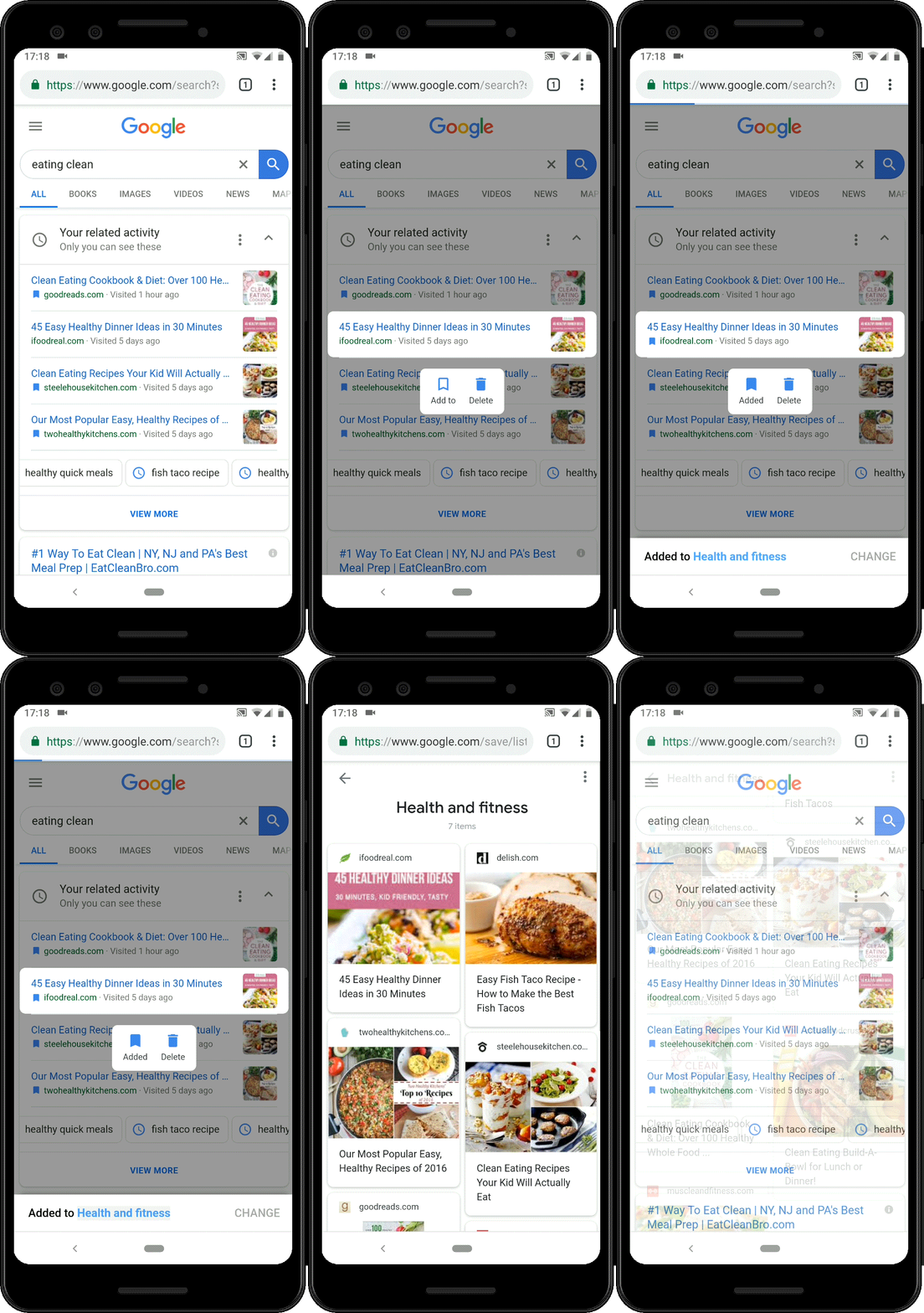
    The activity card contains links to web pages on the topic that you have visited previously, along with your past search queries on the topic. By clicking on these links, you can easily retrace your previous search path or find out new pages on that topic.

    If you want to bookmark a page from your activity card for later reference or for reading later, long press the link and tap on “Add To” button to add it to a specific collection. You can retrieve your saved collections by tapping on the bar at the bottom of your Google app or by pressing the menu button on the top left side of the mobile web search page.

    You can delete an item from the activity card by tapping on the 3-dot icon. Alternatively, you can also use this button to turn off the activity card feature completely.  

    How will Activity Cards impact the users?

    The activity cards provide a great way for users to accelerate their future searches by helping them retrace earlier content or find out new content. Additionally, the collections as part of the activity cards provide users with a quick way to access their preferred content immediately.  

    Why am I unable to find the Activity Card?

    Right now, the Activity Card is only available in the US for Google app and mobile web users.  

    Google working to improve user experience continuously

    The tech giant is known for presenting new features that improve the user experience. For instance, recently, Google made it easy for users to find out which streaming platform is available to stream a particular show/movie when they searched for it. In August last year, Google changed the search results page to include panels that contained subtopics related to the search phrase. And, this new feature from the search engine is another example of the company’s continuous efforts to improve the user experience.

  • Google Q&A: Google’s Newest Knowledge Panel Feature

    Google Q&A: Google’s Newest Knowledge Panel Feature

    Google Q&A was rolled out in August 2017. It is a customer-facing feature that allows prospective customers and brands to enquire and respond to questions pertaining to a particular business. These answers are taken via the local knowledge panel and are displayed on the search results page. This also allows users to upvote the answer.

    What are the new updates?

    A few days back, Google announced it is expanding support for rich results within Q&A pages on the web. Google’s aims to use the Q&A feature to offer customers with additional information about a particular organisation or brand. It will help customers to find significant and well-timed responses to common queries. It also prompts them to be directed to the business site from this knowledge panel itself.

    This new supported structured data format is developed and designed to help Google with the question and answer formatted snippets carousel. This snippets carousel lets users slide through answers and questions from Q&A pages.

    This Q&A structured data works for sites that have pages that are already in question and answer format. This is mainly designed for social news sites, forums, and help and support message boards.

    A look at the Q&A pages guidelines for better results

    Google has officially published structured data markup to design this type of Q&A pages for businesses. Appropriately marked up pages are qualified to have a rich result displayed on the search engine result pages. This rich treatment helps in reaching the right users on search. Marking up Q&A pages helps Google generate a better snippet for a webpage.

    There are following guidelines to design Q&A page for the rich treatment. One must follow these guidelines.

    • One should mark up his/her website’s pages by applying any of the three compatible formats like JSON-LD, Microdata, and RDFa. Then only it can be eligible for the rich result.
    • One should not use access control mechanisms like robots.txt or noindex. This will prevent proper indexing of the structured data pages to Googlebot.
    • Always use the most recent and original content.
    • Never mark up misleading or irrelevant content.
    • Content should not promote any violence, negative, or harmful activities.
    • Make sure to abide by the schema.org guidelines for correct relevant type and property names.
    • All image URLs have to be accessible for bot crawling and indexing.

    How to use it effectively?

    The primary approach for getting higher clicks through these Q&A pages is mainly divided into five parts that any business or an SEO agency should use to get the desired result.

    • Plan

    The primary goal of Q&A pages is to help and ease the customer journey from search to call. So an SEO agency should assist a business or brand in planning the content.

    • Post

    Google expects that the business will get engaged in the Q&A process. So the business or the agency working on behalf of them should post their questions.

    • Monitor

    One should properly analyse the questions which are responded efficiently.

    • Respond

    Users should properly respond to the questions in a timely fashion. That will help the future searchers to see that the business was engaged and responsive.

    • Report

    Users should familiarise themselves with the new Google Maps User Contributed Content Policy. Any answers or questions should not violate this policy. If it occurs, then it should be reported to Google as it can poorly reflect on the business.

    Rich results can help strengthen the display of a search result among many other search results. Of course, if the snippet has a carousel with answers and users can scroll through then it will definitely get a higher click than the standard blue link results or regular snippets.

  • Google Takes a Bold Step Against Comparison Shopping Services

    Google Takes a Bold Step Against Comparison Shopping Services

    In a report from Sky News last month, Google has brought down the incentives substantially for retailers who benefited from deploying untrue and fake websites on price comparison for eCommerce products. This means that Google will incentivise advertisers to create price comparison sites that would be displayed on the search engine’s Shopping Box.

    It has been noticed that this move is rather a response to the penalty of €2.4 billion slapped on Google last year by the European Commission. This fine was attributed to Google’s Anti-competitive practices on the digital space.

    A background into Comparison Shopping service

    The Comparison Shopping service came into being since June 2018. The European Commission has mandated the search engine giant to provide comparison shopping services with the same chance as Google Shopping to display ads on the SERP or search engine results pages.

    Once the service was in effect, Google purportedly allowed advertising agencies to create comparison shopping sites which permitted them to tactically position ads which appeared in Google Shopping. This was done in an attempt to benefit from the incentives offered by Google, by creating fake comparison shopping sites. There have been many sites which didn’t meet the relevance factor and some didn’t even have a proper website once users were re-directed from the SERP to the site.

    Evidences and Confessions

    An ad firm, Shoptimised, admits that their comparison site was never created with the intention of serving customers. Another Ad agency happened to spill the beans to Sky News and confessed that they built a shopping service for their clients for one reason only – to avail of the incentives from Google, and not particularly to add value to a customer’s shopping experience.

    It has been revealed that Google reportedly presented a staggering sum of £32,000 to those companies who would choose to advertise through a Google-endorsed comparison shopping service. Not just that, but Google also made available a 20% off on ads to sweeten the deal all the more.

    All this has led Google to be under the constant vigilance and pressure of the European commission ruling.

    The After-effects of the Fine by European Commission

    In the light of the pressure imposed by European Commission, Google has now drastically cut the incentives offered to such Google-certified services by as much as 85%. This is because of the criticism Google happened to face ever since this serious matter has come to light.

    Google had to lower the rebate (a partial refund to someone who has paid too much for utility, tax etc.) on advertising spend from 30% down to a pitiable 5%, which was made effective from November 1st this year. This sudden reduction in incentives has left a bad taste in mouth for the ad agencies as it didn’t fit with the ROI expected from the ad.

    Companies did not assume that Google’s incentive invitation would soon come under the direct vision of the European Commission, and has eventually led to their utter dismay.

    Various claims of fake comparison shopping sites have been lodged with the European Commission. Though Google stands its guard on the fact that the actions taken by them by lowering incentives have put their actions in due compliance of the Commission’s order.