LS Staging

Tag: Search Engine Marketing

  • SEO in 2022 – Checklist for Brands and Marketers

    SEO in 2022 – Checklist for Brands and Marketers

    While hosting good content will always be a top priority, businesses today know that growing organic traffic to their website is equally important for increasing their online visibility. As a result, there has been a renewed interest and focus on SEO strategies that can help in growing website traffic.

    Digital marketers are keeping abreast of the latest trends and techniques in search engine optimisation and how to leverage them in recent times.

    So what do marketers need to focus on in 2022 when it comes to leveraging SEO? Let’s find out.

    Core Web Vitals

    The Google algorithm uses certain page experience signals to determine the quality of the websites and rank them accordingly. In June 2021, Google added three new page experience signals that are collectively called the Core Web Vitals. These three web vitals are-

    • Largest Contentful Paint (LCP)

    LCP measures the time taken by the largest visible image or block of text on the web page to load.

    • First Input Delay (FID)

    FID measures the time delay between the user’s first interaction and the browser’s response to the user interaction.

    • Cumulative Layout Shift (CLS)

    CLS measures the stability of the website content while the site is still loading.

    The emphasis is on page rendering speed and stability. While websites with simple and static contents are unlikely to be immediately affected by the core web vitals, dynamic websites that host advertisements can get affected in the google ranking algorithm.

    However, digital marketers can start reviewing their SEO strategy and make changes before they experience any drastic change in their ranking in Google search. Furthermore, Google had publicised these changes well in advance, showing the intent to help the SEO and developer community to better prepare their web content.

    Making Websites Mobile Friendly

    The smartphone penetration, along with affordable internet services, has been phenomenal even in developing economies. For instance, India has many households where there is a smartphone but no desktop or laptop PC.

    As a result, most internet surfing today is happening through mobile phones. Therefore, it was inevitable that the Google search algorithm would prioritise mobile-friendly websites.

    So, it is no surprise that starting from 2019, mobile-friendly websites are indexed first by default.

    Understanding MUM

    The Google Multitask Unified Model, or MUM, will use an AI-powered algorithm to improve the online search experience. MUM aims to remove the need for multiple searches by the user. Instead, it aims to interpret the search context through text, images, videos, and audio to understand the user’s needs.

    Furthermore, it understands 75 different languages. Thus, it has the potential to refine over time to understand complex queries used in human-to-human conversations.

    While MUM will be currently introduced as an update to Google Lens, it has a vast potential to change the online search experience completely.

    Therefore, digital marketers will be keeping an eye on how things turn out with MUM. But, for now, marketers need to focus on image optimisation through alt tags, geotagging, etc.

    Emphasise on Voice Search

    We have already witnessed the launch of some fascinating voice-based apps and products such as Amazon’s Alexa, Apple’s Siri, or Google Assistance. It is therefore imperative for businesses to make their websites more conversation-friendly.

    This means more query-based segregation of contents where conversational-style questions are framed to get favourable search results.

    For example, consider using the query “ How to open a bank account?” instead of using the traditional “Steps to open a bank account”.

    Google Does Not Want Searchers to Visit your Website

    About 49% of Google Searches lead to no-clicks. Google wants brands to answer people’s queries without taking them away from the search engine. Snippets can help you rank better, but it also is a double-edged sword as it could mean the visitor may not click on the link and may be satisfied with the answer provided. While this may seem detrimental for your SEO, featuring snippets can help you get a better ranking and build your brand value. This, in turn, can impact your overall SEO score.

    Rank Better in 2022 with SEO

    Creative advertisements, quality content, and storytelling will remain integral to brand-building and sustained business growth. However, SEO is likely to play an equally big part, if not more, in shaping the online visibility of businesses.

    With Google tweaking its algorithm every once in a while in addition to incorporating new features or parameters, the world of digital marketing will surely witness some interesting times ahead.


  • Connect Organic and Paid Search to Boost ROI

    Connect Organic and Paid Search to Boost ROI

    Most brands and marketers already understand how critical it is to have powerful organic and paid search strategies. After all, around 63% of the online experiences begin with a search engine, according to a report by BrightEdge.

    But if you are keeping the channel teams siloed and not integrating the two, you sure are missing out on the opportunity to boost conversions, ranking, and ROI. By connecting organic and paid search, you can effectively coordinate and streamline your search marketing strategy. At the same time, brands can also save time and money spent on content production and ads.

    But what is the most effective way to combine the two? Here are 3 of the most popular ways in which brands and marketers can combine organic and paid search-

    1. Leverage Paid Search Data for Publishing Great Content

    One of the easiest ways to connect organic and paid search is to use data from paid campaigns to publish content for your website. If you are struggling to come up with fresh content ideas to attract traffic, you can craft something around the keywords that are bringing the maximum number of PPC clicks.

    Alternatively, such top-performing keywords can also be added to the meta descriptions to boost your website’s organic ranking. The keywords and phrases that are bringing in traffic can also be explored further through additional pieces of content. For instance, if people are searching for “how” one of your products work, you can consider publishing a few instructional blogs.

    2. Encourage Return Store Visits

    According to a recent survey by American Express and Nielsen, Indian consumers spend most of their online time shopping. While shopping online, people browse through several stores before making a purchase. Unfortunately, most of the people who might have visited your online store while searching for a product might not remember your brand after a single visit.

    It is possible that the initial visit might have come from your higher organic ranking for a particular keyword. With PPC, you can target such visitors through a remarketing campaign. The website cookies record such visits and abandoned carts. Paid ads can be used for displaying products or messages to these one-time visitors throughout the Google Display network. 

    3. Merging Organic Search with PPC Bidding

    Brands can also work on a bidding strategy that can react to a particular organic data feed to boost ROIs. For instance, keywords with higher organic coverage but lower competition can be selected as higher efficiency targets to minimize ad spends. With the help of bidding strategies that revolve around auction timing, the algorithm uses intent signals collected in real-time. 

    At the same time, the attribution is driven by data to ensure that the conversion value depends on the stage at which a consumer is in their buying journey. These strategies help optimize the ad spends, allowing brands to spend more on other potential areas.

    Combine Organic and Paid Search for Improved ROI

    Several brands treat organic and paid search as different entities that need individual teams and exclusive strategies. By combining organic and paid search, brands and marketers can unleash the true potential of their search marketing campaigns and boost ROIs.

    The expertise of a reliable digital marketing company is your best bet to take maximum advantage of this combination and achieve improved results.

  • 5 Steps to SEM Success in the Era of Machine Learning

    5 Steps to SEM Success in the Era of Machine Learning

    It’s no secret that AI and machine learning have made it challenging for SEM marketers to create new advertising strategies that work. In a recent conference at the SMX Advanced seminar held in Seattle, the keynote speaker, Nicolas Darveau – Garneau, Google’s Chief Search Evangelist listed the ways to optimize SEM campaigns in the era of machine learning and AI.

    Here, are the five steps outlined by Darveau – Garneau to help marketers outsmart the machine learning and other smart tools.

    1. Combined Measuring

    Instead of looking at customer interactions and data in separate platforms and modes, marketers have to combine data from across channels to get the bigger picture. Standalone data has to be integrated holistically, to get a clear idea of the customer profile and position in the funnel.

    Darveau – Garneau recommends marketers to measure ROI on each campaign and pool it together across ROI in all Google tools. This will help marketers to spot opportunities quickly and make the best use of it, across campaigns.

    2. Fix the Right Goals

    In his address, Darveau – Garneau illustrated this point using an analogy he picked from car insurance companies. He stated that though different car insurance companies sell similar products, each company has hugely varying goals. For instance, company A may focus on capturing the maximum number of leads, while company B might focus on selling the maximum number of policies. While company C may be focused on selling only premium policies.

    It’s essential that businesses identify their unique goals, using their market value and niche audience. Once you have identified the unique goal of your business, you can use machine learning tools, to help you target ideal customers who match your specific goals.

    3. Track the Right Metrics

    Darveau – Garneau stated that metrics vary depending on the goals being targeted. Hence, it’s essential for all businesses to know the right metrics they should be targeting to evaluate the performance of a specific campaign.

    For instance, the objective of your campaign may be boosting brand awareness, while the objective of your competitor may be increasing conversions. You cannot use the same metric to measure the efficiency of both these campaigns. Identify the right metric and then feed it to your machine learning tools to get the complete picture of the campaign.

    4. Focus on Long-term Goals

    Darveau – Garneau states that brands that focus only on short-term goals are missing out on key opportunities. When you focus on short-term goals, you aim only for acquisition. Marketers must focus on other key elements like – loyalty building, loyalty optimization, customer retention, brand value if they want to remain successful in the long run.

    5. Spend more for Acquiring the Best Customers

    It’s not just about increasing leads but pulling in high-quality leads, which adds to the customer lifecycle value. Darveau – Garneau suggests that brands use machine learning to pinpoint the ideal audience. He further stated that the extra time, resources and effort you put in to generate high-quality leads is totally worth it.

    The Takeaway:

    There’s no way that marketers can reverse or stop the progress of machine learning. It’s here to stay. Instead of fighting against it, SEM marketers should learn how to harness their capabilities for their advantage. And, they must learn it quick, if they wish to thrive and taste success in the automated digital landscape of the near future.

  • Moving up the Digital Arch with Integrated Digital Marketing focused on Customer-Centricity

    Moving up the Digital Arch with Integrated Digital Marketing focused on Customer-Centricity

    The new-age connected consumers are faced with a choice explosion. What does this mean for digital marketers? To give more choices to the consumer or improve the consumer’s choosing experience?

    As a brand, if you are looking to win the big share of the customer-base pie, it’s essential that you take an integrated digital marketing approach one that encompasses technology, creativity, data and analytics in digital advertising to create successful customer experiences.

    Here’s why you can no longer afford to ignore Customer Experience Management:

    Here are a few reasons why your brand is losing out on ROI as well as credibility by having a lackluster single-channel digital marketing strategy:

    • The Evolution of the Modern Consumer

    With increasing internet penetration in India, online buyers are rapidly increasing. m-Commerce is growing at an exponential pace especially the m-wallets transactions. They are aware of the marketing and advertising efforts of brands, and they no longer trust traditional advertising – especially from big corporations and celebrities. However, they trust brands that are organic, authentic, and honest.

    This means, your content, SEO, and other marketing efforts have to work together to create authoritative, authentic, and engaging content.

    • Customers trust other Customers

    Do you know whom your customers trust the best? Other users of your product. The growth of influencer marketing can be attributed to this.

    You need to work on digital marketing efforts that lead to the generation of customer reviews, social shares, and other user-generated content to build brand credibility and trust. Organic shares of your brand’s content increase engagement because your potential customers see other users interacting with your brand and are likely to follow suit.

    • Multi-device Multi-channel Lifestyles

    This is increasingly true for customers across generations. Your brand needs to develop a multi-channel, integrated marketing approach if you want to reach out to customers who effortlessly straddle more than one channel across multiple devices.

    According to data revealed by SalesForce, it was found that an average customer goes through 6 to 8 touchpoints, before they make a purchasing decision. This makes it crucial that your brand develops a unified, integrated digital marketing approach that focuses on customer experience. It’s time that your brand shifts its focus from CRM to CXM.

    Customer-Centricity – Easier Said than Done

    Though brands have been trying to shift to a customer-centric approach for nearly two decades now, the CMO states that only 14% of marketers believe that customer-centricity is what sets them apart.

    Why do most businesses fail to figure out customer-centricity? This is because the volume, variety, and velocity of customer data are challenging for businesses to handle. While some companies don’t have the tools and technology to divide customers into segments, others lack in targeting customers with the right personalized communications.

    Another huge barrier is lack of customer-centric culture at businesses. Most companies remain focused on sales, products, or services. The customer-centricity approach is only restricted to certain operations like marketing.

    Businesses can move to a customer-centric approach with data-driven marketing. To provide your customers with the best experience, you need to gain access to customer insights. Enterprises realize that customer-centric strategies, along with an integrated digital marketing approach are the best way forward.

    By gathering and analyzing customer data and tailoring your marketing efforts to focus on customer experience, you can surge ahead outpacing your competitors and build a brand that stands tall among your target audience.

    Logicserve Digital is a new-age digital marketing and digital consulting company with offices spanning across India. They have enabled leading brands to navigate through the new-world digital marketing challenges by driving communications across multichannel platforms and devices. Their in-depth knowledge, expertise and innovative ideas have helped brands to leap forward in digital ecosphere. With the right mix of data and optimum use of technology, Logicserve has created success stories for brands across varied sectors.

  • Customer Acquisition Vs. Customer Retention – 5 Best Practices to Increase Revenues

    Customer Acquisition Vs. Customer Retention – 5 Best Practices to Increase Revenues

    One of the most heavily debated issues in marketing circles is – customer acquisition vs customer retention. Here, we discuss the acquisition vs retention to help you choose the right approach for your business.

    The Growth Equation

    To fully understand acquisition (getting new customers) versus retention (getting old customers to come back and build loyalty), you need to understand your brand’s growth and revenues.

    Here’s an equation to compute that:

    Monthly Growth Revenue = (No. of new customers acquired in a month * Average spend for each new customer) + (No. of returning customers in a month * Average spend for each returning customer) + (No. of resurrected customers in a month * Average spend for each resurrected customer)

    You need to understand this growth equation to decide, which category of customers matter the most for your business. Here are some best practices to help you make the most of customer acquisition and retention.

    1. Identify what “Customer” means to your Business

    Very often, businesses overlook the crucial step of defining what customers mean to their business and how to translate it to set the goals of their search campaigns. The definition of a customer varies from business to business. For instance, some enterprises define customers as someone who purchased in the last month, while others define customers as visitors who bought at some point.

    For example, two customers purchased from you in the last month. One customer searches for your product using your brand name, while the other customer searches using a generic term. So, should you treat both these customers similarly or use different marketing strategies to acquire them? These are some aspects to consider while defining customers.

    2. Understand the Purchase Path of Customers

    To understand whether the amount you spend on acquiring or retaining a customer is worth it, you need to know your customer’s purchase path. Only when you are aware of their purchase pattern, you can justify the heightened costs of acquiring the customer.

    Remember that most customers interact with your brand using multiple channels like – direct, search, email, affiliates and more. So, it’s essential to have a multi-channel attribution model to monitor and track performance across channels.

    3. Create Tailored Campaigns to Support Different Audience Segments

    Once you have identified your customers and tracked their purchase paths, segment your ad campaigns for each category of customers. Use features like RLSAs (Remarketing Lists for Search Ads) and Customer Match, etc.

    Here are a few examples of how you can segregate audiences:

    • New and un-cookied customers (prospects) – This list consists of audiences who are un-cookied and have never purchased from you ever before.
    • New and cookied customers – This list includes customers who have visited your site, but have not made a purchase with you in forever or within a specific period, say in the last 180 days.
    • Returning customers – This includes audiences who have purchased within the last 180 days or so.

    You can also further divide customers into dormant, high-value, high lifetime value, first-time buyers and so on.

    4. Define Unique Goals for each Audience Segment

    Once you have segregated audiences, the next step is to assign a goal for each audience bucket. The goal should be aligned with the campaign. Also, remember that there is a direct relationship between customer return and revenue. If you are solely focused on returning customers, then the return revenue will be restricted.

    Generally, it costs more to acquire new customers than to retain existing customers. It costs 5x more to acquire new customers than to retain existing ones, according to a market survey.

    5. Track KPIs for Success

    Here are a few questions you must ask yourself as you evaluate your marketing campaigns: are we hitting return goals? Are new customers similar to your ideal customer profile? Are you increasing the total number of new customers acquired, while boosting profit levels? Have you managed to reduce the cost of returning customers? And so on.

    Which one to Focus – Customer Acquisition vs Customer Retention?

    It all depends on your growth equation. You must consider available resources, time and goals and decide what is best for your business. Remember that while it may make sense to focus on customer retention now, a few months down the line, once you have stabilized existing customer relationships, you may shift your focus to customer acquisition.

    Finally, to build a profitable business, you must focus on both and make incremental tweaks to your marketing strategies every few months, depending on available data.

  • Writing for Search Engine Bots Vs. Writing for People – Which Approach Works in 2019?

    Writing for Search Engine Bots Vs. Writing for People – Which Approach Works in 2019?

    When it comes to content writing, there are two distinct approaches to take. One – write for search engine bots, filling your content with keywords. Two – write for your readers, offering them value, while making your content click-worthy and share-worthy.

    Both these strategies have a common goal – to boost the visibility of the content and to pull in more traffic. But, which of these two approaches work? Find out here.

    The End of the Black and White Hat Techniques

    For years, SEO specialists and digital marketers have been trying to win the attention and favor of search engines by employing various techniques commonly known as white hat and black hat strategies.

    Simply put, black hat was for those who aimed for quick results, by using not-so-scrupulous techniques like hidden texts, keyword stuffing, content spamming, link farming and so on. On the other hand, white hat played by the rules of search engines, meaning results took longer to materialize. Effective keyword usage, internal linking, generating relevant backlinks were some of the popular white hat strategies.

    While white hat strategies are more ethical, the point here is that search engines have come a long way and have seen significant evolutions. The complicated Google algorithms of today penalize both black hat and white hat strategies. That is because Google doesn’t want to be manipulated anymore. When you employ these strategies, you are likely to get your site to lose its ranking or even de-indexed.

    Focus on Your Audience

    Content marketing today is all about the end readers. As a content writer, you need to ensure that you are providing your audience with value, giving them what they are looking for. You need to ensure that your audience connects with your content. It’s no longer, just about satisfying search engine bots to boost your rankings.

    It’s all about high-quality, well-written relevant content that appeals to the end reader.

    What about Search Bots?

    Search engines today have highly-sophisticated algorithms that use advanced technologies like machine learning, AI and more. This means Google and all other search engines can easily identify well-written high-quality content that provides users with the relevant information, from content that was written to trick search bots.

    It’s no longer about keyword stuffing to pull in the attention of search bots. It’s all about high-quality content that offers value to readers, thereby winning the attention of search bots and ranking higher. To put it in a nutshell, if you write good content that satisfies your target audience, Google will reward you. The reverse (content written for search bots) isn’t true.

    What Qualifies as Good Content for Google?

    Check out Search Quality Evaluate Guidelines published by Google to find out what qualifies as good content, from Google’s point of view. This document is the Bible for content writers. It gives you a clear idea of how Google’s bots evaluate and rank different contents. It doesn’t just point out what is good content but also explains why content is considered bad.

    Here are some pointers that help you create Good High-Quality Content:

    • Start by defining the purpose of your content. Identify the focus topic, your target audience and the intent (what you wish to achieve).
    • Do your research. Before, you start writing spend time analyzing the topic, understand what is it about and then give your opinions/views on it.
    • Edit and use correct grammar. Use the right punctuations, grammar and try to keep the content to the topic.
    • Make it informational, educational and relevant. You need to ensure that your content satisfies the purpose. Does it provide readers with the relevant info? Does it answer their questions?
    • Always cite sources. Remember that statistics are just a string of numbers if you don’t have the relevant sources to support it. Make sure to cite the sources.

    As you can see, you can easily satisfy both your readers and search engine bots with high-quality, relevant, and engaging content. This is certainly the approach to take for content writing in 2019.

  • Google Rolls Out Three Brand New Features, Including Video for Responsive Display Ads

    Google Rolls Out Three Brand New Features, Including Video for Responsive Display Ads

    Google recently announced via a blog post, that they are introducing three new features for Responsive Display Ads that will improve the functionality of the ad network, providing marketers with new reporting capabilities.

    Responsive Display Ads have overtaken standard ads as the preferred ad format for the Google Display Network. As you know, these ads can be used in both your conventional Ad marketing as well as for smart Ad displays.

    To generate a responsive display ad, marketers have to upload – images, logos, headlines, descriptions and video to the Display Network and Google automatically generates responsive ads that work across all devices.

    Here are the top benefits of Responsive Display Ads:

    • Ad Optimization – When you use responsive display ads, Google’s machine learning tools use advanced algorithms to determine the best combination for your assets, based on your ad’s performance over time.
    • Better Reach – Responsive display ads use several types of assets like headlines, logos, images, and even videos. Google automatically adjusts the size of your ad to fit the available space best. This means your Ad reaches a broader audience than before. For instance, it may be displayed as a dynamic text ad on one device, whereas it can be displayed as banners on another site.  
    • Makes Ad Management Easy – Using responsive display ads, managing your ad campaigns is easier than ever before. You can quickly manage different ad portfolios, segregate ads into various groups, thereby helping to improve your marketing.

    Google is now rolling out three new features for Responsive Display Ads. Let’s take a closer look at these features being introduced.

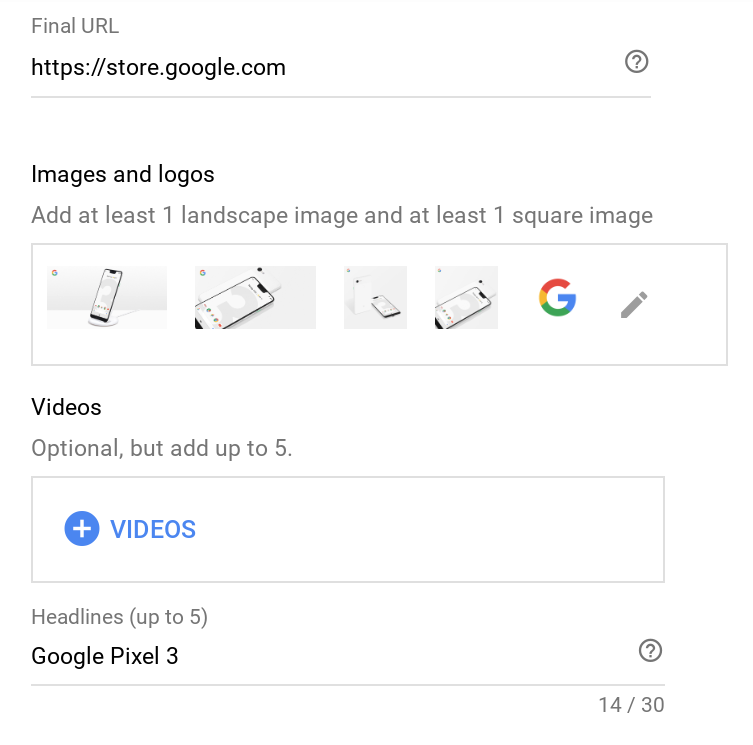
    1. Include Video Assets


    Image via Google

    You can now include videos as assets while creating Responsive Display ads. This new feature ensures that your ad has an expanded reach. When you use videos as an asset, Google automatically displays videos when machine learning tools predict that videos will perform better.

    You can select up to five different videos to be included in your responsive display ad. You can include URLs to five different videos from your YouTube channel.

    Using Ads with video assets remains the same. The process for ad creation, optimization and testing are as usual.

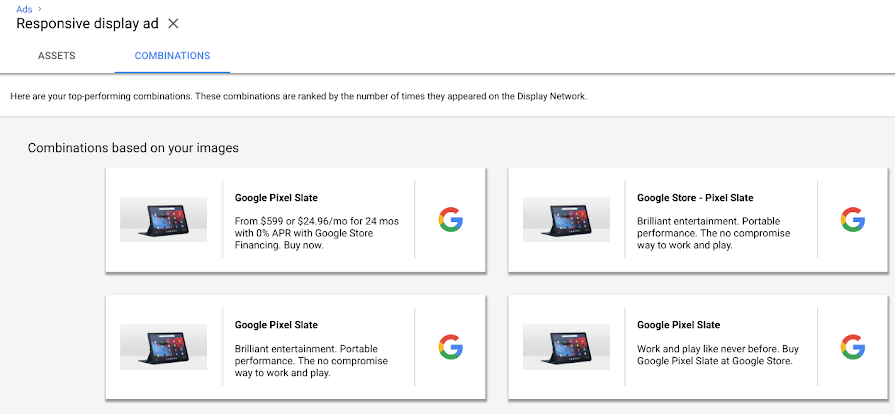
    2. Combinations Report


    Image via Google

    Google has introduced a new combinations report that provides added insight into the performance of your ads. This report helps you to test the effectiveness of different asset combinations so that you can easily find out the top-performing combinations.

    The combinations report shows the list of asset combinations that are being automatically generated in your responsive display ads campaigns and helps you find out the individual performance levels. The report has a separate section allocated to various asset combinations like – text, images, dynamic feeds, headlines, and videos.

    To check out this report in your Google Ads account, head to “View Ad Details,” under the Ads tab, and choose “Combinations.

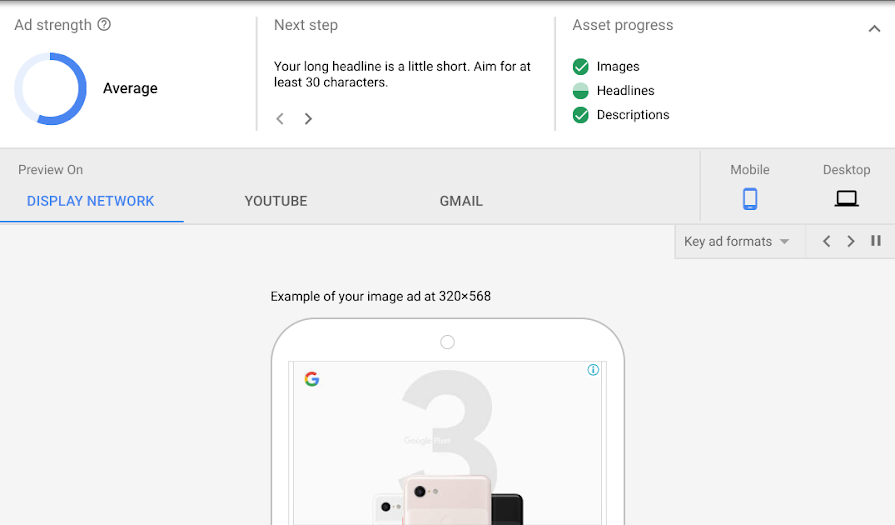
    3. Ad Strength Scorecard

    Image via Google

    The final feature, this helps you to figure out the strength of your ad before it goes live. The ad strength is displayed as a visual scorecard, with ratings like “Average, Good, Poor and so on.” Google monitors the strength of your assets like unique headlines used, complete and relevant descriptions, image quality and other factors to determine the strength of your ads.

    Additionally, you can also find further recommendations to improve the score of your ad, by clicking on the “Next Steps,” section.

    Which of these three new features are you likely to use as a digital marketer?

  • Single and Exclusive Search Advertising Platform for Bing and Yahoo Ads

    Single and Exclusive Search Advertising Platform for Bing and Yahoo Ads

    With this latest partnership agreement, Yahoo ads will now be available via the Bing Ads platform, providing advertisers and marketers with a single, integrated platform.

    Microsoft recently announced that the company is updating their partnership terms with Verizon media to provide advertisers with more convenience. The new partnership will further strengthen ties between these two companies.

    Verizon Media Group, previously known as Oath, is a huge conglomerate that owns AOL and Yahoo, among several other brands. And, the partnership between Microsoft and Yahoo had existed for over a decade and can be traced back to 2009, when the two companies came together for the first time.

    What are the terms of this new partnership?

    As per the latest announcements, Microsoft owned Bing Ads will be the exclusive search advertising platform for the entire list of brands owned by Verizon Media Properties, including the popular Yahoo and AOL, among other brands.

    Earlier in 2015, when Yahoo was independently owned and not under the Verizon umbrella, Yahoo retained the right for up to 49% of search ads on its platform via Gemini. The remaining 51% of ads flowed through Bing Ads.

    Now with the new announcement, all ads on the Yahoo platform will be via Bing Ads. It is to be noted that previously Yahoo had signed a three-year deal with Google in 2015. With the new announcement, Google and other search platforms will have no share in the Yahoo search inventory.

    Apart from Yahoo, the new announcement ensures that all search inventory on the other Verizon owned properties like – Aol.com, AOL Mail, Yahoo Mail, TechCrunch, Huffington Post, and others will be exclusively routed via Bing Ads.

    How does the new partnership impact native ads?

    Microsoft is introducing new ad placements on its platform MSN. Oath Ad Platforms, which was earlier known as Gemini, will have exclusive third-party access to the new native ad inventory introduced on MSN.

    Additionally, the Microsoft Audience Network which caters to native ads will have access to inventory on all Verizon owned properties. You can monitor native ad performance on Verizon Media properties using the syndication traffic channel on Bing Ads UI.

    If you are wondering what happens to the once popular AOL platform, it’s worth noting that Bing Ads took over AOL search from Google, back in 2015. Bing continues to power the organic search results and ads on the AOL platform.

    What does this mean for advertisers and marketers?

    Search ad buyers can now reach Yahoo’s audiences using the Bing Ads platform. Microsoft reports that with this move, it plans to increase ad clicks by 10 to 15% in the US.

    Apart from the increase in click volumes, Microsoft also expects to provide advertisers with other tracking and reporting features like – audience targeting using Microsoft Graph, and ad optimisation powered by data from MicrosoftAI and LinkedIn data.

    When is the transition set to occur?

    The transition from Yahoo ad networks to Bing Ads will occur from 15th March to 31st March of this year. By the end of the transition period, 100% of search volumes on Verizon Media owned properties will be handled exclusively by Bing Ads.

    What are the measures advertisers should take to handle the transition?

    • Keep your ad budgets in Oath ads during the transition period, to avoid loss of volumes.
    • From March 15, copy ads on your Oath platform to Bing.
    • During the transition, ads will continue to be served on both platforms. So, ensure that you closely monitor bids, budgets, and traffic.

    On 31st March, the Oath Ad platform will stop supporting paid search traffic completely. Continue your campaigns from the Bing Ads platform.

  • Google Takes a Bold Step Against Comparison Shopping Services

    Google Takes a Bold Step Against Comparison Shopping Services

    In a report from Sky News last month, Google has brought down the incentives substantially for retailers who benefited from deploying untrue and fake websites on price comparison for eCommerce products. This means that Google will incentivise advertisers to create price comparison sites that would be displayed on the search engine’s Shopping Box.

    It has been noticed that this move is rather a response to the penalty of €2.4 billion slapped on Google last year by the European Commission. This fine was attributed to Google’s Anti-competitive practices on the digital space.

    A background into Comparison Shopping service

    The Comparison Shopping service came into being since June 2018. The European Commission has mandated the search engine giant to provide comparison shopping services with the same chance as Google Shopping to display ads on the SERP or search engine results pages.

    Once the service was in effect, Google purportedly allowed advertising agencies to create comparison shopping sites which permitted them to tactically position ads which appeared in Google Shopping. This was done in an attempt to benefit from the incentives offered by Google, by creating fake comparison shopping sites. There have been many sites which didn’t meet the relevance factor and some didn’t even have a proper website once users were re-directed from the SERP to the site.

    Evidences and Confessions

    An ad firm, Shoptimised, admits that their comparison site was never created with the intention of serving customers. Another Ad agency happened to spill the beans to Sky News and confessed that they built a shopping service for their clients for one reason only – to avail of the incentives from Google, and not particularly to add value to a customer’s shopping experience.

    It has been revealed that Google reportedly presented a staggering sum of £32,000 to those companies who would choose to advertise through a Google-endorsed comparison shopping service. Not just that, but Google also made available a 20% off on ads to sweeten the deal all the more.

    All this has led Google to be under the constant vigilance and pressure of the European commission ruling.

    The After-effects of the Fine by European Commission

    In the light of the pressure imposed by European Commission, Google has now drastically cut the incentives offered to such Google-certified services by as much as 85%. This is because of the criticism Google happened to face ever since this serious matter has come to light.

    Google had to lower the rebate (a partial refund to someone who has paid too much for utility, tax etc.) on advertising spend from 30% down to a pitiable 5%, which was made effective from November 1st this year. This sudden reduction in incentives has left a bad taste in mouth for the ad agencies as it didn’t fit with the ROI expected from the ad.

    Companies did not assume that Google’s incentive invitation would soon come under the direct vision of the European Commission, and has eventually led to their utter dismay.

    Various claims of fake comparison shopping sites have been lodged with the European Commission. Though Google stands its guard on the fact that the actions taken by them by lowering incentives have put their actions in due compliance of the Commission’s order.

  • How Structured Data Drives SEO Outcomes?

    How Structured Data Drives SEO Outcomes?

    Search Engine Optimisation is a highly specialised domain that plays a pivotal role in digital marketing campaigns for a brand. Considering that more than 63,000 search queries happen per second on Google, targeting your SEO plan better is highly imperative for better ROI. And one of the key factors here is the way you harness structured data to drive SEO outcomes.

    The schema.org is the underlying architecture that gives meaning to structured data on the Web. With this, SEO ranking signals amplify to the benefit of the brand. It helps the Google bot to understand the type of product, its salient offerings, and deals. Some of the commonly used schema include products, ratings, date, recipe, or job posting. The schema.org helps marketers to meet two key goals –

    1 – It helps the bots to match billions of web pages to a vast number of queries that happen daily on aspects like relevance and meaningfulness

    2 – It helps your digital brand to communicate better with search engine bots, and improve the efficacy of its content

    As an outcome, users are served with rich results in the form of rich snippets, rich cards (for mobile devices) and knowledge graph boxes for desktop and mobile searches. This results in a higher number of click-throughs, more traffic, better engagement, and the likelihood of a higher volume of conversions. This is the substantial edge that structured data provides to your SEO campaign and to your business bottom line.

    What is the impact seen?

    In SERP, it is important to influence purchase decisions. With the rich content output from structurally sound web pages, it is possible for your brand to be displayed on top of your competition at the hero position. The user can extract a lot of helpful information from the rich snippets without even placing a click. As an outcome, when the click actually happens, you can be assured that they would’ve moved closer to the sales funnel in the form of qualified leads.

    This fact has been corroborated by the search engine behemoth as well. Google has confirmed that structured data helps the bot to understand the content better and rank it in favour of the brand. It improves Google’s credibility as a search engine, as it now has the ability to deliver more relevant results on the first page of SERPs that provide instant information to users without having them to traverse through too many web pages to find what they are looking for.

    It has also helped Google to tighten its audit mechanism to ensure only relevant results are displayed to the users For example, in case of a job posting, the same must be taken down inside 24 hours of the expiry of the ad; otherwise it may face penalties.

    How is it relevant to the future?

    The future of search is clearly voice. With a huge population of digital users now using voice to search for information, it is clear that Google will adopt an approach that helps it to strengthen its base in this space. And structured data will help it to achieve exactly that.

    In voice, semantic search complexities present a few challenges. With the growing influence of AI and machine learning on voice search, structured data can expedite the efficacy of voice search in terms of accuracy and relevance.

    Be it the present scenario or the future voice-oriented search landscape, one thing is clear. Structured data will be a key influencer in impacting rankings for organic searches for a brand. Hence, it is a wise move to ensure structural integrity of the data and make it search engine friendly.