LS Staging

Tag: Search engine

  • The Massive SEO Impacts of Changing Site URLs and Why Businesses Should Avoid It

    The Massive SEO Impacts of Changing Site URLs and Why Businesses Should Avoid It

    Webmasters have always advised businesses that they must not change the site URLs unless it’s needed. Even senior Google executives have stressed this often. To give an example, here is what John Mueller, Webmaster Trends Analyst at Google, tweeted on the topic.
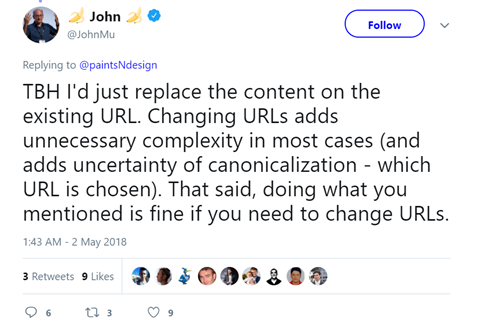
    Image via Twitter

    So, how do businesses determine if the change is needed or not? Read on to know more.

    One unavoidable situation where webmasters will have to change the URL is during a company rebranding where the company takes a new name. Other scenarios include major site redesign or migration, where the existing URLs are no longer available.

    Reasons why it’s recommended to avoid URL changes 

    Apart from an SEO perspective, there are plenty of reasons why webmasters have to maintain the URL structure wherever possible.

    Changing the URLs break down bookmarks that site visitors have saved in their browsers. The critical point to note here is that the URL is the direct relationship between users and the site. Changing it could lead to breaking this relationship.

    Additionally, advertisers would have used URLs in offline marketing materials like pamphlets, visiting cards, all of which must be changed.

    While 301 redirects work to redirect users from an old URL to a similar new URL, they don’t work when the site has undergone complete restructuring. If there is no direct page to send the user to, then the users are likely to get lost.

    With all these said, the number one reason to avoid changing URLs at all costs is that it impacts SEO rankings negatively. All the links earned by the site over the years is lost, and it takes a considerable time for Google to index the new pages and include them in organic search results.

    Links are still one of the top-ranking factors used by Google. Both the quality and quantity of the links play a crucial role in determining the relevancy and trustworthiness of a site. A site redesign could lead to loss of links, thereby decreasing the site’s SEO ranking.

    Ways to Reduce SEO Impacts while Changing URLs

    While it’s not possible to retain the SEO ranking as it is during a change in the URL, some best practices can help in reducing the impacts of the change.

    Webmasters who are changing the URL structure of a site should maintain a current and future sitemap. All existing pages should be redirected to a similar page using 301 permanent redirects. However, webmasters must be cautious while using 301 redirects. Redirecting an old page to a new page that doesn’t have a similar topic may lead Google to reduce the value of the new links.

    Redirecting all pages to a top-level page or homepage is also not the right move, as Google could devalue these links. Devaluation of links means that the site loses a portion of the link profile, which impacts SEO rankings negatively.

    Not just internal links, but external links must be updated to reflect the new site structure. Paid campaigns, off-site advertising, social media advertising have to be changed to include the new links.

    The Key Takeaway

    Changing the URLs of a site leads to loss of site ranking, which causes a drop in traffic. However, webmasters can overcome this loss in rankings by following a strategic site migration plan. What matters here is how long does it take for a business to overcome this temporary setback.

    This depends on the nature and the size of the business. Small businesses that do not have significant traffic influx can recover quickly from changing the URL structure, while bigger businesses may feel the impact for a longer time.

    If a URL change is unavoidable, webmasters have to ensure that they follow a proper migration plan with the right URL re-mappings.

  • Is There Any Difference Between SEM and SEO?

    Yes, of course there is a difference between the two techniques. People often get confused by search engine optimisation (SEO) and search engine marketing (SEM) as, these terms are frequently used interchangeably. In this article, you will find out how each method is different?

    SEM is a form of Internet marketing technique that is employed to promote web sites by increasing their visibility in search engine result pages. On the other hand, SEO is the first step in SEM that allows for broad reaching site promotion. SEM not only includes SEO strategies, but also various other methods to increase the web site’s targeted traffic and exposure. Some other SEM methods consist of: paid inclusion, paid advertising, and pay-per-click.

    SEM refers mainly to the text advertisements that are published at the top or on the right hand side of the search engine results pages. These ad links are purchased mainly from the major search engines like Google and Yahoo.

    SEM also includes any banner ads or ad placement advertising at authority related sites. With SEM, you can have full control over your budget, keywords, and web sites you wish to target.

    As above mentioned SEO is the foremost step in SEM and is aimed to increase a site’s organic and natural ranking in the search engine results pages. Furthermore, SEO involves On-page optimisation and Off-page optimisation.

    On-page optimisation elements are: keyword density, keywords in the content, title tag optimisation, keywords in hyperlinks and URL, meta tags, sitemap, and link structure. And Off-page optimisation elements include: back links, link exchanges, traffic, keywords in the anchor text, and much more.

    Therefore, SEO focuses on increasing the volume as well as quality of the traffic to your web site from the search engines. As the Internet marketing method, SEO considers how the search engines work and what people look for.

    Optimising your web site would involve editing its content and HTML coding to improve its relevance to definite keywords and to remove barriers to the indexing activities of the search engines.

    Thus, both the techniques-SEM and SEO are important to help you promote your web site through better visibility in the search engine results pages.

  • What are Web Crawlers and Spiders in Search Engines?

    To perform search engine optimisation, web crawlers play a pivotal role. A web crawler (also known as a web spider or search engine robot) is a programmed script that browses the World Wide Web in a methodical, automatic manner. This process is called as web crawling or spidering.

    Search engines and many web sites make use of crawling as a means of providing the latest data. Web crawlers are generally used to create a copy of all the visited pages for subsequent processing by the search engine that will index the downloaded pages to facilitate fast searches. To put it simply, the web crawler or web spider is a type of bot, or a software program that visits web sites and reads their pages and other information to create entries for a search engine index.

    When the web spider returns home, the data is indexed by the search engine. All the main search engines, such as Google and Yahoo, use spiders to build and revise their indexes.

    Moreover, the spiders or crawlers are used for automating maintenance tasks on the web site. For example, the crawlers are used to validate HTML code, gather certain types of data from the web sites, and check links on the web page to other sites.
    Furthermore, what the crawler sees on a web site will determine how the site is listed in its index. The search engines find out a web site’s relevancy based on an intricate scoring system, which they try to keep secret