LS Staging

Tag: ROI

  • Weekend Digital Media Round: The dark side of india’s digital gold rush, The future of advertising: integrating creativity and technology, AI is the latest gatekeeper between brands and buyers & More….

    Weekend Digital Media Round: The dark side of india’s digital gold rush, The future of advertising: integrating creativity and technology, AI is the latest gatekeeper between brands and buyers & More….

    1.The dark side of india’s digital gold rush

    India’s rapid digital commerce growth is increasingly tainted by “dark patterns” — deceptive design tactics that trick consumers into overpaying or signing up for unwanted services. Weak regulation and poor data protection allow these practices to flourish across sectors, eroding consumer trust and exposing users to financial and privacy risks. [Source: ET Brand Equity]

    2. The future of advertising: integrating creativity and technology

    Creativity and technology are increasingly converging to shape the future of advertising, with connected TV (CTV) emerging as a key platform. By using data, automation, and personalization, brands can deliver more interactive, tailored experiences that strengthen audience engagement and transform how advertising works. [Source: The Drum]

    3. AI is the latest gatekeeper between brands and buyers

    AI tools like ChatGPT and Google’s AI Overviews are becoming key intermediaries between brands and consumers, shaping purchase decisions with single, synthesized recommendations. Because these systems can portray the same brand very differently, companies are now optimizing content for bots rather than people, flooding the web with promotional material. As AI-driven shopping grows, traditional SEO and advertising rules are rapidly becoming obsolete and unstable. [Source: Seamafor]

    4. From a Tool to a Partner: the Agentic AI Difference

    Generative AI mainly responds to prompts for specific tasks like content creation, while agentic AI can plan, reason, and act autonomously to achieve business goals.  The article explains how agentic AI shifts marketing from manual execution to workflow orchestration, acting like a virtual teammate that manages end‑to‑end processes. This evolution enables faster time‑to‑market, better use of data, and frees humans to focus on strategy and governance. [Source: CMS Wire]

    5. 5 Things I Learned About The Future Of Search From Liz Reid’s Latest Interview

    Search is moving beyond traditional blue links toward AI‑driven answers, agent interactions, and more personalized experiences. Google expects AI agents to handle much of web activity, while Search, Gemini, and AI Mode continue to evolve toward a new blended or entirely new product. Success in this future will depend on truly original content, stronger personalization, and emerging monetization models like micropayments. [Source: Search Engine Journal]

    6. LinkedIn is a leading source for AI answers

    LinkedIn has emerged as one of the most-cited sources in AI chatbot answers, ranking just behind Reddit in a large SEMrush study and climbing rapidly in other reports. The findings highlight LinkedIn’s growing role in AI-driven discovery, making it a critical platform for marketers and brands aiming to appear in AI-generated responses as more users start searches through AI tools. [Source: Social Media Today]

    7. Domain-specific AI models are the future of enterprise ROI

    Enterprises are increasingly realizing that **domain‑specific AI models** deliver far better ROI than large, general‑purpose models because they are trained on proprietary business data and processes. These smaller, focused models understand real operational context, improve accuracy, lower costs, and enable practical personalization, proving that depth and relevance matter more than sheer model size when driving measurable business value. [Source: Tech Radar]

    8. The New SEO: From Rankings To Recommendations In AI Search

    Search is shifting from blue‑link rankings to AI‑driven recommendations, where users ask a question, get an instant answer, and act without visiting multiple websites. As AI summaries reduce clicks, SEO success now depends on being trusted and cited within AI answers—by offering clear, helpful content, consistent brand signals, and strong third‑party credibility—rather than just ranking high in search results. [Source: Forbes]

    9. What is brand experience and why is it so crucial right now?

    Brand experience refers to the way people interact with a brand across every touchpoint, combining visual identity, behaviour, and emotional connection across physical, digital, and human experiences. In an increasingly competitive and connected world, strong brand experiences help businesses stand out, build trust, and create moments that are remembered and shared. [Source: Creative Bloq]

    10. AI is changing how brands sell but not why people buy

    AI is rapidly reshaping how brands market in India, with most already using generative AI to improve clarity, speed, and consistency in customer communication. However, while AI strengthens rational decision-making, human creators remain essential for building emotional trust—making a hybrid model of AI efficiency and human storytelling the future of effective brand building. [Source: ET Brand Equity]
  • Weekend Digital Media Round- It’s Time to Start Viewing Audio as More Essential in Media Mix Models, 40% of gen z discovery happens on social feeds: Report, Why A Social-First Approach Is The Future Of Marketing & More….

    Weekend Digital Media Round- It’s Time to Start Viewing Audio as More Essential in Media Mix Models, 40% of gen z discovery happens on social feeds: Report, Why A Social-First Approach Is The Future Of Marketing & More….

    It’s Time to Start Viewing Audio as More Essential in Media Mix Models

    Digital audio is significantly underrepresented in media budgets despite its massive reach and engagement potential. The industry is now focusing on integrating granular, high-quality audio data into media mix models to prove ROI and position audio as a core channel for full-funnel impact. [Source: Ad Week]

    40% of gen z discovery happens on social feeds: Report

    Gen Z in India is reshaping online shopping by relying heavily on social media for product discovery while preferring traditional e-commerce platforms for secure transactions. Despite 80% of purchases happening on mobile, cart abandonment rates remain high due to unexpected costs, complex checkouts, and delivery delays, making transparency, simplified mobile experiences, and faster logistics critical for reducing drop-offs. [Source:  Social Samosa]

    Why A Social-First Approach Is The Future Of Marketing

    Social-first marketing is becoming the core of brand strategy, not just an add-on. In 2026, expect influencer partnerships to merge with performance marketing, social commerce to dominate with instant purchases, and real-time content to drive trust and engagement. [Source: Forbes]

    From Listening to Action: Elevating CX in the Experience Economy

    Organizations face a growing gap between customer expectations and actual experiences, with 63% of consumers leaving after one or two poor interactions. Forsta’s Human Experience (HX) framework helps close this gap by unifying customer, employee, and brand data to enable fast, empathetic action. Trust has become the key loyalty driver, and brands that act on feedback quickly and transparently can turn dissatisfaction into advocacy and revenue growth. [Source: CMS Wire]

    Breaking clutter digitally: how brands can stand out in crowded festive campaigns

    Festive campaigns in India face intense digital clutter, making relevance and authenticity key differentiators. Brands that blend cultural nuance with modern values, leverage technology for real consumer needs, and balance storytelling with utility stand out in this competitive season. [Source: CMO Tech]

    Not Seeing ROI From Your Branding Efforts? Here’s How to Change That.

    Most small businesses either overspend on branding that doesn’t build real value or underspend in ways that limit growth. The key is to treat branding as a long-term investment, focusing on strategic, high-impact actions that build trust, credibility, and differentiation over time. [Source: Entrepreneur]

    Digital Equity Is Brand Equity: Don’t Lose Search Visibility In a Merger

    Mergers and acquisitions often overlook digital infrastructure, causing severe drops in search visibility and revenue. The article explains the Digital Dilution Effect, where poor SEO and content migration during M\&A erodes brand equity, and offers a recovery playbook emphasizing early audits, visibility preservation plans, and SEO involvement from day one. [Source: Search Engine Journal]

    How AI agents are reshaping enterprise experience and intelligent flow

    AI is driving a shift from optimizing legacy systems to re-engineering enterprises for adaptability and intelligent flow. Businesses that embrace AI agents to unify operations, break silos, and amplify human potential will gain speed, trust, and competitive advantage in an era of constant disruption. [Source: CIO]

    How To Manage Demand Fluctuation During Key Ecommerce Shopping Seasons

    Managing seasonal demand in PPC requires proactive planning and flexibility. Marketers should anticipate spikes using historical data, adjust bids and budgets dynamically, align campaigns with inventory, and maintain cross-team coordination. Post-peak analysis and gradual scaling back are key to sustaining performance and preparing for future cycles. [Source: Search Engine Journal]

    How generative AI is transforming brand storytelling in the Middle East

    Generative AI is rapidly transforming brand storytelling in the Middle East, enabling hyper-personalized content, real-time adaptation, and immersive experiences like virtual tours. While AI boosts creativity and efficiency, brands must maintain authenticity through human oversight and alignment with their unique voice and values. [Source: The Drum]

  • Weekend Digital Media Round-Up The Future Of AI Market Research: Two Powerful Paths Are Emerging, The One-Dial Illusion: Why CX Leaders Keep Crashing on ROI, Evolving The Advertising Landscape: Measuring And Maximizing CLV & More….

    Weekend Digital Media Round-Up The Future Of AI Market Research: Two Powerful Paths Are Emerging, The One-Dial Illusion: Why CX Leaders Keep Crashing on ROI, Evolving The Advertising Landscape: Measuring And Maximizing CLV & More….

    1.The Future Of AI Market Research: Two Powerful Paths Are Emerging

    AI is transforming market research by enabling faster, scalable insights through two key approaches: AI-powered human interviews and synthetic respondents. While synthetic models offer speed and cost-efficiency, human input remains essential for emotional nuance and validation—making a hybrid strategy the most effective path forward. [Source: Forbes]

    2. The One-Dial Illusion: Why CX Leaders Keep Crashing on ROI

    CX leaders often rely too heavily on single metrics like NPS or CSAT, which can mislead strategic decisions. True ROI comes from tracking four key dimensions—growth, efficiency, risk, and trust—over time, using longitudinal data to reveal whether customer experience efforts are compounding value or eroding it. [Source:  CSM Wire]

    3. Evolving The Advertising Landscape: Measuring And Maximizing CLV

    Advertising has evolved from impression-based and click-driven models to AI-powered strategies focused on maximizing customer lifetime value (CLV). By leveraging AI, businesses can better target high-value customers, personalize engagement, and drive long-term profitability through smarter budget allocation and deeper customer relationships. [Source: Forbes]

    4. If You Want Your Brand to Be Discovered, You Have to Harness AI — Here’s How

    AI is transforming how consumers discover brands, shifting from traditional search to direct recommendations via tools like ChatGPT. To stay visible, businesses must invest in Answer Engine Optimization (AEO), secure strategic press coverage, build affiliate programs, and optimize their digital presence for AI platforms. [Source: Entrepreneur]

    5. The synthetic scroll has arrived with Meta’s Vibes and OpenAI’s Sora — marketers are watching nervously

    Meta’s launch of the Vibes feed and OpenAI’s release of the Sora app signal a shift toward AI-generated, hyper-personalized content in social media. While tech experts are intrigued, marketers and creators are expressing concern over the implications for authenticity and control. [Source: DigiDay]

    6. Technology: AI Influencer Trend: The Virtual Gold Rush Defining the New Creator Economy and Brand Blueprint

    AI influencers like Lil Miquela are reshaping the creator economy by offering brands a fully controllable, scandal-free, and scalable alternative to human celebrities. These CGI-driven personas generate millions in revenue, attract luxury partnerships, and appeal to Gen Z through aspirational storytelling and hyper-realistic visuals. [Source: Insight Trends World]

    7. Sora Marks OpenAI’s Leap Into Social Media—and Into a Reality Crisis

    Sora 2 is transforming social media by blending generative AI video creation with interactive features like “cameos,” allowing users to appear in each other’s clips. While it’s gaining popularity rapidly, surpassing TikTok and Instagram on app charts, it’s also raising concerns around copyright, deepfakes, and authenticity. [Source: Observer]

    8. How To Build SEO Strategies Around Real Customer Behavior

    Effective SEO today goes beyond keywords—it’s about understanding real customer behavior, intent, and context. By analyzing how and why people search, marketers can create content that aligns with user needs, improves engagement, and drives conversions. Tools like Google Analytics, heatmaps, and customer service data help uncover these insights and guide strategy. [Source: Search Engine Journal]

    9. Influencer Marketing Is Your CTV Strategy Secret Weapon

    Influencer marketing and Connected TV (CTV) are no longer competing strategies but complementary forces in modern video advertising. By integrating creator-generated content (CGC) with CTV, brands can build trust and scale reach through cohesive storytelling across platforms. [Source: AdWeek]

    10. How to measure and maximize visibility in AI search

    AI visibility is becoming crucial as search shifts from traditional rankings to direct answers from models like ChatGPT and Google AI Overviews. To stay competitive, brands must optimize content for mentions and citations in AI responses, focusing on quality, expertise, and technical accessibility. [Source: Search Engine Land]

  • Weekend Digital Media Round-How brands and retailers are preparing for GEO, ‘the future of SEO’, Voice and Immersive Interfaces: Preparing Your Product for the Future of UX, How To Build A UGC Marketing Machine That Actually Drives Sales & More…

    Weekend Digital Media Round-How brands and retailers are preparing for GEO, ‘the future of SEO’, Voice and Immersive Interfaces: Preparing Your Product for the Future of UX, How To Build A UGC Marketing Machine That Actually Drives Sales & More…

    1.How brands and retailers are preparing for GEO, ‘the future of SEO’

    Generative Engine Optimization (GEO) is gaining traction as brands adapt their content strategies for AI-driven search tools like ChatGPT and Google Gemini. By focusing on structured data, conversational formats, and AI-friendly content, companies aim to stay visible in the evolving search landscape. [Source: Modern Retail]

    2. Voice and Immersive Interfaces: Preparing Your Product for the Future of UX

    Voice and immersive interfaces are rapidly becoming essential in UX, excelling in multitasking, accessibility, and spatial tasks where traditional interfaces fall short. The article urges designers to adopt a voice-first mindset and rethink user interactions to be more natural, intuitive, and inclusive. [Source: UX Magazine]

    3. How To Build A UGC Marketing Machine That Actually Drives Sales

    User-generated content (UGC) is proving to be a powerful alternative to traditional ads, driving higher trust and conversion rates by showcasing real customer experiences. Brands that treat UGC as a strategic system—using data-driven creator selection, tagging, performance tracking, and iteration—are seeing significant improvements in ROI and customer acquisition. [Source: Forbes]

    4. The Acceleration of Voice AI: Where Customer Service Goes From Here

    Voice AI is rapidly transforming customer service, evolving from basic IVR systems to sophisticated, human-like conversational tools powered by generative AI and large language models. With real-time agent assist, hyper-personalization, and automated post-call assessments, it’s boosting efficiency, customer satisfaction, and reducing operational costs—setting the stage for broader adoption across industries. [Source: CMS Wire]

    5. How To Measure Brand Marketing Efforts (And Prove Their ROI)

    Brand marketing plays a crucial role in driving digital visibility and business outcomes, especially in an AI-driven search landscape. The article outlines how to measure brand impact across the funnel—awareness, consideration, conversion, and loyalty—using both qualitative and quantitative metrics to prove ROI and align efforts with business goals. [Source: Search Engine Journal]

    6. Your team’s marketing skills are already obsolete

    Marketing teams must evolve beyond traditional skills to thrive in today’s fast-paced environment. Success now hinges on integrating computational thinking, signal detection, and cultural fluency into adaptive systems that continuously optimize campaigns. The shift demands marketers who can fluidly navigate strategy, data, and audience ecosystems. [Source: Fast Company]

    7. Quantum computing is coming for your data. Here’s how to stay secure

    Quantum computing poses a serious threat to current encryption methods like RSA and ECC, potentially exposing sensitive data through future decryption. To stay secure, enterprises must urgently adopt post-quantum cryptography, monitor quantum key distribution advancements, and create long-term strategies for quantum readiness. [Source: CIO]

    8. From reactive to proactive: How AI protects and amplifies executive brands

    AI is transforming executive online reputation management (ORM) from reactive damage control to proactive brand amplification. By leveraging tools for content creation, SEO, and real-time monitoring, leaders can shape their digital presence strategically and safeguard their credibility before crises emerge. [Source: Search Engine Land]

    9. The Nervous System for AI: Why Every Product Manager and Designer Needs an Agent Runtime Environment

    AI agent projects often fail due to fragmented systems and lack of proper infrastructure. The key to success lies in implementing an AI agent runtime environment a foundational layer that enables memory, orchestration, compliance, and scalability, turning isolated pilots into resilient, ROI-driven solutions. [Source: UX Magazine]

    10. Future-proofing the enterprise: Cultivating 3 essential leadership skills for the agentic AI era

    To thrive in the agentic AI era, leaders must develop three critical skills: becoming Agent Architects who design and oversee AI workflows, Innovation Orchestrators who amplify human creativity alongside AI, and Ethical Stewards who ensure responsible and transparent AI deployment. These capabilities are essential for future-proofing enterprises and maintaining competitive advantage in a rapidly evolving landscape. [Source: CIO]

  • Adapting to Apple’s Privacy Updates: Maximizing Ad ROI in a Restricted Data World

    Adapting to Apple’s Privacy Updates: Maximizing Ad ROI in a Restricted Data World

    The digital advertising landscape has undergone a dramatic transformation, driven by Apple’s privacy updates. What started with iOS 14 has evolved into a comprehensive privacy shield that’s changing how marketers connect with their audiences. These changes aren’t just technical updates—they’re reshaping the entire digital marketing playbook, forcing advertisers to rethink strategies that have been standard practice for years.

    The Privacy Revolution

    Apple’s introduction of App Tracking Transparency (ATT) marked the beginning of this shift. Apps now must obtain explicit permission before tracking user activities across other applications and websites. The once-reliable Identifier for Advertisers (IDFA) has become increasingly scarce as users embrace their right to opt out of tracking, leaving marketers with significantly less data to work with.

    Subsequent iOS updates have further strengthened privacy protections. Mail Privacy Protection prevents senders from knowing when emails are opened, while Link Tracking Protection removes tracking parameters from URLs. These changes have effectively dismantled many traditional marketing measurement tools, requiring a fundamental shift in how advertisers approach campaign tracking and optimization.

    Impact on Marketing Strategies

    The effects of these privacy updates have been immediate and significant. Marketers now face reduced access to user behaviour data, making it harder to create targeted campaigns that previously relied on detailed user profiles and cross-app tracking. Attribution has become more challenging, as tracking user journeys across platforms is no longer straightforward. This has led to increased acquisition costs and limitations on personalization capabilities.

    The challenges extend beyond just targeting and measurement. Many advertisers have seen their cost per acquisition rise as they struggle to reach their intended audiences with the same precision. Personalization, once a cornerstone of digital marketing, has become more difficult without detailed behavioral data. This has forced marketers to find new ways to create relevant content and experiences for their audiences.

    Adapting to the New Reality

    First-party data has become invaluable in this privacy-centric landscape. Smart businesses are building direct relationships with customers through loyalty programs and enhanced user experiences. They’re creating compelling reasons for users to share their information voluntarily, rather than relying on passive tracking. This shift towards direct relationships often results in higher-quality data and stronger customer connections.

    Contextual advertising is experiencing a renaissance. Instead of tracking users across the internet, marketers are focusing on placing ads in relevant content environments. This approach respects user privacy while maintaining advertising effectiveness. By understanding the context in which their ads appear, brands can still reach interested audiences without needing individual user data.

    Attribution models are evolving to meet these new challenges. Multi-touch attribution helps understand the value of different marketing touchpoints, while marketing mix modelling provides broader insights into campaign performance without requiring individual user tracking. These methods help marketers understand the impact of their efforts while respecting privacy boundaries.

    Innovative Approaches to Customer Engagement

    Successful marketers are finding creative ways to enhance customer engagement within privacy constraints. This includes:

    – Developing stronger email marketing programs that focus on engagement rather than just open rates

    – Creating valuable content that encourages voluntary user interaction

    – Building community-driven marketing initiatives that foster organic engagement

    – Implementing sophisticated testing strategies to optimize campaigns without relying on personal data

    The Technology Response

    New privacy-preserving technologies are emerging to bridge the gap between privacy and performance. Apple’s Private Click Measurement allows advertisers to measure ad effectiveness without compromising user privacy. SKAdNetwork provides aggregated conversion data, offering valuable insights while maintaining user anonymity.

    These technological solutions, while not as detailed as previous tracking methods, provide a framework for measuring success in a privacy-conscious way. Marketers are learning to work with aggregated data and probabilistic attribution models, finding new ways to demonstrate ROI and optimize campaigns.

    Building Trust in the Privacy Era

    The shift toward privacy-first advertising has an unexpected benefit: it’s helping rebuild trust between brands and consumers. By respecting user privacy and being transparent about data collection, companies can strengthen their relationships with customers. This trust becomes a valuable asset, making customers more likely to share information directly and engage with the brand.

    The Road Ahead

    The future of digital advertising lies in finding the balance between effective marketing and privacy protection. Success requires adapting to these changes proactively rather than viewing them as obstacles. Marketers who embrace this shift and focus on building authentic connections with their audience will thrive in this new environment.

    By emphasizing quality content, contextual relevance, and transparent data practices, brands can maintain strong relationships with their customers. While the tools and methods may have changed, the fundamental goal remains the same: connecting the right message with the right audience at the right time.

    The privacy-first digital world demands a new approach to marketing, but it also offers opportunities for innovation and improved customer trust. Those who adapt quickly and thoughtfully will find success in this new landscape, while those who cling to old methods risk falling behind.

    As we move forward, the most successful marketers will be those who can balance privacy requirements with effective advertising strategies. This means continuing to innovate, test new approaches, and most importantly, maintain a strong focus on creating value for customers while respecting their privacy preferences.

  • Revolutionizing Digital Marketing: DigiVerse’s Game-Changing Solution

    Revolutionizing Digital Marketing: DigiVerse’s Game-Changing Solution

    In today’s business world organisations from all sectors are going through a transition from offline to online. Pushing the horizontals like digital brand experience and marketing to take a centre stage. Thereby the digital tools and platforms which are needed by an organisation to manage these scaled up operations are available in abundance. But the real question is that are these tools or platforms are serving the right purpose or are there still major gaps in the data and management?

    Digital Marketing teams are bombarded with challenges like data inaccuracy, co-ordination and reporting while brand managers, CMOs, CEOs, CXOs and various brand heads faces lack of timely data for decision making. These problems arise due to multi partner conflicts with the organisation for data collation from different channels and platforms.

    On interacting with more than 50 C-suite professionals; LS Digital team was able to highlight the below problems:


    1. Lack of a business single view dashboard (ROI, COAs, NRs, Media Plans etc:

    This data takes time to collate which leads in revenue and time loss as the cost and revenue centres
    for most brands work in silos.

    2. No Media plan repository

    Brands does not have a repository of media plans so that they can use it actively for budget
    allocation strategies. This leads to lack of historic data for data driven media mix modelling and other
    AI ML use cases.

    3. Lack of task management view:

    There is no task view system do that they work collaboratively with multiple partners leading to
    bottlenecks and unexplained delays in campaign execution.

    Brands and organisation struggle with these problems on a day-to-day basis which leads to revenue
    loss, time loss. Ineffective business and incurring cost. At the end of the day the brand managers are
    left with a pile of excel files which again requires collation to give it to upper management.

    So, what is the solution to this? Are these problems ever get resolved by the companies? To answer
    these questions LS Digital presents a tool for the digital marketeers built by digital marketeers.

    Digiverse tool which is fully cloud based and extremely easy to use and is flexible to handle any
    organisation structure. While figuring out how to make it most useful for the large organisations, we
    have integrated superb features like:

    • End to End user journey tracking with Backend data triangulation
    • Advanced data analytics to track and optimize campaigns.
    • A centralized platform to manage all digital marketing efforts.
    • Real-time performance tracking and reporting
    • Integration and report automations with popular marketing and analytics tools
    • Invoice management system.

    The astonishing fact is Digiverse saves 1014 hours per year per employee of a brand. This is with the help of data visualization and process optimization features which helps the businesses make informed decisions and improve returns on their Digital Marketing. “DigiVerse is designed with an experience of serving over 500 clients in different verticals for the sole purpose of making digital marketing operations management more efficient and effective for businesses of all sizes,” said Vinay Tamboli. The tool is user-friendly and offers a range of features that will help businesses achieve their marketing goals and increase ROI.

  • Measure your conversions and track the ads on Facebook

    Measure your conversions and track the ads on Facebook

    Do you regularly advertise on Facebook? But are your ads getting you the value? Or do you properly track and measure your return on investment on these ads? It is essential that you meet the objective you are setting on Facebook to understand the value. Let’s dive in the pool of Facebook conversion and pixels that keep tracking your ads.

    measure-conversions-on-facebook


    What is Facebook ROI?

    You must have often heard that you cannot measure return on investment on Facebook. You can measure all the efforts you put in for Facebook advertising, especially the one that drives an action and assigns a value to it. This is done through the following parameters:

    • Conversion Tracking
    • Offsite parameters

    What is known as Conversion Tracking?

    With this Facebook allows tracking all the conversions that have happened on your FB ad.

    For example: If you ran an ad and your conversions went up 40%. But do have proof to show that these conversions were because of your ads you did on Facebook? Or could it be something that would have driven it?

    This is where conversion tracking comes into the picture. With this, you are aware along with Facebook that users visited your site from the Facebook ad. With Facebook’s pixel you also get to know that your ad was performed.

    What is a Pixel Code?

    As the name suggests, it is a code provided by Facebook to track the ad objectives and parameters. This code is placed on the desired page, to understand that users have visited the page through Facebook.

    For example- You are running a Facebook ad to sell black dresses, when a user clicks on your ad, Facebook records an ad click. The users is taken to the assigned landing page after the user has shown interest and clicked on the ad. Facebook can follow the person anywhere to a different page using the snippet of the code.

    If the Facebook pixel is placed on the web page of the black dress and if the user visits that page through the Facebook ad, then the ad is termed to be successful. The Facebook pixel can also be placed on pages that the advertiser keen to convert. It can be the information page, basket page, contact us page, payment gateway or any other page.

    Different types of Conversions and Optimized CPM

    The most amazing part about this conversion tracking is that Facebook utilizes Optimized CPM to regulate who your ad reaches out to.

    This CPM will allow all advertisers to arrange all marketing goals regarding priority and then delivers all these ads against the goals in the most efficient way. Allows the users to maximize the budget value.

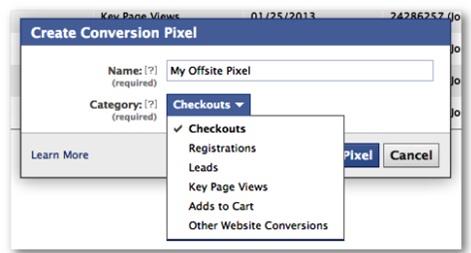
    Following are the different types of conversions:

    • Checkouts
    • Leads
    • Registrations
    • Page views
    • Add to cart
    • Other website conversions/visits


    Conversion Tracking

    Facebook users perform the above-desired actions through ads that use the conversion tracking. This targets ads to consumers who are most likely to convert to sales.


  • Managing Pay per Click Advertising

    Pay per Click is a lucrative marketing strategy which can be you business booster if properly managed. There are certain factors important to run a successful and profitable pay per click campaign.

    The primary aim of a pay per click campaign is to attract potential users to the concerned website through the search engine. Thus the most essential factor in a pay per click campaign is the selection of search engines. Unpopular engines will bring unwanted visitors, adding to your cost incurred and keeping ROI negligible.  Search engines like Google, Yahoo, and MSN are the most popular ones used for PPC campaigns.

    The next essential factor affecting pay per click campaigns is the selection of keywords. In pay per clicks it is the keywords that are the core of the campaign. The most popular keywords find the highest position in the search engine ranking pages increasing the ad popularity amidst high rate of conversion.

    Continuous campaign monitoring and proper bidding management also help in the marketing motto. Turning a pay per click campaign profitable needs carefully vigilance and calculated strategy.

  • Pay Per Click – Measurable ROI

    In Pay-Per-Click type of Internet marketing the advertisers pays an amount every time their ad is clicked by a prospective customer. This is also known as the click-through rate (CTR); both of these are integral part of web optimization.

    Pay per click marketing is lucrative and measurable in terms of return of investment ROI. There are various methods of quantifying the ROI in PPC marketing. One important tool is tracking user actions like buying product, requesting a brochure/newsletter or even more information. This explains the users who have only viewed a page and those who have actually turned into clients. This also helps in calculating the number of sales against spending.

    There are no strict rules in pay per click advertising or marketing and with extensive online tools available to optimize Internet marketing, measuring the returns is a simple process. The true measure of a business profit is the piling order request transforming to orders and subsequently getting the aimed revenue.