LS Staging

Tag: remarketing

  • The Role of Customer Call Data in Bridging the Existing Data Gap in Remarketing

    The Role of Customer Call Data in Bridging the Existing Data Gap in Remarketing

    Remarketing has significantly evolved over a period of years. However, with individual browsers blocking cookies, significant traffic coming in from mobiles, and new regulations, remarketing can become intrusive for your customers. The key is to do it the right way. Relying on cookies alone for remarketing does not give the best results. Did you know your customer call data can be a gold mine in bridging the data gap?

    Let’s take a look at how marketers can enhance the remarketing journey by tracking data from customer calls.

    Why Call Tracking Data plays a Crucial Role in Remarketing?

    Businesses that generate valuable sales inquiries via inbound phone calls can use this data to enhance the remarketing experience.

    To give an example, let’s say a potential customer visits your website, clicks on a product page, and leaves without completing the purchase. The customer then completes the sale by calling your customer care team. Retargeting this customer for a product they have already purchased not only reduces the efficiency of remarketing but also is a waste of marketing budget.

    As you can see, marketers are left with a massive data gap – if they rely on data only from cookies. According to market studies, over 56% of marketers do not have any idea of customer conversions that happen via inbound customer calls.

    According to Dan Miller, the founder and lead analyst at Opus Research, insights gathered via customer conversations very often do not reach the marketing team. As a result, a large number of companies are missing out on critical opportunities to create a more relevant and consistent customer experience across various digital and human touchpoints.

    Call-Tracking and Conversational Analytics Platform bridges the Data Gap for Remarketing

    When existing and potential customers call the customer service team, they are providing your business with a veritable mine of first-party data. You can use this data to classify customers into meaningful datasets. A call tracking and conversational analytics program is fully-automated software that helps marketers gather crucial information from customer calls.

    It helps businesses:

    • Classify customer calls into intelligent subsets like service calls, sales calls, feedback calls, complaint calls, etc.
    • Automatically determine the outcome of inbound customer phone calls
    • Collect data about the customer’s digital journey like keywords, UTM parameters like utm_source, utm_medium, utm_campaign, etc. GCLID parameters and more
    • Transfer data gathered from calls to your remarketing campaign database in real-time

    A call-tracking platform helps in enhancing the efficiency of a remarketing campaign without spending endless hours tracking data manually. The data collected by the platform can be fed automatically to the ad network in real-time, to make ads more relevant.

    Additionally, it helps in predicting the nature of a customer call accurately. Using this information, marketers can decide on the best course of action – whether retargeting ads to customers who didn’t complete the purchase or upselling to customers who have already converted. Marketers can also use call data to feed Google’s automated bidding algorithms to adjust PPC ad bids according to the customer journey, tracked via phone calls.

    So, what’s the Key Takeaway for Marketers?

    By investing in a call tracking and conversational analytics platform, marketers can take away the guesswork from remarketing. Using customer call data, remarketing can be made more relevant, more targeted, and more efficient.
  • A Paradigm Shift in the Ad Industry: From Cookie-Based Remarketing to People-Based Targeting

    A Paradigm Shift in the Ad Industry: From Cookie-Based Remarketing to People-Based Targeting

    Just a few years ago, cookie-based remarketing was the biggest trend among marketers. It helped advertisers and marketers retarget customers effectively and helped to close the deal.

    However, the biggest problem with cookie-based ads is that they are getting increasingly irrelevant and ineffective, thanks to the popularity of mobile apps, and other walled networks like Facebook, Google, and Amazon.

    Studies report that over 66% of mobile devices that are in use don’t accept cookies. That presents a significant loss in traffic volumes. Additionally, today users access the internet across devices – smartphones, desktops, laptops, tablets and more. Apart from devices, they are also using different browsers (Firefox, Chrome, Safari, and others) for each device, making cookie-based ad targeting irrelevant.

    So, what does this mean for marketers?

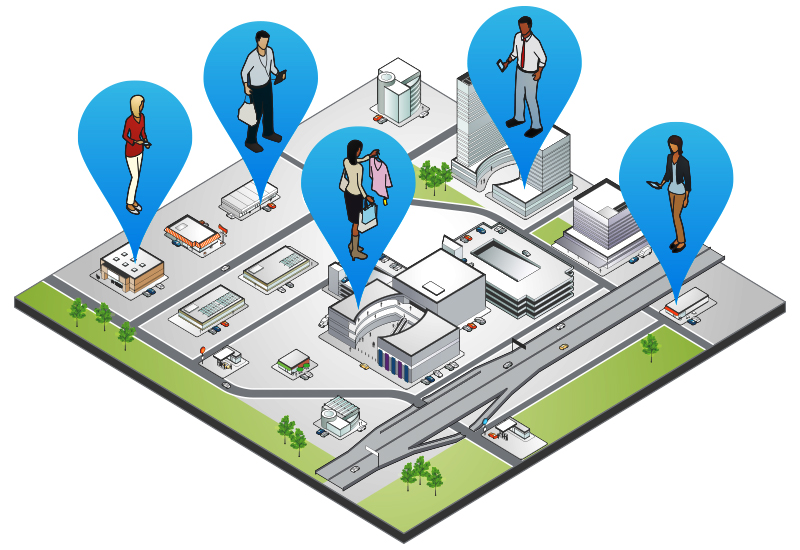
    Cookie-based advertising is fading fast. This is where people-based targeting comes into the picture. As the name implies, people-based targeting helps you track an individual across devices, browsers, and apps.

    Here, let’s show you two significant initiatives that are currently being deployed for people-based targeting: the IAB Tech Lab’s DigiTrust and the Advertising ID Consortium.

    Though both these methods are different, they have a similar goal – avoid relying on cookies, and ultimately improve the speed and relevancy of ads.

    The Advertising ID Consortium: What it is and what does it do?

    The Advertising ID Consortium came into existence in 2017 and was initially founded by AppNexus, MediaMath, and LiveRamp. Initially, the project aimed to avoid the hassles of cookie syncing. However, now the mission of the project has extended to include the creation of a “people-based” identity that works across devices.

    LiveRamp is an identity resolution provider that has created a solution known as IdentityLink. This connects large datasets that contain information about millions of users to create an anonymous profile, based on a person’s interactions in the online and offline world.

    Right now, the Consortium focuses on just a few cookies, and the identifiers in these cookies are available to the exchange partners of the consortium. Participating companies can connect the identifiers and track a user across channels.

    DigiTrust from the IAB TechLab: What it is and what does it do?

    DigiTrust is a non-profit ad platform that is a part of the IAB (Interactive Advertising Bureau) TechLab. While it participates with the Consortium, it uses its own ecosystem.

    It issues a cookie that can be read by participating organizations using the DigiTrust API. Additionally, this cookie can be issued by websites, thereby allowing the cookie to be considered as first-party. The DigiTrust cookie contains an identifier for the user, along with the user’s preferences and consent.

    DigiTrust states that it is 100% accurate in identifying a particular user. This rate is much higher than what is possible with cookie matching.

    Audience Reach

    Currently, nearly 50 platforms are participating in the DigiTrust initiative. On the other hand, the coverage of the Consortium is limited to a dozen ad platforms, right now.

    What does this mean for the future of ad retargeting?

    According to studies by Forbes and Forrester Research, people-based marketing is the future of digital ads. Instead, of targeting specific devices, the focus will be on targeting people across devices, browsers, and platforms. With the move away from cookie-based remarketing, marketers will be able to reach a person across platforms and devices.

  • What is GDN and different types of targeting?

    With the world going Digital, marketers are shifting their advertising edges towards the internet. Google helps advertisers to place their ads on various websites and channels that deem fit and appropriate for the brand. The Google Display Network consists of a series of websites that partner with them to display ads on their websites and web pages. Since target audience for marketers spends a lot of time on the internet, it is important to target the relevant target audience. This is an important way to reach out to a broader set of people.

    It uses the same AdWords dashboard like search advertising, but there are a few differences for optimising the campaign. The difference between SEO and GDN is as follows:

    • SEO targets users who are actively looking and want to purchase the product.
    • The targeting is more funnelled and very specific.
    • GDN involves content consumption that the target audience is interested in.
    • However, it isn’t targeted to people who are looking for the product but show ads on content areas that make them purchase a particular product.

    remarketing

    There are different types of targeting for GDN:

    Contextual targeting

    With this type of targeting, ads are shown to users on sites are directly related to the keywords and information is distributed to users by the type of content. Your ads with this type of targeting will be connected to the users once they are engaged in relevant content areas.

    With this kind of targeting, you can look out for users who are very much interested in what you want to sell. You can proceed with keyword level and use a bidding system to find your customers. You can customise it the way you want to by remarketing, controlling systems, frequency control and capping.

    Placement Targeting

    As the name suggests, it places your ads on websites and web pages. It also shows your ads on videos, mobile sites, and RSS feeds. With this kind of targeting, you can choose a particular page that caters to the content related to your brand. For example, if you sell sarees then your ad will be shown on a page that shows content about tips to wear a saree.

    Remarketing

    With this type of targeting, you can show your ad to people/users who have already seen or visited your website on GDN.

    Interest Targeting

    As the name suggests, it targets websites that the user is interested in. For example, if the user of your brand is interested in pop music then your ad will be shown on websites that have content about pop culture.

    Topic Targeting

    This type of targeting is similar to interest targeting, but it concentrates on websites than users. If your brand is a sportswear, then the ad will be shown on sports websites or topics related to sports. You can do holistic targeting with this rather than individual targeting.

    Geographic & Language Targeting

    You can target users by their locations and the language they speak.

    Demographic Targeting

    You can target users on the basis of their age and gender.

    LogicSpeak : There are many targeting options available. Remarketing is one of the most effective types of targeting that you should consider for your campaigns.

    Looking for more information? Feel free to write to us at sales@logicserve.com