LS Staging

Tag: Pay Per Click

  • How to tackle programmatic ad fraud?

    How to tackle programmatic ad fraud?

    Marketers are increasingly relying on programmatic ads to push targeted marketing messages to an intended audience. These are proven to generate better results with better precision. However, its increasing popularity also means that the industry is now grappling with the massive losses that have arisen due to manipulation of the marketing metrics to track the efficacy of the ad campaigns. This is exactly what programmatic ad fraud denotes.

    As per a Pixelate study, over one-third (35%) of programmatically driven ad impressions in the United States in first quarter 2017 were fraud. This shows how acute the problem has become, and not just in the US but across the globe.

    What can be done?

    Instead of being a mute spectator to ad frauds, smart marketers can ramp up their anti-fraud initiatives with these counter measures:

    1. Choose your success metrics better

    Basic metrics like CTR are very easy to track and analyse. Also, they are very easy to manipulate negatively. This issue is prevalent across devices like laptops, connected TVs, smartphones, and tablets. Instead, you need to rely on other metrics that are less prone to frauds. Some of these include:

    – Site navigation

    – Time spent on the site

    – Sign up rate for a particular product or service

    These measures show the level of engagement with the customers. And digital advertisers can be assured that it is not a bot that your site is interacting with.

    2. Single out the main culprits

    In today’s age, the advertiser relies on third-party paid sites to grow the user base, fulfil advertising minimums, and drive more impressions. You need to conduct routine checks on your vendors to ensure that the quality is as per what is stated in their report. These controls are crucial in eliminating frauds and cleaning up your campaign in an effective manner. One way to ensure that you are dealing with good quality vendors is to check if they are accredited by Media Rating Council.

    3. Maintain, share, and assess from a blacklist    

    Marketers today have the opportunity to know if the impressions they are tracking for programmatic ads are blacklisted or no. The underlying principle is that only a handful of sites deliver a majority of the fraudulent ad traffic.

    See anything problematic with the URL www.huffigntonpost.com? If not, have a closer look as it is designed by fraudsters such that it is tough to unravel the fraud (the spelling is incorrect in the above URL). The good news is that today’s fraud tracking programs and tools analyse user behaviour to uncover fraudsters. So, while they may continue evolving their fraud strategies, they may leave behind a fingerprint. When you flag these, the blacklist will block these sites and thus provide you with a much cleaner inventory list to purchase.

    With these steps, concrete actions can be taken to ensure that the occurrences of ad fraud and losses come down significantly. Do let us know if any other measure forms a part of your anti-fraud arsenal? We would love to hear from you.

  • How to utilise lookalike modeling to improve your marketing potential?

    How to utilise lookalike modeling to improve your marketing potential?

    “We tend to be in groups that closely resemble our own persona. We tend to buy or subscribe to the same things as done by our lookalikes.” This is the underlying philosophy of lookalike modeling adopted by ad agencies and marketers around the globe. With this approach, they seek to identify new prospects who closely match the existing customers’ persona, with the belief that they will convert better than others.

    What is driving this new trend?

    Marketers are today utilising lookalike modeling to significantly expand the range and depth of ways (both online and offline) used to target potential customers and identify the ones most likely to convert. The huge amount of data available at different points of the customer journey (from cookies to customer data platforms like CRMs) plus the growing penetration of big data analytics, means one clear thing – lookalike modeling is definitely giving an edge to marketers adopting the technique for ramping up their marketing campaigns for better gains.

    What can be tracked?

    Numerous data points can be tracked to see if a new prospect matches the existing users or customers. The most basic one is demographic based targeting. However, as the sample increases (for example men aged 18-35) the relevance of a niche sample keeps decreasing. With lookalike modeling, this limitation can be removed efficiently. The technique employs statistical and analytical methods to assess the characteristics, online browsing signals, and features of a ‘seed set’ that forms the basis for determining the perfect lookalike target groups.

    Why is it important?

    The biggest advantage of lookalike modeling is its ability to merge the offline-online data signals to provide a seamless picture of the perfect segment of likely customers worth targeting. It brings together diverse purchase signals like on-site actions, engagement through email campaigns, in-app usage, call center contacts, and e-commerce product reviews. This has a better chance of providing a more accurate picture of lookalikes that match your most influential or high-value customers.

    How can it be accomplished?

    Some basic ways in which lookalike modeling is utilised include the below –

    1. Social Media – You have the option to build your likely customer list from a seed list on the social media platform. An example is the Facebook Lookalike Audiences, which helps marketers to create a list based on which page they visited. Based on the target pointers they are assessing, they can determine how broad or how niche they want the targeting to be
    2. Search Engines – Similar Audiences through Google Match too helps optimise bidding tactics around high-potential prospects that are very likely interested in the products
    3. Direct mail – Specialized list providers now collect a vast repository of data around a particular mail ID. This helps them to provide similar matches to a particular profile and provide marketers with a chance to reach out to these lookalikes for better conversion possibilities

    To wrap up

    It will be a smart move to check out this technique to ensure that new customers are on-boarded quicker owing to their lookalike persona that matches existing or high-value customers.

  • Top 3 Strategies for Paid Ads you should implement for the upcoming Holiday Season

    Top 3 Strategies for Paid Ads you should implement for the upcoming Holiday Season

    The last few years have seen a humongous traction in holiday shopping on e-commerce sites. Talk about Cyber Monday, and e-retailers point to a peak summit in reporting GMV and revenues. Americans spent an average of $935.58 during 2016 holiday shopping season. No wonder that 20% of the retail industry’s annual sales happen on 22nd, 23rd & 24th December.

    This also means that the level of competition for visibility in this will be unbelievably cut-throat. If you are an e-retailer, you need to employ more than one paid marketing strategy to gain shopper attention in a crowded supply space. Here are the top 3 strategies that we have compiled for you to target holiday shopping better:

    1. Google Product Listing Ads

    Google PLAs are undoubtedly the biggest revenue generators for holiday e-commerce. You need to check for enablers like long-tail keyword optimization, and crafting compelling product description with detailed product attributes. This way your product should show up irrespective of whether the searcher types in “white running shoes” “size 13 shoes” or “Men’s Adidas Size 13 Running Shoes Adi Pacer 1.0 Low Shoes.”

    2. Amazon Search 

    The Return on Ad Spend (ROAS) has been one of the highest through Amazon, and there is no reason why you should not try out this online channel. Amazon PPC is an excellent way to get listed especially considering that shoppers use it as a search engine within site to discover newer and more products. Imagine if your Amazon PPC lands your products on top of the listing? That is the power of Amazon search. Use it judiciously after factoring in drivers like how much margin you can put on advertising, and how the paid traffic converts to sales.

    3. Retargeting 

    When you focus on paid ads, make sure to target customers that were almost about to make a sale, but didn’t convert at the last minute. With retargeting you get reduced cost per impression, better ROI, higher conversion rates, and laser- sharp targeting (because they had taken the efforts to come to the e-commerce site to buy products earlier).

    The road leading to holiday e-commerce will be successful only if you start today. Hurry up and utilize these tactics to a great 2017 holiday shopping season.

  • Weekend Digital Media Round-up: Google testing new lightweight version of search for slow speed networks, AdWords Universal App Campaigns take over, Facebook’s selling in-stream-only video ads and more..

    Weekend Digital Media Round-up: Google testing new lightweight version of search for slow speed networks, AdWords Universal App Campaigns take over, Facebook’s selling in-stream-only video ads and more..

    1. Google is testing a new lightweight search app for slow internet networks

    Google is testing a new lightweight version of their search app in Indonesia and maybe India, to see how they can speed up their search services in locations where internet speeds are on the slower side. [Source: Search Engine Land]

    1. Facebook Adds New Branded Content Tools to Better Facilitate Influencer Marketing

    With influencer marketing on the rise, Facebook’s adding some new tools to make it easier for businesses to get the most out of their influencer collaboration efforts – while also providing transparency in the process. [Source: Social Media Today]

    1. Facebook will penalize fake videos in latest news feed algorithm update

    Facebook’s news feed algorithm will start penalizing photo posts that mimic video thumbnails — play button and all — as well as video posts that solely feature a static image. [Source: Marketing Land]

    1. AdWords app-install campaigns to sunset as Universal App Campaigns take over

    The company is moving all app-install ads under the umbrella of UAC. Google said that as of October 16, all app-install campaigns will run as UAC ads. All current app-install campaigns will stop running on November 15; so developers and publishers need to convert their campaigns accordingly. [Source: Search Engine Land]

    1. Report: ‘Asset tracking’ now a primary use case for indoor location and beacons

    Proximity and beacon data platform Unacast has released its Q2 Proximity.Directory report. The report goes beyond marketing use cases to look at how proximity sensors are being deployed for “asset tracking” (people and places) across industries such as healthcare, logistics, manufacturing and others (marijuana is one of the featured categories). [Source: MARTECH TODAY]

    1. Facebook Updates News Feed Layout to Improve On-Platform Engagement

    Facebook has announced an update to their News Feed layout which will help cater to common user concerns and make the Facebook process easier and more clear-cut. [Source: Social Media Today]

    1. Dynamic Search Ads pilot in Bing Ads now open to all US advertisers

    Bing Ads’ testing of Dynamic Search Ads (DSA) is expanding to and now available to US advertisers. [Source: Search Engine Land]

    1. Pinterest Adds Pinch to Zoom, Updated Visual Search

    As Pinterest works to evolve its visual search options, they’re also looking to put more emphasis on their search tools and functions, in line with user demand. Their latest advances on this front see them introducing pinch to zoom, already a common function on many other sites, and moving the visual search button to make it more prominent. [Source: Social Media Today]

    1. Facebook offers in-stream-only video ad buys as it looks to rival YouTube, TV

    Facebook has started selling video ads that will only appear in videos that people watch on its social network or across its ad network of third-party sites and apps. In other words, video-hungry advertisers can finally buy video ads from Facebook that will only run in the same context as the ads they buy from YouTube, Hulu and TV networks — in-stream video ads that people will be more likely to watch, and watch with the sound on. [Source: Marketing Land]

    1. Google Questions and Answers for local businesses now available For Android

    Google has launched a new feature for businesses within Google Maps to answer commonly asked questions from prospects and customers directly over their Android devices. [Source: Search Engine Land]

    Expert Opinion:

    1. How will brands benefit from micro-influencers?

    Influencer marketing is one of the widely used marketing strategies by brands worldwide. However, rather than using celebrities and influential personalities, a lot of brands are shifting the focus towards micro-influencers. At Videocon, we have had a lot of success in boosting sales with micro-influencers.

    Micro-influencers, who are local people with smaller but relevant and loyal set of audience, prove to be a better medium to reach the correct set of target audience while achieving better results for brands. Also, since micro-influencers have a more valued and trusted set of followers, the brands can achieve long-term results. Studies suggest that 94% of consumers consider micro-influencers highly knowledgeable and 82% consumers follow a micro-influencer’s recommendation.

    Contrary to the higher costs involved for campaigns with celebrities and influential personalities, micro-influencers also lower the overall costs of the marketing campaigns and provide the flexibility to engage with multiple influencers for a single campaign. It is observed that the users with 1000-4000 followers showcase 4.5% engagement while the ones with more followers showcase lesser engagement.

    With so many benefits and better engagement, micro-influencers should be an important part of your digital marketing strategy.

    Shikher Gupta, Head – Brand and Digital Marketing, Videocon.

  • 3 Ways You Can Achieve Better Results By Leveraging AI

    3 Ways You Can Achieve Better Results By Leveraging AI

    With Artificial Intelligence emerging as the need of the hour for every organisation, enterprise owners need to tap into the right sources for leveraging this innovative technology! If you own a venture and want it to be driven by AI, it’s imperative to embrace analytics and personalise experiences. Let’s find out how data and analytics can help you make the most of Artificial Intelligence!

    The role of data

    Irrespective of the sector you are operating in, Big data happens to be a force to reckon with. From e-commerce owners to service industry professionals, every business entity is relying on Big Data and data analytics. Marketers have huge amounts of data at their disposal. They can tap into these data sources and leverage them to gain crucial insights into consumer behaviour.

    The crucial ways

    If you want to incorporate AI and gain actionable insights, it is imperative to do it in the right way. Here’s how data analytics can help you win the game!

    1. Think real, think customers

    You have to study consumer behaviour and understand what they want. That’s the key to gaining information about their preferences and choices. Develop a crystal clear picture of your consumers’ behavioural patterns. It is crucial to get a real and authentic idea, and not just rely on data points.

    1. Predictive analytics

    If descriptive analytics was the first step, effective predictions would turn out to be the next significant move. Try delving deep into historical data as that will help you in this context. You can develop some ideas about consumers who opt for discounted products, as well as the group of consumers who won’t. It will be helpful in determining product prices and marketing strategies.

    1. Prescriptive analysis and decision-making

    It’s not just enough to analyse. You have to take positive decisions. That’s what prescriptive analysis is all about. With 10% of enterprises embracing this technology, it’s time to adopt it and make smart decisions.

    Final thoughts

    Now, you know how data analytics can help you leverage AI to get the best results. Product developers and venture owners can rely on data sets thus creating personalised experiences for the target audience. That’s the power of data analytics and its role in implementing AI strategies.

  • Understanding the Customers’ Device Graphs is the key for Targeted Marketing

    Understanding the Customers’ Device Graphs is the key for Targeted Marketing

    In the purview of the growing usage of the different mobile devices among the consumers globally, cross-device identity matching has gained a huge significance among the marketers. The modern day marketers are taking the device graph serious since it provides them a solid foundation for profiling the different users based on their mobile device usage for different purposes. Today, it is nearly impossible for a business owner to get a complete picture of their existing or potential customer unless and until they track their daily activities across all devices.

    There are two major players specializing in the Device Graph, vis-à-vis Tapad and Drawbridge. There are also other companies like Criteo, which specializes in retargeting that develops Device Graphs as essential marketing tools. The big cloud companies like Adobe, Salesforce and Adobe have either developed their own tools or they have a partnership deal with vendors who develop device graphics as an integral part of their platforms.

    Mike Murphy, the Senior Marketing Manager at Drawbridge suggests that all the Device Graphs are built on a single fundamental idea, however, each developer has a different formula in terms of providing weightage to a certain attribute. Typically, there are to major techniques, which are probabilistic and deterministic and most Device Graphs use both techniques in some way or the other.

    The Deterministic technique are considered to be a gold standard since they  provide definitive results on which device the customer uses the most. This data is usually collected through the logins of the users. For instance, if the customer regularly uses his smart phone or the tablet device to log onto a particular website or portal, the brands can easily conclude that the user is most associated with that particular device. The Probabilistic technique on the other hand user the most common probable data points such as the time of the day when the device is used the most by the customer, the physical location of the device, which is derived by the IP address and the browsing patterns of the user. Murphy stated that Drawbridge has the potential to identify the device usage of an individual even if the same device is shared by other members in a household for different purposes.

    In the video below, Tapad shows the Device Graph process which are largely derived using the probabilistic technique:

    https://youtu.be/M-0P-_lFVq0

    More often than not, Device Graphs are made using both deterministic and probabilistic techniques. For example, the user’s multiple device usage can be determined with a high degree of accuracy only if one the devices was used to log into the brand’s site. That one particular device, which is used by the customer becomes the definitive association and the other devices, which are placed at the same location may be used for visiting the same website on a daily basis. This and other attributes of the device usage pattern can give the Graph-maker sufficient data to conclude that the devices belong to the same users even though he/she has used only one device to login.

    Whilst it is known that the deterministic-based approach yields more accurate results, there are many vendors who claim that the probabilistic approach has provided results that are 80 to 90% accurate. Retargeter Criteo has claimed that it considers Device Graphs to be a vital tool for its businesses and it has built the largest global scale mapping of email addresses to Cookies.

    Murphy considers the usage of Device Graphs will continue to rise in the near future and it will continue to use a combination of both deterministic and probabilistic techniques. However, one of the possible exceptions would be the usage of biometric identification for logging into the aps or the website.

  • Will Google’s Natural Language and Machine Learning Democratize Analytics?

    Will Google’s Natural Language and Machine Learning Democratize Analytics?

    Last week, the world’s leading search engine, Google announced that it would integrate the voice-activated assistance feature in the Google Analytics in its mobile app. This comes as a great news for the users as they would now be able to ask queries in the tool using the natural language; this would make the previous structured query system outdated.

    The users can access the feature by clicking on the ‘ask a question’ section, which would soon be integrated into GA. However, Google announced that the ‘ask a question’ feature, for now, will only be available in English and it will be rolled out for all the users globally. While the feature is now going to be a reality, the concept was first announced by Google at its advertising and analytics events in San Francisco in 2016. The feature is built on the Analytics Intelligence, which was rolled out in September 2016.

    Babak Pahlavan, the head of Measurement and Analytics at Google, said that the company was highly motivated to the Analytics more user-friendly and increase its accessibility through machine learning. He further said, the machine learning capabilities of Google has significantly accelerated the development and the launch of the natural language feature.

    Several surveys have corroborated that nearly 70% of the small and medium sized (SMEs) business from around the world do not use the analytics. It is thus apparent that there is a lot of room to simplify the tool to make it more accessible for the SMEs and help the take advantage of the analytics to improve their business prospects. Pahlavan, said that with regards to the survey results, the voice-activated assistance feature would be a great boon for business owners as it would help them get answers to many of the usual business related questions.  However, you need to know that the GA voice system will not be able to answer all the questions as yet.

    For the time being, the GA voice assistance system is equipped to answer only the ‘what’ question, however, soon, Google will improve the feature to answer the ‘why’ questions, said Pahlavan. The measurement and analytics head stated that Google sees the voice assistance and machine learning as a way to simplify the GA usage and to make it more democratic in the near future. It is estimated that nearly 700,000 people from around the world use GA on their mobile devices every month, with a vast majority of the users using it every day. With the new ‘ask a question’ feature integrated on the GA app, it is sure to increase the engagement and the usage over the mobile.

  • Google Can See the JavaScript Links that No One Can See

    Google Can See the JavaScript Links that No One Can See

    In what may come as a revelation for many small and medium sized organisations, Google is now parsing Javascript and processing content within the DOM. Google has tested and confirmed that many tools available that provide data backlinks and can only see the HTML elements that are classically formatted within the source code of a particular page. These tools do not capture the link referrals from JavaScript redirects that are dynamically inserted <a> tag link or the URLs that are associated with JavaScript onclick events.

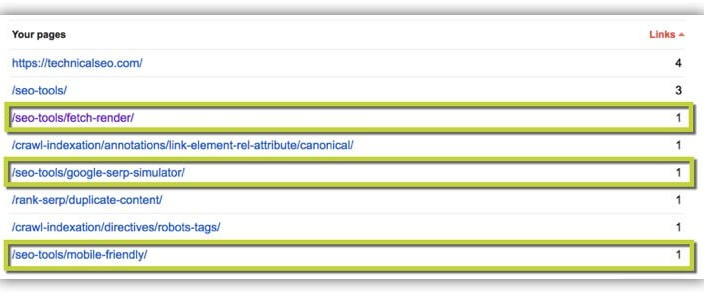
    Apart from the GSC or the Google Search Console that has limited backlink data, the top players in backlink data providers like Ahrefs, Majestic SEO and Moz Open Site Explorer are not reporting on the JavaScript-based link referrals currently. In a test setup to point the JavaScript-based links at TechnicalSEO.com, the links to the targeted pages were not present on the referring site previously.

    While the URL ‘strings’ are found in the page’s source code, they are linked to the onclick events and not within the href attribute of the <a> element. The links in the above imaged are picked up and are reported within the GSC. It is thus quite clear that Google has much understanding of the things that can be classified as ‘link referral’ in today’s digital ecosystem. However, it is quite unfortunate that the same links are not reported by the top data providers that are mentioned earlier.

    Some of the most common concerns that SMEs may have are addressed below:

    Is it really something to worry about?

    The lack of visibility for JavaScript-based link referrals could be an area of concern for webmasters. Since Google can parse the JavaScript, the JavaScript based link referrals are able to be considered while analysing the profiles for webspam. It is highly likely that Google is considering the JavaScript-based links within the link penalties, its inability to view the data within the backlink data tools can hinder the webmasters’ ability to make sure that the profiles are as per the rules.

    Since the Google is providing the links, GSC data should be enough to work from because it is the data owned by Google. Isn’t it?

    It is quite unfortunate that the ‘links to your site’ data will not show you everything that you would need to see to be able to conduct a thorough review of the backlink profile. The data is quite limited; it provides only about 1,000 rows per example and the sample report. As the best measure, people who are trying to review and monitor the backlink profiles, they are encouraged to use the multiple data providers and not just GSC. There have been many instances where the example links that is provided by the Google Webspam Team in a Manual Action message which was not found by any backlink tools including the GSC.

    Do the JavaScript-based link referrals have the same weightage as the conventional redirects?

    Yes. Google not only looks at the JavaScript redirects but Mariya Moeva, a team member at Google, looks at the DOM rather than the source code of a page. This was confirmed by the Mariya Moeva, a Search Quality Team member at Google. It is therefore clear that the elements that the dynamically inserted <a> would have the same weightage as they would be located within the source code.

    What would be the number of backlinks affected by this?

    It would be hard to provide the exact number, but in a survey conducted by OverStack it was noted that in 2016 more than 56,000 developers from around the world Javascript was the most popular technology; it was used by 90.5% of the front-end developers and 54.4% back-end developers.

    What do I do with this knowledge?

    For now, the SMEs owners can wait for the backlink data providers to catch up the JavaScript-based link referral reporting. Today, there are many tools that are going against the wide web and are appreciating the JavaScript for each page in their indices.

  • 10 Simple Ways to Improve the Accuracy of Google Analytics Data

    10 Simple Ways to Improve the Accuracy of Google Analytics Data

    Often, business owners find themselves staring at the Google analytics data and are sceptic about its accuracy. The objective of this post is to help you identify the most common errors of the Google analytics data and provide you ways to fix the errors.

    No view filters

    View filters are of great use to segment the vast data into different relevant buckets for easy analysis. However, the amateur users do not use the filters to its fullest potential. The search and replace filters functionality greatly help in making the page requests URI easily readable. The upper and lower case filters help in making sure that the report rows do not split because of their case sensitivity. It is advisable for all the business owners and marketers to use the various filters while using the Google analytics; it will help you clean up the data and not just segment it. The view filters offer a perfect solution for cleaning up all your data.

    Filters

    While using filters is a great way to clean the data, on the flip side, the filters, if used incorrectly can be destructive. The irrevocably alter the data as it comes into the Google Analytics reporting database. The best solution to avoid losing data is always to have a single view that is not filtered by any destructive options in the configuration. You can create a quick and dirty testing view and throw all your filters there first and filter the data. Deploying the filters incorrectly can be detrimental, especially if you are dealing with historical data.

    Self-referring

    If you check the referral report and see your domain as a referral, then you would have a self-referring issue. This problem occurs because you would have no idea of the source of the traffic, which literally translates to not being able to attribute the traffic to your marketing endeavours. It would be worse if you have spent money on online marketing and you have no idea about what percentage of traffic makes up for the self-referrals.

    There is literally a sea of information available on the internet on how to fix this issue. However, experts suggest that the most common reason why this happens is that one or more than one page on your website lacks the GATC or the Google Analytics Tracking Code. The problem with not having GATC is that, if a user over the course of the time they spend on the website, visits a certain page that does not have the tracking code, then the GA would consider the previous page as exit and the next page would be considered as the entrance with your domain as the referral. GA experts have corroborated that the most common page that lacks tags is the 404 error page.

    No stripped query parameters

    The query parameters are simple, the values that are added to the URL in the format of ?key=value&key2=value2. You can strip out the view-by-view query parameters through the view setting page on the admin menu. These values mean many things and it is very common for the content management systems to use the values and the external tracking applications. The query parameters, not necessarily always dictate the content on the page; sometimes it is just the session or the user data the CMS needs to shuffle the page around. An important note – as an analyst, they hold no significance for you.

    You must know that every reporting row in your content report is unique and every combination of query parameter will have its own row, which will split the data for a page into different rows. It is quite possible that you would only look at the row for a particular page that is utilised the most and it surfaced by column sorting.

    Not having default view page

    Another effective and easy technique to clean up the day is to set the default page in the view settings. What this essentially does is, it aggregates the root domain “/” with any page that you set as the default page. For example, if you set “index.php” as the default page, the “/index.php” in the content report will be combined in with “/” into one clean row. All the query parameters that you have added will break into their own separate rows.

    A bad architecture

    Apart from the bad data, the odds are quite high that you might be looking at the wrong place. While setting up the account make sure that you name the account so that, is easily identifiable; you must know which web property or account you are referring to within 10 seconds. Setting up an account can be very basic or complex; you need to figure out a way to know how everything ties together.

    No annotations

    One of the major benefits of having annotations is that it compensates for the changes you have made to the account while viewing the historical data. You may probably remember the last couple of changes that you have made to the GA account. However, it is not possible for you to remember the changes made over the course of one year. It is literally not possible to remember all the filters that you have applied. This is where the annotation plays a vital role. While you are building historical data, the annotation will give a clear log of what the data means so that you get the right insights.

    Case sensitive campaign fumbles

    One of the best features in GA is the campaign tracking feature. However, you must know that the campaign tagging is always case-sensitive, which means that if you are launching three different campaign and you list the medium as EMAIL, Email and email, these will show as completely different mediums. It is therefore highly advisable that you have some kind of reference document that the marketing professionals can access and collaborate while creating campaign tags.

    Adding the code at the wrong place

    The best way to place the GATC on the website is quite dynamic and it keeps changing. While you are creating a web property or within your GA admin panel where the tracking code is located there is always a brief description where it exactly needs to be placed.

    Using GATC that is outdated

    This is another very common reason why the data is messed up. The javascript tracking code that you place on the page calls the Google mothership and references, which can be best described as a little web program. This program, just like any other computer program is constantly improved and on some occasions, you would need to update the GATC and take advantage of the new features of GA. Make sure that the GA code is up to date.

  • Top Marketing Trends Enhancing Customer Expectations in 2017 – Part 2

    Top Marketing Trends Enhancing Customer Expectations in 2017 – Part 2

    In today’s post, we will shed light on few more trends put forward by IBM and its partners that will help you drive multiple initiatives for strengthening customer connections for driving business growth and exploring innovative business opportunities. Here’s a rundown of the marketing trends that are worth paying attention to:

    • Center-brain Marketing Combines Creativity and Tech to Drive Success in a Machine Learning-Driven Future: Marketing was traditionally considered as a right-brain activity; however, marketing is also a left-brain activity that is driven by cognitive technologies, data, and analytics. Marketing will soon be under the control of left-brain people who utilise artificial intelligence and machine learning for making crucial marketing decisions. With the concept of center-brain marketing, both technology and left-brain technical people will function together with right-brain creative thinkers to attain success in a machine learning-driven future.

    Centre-brain marketing transformation makes use of technology, strategy, processes and people to make sure your organization is reaping the benefits of machine learning and left brain analytics while enabling right-brain creativity to generate the kind of revolutionary marketing that can propel the success of customers along with brand preference. Cognitive technologies will drive the future of marketing and companies lacking the right processes and workforce will be overshadowed by higher-performing business rivals. To know more, watch this video:

    • Interactive email will empower new e-commerce opportunities: Email is the ideal platform for e-commerce conversion as it delivers the highest relevance along with well-timed content to your target audiences. Since email requires recipients to click through for completing an action, marketers are now counting on HTML Commerce which will enable marketers to sell directly from within HTML emails. It no doubt, requires some effective coding and the task of populating some dynamic content to cater to individual recipients but it offers outstanding opportunities. You should always keep in mind that your email database is the most crucial asset of your business; therefore, you should come up with smart strategies to drive significant growth for your company.  Watch this video to know more:

    • The astounding growth of dark data is motivating marketers to maximize their existing data: Dark data refers to the unstructured data acquired via different computer networks. It is the data accumulated, processed and stored by organizations for conducting daily business activities but are left unused as the executives are unable to make sense of it due to lack of proper tools. According to data analysts, by the year 2020, the digital universe will be 40 times bigger due to the significant increase of dark data. The marketers find this data explosion quite overwhelming as they are not prepared to tackle the challenges that their business is about to face owing to this outburst of data.

    In 2017, marketers will emphasize more on making sense of the available data instead of capturing more of it. The focus will be on finding buying patterns, insights and behaviours in the available data.

    Leading companies will count on the following five Vs of dynamic data—

    • Volume: to determine how much data needs to be measured.
    • Variety: to determine the variety of data required from different channel and how much of it is actually valuable.
    • Velocity: to determine how fast your customer data travels.
    • Veracity: to determine the accuracy of data.
    • Value: to ensure that you capture useful data and also create more value for your consumers.

    These 5 Vs will inspire marketers to feel less overwhelmed and more confident about their business as they will be prepared to handle big data explosion. To know more, watch this video:

    • Mobile Apps are Changing the Face of Mobile Communication: Behaviour of mobile customers is changing rapidly. Today users download lesser number of mobile apps as they are moving to core apps. Moreover, at present times, brands do not consider apps as mere icons, but utilities that can have a significant impact in the daily lives of customers. To keep up with this trend, app developers are including their services– normally found within their exclusive app environment—through AI assistants, mobile operating systems, and other apps.  For example, Uber is one such app that has been incorporated into Google Assistant, Allo, iMessage, Alexa, etc. To begin with, digital marketers should find out the platforms where their customers prefer spending maximum time. Social media platforms and messaging apps are some of the places digital marketers can consider.  To know more, watch the following video:

    • Smart marketers are pursuing a comprehensive view of customers’ journey to transform customer experience: In 2017, digital marketers will be taking all possible measures to offer customers with outstanding experiences by taking into account the comprehensive view of the customer journey. Smart marketers are leveraging advanced technology to analyse customer journey so that they can identify different issues and work together with their teams to resolve the issues. Moreover, organizations are also trying to comprehend why certain customers take certain actions during their journey with a specific brand. To offer exceptional customer experience, marketers are aligning all the departments of an organization, from billing and shipping to sales and customer service so as to create interactions of superior quality across all channels. Moreover, brands have been also giving priority to customer data for understanding customer journey. Having access to customer data is the best way to get insights about customer journeys.

    Besides these marketing trends, few bonus trends have been put forward by IBM’s partners.

    • Chatbots will gain momentum across industries:  Chatbots can not only modernize transactions but also make the process of consumer interactions more efficient. Chatbots can be deployed across any messaging channel including Skype, WeChat, SMS, Facebook Messenger, and email. This year, marketers will focus more on the distinctive functionalities of chatbots so as to improve the process of interaction with new as well as existing customers.
    • Marketers will focus more on automation and personalization: Marketing automation along with data-driven personalization is currently revolutionizing email marketing. This year, most of the brands will be emphasizing more on targeted messaging for increasing ROI.
    • Performance-driven organizations will incorporate cognition and operationalisation into customer journey mapping: Customer journey mapping is a great way to comprehend customers’ perspectives as it helps businesses to cater to the requirements of their customers. It entails the creation of a visual map of the different ways in which customers connect with businesses all the way through the buying cycle. Moreover, it also motivates companies to achieve their business objectives for individual customers. This year, businesses will shape the customer experience by operationalizing customer journey maps. It means integrating the maps into the CRM platforms used by sales and customer service. Besides this, businesses will also incorporate cognitive capabilities to enhance customer engagement throughout customers’ journey and across the sales, marketing and service departments of an organization delivering that journey.

    Conclusion:

    By inculcating the trends, insights and tactics put forward by IBM and its partners into your marketing strategy, you can successfully go beyond the expectations of their customers. Smart brands follow a holistic approach to enhance customer experience. By analysing your current performance and by identifying the problem points that need improvement so as to delineate a plan of action, you can go a long way in redesigning customers’ journey.