LS Staging

Tag: Pay Per Click

  • 3 AdWords features you’re probably underutilising


    Most of Google’s revenue is from online ads they provide on their search engine. Google is basically a search engine, and hence their primary focus is to expand their user base more, so much so that everyone starts using Google search. Google, however, provides search results for free, which poses a question of revenue. This is where AdWords come in the picture. Google AdWords are most definitely one of Google’s primary, most important service that generates most of Google’s revenue.

    Millions of businesses have used AdWords, and continue using them today, to gain as much exposure as possible on the most significant search engine platform today. AdWords gives companies the freedom to manage their ad campaigns themselves and provide their own preferences for the ads. This feature has attracted a lot of business owners over the years and made AdWords the best medium for expanding the audience. However, people who have been using AdWords for a long time sometimes get stuck in their ways and miss out on attractive features Google keeps rolling out regularly. These features can give you many extra benefits, and you can use AdWords to their full extent. Here are some AdWords features that you should utilise to get the best out of your investment.

    1. Gmail Ads

    Gmail ads have been available to companies for a long time, but not many have opted for them. This is because ads on Gmail have to be seen in the promotions tab, and not many people check that section. This has caused Gmail ads not to sell as efficiently. However, Google has started dynamic retargeting of Gmail ads, which means users won’t be able to ignore Gmail ad placements completely.

    Gmail ads, when paired with attractive images and redirect buttons, can urge people to directly go to your site, which is a significant advantage, considering your ad will be standalone and not with other ads. Hence, people should start considering Gmail ads as a viable option for advertising.

    1. Variations

    Google AdWords has been a staple advertising medium for many companies and the number continues to grow. Many companies have used AdWords for a long time and are set in their traditional way of advertising. But now, with Google rolling out new features for AdWords, people can essentially utilise AdWords to their maximum potential. The new features rolled out by Google allow the users to try variations and Google will provide regular analysis of how your variations fared, which saves an enormous amount of time and at the same time allows you to understand how you can better your ad campaigns.

    1. Experiment With AdWords

    AdWords has millions of companies using it and most of them have been using the same ad marketing strategies since they started using AdWords. This is synonymous with running the same experiment for years at a stretch. Sure running the same ad campaign is helping your company, but experimenting can actually boost your business. There is always something to test, and it should be because that test might be your new strategy for ad campaigning and surge your website traffic.

    AdWords are a powerful tool by Google, and you should keep trying variations and using all the features provided by Google for AdWords in order to utilise it optimally.
  • Unpartial – the AI-powered Chrome extension to spot fake news

    Unpartial – the AI-powered Chrome extension to spot fake news

    The world is advancing fast in the field of Artificial Intelligence, and various tech giants such as Google and Microsoft come up with new frameworks and AI-powered devices which have made it possible to use the technology across multiple industry verticals.

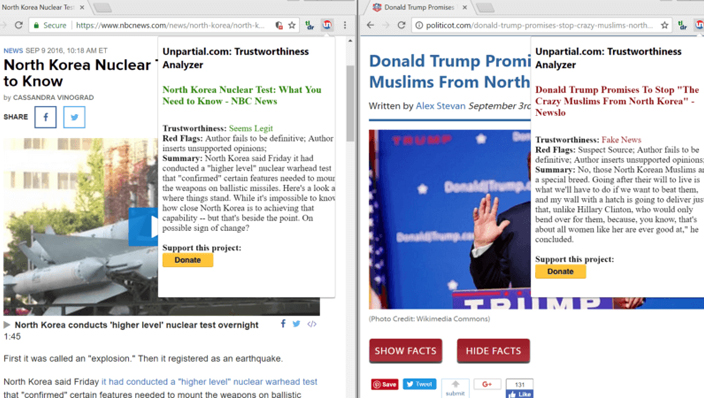
    This week, an AI company called Recognant, based in San Jose, California has released an extension for Chrome that informs users if the news they are viewing on the browser is fake. The AI tool is said to have a function which tests the ‘trustworthiness’ of an article or a story.  Recognant has named the AI tool ‘Unpartial’, and as said by the developers at Recognant, the primary purpose of Unpartial is to check the ‘trustworthiness’ of a story, ultimately telling if the story is fake or not.

    How does the AI work?

    The principal question that arises here is how does it judge whether a story is ‘trustworthy’ or not? Well, according to its developers, Unpartial doesn’t check the source or facts of the story but uses generated rules to check the internal validity of the given story. The tool can only work for articles which have more than three hundred words.

    When given an article, Unpartial checks it by cross-checking it with a variety of factors like checking the grammar, the volume of facts, and if the math makes sense. After passing the article through all the generated procedures, it gives its verdict of whether or not the article is false. The extension, if needed, can be accessed by clicking on the UN button on the Chrome toolbar. The ratings by Unpartial go from ‘Seems Legit’, which means the article is trustworthy, to ‘fake news’, which means fake story. The extension also dubs articles as ‘seems sketchy’ or ‘super shady’.

    How this extension delivers value?

    Recognant says that it focuses on making AI that is used mostly for NLP (Natural Language Processing) and the software they have developed have been used by multiple organisations like cancer research organisations, to collect knowledge on cancer and various ways to advance their research. It has also been used by several Non-Profit Organizations to find out which online ads are marketing human trafficking.

    Developers at Recognant developed Unpartial because they believed that misleading news and articles can have adverse effects on the society and can prove harmful as they provide wrong information about things, which lead people to believe in false theories. If a website presents false information about cancer treatment or AIDS virus, this will implant false knowledge in the reader’s mind, and that can be bad for people and those around them.

    Developers say that unlike IBM’s Watson, Unpartial is an AI called mind simulation, wherein the AI is programmed with an initial set of rules, and then goes on to test the article using the software’s generated rules.

    Hence, as compared to Watson, which uses neural nets, Unpartial proves to be more efficient in identifying the real stories from the false ones. This is because, in case of mind simulation, you can actually check why an article has been given a ‘false news’ tag by Unpartial. In short, this tool provides transparency, unlike neural net.

    What do we think?

    The accuracy of Unpartial is almost spot on, as it was tested by Recognant, by giving Unpartial a hundred thousand articles to go through and judge their authenticity, and the AI got the results correct 99 percent of the time.

    With about 1/4th of users sharing fake news (irrespective of whether they knew at that time or not), this extension is sure to curb the rising menace of fake news and give proper perspective to news as it should be shown online.

  • All you need to know about AdWords Conversion Linker

    All you need to know about AdWords Conversion Linker

    When you open your Google tag manager account, you might have noticed a small banner at the bottom of the screen. It is the upcoming Safari update. The new Safari update will see the introduction of the Intelligent Tracking Prevention (ITP).

    This move is a great start to improve people’s privacy. With the help of machine learning tools, the domains are determined which helps to track people across multiple websites. By only letting cookies which are acting in a third party context, it helps to limit the tracking of the ‘allowed’ Domains. The below points will help you to quickly understand the impact of the new Conversion Linker and why you need to implement it.

    Understand the functioning of cookies

    A cookie contains many bits of information along with the domain name. The other bits of information may include name, content and the expiration date. One important thing to remember is that the cookie can only talk to the domain it has been specifically written for.

    For example when you visit a website for Astra fashions, then the cookie written for www.astrafashions.com will be deemed as a first party cookie. If the website has a cookie which sends the data to another website, then it would be considered as a third party cookie. It is essential to understand that cookies are not naturally listed as a first or third party, it is determined at runtime by the browser.

    What’s the relation with AdWords?

    First, it is to be understood that, as AdWords cookies send all the data to www.googleadservices.com, they are considered to be third-party cookies. More and more browsers are attempting to block third-party cookies to protect their consumers’ privacy. Leading browser companies like Safari and Firefox are taking the lead in its implementation. This means more and more people are not tracked through the regular Adwords conversion tag. With the ITP update on Safari on the horizon, it’s going to get a lot worse than before. It can have a cascading effect as the Adwords conversion data may get lost due to non-tracking.

    Google, as we know, has a solution for every problem. In September it had released a new Adwords conversion tracking option which has replaced the old cookie with a supplementary Google analytics cookie. Due to this the cookies will now be considered as the first party, and thereby the above limitation can be bypassed easily. The updated Google Tag Manager Conversion Linker helps to set a cookie in your own browser and therefore even in third-party browsers it can be tracked appropriately. This way you can track all the users of browsers who have third-party cookie blocking by default and also those who have purposely chosen to block the third party cookies.

    It is very easy to setup your GTM Conversion Linker Tag:

    Step 1: Firstly click on add a new tag and thereafter click on conversion linker.

    Step 2: Set the appropriate default trigger for all pages, and it’s all done.

    With these steps, conversion can be tracked conveniently even for browsers that have blocked third-party cookies.

  • Weekend Digital Media Round-up: Google’s new mobile search results interface, Facebook’s dynamic creative, Snapchat’s Snap Pixel and more..

    Weekend Digital Media Round-up: Google’s new mobile search results interface, Facebook’s dynamic creative, Snapchat’s Snap Pixel and more..


    1. Google rolling out new curved mobile search results interface

    It appears that Google is now rolling out the new curved mobile design that they have been testing for several months. This would be the first major redesign to the Google search results since 2013 saw the unified card design released. [Source: Search Engine Land]

    1. Facebook Adds Split Testing, Improved Ad Analysis Options Within Ads Manager

    In order to provide advertisers with more insights into what’s working – and what’s not – with their ad efforts, Facebook’s rolling out two new testing options which will enable more accountable, traceable experimentation with various creative aspects. [Source: Social Media Today]

    1. eMarketer Releases New Worldwide Ad Spending Estimates

    Spending on paid media worldwide will reach $584.14 billion by the end of this year and approach $757.44 billion in 2021, eMarketer estimates, driven largely by advertiser investments in mobile formats. Ad spending growth rates will range between 4.9% and 8.3% over the forecast period. [Source: eMarketer]

    1. Snapchat Adds ‘Snap Pixel’ to Track Ad Response, Showcases New Lens Option

    Snapchat has announced that they’re now looking to roll out a new ‘Snap Pixel’, a conversion tracking tool which will enable advertisers to measure the traffic being driven to their sites via Snapchat ads. [Source: Social Media Today]

    1. Microsoft folds LinkedIn contact info into Outlook to boost business communications

    Commercial Office 365 users can now see the LinkedIn profiles of their contacts within the email provider. The feature lets business users see LinkedIn profile information, including connections and work history, within Outlook.com, SharePoint, and OneDrive for Business. [Source: TechRepublic]

    1. Facebook’s dynamic creative can generate up to 6,250 versions of an ad

    Facebook is rolling out a way for brands to automatically create thousands of different versions of an ad that will vary in content based on who they are shown to and where they appear. [Source: Marketing Land]

    1. Google searches now correspond to user location instead of domain

    Google announced today that it is changing the way it labels country services on the mobile web, Google app for iOS and desktop Search and Maps. To make search results more relevant, Google says the country of service will no longer be indicated by the country code top level domain name (ccTLD) such as “google.co.uk” for the UK or “google.com.br” for Brazil, but instead will default to the country where the user is performing the search. [Source: Search Engine Land]

    1. With 217 million Indian users, Facebook to help businesses drive growth

    Facebook with over 217 million monthly active users in India is closely working with marketers and advertisers to discuss how the social media giant can help businesses drive growth. [Source: The Economic Times]

    1. Content Analytics launches retailers’ Scorecards for brands’ product pages

    The San Francisco-based company, Content Analytics, is adding another resource to its toolbox. Called VendorSCOR, it automatically generates Vendor Scorecards about a product page that an online retailer could send to its brands. Content Analytics says this is the first solution for generating these kinds of report cards. [Source: MARTECH TODAY]

    1. Facebook Provides New Ways for Travel-Based Businesses to Reach Interested Users

    As we head towards the holiday season, Facebook has announced an update for their Dynamic Ads for Travel, which help travel brands hone their ads on the most receptive audience. [Source: Social Media Today]

    Expert Opinion:

    1. Making email marketing more relevant and effective

    Email marketing has been a highly favoured marketing tool used across sectors, primarily due to the probability of high ROI. While we always pay attention to the look and feel, the open rates, click rates, etc; it is important to focus on making the inbox experience more engaging by offering relatable content and through user-friendly designs.

    Some of the ways of making email campaigns more effective are:

    • Creative use of behavioural triggers: Behavioral email is the practice of sending automated, targeted emails to the contacts in your database based on their interactions with your company across multiple channels: social media, email, your website and beyond. It is the actions of your site visitors that dictate what emails they receive. This method has proven to be effective to address ‘abandoned cart’ issue.
    • Greater use of dynamic elements: Dynamic emails allow marketers to replace key pieces of the message to reflect a subscriber’s profile attributes, interests and previous activity. E.g. If an online pet product store is running an email campaign to inform its existing customers about new discounts. Instead of sending a standard mail to all recipients, it could customize each mail by mentioning the brand of products the customer has purchased earlier.
    • Use of automation: This can also be called trigger based email marketing. A mail is sent to the user when they perform a certain action. For e.g.: A mail that explains how a site’s features can be used as soon as the user signs up on the website in order to get them started.
    • Mobile-optimised customer journey: While the practice of creating mobile friendly email content has been on rise, it is essential to see it through till the end of a user’s journey. For e.g. in case of a ‘Call to Action’ mail campaign, even the subsequent transaction page should be mobile friendly in order to ensure smooth start to end customer experience.
    • Use of Artificial Intelligence (AI) to improve performance: Email marketers can let AI determine what kind of content recipients are most likely to respond to. Machine learning allows these platforms to learn what resonates best with a specific marketer’s audience. These platforms then use natural language technology to create subject lines, body copy and calls-to-action that not only sound like they were written by a human, but are consistent with the language typically used by the brand.
    • Embedding personalised videos in emails: Another trend that is rapidly catching up is embedding personalised and customized videos in emails. The content of the video dynamically changes as per the details of every recipient. These videos can be made interactive to make the experience further engaging.

    Sohel I S, CEO, HDFC RED

  • 3 Effective Ways to Better Personalise Programmatic Ads

    3 Effective Ways to Better Personalise Programmatic Ads

    The policy of personalising ads according to a user’s preferences and transactions has been gaining ground over the last few years. But it’s essential to distinguish and draw a line between the truly personalised and being obnoxious.

    With almost unlimited data at our disposal, it sometimes becomes challenging as to where to draw the line. Businesses think that the ultimate use of their advertising resources would be where they are able to send users unique content and messages at the right time on the right platform and in proper context.

    What has changed is the scale of programmatic ads

    While this was done in small proportions previously, it has truly gained an enormous traction in the last few months. The reason for its emergence is personalisation engines and way more digital marketing platforms. With ad blocking growing 41% year over year, it was imperative for the advertisers to bring something new to the table to counter it.

    Silly things like blocking users who use the ad blocking software or trying new tricks to get around ad blockers wouldn’t be able to solve the problem. It is no wonder that some firms like the New York Times even went to the extent of requesting users to avoid the ad-blocking softwares.

    How to enhance the personalisation within programmatic?

    Programmatic personalisation strategy should be more than pure data and technology. It should enable advertisers to create more lasting and memorable user experiences, make messages more relevant to them and even facilitate effective conversations with their current and prospective customers. There are multiple marketing touchpoints which can be utilised efficiently to get the most output for the advertiser’s money.

    1) Start with data

    By carefully analysing data you can reward scintillating outcomes in marketing. By carefully examining the data, advertisers can progress to make more personalised ads and messages for individual users. The relevancy of the ads with unique users is of prime importance. The key for delivering the relevant media to users is through an efficient data analysing strategy.

    2) Nothing’s more effective than real-time advertising

    By providing unique content to individual users on a real-time basis sharply increases the effectiveness of programmatic advertising. A person’s shopping profile and a history based on previous transactions can be used efficiently to create ads based on his interest.

    3) Technology is the key

    Technology is one of the wheels along with data that can help solve the personalisation in programmatic. With the help of efficient, reliable and scalable technology, data can be turned into a value of enormous proportions. By helping to create stronger ties between you and the consumer, technology can be of the great essence.


    Now is the time for companies to increase their share of programmatic with personalisation. The entry of big players into marketing technology has given this market a kind of buzz. Most of these players already have significant consumer data along with industry data. For them monetising this information for personalised advertising will be the next logical step.

  • Weekend Digital Media Round-up: Google’s AMP Project updates, Instagram’s New Polls feature in Stories, LinkedIn’s Talent Insights and more..

    Weekend Digital Media Round-up: Google’s AMP Project updates, Instagram’s New Polls feature in Stories, LinkedIn’s Talent Insights and more..


    1. Google releases a variety of Accelerated Mobile Pages Project (AMP) updates: scrolling animations, video analytics, fluid ad support

    Google announced several Accelerated Mobile Pages Project (AMP), technical updates. These included scrolling animations, an improved responsive-navigation sidebar, support for video analytics, fluid ad support and other features to improve ad targeting. [Source: Search Engine Land]

    1. LinkedIn Adds New ‘Talent Insights’ to Help Employers Improve Hiring and Recruitment Efforts

    While Facebook’s also trying to muscle in on LinkedIn’s turf by introducing job listings on Pages, LinkedIn’s data gives them a big advantage. The latest development on this front is LinkedIn’s new ‘Talent Insights’. [Source: Social Media Today]

    1. Mobile ads will make up 62% of digital ad spends in India by 2021: Report

    Although television still remains the biggest advertising platform in India, growing demand for smartphones, cheap 4G handsets and falling data prices are expected to increase mobile ad spending significantly, according to marketing research firm eMarketer. [Source: Mint]

    1. Google test surfaces user data in DoubleClick for Publishers as part of new Insights Engine Project

    Google is laying the groundwork for turning the love-hate relationship many publishers have with the company into a love-love relationship. Among the recent announcements by the company was the launch of a new effort to share user data with publishers and introduce more machine learning into Google’s publisher products. [Source: Marketing Land]

    1. Instagram’s Adding New Shopify Tags to Enable In-Stream Purchases

    It’s been a while since we’ve heard anything more on Instagram’s shopping tags, their coming eCommerce addition which would enable businesses to add information and price tags to products featured in their posts. [Source: Social Media Today]

    1. Google: First Click Free is over, being replaced by Flexible Sampling

    Most online news publications are not able to support themselves with advertising these days. For this reason, among others, Google is yielding to publisher requests and replacing its much-debated “First Click Free” program with what it calls “Flexible Sampling.” [Source: Search Engine Land]

    1. Google intends to beat Amazon and Apple with the combination of ‘hardware, software and AI’

    Google believes it has found a winning formula in its smartphone war with Apple and in its smart home war with Amazon. Eight new or updated devices are being introduced, from new Pixel smartphones to a Google Home Mini, a new laptop and a new smart camera. All or nearly all of them feature the Google Assistant and are designed to integrate with other Google devices and work seamlessly together. [Source: MARTECH TODAY]

    1. LinkedIn’s Adding Snapchat-Like Geofilters for Conferences and Events

    Yes, LinkedIn is also copying Snapchat – though their use-case is a little different, and does make a lot of sense. As part of their new native video tools, LinkedIn’s giving conference attendees the opportunity to add dedicated event frames to the videos they create while attending such functions. [Source: Social Media Today]

    1. Google announces AdWords daily budgets can overspend by 2x, automatically

    Google AdWords notified advertisers in their accounts and on Twitter that a change had already happened to the way budgets get handled on a daily basis. It is not going over well. [Source: Search Engine Land]

    1. Instagram Adds Polls in Stories, New Creative Tools

    Instagram’s adding a new method for conducting polls, with a sticker option that lets you pose a question within your Instagram Story and see the results from your followers as they participate. [Source: Social Media Today]

    Expert Opinion:

    1. Marketing for the new age hyperconnected consumers

    Digitalization has changed the way we consume and process information. With the deluge of information, the customer’s attention span is shrinking and the interactions are becoming evanescent. This changing customer behavior is compelling the digital marketers to think creatively about the new strategies to remain relevant to the fast-evolving customer behaviors.

    With the rising use of smartphones and insatiable appetite for data, the new age consumers are now getting ‘hyper-connected’- Perpetually and with increasing frequency. As per the recent study done by Gfk, there are around 41 million hyperconnected consumers in India and the internet users in India will burgeon to more than 450 million by June 2018. This naturally is increasing the frequency with which these consumers are engaging with different brands showing a substantial level of engagement with at least one brand on social media.

    Considering these facts, it’s becoming imperative for brands to focus on the hyper-connected consumers with hyper personalisation. The user experience across the touch points needs to be coherent and intelligent to communicate the ‘right product’ with the ‘right price’ to the ‘right customer’ at the ‘right time’ through the ‘right channel’. In order to get this entire experience ‘right’, requires a thorough redesign of the processes, data crunching and redefining communication message. There is clearly a need for digital professionals to evolve into Techno-marketers who understand the new age customers, their needs and have the requisite technology skills to provide a seamless customer experience. When the customer experiences are value accretive at every touch point, organizations will start winning loyal customers and naturally create winning brands.

    Gaurav Hazrati, Senior Vice President and Head, Digital Banking-Consumer Banking, IndusInd Bank

  • Take your PPC advertising to the next level with Artificial Intelligence

    Take your PPC advertising to the next level with Artificial Intelligence

    At a time when the world is raving about Apple’s Siri, Microsoft’s Cortana and Google Now, Is Artificial Intelligence all ready to take over the PPC world by storm?

    Let us see how machine learning will dominate the future of PPC and how the businesses can leverage from it.

    Machines will not ultimately take over the job of PPC professionals, but it will change their role, by automating processes. PPC can soon be a winning strategy for an organisation’s overall digital marketing programs. Below are some of the machine learning features from Adwords that can help you take that leap in your PPC advertising by being more strategic:

    1. Smart bidding: Google’s smart bidding is a machine based bidding with the ability to analyse voluminous data thus maximising conversions for your client campaigns. It comprises of smart bidding strategies such as Target CPA, Target ROAS, Max Conversions and Enhanced CPC. Under this method, Google can process a large amount of real-time data in a jiffy and analyse “signals” to get a clear understanding of your audience and how to convert them.

    However, you cannot expect results overnight with smart bidding; you need to give the system a considerable amount of time to learn, grow and optimise on the new strategies. Over time, you will notice efficiency in CPA and growth in volume.

    1. Smart display campaigns: Sit back and relax as Google’s Artificial intelligence completely controls your campaigns. All you need to do is mention your Target CPA and Budget; Google will do the rest!

    For example; A popular hotel search platform, Trivago used Smart display campaigns to reach audiences looking for travel packages around the world and reported an increase in conversions by 36%. They only provided creatives such as headlines like “Find Great Hotel Deals”, striking images of the places to travel, target CPA, a daily budget and Adwords did the rest for them.

    Credit Karma, a financial management website reported 37% higher conversions using Smart display campaigns and witnessed increased signups on their page.

    Hulu Japan, a subscription video service, used Smart display campaigns to increase their subscriber base and got a whopping 37% increased conversion rate.

    1. In-Market audiences: Looking for your favourite brand of perfume and it shows up right in front of you, does that feel great? Oh yes! This is exactly what this feature does. It helps you reach out to potential customers who are actively researching, browsing and seeking out for the products or services that you have to offer them. This feature helps you to target the right customer at the right time, just before they make that crucial decision to buy. Google classifies and connects you to potential customers based on their in-market behaviour and purchase intention.

    So why wait? Optimize machine learning to execute swiftly and strategise your marketing campaigns better. There are things which you can do but artificial intelligence can’t! Translate the insights available from machine learning and convert them into effective strategies for your business, to increase the impact of your digital marketing campaigns.

  • SEO+PPC = the perfect recipe for new age search marketing

    SEO+PPC = the perfect recipe for new age search marketing

    Not sure how to decide between SEO and PPC for your business campaigns? Find out how a “Single source of truth” may be your answer.

    It has been a long-debated topic whether paid or organic search marketing, which of the two can really get conversions and benefit your business.

    However, a liaison of both these methods of search marketing can go a long way in driving traffic to your website that can convert into a customer. Let us find out how:

    1. A right mix of PPC and SEO

    Displaying ads which don’t cater to the information that the user is looking for is a complete no-no.

    For example: If a user is searching for “the best mobile phone of 2017” and your paid ads are simply displaying iPhone X then that will not tempt the user to click on the Ad. Though these ads display on the top of search results, the user may overlook it since it does not serve his purpose. The user here will instead click on the reviews and recommendations of the best phones, displayed in organic search results.

    On the other hand, if a user has made up his mind as to which phone he wants to purchase, he will click on the paid ads that can serve his purpose.

    Insight: Integrating organic search content with paid results can be the key to conversions.

    1. Outsmart competitors organically

    Your website should be a storehouse of information that drives users via both paid and organic search results. A small amount of research as to which websites, blogs or forums are driving the most traffic in your niche sector can be useful in deciding the most engaging topics.

    Using search tools such as search metrics, SEMrush, spyfu, etc can help you find out the most engaging keywords for your business.

    1. The Speed and flexibility of PPC

    Once you know the topics and keywords, you can use it to run broad matched paid search campaigns.

    Pay Per Click approach can be your trial and error method to find out which terms not to opt for. Once you select the “broad match” option for keywords, you will get a clearer picture as to which keywords engages users to click on the links.

    The crux of the matter is that combining both SEO and PPC strategy is a skill that every marketer should try to incorporate into businesses. The right approach is to create a synergy between SEO enhanced content and paid traffic for a powerful and profitable result.

  • Weekend Digital Media Round-up: Google’s New Smart Screen Competitor To Amazon’s Echo Show, Twitter’s doubling the length of tweets, Snapchat’s Sponsored 3D World Lenses and more..

    Weekend Digital Media Round-up: Google’s New Smart Screen Competitor To Amazon’s Echo Show, Twitter’s doubling the length of tweets, Snapchat’s Sponsored 3D World Lenses and more..


    1. Google is building a smart screen competitor to Amazon’s Echo Show

    Google is building a tabletop smart screen for video calling and more that will compete with Amazon’s Echo Show. The device could help Google keep up in the race for the smart home market after Amazon just revealed a slew of new Echos and as Facebook continues to work on its codename “Aloha” video calling screen. [Source: TechCrunch]

    1. MailChimp adds Google Ads as it becomes a multichannel platform

    MailChimp took another step toward becoming a multichannel marketing platform, announcing that users can now create and deploy Google Remarketing Ads within its dashboard. [Source: MARTECH TODAY]

    1. Facebook and Twitter Continue to Expand their TV-Like Video Efforts, Add New Opportunities

    Both Twitter and Facebook have continued their push into TV-like content this week, with new announcements on programming which will further expand their efforts. [Source: Social Media Today]

    1. Twitter tests doubling the length of tweets to 280 characters

    Twitter’s defining feature — the tweet’s 140-character limit — may soon go the way of Instagram’s square posts and Vine’s, well, everything. If Twitter does opt to officially adopt 280 characters as the new maximum length, it would mark the biggest change to the social network since its founding in 2006 and the biggest big bet yet by the company to increase its user base. [Source: Marketing Land]

    1. Instagram Adds New Comment Control Options to Help Improve User Safety

    Instagram, which has traditionally focused on images as opposed to exchanges, has worked to stay ahead of the curve, introducing advanced reporting tools and features to give users more control over what they see on the platform. And now, Instagram’s adding in some new tools to help, with three updates to help improve community safety. [Source: Social Media Today]

    1. YouTube unveils new tools to create custom ads at scale, sequence videos & more

    Designed to help advertisers reach their audiences with relevant messaging, at scale, the new features touch on improved targeting options, creative offerings and measurement tools. [Source: Marketing Land]

    1. Bing Ads rolling out offline conversion imports to capture impact of ads on offline sales

    Advertisers that run Bing Ads campaigns to generate leads can now upload offline conversion data back into the platform to get a more complete picture of campaign impact on actual sales. [Source: Search Engine Land]

    1. Pinterest Introduces Taste Graph For Better Ad Targeting

    Pinterest announced the unlocking of more than 5000 varied ‘interests’ that digital advertisers can target against a ‘Taste Graph’. This means a much better precision-based targeting will be made available for digital ad marketers, which in turn, is expected to boost the conversion from Pinterest substantially. [Source: Logicserve Digital]

    1. Facebook’s Adding a New Messages Ad Objective to Drive Messenger Business

    Facebook’s introducing a new messages objective for ads which will help businesses raise awareness of their Messenger presence (and bots) and directly connect more users to the option. [Source: Social Media Today]

    1. Snapchat rolls out Sponsored 3D World Lenses, bringing its AR format to advertisers

    Snapchat debuted its latest augmented-reality ad format on Thursday. Advertisers can now create their own branded versions of Snapchat’s 3D World Lenses that allow people to augment videos shot with their phones’ rear-facing cameras with animated three-dimensional objects, like Snapchat’s famous dancing hot dog, that can be moved and resized to fit the scene. [Source: Marketing Land]

    Expert Opinion:

    1. How do you think Programmatic Guaranteed (PG) deals will work in India?

    Ad tech is constantly evolving. We keep hearing about so many new technologies and platforms that offer a host of benefits for online advertisers and publishers.

    Programmatic Guaranteed is one of the latest technologies provided by Google which eliminates lot of the back and forth that happens between buyers and sellers during a direct deal setup. With PG, a buyer can pre-negotiate the terms of a deal and lock-in their ad spends, delivery or volume commitment with an end publisher using Google’s DoubleClick for Publishers (DFP) ad server. For advertisers, PG is about securing pre-negotiated rates against an audience that is otherwise hard to find.

    Programmatic Guaranteed efficiently automates traditional reservation buys, enabling publishers and advertisers to negotiate and execute one-to-one deals in a secure digital setting. It is rapidly seen as a way to assure media buyers as well as sellers against concerns about the miss-delivery of various ads using such technologies, and also the potential loss of inventory prices via auction-based selling using real-time bidding (RTB) technologies.

    Programmatic Guaranteed is a great way for hesitant buyers to test the programmatic technology. Buyers who are uncertain about programmatic are using the method to experience the benefits of programmatic buying, without the ambiguity that comes while bidding for a price and not knowing if the required inventory will be secured by them.

    Publishers across every category and continent are seen to be offering larger inventory through programmatic deals. PG is expected to evolve rapidly in the coming years. Some of the key factors shaping the evolution of programmatic guaranteed include:

    – Many publishers are pushing agencies to use PG with some publishers becoming PG only

    – Advertisers are drawn towards the security and brand safety features of PG

    – Multinational brands are driving buy side adoption

    Programmatic Guaranteed is creating new opportunities for advertisers and publishers to connect. Programmatic guaranteed penetration is expected to grow 6 -10 times in India by 2020. Programmatic platforms are predicted to connect every piece of the advertising ecosystem in the future. By harnessing the power of data, inventory and audience discovery will become seamless, and it will be easier for buyers and sellers to find each other and their target audience. Building new relationships will become faster and simpler with the use of PG.

    PG is indeed changing the ad tech space in India with many publishers and advertisers moving towards a future with the highest touch deals taking place in a programmatic environment.

    Prabhvir Sahmey, Head of Media Buying & Analytics Solutions, India (DoubleClick & Google Analytics 360), Google

  • How to Improve Display Ad Campaign Targeting?

    How to Improve Display Ad Campaign Targeting?

    Be it remarketing, product-specific display, membership programs, or discount offers, these key types of display advertising can be an excellent way to bring your business to a new set of eyeballs and increase brand awareness. Display advertising is similar in processes and outcome as other forms of digital marketing. Get it in front of the right set of people at the right time, and see the miracle of high CTRs. However, many marketers fall short on this crucial goal.

    In this post, we look at some practical ways that can improve your brand visibility with a better level of targeting:

    1. Adding a personal touch

    Nothing works better than having a greater degree of personalisation attached to your marketing messages. If your headline and caption resonate with the current and relevant pain points of the customer viewing the ad, there will likely be a better conversion.

    Along with personalised captions, also make sure to use clear and sharp images that do not turn pixelated irrespective of the device or screen size in which the user is viewing the ad.

    2. Get your KRA right

    Google’s business objective (earnings by impressions) will be far different from your own internal marketing KRA (earnings by conversions). Make sure that you realise this and set up ad campaigns that are targeted the right way. For instance, if you have a mobile app development ad to be shown, you need to factor in uncommon sites like Inc.com, Entrepreneur, Forbes, TechCrunch, TED, or Mashable. These sites are where your key audience (business owners, CxO, CTOs) will be likely to follow and this is where you can reach out to them.

    So, targeting by interest as well as by topics will be the right way to go.

    3. Keep checking placements

    Even after setting up the campaign and running it for 3-4 months, you need to keep looking at the ‘Placement’ section (Google AdWords -> Display Network -> Placements). This portion shows where your ads were displayed in the chosen timeframe. It also comes with a lot of stats like clicks, impressions, and conversions.

    Such on-going review and assessment will uncover interesting stats like –

    • Sites with lots of impressions but lower number of clicks (you can exclude these as they aren’t worth your time or dollars)
    • Sites with good number of clicks but high bounce rate (this means there is some anomaly – wrong audience or wrong ad placement. Solving the underlying issue will help a lot)

    4. Introduce rich media at the right time

    Many clients seek to introduce rich media right from the start of the campaign. Our point is that while it is important, it takes a lower priority than setting up the right ads with the right topics for the right kind of visibility. It will be a cost-effective move to start with static images initially and get other aspects fine-tuned for success. Post this, you can add rich elements like hover effects or videos.

    As evident, the judicious use of data presented by tools like Google Analytics and AdWords can be a critical differentiator to ensure the success of your display ad campaign targeting. By tiling these pointers, you can improve the efficacy of the display ads and help you with your brand awareness goals.