LS Staging

Tag: Pay Per Click

  • 5 Audiences to NOT Include in your PPC Campaigns

    5 Audiences to NOT Include in your PPC Campaigns

    Identifying the audiences NOT to reach is as important as identifying audiences you want to reach for PPC campaigns. By not showing ads to negative audiences, marketers can reduce spends and avoid tiring out potential customers by running irrelevant ads.

    Here, in this guide, you can take a look at the five audience categories to exclude from PPC campaigns.

    1. Support Seekers 

    People who are looking at your web pages for support are generally existing customers. They are not looking to purchase from you, but require extra assistance.

    Brands can build retargeting lists based on the URLs visited. Customers who visit the FAQ and other support section of the website can be excluded from PPC campaigns.

    2. Previous Customers 

    Including or excluding previous customers depends on business goals. Let’s understand this with an example. Consider a brand that has a multi-step funnel before customers convert.

    At the first point of contact with the brand, customers are offered an asset like free delivery on their first order when they sign up for the newsletter. Marketers can now include these customers to a retargeting list and entice them for a second transaction. On the other hand, marketers can exclude them from the campaign, since they already have the asset (free delivery coupon) in hand. However, marketers can decide to include them in another campaign, say a product demo campaign.

    This way, marketers can ensure that past customers are not retargeted for duplicate messages. Instead, it gets them to take the next step in the funnel.

    3. Job Seekers 

    It’s common knowledge that site visitors who are more interested in the career section of your website are not likely to purchase from you. So, it makes sense not to include this set of audience in your PPC campaigns’, and thereby avoid unnecessary spends.

    4. Present Customers – But it depends

    Current customers fall under the grey area of PPC campaigns. Some PPC marketers argue that they should be included while others believe otherwise.

    • Brands that are looking to upsell can include current customers for ad campaigns.
    • Alternatively, marketers can include customers who have purchased Product A for campaigns related to Product B and vice versa.
    • Existing customers provide recurring revenue to brands. You can segment them into smaller segments based on whether they are likely to repurchase or not.

    5. Audiences in non-retargeting Campaigns 

    It’s a good practice to avoid audiences from other campaigns in specific retargeting campaigns. For instance, if a brand is running an interest-creating campaign on Facebook. Make sure to include the audience from this campaign in one particular retargeting audience list so that you can send them specific messaging, getting them to convert.

    Define your Audience for Precise Targeting 

    While these are the top 5 audience categories to exclude from your PPC list, there may be several other categories based on your goals and objectives. Make sure to refine the audience list that you want to show and not show your ads. This way, you can avoid wasting money on the wrong audiences while getting the right audiences to convert.

  • 5 Reasons why Automated Bidding is NOT the Magic Potion to all PPC Challenges

    5 Reasons why Automated Bidding is NOT the Magic Potion to all PPC Challenges

    It’s no surprise that Google is pushing advertisers to make use of its machine learning tools and features. Automated bidding for PPC campaigns is one such strategy that Google is using to entice advertisers.

     What is Automated Bidding? 

    As the name implies, it’s an automatic bidding strategy used for Google AdWords campaigns. In automated bidding, Google monitors the performance of the campaign using advanced machine learning tools, which automatically sets and adjusts bids for every auction, based on the goals defined.

    Google currently offers six different automated strategies to meet different PPC goals. Here’s are different automated bidding strategies that PPC advertisers can use:

    S.No. Bid Strategy Goal
    1 Maximize clicks To increase traffic to the site
    2 Target impression share To increase site visibility
    3 Target CPA automatically To increase conversions
    4 Target ROAS To meet a target ROAS while assigning different values to each conversion
    5 Maximize conversions automatically Get more conversions within the budget
    6 Maximize conversion value automatically Get more conversion value


    Does this mean, PPC campaigns can be run automatically without the need for PPC experts? Well, No, in this guide, we take a look at why using automated PPC bidding strategies may not always be the right choice.

    #1: Automated Bidding doesn’t mean it’s a Completely Hands-off Approach 

    Advertisers falsely assume that once they set up automated bidding, the tool itself takes care of all the aspects of the campaign.

    To give an example, IS (Impression Share) is a metric that advertisers regularly monitor while using manual bidding. When switching to automated bidding, advertisers stop monitoring this key metric, which could lead to plenty of lost impression shares.

    One reason for lost IS with automated bidding is that when a competitor’s actions change the value per click, the automated bid strategy stays within the bounds set by the advertiser. This leads to losing impression shares to competitors.

     #2: Advertisers are likely to Miss Out on Key Insights 

    Let’s explain this with an example. For instance, if the conversion rate drops after launching a new landing page, automated bids will reduce the number of bids, so that it can remain within the target. The advertiser will not know why the bid values were dialled down.

    The result – they are likely to lose more impression shares.

    #3: Bid Automations do not Automatically Rectify all the Mistakes of Manual Bidding

    Majority of advertisers consider automated bidding as the solution to achieving results that they were not able to achieve manually. They think that once they set the target, the system will automatically reach the desired goal.

    This is a significant mistake. For instance, if advertisers set a low target, they could potentially lose volume. On the other hand, if the goal is too aggressive, it causes a loss of profitability.

    Just like manual bidding, advertisers have to monitor and change targets based on performance.

    #4: Automated Bidding Complicates the Math

    PPC advertisers are likely to be familiar with the basic math of PPC for manual bidding like:

    • Increase the CPC bids to become more aggressive
    • Increase the tROAS to become more aggressive and so on.

    With automated bidding, advertisers have to relearn the math once again to get it right, and the worst part is that the math is not transparent as with manual bidding.

    #5: Even Automated Bidding Requires Multiple ROAS

    Several advertisers falsely believe that with automated bidding, they can set a single target for the entire campaign. Sadly, it doesn’t work that way. Advertisers still have to set different goals for various ad group levels.

    The key takeaway – Advertisers should continue to keep an eye on Details, even while using Bid Automations

    While there’s no denying that automated bidding is a powerful tool, advertisers have to consider the following factors before they start using it:

    • Understand it inside out
    • Continue to keep an eye on details
    • Targets are still fluid goals that vary based on changing requirements
  • Why Marketers must look beyond Buyer Personas and use Data-Driven Insights to Identify their True Audience

    Why Marketers must look beyond Buyer Personas and use Data-Driven Insights to Identify their True Audience

    It’s a half-full, half-empty scenario. You could be seriously undermining the potential audiences outside your buyer personas by boxing your online marketing strategy around a fixated customer demographics.

    Let us explain the above statement with an example. Consider the case of a fitness wear brand whose target audience is women in their 20s and 30s. However, an in-depth look at web analytics for the brand’s e-commerce website reveals that they attract significant traffic from other women who lie outside this age group.

    By leveraging this data, the brand can convert these outliers (casual visitors beyond their target demographics) into paying customers. The brand can alter their marketing strategies or increase product categories to appeal to women of all ages, thereby boosting sales and revenues through these insights.

    On the other hand, if the brand doesn’t focus on web analytics, it’s likely to lose out on crucial conversion opportunities – as they would not have looked beyond their standard buyer personas.

    Brands should avoid getting trapped by a Limited Tunnel Vision of their Audience

    As this example illustrates, it is crucial for businesses to look beyond typical customer personas and consider the demographics of all current site visitors. Having a clear picture of the entire web audience helps businesses convert casual onlookers into paying customers.

    Once they accurately understand and segregate traffic categories, businesses can better channelize their marketing efforts, allocating the right budgets for various marketing campaigns, thereby enjoying higher conversions.

    How to perfect Web Audience Intelligence?

    To get an accurate picture of the current web audience, marketers must monitor both web analytics profiles and social advertising platforms. Here are a few guidelines on how marketers can learn about their true audience on different platforms:

    • Google Analytics

    By using various segmentation features and lists on Google Analytics, brands can get a clear picture of customer conversions based on age and gender. Additionally, it’s also possible to find out how age and gender are related to other user behaviour metrics like time spent per session, bounce rates and pages per visit.

    This gives a clear picture of who is visiting the site, as well as who is converting, thereby helping brands get better insights into their web audience.

    • PPC Ads

    PPC ad analytics help brands understand searcher intent, thereby moving visitors from down the funnel into upper levels. With that said, marketers have a hard time trying to understand why, despite high click-through-rates, the conversion rates remain low.

    By using audience demographics (like age, gender, household income, etc.) from Google AdWords/Bing Ads, marketers can compare how different factors contribute to CTR, CPC, Cost per conversion and other key metrics.

    Let’s take the above example of the fitness wear brand. If they find that they get plenty of ad clicks from women aged 40 and above, but poor conversion rates, then the brand can understand that they have to restrict ad clicks from certain demographics or alter the content to suit this demographic. If they take the second approach, they can come up with new product sizes and styles to appeal to this audience category and get them to convert into paying customers.

    • Facebook Ads

    Marketers can compare data like the age and gender of the followers obtained from Facebook Insights with the data from Google Analytics to find out if there is any difference between the general followers on FB and the visitors on the site.

    • LinkedIn Ads 

    LinkedIn doesn’t offer ad insights based on age and gender. Instead, it shows audience segmentation based on levels. Using the insights offered, marketers can find out if their ad clicks on the platform are coming from senior-level employees or entry-level employees.

    • Twitter Ads

    Twitter doesn’t offer detailed insights into followers, like Facebook. However, the platform provides gender and marital status insights. Marketers can use this data to compare it with insights from other platforms.

    The Key Takeaway

    While it’s healthy for brands to develop buyer personas to channelize their marketing efforts, it’s crucial not to miss out on sales opportunities beyond the pre-defined personas.

    By using data derived from all the platforms mentioned above, brands can gain a clearer understanding of website visitors, converters and how it varies from pre-defined buyer persona, thereby strategizing their marketing efforts to appeal to their entire web audience.

  • PPC 2018 in Review: How These Top 5 Trends will Impact Paid Advertisers in 2019

    PPC 2018 in Review: How These Top 5 Trends will Impact Paid Advertisers in 2019

    2018 was a huge year for PPC marketing. There were several massive changes in the paid search landscape – the launch of new campaigns, enhanced features, better targeting capabilities, new tools and more.

    How do these big changes and trends impact PPC advertisers in 2019? That’s one of the big questions in everyone’s mind. Here, in this article, we take a look at how the trends and changes of 2018, shape the way paid search marketers will work in 2019 and beyond.

    1. Google Ads Gets a New Name and a New UI

    Google announced the name change of Adwords to Google Ads, in June 2018. This name change reflects the platform’s move away from keywords. Going forward keywords will play a lesser role in paid search marketing and will be more focused on audiences. Additionally, the name change of the platform indicates Google’s growth beyond text ads to ads of different formats and across a variety of sites and apps.

    The new Google Ads UI is more of a command centre than the previous dashboard style. There’s a new YouTube reach planner, the ability to make changes right from the Overview section, notes and several other new features.

    Experts predict that this new UI will be the most significant change in PPC for 2019. There are several new ways to segment data, and finally, marketers will make the shift from keywords and text ads, to new categories of ads.

    2. Enter the Era of Amazon’s Advertising

    2018 was the year when Google, Bing, and Facebook recognised the role of the e-commerce giants when it came to PPC marketing. According to reports by eMarketer, Amazon is currently the third-largest digital ad marketplace in the US. Though it’s far behind Google and Facebook, Amazon’s ad revenue is expected to skyrocket in the coming years.

    What does this mean for paid advertisers? Experts predict that paid advertisers will lean towards Amazon, both in terms of budget allocations and campaign management.

    With the ad format in Amazon, different from Google and Bing, advertisers will have to develop distinct practices specifically for the platform. Though Amazon’s ad management and reporting capabilities are nowhere near Google, right now, experts expect to see significant progress this year and in the coming years.

    3. AI-Powered Insights

    While AI in marketing has been around for some time now, both Google and Bing allocated significant resources for AI-research in 2018. This helps in improving AI-driven recommendations in both the search engines.

    The Competition tab from Bing offers performance insights and other location-based recommendations, powered by machine learning networks. Google also offered better data visualisations, which help advertisers track the performance of their campaigns, effectively. 

    How do these impact the advertiser? With quicker insights powered by AI, advertisers will spend lesser time on analysing spreadsheets and instead focus on developing their marketing strategy and creative tactics.

    4. Increase in Cross-Channel Advertising

    Today, the digital marketing space is so varied, and there are plenty of channels and platforms, all offering different benefits to the advertiser. In the coming years, you can expect advertisers focusing on cross-channel and cross-device attribution.

    However, while it’s easy to build and co-ordinate multi-channel campaigns, reporting silos is still a major challenge for paid advertisers. Advertisers can expect new tools that make it easy to monitor and track performances for cross-channel advertising campaigns.  

    5. Video will Continue to Play a Significant Role

    Though video marketing has been around for a long time, the trend doesn’t seem to die away, anytime soon. PPC marketers should plan on including video into their strategies to gain coveted placements on SERPs.

    Even if you don’t want to increase spends on video marketing, you can still leverage YouTube audiences as part of your PPC search campaigns. And, experts predict that more platforms will adopt Google’s recent introduction of vertical video ads.  

    Looking Ahead for 2019

    2018 was a significant year for PPC. With the arrival of Amazon, depreciation of keywords and the increasing role of machine learning and AI, 2019 presents several new challenges and opportunities for paid advertisers. And, PPC advertisers have to embrace these new trends, to stay ahead of the pack and create successful campaigns.

  • Google Now Pays For Conversions Bidding In Display Campaigns

    Google Now Pays For Conversions Bidding In Display Campaigns

    In the ever-changing, ever-evolving world of Google, changes are not all that surprising. However, Google still manages to take people off-guard with some variation or another.

    The latest one in the line being, conversion-based bidding called “Pay-For-Conversions” available for display campaigns.  

    Why Should You Know About This?

    If you are an advertiser, basing your strategies on Google’s functioning, then this is important information. With the bidding functionality now available, advertisers will be charged when users convert from ads.

    This move is similar to Google’s search campaigns. Advertisers that want to pay by conversion rates would set for themselves a target Cost Per Acquisition or CPA that needs to be acquired in the bidding section of the campaign settings. To further clarify how this works, Google graced its confused audiences with an example.

    “Let’s say your target CPA is $10, and you drove 30 conversions over the weekend. You’ll pay exactly $300, with an actual CPA of $10.” Further, they said, “you’ll never pay above your target Cost Per Action.”

    Google, therefore, is trying to put it out that Pay-For-Conversions will use the same functionality (in algorithmic terms) as that of Click-based payment. This hints towards the goal which is to garner as many conversions as possible by the desired target threshold.

    For Those of You Who Are Still Wondering What Target CPA Is

    Formerly known as Conversion Optimizer, Target CPA bidding is an automated bidding strategy provided by Google Adwords. Target CPA optimises your bids so that you get the most conversions for your target CPA, which you set as a goal.

    Let’s put it this way, say you found out through intensive research and experience that you can pay up to $2 to gain a customer, and still have margins left to cover your costs, so you would then choose a target CPA of $2 and Google will then deploy algorithms to get you the best bids to reach that goal.

    Some Additional Information on Target CPA

    •    Target CPA is a lucrative option for high volume campaigns like the ones which promote products or services with identical margins.

    •    The upper limit on a target CPA is $200.

    •    In case you happen to get an error while trying to pay for conversions, then your account would be disqualified for “undisclosed reasons.” For added authenticity, Google says that eligibility is refreshed on a daily basis.

    •    What advertisers need to keep in mind is that Pay-For-Conversions don’t work on conversions imported from calls or Salesforce. They also do not work for cross-device conversions or shared budgets.

    •    There also happens to be an option called Smart Display Campaign, which offers pay conversions. Campaigns need to at least reach 50 conversions in the course of 30 days to be eligible for the Smart Display Campaign (which is basically an advertising solution to handle variables so as to acquire a larger customer base.

    Now that we have all the details about this update, advertisers need to make sure to set a target Cost Per Acquisition. This will help to make sure that the update works in their favour and they can make the most out of this new update announced by Google.

  • Revenue Boost Made Possible With These Innovative AdWords Strategies

    Revenue Boost Made Possible With These Innovative AdWords Strategies

    Although every digital venture is different from the other, they do share some common points of interest. Optimising sales, driving huge traffic, and generating high revenues is all that they wish for. It goes without saying that marketers are always striving hard to come up with new marketing methods and innovative advertising strategies, thus carving a distinctive niche in the digital arena. It would not be wrong to say that the competitiveness between brands is increasing with each passing day and marketers are continually looking forward to new innovations.

    What’s important?

    You have to get one thing straight, and that’s the need for creating innovative campaigns that help you make a difference. Even if you think that paid search strategies and PPC campaigns will fetch you qualified leads, you might go wrong. Everyone out there is putting their best efforts to captivate leads and turn them into potential consumers. If you wish to survive in this cut-throat competition, you will need to do something that works for your brand.

    Targeting the right leads

    Your venture’s popularity will depend on your efforts to capture highly qualified leads. Offering relevant updates and seamless experiences to target audiences will be critical to earning huge revenues. All you have to do is conceptualise, ideate, strategise and create personalised modes of paid marketing.

    Building a targeted and effective AdWords campaign will be the right thing to do. Since numerous business owners would be leveraging paid marketing modes, it’s high time to think differently and stand out from the rest of the crowd. Here are some ways to help you create innovative strategies with AdWords:

    1. Know your target group

    The business arena and professional landscape is filled with leads that have potential to be qualified customers. However, all of them aren’t the right resource for your venture. It is highly imperative to identify the target group and develop crystal clear idea of their needs. Once you are aware of what your customers want, carving targeted and specific strategies won’t be difficult.

    1. Leverage Geo-customizers

    Since you are relying on paid search, why not opt for geo-customizers. Personalisation is the key, and there’s no way you can ignore that. This particular feature will prepare and update your ad copies according to searcher’s interests. That’s quite beneficial for a business and there’s reliable stats to prove it. Geo-customizers boost CTR by a whopping 30%. That’s not the end of the story; the feature also brought down CPA rates by 50% and that too within a span of two weeks.

    1. Rely on social media

    When it comes to targeting potential audience and targeted visitors, there’s no denying that the role played by social media platforms is critical. With Twitter and Facebook’s support, you will have the opportunity to target a specific group of audience. Other than that, you can classify your consumer-base according to demographics thus making business promotions even more effective than ever.

    Revenue generation and uninhibited amounts of web traffic are essential for your dream enterprise. It is quite evident that you will only get that after creating personalised, customised, and dynamic paid campaigns. Identify your targeted leads and get going right now.

  • Google AdWords Responsive Search Ads Now Allows 3 Headlines

    Google AdWords Responsive Search Ads Now Allows 3 Headlines

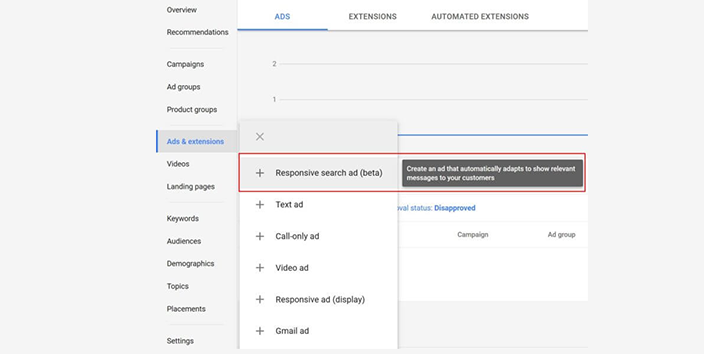
    The development team at Google AdWords seems to be coming up with new and exciting updates for its beta version of responsive test ads. In the most recent update, advertisers are now allowed to provide more than one headline for an ad. The new ad format is in sync with the proliferation of machine learning and hence offers more space for advertisers to build their headline.

    As many marketers would have seen – once they use the standard dynamic ads, they will start seeing recommended responsive ads built into their dynamic campaigns. With the dynamic nature, Google Machine Learning algorithm takes over to serve the most relevant ad likely to generate the best possible ROI on the advertising costs.

    Responsive ads are introduced to improve the overall efficacy of dynamic remarketing campaigns. It has the capability to automatically adjust to a banner ad or a dynamic text ad based on the available ad real estate.

    The changes in the new ad format

    As a part of Google initiative to let machine learning to optimise ads, it has added a slew of measures in place since last year. Be it getting rid of manual A/B testing, dynamic search ads, or automated ad rotation optimisation; there are quite a few initiatives taken by Google in this regard.

    The rationale behind multiple ads is simple – your group gets to participate in a higher volume of ad auctions. This is applicable when there are more options for the keywords to deliver the ads. Additionally, it means handing over more control from the humans to the AI-based computer systems. All these updates point to one key effect – manual A/B testing will no longer be as effective as it was before.

    The two key changes to the headlines in responsive ads are as below:

    1. Show a max of three headlines in place of the current two headlines

    2. Show a max of two descriptions (90 alphabets) in place of the current one description (max 80 alphabets) 

    Best practices for writing effective headlines

    1 – Advertisers can integrate a maximum of 15 headlines plus 4 descriptions. With this, advertisers need to add different flavours and varieties – all leading ultimately to the singular goal of achieving brand visibility

    2 – You need to provide different headlines and descriptions – such as varying between the headlines on product USP, value propositions, benefits, call to action, and features.

    3 – Remember to follow the current guidelines of writing headlines that are relevant to the keywords and having at least one keyword present in the headline

    4 – Use ‘pinning’ option when dealing with sensitive categories. Make sure to pin more than one headline and description to make the dynamic matching more effective.

    5 – Make use of the ad type column in the reporting metrics view. Under this, you can filter results for only responsive search ads. This will allow you to see the performance of the dynamic ads served by Google machine learning algorithm working in the background.

    What are your thoughts on the new updates to responsive ads on Google AdWords? Do write to us and let us know.

  • Simple ways to stay productive when the AdWords interface changes

    Simple ways to stay productive when the AdWords interface changes

    The recent change in the AdWords interface seems to be creating some ripples in the Pay-Per-Click (PPC) industry. Though it may aesthetically please some, it surely is not pleasant to PPC professionals who rely on it for their revenue generation goals.

    In order to achieve PPC optimisation, a software must adhere to two things always:

    1. It needs to save time
    2. And it needs to improve performance

    Years of experience in the PPC industry would render one the knowledge that different interfaces may be required by different account managers to achieve the goals mentioned above. To comprehend it in simpler terms, there is never one clear, distinct and precise solution to it all.

    Time is often the most crucial element out there in the world of PPC. Choosing the right tools then becomes essential for PPC professionals since it helps save time and ups the performance also.

    Here are some ways in which you can stay productive in the stir of changing interfaces.

    1. Opt for Quick win optimisations

    Perfection has always been the most sought-after virtue, and PPC professionals chase nothing else as much. One could spend hours trying to perfect an account, but the key lies in understanding that there are many aspects to perfecting an account. Devoting more than even five minutes per account could be a demanding task.

    What can be done about this then?

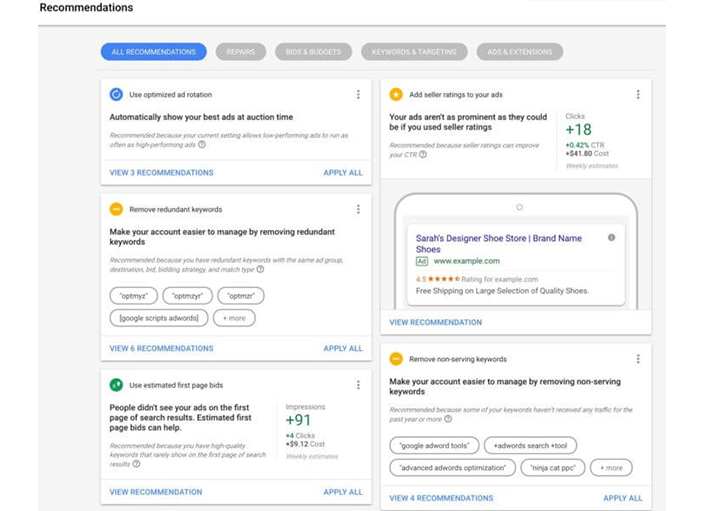
    Smaller bits done frequently does the job. Small improvements made regularly and frequently is what will reward you with better outcomes. When it comes to AdWords, a quick win could be tackling suggestions that come up in the Recommendations section. Optimisations are much focused. Instead of doing an in-depth fix-up, go for the ones that impact the most.

    1. One-click optimisations

    This can be useful when the PPC professional has time to spare. This is when going deeper and fixing a problem would be possible. Quick wins are good but when you deep dive on the basis of an approach backed by statistics, it can fix bigger and wider issues.

    In the AdWords world, this might come down to downloading many reports that consist of an endless array of data, combining them in spreadsheets and creating AdWords editor that is compatible with necessary changes.  Rather than pulling out perfect algorithms, deploying certain optimisations would save time and that is what is most important. It also leaves the final step in the hands of the users.

    1. Optimisation checklists

    While the above suggestions are time oriented, this one is not. There are several agencies who employ people with the sole motive of running through optimisation checklists. They could spend hours in AdWords, but sometimes even that may not be enough to yield satisfactory results.

    By using third party software like Optmyzr, one could reap more out of optimisation as the software would be deeply integrated with PPC engines.

    1. AdWords on autopilot

    AdWords scripts make your dream of going to that long-awaited place you always wanted to visit a reality. Automation can be risky because building an algorithm that functions and acts on every nuance of the trade the way a human mind would is difficult. However, there are many PPC tasks that do not really need that final human approval.

    For such tasks, AdWords scripts are ideal. The task could be anything from mailing keywords, generating back-office reports or even stopping campaigns that depleted their budgets. AdWords script will efficiently manage the hassle.

    So when AdWords changes its interface, you’ve really got nothing much to worry about as it would never affect your productivity. When staying at the top of your game is the concern, playing smart and not hard is what pays off.

  • Google AMP team comes up with ‘Render On Idle’ feature

    Google AMP team comes up with ‘Render On Idle’ feature

    Businesses and publishers will welcome the new move by Google AMP team that has launched some new features recently. One such feature is the ‘Render on Idle’ feature. This will load ads faster and lead to higher ad impressions when the browser is in the idle mode. The ads would load 12 viewports in this feature as opposed to 3 in the past. This facilitates better visibility on the ads because they load earlier in the page load lifecycle.

    A look at AMP

    For the uninitiated, Google AMP is an open standard that favours mobile-centric internet browsing and ad serving. An AMP page will have faster page load on mobile devices. In 2016, this technique was also integrated into search engine ranking signals and thus, impacted the SEO fortunes of companies.

    Once the AMP page is created, you can serve ads using the <amp-ad> tag. When the type is DoubleClick or DFP ads, you can turn on the ‘render on idle’ feature and start serving ads even when no other content is being loaded.

    As an outcome, there is a marked increase in the number of impressions with a limited increase in clickable impressions and eventual clicks. This is expected to provide more useful analytics to publishers too. If you are a publisher using DoubleClick AMP Ad tag or any tag that uses FastFetch ad request and rendering, then you would see the tangible effect of this feature in play. Publishers who have used this feature reported a 13% increase in impressions and 0.5% increase in clicks and viewable queries.

    There are two scenarios that will not allow ‘Render on Idle’ to run (as these force delayed Fetch which doesn’t go with this feature):

    1 – Using remote.html

    Rectify this by using Real-Time Config. This facilitates integrations with other technology partners

    2 – Using ‘useSameDomainUntilDepracated’

    Rectify this by removing this attribute from the tags and instead use SafeFrame API

    With this feature, Google and AMP are making it easier for publishers to monetise their businesses and earn potentially more from their ads. If you are on the Delayed Fetch, then you need to move to Fast Fetch for the ‘Idle on Render’ feature to take place.

  • Google Chrome’s Ad Blocker is Now Live

    Google Chrome’s Ad Blocker is Now Live


    Content marketers and publishers must have been aware of the ad blocker feature Google had announced back in June 2017. In that announcement, Google had made clear that ads that don’t conform to the Better Ads Standards as mentioned by the Coalition for Better Ads, will be blocked by the browser from 2018. True to its word, Google has made this feature live from 15th Feb 2018 onwards.

    Specification of the blocker

    Annoying ads that make for poor browsing experience will be hit the hardest by this move. Videos with loud volumes, flashing ads, prestitial ads with a countdown, or ads that do not clearly show the exit/close button, are counted as particularly annoying by the coalition and will be the first to be impacted by the ad blocker implemented into the Chrome browser.

    How can publishers track this?

    Google Search Console has an Ad Experience Report available to track ad performance. In this, publishers see a ‘warning’ or ‘failing’ assessment from Google, based on these threshold values –

    • 7.5 percent of page views in the first 2 months of the program.
    • 5 percent in the next four months.
    • 2.5 percent thereafter.

    These define poor experiences that do not match the better ad standards.

    How it works on the user end?

    The Chrome browser’s ad filter will check if the page is a part of the site that is marked as ‘failing’ or no. If this is a ‘failing’ site page and has a URL pattern that matches a known list of such ad-related patterns, then the browser will prevent the loading of the ad on that page.

    When this happens, the user gets a message where he/she can select whether to keep the ad blocked or go ahead to view it. This message is placed on the address bar (for desktop) or the bottom of the screen (for Android mobiles).

    How will this move be received?

    From a user point of view, this move is definitely getting a big thumbs-up. Users were increasingly getting annoyed with pushy ads being served on web pages. It is no wonder that the adoption of ad blockers had increased to 28% for desktop internet users and 11.8% for smartphone users. Most of the ad experiences are terrible, and this ad blocker will seek to reverse some of the negative sentiments around the digital ad based ecosystem.

    For a genuine publisher too, this move will be good news. Instead of a blanket ban on all ads served, the move seeks to penalise only those ads that are truly annoying. This way, genuine ad publishers do not get hurt because of the actions of a few dishonest advertisers.

    But it is equally true that Google sells ads and will now play a gatekeeper’s role. There will be a question of “who will guard the guardian” when it comes to the ad formats and ad content owned by Google.

    Google has stated that the step will work towards one goal – i.e. to a world where ad blocking itself will no longer be needed. And this will happen only when all ads work seamlessly without annoying the site users. Whether this goal actually materialises, only time will tell.