LS Staging

Tag: paid search

  • Connect Organic and Paid Search to Boost ROI

    Connect Organic and Paid Search to Boost ROI

    Most brands and marketers already understand how critical it is to have powerful organic and paid search strategies. After all, around 63% of the online experiences begin with a search engine, according to a report by BrightEdge.

    But if you are keeping the channel teams siloed and not integrating the two, you sure are missing out on the opportunity to boost conversions, ranking, and ROI. By connecting organic and paid search, you can effectively coordinate and streamline your search marketing strategy. At the same time, brands can also save time and money spent on content production and ads.

    But what is the most effective way to combine the two? Here are 3 of the most popular ways in which brands and marketers can combine organic and paid search-

    1. Leverage Paid Search Data for Publishing Great Content

    One of the easiest ways to connect organic and paid search is to use data from paid campaigns to publish content for your website. If you are struggling to come up with fresh content ideas to attract traffic, you can craft something around the keywords that are bringing the maximum number of PPC clicks.

    Alternatively, such top-performing keywords can also be added to the meta descriptions to boost your website’s organic ranking. The keywords and phrases that are bringing in traffic can also be explored further through additional pieces of content. For instance, if people are searching for “how” one of your products work, you can consider publishing a few instructional blogs.

    2. Encourage Return Store Visits

    According to a recent survey by American Express and Nielsen, Indian consumers spend most of their online time shopping. While shopping online, people browse through several stores before making a purchase. Unfortunately, most of the people who might have visited your online store while searching for a product might not remember your brand after a single visit.

    It is possible that the initial visit might have come from your higher organic ranking for a particular keyword. With PPC, you can target such visitors through a remarketing campaign. The website cookies record such visits and abandoned carts. Paid ads can be used for displaying products or messages to these one-time visitors throughout the Google Display network. 

    3. Merging Organic Search with PPC Bidding

    Brands can also work on a bidding strategy that can react to a particular organic data feed to boost ROIs. For instance, keywords with higher organic coverage but lower competition can be selected as higher efficiency targets to minimize ad spends. With the help of bidding strategies that revolve around auction timing, the algorithm uses intent signals collected in real-time. 

    At the same time, the attribution is driven by data to ensure that the conversion value depends on the stage at which a consumer is in their buying journey. These strategies help optimize the ad spends, allowing brands to spend more on other potential areas.

    Combine Organic and Paid Search for Improved ROI

    Several brands treat organic and paid search as different entities that need individual teams and exclusive strategies. By combining organic and paid search, brands and marketers can unleash the true potential of their search marketing campaigns and boost ROIs.

    The expertise of a reliable digital marketing company is your best bet to take maximum advantage of this combination and achieve improved results.

  • 5 Marketing Channels that Benefit from Data Collected via Paid Search

    5 Marketing Channels that Benefit from Data Collected via Paid Search

    Marketing has come a long way since the mass targeting of a few decades ago. Today, marketing is driven by customer information captured at every stage of the buying process and extensive data-backed analytics.

    Marketers no longer have to shoot in the dark – they can build accurate and customized strategies to reach their target audience precisely.

    Businesses that employ data-driven marketing strategies see a whopping 5-8X return on marketing spend. Marketers who use data-backed personalization techniques exceed their revenue goals 83% of the time.

    While most top marketers agree that data is the future of marketing, the majority fall short when it comes to leveraging the data available at hand. One area where marketers fail to make the best use of is – using data gathered from paid search for optimizing other marketing strategies.

    Paid Search – A Treasure Trove of Reliable Data

    While marketers have plenty of channels to gather customer data, search engine marketing is the most effective (and sadly, the most overlooked). Using the data from paid search, marketers can learn:

    • Searching habits of customers
    • Their buying journey
    • Their pain points
    • Demographics
    • And plenty more

    Here are a few ways in which marketers can integrate insights collected from paid search with other marketing strategies like:

    1. Retargeting

    Retargeting is the practice of reaching out to people who have already purchased from a brand or exhibited an interest in specific products or services.

    How to use data from Paid Search? Retargeting works better when you have clear insights into what a customer is looking for, the previous products purchased from you, why the customer didn’t complete the sale (their pain points/expectations), etc.

    With the data collected from paid search, you can efficiently retarget the right customer with the right offer. It helps you provide the customer with an elevated personalized shopping experience, thereby boosting conversion rates.

    2. Social

    Social media marketing is an excellent way for marketers to increase brand/product/service awareness, boost website traffic, and ultimately increase sales.

    How to use data from Paid Search? Look for keywords and ad copies that generated the maximum clicks and conversions on paid search. By adding this to social messages, marketers can replicate the success of paid search on their social marketing channels.

    3. Email

    Email thrives on personalization. Email marketing has to resonate with the recipient to engage and move them to the desired CTA.

    How to use data from Paid Search? The demographic data collected from paid search can be used in creating highly tailored emails that address the requirements/pain-points of the target audience. Additionally, the data collected can be used to create email campaigns that automatically respond based on customer action and guide them throughout the sales funnel.

    4. Amazon Shopping

    The biggest marketplace on the planet. According to a survey by Jumpshot, 54% of consumers today skip Google and other search engines and go directly to Amazon when searching for a specific product. Marketers need to amp up their Amazon marketing techniques as much as they focus on Google.

    How to use data from Paid Search? While Google and Amazon are miles apart, they share similarities. Marketers can translate what they have learned from data insights on paid search and apply it on Amazon to boost conversions.

    5. SEO

    Despite several new channels, organic search results still play a critical role in determining the online visibility of a business.

    How to use data from Paid Search? By analyzing the search volumes for specific phrases or keywords, marketers can include the phrases/keywords that work well in their SEO strategies. Additionally, paid search insights can help marketers identify which content works better with which customer segment, thereby fine-tuning their SEO approach.

    Use Cross Channel Data to Amplify Marketing Techniques

    Ultimately, irrespective of the channel marketers’ use – customers want content that delivers value to them. Instead of focusing on data derived only from a particular channel, marketers have to widen their data-handling approach.

    By using data from paid search in other marketing channels, and vice versa, marketers will be able to create consistent, relevant, and accurate messaging across channels. This, in turn, increases brand trust and value, thereby boosting conversions and winning customer loyalty.

  • Measure your conversions and track the ads on Facebook

    Measure your conversions and track the ads on Facebook

    Do you regularly advertise on Facebook? But are your ads getting you the value? Or do you properly track and measure your return on investment on these ads? It is essential that you meet the objective you are setting on Facebook to understand the value. Let’s dive in the pool of Facebook conversion and pixels that keep tracking your ads.

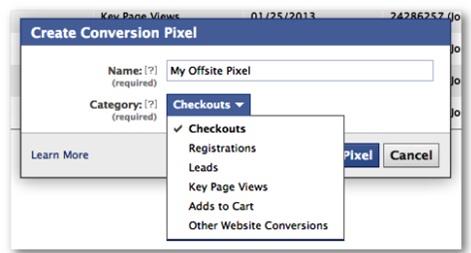
    measure-conversions-on-facebook


    What is Facebook ROI?

    You must have often heard that you cannot measure return on investment on Facebook. You can measure all the efforts you put in for Facebook advertising, especially the one that drives an action and assigns a value to it. This is done through the following parameters:

    • Conversion Tracking
    • Offsite parameters

    What is known as Conversion Tracking?

    With this Facebook allows tracking all the conversions that have happened on your FB ad.

    For example: If you ran an ad and your conversions went up 40%. But do have proof to show that these conversions were because of your ads you did on Facebook? Or could it be something that would have driven it?

    This is where conversion tracking comes into the picture. With this, you are aware along with Facebook that users visited your site from the Facebook ad. With Facebook’s pixel you also get to know that your ad was performed.

    What is a Pixel Code?

    As the name suggests, it is a code provided by Facebook to track the ad objectives and parameters. This code is placed on the desired page, to understand that users have visited the page through Facebook.

    For example- You are running a Facebook ad to sell black dresses, when a user clicks on your ad, Facebook records an ad click. The users is taken to the assigned landing page after the user has shown interest and clicked on the ad. Facebook can follow the person anywhere to a different page using the snippet of the code.

    If the Facebook pixel is placed on the web page of the black dress and if the user visits that page through the Facebook ad, then the ad is termed to be successful. The Facebook pixel can also be placed on pages that the advertiser keen to convert. It can be the information page, basket page, contact us page, payment gateway or any other page.

    Different types of Conversions and Optimized CPM

    The most amazing part about this conversion tracking is that Facebook utilizes Optimized CPM to regulate who your ad reaches out to.

    This CPM will allow all advertisers to arrange all marketing goals regarding priority and then delivers all these ads against the goals in the most efficient way. Allows the users to maximize the budget value.

    Following are the different types of conversions:

    • Checkouts
    • Leads
    • Registrations
    • Page views
    • Add to cart
    • Other website conversions/visits


    Conversion Tracking

    Facebook users perform the above-desired actions through ads that use the conversion tracking. This targets ads to consumers who are most likely to convert to sales.


  • Paid Search 2014 Vs 2013 Trends

    Paid Search 2014 Vs 2013 Trends

    Paid Search 2013 -2014 @LogicserveDigi

    More and more consumers are opting for online shopping. With this, the efficacy of paid search for online retailers keeps growing. Both mobile traffic and money spent online by mobile visitors are increasing at more than 50% YoY. Percentage of paid search is quite significant in different segments of the retail sector. Paid search also generated more revenue for companies compared to organic search.

    If you are looking to improve your online sales or your website’s search engine rank, paid search marketing is one of the great ways to improve your game. Global advertisers spent 15% more on PPC and other search advertising in Q1 2013, YoY. CTR (click through rate) has more than doubled from an average of about 5% in 2011 to 11% in 2012. Almost half of the nearly 2,000 marketers surveyed in 2012 said that they used PPC in their online campaigns.

    With Google increasingly displaying the paid search results in a manner that is hardly distinguishable from organic search results, more users find it difficult to differentiate between the two. Hence more users will continue to click on the paid results increasing the value of paid search marketing.

    2013 saw the growth of paid advertising in both Facebook and Twitter. With Facebook becoming better at targeting its ads to its users, the ROI of Facebook PPC ads should increase as well. Mobile search grew in 2013 with more consumers than ever owning smartphones and tablets. While users may browse the web via multiple devices, they are increasingly making purchases with mobile devices. So, e-commerce retailers need to have mobile-optimized websites that makes the buying process a hassle-free experience for customers.

    2014 is likely to see some new trends in paid search advertising. Expect more search optimization that is conscious of demographic data. Clearly, young people and older, wealthier people may choose to spend their vacation time in California, Florida or Disneyland differently. It would be great if ads can be targeted based on the age of the user. It might make sense to target cruise liner trips to the wealthier and older demographic and while targeting more activity-based and adventure-driven stuff to a younger demographic.

    Tracking how users use their mobile devices is critical if paid search advertisers are going to be able to allocate their ad budget effectively. Advertisers will try to get better to track user behavior on their smartphones and how they divide up their activities on different devices. Social media players (Facebook, Twitter, Pinterest, LinkedIn) are all trying to get more engagement from their users. With all of these players now becoming public companies, they’ll try to maximize their revenue with paid advertising. We’re already seeing Facebook video ads and trending topics and so on. Twitter is inserting ads into its users’ TL. Expect more innovation along these lines.

    Since advertisers want to have a good idea about how effective their ads are, search engines like Google (with their AdWords) are updating their measurement and reporting tools. Google is eager to prove the effectiveness of paid search. Both Google AdWords and Bing ads have become more flexible about how to bid across their PPC platforms. Advertisers should love the idea of being able to bid differently based on time of day, location, device, etc. Facebook has also gotten into the game of flexible bidding. This will all continue to become even more complex in 2014 with multiple layers of bidding options.

    “PLAs (product listing ads) will be moving from the right hand side of the SERP to top spots on the left and its popularity is growing and may outperform regular paid text ads,” as shared in my earlier post.