LS Staging

Tag: omnichannel marketing

  • 5 Programmatic Advertising Trend You Cannot Ignore in 2022

    5 Programmatic Advertising Trend You Cannot Ignore in 2022

    The ability to streamline ad purchases and offer audiences at scale has made programmatic a go-to digital advertising solution. While programmatic advertising is hailed across the world, Indian marketers are more heavily invested than their peers.

    According to an ExchangeWire report, only 2% of the advertisers are not using programmatic advertising in India compared to 33% in Japan, 9% in Australia, and 6% in Indonesia. But just like other advertising channels, knowing the latest programmatic trends is the first step to making it work for your business.

    Here are the top 5 programmatic advertising trends that advertisers and digital marketers should not ignore in 2022-

    1. CTV Advertising

    CTV or Connected TV advertising ruled the roost in 2021. A report suggests that between 2020 and 2021, CTV viewing increased by 31% in India. The digital transformation in the country coupled with viewers steadily switching to CTV and OTTs from conventional linear TV encouraged advertisers to add CTV to their programmatic marketing mix.

    Advertisers can tap into the vast potential of CTV advertising to make the most of their marketing budget in 2022.

    2. Omnichannel Marketing

    India has one of the fastest-growing electronic devices markets. The sales volume for smartphones, tablets, and smartwatches has been consistently rising throughout the country. With the help of an omnichannel programmatic ads strategy, advertisers can target such devices.

    One of the biggest advantages of programmatic advertising in this regard is its ability to customize the ad offerings for each device for higher engagement.

    3. Reducing the Reliance on Cookies

    Since the introduction of programmatic advertising in digital marketing, cookies have played a critical role. While Google has delayed the phasing out of 3rd party cookies to 2023, advertisers should start working on a transition strategy for the cookieless future from 2022.

    Rather than expecting a silver bullet, 2022 can be the time for advertisers to search for identification alternatives that can help them generate revenue from online advertising.

    4. Contextual Advertising

    Cookies encouraged advertisers to look past contextual targeting and focus more on behavioural targeting as it enabled advertisers to collect user information without their agreement.

    With India all set to introduce its own set of GDPR-like data protection laws, contextual advertising might be one of the biggest digital advertising trends in 2022. In contextual advertising, cookies are not required as it does not target individual users.    

    5. Mobile Gaming Advertisement

    According to a report, there are around 430 million mobile gamers in India, which is expected to surpass 650 million by 2025. Using programmatic ads on mobile gaming apps could be an effective strategy for advertisers in 2022 and beyond.

    As programmatic advertising solutions allow advertisers to reach the right audience in the right place and at the right time, using the advertising channel to reach the target audience through mobile gaming apps could deliver impressive ROI.

    Making the Most of Programmatic Advertising in 2022

    With 2022 around the corner, it is an excellent opportunity for advertisers and marketing agencies to start working on their programmatic advertising strategy for the new year. Adopting the top trends or taking inspiration from them to create a personalized programmatic strategy can effectively reach the target audience and improve ROI.

    The assistance of a reputed digital marketing company could help improve the effectiveness of your ad campaigns and unlock the hidden potential to take them to the next level.

  • How the Omnichannel Approach Improves Customer Experience

    How the Omnichannel Approach Improves Customer Experience

    A few years ago, brands offering high-quality products and world-class service were believed to have cracked the code for winning customers. After some initial success, most such brands were unable to keep the momentum.

    If it is not product or service quality, what is the single most important factor for attracting and retaining customers?

    Customer Experience is the Key

    While there are several aspects that build a successful brand, one of the top priorities should be to deliver a great customer experience.

    According to Zendesk’s Customer Experience Trends Report 2021, 72% of Indian customers have said that they are willing to spend more with a brand offering a good customer experience. Moreover, the report also suggests that 50% of the customers will switch to a competitor after just one bad experience.

    But with the number of traditional and digital channels for engaging with the brands steadily rising, especially since the pandemic, delivering improved customer experience is a major challenge. An omnichannel approach could be an effective solution. Here are some of the different ways in which an omnichannel strategy could boost customer experience-

    1. Consistent Messaging and Improved Awareness

    An omnichannel strategy aims to deliver an integrated shopping experience to the customers whether they shop from an online store or a virtual store. For instance, a customer who wants to purchase a new smartphone should have the same experience on a brand’s website, app, and even in their brick-and-mortar store.

    The approach allows the business to have consistent messaging irrespective of the channel used by the customers. As the message remains the same, it helps in improving the customer journey and often leads to increased brand awareness.

    2. Increased Number of Purchase Channels

    According to a study by Harvard Business Review, around 73% of consumers now use multiple channels during their shopping journey. In other words, it is now crucial for brands to be present across as many channels as possible to deliver an improved customer experience.

    An omnichannel strategy provides businesses with an opportunity to have a healthy presence across channels, be it on the web, mobile, or in physical stores. According to a joint study by MediaCT, Sterling Brands, Ipsos, and Google, 75% of the consumers are more likely to visit an offline store if they have come across the brand’s information online.

    Moreover, the Harvard study also suggests that omnichannel customers spend around 4% more on average every time they shop offline and 10% more when shopping online. This could lead to significant improvement in sales and revenue for the brand.

    3. Omnichannel Attribution Helps Map Customer Journey

    If you can’t measure it, you can’t improve it. Omnichannel attribution is a measurement model that brands can use to measure the effectiveness of each element of their marketing initiatives. Each channel or touchpoint that contributed to a sale can be pinpointed to understand the customer journey better.

    The information can then be used for fine-tuning the marketing strategy and deliver an improved experience to the customers. Omnichannel attribution enables brands to track how effective their online and offline initiatives are even when multiple channels are utilized.

    Improving Customer Experience with a Custom Omnichannel Strategy

    Merely being present across the channels is not adequate anymore. Customers now prefer a consistent and rewarding shopping experience across channels, which makes omnichannel marketing an excellent way to fulfil their expectations and provide them with an improved experience.

    Most brands foraying into omnichannel marketing do so with the expert assistance of reliable digital marketing companies. Experienced marketers can customize the omnichannel strategy for a brand to ensure that every initiative is fully focused on fulfilling the brand’s objectives while also delivering an improved experience to the customers. 

  • What is Omnichannel Attribution and How to Get It Right?

    What is Omnichannel Attribution and How to Get It Right?

    Fulfilling customer expectations, improving customer retention rates, and generating higher revenues are some of the primary reasons that make omnichannel marketing a must for every successful brand.

    Especially in a country like India, where consumers are inherently omnichannel and combine online and offline touchpoints before making a purchase, offering a unified experience across channels is becoming more important than ever. According to research available on Mint, around 74% of Indian consumers shop across channels, including trade outlets, local retailers, and online.

    If you are planning to implement an omnichannel strategy, how will you recognize the channels and customer touchpoints that are working and ones that are not? Will you be able to pinpoint a specific channel that is bringing in maximum conversions? Without an effective omnichannel attribution model, multichannel measurement could be very challenging.

    What is Omnichannel Attribution?

    Omnichannel attribution can be defined as a measurement model that brands can use to figure out the effectiveness of each element used in a marketing mix. It can help measure the role of every element that ultimately helped or encouraged a customer to make the purchase.

    Let’s understand this with an example.

    Tanmay, a working executive, is contemplating investing in a life insurance policy. He sees a billboard ad for an insurance product while driving through the highway on his way to work. Later in the day, he sees a TV commercial for the same product. The curiosity encourages him to search for the policy online through his smartphone and land on the same company’s PPC ads and organic search results. The following day, while browsing the web on his laptop and scouting through social media, he then sees a retargeting ad for the product. He then decides to purchase the product offline or online.

    With omnichannel attribution, brands can know the effectiveness of each touchpoint that resulted in the sale. Moreover, it can also be used for understanding how individual touchpoints assisted in improving the effectiveness of other channels.

    What are the Common Omnichannel Attribution Strategies?

    While there are a few common attribution strategies, none of them is perfect and requires customization as per the goals and expectations of a brand. Most brands work with either a digital marketing company or their internal marketing team to help them design a personalized attribution model. Here are two of the most commonly used strategies-

    • MTA

    The MTA or Multi-Touchpoint Attribution provides personal-level granular data of each touchpoint in real-time. This data can be analyzed by marketers for making changes to the live campaigns to meet customer expectations and needs better.

    But a common problem with the MTA model is it does not provide any insight into how important the role of a particular touchpoint was in the customer’s buying journey. 

    • MMM

    Unlike the MTA strategy that focuses on personal-level data in real-time, the MMM or Media Mix Modeling only considers aggregate data that has been collected over a longer duration. This makes it an effective strategy to understand the overall impact of a campaign and historical trends better.

    However, this model offers no assistance in helping brands understand the individual preferences of a customer. Also, as MMM requires long-term data, marketers cannot use it for real-time campaign optimization. 

    Measuring Impact of Each Channel with Omnichannel Attribution

    While having a multichannel presence is paramount, it is equally essential to effectively measure the impact of each channel on the customer journey. Only when a brand can measure the impact can they use the data to improve their strategies further.

    Omnichannel attribution is an evolving field that brands should make a note of when it is still in a preliminary stage as it can help make their omnichannel strategies more effective and enable them to optimize their media spends.

    Marketing experts can help brands build an effective attribution model that is customized as per their objectives so that they can accurately measure the strengths and weaknesses of their omnichannel campaigns and make them more effective.

  • The Rise of Omnichannel Marketing in the Post-Pandemic World

    The Rise of Omnichannel Marketing in the Post-Pandemic World

    With almost every country resorting to strict lockdowns for preventing the spread of coronavirus, brick-and-mortar stores had no option but to remain shut for several months. The e-commerce industry became the biggest beneficiary of the pandemic, with the likes of Amazon registering record sales and revenue.

    Apart from digital experiences becoming a more common aspect of consumers’ everyday life, the pandemic also accelerated the evolution of online channels and customer expectations. Most consumers now use multiple channels and expect a seamless and consistent experience across channels.

    Omnichannel marketing effectively targets this consumer behaviour, making it an essential tool in the marketing arsenal of every brand in the post-pandemic world.

    What is Omnichannel Marketing?

    In a nutshell, omnichannel marketing is a cross-channel strategy to improve customer experiences and drive improved relationships across digital and traditional touchpoints and channels. Every channel works in tandem with the overall marketing strategy to deliver a unified experience.

    Whether a customer is shopping online from mobile or desktop or a physical store, the experience across the channels will be seamless and consistent. Some of the basic examples of omnichannel marketing are cart abandonment emails, retargeting ads from abandoned carts, and promotional SMS messages when a customer is shopping in-store. 

    Why Omnichannel Marketing in the Post-Pandemic World?

    Here are some of the top reasons why brands should focus on building an omnichannel presence in the post-pandemic world-

    1. Delivering Personalized Communication and Experiences

    According to a Zendesk report, more than 50% of the customers in India agree that experience is now more important to them than it was a year ago. The report also suggests that 40% of the customers would prefer to shop from a different brand after just a single bad experience.

    An omnichannel marketing strategy unifies all the online and offline channels to ensure that customer experiences are consistent across platforms and devices, making it easier for brands to engage with the customers on a more personal level.

    2. Improved Engagement and Revenue

    Customers also respond much better to omnichannel strategies. As per an Omnisend report that analysed more than 2 billion campaigns, marketers using 3 or more channels generated 18.96% engagement compared to 5.4% engagement earned by marketers only using a single channel.

    Moreover, omnichannel customers also had a 250% higher purchase rate compared to single-channel customers. In other words, omnichannel marketing not only improves engagement but also encourages more purchasing, helping brands generate more revenue. As several brands were hit financially during the pandemic, an omnichannel strategy could help make an effective comeback.

    3. Data Analytics at Its Best

    Going omnichannel also extends to data analytics. Omnichannel attribution makes it possible for brands and marketers to track engagement across all the channels and touchpoints. This provides them a better understanding of the customer journey and preferred engagement channels and makes it easier for them to understand which channels/touchpoints/campaigns deliver the best results.

    All this data can then be used for fine-tuning the marketing strategy for optimizing media spends and building targeted campaigns.

    Futureproof Your Brand with Omnichannel Marketing

    While omnichannel marketing has been around for some time, it was only during the pandemic that its importance shot up due to the changing consumer habits.

    With customers getting used to the extensive range of channels and touchpoints that make their buying journey easier and more rewarding, omnichannel is all set to become a dominant marketing strategy for every successful business.

    The expertise of a reliable digital marketing company could help brands make the most of this marketing trend that is expected to revolutionize the marketing landscape. 

  • Why Should Brands Focus on Building an Omnichannel Presence?

    Why Should Brands Focus on Building an Omnichannel Presence?

    Since the introduction of e-commerce, the needs and expectations of modern consumers have evolved consistently. The COVID-19 pandemic resulted in a major shift in the consumers’ shopping patterns and their expectations from the brands.

    With physical stores shut for several months during the lockdowns, consumers went online to shop for products and services, encouraging brands to implement a digital-first strategy. Moreover, it is expected that the online shopping trend will continue well into the future and help the Indian e-commerce industry reach a new pedestal.

    According to a report on Business Standard, the e-commerce industry in the country is expected to grow 84% and reach a market size of $111 billion by 2024.

    But now that the lockdown is mostly lifted across the country, brands should focus on building an omnichannel presence to stay competitive and succeed.

    Why an Omnichannel Presence Over Multichannel Presence?

    With consumers now using multiple online and offline channels to interact with brands, businesses must have a healthy presence across all the popular channels. In short, this is what a multichannel strategy is all about.

    But a significant problem with this strategy is that businesses generally manage these channels individually, resulting in an inconsistent consumer experience. On the other hand, an omnichannel strategy unifies all the online and offline channels to provide a seamless consumer experience across platforms and devices.

    Benefits of Building an Omnichannel Presence

    Here are some of the top advantages of having an omnichannel presence-

    • Be Hypercompetitive

    24×7 customer service, personalized communication, and ease of navigation across channels are some of the things that bigger brands like Amazon have made people used to, especially during the pandemic. They now expect a similar level of service from smaller brands too.

    According to a report on CXToday, 9 out of 10 consumers want an omnichannel experience. With the help of an omnichannel strategy, brands can be present across the channels and fulfil these newly-developed consumer expectations.

    • Boost Sales and Turnover

    The “customer-first” approach of an omnichannel strategy also strikes a chord with the consumers. Needless to say, every customer would prefer brands that allow them to be in the driver’s seat. This can help a business reach new customers and turn the existing ones into loyal brand advocates.

    Once a brand starts turning into a consumer favourite, improved sales and turnover will mostly follow. In fact, omnichannel customers spend 10% more online and 4% more offline than single-channel customers, according to a study by Harvard Business Review.  

    • Increased Recommendation and References

    No matter how good or expensive your marketing initiative is, it will mostly never be able to match the word-of-mouth publicity. According to Talk Triggers’ “Chatter Matter” report, 83% of the consumers agree that word of mouth recommendations they receive from family and friends makes them more likely to purchase a product or service.

    The Harvard Business Review research mentioned above also suggests that omnichannel customers are more likely to recommend the brand to their family and friends than single-channel customers.

    The Future of Marketing is Omnichannel

    The omnichannel shopping experience is redefining the way consumers shop online and offline. It is also providing brands with intuitive ways in which they can engage with the customers. This post-pandemic period is an excellent opportunity for brands to reimagine customer touchpoints and work on creative strategies that can fulfil the updated needs and expectations of the consumers.

    While major brands like Amazon continue to raise the omnichannel marketing bar, smaller businesses can rely on digital marketing experts to continue evolving and growing.

  • Consumer Journey Mapping for Success

    Consumer Journey Mapping for Success

    Defining the buzz word Customer Journey Map?

    To phrase it in simple terms, it’s a visual representation of the customer’s experience. It should accurately reflect the entire experience right from the moment a customer makes contact with your brand, to the moment they complete a purchase (and sometimes even after sales experiences). A CJM should include customer emotions – both positive and negative.

    A CJM helps teams understand how different customer touchpoints interact with each other, the time required, and how the customer’s emotions vary throughout the experience.

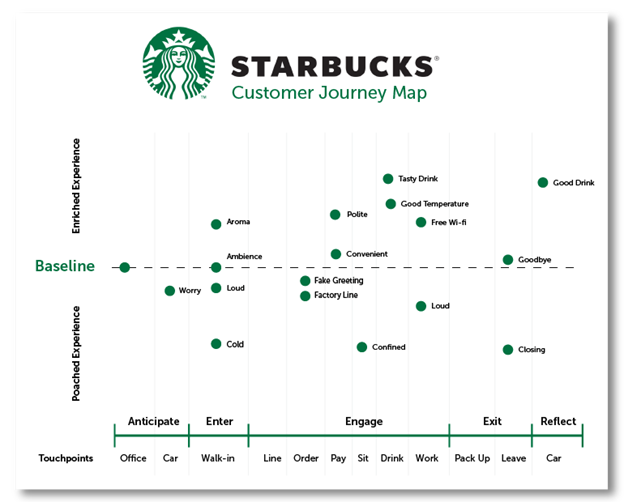
    Both Apple and Starbucks are pros in using a highly detailed model to visualize the customer experience. For instance, Starbucks starts the customer experience right from the moment a potential customer thinks about purchasing a cup of coffee.

    Using Customer Journey Mapping for Success –  

    • Look beyond data-driven principles
    • Create personalized content for digital experiences
    • Focus on the emotions & motivations
    • Focus on the overall experience, not just the journey

    https://Image via Podium

    As you can see, this map not only includes all possible emotions of the customer and various touchpoints; it also offers a baseline for what the brand considers as “an enriched customer experience.” This helps the Starbucks employees ensure that each customer gets the best possible experience at all times, thereby enhancing the brand’s value.

    It’s essential that you consider all touchpoints and customer perspectives when mapping out the customer journey. Make sure to consider the emotional journey of touchpoints to figure out the right course of action.

    Let’s understand the role of emotions in a Customer Journey

    Emotions hold the key to either make or break a customer experience. Emotions make customers decide whether they want to buy or not buy from a particular brand. Most importantly, customer emotions determine whether they want to remain loyal to a brand.

    The emotions a customer experiences while interacting with a brand can be divided into four different clusters:

    Emotion Cluster Type

    Emotions Experienced

    Value

    Advocacy Cluster Happy, Pleased Drives long-term value
    Recommendation Cluster Safe, Focused, Trusting, Valued Influences short-term spend
    Attention Cluster Interesting, Energetic, Indulgent, Exploratory
    Destroying Cluster Irritated, Hurried, Neglected, Unhappy, Stressed, Disappointed, Frustrated, Dissatisfied

    Identifying these twenty emotions that influence customer experience may not be easy at first. However, once you build a detailed CJM and understand the emotional engagement behind each touchpoint, then you can understand whether these emotions drive or destroy value for your brand.

    You can then work on building an emotional experience that is planned and deliberate and not leave it to chance.

    The Bottomline

    You would have heard the saying – conversion is king in digital sales. Most marketers and brands focus on closing a sale and converting a customer into a buyer, that they forget the most indispensable part of the journey – the customer experience.

    Booking.com is a great example of data-driven design. They do a lot of A/B testing to see how people best convert to booking flights and hotels on their platform.

    Through their tests, they’ve discovered that adding “Urgency Messaging” drives people to book more. Urgency messaging is something like “Hey this hotel has just 4 rooms left, book soon”. That’s nice, however, over the years, booking.com has added one urgency message after another, to the point where now it looks more like a shady used car lot than like a serious place to book hotels.  Most recently, it has started showing you hotels you can’t even book, just to drive home that point that “people are booking hotels here at booking.com so you should too”: And I’m sure it works to improve conversions by 0.4%. But if you look at the whole experience, it’s really starting to degrade. That’s the type of result you get when you myopically optimize your product based on data points and single-digit improvements to conversion, without considering the overall experience.(source: Medium.com)

    While it’s true that conversion rates help you determine whether a campaign, product, service, or app is successful, digital marketers have to look beyond the conversion numbers. You need to focus on the broader customer journey, so that you can continue increasing conversion rates, over the lifetime of the customer.

    Remember that for customers clicking “confirm order,” is just a single step of the journey. All other aspects of the brand – the overall experience – is what turns them from a one-time customer to being loyal to your brand, for years to come. As a digital marketer, focus on providing customers with an enriched experience, and the rest will fall into place automatically.

    Logicserve Digital is a leading Digital Marketing & Digital Consulting services company with offices spanning across India. We partner with clients all over the world to create perfect digital journeys. As Certified Adobe Partners we are growing in what we do and how we do it. We help in determining the feasibility and end-to-end requirements needed for enterprise-level CX initiatives at an early stage.

    Our Services:

    Adobe Target for Personalization

    Making every experience relevant and personal is the sign of an experience business. Adobe Target is a personalization engine that lets you test and optimize with machine learning across mobile apps and the web.

    • Take omnichannel personalization to the masses.
    • Stop guessing with A/B and multivariate testing.
    • Improve every experience with AI-powered automation and scale.

    Adobe Analytics

    • Reports & Analytics: Reporting on key digital metrics and dimensions as well as scheduling custom reports and dashboards for delivery. Ad hoc Analysis: Advanced analysis tool with rich segmentation capabilities and multi-dimensional breakdowns
    • Analysis Workspace: Robust, flexible canvas for building, curating, and sharing custom analysis projects, using various tools such as freeform and cohort analysis
    • Report builder: Excel integration for custom reporting and analysis directly in Microsoft Excel
    • Mobile App Analytics: App-centric user interface with various mobile marketing capabilities (in-app messaging, push notifications, geo-targeting, etc.)
    • Data workbench: Advanced data discovery tool for analyzing customer data across multiple channels (web, point-of-sale, kiosk, call center, IVR)

    Adobe Campaign for Customer Engagements

    • Email marketing – Good cross channel campaigns are built on email.
    • Customer journey – We know your customer’s journey matters. See the whole picture of that journey to know your customers and how they get to you.
    • Omnichannel marketing – Customers matter more than channels. So, build cross-channel campaigns that talk to your customers when and where they want.

    To know more about enhancing marketing lifecycles, please feel free to get in touch with our Customer Experience Expert – Mr. Ashish Duggal at +91 98200 55843 or write to him at ashish.d@logicserve.com