LS Staging

Tag: Google

  • Weekend Digital Media Round-up: Google Ad’s Automated Bidding Solutions, Facebook’s New Shopping Ads, Adobe’s New Customer Journey Analytics & More…

    Weekend Digital Media Round-up: Google Ad’s Automated Bidding Solutions, Facebook’s New Shopping Ads, Adobe’s New Customer Journey Analytics & More…

    1. Google Ads Offers More Choices for Automated Bidding Strategies

    Google Ads is expanding its automated bidding solutions by giving advertisers three more options to choose from. The new choices include a new way to pay for campaigns, expanded support for non-guaranteed deals and the ability to manage automated bidding at the insertion order level. [Source: Search Engine Journal]

    2. Facebook Tests New In-App Shopping Ads for Both Facebook and Instagram

    Facebook is testing out two new shopping ad options, both of which are aimed at streamlining the path to purchase, and keeping users in-app, as opposed to filtering them off to other websites. [Source: Social Media Today]

    3. Adobe adds Customer Journey Analytics, designed to be accessible to all marketers

    Adobe has released Customer Journey Analytics as part of its Adobe Analytics platform. The new analytics offering is powered by Adobe Experience Platform and is touted as an easy-to-use, interactive analytics interface that enables “anyone in an organization” to work with data, not just data scientists. [Source: Marketing Land]

    4. Microsoft opens responsive search ads beta to all advertisers

    All advertisers can now start testing responsive search ads in their Microsoft Advertising accounts. With responsive search ads (RSAs), first introduced by Google last year, the ad systems automatically serve up a combination of headlines and descriptions provided by the advertiser. [Source: Search Engine Land]

    5. YouTube Launches New, Dedicated Fashion and Style Content Hub

    YouTube is rolling out YouTube.com/Fashion, a single destination for style content on YouTube. With fashion and beauty content seeing significant increase in viewership across its platform, it makes sense for YouTube to give beauty and style videos their own dedicated focus, in order to better showcase what exactly it has on offer. [Source: Social Media Today]

    6. Microsoft Advertising Now Identifies Negative Keyword Conflicts in Shopping Campaigns

    Microsoft’s product negative keyword conflicts report shows shopping campaign advertisers which product ads are being blocked by negative keywords. The report also identifies the level at which the conflict arose, which is defined as the conflict level. [Source: Search Engine Journal]

    7. Facebook changes how it handles user location data settings in response to Android, iOS updates

    Facebook is updating how its user location settings work. Both Android and iOS are rolling out new features to give users more control over how they manage their location settings at the device level and within the individual apps being used on a device. In response, the company is changing how users manage their location data within the Facebook app. [Source: Marketing Land]

    8. Instagram Is Reportedly Working on a New Tool Which Replicates TikTok’s Key Features

    Instagram is once again replicating a competitors’ features, this time with TikTok in the firing line. It may seem a little cheap, a little tacky even to be so blatantly copying your competition. But it clearly works. [Source: Social Media Today]

    9. Google Will Now Treat Meta Robots Nofollow as a Hint

    Google Webmaster Trends Analyst Gary Illyes tweeted that Google is officially changing support for Meta Robots Nofollow. Google now treats the meta robots nofollow as a hint, similar to the behavior to the recently updated nofollow link attribute. [Source: Search Engine Journal]

    10. Facebook Adds New Tools for Public Figures, Including Multi-Contributor Stories and Product Tags

    Facebook has announced a new set of updates for public figures and they provide an interesting glimpse as to where we might see Facebook Stories, in particular, headed in the near future. [Source: Social Media Today]

  • No more accelerated Ad delivery for Search and Shopping campaigns.

    No more accelerated Ad delivery for Search and Shopping campaigns.

    Google Ads has announced its plans to switch to standard delivery of ads by 1st October.

    What is Changing?

    Earlier this month, Google announced that it plans to change the ad delivery mechanism for Google Ads campaigns. Starting 17th September, standard delivery will be the only option for new campaigns, and from 1st October, all existing search and shopping campaigns will be automatically switched to standard delivery.

    Quick Recap into Ad Delivery Mechanisms

    The ad delivery method determines how long the ad budgets last. The two options available earlier were:

    • Standard Ad delivery – Here, Google optimizes the distribution of the ad cost to make the budget last for the entire day. Here, the ads are distributed evenly throughout the day.
    • Accelerated Ad delivery – Here, the ad budget is not distributed and is likely to be exhausted before the end of the day. Works well when marketers want to show their ads on specific times of the day, say early in the morning.

    The standard ad delivery option was the default choice earlier. From this month, it will be the only choice, and from 1st October, the accelerated ad delivery option will no longer be available.

    Why is Google making this change?

    Generally, advertisers on Google Ads don’t opt for the accelerated delivery option, especially when they have limited budgets. With standard delivery, advertisers were able to generate as many conversions as possible within a specific target CPC (Cost-per-conversion). This was a tactic used by advertisers, who wanted to get the most out of their budgets.

    Google notes that the accelerated delivery option isn’t quite effective for campaigns that don’t have budget limitations. On the other end of the spectrum, accelerated delivery doesn’t work very well for campaigns that are budget limited as well. This is because using accelerated deliveries increases CPCs due to high competition early in the day, and causes the entire budget to be exhausted in earlier time zones.

    On the other hand, standard delivery considers the ad performance throughout the day and works better at maximizing ad performance, by the daily budget. When advertisers choose standard ad delivery, their budget is evenly distributed throughout the day. According to Google, this helps in optimization of spends based on user searches.

    What does Google recommend as an alternative?

    Google recommends that advertisers maximize conversions and clicks by using different bidding strategies to boost ad performance. Additionally, Google also recommends using ad scheduling to manage the optimal time for showing ads and adjust bids in accordance with the period.

    The Key Takeaway for Advertisers from this recent change

    A large number of advertisers who are used to the accelerated ad delivery option will most likely miss this feature once it goes away. However, advertisers have to understand that similar changes are likely to occur more in the future, as Google optimizes the performance of its machine learning algorithms.

    With this change, Google is signaling to advertisers that its algorithm is better equipped to optimize ad delivery based on the advertiser’s goals and other contextual signals, instead of showing the ads frequently and early in the day.

  • Weekend Digital Media Round-up: Google Ad’s Smart Bidding Strategy, Facebook’s ‘Off-Facebook Activity Tool’, Twitter’s New Video Ad Bidding and More…

    Weekend Digital Media Round-up: Google Ad’s Smart Bidding Strategy, Facebook’s ‘Off-Facebook Activity Tool’, Twitter’s New Video Ad Bidding and More…

    1. Google rolls out maximize conversion value smart bidding strategy

    Google Ads’ new smart bidding strategy is lined up. Maximize conversion value is now available in all Search campaigns which aims to optimize for the greatest conversion value within budget. [Source: Search Engine Land]

    2. Facebook’s ‘Off-Facebook Activity Tool’ disconnects user ad targeting data from profiles, doesn’t delete it

    Facebook is rolling out an Off-Facebook Activity tool that allows users to see a summary of the apps and websites that have shared their user data with Facebook and gives them the opportunity to clear the information from their Facebook accounts. [Source: Marketing Land]

    3. Twitter Launches 6-Second Video Ad Bidding, Providing New Options for Video Marketers

    Twitter is launching a new video ad option in the form of 6-second video ad bidding, which will see advertisers only charged if and when their video ad is in view for six seconds. [Source: Social Media Today]

    4. Google AdSense, AdMob rolling out system updates for preventing ad spend on invalid traffic

    Google is making system updates to fight invalid traffic and suspicious activity on its ad networks, the company announced on Wednesday. It will also give AdSense and AdMob publishers more information when ad serving is restricted as a result of these new measures. [Source: MarTech Today]

    5. Google Ads Lets Users Add Filters to the Overview Page

    Google Ads is introducing filters to the Overview page. The Overview page is the first place users land on after logging in. That means everyone interacts with this page at some point while using Google Ads. [Source: Search Engine Journal]

    6. Facebook Looks to Launch WhatsApp Payments in Indonesia

    Facebook clarified that India was not part of its initial rollout plan, which may be due to concerns around cryptocurrency from Indian regulators. WhatsApp is now also in talks with multiple Indonesian digital payment firms over plans to offer WhatsApp Pay in that market. [Source: Social Media Today]

    7. Google Search Console Shows New Image Search Data for AMP Pages

    Google has started to show data in Search Console related to a new image search feature introduced last month. Data will be tracked for images that appear on AMP pages and interacted with via Google’s new ‘swipe to visit’ feature, which is exclusive to AMP. [Source: Search Engine Journal]

    8. Google’s lightweight Go search app is now available worldwide

    Google has started the global rollout of its lightweight Go search app. As well as being designed to work on low-powered devices, the app also has a few features that the company says are designed for the needs of emerging markets. [Source: The Verge]

    9. Google Ads to remove accelerated ad delivery option next month

    Google Ads announced a coming change to ad delivery options. The accelerated delivery option will be removed and standard delivery will be the only option for Search and Shopping campaigns, as well as for campaigns with shared budgets. [Source: Search Engine Land]

    10. Google announces three big changes for developers on Google Play Store

    Google has made some silent changes for publishing new Android app on the Google Play store. The company has made it mandatory that all new Android apps would need at least three days for approval. The other two new changes will make it difficult for developers to have an accurate launch date for new games or future apps. [Source: The Times of India]

  • Google to Remove Average Position Metric in Google Ads from 30th September 2019

    Google to Remove Average Position Metric in Google Ads from 30th September 2019

    Earlier this year, in February, Google had announced that the company is planning to retire the average position metric from the Google Ads platform. In a recent post published by the search engine giant, the company has now revealed the deadline for the removal of this metric.

    When will the Average Position Metric be removed?

    The metric will be no longer functional from 30th September 2019 onwards.

    What is the Average Position Metric, and why is it Popular?

    The average position metric has been a permanent fixture in Google Ads reports and is one of the most popular metrics for nearly two decades since the Google Ads platform debuted. As the name implies, this metric denotes the average position of an ad, as it is displayed on Google’s results page.

    For instance, if the average position metric indicates a value of 3, then it means that the ad, for which the metric is used, is displayed on top of the page mostly.

    However, this metric shouldn’t be taken at face value. Since this is an average position metric – the number 3 doesn’t indicate the absolute position of the ad on the results page. For instance, an ad could be displayed in a position as low as 6 for a few impressions, but it could have a higher ranking average metric like 2 or 3. So, marketers had to take this metric with a pinch of salt, but nevertheless, it was one of the most popular metrics in Google Ads.

    Why is Google retiring this Metric?

    Google has stated that the Average Position metric is not as relevant as it was once before. Alternatively, Google has introduced two other new metrics that give marketers and campaign managers a better picture of the prominence of ads than the average position metric.

    What are the New Metrics being Introduced?

    In November of last year, Google introduced two other alternative metrics that were intended as a replacement for the Average Position metric. These two new metrics are:

    • Impression Percentage (Absolute Top) – This metric gives the percentage of impressions, for which an ad is displayed on the absolute top of the page (at position No.1)
    • Impression Percentage (Top) – This metric gives the percentage of impressions, for which an ad is displayed on the top of the page (positions No.1 to 3)

    Image via Google

    The above image shows the absolute top and top positions that are measured using this metric. Here’s how to interpret these two new metrics.

    • Receiving 75% on the absolute top metric indicates an ad occupies the top ranking for 75% of the impressions.
    • On the other hand, scoring 75% on the top metric indicates that an ad occupies any one of the top 3 positions 75% of the time.

    How do the New Metrics Impact Google Ad Users?

    Google has announced clearly that it’s retiring the old Average Position metric and it won’t be available after 30th September.

    One of the biggest benefits of the new metrics is that it doesn’t use averages. The biggest drawback of the average position metric is that the results were skewed and it was difficult for marketers to determine the actual position of ads accurately.

    The new metrics give a clearer picture on the actual placement of an ad, rather than the average numbers. This is a crucial advantage for marketers to refine their ad strategies and bids.

    How does this change Impact Digital Marketers?

    Digital marketers have to adopt the two new metrics. Also, digital marketers have to review scripts that use the average position metric and rework on these scripts to ensure that it continues working as intended, without the old metric.

  • Google Plus Officially Shutting Down: Here’s how to Download, Save and Retrieve Your Data

    Google Plus Officially Shutting Down: Here’s how to Download, Save and Retrieve Your Data

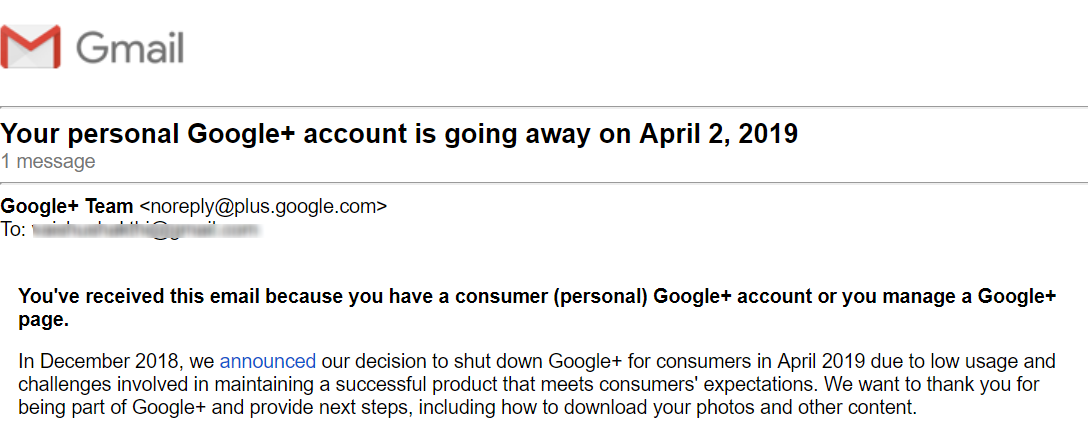
    Google recently sent an email to all users of Google+ (the social media platform of Google) announcing that the platform is officially shutting down on 2nd April 2019. Google announced the company’s decision to shut down the failed social media network in December 2018 via a blog post.

    Why is Google Shutting down Google+?

    In the recent email sent out to customers, Google states that there were several challenges in maintaining a platform that exceeds user expectations and due to low usage, the company has arrived at this decision to retire the social network from Google.

    While that may be the official reason, digital media experts believe that the platform is closing because of a data breach that occurred on it. In March 2018, more than 500,000 accounts on the platform had their personal data illegally shared to third-party developers. This data breach occurred around the same time as the notorious Cambridge Analytica data breach that brought Facebook under intense scrutiny.

    The worst part about this data breach on Google+ is that Google didn’t inform users about it for several months. Though Google claims that none of the data that was leaked was mishandled, it could result in investigations for Google both in the US and Europe.

    Another reason for the closing of the platform is poor usage. Google+ was introduced in 2011 when both Twitter and Facebook were at the top of the social media game. Despite some initial buzz, Google+ never caught on. Though Google+ never went mainstream, it has a niche community of users who prefer an alternative platform that is less crowded.

    How to Retrieve Data from Google+ before it’s Gone Forever?

    If you have saved photos or videos in your Google+ album archive, you won’t be able to access it after April 2nd. However, if you have taken a backup of these photos to your Google Photos, then you need not worry. As the photos from Google+ backed on Google photos won’t be lost.

    If you are a Community Owner or Moderator on Google+ you can download and save your data. From March 2019, you can also download additional data about your community like – photos, body and author details for all community posts.

    If you use Google+ to sign into other apps and sites, the G+ sign in button option will be removed in the coming weeks.

    If you use Google+ to post comments on sites, then you will no longer be able to do so. The option to post comments using Google+ will be removed from Blogger on 4th Feb and from other sites by 7th March. All the comments you posted using Google+ from all sites will be deleted from 2nd April.

    If you are a G Suite customer, your Google+ account for G Suite will remain open. However, Google states that G Suite will be updated soon with a new look and several new features.

    If you are a developer using Google+ sign in or APIs, check out this post from Google to find out how this shutdown will impact you.

    Key Dates to Remember:

    April 2, 2019 – Consumer Google+ accounts and Google+ pages will be closed, and Google will start the process of deleting content from individual Google+ accounts. The process of deletion of customer data will take a while, so you may be able to access some of your data after this deadline, but there’s no guarantee.

    From Feb 4th, 2019 – Users will no longer be able to create new Google+ pages, user profiles, events or communities.

    For more details about the closure of Google+ check out this FAQ section from Google.

  • Google Adds Sticky Header to Search Page

    Google Adds Sticky Header to Search Page

    Google has rolled out a couple of interesting updates to its search page. If you have recently accessed the search engine results page you must have seen that the search bar doesn’t disappear even when you have scrolled from the top of the page to the next fold. This is a part of the extensive testing it has been conducting since August this year. Now it is rolling out these updates at a universal level.

    A look at the changes

    Now when you scroll on a Google search results page, you will see that the search bar remains fixed to the top of the page. This way, if you need to quickly type a query again, you can do so without travelling all the way back to the top of the page. All you need to do is type on the sticky search bar and hit Enter. As compared to the older search bar, this is the key change that is now visible. It saves users a couple of seconds if they want to search another query. They can save time in travelling to the top of the page and type the query from the current location itself. It is interesting to note that this is for desktop- only change and no change will be visible on tablets or smartphones.

    The new design does feel a lot wobbly and might need some fine- tuning work so that it doesn’t shake so much at the time of scrolling up and down. Users might take some time to get accustomed to the new design. There is expected to be a lot of complaints that will emerge against this change. But eventually they will have to be prepared to see this update being visible for a long time.

    What are the initial reviews?

    While many customers have welcomed the change, there are many users who have complained about the new update. The constantly visible search bar at the top even after scrolling seems to be a distraction for many users. Also, users feel that there is already a way to access the search bar at all times even in the older layout, i.e. typing the search query on the address bar, which will re-direct to the Google search results page.

    However, we feel that Google has been testing this update for pretty long. Hence we can expect the changes to stay on the site for long even if the number of impressed users is a bit lower than expected.

    What else has changed?

    The search bar/ field too has undergone a design revamp. Instead of the sharp edges we are accustomed to seeing for so many years now, there has been a slight update here. It now features rounded edges on all four corners.

    What is your opinion of these new changes brought about by the search engine giant on its search engine results page? Do leave us a comment and let us know your thoughts.

  • Weekend Digital Media Round-up: Google’s updated index coverage report, Facebook’s ‘Live Video mode’ for sellers, YouTube’s Stories launch and more…

    Weekend Digital Media Round-up: Google’s updated index coverage report, Facebook’s ‘Live Video mode’ for sellers, YouTube’s Stories launch and more…

    1. Google Search Console updates index coverage report for mobile-first indexing and warns about replacing old reports

    Google has made two changes in Google Search Console over the past 24 hours. Most significantly, the index coverage report now uses mobile-first indexing data when available. Meanwhile, Google has issued notices about sunsetting old Google Search Console reports when similar reports exist in the new Google Search Console. [Source: Search Engine Land]

    1. Facebook’s Testing a New “Live Video Mode for Sellers” for Pages to Promote Products

    Facebook is testing a new element in its slowly evolving eCommerce tools with a dedicated Facebook Live mode that enables Pages to showcase products in their stream, which viewers can then easily purchase via screenshots. [Source: Social Media Today]

    1. YouTube Launches YouTube Stories, Limited to Prominent Creators Only

    This week, YouTube has announced the launch of ‘YouTube Stories’, its take on the next-gen social sharing format. You’ll soon see a new Stories bar at the top of the app, showcasing the latest Stories from creators you follow. [Source: Social Media Today]

    1. Google Takes a Bold Step Against Comparison Shopping Services

    Google has brought down the incentives substantially for retailers who benefited from deploying untrue and fake websites on price comparison for eCommerce products. This means that Google will incentivise advertisers to create price comparison sites that would be displayed on the search engine’s Shopping Box. [Source: Logicserve Digital]

    1. Is Google Image Search launching a new design for image preview?

    Google appears to be rolling out a new design for the previews within image search results. When you click on an image, instead of loading the preview in a black background frame as it did previously, Google is now showing the image preview on the right-hand side. [Source: Search Engine Land]

    1. Instagram Adds Automatic Image Descriptions to Assist Visually Impaired Users

    Facebook has been developing its image recognition capacity for some time, and is already utilizing its advanced object identification tools to help categorize and sort photos on its main app. Now, those same tools are being extended to Instagram, with the visual-focused app this week announcing the addition of automatic alternative text to provide descriptions of objects in photos via screen readers, and custom alternative text, so users can add descriptions of their photos when they upload. [Source: Social Media Today]

    1. Google Ads Can Now Count Calls from Location Extensions as Conversions

    Calls from Google Ads location extensions can now be counted as conversions as long as account-level call reporting is enabled. Google announced that this change is available to advertisers as of this week. [Source: Search Engine Journal]

    1. Google to Serve Ads Across Disney Properties Through New Partnership

    Google has formed a new global strategic partnership with The Walt Disney Company, which will allow Google to serve ads across Disney properties. Disney will bring its entire global video and display business onto the Google Ad Manager. [Source: Search Engine Journal]

    1. WhatsApp may soon rollout consecutive voice messages, group call shortcut

    Adding to a myriad of new features, WhatsApp is now reportedly working on two new features — consecutive voice messages, and a group call shortcut. The features are currently only available for beta testers of the app for now. [Source: Firstpost]

    1. Google May Support Other Types of Structured Data if it’s Used by More Sites

    Google’s John Mueller has revealed that the search engine may support additional structured data types depending on how many websites are using it. When Google thinks about what type of structured data to support next, it looks to see how many sites are actually using it. [Source: Search Engine Journal]

  • Google Takes a Bold Step Against Comparison Shopping Services

    Google Takes a Bold Step Against Comparison Shopping Services

    In a report from Sky News last month, Google has brought down the incentives substantially for retailers who benefited from deploying untrue and fake websites on price comparison for eCommerce products. This means that Google will incentivise advertisers to create price comparison sites that would be displayed on the search engine’s Shopping Box.

    It has been noticed that this move is rather a response to the penalty of €2.4 billion slapped on Google last year by the European Commission. This fine was attributed to Google’s Anti-competitive practices on the digital space.

    A background into Comparison Shopping service

    The Comparison Shopping service came into being since June 2018. The European Commission has mandated the search engine giant to provide comparison shopping services with the same chance as Google Shopping to display ads on the SERP or search engine results pages.

    Once the service was in effect, Google purportedly allowed advertising agencies to create comparison shopping sites which permitted them to tactically position ads which appeared in Google Shopping. This was done in an attempt to benefit from the incentives offered by Google, by creating fake comparison shopping sites. There have been many sites which didn’t meet the relevance factor and some didn’t even have a proper website once users were re-directed from the SERP to the site.

    Evidences and Confessions

    An ad firm, Shoptimised, admits that their comparison site was never created with the intention of serving customers. Another Ad agency happened to spill the beans to Sky News and confessed that they built a shopping service for their clients for one reason only – to avail of the incentives from Google, and not particularly to add value to a customer’s shopping experience.

    It has been revealed that Google reportedly presented a staggering sum of £32,000 to those companies who would choose to advertise through a Google-endorsed comparison shopping service. Not just that, but Google also made available a 20% off on ads to sweeten the deal all the more.

    All this has led Google to be under the constant vigilance and pressure of the European commission ruling.

    The After-effects of the Fine by European Commission

    In the light of the pressure imposed by European Commission, Google has now drastically cut the incentives offered to such Google-certified services by as much as 85%. This is because of the criticism Google happened to face ever since this serious matter has come to light.

    Google had to lower the rebate (a partial refund to someone who has paid too much for utility, tax etc.) on advertising spend from 30% down to a pitiable 5%, which was made effective from November 1st this year. This sudden reduction in incentives has left a bad taste in mouth for the ad agencies as it didn’t fit with the ROI expected from the ad.

    Companies did not assume that Google’s incentive invitation would soon come under the direct vision of the European Commission, and has eventually led to their utter dismay.

    Various claims of fake comparison shopping sites have been lodged with the European Commission. Though Google stands its guard on the fact that the actions taken by them by lowering incentives have put their actions in due compliance of the Commission’s order.

  • Adding Subdomains and Domains Together Now Possible on Google Search Console

    Adding Subdomains and Domains Together Now Possible on Google Search Console

    Digital marketers and webmasters have been using Google Search Console to better manage their websites and score well on the paid marketing and SEO parameters. There are many advantages offered by Google Search Console such as:

    1. Faster indexing

    With the ‘Fetch as Google’ functionality inside the Search Console, you can inform Google to index newly updated or newly added pages by the search bots. Without this assistance, the regular indexing process can take upto many days. However, with Google Search Console, the indexing request is processed in a matter of hours (and even instantaneously in some cases).

    2. HTTPS transitioning

    When we are moving the site from HTTP to HTTPS, Google Search Console helps make the movement easier and without any issues. Once your SSL is completely configured, all you need to do is go to the ‘add a site’ feature and claim your own HTTPS profile.

    3. Sitemaps

    Google Search Console can also be used by webmasters to submit a sitemap of the website to the search engine. All individual pages of the site can be processed appropriately using this method.

    While these strong set of functionalities do help make the web admins more effective, there are more roll-outs emerging.

    Introducing Domain property

    The research and development team at Google Search Console is assessing a unique method to enable users to seamlessly add all data for a site’s subdomains, domains, and subpaths. Google has achieved this by building and introducing Domain property – a web-based property that helps admins to accomplish this purpose.

    The Domain property combines data for the given domain, all subdomains, subpaths and protocols. All the protocol and subdomain variations for a particular website domain are integrated into the Search Console via this Domain property. An exciting aspect about this property is that it will store and allow access to all data related to all URLs without any cut-off date. A domain property is atomic, containing data of all included URLs during the lifetime of the property.

    It is obvious that the webmasters will not be able to split aggregated data by subdomain or protocol from a Domain property. They can, however, split your data by other methods.  As an additional plus point, the web admins have the facility to build distinct Search Console properties for domains that are integrated within a Domain property as per their monitoring needs.

    This feature does seem to have deeper implications from a search engine marketing perspective. We will be on the lookout for valuable comments from web admins who have tested this new module. If you have any report on the efficacy or shortcoming of this module, do feel free to share it with us in the comments box below.

  • Google Maps Introduces ‘Follow’ Feature For Businesses

    Google Maps Introduces ‘Follow’ Feature For Businesses

    Facebook’s growing clout among advertisers has been a source of concern for many leading players. One such giant is google. It has been following Facebook’s steps in various areas of business pages display and format. In the latest news, we see that the search engine pioneer has introduced a ‘Follow’ feature for Businesses in Google Maps.

    With this feature, Google Maps has been steadily evolving into a well-rounded social platform rather than just a channel to find locations or get directions. Some of the recent additions include group trip planning, ETA sharing, and music controls. Today we will take a look at how the ‘Follow’ features adds value to businesses across the globe.

    What is this feature about?

    When users click on the ‘follow’ button for a business, they can track the company more effectively. Users get to see an expanded coverage about a brand – for e.g. the latest news, upcoming events, ongoing deals and other discounts. Users can view this in the ‘For You’ tab on the Google Maps site.

    To take on rivals in effective business advertising it has now started to display an in-depth view of the business such as offers, deals, and events. Google has a definite source for taking this information. It gets this intel from Google My Business posts. These small updates of around 300 words present in Google Business Listing help the search engine to curate content that is worthy of displaying to people who are following a brand.

    Companies can also utilise Google Maps to reach more leads before they are actually open to the public. They can showcase their opening date which will begin displaying up to three months before the opening date.

    This profile will show the opening date in orange text. It will be positioned just below the business name. Users get the option to save the business to their lists. They can also view all the regular information such as address, website, photos and contact details. This helps build sufficient buzz around the store and improves your pre-launch marketing efficacy.

    Though the feature has been in the beta phase and was rolled out among a select set of brands, the official announcement came in only last week. The first OS preference will obviously be Android with a provision for extending to other OS’s later on.

    The brand new “Follow” feature is going for a phase-wise deployment strategy. In the initial phase, it is targeting some 150 million places already present on Google Maps. The button will be shown to users to seek out these businesses and help them know the brand better with useful snippets of information.

    The level of adoption by users in the future will give a glimpse of how effective the feature will be in helping Google overcome Facebook’s business page dominance. But Google is sure to keep evolving its ecosystem to make it more effective for brands and more impactful for users.

    What are your thoughts about Google Maps’ new feature? Do write to us and let us know in the comment box below.