LS Staging

Tag: google news

  • Weekend Digital Media Round-up: Google Trends get new features, Facebook’s new influencer marketing platform, Twitter’s expanded programmatic offerings and more..

    Weekend Digital Media Round-up: Google Trends get new features, Facebook’s new influencer marketing platform, Twitter’s expanded programmatic offerings and more..

    1. Google Trends gets updated with new features and design elements

    Google Trends has updated its feature set and design to provide a simpler navigation and more ways to explore data and stories around one of the world’s biggest journalistic datasets. The purpose of the new design is to help journalists build stories around data they can find in this tool. [Source: Search Engine Land]

    1. Facebook’s Coming Up With A New Influencer Platform To Expand Collaboration Options

    The market is brimming with influencers these days. Sensing the immense scope in this, Facebook – known for foreseeing trends sooner than others – is now trying to come up with new ways to attract more influencers to its network. [Source: Logicserve Digital]

    1. Twitter looking to expand its programmatic offerings with Timeline Ad network pilot program

    Twitter has started recruiting publishers to take part in a pilot programmatic ad network that will place ads in Twitter Timelines embedded in publishers’ sites. [Source: Marketing Land]

    1. Facebook and Twitter announce stricter political ad guidelines ahead of midterms

    Facebook and Twitter are clamping down on political ads ahead of the 2018 midterm elections in an effort to close loopholes that were exploited during the 2016 presidential campaign. [Source: CNBC]

    1. Microsoft acquires Semantic Machines, signaling a deeper move into ‘conversational AI’

    With the recent acquisition of Semantic Machines, Microsoft is bolstering its commitment to conversational artificial intelligence (AI). With this move, Microsoft underscores its dedication to being on the leading edge of conversational AI and commitment to Cortana, its struggling-for-market-recognition voice assistant product, and other conversational products and platforms. [Source: MARTECH TODAY]

    1. Facebook’s latest on fake news, misinformation campaigns & user privacy

    Facebook published three separate announcements covering its current efforts to stop the spread of fake news, fight misinformation campaigns and protect user safety. The overlap between these three issues has been a focus for Facebook since the company announced in March that it had suspended Cambridge Analytica for exploiting user data. [Source: Marketing Land]

    1. Gmail Adds New Tagging Options to Streamline Email Composition

    If you use Gmail – which you probably do, considering the email option has more than a billion active users – you might be interested in the app’s latest update, and specifically, some of the new functionalities they’ve added in. [Source: Social Media Today]

    1. Instagram Tests New Tools to Help Users Track Time and Usage In-App

    Instagram is testing two new features that will keep users informed of how much time they’re spending in the app, helping to improve mental wellbeing and eliminate some of the FOMO that’s come with the introduction of the Instagram algorithm. [Source: Social Media Today]

    1. New Advances Could Point to the Future of LinkedIn’s Digital Assistant Tools

    Back in 2016, LinkedIn showcased a range of then coming new features, including their LinkedIn ‘Inbot’ personal assistant tool, which, when synched with your calendar, would be able to automatically arrange meeting times for you. Thus far, we’ve not seen any real progress on this front, but this week, we may have been given a hint of where LinkedIn’s digital assistant tools are headed, with Microsoft showcasing its advanced ‘Xiaoice’ digital assistant tool which is currently in use in China. [Source: Social Media Today]

    1. Facebook Updates Two-Factor Authentication Options to Improve Account Security

    Facebook is adding new measures to improve account security, with additional two-factor authentication options now available to all users. [Source: Social Media Today]

  • Weekend Digital Media Round-up: Google’s updated GDPR guidance, Facebook’s new elements to Ads Manager, updated YouTube Red and more..

    Weekend Digital Media Round-up: Google’s updated GDPR guidance, Facebook’s new elements to Ads Manager, updated YouTube Red and more..


    1. Google issues updated GDPR guidance to publishers on how to gain consent from users

    Google has updated its cookie guidance resource, CookieChoices, to include new tips and suggestions to advertisers and publishers in advance of the May 25 deadline for enforcement of the General Data Protection Regulation (GDPR). Its GDPR updates include a link to its EU user consent policy, sample consent notices and third-party consent tools for publishers to use on their own sites. [Source: MARTECH TODAY]

    1. Facebook Adds New Elements to Ads Manager, Helping to Compare Campaign Performance

    Following the merging of Facebook’s Power Editor and Ads Manager into a single platform last year, The Social Network is now working on ways to increase the efficiency of the tool, and providing new ways to help advertisers get the most out of their ads platform. Along this line, this week, Facebook has announced three new Ads Manager options in response to user requests. [Source: Social Media Today]
    1. YouTube Announces Revision of YouTube Red, Expands Potential of TV-Like Offerings

    YouTube has this week announced an update to YouTube Red, with the ‘Red’ title being depreciated in favor of two new elements – YouTube Music, which, as it sounds, will focus on just music content, and YouTube Premium, which will cost a little more than YouTube Red, but will provide access to YouTube’s coming slate of original programming. [Source: Social Media Today]

    1. Google Duplex To Have Built-In Disclosure About Its ‘Bot’ Status

    Google’s recent update created quite a stir when it unveiled the AI based Duplex system at the I/O Conference 2018. The system can actually make phone calls in a human voice for tasks like booking a movie ticket or booking a restaurant table. Instead of the reactive chatbot conversation utilised in customer support functions, the Duplex is designed to be more proactive voice assistant to the users. [Source: Logicserve Digital]

    1. LinkedIn releases new updates to Sales Navigator, says the sales prospecting tool is GDPR-ready

    LinkedIn’s Sales Navigator is getting a refreshed lead page, new mobile account pages and more integrations with five new marketing platforms. The company also says its sales prospecting tool is GDPR-ready. [Source: MARTECH TODAY]

    1. AdWords sets parallel tracking deadline & will warn advertisers using HTTP landing pages

    Google made two announcements on Thursday. One impacts advertisers using third-party click measurement systems. The other affects advertisers who haven’t converted their sites to HTTPS yet. [Source: Search Engine Land]

    1. Facebook adds Voice Posts, Stories archive, and new cloud storage features

    Facebook is making three updates that it says will help users better “create and save memories.” The changes will let you save your photos and videos directly to your account in the Facebook cloud, share voice messages with friends, and archive your favorite Facebook Stories. The new features announced today will begin rolling out in India, before hitting the rest of world “shortly thereafter.” [Source: The Verge]

    1. Instagram Officially Launches Ability to Re-Share User Posts in Stories

    Instagram has announced that the capacity to share regular, public Instagram posts to Instagram Stories is now being rolled out to all users. The functionality was first seen in testing back in February, and it’s an interesting, though not overly ground-breaking option. [Source: Social Media Today]

    1. Google confirms it shortened search results snippets after expanding them last December

    Google has confirmed that only about five months after increasing the search results snippets, it has now decreased the length of these snippets. If you went ahead and already lengthened your meta descriptions, should you go back and shorten them now? Google’s advice is to not focus too much on these, as many of the snippets Google chooses are dynamic anyway and not pulled from your meta descriptions. [Source: Search Engine Land]

    1. Facebook expands its list of marketing partners, while limiting what view tags can do

    Facebook announced that it is expanding its list of third-party solutions to measure ad effectiveness, while at the same time, it is limiting the capabilities of its view tags feature. The company is onboarding marketing partners in three specific areas: marketing mix modeling (MMM), viewability and mobile app measurement (MMPs). [Source: Marketing Land]

  • Weekend Digital Media Round-up: Google’s multiple announcements at I/O Event, Facebook’s blockchain division, Instagram’s new business tools and more..

    Weekend Digital Media Round-up: Google’s multiple announcements at I/O Event, Facebook’s blockchain division, Instagram’s new business tools and more..

    1. Google Announces Major Tech Advances at Annual I/O Event

    Google announced a range of significant tech advances at their annual I/O developer conference this week. And while these new developments are still in their early stages, they could have major of implications – both for user discovery and consumption habits, and consequently, for digital marketers as well. [Source: Social Media Today]

    1. Facebook witnesses its biggest ever management reshuffle, launches blockchain division

    Facebook Chief Executive Mark Zuckerberg has ordered one of the biggest management shakeups in the history of the social network, giving more responsibility to his chief product officer and launching a blockchain division. [Source: ET Brand Equity]

    1. Google to stop media buyers from using DoubleClick IDs, keeping measurement & attribution within its ‘walled garden’

    Google has told media buyers who use its data transfer service that they will no longer be able to use a DoubleClick ID. Google has told its partners that beginning May 25, DoubleClick will no longer populate the encrypted UserID field that stores the DoubleClick cookie ID and mobile device IDs in DCM and DoubleClick Bid Manager (DBM) logs for impressions, clicks and site activities associated with users in the EU. [Source: MARTECH TODAY]

    1. Digital Advertising Revenue Grew 21% and Surpassed TV Ad Spend Last Year

    Despite all the worries about ad fraud, ad blocking and other ailments of the internet, the growth of online advertising seems to show no signs of slowing down. According to a new report by PwC, digital advertising revenues continued to climb in 2017, rising 21 percent to $88 billion in the U.S. [Source: Adweek]

    1. Instagram Adds New Business Tools, Including Improved Inbox Management Options

    Instagram’s rolling out a much-needed update to their messaging platform, which will help businesses make better use of the app. Now you’ll see important new customer messages in your main Direct inbox, instead of in the pending folder. You can also star and filter your conversations to come back to messages you want to follow up on. [Source: Social Media Today]

    1. Google AdWords Responsive Search Ads Now Allows 3 Headlines

    The development team at Google AdWords seems to be coming up with new and exciting updates for its beta version of responsive test ads. In the most recent update, advertisers are now allowed to provide more than one headline for an ad. [Source: Logicserve Digital]

    1. WhatsApp now lets you play Facebook and Instagram videos within the app

    WhatsApp has added support for playing Instagram and Facebook videos within the app. Now when contacts send you Facebook and Instagram videos, you can watch them inside WhatsApp without having to exit your conversation thread and go into other apps. [Source: The Verge]

    1. New AMP features announced for geotargeting content, as well as some GDPR support

    Google’s AMP (Accelerated Mobile Pages) team has announced a new component that enables users of the mobile-optimized framework to target content to site visitors based on their locations. This new “amp-geo” component allows content to be served dynamically based on the visitor’s country, inferred from the IP address. [Source: Search Engine Land]

    1. Twitter Tests Two New Interactive Options, Including Encrypted DMs

    Twitter’s reportedly working on two new features which could broaden your interactive options in the app. The first is encrypted DMs and the other messaging option Twitter is working on is the ability to add GIFs to your quote tweets. [Source: Social Media Today]

    1. Facebook lets publishers cross-post Live videos across multiple Pages & tests a rewind button

    Facebook is continuing to give Pages more video features. After announcing new video metrics last week, the platform is now making it possible to cross-post Live video broadcasts across multiple pages. [Source: Marketing Land]

  • Weekend Digital Media Round-up: Google rolls out new features in AdWords, Facebook’s AR Studio, Twitter’s Breaking News module and more..

    Weekend Digital Media Round-up: Google rolls out new features in AdWords, Facebook’s AR Studio, Twitter’s Breaking News module and more..

    1. Google targeted under EU plan to regulate search engines

    Brussels is for the first time preparing to regulate how search engines such as Google operate, under draft proposals designed to bolster the rights of businesses and app makers that rely on big internet giants to sell their services. [Source: Financial Times]

    1. Notes are coming to AdWords, plus Recommendations & an Account Performance Score

    Over the past several months, Google has been rolling out new features exclusively in the new AdWords interface, or “experience.” On Tuesday, the company announced some attention-grabbing new features aimed at improving productivity on the platform. [Source: Search Engine Land]

    1. Facebook’s Adding Image-Recognition Triggered AR Experiences to AR Studio

    Facebook has announced a new option within their suite of AR tools, adding ‘target tracking’ to their AR Studio platform which will enable developers to build AR experiences triggered by image content. [Source: Social Media Today]

    1. Google AMP Team Comes Up With ‘Render On Idle’ Feature

    Businesses and publishers will welcome the new move by Google AMP team that has launched some new features recently. One such feature is the ‘Render on Idle’ feature. This will load ads faster and lead to higher ad impressions when the browser is in the idle mode. [Source: Logicserve Digital]

    1. Chat rate is the new CTR for AdWords message extensions

    Google rolled out its click-to-message AdWords extension in October 2016. Similar to call extensions, message extensions allow users to message a business directly from the ad. Now the company is announcing formal reporting for messaging. It will be available in the next few weeks in the US, the UK, Canada, France, Brazil and Australia. Users of message extensions will need to turn on message reporting in account settings. [Source: Search Engine Land]

    1. Bringing search intent to video: Google extends custom intent audiences to YouTube, launches TrueView for Action ads

    Google unveiled two features designed to improve direct-response advertising performance on YouTube — beyond e-commerce and Shopping ad formats. [Source: Marketing Land]

    1. Google search results page displays answer without any search results

    Google is now showing answers without any additional search results for some queries. For example, if you search for [time in los angeles] or [time in new zealand], Google will show the answer, then show a button below the answer to load the search results. [Source: Search Engine Land]

    1. Twitter’s Testing Out a New Breaking News Module at the Top of User Timelines

    Looking to capitalize on its position as a key source for real-time updates on news and events, Twitter’s testing out a new breaking news module, which will highlight big news stories at the top of user timelines. [Source: Social Media Today]

    1. AdWords custom columns now available at keyword and ad levels

    Custom columns in AdWords can help marketers get more detailed insights into how their campaigns are performing based on non-standard metric targets. Now, advertisers can create and track custom metrics at the keyword and ad levels in addition to the campaign and ad group levels. [Source: Search Engine Land]

    1. Google adding business descriptions in Google My Business & local panel

    Google looks to be adding a feature in Google My Business that allows business owners to add descriptions that appear in the local panel in search results. [Source: Search Engine Land]

  • Weekend Digital Media Round-up: Google’s multifaceted featured snippets, Facebook’s new messenger business tools, New social app ‘Vero’ and more..

    Weekend Digital Media Round-up: Google’s multifaceted featured snippets, Facebook’s new messenger business tools, New social app ‘Vero’ and more..

    1. Multifaceted featured snippets begin rolling out in Google search results

    Google has been rolling out many new search features over the past few months related to images, featured snippets, and the knowledge graph. The search giant released another feature called “multifaceted featured snippets.” [Source: Search Engine Land]

    1. Facebook Adds New Messenger Business Tools as Part of Messenger Platform 2.3

    While Facebook continues to experiment with new ways to get people spending more time on their main platform, they’re also working on options to develop more business tools within Messenger. [Source: Social Media Today]

    1. Vero Is Taking On Instagram By Fixing the One Thing Everyone Hates About Instagram

    Vero is a new social media app trying to take on Instagram, Facebook and more. It’s ad-free and organized chronologically, as opposed to Facebook and Instagram’s algorithm-driven feeds. It’s also gaining steam just as many influential Instagram users are complaining about a drop in “likes” and other engagement in recent weeks. [Source: TIME]

    1. Dropbox Looks To Be Worth Nearly $10 Billion Heading Into Its IPO

    Dropbox filed for an IPO with the SEC late last week, with the intention of being listed on NASDAQ over the coming weeks under the ticker DBX. The move by the popular cloud storage company makes sense, as upbeat equity market conditions should allow it to raise the $500 million it seeks at a favorable valuation. [Source: Forbes]

    1. Twitter launches Bookmarks, a private way to save tweets

    Twitter is publicly launching its “Bookmarks” feature, which has been in testing since late last year, following the company’s HackWeek project dubbed #SaveForLater. [Source: TechCrunch]

    1. Google’s Flutter app development framework is now in beta

    Google announced the official beta release of its Flutter app development framework. It’s one way to make an app, and it’s especially well-suited to fancy user interfaces. [Source: The Verge]

    1. YouTube Adds New Live-Streaming Tools, Including Monetization Options

    YouTube’s taking their live tools to the next level. The company has announced a range of updates for their live-stream offering – and interestingly, YouTube’s live video efforts are being assisted by former Facebook Live Product Manager Vadim Lavrusik. [Source: Social Media Today]

    1. Google Assistant Gets Exciting Updates In Language Support And Routines

    In a significant push to fend competition in the AI-based voice tech space, Google recently announced a slew of measures for Google Assistant. With this move, the compatibility with Google Assistant will now reach 95% of the eligible Android devices in terms of language support. [Source: Logicserve Digital]

    1. Porsche ‘First’ To Test Blockchain Technology For Cars

    Automobile manufacturer Porsche is exploring Blockchain apps in its vehicles in cooperation with the Berlin-based startup XAIN. Possible applications for Blockchain technology range from locking and opening car doors via an app, with the possibility for temporary access authorization, to new and improved business models through encrypted data logging. [Source: Cointelegraph]

    1. Facebook launches a local news accelerator for publishers

    Facebook is trying to play extra nice with local news publishers by putting $3 million behind the launch of the Local News Subscriptions Accelerator. The three-month pilot program will help 10 to 15 U.S.-based metropolitan news organizations gain more digital subscribers both on and off Facebook. [Source: TechCrunch]

  • Google Launches ‘Allo’—A Messaging App with A Difference

    Google Launches ‘Allo’—A Messaging App with A Difference

    Tech giant Google, known for its sophisticated tech innovation, has added another feather in its cap by announcing the launch of its brand new smart messaging app— ‘Google Allo’ for iOS and Android smartphone users, worldwide.  The myriad exciting features of Allo, such as photo sharing and smart reply option with heaps of stickers and emojis make it stand out as the most brilliant messaging app in the market today.

    Google_Launches_Allo_Messaging_App

    Besides this, Allo also allows you to text your friends who are not yet using this app, via SMS. What’s more, Google Allo also features Google Assistant to assist users in making plans or finding relevant information or videos, as and when required.

    All You Need to Know about Google Allo’s Innovative Features—

    • An Extensive Assortment Of Emojis and Stylish Stickers:

    When it comes to emojis and stickers, Google Allo has the potential to outsmart all other existing messaging apps available on Play Store. To make chat sessions engaging and cheerful, Allo features a vast collection of emojis and over 25 downloadable sticker packs to suit your different moods. Allo also enables you to resize your text and the emojis you send as per your choice.

    • Share Your Photos With Friends And Family In Style:

    Google Allo not only allows you to share photos but you can also use its Doodle feature to scribble on your photos before sending them to your near and dear ones.

    Smart-reply feature: Allo’s smart-reply feature adds the ‘fun-factor’ to your chat sessions by suggesting emojis and words to include. Moreover, it also analyses photos received by you and suggests replies such as “You look beautiful”. This feature suggests texts and emojis based on your personality and the frequency of specific words used by you while chatting, such as ‘LOL’ instead of ‘Haha’, or ‘TTYL’ or ‘catch you soon’.

    • Sends Encrypted Texts To Secure Your Privacy:

    Google is concerned about your privacy. To keep your interactions safe and secure, Google Allo makes use of TLS (Transport Layer Security) technology which helps in encrypting your texts.

    • Incognito Mode to Enable You to Chat Anonymously:

    Google Allo also features an ‘Incognito’ mode to protect your privacy. By chatting in Incognito mode, you can enjoy privacy features such as—

    (i) Discreet notifications

    (ii) End-to-end encryption

    (iii)Message Expiration that automatically makes your texts disappear once the texts have expired. The expiry time ranges from five seconds to 1 week.

    • Get A Smart Personal Assistant Via Google Assistant:

    Chats generally entail making plans with friends, colleagues or clients. For example, if you are planning for a weekend luncheon with your friends or a movie date, Google Assistant will assist you by suggesting restaurants nearby, including movie times. At the same time, you can also have a one-on-one interaction with your Google Assistant in Allo.

    Though WhatsApp is already ruling the market today as the most-preferred messaging app, Google Allo’s new additional features may soon steal the limelight and take the lead globally. However, only time will tell if Allo will succeed in replacing WhatsApp or get lost in the muddle of bandwagon messaging apps.

  • User Explorer from Google Analytics Get detailed insights on your website or app user at an individual level

    User Explorer from Google Analytics Get detailed insights on your website or app user at an individual level

    Google Analytics @LogicserveDigi

    If you are using any of the marketing automation platforms or customer analytics tools like Hubspot, Pardot, Marketo, Eloqua, Kissmetrics or Mixpanel, to know the individual user behaviour on your website or mobile app, you may now want to use Google Analytics’ latest feature called the ‘User Explorer’ report instead. As the name suggests, the report provides detailed insights into an individual user’s activity on your website or the mobile app, as against the aggregate user behaviour that Google Analytics used to provide so far.  This extremely useful feature from Google is now out on beta, and is available under the ‘Audience’ menu in the Google Analytics view of your website or mobile app.

    This feature will allow marketers to understand the entire user journey and the actions taken before reaching a desired outcome. It can also help them re-engage anonymous individual customers who have not converted, through existing marketing channels. Especially for the e-commerce sites, the report can provide post-purchase behaviour of an individual customer, like the frequency of return visits and purchases, thus enabling the e-commerce players to calculate an individual customer’s lifetime value.

    What can you get from the User Explorer report?

    Overall User Analysis

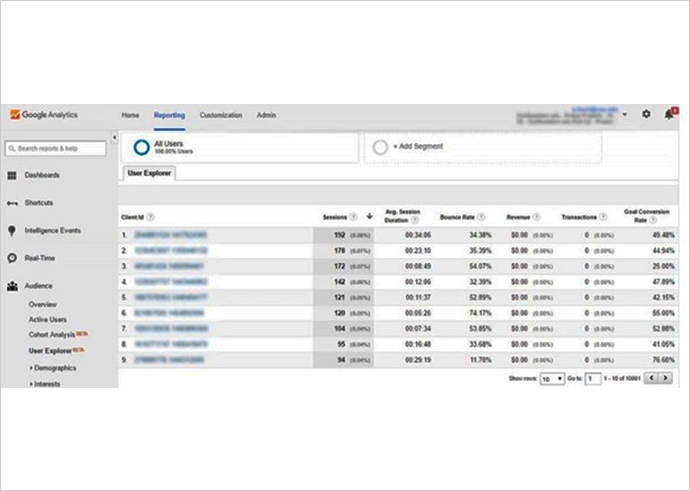
    To begin with, the default User Explorer page displays a list of client IDs collected from visitors’ devices and browsers with basic data, including count of sessions during the selected time period, average session duration, bounce rate, revenue, transactions and goal conversion rates. You can sort this list on each of these metrics, to answer questions like ‘who have visited the most often’, ‘who have spent the most time’, ‘who have had the highest no. of transactions’ or ‘who have the highest goal conversion rate’.

    user explorer google analytics @LogicserveDigi

    Multisession User Analysis

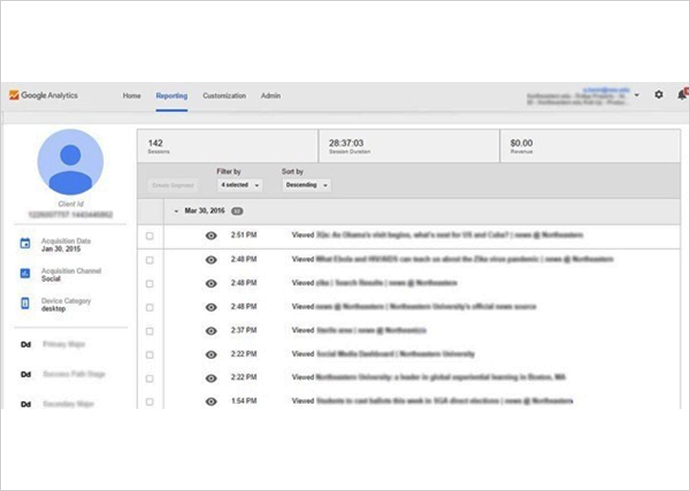
    This is where the feature adds significant value. Clicking on any of these client IDs provides the detailed analysis at an individual level, where the report displays a user’s activity in a timeline view, with key facts like the user’s acquisition date, acquisition channel, device type, and their custom dimensions. The user interactions in this view can be filtered by Pageview, Appview (available only in mobile app views), Goal, E-commerce or Event, and individual activities can be clicked for additional details.

    Google analytics news @LogicserveDigi

    The client IDs are randomly generated by Google Analytics, and thus, are completely anonymous. Though these IDs persist across multiple sessions, they change if the user changes the device or the browser to access your website or app. You can get cross-device and cross-browser user tracking, by enabling user authentication systems (like user logins) on your website or app.

    User Segmentation

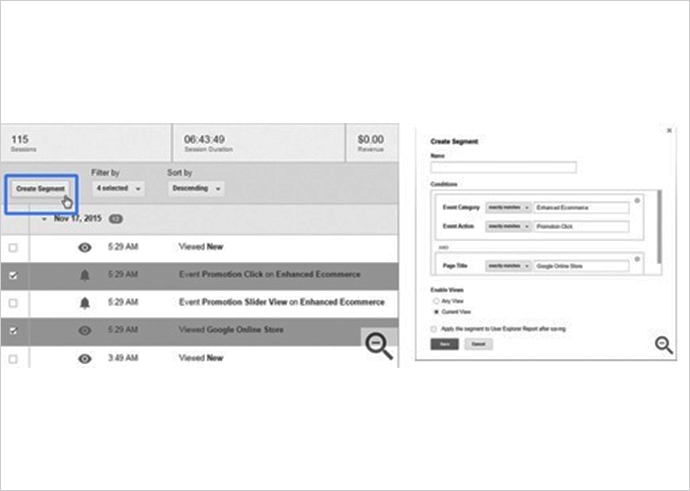
    You may be using Google Analytics user segments already, through Cohort Analysis, to study specific types of visitors, but User Explorer takes this one step further. By clicking on a combination of actions that a specific user engaged in (a certain page visit, an event triggered, specific value generated), you can create a user segment which, if applied to the entire report, will allow you to extract similar users in your audience. This will let you see how a particular user segment behaves across your site or app. You can also re-market specifically to customers of this segment.

    google analysitcs news @LogicserveDigi

    How to get the most out of your User Explorer report?

    To get the most out of this feature by Google Analytics, make sure you do the following:

    • Add “short of purchase” as a value to your goals to help you identify users close to being your customers
    • Filter out the staff and agency visits from your reports, using a filtered view
    • Create and use segments to understand different types of visitors: loyal fans, fast shoppers, international customers, anxious online shoppers, job seekers, information hunters, lowest price buyers
    • Add user authentication systems like user logins to your sites and apps to enable cross-device and cross-browser multi-session analysis


    You can imagine how useful this new feature from Google Analytics will be, right from identifying your most valuable customers, their behaviour before they reach a desired outcome, to cross-device user journeys in response to your marketing campaigns, thus knowing their effectiveness, to establishing best practices to re-market specific user segments. The User Explorer report can also help you trace inconsistencies in the UX and UI design of your website or app, based on the user experience, which can then be improved to drive higher conversions. All in all, the User Explorer report from Google Analytics can be your next starting point to build amazing experiences for your customers.

  • SEARCH COMPANION ADS – An efficient way to expand targeting options on GDN

    Google as the largest search engine is constantly on toes to develop and offer advertisers ground-breaking ways to turn up in front of the customers. Now, it has come up with a new method which targets users based on their intent, called as Search Companion Marketing or SCM on the GDN (Google Display Network).

    THE IDEA!

    The idea behind SCM is to make targeting users easier by showing ads based on the intent of the search. This is made possible by showing image and text ads on the GDN to users that put a search query on search engines such as Google, Yahoo and Bing.

    On the GDN, advertisers can choose to target keywords that are highly relevant and reach the users efficiently. For an extensive Display Ad campaign, advertisers can smoothly transition from their Display Advertising to Search Companion Ads.

    For example, a user types a query, say, “Biryani recipe”. When the search engine displays the result, he clicks on any of the organic links that are a part of the GDN. The user will see several ads about the nearby restaurants that specialize in Biryani, or the history of the Biryani and so on. Depending on which link the user chooses to click, Google AdWords will analyze your intent and signal the most relevant ad to the said intent.


    How to implement SCM in Google AdWords?

    You first need to create a campaign with keywords by targeting the GDN, to get started with SCA. Next, you need to contact the Google Representative to enable the SCM feature.


    What makes SCA’s different from Display Ads?

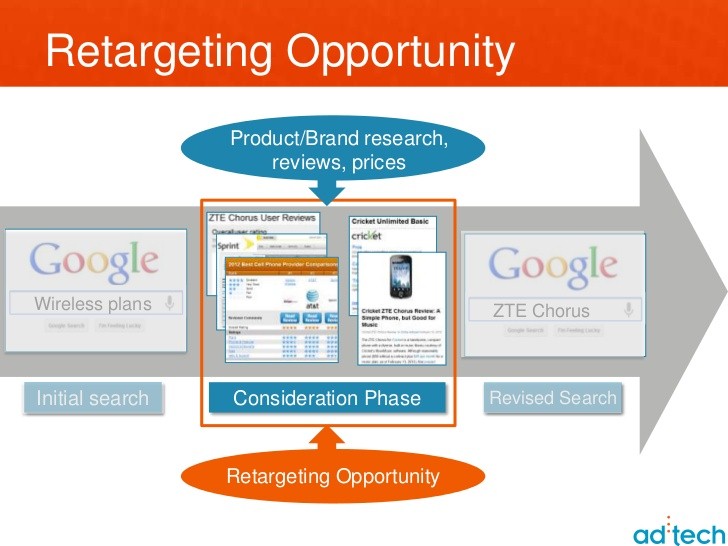
    Search Companion Marketing is about ‘remarketing’ which is more concerned about the search query of the users instead of the advertisers pages or links or forms. The user is remarketed only for the period of the online session.


    search companion ads


    Key takeaways:

    • If you have adequate conversions to get Google tracking and optimization, SCM can work efficiently for lead generation with enhanced CPC bidding
    • Advertisers who focus on lead generation can use SCA optimally
    • SCA displays ads to the searchers who have already expressed interest in the advertisers’ ad, so it flawlessly ranks them higher in the conversion funnel.