LS Staging

Tag: google analytics

  • Understanding the Customers’ Device Graphs is the key for Targeted Marketing

    Understanding the Customers’ Device Graphs is the key for Targeted Marketing

    In the purview of the growing usage of the different mobile devices among the consumers globally, cross-device identity matching has gained a huge significance among the marketers. The modern day marketers are taking the device graph serious since it provides them a solid foundation for profiling the different users based on their mobile device usage for different purposes. Today, it is nearly impossible for a business owner to get a complete picture of their existing or potential customer unless and until they track their daily activities across all devices.

    There are two major players specializing in the Device Graph, vis-à-vis Tapad and Drawbridge. There are also other companies like Criteo, which specializes in retargeting that develops Device Graphs as essential marketing tools. The big cloud companies like Adobe, Salesforce and Adobe have either developed their own tools or they have a partnership deal with vendors who develop device graphics as an integral part of their platforms.

    Mike Murphy, the Senior Marketing Manager at Drawbridge suggests that all the Device Graphs are built on a single fundamental idea, however, each developer has a different formula in terms of providing weightage to a certain attribute. Typically, there are to major techniques, which are probabilistic and deterministic and most Device Graphs use both techniques in some way or the other.

    The Deterministic technique are considered to be a gold standard since they  provide definitive results on which device the customer uses the most. This data is usually collected through the logins of the users. For instance, if the customer regularly uses his smart phone or the tablet device to log onto a particular website or portal, the brands can easily conclude that the user is most associated with that particular device. The Probabilistic technique on the other hand user the most common probable data points such as the time of the day when the device is used the most by the customer, the physical location of the device, which is derived by the IP address and the browsing patterns of the user. Murphy stated that Drawbridge has the potential to identify the device usage of an individual even if the same device is shared by other members in a household for different purposes.

    In the video below, Tapad shows the Device Graph process which are largely derived using the probabilistic technique:

    https://youtu.be/M-0P-_lFVq0

    More often than not, Device Graphs are made using both deterministic and probabilistic techniques. For example, the user’s multiple device usage can be determined with a high degree of accuracy only if one the devices was used to log into the brand’s site. That one particular device, which is used by the customer becomes the definitive association and the other devices, which are placed at the same location may be used for visiting the same website on a daily basis. This and other attributes of the device usage pattern can give the Graph-maker sufficient data to conclude that the devices belong to the same users even though he/she has used only one device to login.

    Whilst it is known that the deterministic-based approach yields more accurate results, there are many vendors who claim that the probabilistic approach has provided results that are 80 to 90% accurate. Retargeter Criteo has claimed that it considers Device Graphs to be a vital tool for its businesses and it has built the largest global scale mapping of email addresses to Cookies.

    Murphy considers the usage of Device Graphs will continue to rise in the near future and it will continue to use a combination of both deterministic and probabilistic techniques. However, one of the possible exceptions would be the usage of biometric identification for logging into the aps or the website.

  • Weekend Digital Media Round-up: Google’s new call bid adjustments in AdWords and changed Sitelinks design, Instagram’s new analytics for brands’ organic posts, LinkedIn’s Website Demographics and more…

    Weekend Digital Media Round-up: Google’s new call bid adjustments in AdWords and changed Sitelinks design, Instagram’s new analytics for brands’ organic posts, LinkedIn’s Website Demographics and more…

    1. Google has dropped Google Instant Search

    After launching Google Instant — Google’s method of showing search results as you type them — several years ago, Google has removed the feature from search. [Source: Search Engine Land]

    1. LinkedIn Provides Capacity to Add Multiple Images in a Single Post

    LinkedIn continues to add new tools and features, improving the user-experience in tiny increments, as opposed to adding in wide-scale changes. The latest addition comes in the form of multi-image posting. [Source: Social Media Today]

    1. Instagram starts sharing analytics for brands’ organic posts, Stories through API — but there’s a catch

    Instagram started sharing analytics for brands’ organic posts and Stories through the Instagram Platform API, so that brands can pull up these stats within the marketing dashboards they use to manage and monitor their various social accounts. [Source: MARTECH TODAY]

    1. Google officially changes Sitelinks design to carousel format

    Google has been testing a carousel format for these Sitelinks for over a year and today has confirmed they are now rolling out the new carousel-based design for mobile search results. [Source: Search Engine Land]

    1. Google testing list format for AdWords enhanced sitelinks

    Google is now testing a list format for enhanced sitelinks. The link font is smaller, but taken together, the list of four enhanced sitelinks takes up more real estate than the column format. [Source: Search Engine Land]

    1. YouTube Adds New Tools to Help Publishers Moderate Comments

    Over on the YouTube Help forum, the platform has announced that publishers will now be able to have comments with links or hashtags included within them to be held for review. [Source: Social Media Today]

    1. LinkedIn’s Website Demographics lets brands analyze site visitors using LinkedIn data

    LinkedIn is going to give businesses a better idea of who’s visiting their sites, such as those visitors’ job titles, company names and locations. [Source: MARTECH TODAY]

    1. Google intros new call bid adjustments in AdWords

    Google is adding a bid adjustment in AdWords specifically for calls. The bid adjustment for calls informs how often call information appears in mobile search ads. [Source: Search Engine Land]

    1. Linqia unveils ‘first’ platform for predicting influencer engagement

    Linqia is out this week with a new version of its platform that it says offers the first predictive analysis of influencers’ performance. [Source: Marketing Land]

    1. Google confirms testing auto-play videos in the search results

    Google has confirmed that they are running a small experiment where they auto-play videos in the search results page. When you do a search for some movies (and possibly television shows), Google will begin autoplaying a video in the right hand sidebar, appearing within the knowledge panel. [Source: Search Engine Land]

    Expert Opinion:

    1. Make the most out of your marketing budgets with cross-device marketing.

    Cross-device targeting is the practice to identify and deliver ads to a specific set of audience across various devices they use. Cross-device marketing is a very effective approach that marketers can use to reach the correct audience and achieve the desired results from their campaigns. Combined with device graphs, marketing professionals can correctly identify various consumer devices to connect with and measure every interaction. Combining the data from different customers across different devices, marketers can plan the campaigns efficiently and achieve positive returns on the ad spends.


    Cross-device marketing can help marketers to:

    – Deliver personalised content and provide delightful experience

    – Accurately target the audience and reduce wasted ad spends

    – Optimise business results with correct attribution

    Mastering cross-device data and managing campaigns using this data can be a game changer for making the most out of the marketing budgets. Also, with the understanding of cross-device identity, marketers can be future ready with the introduction of new devices which will open up more opportunities to target the customers in different ways.

    According to IHS, there were around 15.4 billion connected devices in 2015, and this number is projected to go up to 30.7 billion by 2020, ranging from watches to TVs to cars to home appliances. Each of these devices is an opportunity for the marketers to interact with the consumers digitally and gain possible conversions for their activities.

    Subhrangshu Neogi, Director, Head – Group Marketing & Brand, Religare

  • Will Google’s Natural Language and Machine Learning Democratize Analytics?

    Will Google’s Natural Language and Machine Learning Democratize Analytics?

    Last week, the world’s leading search engine, Google announced that it would integrate the voice-activated assistance feature in the Google Analytics in its mobile app. This comes as a great news for the users as they would now be able to ask queries in the tool using the natural language; this would make the previous structured query system outdated.

    The users can access the feature by clicking on the ‘ask a question’ section, which would soon be integrated into GA. However, Google announced that the ‘ask a question’ feature, for now, will only be available in English and it will be rolled out for all the users globally. While the feature is now going to be a reality, the concept was first announced by Google at its advertising and analytics events in San Francisco in 2016. The feature is built on the Analytics Intelligence, which was rolled out in September 2016.

    Babak Pahlavan, the head of Measurement and Analytics at Google, said that the company was highly motivated to the Analytics more user-friendly and increase its accessibility through machine learning. He further said, the machine learning capabilities of Google has significantly accelerated the development and the launch of the natural language feature.

    Several surveys have corroborated that nearly 70% of the small and medium sized (SMEs) business from around the world do not use the analytics. It is thus apparent that there is a lot of room to simplify the tool to make it more accessible for the SMEs and help the take advantage of the analytics to improve their business prospects. Pahlavan, said that with regards to the survey results, the voice-activated assistance feature would be a great boon for business owners as it would help them get answers to many of the usual business related questions.  However, you need to know that the GA voice system will not be able to answer all the questions as yet.

    For the time being, the GA voice assistance system is equipped to answer only the ‘what’ question, however, soon, Google will improve the feature to answer the ‘why’ questions, said Pahlavan. The measurement and analytics head stated that Google sees the voice assistance and machine learning as a way to simplify the GA usage and to make it more democratic in the near future. It is estimated that nearly 700,000 people from around the world use GA on their mobile devices every month, with a vast majority of the users using it every day. With the new ‘ask a question’ feature integrated on the GA app, it is sure to increase the engagement and the usage over the mobile.

  • Weekend Digital Media Round-up: Brand new Google search console, Amazon’s new Spark social feed, Snapchat’s Snap Publisher and more…

    Weekend Digital Media Round-up: Brand new Google search console, Amazon’s new Spark social feed, Snapchat’s Snap Publisher and more…

    1. Original Programming is Set to Make a Big Splash on Social Media

    With the recent announcement that Snapchat is diving into more original news programming in partnership with NBC, we’re seeing more and more investment dollars being put into custom content. Don’t expect that to slow down anytime soon. [Source: Social Media Today]

    1. Facebook plans to start testing Instant Article subscriptions as soon as October

    Facebook’s Instant Articles format may not be the revenue rainmaker that publishers had hoped for, but the company is readying another method for media companies to make money. [Source: Marketing Land]

    1. Google Analytics rolling out ‘ask a question’ to get answers instantaneously

    A little over a year ago, Google teased using natural language to get data from Google Analytics just by asking. That “asking a question” functionality has now arrived in Google Analytics and Google Analytics 360 globally. [Source: Search Engine Land]

    1. Google Introduces New, Personalized Information Feed to Improve the Utility of Their App

    As web search evolves into more predictive, intelligent models, Google’s working to evolve their app to meet the rising demands of the modern consumer. [Source: Social Media Today]

    1. Amazon’s new Spark social feed wants to be ‘Instagram for products’

    Amazon has introduced Amazon Spark, a very Instagram-like social shopping feed. Not all of the images and posts are tied to products but most are — and can be purchased on Amazon. [Source: MARTECH TODAY]

    1. LinkedIn Adds New Data Tools to Help Advertisers Maximize their on-Platform Efforts

    LinkedIn’s introducing a range of new data tools which will provide more transparency on performance, and more data for improved targeting on the platform. [Source: Social Media Today]

    1. Snapchat releases Snap Publisher: self-serve ad creation tool converts horizontal videos, websites into vertical video ads

    One of the knocks against advertising on Snapchat is that it’s hard to make ads for Snapchat. The mobile app’s insistence on vertical video compels advertisers to create campaigns from scratch rather than reusing ads that ran elsewhere. Now Snapchat is addressing that obstacle. [Source: Marketing Land]

    1. Facebook’s Removing the Ability to Edit Link Previews – Here Are Your Alternatives

    Facebook announced a pending change to their Graph API which would remove the ability for Pages to edit link previews attached to posts – that change comes into effect this week, but the backlash has lead to Facebook providing a stay of execution, of sorts, on the feature for some Pages, with a new option that will enable publishers to maintain the capacity to edit previews. [Source: Social Media Today]

    1. Google beta testing brand-new Google Search Console design

    Google is currently testing a new design and user interface for the Google Search Console. The new user interface takes a design look from the revised mobile-friendly testing tool that launched less than a year ago. [Source: Search Engine Land]

    1. Snapchat Enables Recording Beyond 10-Seconds, Adds New Creative Options

    Keeping up their pace of adding new features and tools, Snapchat’s launching two new updates this week, one of which could fundamentally change the Snap process. [Source: Social Media Today]

    Expert Opinion:

    1. How can brands use immersive marketing to provide unique customer experience and maintain brand credibility?

    Storytelling has always been an important factor for any campaigns and ads to engage with the audience, and convey the brand message effectively. However, the 2D story approach is winding down, and a three dimensional, fully immersive approach is gaining pace these days.

    Immersive technology combines virtual reality (VR), augmented reality (AR) and mixed reality (MR) to create a unique experience for the customers which is relatable, impactful, memorable and fun. VR has played a major role in changing the way marketers can play with the campaigns and provide an impactful immersive experience to the audience. As per Statista Inc., the virtual reality console market is estimated to reach 4.5 billion U.S. dollars in 2018.

    Immersive marketing can help marketers to:

    – provide a seamless experience to customers and improve brand credibility

    – provide unique content to the individual customers’ basis their preferences

    – tackle language barriers through immersive visual solutions

    – provide detailed and precise customer analytics

    Immersive marketing is changing the marketing world at a fast pace. Reports by Statista Inc. suggest that, by 2018, the number of active VR users is estimated to reach 171 million. Considering the changing customer behaviour & expectations and the way audience is adopting newer technologies, it is high time that the marketers get themselves accustomed to the immersive marketing techniques and use them to achieve optimal customer engagement and brand reputation.

    Vishwajeet Parashar, Group Marketing Head, Bajaj Capital Ltd.

  • Weekend Digital Media Round-up: Google’s New AdSense Format, Snapchat’s New Creative Tools, WeLens Video VR Software and more…

    Weekend Digital Media Round-up: Google’s New AdSense Format, Snapchat’s New Creative Tools, WeLens Video VR Software and more…

    1. IAB Tech Lab Releases MRAID 3.0 For Creating In-App Rich Media Ads Across Platforms

      The IAB Tech Lab announced the release of MRAID 3.0. This version of the Mobile Rich Media Ad Interface Definitions builds on the universal specs for creating in-app rich media ads that can automatically run in any MRAID-capable app, across devices and operating systems. [Source: MARTECH TODAY]

    1. Snapchat Adds New Creative Tools, Including Links In Snaps

      Originally, only verified users had access, but that option is becoming more widely available – now, verified users and business profiles with more than 10k followers can also use it. But still, those are fairly restrictive requirements, especially since it’s not possible to request verification. [Source: Social Media Today]

    1. 10 Simple Ways To Improve The Accuracy Of Google Analytics Data

      Often, business owners find themselves staring at the Google analytics data and are sceptic about its accuracy. The objective of this post is to help you identify the most common errors of the Google analytics data and provide you ways to fix the errors. [Source: Logicserve Digital]

    1. Google Goes After Mobile Native Advertising With New AdSense Formats

      Google is plugging the hole that has remained a key weakness in mobile advertising: native ads. On Wednesday, the company announced the launch of native ads for all AdSense publishers. [Source: Marketing Land]

    1. Google Maps Will Use Crowdsourcing To Identify Wheelchair-Accessible Locations

      Google Maps has rolled out a new editing feature that crowdsources accessibility details about locations or business listings — making it possible for anyone to add details on whether or not a place is wheelchair-accessible. [Source: Search Engine Land]

    1. WeLens Introduces Software To Manage Group Screenings Of 360-Degree Video VR

      VR is rapidly becoming a way for brands to directly demonstrate the user experience of their products, or to visualize the care with which their products were created. But, since 360-degree video VR was initially created as a solo experience, the management of group screenings has not been a top priority. [Source: MARTECH TODAY]

    1. Facebook Introduces 7 Critical Changes To Make It A Real Local Search Player

      The leading global search engine, Google has been dominating the search market shares for several years now, and all the efforts by the competitors to steal the market share has been futile. Not to mention, in the mobile search sector, Google with its 95% share holds a monopoly. [Source: Logicserve Digital]

    1. Google Posts Are Removed After 7 Days, With One Exception

      Google has confirmed that most Google Posts are removed seven days after they are first published. The exception to this rule is Google Posts that are based on upcoming events. Event-based Google Posts are removed after the event date. [Source: Search Engine Land]

    1. New Evidence Highlights The Conversion Lift Of Mobile Optimization

      No one doubts that the future of marketing is mobile. We reached a significant tipping point late last year, when mobile internet usage exceeded desktop for the first time, and usage worldwide continues to soar. Today we’re spending about 70 percent of our media time and 79 percent of our social media time on mobile. [Source: Marketing Land]

    1. Facebook Continues Video Push, Adding New Group Video App And TV-Like Content

      Back in 2014, Facebook CEO Mark Zuckerberg said that Facebook would be ‘mostly video’ within five years. Zuckerberg has described video as a ‘mega trend’, of the same magnitude as mobile, which is why they’ve made video a key focus moving forward – and why we can expect to see more video-aligned products and options added to Facebook’s repertoire as the platform advances. [Source: Social Media Today]

      Expert Opinion

    1. How can brands enhance lead generation and closure using data science?


    Data science is changing the way marketers and salespeople are approaching customers.

    It involves a variety of techniques, machine learning, data mining and statistical analysis to enable brands to understand their customers closely. These support in analyzing consumer behavioral patterns and accordingly craft communication to reach out to them. The three most common lead generation strategies utilized by brands are email marketing, search and display marketing and content marketing. All these strategies provide a lot of insightful data which can eventually help companies with their sales conversions, thanks to data science technology.

    Brands must cull various insights, build and test their hypothesis around the following:
    · Who they should target?
    · What will be the type of communication?
    · Specific landing page based on user journey.

    In the long run brands will also be able to discover statistically meaningful correlations between buyer behavior and conversion. Once the lead is generated, marketers can enhance the opportunity by researching about their customers on social media to understand their interests, likes, etc. and giving inputs to the sales team to make the interactions more meaningful.

    In future, marketing automation, nurture marketing, predictive analytics, content automation, etc. will help brands engage with their customers effectively and improve conversion.

    Mr. Siddhartha Singh, General Manager Digital & eCommerce, Eureka Forbes Ltd


  • 10 Simple Ways to Improve the Accuracy of Google Analytics Data

    10 Simple Ways to Improve the Accuracy of Google Analytics Data

    Often, business owners find themselves staring at the Google analytics data and are sceptic about its accuracy. The objective of this post is to help you identify the most common errors of the Google analytics data and provide you ways to fix the errors.

    No view filters

    View filters are of great use to segment the vast data into different relevant buckets for easy analysis. However, the amateur users do not use the filters to its fullest potential. The search and replace filters functionality greatly help in making the page requests URI easily readable. The upper and lower case filters help in making sure that the report rows do not split because of their case sensitivity. It is advisable for all the business owners and marketers to use the various filters while using the Google analytics; it will help you clean up the data and not just segment it. The view filters offer a perfect solution for cleaning up all your data.

    Filters

    While using filters is a great way to clean the data, on the flip side, the filters, if used incorrectly can be destructive. The irrevocably alter the data as it comes into the Google Analytics reporting database. The best solution to avoid losing data is always to have a single view that is not filtered by any destructive options in the configuration. You can create a quick and dirty testing view and throw all your filters there first and filter the data. Deploying the filters incorrectly can be detrimental, especially if you are dealing with historical data.

    Self-referring

    If you check the referral report and see your domain as a referral, then you would have a self-referring issue. This problem occurs because you would have no idea of the source of the traffic, which literally translates to not being able to attribute the traffic to your marketing endeavours. It would be worse if you have spent money on online marketing and you have no idea about what percentage of traffic makes up for the self-referrals.

    There is literally a sea of information available on the internet on how to fix this issue. However, experts suggest that the most common reason why this happens is that one or more than one page on your website lacks the GATC or the Google Analytics Tracking Code. The problem with not having GATC is that, if a user over the course of the time they spend on the website, visits a certain page that does not have the tracking code, then the GA would consider the previous page as exit and the next page would be considered as the entrance with your domain as the referral. GA experts have corroborated that the most common page that lacks tags is the 404 error page.

    No stripped query parameters

    The query parameters are simple, the values that are added to the URL in the format of ?key=value&key2=value2. You can strip out the view-by-view query parameters through the view setting page on the admin menu. These values mean many things and it is very common for the content management systems to use the values and the external tracking applications. The query parameters, not necessarily always dictate the content on the page; sometimes it is just the session or the user data the CMS needs to shuffle the page around. An important note – as an analyst, they hold no significance for you.

    You must know that every reporting row in your content report is unique and every combination of query parameter will have its own row, which will split the data for a page into different rows. It is quite possible that you would only look at the row for a particular page that is utilised the most and it surfaced by column sorting.

    Not having default view page

    Another effective and easy technique to clean up the day is to set the default page in the view settings. What this essentially does is, it aggregates the root domain “/” with any page that you set as the default page. For example, if you set “index.php” as the default page, the “/index.php” in the content report will be combined in with “/” into one clean row. All the query parameters that you have added will break into their own separate rows.

    A bad architecture

    Apart from the bad data, the odds are quite high that you might be looking at the wrong place. While setting up the account make sure that you name the account so that, is easily identifiable; you must know which web property or account you are referring to within 10 seconds. Setting up an account can be very basic or complex; you need to figure out a way to know how everything ties together.

    No annotations

    One of the major benefits of having annotations is that it compensates for the changes you have made to the account while viewing the historical data. You may probably remember the last couple of changes that you have made to the GA account. However, it is not possible for you to remember the changes made over the course of one year. It is literally not possible to remember all the filters that you have applied. This is where the annotation plays a vital role. While you are building historical data, the annotation will give a clear log of what the data means so that you get the right insights.

    Case sensitive campaign fumbles

    One of the best features in GA is the campaign tracking feature. However, you must know that the campaign tagging is always case-sensitive, which means that if you are launching three different campaign and you list the medium as EMAIL, Email and email, these will show as completely different mediums. It is therefore highly advisable that you have some kind of reference document that the marketing professionals can access and collaborate while creating campaign tags.

    Adding the code at the wrong place

    The best way to place the GATC on the website is quite dynamic and it keeps changing. While you are creating a web property or within your GA admin panel where the tracking code is located there is always a brief description where it exactly needs to be placed.

    Using GATC that is outdated

    This is another very common reason why the data is messed up. The javascript tracking code that you place on the page calls the Google mothership and references, which can be best described as a little web program. This program, just like any other computer program is constantly improved and on some occasions, you would need to update the GATC and take advantage of the new features of GA. Make sure that the GA code is up to date.

  • Weekend Digital Media Round-up:  Google’s new tools for advertising models, Amazon’s shoppable stickers, Pinterest’s autoplay video ads, Google Attribution and more…

    Weekend Digital Media Round-up: Google’s new tools for advertising models, Amazon’s shoppable stickers, Pinterest’s autoplay video ads, Google Attribution and more…

    1. Google Confirms It’s Rolling Out New Reviews Format For Hotels

    Google has confirmed with Search Engine Land that it is now rolling out a new user interface and feature set around local reviews for hotels. Earlier this month, we saw Google begin testing new hotel reviews features, and now Google has begun to roll them out.  (Source: Search Engine Land)

    1. Taboola’s Grid Of Recommended Stories Is Now An Infinite, Scrolling Feed

    Taboola, the grid of content discovery that appears at the end of many online stories, is today giving publishers the option of using a continuous scrolling feed. CEO and founder Adam Singolda told me that this launch represents “a whole new Taboola. (Source: MARTECH TODAY)

    1. Amazon Introduces Shoppable Stickers To Its iOS App

    The social networking apps like Instagram, Facebook, Twitter, and Snapchat have redefined the way people communicated through chat. The addition of several stickers has made talking more fun as well as there is an animation to express almost every feeling. (Source: Logicserve Digital)

    1. Pinterest Introduces Autoplay Video Ads, New Opportunities for Video Ad Exposure

    Now, when you scroll through your Pinterest feed, video content will autoplay – previously, with Pinterest’s Promoted Video and Cinematic Pins, video content would move as you scroll, but not play as such, just shift in response to your movement. (Source: Social Media Today)

    1. Google Sets Up New Tools To Power Up Its Advertising Model

    Google is expanding its local ad efforts and its store visits technology to video, allowing consumers to discover nearby retail outlets, leading to a direct path from a video ad to shopping offline. It will also help advertisers track the offline effectiveness of their video spends. (Source: Brand Equity)

    1. Google Is Extending In-Market Audience Targeting To Search Campaigns

    Google is continuing to extend its audience targeting capabilities into Search. The company announced Tuesday that In-market audiences, currently only available for Display Network and YouTube campaigns, will be coming to Search campaigns. (Source: Search Engine Land)

    1. Instagram Introduces Story Search for Locations

    In the purview of Snapchat adding the new search functionality for the stories, Instagram follow suits, and it is now giving the users the ability to search stories based on location and hashtag through their Explore section. (Source: Logicserve Digital)

    1. Types of Google AdSense Policy Violations & New Page Level Policy Action

    Google stopped serving ads on the whole site that violates AdSense policies. Google will now remove ads only from a particular page that violates Adsense policy guidelines. Having said so, Google will impose Site level actions if needed. (Source: SEO in Short)

    1. At IAB Programmatic Symposium, digital advertising looks to grow up

    About 80 percent of all online advertising is now programmatic, a status that would be cause for celebration of technological progress in any other industry. But, as Barrett and other speakers pointed out, any other industry wouldn’t have brands wondering how much their ads actually cost. (Source: MARTECH TODAY)

    1. ‘Give credit where it’s due’ says Google, as it launches Google Attribution- a free tool for marketers

    Tech giant Google has just made some key announcements at Marketing Next – its annual event where the company unveils its latest innovations for ads and analytics with insights and trends across mobile, analytics, video and platforms. (Source: AFAQS)

    EXPERT OPINION

    Q.Influencer marketing is a big buzz word right now, how do brands measure their ROI?

    Measuring the ROI of your influencer marketing activities mainly depends on the digital brief and the objective of the activity.   Influencer marketing is here to stay, as per a report from ion.co 70 percent of teenage YouTube subscribers trust influencer opinions over traditional celebrities. These influencers play a vital role in the audience’s buying decisions. However, every brand should have their objective set. You can use any of the following goals to measure ROI:-


    • If the goal of your activity is Visibility– 71 % of consumers are more likely to make a purchase based on a social media reference. Hence, it is vital to have social media and blogger influencers who also have a wider audience base along with Google Analytics on their blog. This will enable brands to know if the impressions are targeted well, along with the right communication tone
    • If the goal of your activity is Engagement– 86 % of women turn to social networks before making a purchase. Hence, Influencer marketing also is a good tactic to engage with audience. The most vital aspect is cost-per-engagement. It can be measured in the amount spent per like, comment or video view or click through, etc. Engagement is a strong indicator of how consumers perceive the brand. This insight can be used to create brand loyalists in the long run
    • If the goal of your activity is  revenue –   51 percent of marketers say that video content produces the best ROI.  Tracking revenue is quite easier than you think. These three ways can help brands-
    1. a)Use an Affiliate Link:  The unique affiliate link will help you in tracking online sales that are made through either blog posts or social media platforms.
    2. b)Use a promo code: A custom promo code will help with tracking the impact of your campaign
    3. c)Use Google Analytics: Create an event to keep a track on user journey. You can see which of your customers visited your site (e-commerce) from an influencer’s social and blog platform

    Gaurav Chopra, VP, Internet And Mobile Association of India

  • Weekend Digital Media Round-up: Twitter Adds Privacy Controls, 7 Unannounced Updates To Google My Business, Visible History of Quality Score & more…

    Weekend Digital Media Round-up: Twitter Adds Privacy Controls, 7 Unannounced Updates To Google My Business, Visible History of Quality Score & more…

    1. Distil Buys Are You A Human, Launches Free Bot Detection Plug-In For Google Analytics

    The San Francisco-based Distil is now launching a free bot detection plug-in for Google Analytics, called Distil Bot Discovery, based in part on Human’s acquired tech. Deal terms were not made public. The companies said that the new plug-in is the first of its kind for Google Analytics (Source:  MARTECH TODAY)

    1. 7 Unannounced Updates To Google My Business We’ve Seen In 2017

    We all know that Google is constantly launching updates to their products (over 1,600 last year), and some of these changes are well covered and some slip by unnoticed. Google has been quietly rolling out new features and updates to Google My Business over the last several months, and columnist Joy Hawkins has compiled these underreported changes.  (Source: Search Engine Land)

    1. Google Analytics Is Making It Easier To See Users Across AMP And Non-AMP Pages

    Currently, the way Google Analytics separates users on AMP and non-AMP pages can make it difficult to get a full picture of user behavior across the two page formats. Now, Google is updating the way it counts and reports site visitors to AMP and non-AMP pages in Google Analytics by unifying user IDs. (Source: Marketing Land)

    1. In AdWords, Google Advertisers can now see the history of quality score data

    By bifurcating the data on the day by day basis, the advertisers can see how end-of-day Quality Scores have change over a period of time. However, take note that ‘Qual. Score’ column will provide you the details of the current quality score even as you are looking at the score in a different date range. (Source: Logicserve Digital)

    1. Facebook Updates News Feed Algorithm to Further Limit the Reach of Clickbait

    Facebook’s rolling out a new News Feed algorithm update which focuses on reducing the reach of clickbait, which is still one of the most complained about elements of The Social Network.  Facebook’s been working to eliminate clickbait for years – in fact, ever since its inception back in 2013. (Source: Social Media Today)

    1. Four Valuable Tips to Turn Curious Shoppers into Customers

    With such huge growth expectation, it has become more than important than ever before for the retailers to keep the customers engaged throughout their entire shopping experience. For all the retailers out there, the following four tips will greatly help you in accomplishing this. (Source : Logicserve Digital)

    1. Google Adds More Ads To Play Store, And Other App Ads News From I/O

    Google will now show app ads on the Google Play Store home page and app listings pages. The company made several app ad announcements at the I/O developer conference Wednesday, including bidding options and a redesigned AdMob. (Source: Marketing Land)

    1. Google Confirms Jobs For Search Is Rolling Out

    A couple of weeks ago we reported Google was testing a jobs search feature directly in the search results. This would allow you to search Google for [jobs] or specific types of jobs or location of jobs and get job listings directly in the search results. (Source: SEO Round Table)

    1. Adroll Launches ABM Capabilities For Personalized Programmatic Ad Campaigns

    AdRoll has launched a set of account-based marketing capabilities. AdRoll ABM is designed to enable B2B marketers to target accounts with personalized programmatic advertising. Targeting is powered by advertisers’ own CRM data, as well as AdRoll IntentMap data for lookalike targeting. (Source: MARTECH TODAY)

    1. Twitter Adds Advanced Privacy Controls, New Data Collection Methods

    Twitter has announced a new set of advanced privacy options which provide more insight into how your data is being used by the platform, and more control over such information, while they’re also boosting their capacity to collect similar insights, based on your web usage. (Source : Social Media Today)

    EXPERT OPINION
    1. Funnel wise strategy for digital marketing – what should marketers know?

    Just because you are on digital, doesn’t mean that time worn marketing principals are irrelevant. They are more so relevant now than ever. Digital allows us to collect, track, monitor and analyse data to make better-informed marketing decisions.

    Digital mediums are only one facet of this transformation. The challenge before the marketer is to use this data, as it matures, for facilitating an omni-channel consumer journey.

    –    Mr Jaimit Doshi, CMO, Coverfox Insurance

  • Mobile Page Speed – Importance & New Industry Benchmarks

    Mobile Page Speed – Importance & New Industry Benchmarks

    Why should you care about Mobile Page Speed?

    If you are wondering how to impress the Google crawlers, first think of the user experience on your site. One of the most important factors for a better user experience is your page speed. With more than half of the searches now on mobile devices, it is imperative to work on your mobile page speeds.
    An old yet very informative post on Kissmetrics stated the following:
    • 40% users abandon a site that takes more than three seconds to load
    • A one second delay in page response time can reduce your conversions by 7%
    • If a site makes $100,000 every day, one second delay in your page load time can potentially cost $2.5 million loss in sales every year
    There are several useful articles on ‘think with Google’ that helps us understanding the importance of Mobile Page Speed and how to create a better mobile user experience.
    While users expect sites to deliver fast and frictionless mobile experiences, the reality is that most of the mobile sites don’t live up to the expectations. We put most of our efforts to manage key engagement metrics (bounce rate, average time spent on the site, etc), we often ignore the mobile experience. Not to forget, searches on mobile devices have toppled desktop searches. If not now, then never! It’s high time we start concentrating equally on improving the mobile site experience.
    One of the earlier researches from Google in 2016 stated the following facts. Although the research could be limited to US audiences, these facts are good enough for us to believe that mobile is future:-
    • 30% of all the online shopping purchases happen on mobile devices
    • 40% users leave a page that takes more than three seconds to load
    • 79% shoppers who are dissatisfied with a site’s performance say they are less likely to purchase from the same site again
    According to a recent post from Google:
    • 53% users leave a page that takes more than three seconds to load – implies the dissatisfaction level has increased from 40% to 53%
    • Even though mobile searches have toppled the desktop searches, mobile conversion rates are lower than desktop – reasons could be, users still prefer to purchase on desktop and it can also be due to the slow loading mobile pages. Speed equals revenue!
    • 70% of the pages analysed by Google, the visual content above the fold took almost seven seconds to load. And it took around 10 seconds to load the full visual on the page – implies most of the mobile pages are full of unwanted elements that take ages to load.

    What are the new Industry Benchmarks for Mobile Page Speed?

    Source : Think With Google
    Google’s research had many other important findings:
    • 70% of the mobile pages were over 1MB in size
    • 36% were over 2MB
    • 12% were over 4MB
    One should note that 1.49MB takes around seven seconds to load using a fast 3G connection. So it’s pretty clear how important it is for you to have fast loading mobile pages!
    Here is a link that can guide you on how to improve your mobile page speed:
    With Google’s mobile-first index in the reckoning, it’s a must that you start optimising your sites for a better mobile user experience. A stitch in time saves nine!


  • Ad balance from Google Adsense – Know more about it

    Ad balance from Google Adsense – Know more about it

    Google is constantly striving and evolving to provide better search results in the organic listings. Google is also emphasizing the importance of better content and fast loading site pages. Ultimately all these efforts lead to better user experience. Google also tries to add related features to its products.

    Google Adsense is one such product that has constantly evolved in terms of bringing updates in the direction of better user experience. Google’s official blog for Adsense related information, Inside Adsense; posted an update on 13th January 2017 about Ad Balance.

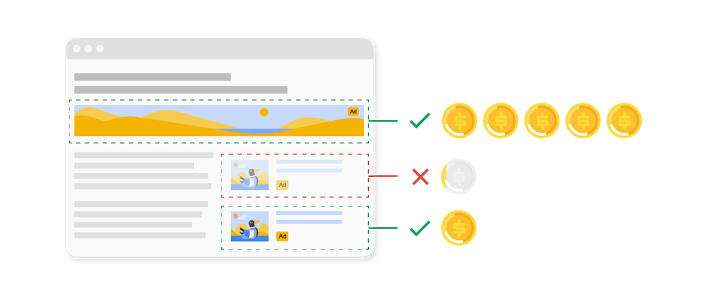
    Ad balance is a feature introduced to give more controls to publishers to provide better ads experience to site visitors. If you frequently visit the new interface of your Adsense account, you might have observed a new subtab named Ad balance under My ads.

    It is very important to find the right balance between the user experience on your site and number of ads you show. Ad balance helps you adjust the volume of ads which can lead to a better user engagement with your content.
    One need to note that this feature would help you showcase your best performing ads but that could also result in a minimal drop in earnings. But if you see the larger picture, with a better user experience, one could stay longer on your site and engage more with your content. This in turn can lead to better earnings in the long run.
    Some other important factors you need to note here:
    • If you have already enabled the Show fewer ads lab, you would be automatically moved to Ad balance feature
    • When ads are removed, the ad unit will show as blank
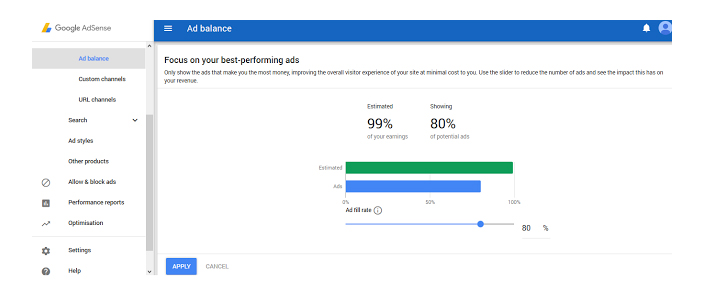
    Now let’s see how the feature looks like:
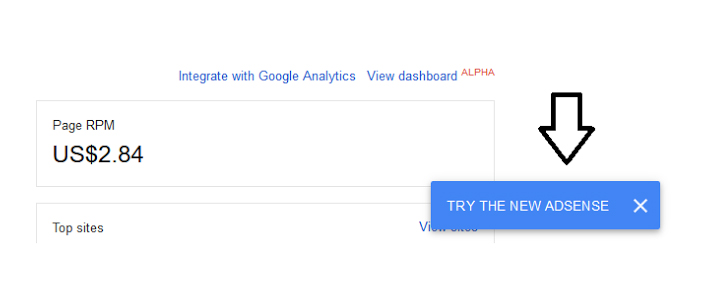
    If you haven’t yet moved to the new Adsense interface, just click on this option that would appear on your old Adsense interface.

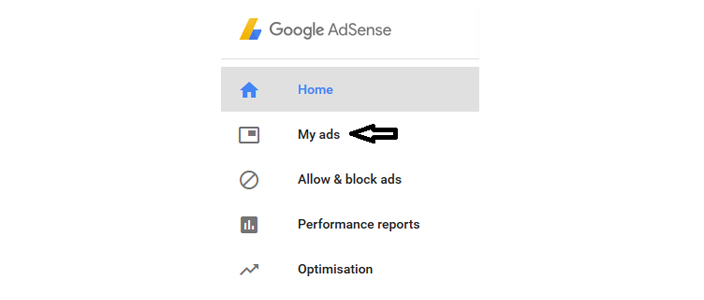
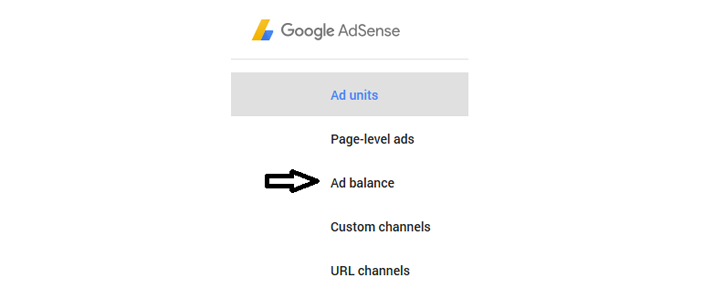
    Click on My Ads under the menu of your new Adsense interface. Then click on Ad balance subtab. You would see a slider for Ad fill rate. This determines how often the ad space on your site is filled with ads.

    For example, you would want to allow 80% potential ads on your site instead of 100%. Use the slider to set the Ad fill rate to 80%. This would fill your page with highest paying ads for up to 80% of the time.
    Worth trying out. If it would add value to the overall user experience, it should ideally help you increase your Adsense revenue. But please note, Google doesn’t guarantee any specific results. Your Adsense revenue depends on various other factors that can include your content, ad placements, site layout, etc.
    The post originally appeared here.