LS Staging

Tag: facebook

  • Weekend Digital Media Round-up: Google’s enhancements for ads, Facebook’s new in-app 360 photos, LinkedIn’s native videos for all users and more..

    Weekend Digital Media Round-up: Google’s enhancements for ads, Facebook’s new in-app 360 photos, LinkedIn’s native videos for all users and more..

    1. Google announces AMP speed and viewability enhancements for ads

    Google’s AMP (Accelerated Mobile Pages) group announced enhancements to ads served in AMP. Specifically, the project has entered phase two of its three-phase plan for supporting comprehensive advertising functionality in AMP. [Source: Search Engine Land]

    1. Facebook’s Adding Publisher Logos to News Links to Reduce the Reach of Misleading Content

    As part of their ongoing efforts to combat fake and misleading content on their platform, Facebook has announced the latest option to better inform users – the addition of publisher logos next to links in Trending and Search. [Source: Social Media Today]

    1. IAB releases its first ‘Podcast Playbook’ guide for marketers

    The podcast has taken another step toward becoming just another marketing channel, with the release today of the Interactive Advertising Bureau (IAB)’s first buyer’s guide for podcast advertising. [Source: MARTECH TODAY]

    1. LinkedIn’s Rolling Out Native Video to All Users

    LinkedIn has now announced that all users will soon be able to post video to the platform, moving in-line with the broader video content shift. [Source: Social Media Today]

    1. Facebook now lets you take 360 photos in-app, use them as Cover Photos

    Facebook has been a big supporter of 360-degree photos and video, adding support for the immersive media formats early on Facebook itself. Now, the social tech company is adding support for capturing 360-degree photos right within the Facebook app itself. [Source: TechCrunch]

    1. Walmart offering voice shopping via Google Assistant and Home

    Google and Walmart have announced a partnership to bring Walmart voice shopping to the Google Assistant and Google Home. Free delivery will also be available through Google Express, which is changing its pricing structure. [Source: Search Engine Land]

    1. Google making renewed effort to help news publishers drive more subscriptions

    Google has always been treated by the news industry as a kind of frenemy. Many news organizations have a tortured history with Google, including some who’ve successfully lobbied against Google in Europe. Yet for roughly a decade Google has been trying to help publishers make more money while continuing to try and serve users and its own commercial interests. [Source: Search Engine Land]

    1. WhatsApp adds new coloured text-based Status, brings it to desktop as well

    WhatsApp has announced the coloured text-based Status updates for its users. The feature is similar to how it works on Facebook, where users can add a coloured background when uploading a text based status update. [Source: Indian Express]

    1. Google auto-playing video previews in search results carousel on Android

    Google announced they have added video previews to the video carousel that shows up in the search results. Currently, this only occurs when you are using the Google app for Android or using Chrome on Android. [Source: Search Engine Land]

    1. Google May Lose Trademark Rights to Its Own Name, Here’s Why

    A trademark lawsuit before the Supreme Court alleges the word “Google” has become too generic, and is therefore no longer eligible for trademark protection. [Source: Search Engine Journal]

    Expert Opinion:

    1. Data driven Personalization is the key to effective digital marketing campaigns

    Personalization in marketing has been the most talked about topic recently and is quickly gaining popularity as an effective marketing tool for brands. Technology has enabled consumption of content at a personal level. The consumer preference is often revealed voluntarily and sometime with incentives. And the same technology has enabled recording & analyzing those preferences, quirks, behaviours, moods, mood swings, for most touch points. With new technologies and advances in the digital marketing field, the possibilities of personalizing marketing communication and campaigns are also expanding. According to a recent study conducted by PWC’s Digital Services group, 94% of senior-level executives believe delivering personalization is critical or important to reaching customers.

    Amongst the clutter of each touch point, if we believe that personalized communication is the only way to gain that fleeting moment of attention, then data driven personalization is the only medium which can help achieve that objective and thereby make Marketing dollar more effective.

    Personalization helps you understand your consumers well which enables you to assist them in providing a seamless customer journey, and helps you differentiate yourself from your competitors. Having said that Every data point recorded doesn’t and will never create a ‘conversion’ or a result that has a monetary value attached to it. But every data point is a building block in the path to the holy grail of personalization where we have true one to one communication and continuous optimization basis behaviour or preferences that are revealed

    Some of the benefits you can reap from data driven personalized digital marketing campaigns are:

    – Drive conversions and increase sales

    – Build long-term and stronger relationships with customers

    – Significant boost in customer engagement

    – Improved customer experience

    – Better customer retention

    – Increased customer loyalty

    Brands need to cautiously use customer data and understand their preferences. This will assist the brand in designing effective marketing strategies that can promote positive communication with their consumers. This, in turn, can help them with improved conversions.

    In a landscape where customer touch points are competing with each other to get customer attention, it is imperative for a marketer to measure the success of each such points of contact Quantifying results of a marketing intervention & then connecting it to business levers is hence a necessity for the marketer to function effectively

    With the rising popularity of digital media and the customers’ inclination towards using multiple devices, the scope of data driven personalization is not limited to selection of the Target Audience or the point of contact or the relevance of the communication – it has to cover the entire life-cycle of a marketing intervention to provide a flawless experience across multiple devices/ touch points.

    Econsultancy’s Internet Statistics Compendium suggests that programmatic and personalization experiences which emphasize on customers could provide anywhere from 2x to 14x more incremental revenue per visitor (RPV) compared to traditional optimization efforts that focus mainly on cosmetic changes.

    In the rapidly growing digital age, brands who thrive on user insights and data to drive customer engagement and sales for the businesses are sure to stand out in the future.
    Manish Dureja, Managing Director, JetPrivilege

  • Facebook Chatbots – The Advantages, the Drawbacks and the Future

    Facebook Chatbots – The Advantages, the Drawbacks and the Future

    In 2016, when the CEO of one of the world’s largest conglomerates, Mark Zuckerberg, the founder of Facebook announced the Chatbot feature for its Messenger app, it came as a great technological revelation. It was specially designed to automate the process of responding the customers’ queries and inquiries; the manual answering processing was replaced by the bots. The primary purpose of introducing the Chatbot was to give the bigger brand the opportunity to engage with their customers in real time.

    Since its advent, several marketers around the world have started using this technology to improve their customer relationships and boost conversations. If you are looking to introduce the technology for your own brand, it would first help you to know what the technology holds for the future and how you can use the Chatbot to its maximum potential for improving your business prospects.

    The current scenario

    Before we delve into looking into the future of the technology, let us take a look at the present scenario. Quite honestly, the launch of the technology has been quite rocky, to say the least. Many of the bots launched initially had a lot of bugs, and many customers said that they felt the bots were more annoying than being helpful. Facebook itself has admitted that the Chatbot feature or the artificial intelligence has not gained enough prominence yet to dominate the market as it was expected to do. However, this does not mean that the future of this feature is bleak. Over the past one years, Facebook has been working incessantly on improving the technology and make it faster and smarter. The artificial technology surely promises to be a major force in the future, and therefore it would be only wise for the businesses to start deploying the technology and roll with the new developments as they come along. Having said this, the artificial intelligence technology is not meant for everyone. Below mentioned are its advantages and drawbacks for the businesses.

    The Pros of Facebook Chatbots

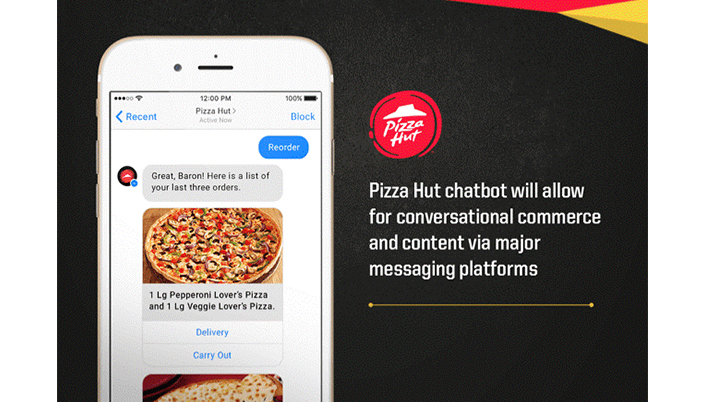
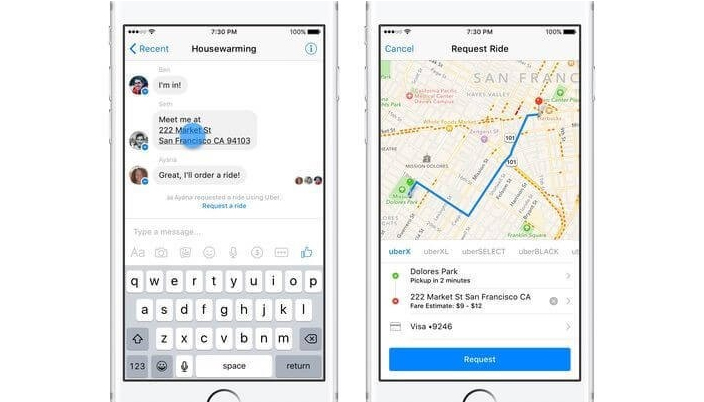
    One of the biggest challenges with any artificial intelligence marketing is to give a personal touch to your communication. It is nearly impossible to make the users feel like that they are having a conversation with a human while communicating with the bots. However, Chatbots are the closest to that. The image below is a classic example of how the chatbots work.

    Redirect the conversations

    With social media the brands can promote the positive testimonials; however, it also propagates the negative feedbacks faster too. You can negate the issue by having a chatbot through which you can redirect the conversation that is in the limelight and onto a private platform automatically and repair the problem immediately. With the usage of the chatbot, you can address the issues of the customers quickly, which is exactly what the customer wants; this would not only make the customer happy but also it would reduce the chances of them ranting about their concerns on the public platform and prevent brand bashing.

    You can get rid of the app completely

    This is probably one of the biggest benefits of using the artificial intelligence; you can get away with the tedious process of updating and maintenance of the app, which is already an overcrowded marketplace. Instead, you can transfer the communication to the chatbot. Several customers prefer this method because it is easier for them to communicate rather than having to open an app; they can use the same platform that they are already using, which in this case Facebook. One of the most popular brands that has started to use the artificial intelligence masterfully and has been quite successful at it.

    Drawbacks

    Human touch will be missed always

    No matter, how helpful the chatbots are they still can never have the same effect that a conversation with a human can provide. Although you can design the bots that can send messages that are as emphatic as they can be to the users’ problems, it can get monotonous at times.

    Today, most of the customer that are tech savvy would immediately know if the responses are automated and they can easily differentiate between the automated and manual response. Often, the automated response bots fall short of the judgement of things that only humans can do.

    If the bot fails, there is no scope for interaction

    While the bots are very prompt in their response time, if they fail, there is no way to follow up with the customer, which in turn can be serious repercussion on the brand image.

  • Facebook’s Latest News Feed Tweak Curbs the Activities of Individual Spammers

    Facebook’s Latest News Feed Tweak Curbs the Activities of Individual Spammers

    In the purview of the Facebook’s battle against spam links invading the newsfeed of the users worldwide, the social networking giant is being proactive to curb the issue and is now targeting the individual users to post the maximum number of spam links. Recently, Facebook announced that it has noticed and tracked the activities of a small set of individuals who regularly post numerous spammy pages and links publicly. Facebook has identified these spam links to be mostly about news stories that are fake and clickbait articles, which lure the users to click on the link and read more but when they do that, the users actually don’t get what the headline states or the content is completely irrelevant.

    To help the genuine users from being victims of spam links and providing them a hassle-free and seamless user experience, the networking giant is taking drastic measures to curtail the reach of the spammy posts in people’s feeds. However, it is to be noted that Facebook’s rectification step will be applied only to the individual articles that are shared by these spam accounts and it will not affect the domain, pages, photos, videos and check-ins posted by those accounts. In a blog post by Facebook, the networking site said, “Most publishers won’t see any significant changes to their distribution in News Feed.”

    With the latest News Feed tweak put in place by Facebook, only the publishers that get a huge influx of traffic from an account that has been marked as spammers will be affected. Also, all the publishers that have articles, which are linked to the spam accounts may see a drastic curtailment in their reach. This restriction comes as a great relief for the daily users who are regularly fed with the click bait articles with the headlines likes ‘you won’t believe what happened next.’ Every click by the user meant that the link would up in the people’s news feed, and it would appear on the feed even if they did not want to see them or click on it. With the tweak, the users are less likely to see such clickbait articles on their feed.


  • Facebook Introduces 7 Critical Changes to Make it a Real Local Search Player

    Facebook Introduces 7 Critical Changes to Make it a Real Local Search Player

    The leading global search engine, Google has been dominating the search market shares for several years now, and all the efforts by the competitors to steal the market share has been futile. Not to mention, in the mobile search sector, Google with its 95% share holds a monopoly. The only closest competitor and the dark horse in the race is another global platform, Facebook, which has the capacity to be a match to the Google’s massive audience share and resources. Facebook has all the vital components including location data, millions of users from around the world, demographic information, millions of business pages, behaviour data, and social networks to assist the users to search for local products and services and also help the business be found by the local audience.

    Although Facebook has huge potential to pose a serious threat to Google in the local search business, it has not been a very effective competitor. In a research conducted by The Local Search Association on how the customers in 12 different cities with varying population search for the local business, it is reported that the search engines account for 80% usage as compared to 48% usage for all social networking platforms.

    In the past couple of years, Facebook has been steadily working to build a robust search function; below mentioned are seven ways by how Facebook is changing how search works on the platform:


    Facebook is focusing on the effective use of the location

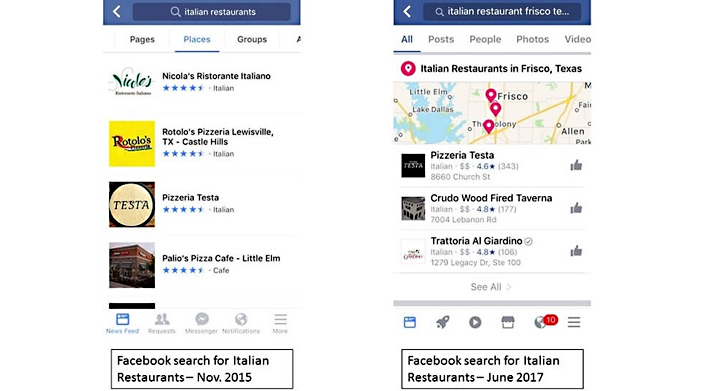
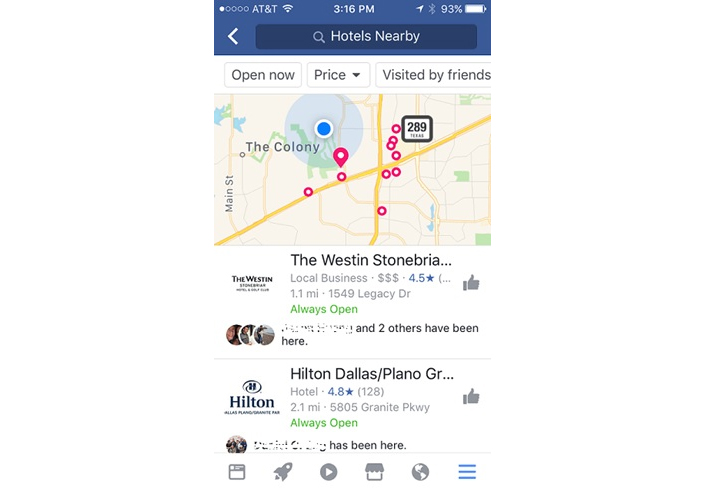
    As documented by Google’s emphasis on proximity and physical address in getting higher local search results, location is the most important aspect of local search. In this purview, Facebook is focusing on highlighting the map at the top of the local business pages in the about us page as well as the home page. In a test conducted by Facebook where the location was not specified by the users, the got results from far off places. However, today, with the improvement in local searches, if you search for restaurants in India, you may get the results of the restaurants within two miles of your current location. Moreover, the results also include the address and the map location. The below image is a comparison of search results in November 2015 and June 2017, which demonstrates the differences in the local listing:


    Priority is given to the place

    With Facebook focusing more on the search result, it is not only using the location more efficiently but also giving much importance to places. Earlier, the places tab was not given any importance by Facebook, however, the tab is highly functional today and it provides the most relevant information for all searches. For example, if a user searches for the best plumbing service Bangalore, the search results show the returned places at the top of the results page and the local business follows next.

    The search results are more specific and robust

    The search results today are not only relevant to the search term but also they provide in-depth information. For instance, if your search for the best lawyer Mumbai, the search result will not only list the lawyers in the vicinity but also would show their address, distance from your current location, their office hours, rating points and even the profile picture. The listing also provides information on the type of lawyer they are and their field of expertise like criminal law, family law or real estate law.

    Improved indexing of information

    One of the major problems that Facebook previously had was with that the indexing of the information was pretty poor. However, Facebook has fixed this problem, which is in line with its focus on improving the local search. The social networking platform has also helped improve the search functionality by adding suggested search terms when the user is trying to search for a particular thing in the search box. The suggested terms frequently pull up the various business categories that Facebook offers to its business users and help them identify the type of business they are into.

    Facebook is testing its beta version of new features including local search and integrating friend posts

    In its bid to make the search unique than Google search, Facebook is trying to incorporate the social media data in its search results. The global social networking giant has been testing with a few users who have mini profile pictures to place the listings of their friends who have either checked in at a certain place or have posted about a particular place or business organisation.

    It is a known fact that the users are prone to trust their friends when it comes to providing reviews. Knowing that a particular person has chosen to subscribe to the services of a certain business, it becomes easier for the users to make their decision. With the huge volume of users on Facebook and the vast information available Facebook could literally change the face of the local search business.


    Facebook is building its database through crowdsourcing

    Facebook, undoubtedly has a huge user base and it is leveraging that manpower for free, just as Google did with its ‘local guide’ plan, which proved to be quite successful. Facebook has been asking its users to provide details about the different places that they have checked into through the Facebook editor. At a time when the user check-in or tries to tag a place, the person will be prompted to answer a series of simple Yes-or-No questions, such as does the place have a parking lot? Is the place open on Monday’s?

    Introducing City Guides

    One of the most popular subjects that most users love to post on Facebook is travel. It has been reported that the social media platforms like Facebook, Twitter, Instagram and Snapchat are helping boost the people’s spending on things like travel, food and entertainment; people love to share with their friends new experiences about their travel adventures and the exotic places they dined at.

    In this regards, the Facebook created city guide to provide people information on the most popular places and the most frequently visited places by people from around the world. One of the distinct features of city guides is that it provides information about the user’s friends who have been to the place they are looking for and when the users tap on the friend, the city guide will bring up a list of the places they have visited. Also, the city guide is designed in a way that it provides information on the local favourites.


    How to be found on Facebook search

    With Facebook introducing all the above improvements to its search functionality, users now have all the reason to spend more time on the platform and consume more content. Thankfully, Facebook has realised the importance of penetrating the local search business, which can greatly help the small businesses to cater better to the audience. So, if you are a business owner, it would be the best time for you to review the About Us Page on your website and look how the information is showing up on the search result and ensure that the page picks up the increasing traffic through Facebook. Here is how you can get started:

    First and foremost review the business profile on Facebook and make sure that the profile is complete including contact information and other vital details about the business.

    Ensure that the local information is accurate and a physical map location show up at the top of the business profile when the page is displayed.

    To describe your business better and get higher traffic, add business categories. Although when you create your own Facebook page, you would be asked to mention just one business category, you can later edit the About section and 2-3 more business categories. This will greatly help in improving the visibility based on the search terms used.

    Activate the buttons on your Facebook profile like call-to-click and appointment schedulers. This will have a significant impact on conversion rate.

    Never leave any sections on the page blank. This may lead Facebook to crowdsource answers. If the question is not relevant to your business, you can answer NO or indicate that the question is not applicable to your business.

    To conclude, Facebook is making some serious in-roads in implementing changes that would improve its local search; especially in melding social media data with local search results. This may put Facebook right at the top as one of the major search players and a leader in the local search business.

  • No Criminal Content – Facebook Sets It’s Priority

    No Criminal Content – Facebook Sets It’s Priority

    It is indeed commendable that Facebook has literally made the world shrink; it has not just helped the like-minded people from around the world connect online but also has broadened their horizons in terms of giving a better understanding of cultures and other’s perspective. However, there is a flipside to a universal platform that lets people broadcast their thoughts as per their convenience. For a majority of the people, Facebook is a tool to connect, share and meet new people, for others, it is a great avenue to vent out their angst, spread hate and propagate their ideologies of violence as well as manipulate the others to follow them.

    The advent of the new feature, Facebook Live has only made things worse. In recent times, there have been several disturbing reports of people committing suicide on a live stream.

    In one of the most bizarre and horrific incidents, a person was live streaming as he killed his family members, the brutal scenes were captured live on camera and broadcast for the people to see. It does not deny that such atrocious events have always existed and we quite often read about it on the internet, however, with Facebook and Facebook Live, in particular, has not brought the incidents to the fore but also spurred it further.

    Mark Zuckerberg, the CEO of Facebook, has been horrified by the occurrence of such events, and in a media interview even stated that it is quite difficult to run a company and also find measures to avoid violent content from being shared on the platform.

    Whilst Zuckerberg is desperate to salvage the situation, it must be understood that it is literally impossible for Facebook to police everything around the world; they cannot stop people from posting real-time content. However, Zuckerberg has indeed initiated a few actions to curb the posting of criminal and gory content. Earlier this week, the CEO announced that the company would expand their content moderation team from 4,500 to 7,000 people over the next one year.

    The expansion of the team is in addition to the various artificial intelligence measures, which were previously announced. Facebook is designing artificial bots specifically meant to detect a change in behaviour and posting patterns of the users and take preventive action.

    The announcement of the content moderation team expansion is indeed a significant step forward taken by Facebook to make the platform a haven. Let’s us hope, the addition of the content moderators will eliminate the misuse or should be was say abuse of Facebook Live.

  • Weekend Digital Media News Roundup: Logicserve Digital partners with Lotame, Facebook Opens Creative Hub, Ranked Conversation on Twitter and more…

    Weekend Digital Media News Roundup: Logicserve Digital partners with Lotame, Facebook Opens Creative Hub, Ranked Conversation on Twitter and more…

    Logicserve Digital brings to you a curated round-up of important digital marketing updates this week. For further queries, you can write to us at: newsbulletin@logicserve.com

    1. Lotame And Logicserve Digital Enter Into A Strategic Partnership

    This move will help the agency provide a customized approach to brands based on their understanding of audience behaviours as well as product needs. (Source : Brand Equity – The Economic Times)

    1. Google Makes It Easier To Add & Remove Emails From Customer Match Lists In Adwords

    Advertisers can now add and remove email addresses from existing Customer Match lists in AdWords by uploading a file to the list. (Source: Search Engine Land)

    1. Amazon Swings Into Header Bidding With Cloud-Based Service For Publishers

    Amazon plans to announce a cloud-based header bidding solution aimed squarely at publishers as early as next week, according to people familiar with the matter. (Source: Ad Age India)

    1. Tips to use Linkedin Pulse To Drive Traffic To Your Website.

    LinkedIn Pulse is an efficient tool if you understand how to use it for promotions and publicizing. It is one of the best platform available in social media marketing. (Source: Logicserve Digital)

    1. Facebook Opens ‘Creative Hub’ Ad Testing Platform To All Users

    Have you ever wanted to try out Facebook ad options like Carousels and Canvas but thought they look a little bit too complicated and are probably beyond your technical capacity?. (Source: Social Media Today)

    1. Using Keywords For Seo Just Got Easier With This Guide

    Choosing the right keyword is the first thing digital marketers should keep in mind before rolling out an online campaign. (Source: Logicserve Digital)

    1. Google and Bing Increase Sitemap File Size Limit To 50 MB

    In a joint announcement between Google and Bing, the companies have stated they are increasing the limit of sitemap file sizes from the standard 10 MB to 50 MB. (Source: Search Engine Journal)

    1. Ranked Conversations Have Arrived To The Twitter Mobile Experience

    Twitter has rolled out conversation ranking to the mobile app, giving it the same experience that the desktop has had since the summer of 2015. (Source: Marketing Land)

    1. Google Drops The Content Keywords Feature From Google Search Console

    It is official. After hinting at removing the Google content keywords report from Google Search Console, Google did it. (Source: Search Engine Land)

    1. Pinterest Launches Showcase To Give Brands A Way To Shape Their Stories

    Announced today, the platform has launched a new feature it calls Showcase, allowing visitors who interact with business profiles on Pinterest to see manually selected visuals that best depict the brand. (Source: Marketing Land)

  • Precise targeting with Lookalike Audience on Facebook

    Precise targeting with Lookalike Audience on Facebook

    facebook_lookalike


    The best part about Facebook advertising are the targeting parameters. These parameters are diverse and provide data that is useful for brands for advertising. As an Advertiser, you have always been intrigued by the different type of audiences Facebook can cater to. There are three kinds of targeted audience:

    • Custom Audience
    • Lookalike Audience
    • Saved audience

    For now, let’s concentrate on Lookalike Audience.

    What is Lookalike audience?

    The Lookalike audience targeting is around since 2013. This allows all advertisers to target all Facebook users who are similar or share same traits with their customers who are on Facebook. With this parameter, advertisers can ask Facebook algorithm to find the following kinds of audience- 1% which is optimized for similarity and 5% which is for greater reach. It is a great way to expand the small customer list that consists of 1,000 people and then can be turned into a Lookalike Audience to reach out a larger pool of audience.


    Lookalikes for Website

    When Facebook launched its Website Custom Audiences, it allowed all advertisers to target visitors who went to their websites. This included a common visitor to the entire site as well as a visitor who went to specific pages. With Lookalike audience for the website, it has been a boon to users.

    With this, an advertiser can find users who show similar behaviour as that of your website visitors. With this, if you don’t get much of traffic to your site then you can target a wider audience pool.

    With this, an advertiser can find users who have similar interests to those visitors who visited a specific page on the website. An advertiser can select the success page to track converting users.

    For example: By your Lookalike Audience, Facebook will help you find users who are similar to those visitors who bought a particular product. You can target them by demographics, age, and gender. Interest targeting is an important feature of Lookalike audience.

    You can also target users who are very similar to those visitors who have visited a specific section on your site.

    For example Visitors of a retail website that sells apparels for all genders. It is important that Lookalike audience is created for all the sections.

    Following are the other objectives of which you can use Lookalike audience:

    • Lookalike Audience for Custom Audience
    • Lookalike audience for Pages
    • Lookalike Audience for Mobile App users

    How to Target Lookalike Audiences?

    Once you have created your Lookalike audience, you can start targeting your ads to users. The ad will reach out to users who have similar interests to the Lookalike audience and then you will have a proper audience set on your platform that will perform the activity of buying, liking, reading or viewing.

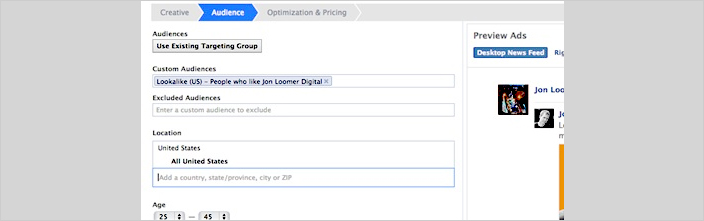
    This can be done from the Custom Audiences text field which is a part of the “Audience” step as shown below:

    facebook_look alike

  • Facebook tests Ads in Groups

    It is believed that since Facebook is running out of Ad Space, it is looking at testing ads in groups. The aim is to make the maximum out of its 500 million users who are still left untapped. It claims to reach its maximum advertising capacity by Mid-2017. Even the workplace initiative is believed to be one of the channels to serve ads. Techcrunch received confirmation from Facebook that as a part of the trial, desktop and mobile versions have been rolled out.

    This update can be a boon for advertisers, as groups are a good way to reach out to the consumers. In time, we would know what the users have to say about this, as groups were one of the few ad-free spaces on Facebook.

    Source: https://goo.gl/HCi259

  • ‘Secret Conversations’ – Facebook’s new feature on end-to-end encryption

    Now you can have encrypted conversations on Facebook, thanks to its roll out of end-to-end encryption for messenger users.

    The feature is called as ‘secret conversations’ and can be found by clicking the top-right button. One has to turn on the feature to use it.

    David Marcus, VP of Facebook Messaging products, had shared on a Facebook post during July’16 about the end-to-end encryption function. Wired’s Andy Greenberg, got a confirmation from a Facebook spokesperson that all messenger users can use ‘secret conversations’. However, every user should be able to use it for the conversations they choose than making it a default option.

    Facebook hasn’t publicised the roll out yet.

    Source: Social Times (https://goo.gl/R1zdIb)

  • Facebook launches Marketplace to support local communities in buying and selling

    In recent times, Facebook groups are being extensively used for businesses other than connecting with people. Many groups help local communities connect with one another and also conduct businesses.

    With the launch of ‘Marketplace’, Facebook is making it easier to discover, buy and sell. You can explore it by tapping the shop icon at the bottom of the app.  Features you must know:

    –    Since it is for local communities, it helps you discover various items that have been listed in your nearby locality. Once you shortlist the item you want to buy, you can directly message the seller

    –    Posting items for sale just got easier. All you have to do is take a picture, add product name, details and price. You have to confirm your location and make the posting

    Marketplace will be rolled out to above 18-year-olds in US, UK, New Zealand and Australia.  With time it will be expanded to other countries.

    Read more about the announcement:  https://bit.ly/2dmqHxn