LS Staging

Tag: digital advertising

  • Facebook Introduces 7 Critical Changes to Make it a Real Local Search Player

    Facebook Introduces 7 Critical Changes to Make it a Real Local Search Player

    The leading global search engine, Google has been dominating the search market shares for several years now, and all the efforts by the competitors to steal the market share has been futile. Not to mention, in the mobile search sector, Google with its 95% share holds a monopoly. The only closest competitor and the dark horse in the race is another global platform, Facebook, which has the capacity to be a match to the Google’s massive audience share and resources. Facebook has all the vital components including location data, millions of users from around the world, demographic information, millions of business pages, behaviour data, and social networks to assist the users to search for local products and services and also help the business be found by the local audience.

    Although Facebook has huge potential to pose a serious threat to Google in the local search business, it has not been a very effective competitor. In a research conducted by The Local Search Association on how the customers in 12 different cities with varying population search for the local business, it is reported that the search engines account for 80% usage as compared to 48% usage for all social networking platforms.

    In the past couple of years, Facebook has been steadily working to build a robust search function; below mentioned are seven ways by how Facebook is changing how search works on the platform:


    Facebook is focusing on the effective use of the location

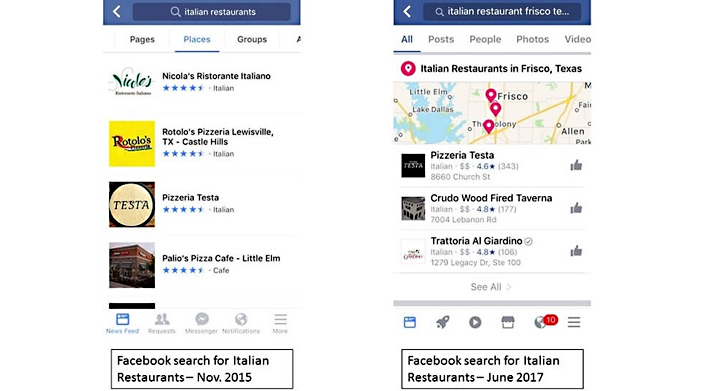
    As documented by Google’s emphasis on proximity and physical address in getting higher local search results, location is the most important aspect of local search. In this purview, Facebook is focusing on highlighting the map at the top of the local business pages in the about us page as well as the home page. In a test conducted by Facebook where the location was not specified by the users, the got results from far off places. However, today, with the improvement in local searches, if you search for restaurants in India, you may get the results of the restaurants within two miles of your current location. Moreover, the results also include the address and the map location. The below image is a comparison of search results in November 2015 and June 2017, which demonstrates the differences in the local listing:
     

    Priority is given to the place

    With Facebook focusing more on the search result, it is not only using the location more efficiently but also giving much importance to places. Earlier, the places tab was not given any importance by Facebook, however, the tab is highly functional today and it provides the most relevant information for all searches. For example, if a user searches for the best plumbing service Bangalore, the search results show the returned places at the top of the results page and the local business follows next.

    The search results are more specific and robust

    The search results today are not only relevant to the search term but also they provide in-depth information. For instance, if your search for the best lawyer Mumbai, the search result will not only list the lawyers in the vicinity but also would show their address, distance from your current location, their office hours, rating points and even the profile picture. The listing also provides information on the type of lawyer they are and their field of expertise like criminal law, family law or real estate law.

    Improved indexing of information

    One of the major problems that Facebook previously had was with that the indexing of the information was pretty poor. However, Facebook has fixed this problem, which is in line with its focus on improving the local search. The social networking platform has also helped improve the search functionality by adding suggested search terms when the user is trying to search for a particular thing in the search box. The suggested terms frequently pull up the various business categories that Facebook offers to its business users and help them identify the type of business they are into.

    Facebook is testing its beta version of new features including local search and integrating friend posts

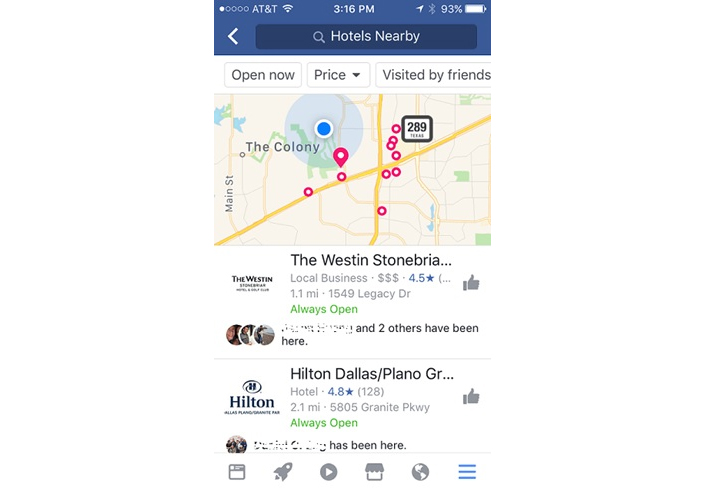
    In its bid to make the search unique than Google search, Facebook is trying to incorporate the social media data in its search results. The global social networking giant has been testing with a few users who have mini profile pictures to place the listings of their friends who have either checked in at a certain place or have posted about a particular place or business organisation.

    It is a known fact that the users are prone to trust their friends when it comes to providing reviews. Knowing that a particular person has chosen to subscribe to the services of a certain business, it becomes easier for the users to make their decision. With the huge volume of users on Facebook and the vast information available Facebook could literally change the face of the local search business.
     

    Facebook is building its database through crowdsourcing

    Facebook, undoubtedly has a huge user base and it is leveraging that manpower for free, just as Google did with its ‘local guide’ plan, which proved to be quite successful. Facebook has been asking its users to provide details about the different places that they have checked into through the Facebook editor. At a time when the user check-in or tries to tag a place, the person will be prompted to answer a series of simple Yes-or-No questions, such as does the place have a parking lot? Is the place open on Monday’s?

    Introducing City Guides

    One of the most popular subjects that most users love to post on Facebook is travel. It has been reported that the social media platforms like Facebook, Twitter, Instagram and Snapchat are helping boost the people’s spending on things like travel, food and entertainment; people love to share with their friends new experiences about their travel adventures and the exotic places they dined at.

    In this regards, the Facebook created city guide to provide people information on the most popular places and the most frequently visited places by people from around the world. One of the distinct features of city guides is that it provides information about the user’s friends who have been to the place they are looking for and when the users tap on the friend, the city guide will bring up a list of the places they have visited. Also, the city guide is designed in a way that it provides information on the local favourites.


    How to be found on Facebook search

    With Facebook introducing all the above improvements to its search functionality, users now have all the reason to spend more time on the platform and consume more content. Thankfully, Facebook has realised the importance of penetrating the local search business, which can greatly help the small businesses to cater better to the audience. So, if you are a business owner, it would be the best time for you to review the About Us Page on your website and look how the information is showing up on the search result and ensure that the page picks up the increasing traffic through Facebook. Here is how you can get started:

    First and foremost review the business profile on Facebook and make sure that the profile is complete including contact information and other vital details about the business.

    Ensure that the local information is accurate and a physical map location show up at the top of the business profile when the page is displayed.

    To describe your business better and get higher traffic, add business categories. Although when you create your own Facebook page, you would be asked to mention just one business category, you can later edit the About section and 2-3 more business categories. This will greatly help in improving the visibility based on the search terms used.

    Activate the buttons on your Facebook profile like call-to-click and appointment schedulers. This will have a significant impact on conversion rate.

    Never leave any sections on the page blank. This may lead Facebook to crowdsource answers. If the question is not relevant to your business, you can answer NO or indicate that the question is not applicable to your business.

    To conclude, Facebook is making some serious in-roads in implementing changes that would improve its local search; especially in melding social media data with local search results. This may put Facebook right at the top as one of the major search players and a leader in the local search business.

  • Weekend Digital Media Round-up:  Google’s new tools for advertising models, Amazon’s shoppable stickers, Pinterest’s autoplay video ads, Google Attribution and more…

    Weekend Digital Media Round-up: Google’s new tools for advertising models, Amazon’s shoppable stickers, Pinterest’s autoplay video ads, Google Attribution and more…

    1. Google Confirms It’s Rolling Out New Reviews Format For Hotels

    Google has confirmed with Search Engine Land that it is now rolling out a new user interface and feature set around local reviews for hotels. Earlier this month, we saw Google begin testing new hotel reviews features, and now Google has begun to roll them out.  (Source: Search Engine Land)

    1. Taboola’s Grid Of Recommended Stories Is Now An Infinite, Scrolling Feed

    Taboola, the grid of content discovery that appears at the end of many online stories, is today giving publishers the option of using a continuous scrolling feed. CEO and founder Adam Singolda told me that this launch represents “a whole new Taboola. (Source: MARTECH TODAY)

    1. Amazon Introduces Shoppable Stickers To Its iOS App

    The social networking apps like Instagram, Facebook, Twitter, and Snapchat have redefined the way people communicated through chat. The addition of several stickers has made talking more fun as well as there is an animation to express almost every feeling. (Source: Logicserve Digital)

    1. Pinterest Introduces Autoplay Video Ads, New Opportunities for Video Ad Exposure

    Now, when you scroll through your Pinterest feed, video content will autoplay – previously, with Pinterest’s Promoted Video and Cinematic Pins, video content would move as you scroll, but not play as such, just shift in response to your movement. (Source: Social Media Today)

    1. Google Sets Up New Tools To Power Up Its Advertising Model

    Google is expanding its local ad efforts and its store visits technology to video, allowing consumers to discover nearby retail outlets, leading to a direct path from a video ad to shopping offline. It will also help advertisers track the offline effectiveness of their video spends. (Source: Brand Equity)

    1. Google Is Extending In-Market Audience Targeting To Search Campaigns

    Google is continuing to extend its audience targeting capabilities into Search. The company announced Tuesday that In-market audiences, currently only available for Display Network and YouTube campaigns, will be coming to Search campaigns. (Source: Search Engine Land)

    1. Instagram Introduces Story Search for Locations

    In the purview of Snapchat adding the new search functionality for the stories, Instagram follow suits, and it is now giving the users the ability to search stories based on location and hashtag through their Explore section. (Source: Logicserve Digital)

    1. Types of Google AdSense Policy Violations & New Page Level Policy Action

    Google stopped serving ads on the whole site that violates AdSense policies. Google will now remove ads only from a particular page that violates Adsense policy guidelines. Having said so, Google will impose Site level actions if needed. (Source: SEO in Short)

    1. At IAB Programmatic Symposium, digital advertising looks to grow up

    About 80 percent of all online advertising is now programmatic, a status that would be cause for celebration of technological progress in any other industry. But, as Barrett and other speakers pointed out, any other industry wouldn’t have brands wondering how much their ads actually cost. (Source: MARTECH TODAY)

    1. ‘Give credit where it’s due’ says Google, as it launches Google Attribution- a free tool for marketers

    Tech giant Google has just made some key announcements at Marketing Next – its annual event where the company unveils its latest innovations for ads and analytics with insights and trends across mobile, analytics, video and platforms. (Source: AFAQS)

    EXPERT OPINION

    Q.Influencer marketing is a big buzz word right now, how do brands measure their ROI?

    Measuring the ROI of your influencer marketing activities mainly depends on the digital brief and the objective of the activity.   Influencer marketing is here to stay, as per a report from ion.co 70 percent of teenage YouTube subscribers trust influencer opinions over traditional celebrities. These influencers play a vital role in the audience’s buying decisions. However, every brand should have their objective set. You can use any of the following goals to measure ROI:-


    • If the goal of your activity is Visibility– 71 % of consumers are more likely to make a purchase based on a social media reference. Hence, it is vital to have social media and blogger influencers who also have a wider audience base along with Google Analytics on their blog. This will enable brands to know if the impressions are targeted well, along with the right communication tone
    • If the goal of your activity is Engagement– 86 % of women turn to social networks before making a purchase. Hence, Influencer marketing also is a good tactic to engage with audience. The most vital aspect is cost-per-engagement. It can be measured in the amount spent per like, comment or video view or click through, etc. Engagement is a strong indicator of how consumers perceive the brand. This insight can be used to create brand loyalists in the long run
    • If the goal of your activity is  revenue –   51 percent of marketers say that video content produces the best ROI.  Tracking revenue is quite easier than you think. These three ways can help brands-
    1. a)Use an Affiliate Link:  The unique affiliate link will help you in tracking online sales that are made through either blog posts or social media platforms.
    2. b)Use a promo code: A custom promo code will help with tracking the impact of your campaign
    3. c)Use Google Analytics: Create an event to keep a track on user journey. You can see which of your customers visited your site (e-commerce) from an influencer’s social and blog platform

    Gaurav Chopra, VP, Internet And Mobile Association of India

  • Weekend Digital Media News Roundup: Is Google Testing New Mobile Search Interface, Amazon’s Digital Day, Can Tweets Be Edited, 2017 Trends & More…

    Weekend Digital Media News Roundup: Is Google Testing New Mobile Search Interface, Amazon’s Digital Day, Can Tweets Be Edited, 2017 Trends & More…

    Logicserve Digital brings to you a curated round-up of important digital marketing updates this week. For further queries, you can write to us at: newsbulletin@logicserve.com

    1. Google Tests New Mobile Search Results Interface?

    Looks like Google is testing yet another Google user interface for the mobile search results. Tejas Thakkar posted a screen shot of the test on Twitter showing search snippets showing the URL (or breadcrumb) at the top, then the title/headline, followed by the snippet/description. (Source: Search Engine Roundtable)

    1. Amazon Launches Digital Day, A New Sales Holiday For Digital Products

    Over the past two years we’ve seen Amazon excel at creating demand for Prime Day, a Amazon-generated sales holiday. This week Amazon is launching a new sales day on digital media dubbed “Digital Day.” (Source: Marketing Land)

    1. Four Essential Content Marketing Tips To Help You Thrive In 2017

    Content marketing tactics are constantly evolving. Moreover, every brand is different and calls for different content marketing strategy; thus, it is imperative for digital marketers to determine what works well for their brand and what does not, so as to evolve their own digital marketing strategy. (Source: Logicserve Digital)

    1. Google Launches A New Look For Recipes In The Mobile Search Results

    Google has launched a new look and feel for the recipe search results done over a smartphone device. Alex Chitu first noticed the change that shows richer images and content for recipe-related queries. (Source: Search Engine Land)

    1. 2017 Global Consumer Trends Marketers Need to Know

    While the U.S. election brought some new attention to the power of rural residents, there is no denying the fact that the globe continues to urbanize. A projected 55% of the planet’s people are forecast to live in cities next year. (Source: Ad Age India)

    1. How To Improve Website Conversion Rates?

    The term ‘conversion’ not only implies ‘sales’ but also refers to the specific actions of online visitors on your site such as— purchasing a product, subscribing to your emails, downloading a whitepaper, or filling out a contact form. (Source: Logicserve Digital)

    1. Twitter Introduces Live 360 Video On Twitter And Periscope

    At Twitter’s recent #WhatsNext event – in which they outlined the future developments coming for the platform – the company’s VP of Ad Development John McFarland noted that they were working on 360 video. (Source: Social Media Today)

    1. Amazon Begins Testing Product Listing Ads On Adwords

    In 2012, Google’s Product Search was transformed from an organic product search tool into a pay-to-play shopping destination. Since the removal of Product Search, Amazon has not participated with Google’s Product Listing Ads. (Source: Search Engine Land)

    1. Could Editing Be Coming To Tweets?

    You think you’ve crafted the perfect Tweet. You hit the big blue button to set it live — only to realise you’ve made an “unpresidented” typo. Editing is something many of us would like to see on microblogging social network Twitter. (Source: CNET)

    1. Duolingo Goes Social With Language Clubs For Mobile App

    Duolingo is getting social. Yes — the language learning app just debuted Language Clubs, which encourage users to share their learning achievements with friends. Adding a bit of competition to the mix, users can also check out weekly leaderboards. (Source: Media Post)

  • Four Essential Content Marketing Tips to Help You Thrive in 2017

    Four Essential Content Marketing Tips to Help You Thrive in 2017

    The New Year is knocking the door and it is high time for content marketers to think about their content marketing strategy for 2017. According to experts, content marketing in 2017 will no doubt flourish, but at the same time, it will become more challenging; thus, brands will need to be more creative with their content marketing strategy in the forthcoming year. In this post, we have compiled four indispensable content marketing trends that you may consider to raise the bar in your business in the coming year.


    By writing compelling content, you can naturally grab the attention of your audience. Thus, before creating content, you should try to understand the needs of your customers to find out the problems faced by them so that you can generate content accordingly to solve their specific problems. For example, you may directly take the opinion of your customers through online polls or discuss with your customer care team to understand what your customers generally ask about. This will help you create convincing content that strikes a chord with your audience.


     You may not be a specialist on the subject matter you are writing about. Therefore, it is advisable to partner with industry experts and influencers to co-create content. This is an effective way of promoting your content as it adds reliability and consistency to your piece. Besides this, when you involve influencers or industry experts in your marketing content, they are likely to share it with their online followers, thus, enabling your content to reach out to a wider audience.


    In the absence of a content distribution plan, even the most innovative and engaging content may stay undiscovered. Therefore, while creating your content marketing strategy, make sure you emphasise on your content distribution plan to generate fresh traffic. Posting your content only on your website or blog is not enough. You should also enhance the social media reach of your content, and involve online influencers to share your content on their networks. The best way is to review the content distribution plan of your competitors and industry players to find out what works for you.

    Infographics are attractive visuals used for simplifying complex data in a convincing manner so as to offer greater precision. In 2017, you can use Infographics as a communication tool, recruiting tool or leads generator by demonstrating the positive facets of your business, such as your sales trends over a specific period or by displaying your survey data and other engaging information. By combining Infographics with well-written text, you can easily penetrate into the minds of your audiences.

    Video marketing too will continue to be a powerful tool for communicating your brand story in 2017. Live video will undergo massive growth in the coming year as Twitter, Facebook Live, YouTube Live, Instagram Stories and Snapchat are embracing live video with open arms. Video Marketing not only brings the highest ROI but also helps brands by illustrating their value proposition and strengthening relationships with their existing and prospective customers. Thus, marketers should keep up with this trend in 2017 to notice marked improvements in their content marketing strategy.

    Content marketing tactics are constantly evolving. Moreover, every brand is different and calls for different content marketing strategy; thus, it is imperative for digital marketers to determine what works well for their brand and what does not, so as to evolve their own digital marketing strategy.

  • Weekend Digital Media News Roundup: What Digital marketers can learn from YouTube, Twitter overcharged advertisers, Instagram’s stickers and more…

    Weekend Digital Media News Roundup: What Digital marketers can learn from YouTube, Twitter overcharged advertisers, Instagram’s stickers and more…

    Logicserve Digital brings to you a curated round-up of important digital marketing updates this week. For further queries, you can write to us at: newsbulletin@logicserve.com

    Well, Twitter has one-upped Facebook. For more than a month, Twitter incorrectly measured brands’ video ads running on Android devices and overcharged advertisers as a result, the company said on Thursday. (Source: Marketing Land)

    In this post, we will highlight the efforts undertaken by the best YouTube advertisers that have helped them go the extra mile to reach the top of the Year-end YouTube Ads Leaderboard which recognises the top 10 most-engaged with, most-loved, and most-viewed Google ads of 2016. (Source: Logicserve Digital)

    Google has announced they’ve upgraded the AMP reports within the Google Search Console to “clearly differentiate between the critical issues that would prevent your page from being shown in the search results, and the other non-critical issues that would be good to fix.” (Source: Search Engine Land)

    Instagram stories has added some new flair to its product offering. Announced on 20th Dec’16, Instagram has added special functionality to its stories. While they do not have a direct impact on advertisers just yet, they may be able to enhance the character of stories provided by brands. (Source: Marketing Land)

    In a data-driven society, data plays a crucial role in digital transformation. We dwell in a multi-device world where data acts as the most important asset for countless marketers. It goes without saying that organizations that count on data to stimulate decision-making and drive superior growth. (Source: Logicserve Digital)

    This became a key focus for The Social Network earlier this year after leaked reports suggested that sharing of personal updates on the network – people’s own thoughts and photos – had fallen by 21% between mid-2014 and mid-2015. (Source: Social Media Today)

    The Mobile Marketing Association (MMA), in association with Kantar IMRB has released a report on Smartphones and Feature Phones Usage and Behavior 2016-17 in India. This is a first-of-its-kind report that studies the evolving nature of the Indian mobile consumers. (Source: Ad Age India)

    Given the popularity of video calls on the platform (245 million people make video calls in Messenger every month) and the use-case highlighted by other group video chat tools, like Houseparty, it seemed like a no-brainer that Facebook would eventually add group video capacity also. (Source: Social Media Today)

    With the exception of Amazon and H&M, the bulk of the ads are from Europe, which isn’t surprising since U.K. marketers treat Christmas the way U.S. advertisers treat the Super Bowl. (Source: Ad Age India)

    According to a new report from LinkedIn, 35% of the U.S. workforce are now freelancers. Whether you’re looking to grow your side hustle or want to jump in with both feet, LinkedIn’s data some valuable trends, gleaned from their ProFinder tool, the platform’s recent foray into the gig economy. (Source: Social Media Today)

  • How to Compete with Large Marketers When It Comes to Programmatic Advertising?

    How to Compete with Large Marketers When It Comes to Programmatic Advertising?

    how do big brands compete @LogicserveDigi

    Digitization has been significantly transforming the world of advertising. Currently, numerous advertisers prefer purchasing automated advertisements (also known Programmatic Advertising). Unlike traditional digital buying, programmatic ad buying is effective, efficient and a competitive option. Moreover, it enables brands to interact with its target audience at the right time and right place.

    Large marketers are making waves in Programmatic Advertising by outsourcing agencies that have access to the most-advanced advertising technology and marketing technology stacks. Such agencies also own a programmatic trading desk that takes care of programmatic media obtained by means of a bidding system that aims to target a specific set of audience.

    Since large marketers are reaping all the advantages in the world of programmatic display, video, and native advertising, it becomes essential for small and mid-sized marketers to utilise the benefits that an agency partner can offer, so that they can take the right steps to balance the large marketer advantage. Now let us spark some insight on how agency partners can help small or mid-sized marketers compete with big marketers when it comes to programmatic advertising:

    • Having Access to Bigger Data: Big marketers have accesses to bigger data which makes them more powerful. In programmatic ad buying, having faulty or incomplete data may prove to be disastrous.  Correct and comprehensive data enables big marketers to make accurate decisions on bidding—ranging from search, and social media to video, audio and display media.
    • Invest offline: Big advertisers adhere to the practice of investing offline. Big marketers while creating awareness about their brand also reinforce the same by presenting programmatic video or programmatic display to their consumers and target audiences. Unlike big marketers, it may not be possible for small marketers to make use of offline media. However, small marketers can take various measures such as retargeting, hyper-local geo-targeting at their physical locations, custom audiences, and using free media significantly to ensure that their consumers and potential customers who are receiving their brand messages are aware of their presence.
    • Frequently updating advertisement creative: Big marketers come up with unique ad creative and also update them regularly, which empower them to bid more insistently. Small marketers may not afford to create or update their ad creative on a regular basis; however, they can practise affordable measures such as— making use of templates for designing a creative, where one can easily alter the image or caption by keeping the logo intact.

    At the same time, small marketers should be vigilant with budgets considering the overall size and ability to allocate budget, wherever required. Though predictable budgets are highly preferred by marketing departments, it is quite difficult to predict budgets in auctioned media owing to the ever-changing bid-landscape. This requires the media-buying department to keep a close eye on campaigns besides managing the volume, ROI and budgets at the same time.

    Last but not least, the ambiguity of programmatic should not intimidate small marketers. In fact, they should use it as an empowering tool to subdue bigger marketers who lack nimbleness.  By being nimble and by leveraging the benefits offered by agency partners, small marketers can go a long way in counterbalancing the big marketer advantage.

  • Mercedes-Benz Retail Group Names Broadplace as its Digital Marketing Agency

    Mercedes-Benz Retail Group Names Broadplace as its Digital Marketing Agency

    mercedes-benz @LogicserveDigi

    Mercedes-Benz Retail Group Names Broadplace as its Digital Marketing Agency

    Broadplace Advertising, one of our group companies, has been appointed as the digital marketing agency for Mercedes-Benz Retail Group UK.

    The focus of this partnership will be to highlight MBRG’s expertise and their well-known heritage. Broadplace Advertising will ensure that it provides a 360 view of customers by:

    • Improving tracking and attribution
    • Data-centric approach
    • Applying best practices through the consumer journey

    The team is thrilled about being responsible for MBGR’s online visibility.  Broadplace’s experience in the digital marketing space and its innovatory approach will play a vital role in making this partnership a success.

    Broadplace has been in the UK digital marketing space since 2005.  A Google premier partner, its in-house technology (including CampaignHub™ and Broadplace Engage+) helps deliver customised solutions for all clients.

  • Broadplace Advertising, named among the 50 most powerful Google Tech Providers in 2016

    Broadplace Advertising, named among the 50 most powerful Google Tech Providers in 2016

    Powerful Google Tech Providers 2016

    Broadplace Advertising, a part of Logicserve Group, has been named as one of the “50 Most Powerful Google Tech Providers 2016.”  One of our group companies, it has been known for using technology to enhance customer service satisfaction which in turn, has helped in improving results for the advertisers.

    CIO Story magazine group goes on to mention that insight gathering and reporting have predominantly been an issue for small business owners. Broadplace’s CampaignHub™ technology has provided customised email reporting that is device responsive and without attachments. This enables the advertisers to check KPIs in their emails and reports real-time through their secured portal. Broadplace uses customised algorithms, optimisations and synopses of complex data in an easy and understandable format for their clients.

    The CIO Story further adds that Broadplace’s instant feedback solution has enabled clients to deploy strategies at almost 50% faster pace. This along with Google Tag Management has led to almost 70% greater performance.

    Satisfied customers are the vital reason for the company’s achievements over the previous year. It was also a part of the top 5 EMEA Google Premier Partners for client satisfaction and retention.

    Under Rohit’s leadership, the organisation has grown significantly and is working with over 300 clients across the UK. His expertise lies in building and leading teams to deliver the client’s visions.

    Adds Prasad Shejale, CEO, Logicserve Digital, “This is a proud moment for us. Logicserve Group’s key strength is understanding data and its optimum utilisation to fulfil the client’s vision. Being a data-oriented group, we have constantly strived to come up with tailor-made solutions that help us make the best use of technology, too.”

    You can read more about the achievement here https://www.ciostory.com/magazines/2016/google/broadplace-advertising-providing-a-high-level-of-customer-service-in-a-traditional-sense

  • We are at AdTech 2016, come; meet us to talk digital!

    adtech


    It’s 2016, and that time of the year when the whole digital marketing space is getting together for one of the biggest digital conferences in the country, Ad:Tech 2016. We, at Logicserve Digital, are excited to attend it and be a part of generating meaningful conversations and being in tandem with the trends that 2016 has to offer for changing the digital media landscape.

    Logicserve Digital is an integrated Digital Media Planning and Buying agency, with expertise in understanding our clients’ business challenges and providing customised solutions to help them achieve their goals. We believe that the apt usage of technology and continuous measurement form the pillars of digital marketing.  Being at Ad:Tech will give us the opportunity to connect with great minds and exchange great ideas on Digital Marketing. Our team is here at the conference, to discuss ideas, learn about innovations and be a part of conversations on the way digital marketing is growing.

    So, come visit us at Booth #20!

    The knowledge exchange will be imperative for creating connections and collaborations that will enable us to make optimum use of digital marketing trends. The insights that will be shared by the keynote speakers who are one of the brightest and the best minds in the digital marketing space  will support with identifying new trends and the way ahead for growth.

    Know the team at Booth #20

    • Prasad Shejale, Co-Founder and CEO – Comes with a dynamic approach towards eCommerce and Search Engine Marketing and consulting
    • Rupak Ved, Business Head – Expertise in business development and building effective client relationships
    • Maanesh Vasudeo, Director, Client Servicing – Has worked on 360-degree award-winning campaigns with a multi-channel approach across multiple platforms. Also has sound understanding of how Paid, Owned, Earned and Technology be leveraged as an integrated solution.
    • Roomana Syed, Associate Director, Client Servicing – Strong understanding of paid media with a result-oriented approach
    • Jay Maurya, Associate Director, Pre-Sales & Media – Expertise in maintaining effective relationships with publishers and providing customised and effective digital media plans based on client requirements
    • Ashish Duggal, Sr. Manager, Business Alliance – Is a solution provider for the client’s requirements on digital media campaigns. He specialises in media planning and buying. His expertise also includes driving focussed ROI campaigns.
    • Sudeshna Chakravarty, Assistant Manager, Business Alliance – Manages end to end execution and co-ordination of 360-degree digital marketing campaigns with a solution based approach to meet the client requirements.

    CEO Speaks:

    Prasad shares that, “ Ad:Tech for me has always been meeting friends and making friends. Discussing what worked and what can work for the coming year, get ideas and seed ideas. This is a platform to look back and build for the next year. Last year was not different at all. We had launched Logicserve Trading Desk (LTD) which has become a great service in India. Ad:Tech is also a good way to relax and have some fun (I can officially blame the conference for delayed responses) ;)”

    Knowledge exchange and innovation driven sessions that we are looking forward to:

    • Inauguration – Opening Keynote presentation by Michael Chrisment, Global Head of Integrated Marketing, NESCAFÉ, Nestlé.
    • Is it about Mad Men or Mad Data: How can brands benefit from data management platforms? – A session on how to wade through the whole of big data and take out the information you want
    • Content meets Commerce – New rules of content monetization? – Talks about how brands build connection between content and commerce through new ways of distributing and marketing content
    • In the digital era, is the industry ready to reconsider the way media is measured? – Will be on using different media to provide the industry with metrics for effective measuring
    • Using Technology to create “IN THE MOMENT” Marketing – Will talk about how brands should embrace this phenomenon to enhance conversions.
    • Looking beyond Vanity Metrics – Pitfalls of not looking at actionable metrics in a cross- channel & cross-device world? – Creating actionable metrics that can be used to answer key questions about the consumers
    • Beyond shares, likes & comments: Measuring the true value of content – What stats are meaningful for understanding the value of content.
    • Is Programmatic changing the environment of a creative world? – How to use technologies to bring stories to life
    • Full-Funnel Content Marketing: Leveraging Content To Move Audiences Down The Funnel – How content can effectively complete a brand’s story.

    With 5,000 plus attendees from over 28 countries, this conference will provide every digital marketer or a branding professional with various opportunities to explore their avenues.

    So drop by at booth #20 if you are at Ad:Tech 2016.

    Kindly fill in your details here.

    [contact-form-7 id=”3373″ title=”Meet @ Ad:Tech”]

  • Google Smart Goals for ‘Smart’ optimisation of your Adwords

    Is there any way businesses can identify premier quality visits to their online websites and at the same time optimise them? Yes, there is a ‘SMART’ way! Smart Goals, powered by Google Analytics, can help you to measure not only conversions but also optimise the Adwords campaign. If you are an advertiser or analytics user these Smart Goals are sure to give you an edge over the competitors. This new Google Analytics feature effortlessly nurtures your bids, ads, and websites.

    What are Smart Goals? Let’s take a closer look!

    Smart Goals, is a smart way to gauge the performance of your website with the help of metrics which traces the high quality visits that have high probability to convert. These metrics consider various signals while assessing the smart goals, such as session duration of the user, pages per session, type of browser used, type of device used etc. Thus, configuring the goals rightly enables Google to provide crucial information, such as the conversion rate of your application or website and also overall number of conversions. So, here is the step-by-step guide on how Smart Goals work:

    A step-by-step guide on how Smart Goals work

    1. By using machine learning, Smart Goals analyses loads of signals to determine which signals have high probability to get converted on your website.
    2. Each quality visit is allotted a score. The best visit is then translated into smart goals.
    3. A threshold is established to determine the ‘best’ visits by picking up about 5% of the traffic coming to the website through Adwords.
    4. Once the threshold is established, the Smart Goal feature is enabled on the website to trace website visits, and also ties it up to the other channels of traffic sources, other than Adwords.
    5. You can effortlessly import the Smart Goals into Adwords once they are enabled in Google Analytics.

    Things to remember before using Smart Goals

    Smart Goals not only help you to optimise your ad campaigns but also help them convert the visits into potential leads and customers. However, before you go further, there are certain requirements you need to fulfil to activate Smart Goals that are listed below:

    • Adwords account and Google Analytics account should be linked
    • Before you set up Smart Goals, ensure at least 1000 clicks to the selected Google Analytics account is sent from the linked Adwords account in the past 30 days
    • No more than 1 million hits per day are received by the reporting view
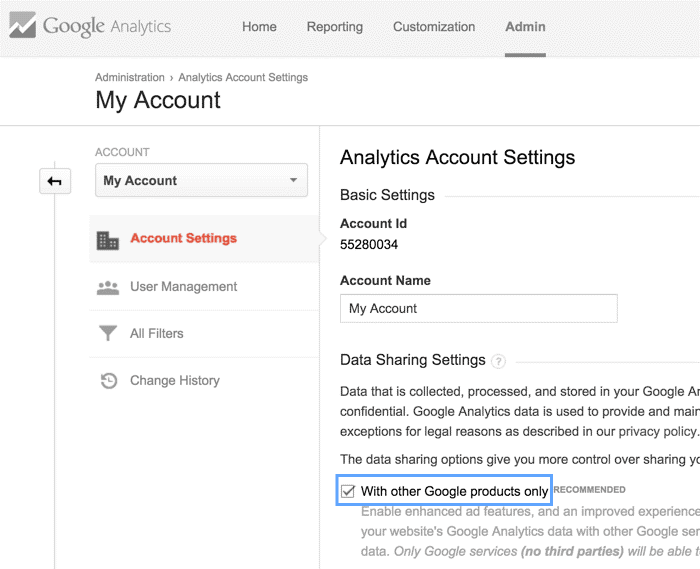
    • Make sure the Google Analytics ‘Data Sharing’ setting – ‘Google Products and Services’ is turned on

    Step-by-step guide to enable Data Sharing

    Once the above given requirements are fulfilled we can move ahead and enable the Data Sharing.

    Smart Goals


    • Login to the Google Analytics
    • Decide on which analytics account you want to enable Data Sharing and navigate to that account
    • Select ‘Account settings’ in the Account column
    • Tick ‘With other Google products only’ check box under Data Sharing settings


    3 Simple Steps to work with Smart Goals

    Now that we have enabled the Data Sharing let’s see how we can enable the Smart Goals.

    Step 1: Enable Smart Goals

    • Login to Google Analytics
    • Select the Admin Tab

    Smart Goals

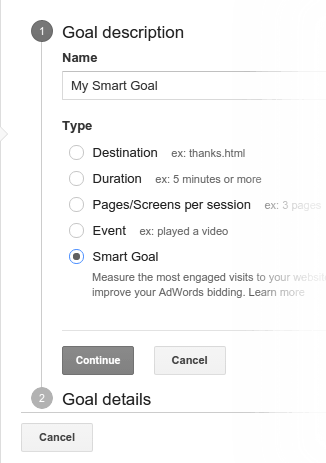
    • Click on Goals > Select Smart Goals
    • Give a name to your Smart Goal and Save

    Smart Goals

    Note: If you select an Industry category, the Goal description might appear different than what is shown in the image above. So, kindly ignore it and click on Smart Goals.


    Step 2: Import Smart Goals to AdWords

    In order to optimise the Google AdWords performance, it is essential to import them into AdWords. Follow these basic steps to do so:

    Smart Goals

    • Link the Google Analytics and AdWords accounts
    • Once linked, wait for 30 minutes to get the imports
    • Sign in to AdWords account
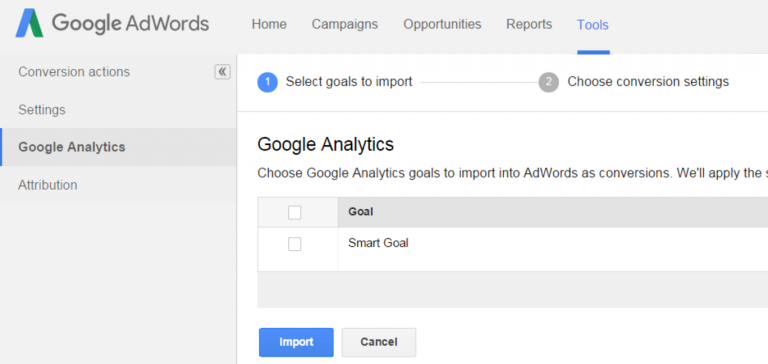
    • Click on the Tools Tab > select Conversions
    • Go to the left hand menu and click on Google Analytics
    • Check the boxes you wish to import. Click continue
    • The next page will display the settings that apply to the goals you selected. Click on import goals
    • Click Close to if you have completed the process or click Import more to import more goals

    Step 3: Use Smart Goals to optimise AdWords

    Once the Smart Goals are imported let them amass data for a few weeks. The first step to start using Smart Goals is to calculate Cost Per Acquisition (CPA). Simply divide the expenditure of the ads by number of Smart Goals completed.

    Let’s take an example:

    Your expenditure in Adwords in past 2 weeks = $2700

    Number of Smart Goal conversions = 90

    Therefore, the average CPA = $2700/90 = $30

    So the average cost for acquiring a session having high probability to convert is $30. In this case, you should set your CPA target to be $30 in the AdWords.

    Note: To optimise AdWords, Google also recommends you to use a flexible automated bidding strategy, called as Target CPA bidding and if you wish to manage the bid by yourself use manual CPC bidding.


    How to see Smart Goals perform?

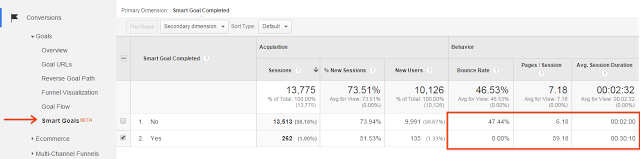
    To see how the Smart Goals are performing, you need to check the Smart Goals report. It helps you to distinguish between the Smart Goals Traffic and the other traffic. To generate the report go to Conversions> Goals> Smart Goals report.

    Smart Goals Limitations

    Though these Smart Goals turn out to be useful for the advertiser, they have their own limitations. They are listed as follows:

    • You cannot customise or configure them
    • They can take up only one of the available 20 slots
    • You can only have one Smart Goal per view
    • They are unavailable for views that get 1 million + visits per day
    • In AdWords, they don’t support VTCs (View Through Conversations) or cross-device conversions

    Well, all said and done, these smart goals are yet not completely rolled out for all the analytics users or advertisers. However, you can expect it to be gradually made available for all the users.