LS Staging

Tag: content strategy

  • Upgrade Your Content Marketing Strategy with Content Experience

    Upgrade Your Content Marketing Strategy with Content Experience

    ‘Content is king’ is a phrase that every digital marketer and brand manager might have read umpteen times. But do you know that this phrase was introduced by Bill Gates?

    In 1996, the Founder of Microsoft wrote an essay titled ‘Content is King’ where he talked about the internet being the future marketplace for content. It has been more than two decades since then, and we can all agree that this prophecy turned out true in every way possible. 

    Content is now at the heart of each of our digital marketing initiative. But while content probably will always be the king, it also goes through innovations and upgrades like all the other aspects of the digital landscape.

    ‘Content experience’ is the new buzzword in the content marketing industry. What is content experience? How can it boost your content strategy? Have a look-

    What is Content Experience?

    Modern consumers now live in a digital world that is ruled by the likes of Netflix and Spotify. These digital platforms take pride in their ability to provide personalized content experiences to their users. Once consumers get the taste of this personalization, they then expect the same from every platform or brand they deal with. In a nutshell, this is what content experience is all about. 

    It is the process of contextualizing and personalizing your content to better match the wants, needs, likes, and dislikes of the audience. No matter how a particular individual experiences or engages with your brand, there should be a level of uniformity and personalization.

    From website content, social media posts, newsletters, videos to even packaging instructions, every possible way in which any kind of content is consumed should be part of the overall content experience.

    How Does Content Experience Help?

    Here are some of the ways in which content experience can boost your content strategy-

    • Improved SEO Reach

    Over the years, Google has upgraded its search algorithm in a way that it can now provide accurate answers to actual conversational user queries and not only technical keywords. Furthermore, increased usage of voice assistance has significantly contributed to this progress. With content experience, your brand could have a voice that is relatable to your target audience.

    In other words, your content would be able to answer conversational queries of the audience, ultimately resulting in higher search engine rankings. Improved SEO reach and higher search engine ranking can also convert into more website traffic and sales.

    • Better Brand Authority

    Gone are the days when basic product demos were adequate to encourage people to buy your products or services. B2C and B2B consumers now prefer purchasing products that have plenty of information available about them on the internet. For instance, according to a report on Inc.com, 91% of the people regularly or occasionally read online reviews.

    If someone wanting to purchase your product or service is unable to find your reviews on the internet, it is very much possible that you might end up losing the customer to a competitor who does. In other words, content experience helps your brand build authority and have valuable information available on the internet, which is now vital for the consumers.

    • Improved ROI

    Last but not least, content experience can also make a world of difference to your bottom line. According to an E-Consultancy report, 80% of the companies that implemented personalization reported improved sales volume.

    Another research by Clickz suggests that companies that use advanced personalization report returns of up to $20 for every $1 they spend. These stats clearly emphasize the vital role that content experience can have on your bottom line. If done correctly, this content marketing strategy can significantly boost your business growth.

    Content Experience- The New Way to Market Content Online

    Modern consumers want to be informed, entertained, and engaged. In simple words, they now look for an experience that can make their purchase journey rewarding and delightful. Providing content experience is a strategy that checks all the right boxes when it comes to satisfying modern consumers.

    With personalization only expected to get more important for consumers in the future, this can be the right time for marketers and brands to start working on a content experience strategy as it could deliver lasting results.

  • Content Accuracy is Not Yet a Google Ranking Factor

    Content Accuracy is Not Yet a Google Ranking Factor

    Content accuracy has always been a point of contention among SEO experts, webmasters and content strategists. While some firmly believe that content accuracy plays a role in determining page rankings, others are on the opposite side of the camp, stating that accuracy is not a ranking factor.

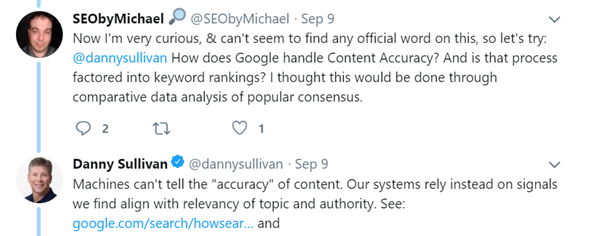
    Recently, this debate cropped up again on Twitter. Danny Sullivan, a veteran journalist who founded Search Engine Land and later joined Alphabet in 2017 as a public liaison for search, was posed this query.

    One of Sullivan’s Twitter followers asked him the following question, “How does Google handle content accuracy?” In response, Sullivan tweeted from his personal account saying that Google’s machines are not yet sophisticated to identify the accuracy of the content. Rather, their machines and algorithms rely on signals for topic relevance and authority, to decide the ranking of the content.

    Here’s the Twitter reply from Danny Sullivan:

    Image via Twitter

    Content Authority not be confused with Popularity

    In continuation with the conversation on Twitter, Sullivan was further asked whether content authority meant content popularity. He responded, saying that content authority should not be mistaken for popularity, as popularity will have no place for new queries that constitute nearly 15% of Google’s daily search volume. Also, content popularity is too simple a signal, and Google doesn’t rely on it to rank web pages.

    The Emphasis on Content Authority by Google

    In April 2017, Google announced the launch of Project Owl to improve the quality of search results. This project stressed more on authoritative content that enjoyed better ranking. Additionally, this project allowed users to send their feedback to Google regarding its auto-complete search suggestions and the featured snipped answers that were listed on the first page of search engine rankings.

    This was Google’s first step to combat the spread of fake news and misinformation on the internet. In November of 2017, Google, along with Facebook, Twitter, and Bing, agreed to use the trust indicators of The Trust Project to aid the prevention of spreading of misinformation and fake news.

    Earlier this month, Google updated its Search Quality Rater Guidelines with an aim to vet out news sources as well as creators of YMYL (Your Money Your Life) content. These guidelines have been modified to allow raters to provide content that has the potential to spread hate, the lowest ratings.

    The Debate Continues on Twitter

    Sullivan’s reply sparked plenty of replies with some users disagreeing with his answer and some agreeing to it. Some stated that today, machine learning tools could assign levels of accuracy to content. Machine learning can assess the accuracy of almost all content that doesn’t relate to personal experience.

    However, others thanked Sullivan for clarifying the issue that content accuracy is not a ranking factor as of now.

    What’s the Takeaway?

    There’s no doubt that content accuracy plays a crucial role in determining its impact on the end-user. However, content accuracy is not one of the top Google ranking factors. Page authority and relevance are likely the top two signals that Google’s algorithms use to rank content.

  • Difference Between Content Marketing and Content Strategy

    Difference Between Content Marketing and Content Strategy

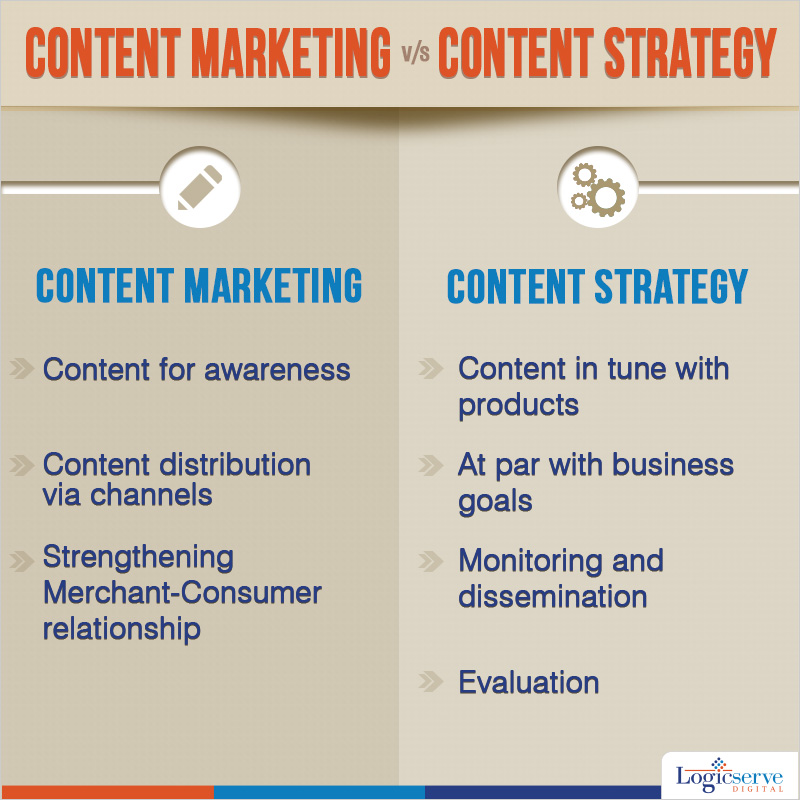
    Difference-between-content-marketing-and-content-strategy @LogicserveDigi

    Content Marketing has taken forefront within an organization or a brand’s content strategy plan but this is exactly what is mystifying largely to the existing content managers. To a certain extent, they are at loss for the skill set required seems to have altered. In reality, they are different and still related.

    With a fine line dividing the two which at times gets blurred, it becomes crucial to understand what each of them actually includes and refers to. Though both relate to ‘content’, marketing refers to spread of reach of content to readers base – expanding as well as relevant. After all, it is the readers who are or likely to be the customers of the product or service offered by the brand or the organizations.

    On the other hand, content strategy involves creating (used again here as well) of content which is more impactful and impressive to the readers while relating to the brand or organization’s offerings and services.

    Content Marketing revolves around

    • Creation of Engaging and Enticing content for enhanced awareness
    • Distribution of Content through viable channels for better outreach and ROIs
    • Strengthening of Merchant – Customer relationship

    Content Strategy revolves around

    • Planning & Creation of Content in tune with products and services offered
    • Creation of Content on par with market dynamics and business goals
    • Monitoring the dissemination of content and its response when in use
    • Evaluation of Content performance during and after its discontinuation along with its preservation

    The content strategy involves the creation planning and productions of content related to the business while the content marketing exactly knows which content will convert potential demand into sales. Hence, the fusion of the two is very much required for an effective business pitch, which is very essential for sales and business expansion to a desired level.

    The role of a content strategist is not limited to creation and publication but extends up to its effective management too. At this stage, it would be right to say that content is a valuable asset used to attract prospective customers. As aptly stately by Rachel Lovinger, “Content strategy is to copywriting as information architecture is to design.”

    Drawing attention to current examples of content strategy and marketing are the promotion of electronic gadgets, smartphones and more. The specifications and the UI features relate to product knowledge which are converted into content in form of user manuals, how to use guidelines, blogs, features, articles, videos and more is developed under content strategy. On the other hand, content marketing involves the distribution of the same across various channels targeting relevant audience for the correct leverage.

    LogicSpeak :

    For success in any online business venture, content marketing is very essential but planning and creation of content comes under the purview of content strategy. Though different, strategy and marketing of content have to be well planned and phased out initiatives of any business. Most digital marketing agencies offers content marketing as well as strategy services which can be utilized by their customers.

    Previous Post: SEO Copywriting

  • What You Need to Know About Creating and Scaling Quality Content

    What You Need to Know About Creating and Scaling Quality Content

    Scaling quality content @LogicserveDigiWith more than half the globe’s population having access to the internet, the nature of content has changed fundamentally. More and more consumers are getting information and forming opinions about brands from digital content sources rather than offline content sources such as newspapers and magazines.

    This poses challenges for businesses and marketers. Those who have observed this trendline and where this is going are already focused on creating quality content to meet the requirements of their target audience.

    Whether it’s a B2B or B2C organization, they’ve all joined the content bandwagon. This nevertheless creates a problem of plenty — some 92,000 new articles published on the internet every day. Add to that the millions of blog posts on millions of WordPress and Blogger blogs.

    Quality Content is the Key

    How to stand out in this avalanche of new content? The basic and minimum requirement is to produce content that is free from grammatical errors and is original. Such content will not only appeal to the readers but will also pass muster with all the content-focused Google algorithm changes the latest round of which was Google Panda 4.0 which was rolled out recently.

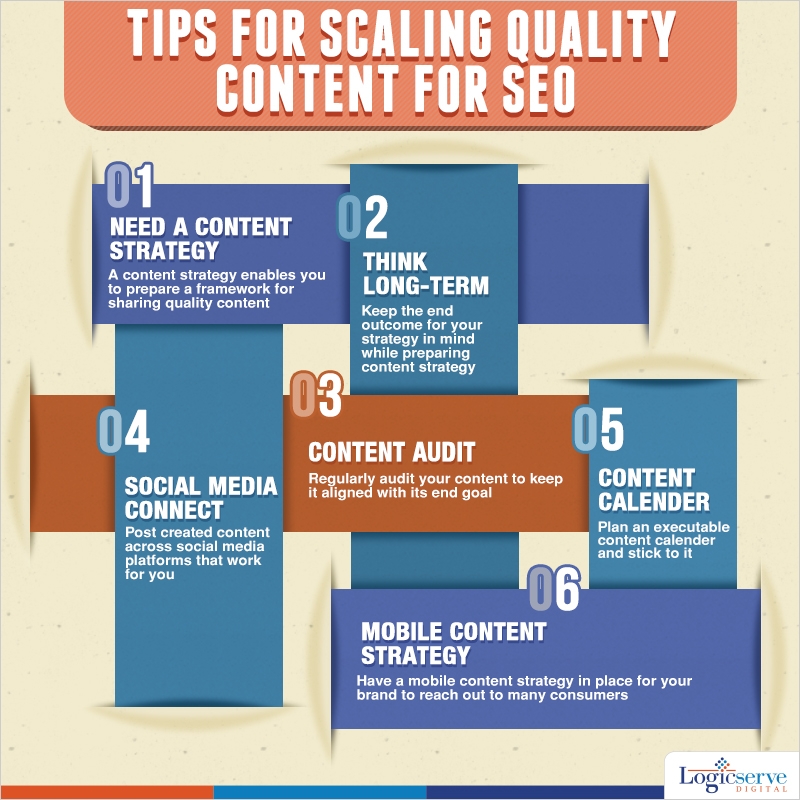
    Everybody Needs a Content Strategy

    If you want to compete in your local city marathon (or the New York City or Boston marathon if you wish), you need to put a strategy in place — you will surely fail if you just decide to sign up for a marathon one fine day without having prepared for the rigors of a marathon.

    Think Long-Term

    Similarly, content marketing is a marathon that requires long-term planning. Determine your content marketing platforms — blogs, email newsletters, social media and so on — and learn as much about your readers as possible (what percentage of them use mobile devices and their age-wise and financial break up and so on). Having this knowledge ensures that you will generate the content that will appear to your target demographic.

    Content marketing is distinct from in-your-face sales or advertising. Content marketing is not about selling stuff. You need to keep that in mind for your content strategy to succeed. Using the marathon metaphor again, a marathon is different than a 100 meter sprint. If you start running at the top of your capacity, you will run a very fine 100 meter sprint but won’t be able to even complete a marathon.

    So as you measure the ROI of content marketing efforts, remember not to focus on pure sales numbers. Content marketing will likely take longer to convert leads as it’s designed and focused primarily to pull potential customers into the marketing funnel.

    Part of having a long-term strategy is to be persistent and consistent with your content strategy. This means you need to have a solid plan — spanning months if not years — for your content marketing initiative. Of course you can keep measuring the reach and impact of each piece of content marketing — each blog post and email newsletter and so on — on a daily basis or as appropriate.

    Content Audit

    To maintain a regular pipeline of content, make sure to audit all your departments to get a sense of what content your company and its different departments have and how much of that is current and how much is outdated. Once you make the audit, you will get to know if there are any missing areas in terms of content that needs to be filled — some products that don’t have brochures or a need to create an FAQ, etc.

    Content Calendar

    Then comes an editorial calendar that should have inputs from every department of the company. Having a calendar has multiple benefits including avoiding any duplication in efforts, a unified location where all content-related effort is tracked and getting the maximum impact out of your content effort.

    Content Planning

    To make the optimum utilization of your time and resources, content creation and content marketing should happen as part of a detailed plan. This ensures synergy in efforts — such as those between the marketing, corporate communication and content marketing. Similarly, you need to have a plan for how to distribute the content in the most effective manner across different content platforms — sometimes long-form content will appeal to your consumers and readers while at other times, shorter forms and byte-sized content will do the trick.

    The Critical Role of Social Media

    Every brand has a presence on Facebook by now. But clever brands will go beyond just bland Facebook posts. Businesses need to be present on multiple social media platforms to reach the widest audience possible and their social media content strategy needs to take account of who their audience is. Facebook pages are great for sharing pictorial content — and never forget to include the right-sized picture with every Facebook post — but that content is only visible to those who already like the page. Twitter posts, on the other hand, are visible to everyone who is on Twitter. Pinterest and Instagram are similarly must-use platforms for brands whose products are targeted to women consumers who tend to frequent these platforms preferentially.

    How to Create Viral Content

    As you seek to create stellar content that stands out in the clutter, you can take inspiration from different sources including current events — whether it’s an ongoing football World Cup or the Olympics or the Super Bowl. Keep in mind your audience as you seek to tie your content to current and trending topics. Social media platforms such as Facebook and Twitter will help you know what the “trending topics” are and these tend to change rather often too and they tend to reflect the interests of the users of those social media platforms. Quora and Hootsuite are also places where you can get ideas for creating content for your blog.

    Refer to competitors’ websites in your domain and see what are the popular topics and posts on their blog. That can give you an idea or a starting point for a blog post of your own. Remember that every piece of content cannot go viral. You have to keep at it — it takes 10,000 hours of practice to become good at something as Malcolm Gladwell put it. Similarly, it will take a while to develop a unique corporate identity or voice and to develop an emotional connect with the readers.

    Sometimes, it’s okay to take a position on a controversial topic — remember how Tim Cook advised a shareholder to sell Apple stock if he didn’t feel comfortable with Apple’s focus on human rights or environmental activism or other social missions. You too can decide to “stick your neck out” — if it can be called that — and declare that indeed you and your company believes humans have caused climate change.

    Mobile Content Strategy

    You got nothing if you don’t have a mobile strategy — in fact some are going so far as to have a “mobile first” strategy. It depends on your business vertical how much you need to focus on having a mobile content strategy but it’s pretty much an indispensable part of an overall content strategy.

    If you are a B2C organization, you should have come to terms already with the fact that your website must be mobile-friendly — if you don’t want to lose a ton of business. Even Google has tweaked its algorithms — Google Hummingbird — to be better prepared to answer long-tail queries and natural language or spoken queries. This is designed to meet the needs of mobile users. Since Google is adapting to a world where mobile internet users have already overtaken or will soon overtake desktop internet users, so should you.

    What you need to do in terms of having a mobile content strategy is remember that many of your readers will be reading your blog posts and email newsletters and other content on mobile devices. So, you need to have a few short blog posts that only has a bullet points and highlights and links to a longer post which is of course essential for SEO as Google tends to give more weight to articles longer than 2,000 words.

    The key to effective mobile content is large fonts, lots of images and videos that users can watch while making their commute to the office via the subway or other public transport. For mobile users with typically short attention spans, content that is easy to grasp is appealing. You should try to keep your content at the level of an eighth-grader — this is not to be condescending to the reader of course but just acknowledging the reality that all of us with busy lives may not quite be up for dry or academic prose that reads like a scientific or literary journal extract. The Fleisch-Kincaid readability score helps in this regard and it’s built right into Microsoft Word — so, you might want to put your content through that metric and see if you need to reduce the number if it appears to be too high.

    Content Curation is Good

    Don’t be afraid or shy about repurposing content or pointing your readers to top-quality content that is not generated by you. You can profitably use tools such as Curata to help you with content curation and you can use content curation in your email marketing or blogging.