LS Staging

Tag: content optimisation

  • Should the best content be on your site or be given away?

    Should the best content be on your site or be given away?


    One of the commonest dilemmas content writers encounter is where does their content belong the best? Would it reap them more benefits if they decided to have the content on their own page? Or would it be wiser to give it away?

    Considering the dominance of SEO criteria in every form of content that goes up these days, there has been a lot of debate regarding where it would be best to place optimised promotional content. And though opinions regarding this vary, they sort of depend on the goals of the webmaster in concern. This eventually makes the debate settle down a bit considering subjectivity and the varied needs of online content developers.

    The rapid proliferation of meaningful content

    Content is now a major aspect of marketing. This has opened floodgates to this profession now as more and more people are starting up with content. Content is gaining acknowledgement fast. As more and more people start off as newbies, they usually are unaware of the benefits that come with the correct placement of content online.

    There are also some who would just like to guest post. They would rather write for columns and editorials for other sites than maintain one for themselves. They do this as maintaining a blog or online journal requires efforts and time. This is an aspect of content not all are willing to comply with.

    Why having it in-house matters?

    Many, however, are of the opinion that if you happen to create quality content, it is preferable to have it on your own site. This makes sense as having quality content would benefit your page and up your SERP ranking. Though the scope of having your page discovered and gaining momentum in the form of web traffic is slower than having your content on other sites, many web content developers prefer their content be on their own site.

    Why having it put out on other sites is better?

    The scales, therefore, tip in favour of having your finest, most optimised content placed on other websites. This adds branches to your content and offers platforms to place your content. This is an effective way of getting your finesse out there. Established platforms have better traffic. This saves you from having to build traffic up from scratch.

    Posting your content on websites that garner steady flow of web traffic renders your website enough link juice to function. You get traction in the least amount of efforts possible. Your website does not have to outperform the big names out there but once you manage to get in enough link juice for your site, you manage to automatically compete against the big names. This gets your site credibility and trust in an organic manner.

    Another benefit of posting on other websites is that, in case of an emergency (like a server issue), your content would be unharmed, and your website’s numbers would stay unaffected.

    Having your content on other website manages to give you the benefits of their website’s credibility and top-notch services without having to shell out hefty amounts of money yourself. In conclusion, the idea of posting content elsewhere has an upper edge over having quality content on your own site.

  • Tips To Promote Your Blog On Social Media

    Promote Your Blog On Social Media @LogicserveDigi

    If you have spent quality time creating content you think is great, then it is also time that you start raking in the benefits of content marketing. Now content marketing using free options such as SEO, social marketing would be the preferred way to go for individuals like you. It may not be viable to spend money on paid as for your blog or site promotion just yet.

    Gamut of social media platforms to tap

    Social media is the hot buzzword today and has been for quite some time. Promoting your content though on the usual Face book, LinkedIn and Twitter is just part of a larger canvas that you have at your disposal and you need to know about the rest.

    Here is how you can go about the whole process of leveraging your content so as to promote it on social media platforms.

    1. It all starts with the content itself. What you create has to be intriguing, relevant, and unique with catchy titles as well as images. Now that you have these, you are ready to share it with the world. You have tools to check the effectiveness of your titles and how a bit of tweaking can make them stand out and get noticed.
    2.  Content has to be such that it makes life easier for customers. They should feel motivated to go online and carry out their transactions, especially when it comes to service industry like banks.

    One example of this is the initiative of Barclays to enable customers who are not that tech savvy to go online. Their Digital Eagles project has led to the accessibility of in branch customer services for many of their customers at their homes. The project is also remarkable from the “human touch” perspective.

    1. Make it easier for people in social media to share your content. Add relevant and crisp Meta tags so that the gist of your content is displayed correctly. Make use of tools to check out if your content pages are optimized as they should be for display on social media.
    2. Make it also easy for your visitors to share your images. You can use tools like SumoMe that enables your visitors to just hover on the image and share them.
    3. Ensure your content is optimized properly for display on mobiles. Today, 20% of the traffic is generated from mobile devices and you cannot afford to ignore them. Brands like Mashable are making use of content curation on Scoop.it to gain visibility through the creation of apps for iPad users.
    4. Create snippets that your visitors can share through Twitter. Here too, you have apps like Clicktotweet that you can add to the blog or site and help your visitors.
    5. All new content that you have created should be shared multiple times so that they get noticed. Make a schedule such that you are able to share it since you do not want to miss out on any visitors who may not be online when you post your blog on say Twitter.
    6. It is also advisable to identify the optimum time to post your content. You can make use of a tool like Buffer that will enable you to schedule posting of content at different times to that you are able to target a broad spectrum of your audience. There are other tools like Socialbro and Face book Insights that are useful as well. You need to try out different times and days to find out what works the best though.
    7. Reach out to communities other than popular social media platforms as they too can generate traffic. One example is Scoop.it that curates content. This is where many people post their content for many others to follow and share it among various social channels. The idea is to get more and more visibility and through that even more shares. Instead of doing it all by yourself, you are making use of popular community boards to do the needful for you.
    8. It is advisable to know about the bloggers in your niche and leverage that information. You should read as well as share other posts and also comment on them. Ensure you specify the Twitter handle of that blogger. People will return such gestures and it is a win-win situation for everybody.
    9. Use social bookmarking effectively through sites of high profile such as Reddit, StumbleUpon, Delicious and Digg. This too involves some effort from your side to read, comment on other posts within these sites but is well worth the investment.

    To summarize, it can be said that great content requires the exposure and visibility it deserves. Forbes for instance has managed to incorporate these ideas into their social media strategy and boosted readership tremendously.

    You too can gain a lot from the above mentioned steps and lend a huge boost to your blog or site in terms of visitor as well as search engine attention.

  • How to Create Content for Mobile

    How to Create Content for Mobile

    Mobile-content-creation @LogicserveDigiYou must be aware of the importance of creating websites that are optimized for mobile viewing. If you want to stay at the top of your business, it is extremely important to keep the mobile users in mind. In order to help you create befitting content for mobile, here are the points you can keep in mind.


    1.     Make a responsive layout

    When you are looking to make your content suitable for mobile users, the very first thing you have to keep in mind is to make your layout responsive. A responsive web layout is so designed that regardless of which device you are using and the screen size, which it has, the content will be clearly visible without any size misappropriation.


    2.     Create touch friendly links and icons

    When you want to have content that is friendly for mobile viewing, it is important to have touch friendly icons. This makes for easy mobile viewing. When people are surfing on their mobile, they are not likely to appreciate pages and pages of endless narrative content. Try and break the content into smaller clickable segments such that one can smoothly navigate from one page to another.

    You should make it a point to have a detailed study of the size of the icons that will suit the screen size of different mobiles. If you have a call to action field on your page, make sure to keep it on focus so that users do not end up missing it altogether.


    3.     Research the needs of your mobile users

    There is absolutely no short cut to success. You have to be sure that you are going through the complete details of what your mobile users want. If you dig at the statistics, you will get a lot of important facts regarding what users want when surfing through your site. The content which you put on your site should not be there merely for the sake of filling the pages.

    You have to research well and find out what your audience connects with and takes a call to action. Once you have a clear idea about the same, you will be able to understand and curate the content accordingly. When you are offering mobile friendly content, you will need a lot of short headlines, catchy subtitles, short paragraphs and a little bit of illustrative content as well. All these together makes for an excellent mobile friendly content. Obviously, you have to keep seo in mind; however, the key idea is to keep your focus upon the ideas which appeal more to your users.


    4.     Format judiciously

    When you are producing mobile friendly content, you have to be careful about the type of formatting you offer. You should make it a point to align your content in an apt manner. Have numerous paragraphs but make them short. Use the right font and try and avoid too much fancy letters. Do not go for too bright or too dull font colors. Keeping these little things in mind will help you churn the perfect mobile friendly content.

    LogicSpeak:

    Creating mobile content is not much different from creating content for other channels. One should always remember that, even though the channels play a role the quality of content is of primary importance.


  • Difference between B2B And B2C Content Marketing

    Difference between B2B And B2C Content Marketing

    B2B Vs B2C Content @LogicserveDigi

    When you are curating content, the strategies aren’t same for one and all. There is a lot of difference in the way you craft content for B2B as compared to B2C. Let us take a look at the details of the same.

    The Difference In Target Base

    As B2B and B2C cater to different segments of customers, you have to keep this in mind when you are making the content for these organizations. B2B refers to business to business dealings and thus the content which you craft needs to be such that it applies to all the major business brands that are your main targets.

    You have to be more factual and load your content with details that are straight and to the point. When business organizations want to engage in business with you, they will need hard core facts and core technical details that have to do with your business. This makes it important for your content to be much more technical than creative.

    B2C organizations on the other hand aim at targeting the end consumers. Here your content has to be creative and catchy such that you can attract the attention of the customers. Customers need not be fed a huge amount of technical details or even facts and figures. All that is desired from you is the fact that your content should be catchy enough to entice users to read it and then lead to the desired call to action as well.

    The different challenges

    The challenges which you are going to face as B2B or even B2C organization are going to differ a great deal.


    B2B:

    – Those organizations that work on B2B framework generally do not have extremely rigid budget issue. However, they face the issue of producing enough content. The type and amount of business which they are catering to may differ significantly and winning over the different business bodies isn’t easy.

    – As the other business bodies are also skilled in their field, one has to produce ample content which is crisp and loaded with all the factual details and researched statistics which will convince the businesses.


    B2C:

    – On the other hand, when we are talking of content marketing strategies for B2C business, we often find budget to be a strict issue. Most of these firms do not have a lot of budget for the sake of content marketing because winning over customers through content is just one facet of their business.

    -The budget needs to be invested in various other places which make it hard to excel in content marketing.

    These are the main differences in content marketing. While the main methods may remain the same, there are differences in the way content marketing has to be approached.


    LogicSpeak:

    So, one should not get complacent and it is important to understand the details of the target base, the focus of the firm, the needs of the business and then the right strategies and methods should be executed so that one can get the befitting results. Content marketing must be done in the best way to achieve the highest output.


    Previous Post: SEO 2015 – What you need to know

  • Google Authorship May be Dead,  But, You are Still Writing. Aren’t You?

    Google Authorship May be Dead, But, You are Still Writing. Aren’t You?


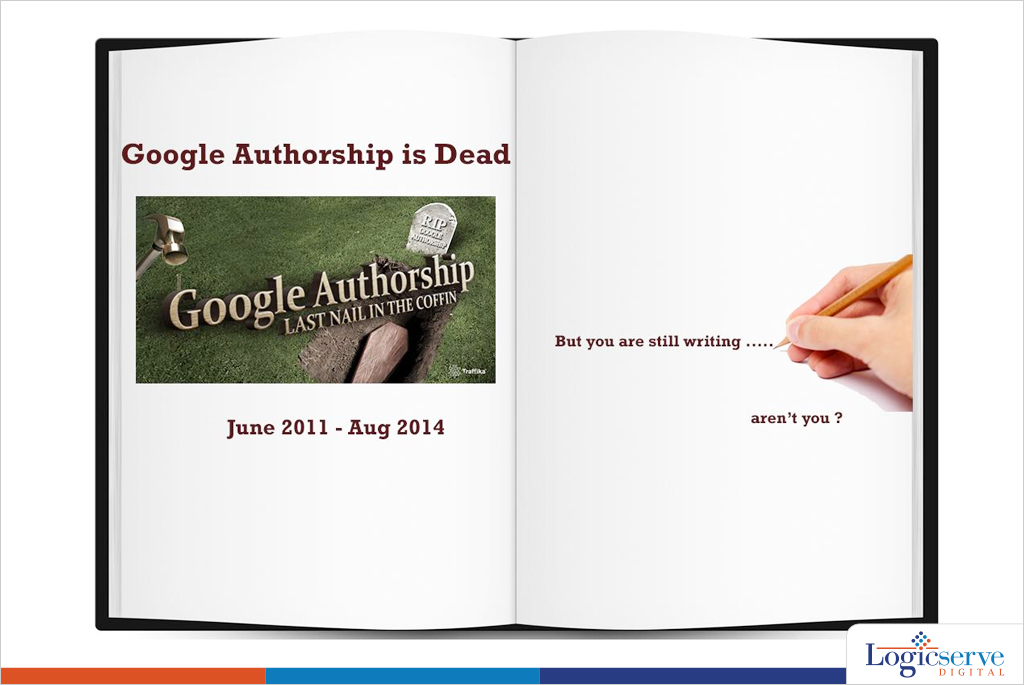
    So much has been written about Google Authorship in the last week compared to the time this was introduced in June 2011. Had this been the frequency of “authorship posts” before Aug 2014, Google Authorship would not be dead afterall.

    It is official – Google Authorship no longer exists.

    John Muller’s Offical post on Google Plus

    I will be coming back to this statement in a while, so hang on to that thought and read ahead
    Google Authorship is dead @LogicserveDigi

    What makes one an Author?

    All of us write, but does that qualify each one of us as an “Author”? Guess not. We write for different reasons. But “To Write” is the only reason for Authors to write for, while the rest of us write for the sake of keeping up with social norms.

    Authors invest time, effort, memory & wisdom of the experience gained over the years to come up with a truly original piece of writing, a.k.a “content”. Every content he/she creates is an extension of self, and hence so much dear. So, it is only understandable that due credit reaches the author. Monetary benefits apart, the credit an author looks for is being recognised for his/her work.

    • To see her work published (online / offline)
    • To have her name associated with the published work (if she is not ghost-writing)
    • Thanks to blogs, webzines, and other online publishing options, one is able to publish under their name.
    • But that is not all, Status updates on Social media (FB, Twitter, Google+, Linkedin, Quora, the list is endless) is also associated with one’s identity. So technically, is the author of that content as well?

    What is Authorship? Is it important?

     Associating the identity of the person with content is authorship.

    This is a good thing. One gets to claim his writings as his own. Plagiarisers & contents scrappers beware. But then, there are those who cheat and steal content with absolutely no shame whatsoever. So to combat such content piracy, authorship to a work is extremely important

    Why did Google launch authorship?

    Same reason as above. It is important. (at least, that is what they thought in the june of 2011)

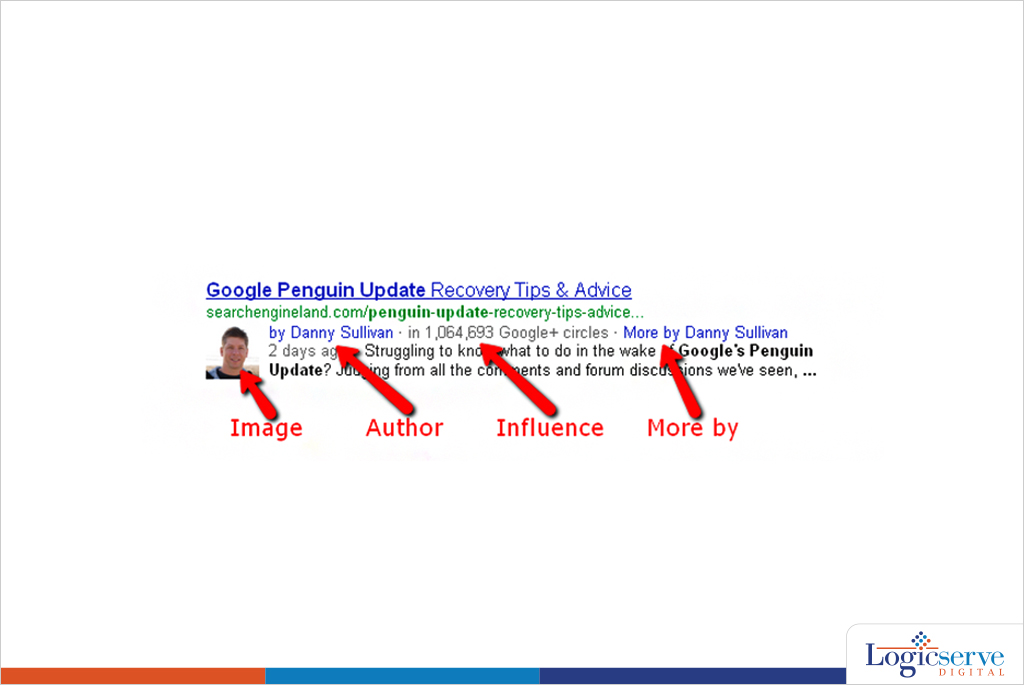
    It is important to associate content with its creator, so that when the content is retrieved via search results, the author gets her due credits by seeing her name alongside the title. Given the “visual appeal”, should the author have a photo associated with her profile that also showed up on search results.
    Update recovery @LogicserveDigi

    How was it received by the online community?

    Bloggers, savvy content providers, columnists who wrote across multiple websites were all gung-ho about the authorship initiative. This was an opportunity to establish authority over their written work, which came with the bonus of “likely surge in traffic”. Gives a visual appeal, and it kind of gives that gentle nudge to click the result with author image, compared to one that does not have an image –at least that is what the authors thought would happen.

    How many actually implemented the authorship markup?

    Tech savvy bloggers were the early adopters. DIY enthusiasts came next. But then, that is pretty much. Truth be said, not many… read negligible.

    Joel Klettke of iACQuire has rephrased the results of the study in simple terms.

    Eric Enge and Mark Traphagen shed some light on the woeful adoption of the “rel=author” tag in their latest post.They sampled 500 authors across 150 different platforms and found that:

    • 50 of publishers had no author page whatsoever
    • 241 of the authors had no profile at all
    • 108 of the authors had a profile, but no link to the publishing site
    • 151 of the authors had a profile with one or more links to the publishing site

    A staggering 70 percent of authors weren’t even trying to implement authorship

    Enge and Traphagen went on to analyze 20 of the sites that DID have author pages and found:

    • 13 of the 20 sites attempted to implement authorship markup
    • 10 of the 13 attempts had errors
    • Despite this, 12 of the 13 attempts received rich snippets in Google SERPs

    Those findings mirror past studies that found:

    • Less than 3.5 percent of the Fortune 100 used rel-author,
    • Only 20 percent of U.S. news publications had marked their content up,
    • Even among the tech savvy, only 52 percent of the top 50 tech blogs had hopped on board, and…
    • Hilariously, only 7 percent of Google’s own blogsused Google+.


    Why such low adoption rate?

    Didn’t people want to see their faces/logo in the search results? Are we being modest?
    Neither.

    • The instructions were too complicated for an average user.
    • Not actively promoted to increase awareness in the community

    So, many did not implement because they just didn’t know about this. Many tried and failed, and moved on with other priorities that mattered. Many just didn’t care and probably anticipated that this will be scrapped like Google Wave, Google Buzz.

    Here is an entire graveyard for Google projects that were discontinued.

    Why exactly did Google decide to pull the plug?

    Honestly, we only know as much as John Muller has shared on his G+ profile. Are these reasons exact or not, one can only speculate.
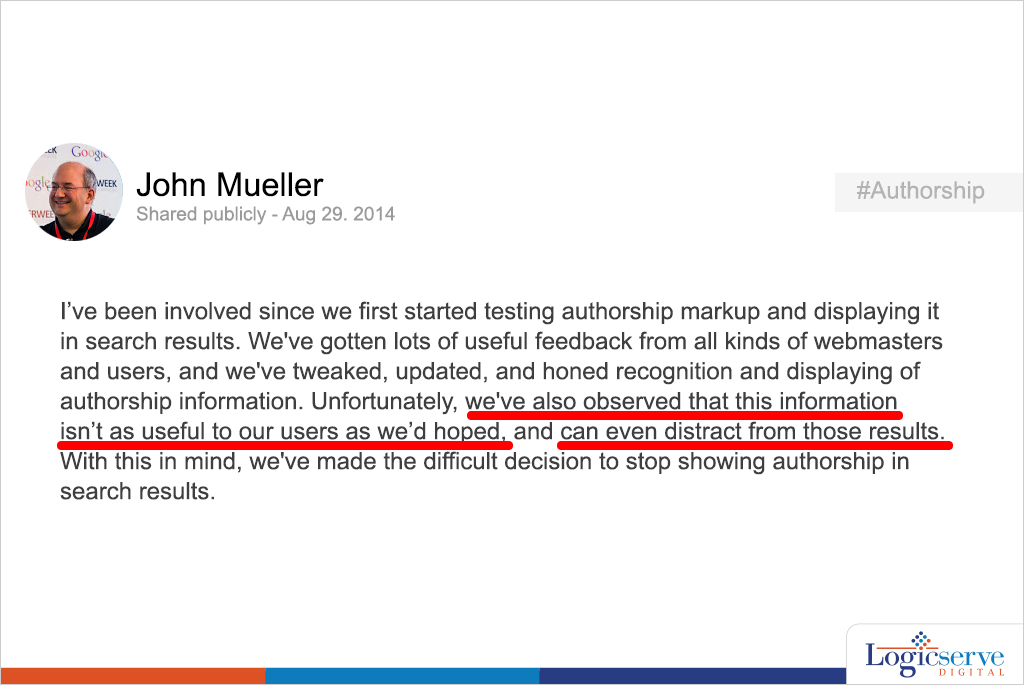
    Mueller announcement @LogicserveDigiSpeculations run amok regarding this decision.

    • “Not as useful as thought it would be”
      • Useful as in how the search results are ranked?
      • Useful as in how the search results are perceived?
      • …hard to say.. hmm
    • “Distract from results”
      • Distract where to ?
      • What do we have in a search result page to get distracted towards?
      • … clicks on paid ads.. perhaps….hmm

    Maybe, users get so focused on the search results; they get distracted from clicking the Advts on the Search result page – as Rand Finshkin (Moz Founder) speculates via this knee-jerk tweet. Jayson DeMers, a regular contributor at the Forbes Magazine has interviewed 7 industry experts is a must read if you are authorship-obsessed.

    What will happen to my SEO efforts put in from 2011-2014?

    Help ! I am having a panic attack.

    Relax, take a breath. Panic will get you nowhere.

    Assuming that you have built your SEO around legit channels (quality content, relevant key words, contextual teasers in social media, linking to quality websites, a decent author bio at all your contributor sites) you do not have to worry. You will be ranked appropriately and very very unlikely to lose traffic on account of Google Authorship.

    Yet, is it better to leave the authorship settings (rel=author) as it is, and include in all future content as well. Who knows, Google being Google, they might not be using this data for now, but could be studying the user behaviour in stealth.

    However, if your SEO strategy is set up with Google authorship at the nexus, then it is a slight cause of worry. Check your Analytics, you might notice a dip in your site traffic between 24-30th June 2014. This is when kill-the-authorship initiative began, Google dropped authorship photos from search results .

    But as I said, this is only a minor setback. With quality content already in place (again, assuming that you are serious about what you write and does not belong to the class of content-stealers), a few hours on legit SEO practices, you should be able to regain lost rank in just a couple of weeks. This is a small thing to pay for the long term benefits that lies in repositioning yourself in the search result page. Reading David Worral’s Google Authorship is not the the holy grail of SEO might help with the panic attack and get back your wits.

    So, what next?

    There is nothing that we can do about this, but move on.

    We as authors / writers can fret all we want, but that is not going to change anything around the authorship programme. This would only pin us down with frustration, which would eventually percolate into our writing as well. Trust me; you certainly don’t want this to happen. Your written work is your extension of self, and you don’t want to appear shabby and unkempt. So, Move on !!!

    Logic speak:

    Go back to good old ways of writing quality content, linking to appropriate quality websites, and use intelligent teasers in your social media posting to drive users to your website. Google Authorship may be dead, but you are still writing. So write and publish wherever it is appropriate. Don’t worry about the bots. People hire people, bots don’t.