LS Staging

Tag: content marketing

  • Difference between B2B And B2C Content Marketing

    Difference between B2B And B2C Content Marketing

    B2B Vs B2C Content @LogicserveDigi

    When you are curating content, the strategies aren’t same for one and all. There is a lot of difference in the way you craft content for B2B as compared to B2C. Let us take a look at the details of the same.

    The Difference In Target Base

    As B2B and B2C cater to different segments of customers, you have to keep this in mind when you are making the content for these organizations. B2B refers to business to business dealings and thus the content which you craft needs to be such that it applies to all the major business brands that are your main targets.

    You have to be more factual and load your content with details that are straight and to the point. When business organizations want to engage in business with you, they will need hard core facts and core technical details that have to do with your business. This makes it important for your content to be much more technical than creative.

    B2C organizations on the other hand aim at targeting the end consumers. Here your content has to be creative and catchy such that you can attract the attention of the customers. Customers need not be fed a huge amount of technical details or even facts and figures. All that is desired from you is the fact that your content should be catchy enough to entice users to read it and then lead to the desired call to action as well.

    The different challenges

    The challenges which you are going to face as B2B or even B2C organization are going to differ a great deal.


    B2B:

    – Those organizations that work on B2B framework generally do not have extremely rigid budget issue. However, they face the issue of producing enough content. The type and amount of business which they are catering to may differ significantly and winning over the different business bodies isn’t easy.

    – As the other business bodies are also skilled in their field, one has to produce ample content which is crisp and loaded with all the factual details and researched statistics which will convince the businesses.


    B2C:

    – On the other hand, when we are talking of content marketing strategies for B2C business, we often find budget to be a strict issue. Most of these firms do not have a lot of budget for the sake of content marketing because winning over customers through content is just one facet of their business.

    -The budget needs to be invested in various other places which make it hard to excel in content marketing.

    These are the main differences in content marketing. While the main methods may remain the same, there are differences in the way content marketing has to be approached.


    LogicSpeak:

    So, one should not get complacent and it is important to understand the details of the target base, the focus of the firm, the needs of the business and then the right strategies and methods should be executed so that one can get the befitting results. Content marketing must be done in the best way to achieve the highest output.


    Previous Post: SEO 2015 – What you need to know

  • Importance of Content in SEO

    Importance of Content in SEO

     
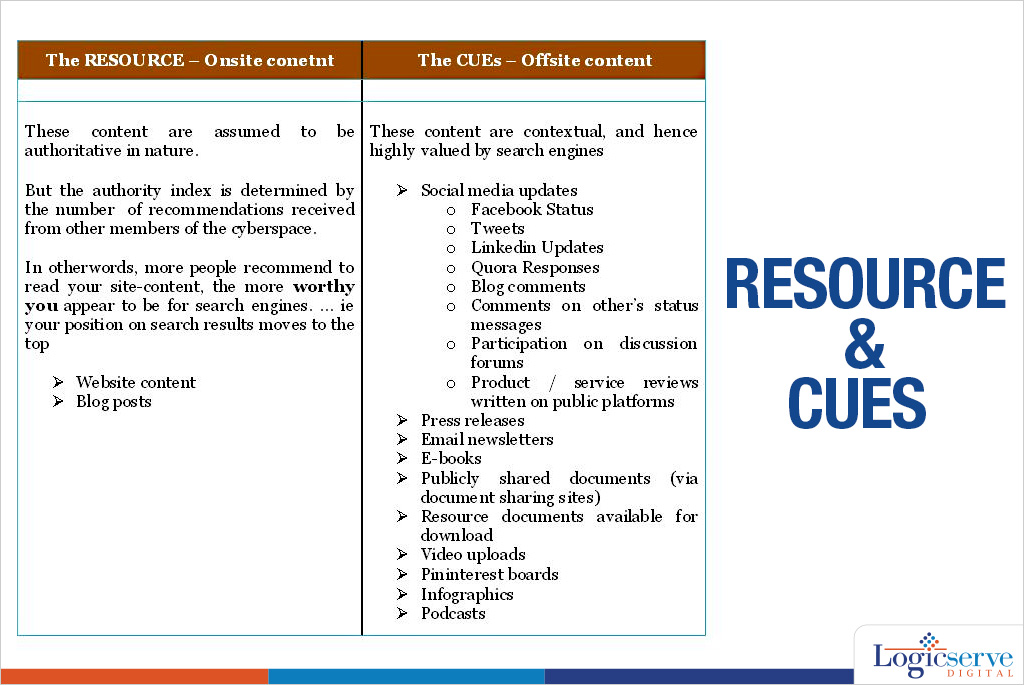
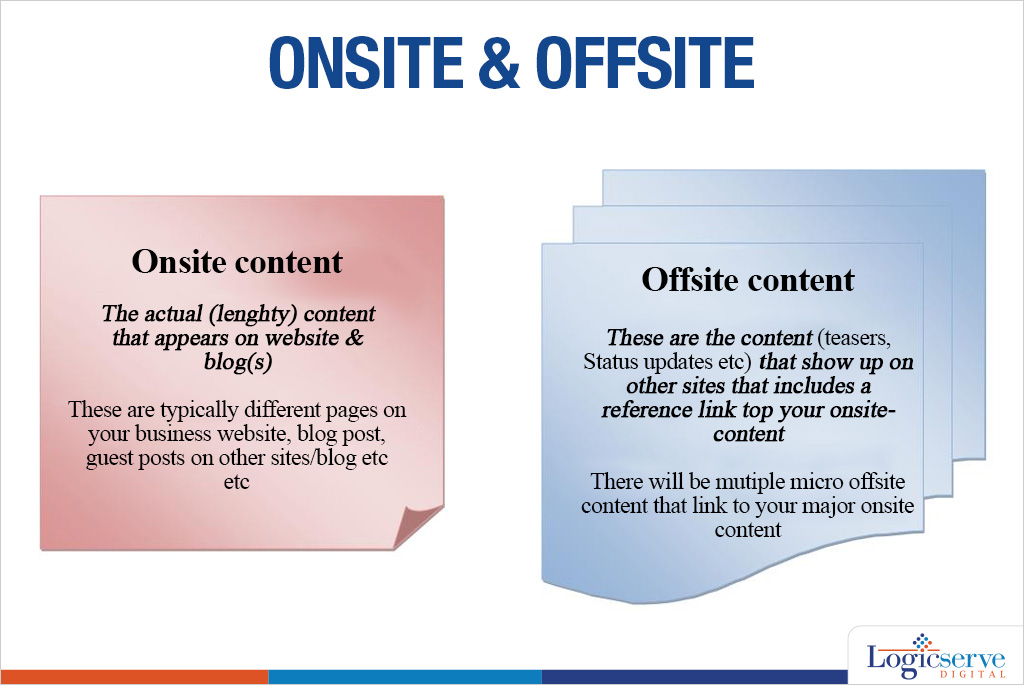
    Content can be broadly classified into 2 categories,

    1024x685_2 @LogicserveDigi

    Search Engines identifies content (based on the near-match-to-search-query) and indexes your content in this   manner

    •  The RESOURCE :

     o   Onsite content – This arguably has the most relevance to the search term compared to your offsite content. So, search engines flags this as the content source for the search-term.

     o   It is here you want your visitors to be.

    •  The CUEs

     o   Offsite content – These as mentioned earlier refers to anything that appears outside of your actual website / blog url. Most common examples of offsite content being social media updates, tweets, brochures, newsletters, sales-pages, Ebooks, presentations, comments on other websites / blogs / social media etc

     o   These are the entities that bring the visitor to your onsite content …read.. chances of better conversion.

     The SOURCE and The CUEs stand to make a better sense when seen this way

    1024x685_1 @LogicserveDigi

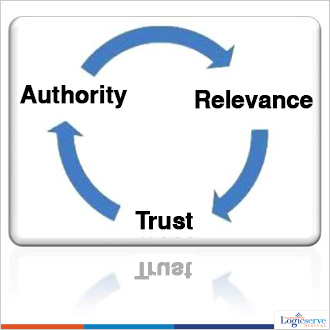
    While onsite content vies for the status of an authoritative source, it is the offsite content that actually grants the authoritative status, based on how many external sites have association (..read links..) to your website / blog.

    So, convincing others to share your

    content is what truly makes up for a good

    SEO practice.


    330x330 @LogicserveDigi

    Question: How to get others to share your content

    Answer: To tap into the potential of the Social media’s sphere of influence.


    Community is a powerful thing, especially when it involves informed individuals. When done right, your sphere of influence will soon become the most sought after one.

    • #tip 101 : Use Social media
    • #tip 102 : Comment sensibly
    • #tip 103 : Be relevant to the discussion
    • #tip 104 : Offer to help
    • #tip 105 : Share not just yours, but other’s content as well.

    Analytics: More (micro) content is generated with relevance to your onsite content

     This is a tricky realm. It is easy to appear headstrong, while trying to be authoritative in one’s comments and status messages. Bear in mind that the social media audience are an informed lot. They have probably seen more of “know-it-all”s than any of us individually. They are ALWAYS the first to spot a fake / pretender / Copycat.

    While this might appear to be intimidating to look at, it is this very factor that adds value when the audience shares your content. Your content is being subconsciously reviewed by the social media audience. Should anyone find your content worthy of sharing, you have hit the bulls eye. Now, your content has an extended audience depending on how many of others chose to share your content.

    More the share, Search engines perceive your content more worthy to be placed on top results.

    Result: Search Engines perceive your content worthy of showing up on top results.

     Logicspeak:

    Time and again it is proved that “Content is King”. The trick here is in recognizing that there is more than one way to generate content. Each content (micro or macro) has a definite purpose. When you see surge in your page views, the content has served its purpose well. Now it is up to you and the business to keep the visitor’s interest alive and convert them into a client / associate.

    Previous Post: Content marketing and SEO: What you need to know

  • Integrated Marketing and SEO — What you Need to Know

    Integrated marketing and SEO @LogicserveDigi

    Making SEO an integral part of your company’s marketing efforts has many benefits. If you are a large company, you will save yourself a ton of money if you run an integrated marketing campaign versus having different marketing silos that focus on offline and online marketing.

    Also, if you don’t have an integrated marketing approach, you might send out confusing signals to potential consumers and you may have a marketing disaster on your hand sooner or later.

    Better to develop a single corporate identity and to promote that identity via an integrated approach that includes all the different marketing avenues including PR, social media marketing, offline marketing campaigns such as events and billboards and so on and combine that seamlessly with online marketing activities such as PPC campaigns, content marketing, social media marketing and SEO.

    If you are a small business, surely you don’t need to be wasting money in running multiple marketing campaigns and the need for an integrated marketing approach with SEO included becomes even more important.

    How To Develop a Top Notch Integrated Marketing and SEO Plan

    You need a vision for your corporate identity and then you can come up with a long-term strategy to be broken up into detailed tactics to accomplish that vision.

    Your integrated marketing plan should include these components:

    1. SEO
    2. PPC
    3. Content marketing
    4. Social media marketing (SMM)
    SEO

    The basic SEO elements of a website should be integrated into the website ideally during the development of the website and these include: on-page optimization, technical SEO, and site structure.

    You should complete a competitive keyword research to determine which keywords are worth focusing on.

    PPC

    This also helps you with running a targeted PPC campaign to test the effectiveness of various keywords and keyword combinations. With further research and A/B testing of landing pages plus ads as well as writing good ad copy, you are ready to run a PPC campaign.

    Content Marketing

    This includes blogging, email marketing, newsletters and other efforts.

    The benefits of blogging are many including:

    • Creating a community of readers
    • Improving your site’s SEO
    • Improving your subject matter authority and becoming a trust-worthy source of authoritative information
    • Bringing customers into the marketing funnel

    Obviously, your blogging should keep in mind the keywords that you want to focus on as part of your SEO strategy.

    Email newsletters have many benefits including:

    • Being able to reach your existing and potential customers in an assured manner
    • Relatively low-cost way to promote any time-sensitive offers and discounts and so on
    • Develop a loyal set of customers

    Content marketing can of course includes other formats including creating YouTube videos and infographics. While infographics help convey information in a user-friendly way, YouTube videos present the message in a format that consumers love to consume. The many recent instances of successful viral YouTube videos prove how useful viral videos can be.

    Social Media Marketing (SMM)

    Your social media plans should be in line with your corporate vision and depends on whether you are a B2B company or a B2C company.

    Facebook company pages and Twitter handles are essential for B2C companies. You have to not only create those pages but also ensure that you are active and posting content via those channels in a regular manner.

    You have to make sure that you address any customer complaints that come to you via FB or Twitter. You have to respond to them swiftly and in a manner that will accrue goodwill to your company.

    Pinterest and Instagram are platforms with different demographics and your business niche will determine how important they should be to your overall strategic marketing plans.

    You can go for an ironic tone or a funny one in your social media accounts but you gotta be consistent in what you want to be. You can get an idea about what will be a successful persona based on the keyword research and A/B testing done as part of your SEO and PPC efforts.

    Integrated Marketing

    When you have an integrated approach to your marketing efforts, you get a positive feedback loop in some ways. For example, you can promote a Twitter hashtag specific to your company not only via your Twitter handle but also on your billboard ads and in your PR newsletters as well as email newsletters and blog posts.

    When you send out a single message via different channels, the message will likely stick with the customers or potential customers more effectively.

    Integration of marketing and the message has to happen at many levels. Your website should have your corporate logo and a color combination which should be replicated throughout all your different marketing formats: email newsletters, blog, Twitter background, Facebook page design and YouTube channel.

    Logicspeak:

    Finally, you need to have a long-term plan and pursue it relentlessly. And you need to keep track of the success of your efforts and see the effects of your integrated campaign on your customer base and what success it is having in pulling fresh new customers into the marketing funnel.

  • Difference Between Content Marketing and Content Strategy

    Difference Between Content Marketing and Content Strategy

    Difference-between-content-marketing-and-content-strategy @LogicserveDigi

    Content Marketing has taken forefront within an organization or a brand’s content strategy plan but this is exactly what is mystifying largely to the existing content managers. To a certain extent, they are at loss for the skill set required seems to have altered. In reality, they are different and still related.

    With a fine line dividing the two which at times gets blurred, it becomes crucial to understand what each of them actually includes and refers to. Though both relate to ‘content’, marketing refers to spread of reach of content to readers base – expanding as well as relevant. After all, it is the readers who are or likely to be the customers of the product or service offered by the brand or the organizations.

    On the other hand, content strategy involves creating (used again here as well) of content which is more impactful and impressive to the readers while relating to the brand or organization’s offerings and services.

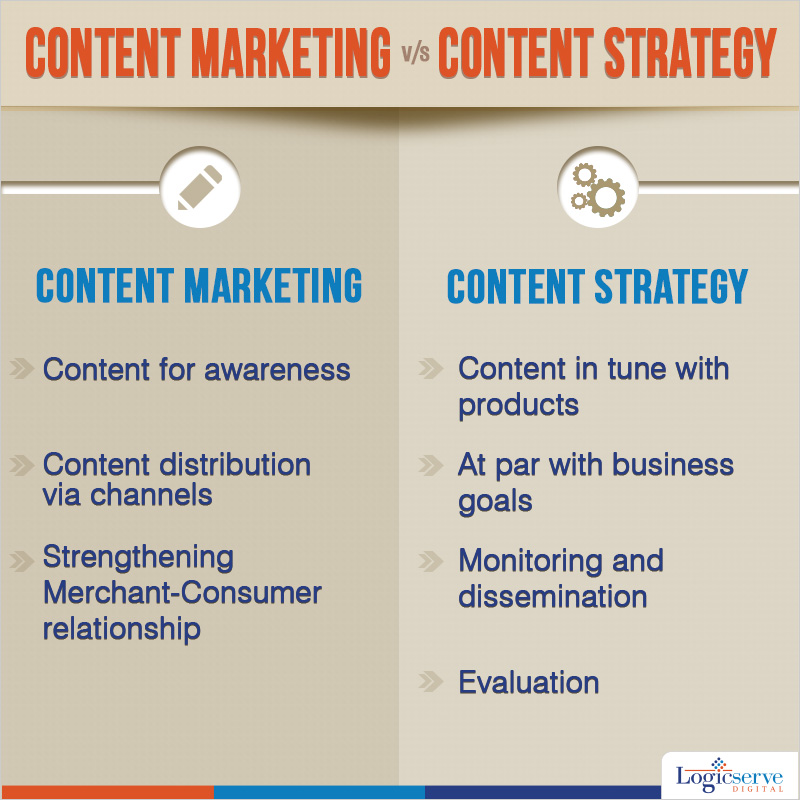
    Content Marketing revolves around

    • Creation of Engaging and Enticing content for enhanced awareness
    • Distribution of Content through viable channels for better outreach and ROIs
    • Strengthening of Merchant – Customer relationship

    Content Strategy revolves around

    • Planning & Creation of Content in tune with products and services offered
    • Creation of Content on par with market dynamics and business goals
    • Monitoring the dissemination of content and its response when in use
    • Evaluation of Content performance during and after its discontinuation along with its preservation

    The content strategy involves the creation planning and productions of content related to the business while the content marketing exactly knows which content will convert potential demand into sales. Hence, the fusion of the two is very much required for an effective business pitch, which is very essential for sales and business expansion to a desired level.

    The role of a content strategist is not limited to creation and publication but extends up to its effective management too. At this stage, it would be right to say that content is a valuable asset used to attract prospective customers. As aptly stately by Rachel Lovinger, “Content strategy is to copywriting as information architecture is to design.”

    Drawing attention to current examples of content strategy and marketing are the promotion of electronic gadgets, smartphones and more. The specifications and the UI features relate to product knowledge which are converted into content in form of user manuals, how to use guidelines, blogs, features, articles, videos and more is developed under content strategy. On the other hand, content marketing involves the distribution of the same across various channels targeting relevant audience for the correct leverage.

    LogicSpeak :

    For success in any online business venture, content marketing is very essential but planning and creation of content comes under the purview of content strategy. Though different, strategy and marketing of content have to be well planned and phased out initiatives of any business. Most digital marketing agencies offers content marketing as well as strategy services which can be utilized by their customers.

    Previous Post: SEO Copywriting

  • What You Need to Know About Creating and Scaling Quality Content

    What You Need to Know About Creating and Scaling Quality Content

    Scaling quality content @LogicserveDigiWith more than half the globe’s population having access to the internet, the nature of content has changed fundamentally. More and more consumers are getting information and forming opinions about brands from digital content sources rather than offline content sources such as newspapers and magazines.

    This poses challenges for businesses and marketers. Those who have observed this trendline and where this is going are already focused on creating quality content to meet the requirements of their target audience.

    Whether it’s a B2B or B2C organization, they’ve all joined the content bandwagon. This nevertheless creates a problem of plenty — some 92,000 new articles published on the internet every day. Add to that the millions of blog posts on millions of WordPress and Blogger blogs.

    Quality Content is the Key

    How to stand out in this avalanche of new content? The basic and minimum requirement is to produce content that is free from grammatical errors and is original. Such content will not only appeal to the readers but will also pass muster with all the content-focused Google algorithm changes the latest round of which was Google Panda 4.0 which was rolled out recently.

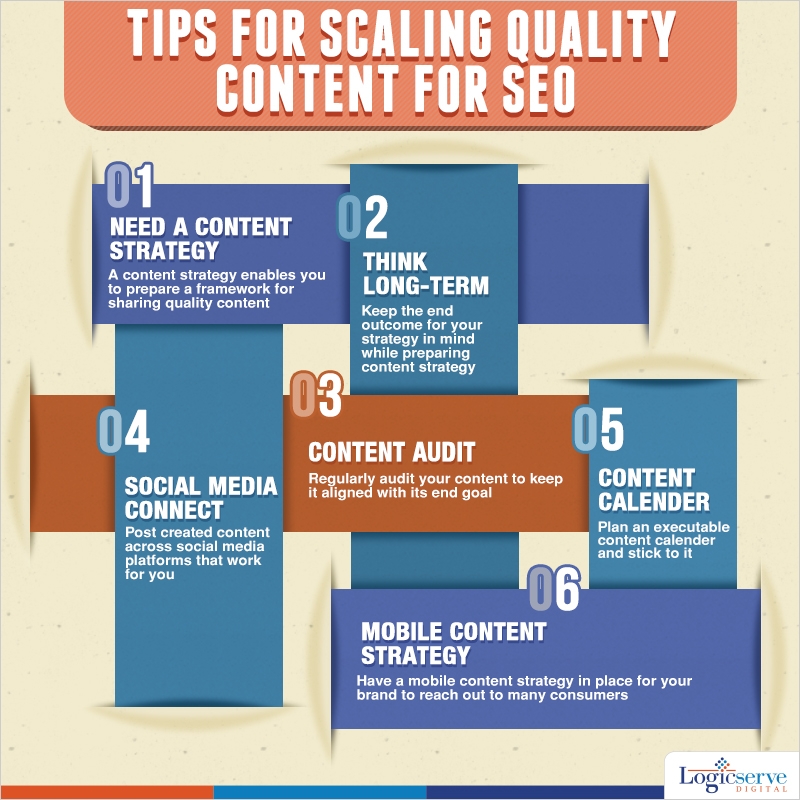
    Everybody Needs a Content Strategy

    If you want to compete in your local city marathon (or the New York City or Boston marathon if you wish), you need to put a strategy in place — you will surely fail if you just decide to sign up for a marathon one fine day without having prepared for the rigors of a marathon.

    Think Long-Term

    Similarly, content marketing is a marathon that requires long-term planning. Determine your content marketing platforms — blogs, email newsletters, social media and so on — and learn as much about your readers as possible (what percentage of them use mobile devices and their age-wise and financial break up and so on). Having this knowledge ensures that you will generate the content that will appear to your target demographic.

    Content marketing is distinct from in-your-face sales or advertising. Content marketing is not about selling stuff. You need to keep that in mind for your content strategy to succeed. Using the marathon metaphor again, a marathon is different than a 100 meter sprint. If you start running at the top of your capacity, you will run a very fine 100 meter sprint but won’t be able to even complete a marathon.

    So as you measure the ROI of content marketing efforts, remember not to focus on pure sales numbers. Content marketing will likely take longer to convert leads as it’s designed and focused primarily to pull potential customers into the marketing funnel.

    Part of having a long-term strategy is to be persistent and consistent with your content strategy. This means you need to have a solid plan — spanning months if not years — for your content marketing initiative. Of course you can keep measuring the reach and impact of each piece of content marketing — each blog post and email newsletter and so on — on a daily basis or as appropriate.

    Content Audit

    To maintain a regular pipeline of content, make sure to audit all your departments to get a sense of what content your company and its different departments have and how much of that is current and how much is outdated. Once you make the audit, you will get to know if there are any missing areas in terms of content that needs to be filled — some products that don’t have brochures or a need to create an FAQ, etc.

    Content Calendar

    Then comes an editorial calendar that should have inputs from every department of the company. Having a calendar has multiple benefits including avoiding any duplication in efforts, a unified location where all content-related effort is tracked and getting the maximum impact out of your content effort.

    Content Planning

    To make the optimum utilization of your time and resources, content creation and content marketing should happen as part of a detailed plan. This ensures synergy in efforts — such as those between the marketing, corporate communication and content marketing. Similarly, you need to have a plan for how to distribute the content in the most effective manner across different content platforms — sometimes long-form content will appeal to your consumers and readers while at other times, shorter forms and byte-sized content will do the trick.

    The Critical Role of Social Media

    Every brand has a presence on Facebook by now. But clever brands will go beyond just bland Facebook posts. Businesses need to be present on multiple social media platforms to reach the widest audience possible and their social media content strategy needs to take account of who their audience is. Facebook pages are great for sharing pictorial content — and never forget to include the right-sized picture with every Facebook post — but that content is only visible to those who already like the page. Twitter posts, on the other hand, are visible to everyone who is on Twitter. Pinterest and Instagram are similarly must-use platforms for brands whose products are targeted to women consumers who tend to frequent these platforms preferentially.

    How to Create Viral Content

    As you seek to create stellar content that stands out in the clutter, you can take inspiration from different sources including current events — whether it’s an ongoing football World Cup or the Olympics or the Super Bowl. Keep in mind your audience as you seek to tie your content to current and trending topics. Social media platforms such as Facebook and Twitter will help you know what the “trending topics” are and these tend to change rather often too and they tend to reflect the interests of the users of those social media platforms. Quora and Hootsuite are also places where you can get ideas for creating content for your blog.

    Refer to competitors’ websites in your domain and see what are the popular topics and posts on their blog. That can give you an idea or a starting point for a blog post of your own. Remember that every piece of content cannot go viral. You have to keep at it — it takes 10,000 hours of practice to become good at something as Malcolm Gladwell put it. Similarly, it will take a while to develop a unique corporate identity or voice and to develop an emotional connect with the readers.

    Sometimes, it’s okay to take a position on a controversial topic — remember how Tim Cook advised a shareholder to sell Apple stock if he didn’t feel comfortable with Apple’s focus on human rights or environmental activism or other social missions. You too can decide to “stick your neck out” — if it can be called that — and declare that indeed you and your company believes humans have caused climate change.

    Mobile Content Strategy

    You got nothing if you don’t have a mobile strategy — in fact some are going so far as to have a “mobile first” strategy. It depends on your business vertical how much you need to focus on having a mobile content strategy but it’s pretty much an indispensable part of an overall content strategy.

    If you are a B2C organization, you should have come to terms already with the fact that your website must be mobile-friendly — if you don’t want to lose a ton of business. Even Google has tweaked its algorithms — Google Hummingbird — to be better prepared to answer long-tail queries and natural language or spoken queries. This is designed to meet the needs of mobile users. Since Google is adapting to a world where mobile internet users have already overtaken or will soon overtake desktop internet users, so should you.

    What you need to do in terms of having a mobile content strategy is remember that many of your readers will be reading your blog posts and email newsletters and other content on mobile devices. So, you need to have a few short blog posts that only has a bullet points and highlights and links to a longer post which is of course essential for SEO as Google tends to give more weight to articles longer than 2,000 words.

    The key to effective mobile content is large fonts, lots of images and videos that users can watch while making their commute to the office via the subway or other public transport. For mobile users with typically short attention spans, content that is easy to grasp is appealing. You should try to keep your content at the level of an eighth-grader — this is not to be condescending to the reader of course but just acknowledging the reality that all of us with busy lives may not quite be up for dry or academic prose that reads like a scientific or literary journal extract. The Fleisch-Kincaid readability score helps in this regard and it’s built right into Microsoft Word — so, you might want to put your content through that metric and see if you need to reduce the number if it appears to be too high.

    Content Curation is Good

    Don’t be afraid or shy about repurposing content or pointing your readers to top-quality content that is not generated by you. You can profitably use tools such as Curata to help you with content curation and you can use content curation in your email marketing or blogging.
  • Content marketing and SEO: What you need to know

    Content marketing and SEO: What you need to know

    Content Marketing @Logicserve

    Content strategists and planners are always looking out for novel ways to get more qualified search traffic. These days, most content experts recommend that companies should combine content marketing with SEO or search engine optimization. When you have a good look at content marketing and SEO, you will find that they are homologous to the pair of peanut butter and jelly. You can eat them individually, but when you combine them, you will surely find the taste fantastic. In other words, peanut butter and jelly complement each other. In the same way, content marketing and SEO complement each other and give increased quality traffic to websites.

    As a content strategist for an ecommerce website or online website, you will have to think of merging the content marketing and SEO efforts. In the past, most content strategists were running content marketing and SEO campaigns separately, but they were not getting the desired results. But, when they combined the content marketing and SEO campaigns together, they found increased benefits.

    If you are a content strategist or content planner for a very large organization, then you will have to restructure your organization as well. This means that you will have to keep the stakeholders in the loop and make sure that you get their consent first. There are some very good ways in which you can combine the SEO and content marketing efforts. Here are a few. First, you can create attractive and meaningful content that even Wikipedia would love to link to. On the internet, you will find that Wikipedia is one of the best sources of relevant traffic. You will find that it ranks for almost all searches for Google and other search engines.

    Second, you will have to create content that is based on keyword data. There are many companies or ecommerce companies that have really not understood the real essence of content writing. Most companies are seen hiring bloggers and asking them to write blogs that are written just for the sake of writing. In fact, you need to blog on the content that customers want to read. So, there are some target keywords that you will have to write on.

    Third, you will have to create quality content before you target larger quantities. In the past, when Google was evolving you could have any type of content and Google would give you thousands of visitors to your website.

    LogicSpeak :

    These days, Google has got smart and has created an algorithm that figures out how to rank the good quality content and filter out the low quality content. For this reason, you will have to create high quality content that is accurate and in-depth. Hiring a good content writer is paramount if you want real good quality content for your website. The content writer needs to have enormous experience in content writing for websites.

    Previous Post: Universal Analytics v/s Classic Analytics

  • Factors for Content Customisation

    Factors for Content Customisation

    Factors for content customisation @Logicserve Digi

    Keeping on par with the current digital marketing trends, content marketing is considered to be a relied upon channel to connect with the audiences in a great way. You too, must be judiciously posting Facebook posts along with blogs, articles, infographics and much more. But have you ever wondered how much it is really viewed, read and imbibed in by the readers or maybe they are getting lost in content overload which could be happening across your profile.

    With great efforts put in to develop quality content which needs to be read but prove useful to the audience, it becomes essential to strategize content as well as its marketing in depth for best results. We present a few key insightful pointers for guiding you across the content related strategies.

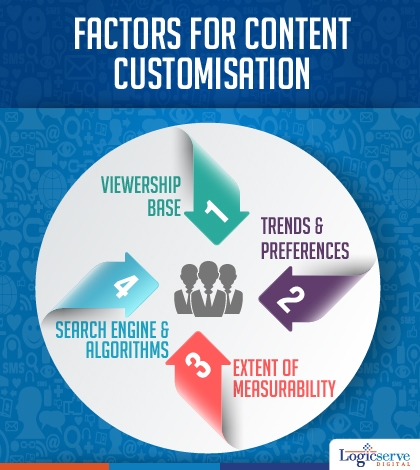
    Viewership Base – With in depth knowledge of your business and its nature, you need to arrive at list of content which could prove useful to your customers whilst they use/prefer/enjoy your products and services. Identifying the most preferred content from contextual, videos, forums, blogs and then developing them for use is what makes your brand more marketable and enhances its visibility.

    Bear in mind – The usability of the article is more important rather than have a keyword rich article

    Compareraja, one of our brands is a product and price comparison portal enjoying a tech friendly viewership base. It posts blogs highlighting the specifications and USP of latest mobiles, smartphones and tablets on a regular basis. This helps the user, in his research stage to finalise his choice about the product he wishes to purchase. Check it out at https://www.compareraja.com/blog/

    Viewership Trends and Preferences – You need to be very careful in choosing the right channel from the available ones as you proceed to distribute your content across them. As each channel has a niche membership base which is distinct. At the same time, you need to understand the fact that an individual has a channel specific profile and would view your content in a similar manner.

    Amongst the most popular channels we have today,

    1. Facebook is ideal for sharing creative images and experiences.
    2. Linkedin, a slightly formal and professional channel can be used for promoting corporate styled slideshows and presentations.
    3. Twitter is preferred for exchanging hot ideas and trends, ideal for announcing promos and deals which need to be shared instantly
    4. Google + allows an exchange of ideas and views to take place across its platform

    Extent of Measurability – To a certain extent, content marketing can be measured through Tweets, page views, number of downloads but when considered against the cost of generation content and its marketing, a set of specially set parameters could come handy in determining its effectiveness. Each of these aspects varies, depending on what you wish to measure. The same applies for other services you avail for your business’s promotion.

    Search Engines and their Algorithms – Keep track of current search algorithms and try to modify your content marketing strategies. With most of the search engines emphasizing on organic search results, the content should revolve around viewer friendly information. E.g Adding information about famous local cuisines or a famous dish of your restaurant.

    LogicSpeak:

    Customisation is the key to get any content strategy successful. One needs to understand the channels and the type of content that works for their audiences in each of these channels and their responses. As shared, the usability of the generated content, matters more than the keyword rich content.

    Previous Post: Using SEO For Enhancing Local Business

  • Good Content Marketing strategies – Are you implementing them?

    Good Content Marketing strategies – Are you implementing them?

    Good Content Marketing strategies

    The year 2012 was highlighted with content marketing strategies gaining a lot of importance. And, as we sail through 2013, content marketing is still the key to stay ahead in the race making it absolutely essential you follow the right content marketing practices as you simply cannot afford to falter at this juncture.


    Good Content Marketing Practices

    Plan and coordinate your content marketing strategy

    Before anything goes live, it is essential to plan and coordinate the entire content marketing activity. This implies your website, social media, press releases and even email newsletters should reflect the same or its related information since all these channels reach out to your readers/customers. Be it offerings of new services, products or news updates, each of them should reflect the same set of information/news/updates albeit in a different manner.


    Your blog should be associated with your website

    Your blog should be associated with your main/corporate site rather than having a separate website for it.  Search engines index each and every new blog post and hence it makes sense for it to be associated with your website which helps in conversions and generating new leads.  Having a blog within a sub domain implies you can give it a new look and feel and optimize it even better while it still stays connecting with your main website. In fact, the readers will easily be able to correlate the blog post with your company


    Informative and Insightful Blog

    A blog is considered as an informal way of presenting facts, figures and insights apart from reaching out to customers.  Taking cue from this, your blog should contain information rich blogs, key insights and latest trends along with a humane touch.   Having other writers and bloggers contribute to your blog could be yet way of garnering interest amongst your reader base. This not only widens the scope of your business but at the same time enhances your credibility in the market.


    Regularly updating the Blog

    Statistics have revealed that blogging on regular basis generates more traffic than those blogs who have infrequent updates. In fact, regular blogging means you wish to be in touch with your readers/customers and hence the efforts are appreciated. In fact, regular blog updates help to build a decent reputation in the online marketplace.


    Arouse Interest in the right manner

    Once you establish a sizeable reader base, you could begin to offer them additional information at no extra cost which could be of great use. For instance, case papers, ebooks, webinars, white papers and other valuable insights form the business point of view could be made available to them on a regular basis which can be shared amongst related colleagues and friends and spread the word around especially to those who are wish for whom your products and service could be useful


    Be Creative and Interesting

    Be different from the rest which means you could post infographics, slideshows, pictorial representation and even graphs to convey your information or display vital data.  You could even encourage guest bloggers on your site and give a fresh perspective to your blog.  Mind you, those bloggers could belong to who’s who list in your business segment.


    Be Interactive

    Infuse life into your blog by welcoming comments and questions on your blog. Also, make it a habit to respond to these questions, queries on time and in a right manner or else stand out to lose a few vital customers.  This is not all; you could plan out activities across various social media networks the most popular ones being Linkedin, Twitter, Facebook and Google+. You could even join relevant syndication portals and submit and share business information through them.

    As you go through and mark these points for good content marketing practices, make sure you implement them as far as possible.  Taking this point further, companies implementing them are likely to attract more site visitors which could mean decent online reputation and good business too.

    Logicserve Digital provides affordable Social Media Marketing & Services for online businesses in India. As a Social Media Marketing Company we provide a wide range of SMM services. Click here to know more.

    Previous Post: Targeting the Right Kind of Customers