LS Staging

Tag: artificial intelligence

  • Weekend Digital Media Round- Why CMOs Are Rethinking AI Pilots in Digital Commerce, Why the New Artificial Intelligence Is So Powerful, Claude’s Cowork chaos: $285B vanishes as markets question Software’s future &More….

    Weekend Digital Media Round- Why CMOs Are Rethinking AI Pilots in Digital Commerce, Why the New Artificial Intelligence Is So Powerful, Claude’s Cowork chaos: $285B vanishes as markets question Software’s future &More….

    1.Why CMOs Are Rethinking AI Pilots in Digital Commerce

    Many AI initiatives in digital commerce fail to scale because they lack clear business context, customer relevance, and change management. A customer‑journey–driven approach, combined with disciplined idea qualification and pilots designed to either scale or stop, helps organizations turn AI from experimentation into sustained growth. [Source: CMS Wire]

    2. Why the New Artificial Intelligence Is So Powerful

    Modern AI systems have become powerful due to the interaction of multiple mechanisms—neural networks, massive data training, learning methods, attention, and specialized hardware. Together, these create complex causal networs that produce emergent abilities like language understanding, reasoning, problem-solving, and creativity, even though AI still lacks human consciousness or emotions. [Source: Psychology Today]

    3. Claude’s Cowork chaos: $285B vanishes as markets question Software’s future

    Markets were rattled after Anthropic’s Claude Cowork plugins showed AI could autonomously execute legal, sales, and financial workflows, wiping out $285 billion in software market value in a single session. Investors fear AI is absorbing entire workflows rather than just assisting, forcing SaaS and IT services firms to rethink business models built on billable hours and human effort. [Source: Wion]

    4. Google’s Search Generative Experience will transform content

    Google’s introduction of AI-driven generative search is poised to reshape SEO by changing how results are created and consumed, pushing marketers to move beyond traditional keyword strategies and instead focus on more natural, conversational, and snackable content that aligns with how users ask questions and engage with information in an AI-influenced search environment. [Source: The Drum]

    5. YouTube CEO Reveals Your Video Marketing Strategy For 2026

    YouTube’s CEO outlines a shift toward treating the platform as a full entertainment, commerce, and discovery ecosystem, where creators operate like studios and brands must co‑produce content rather than rely on one‑off sponsorships. Shorts are positioned as the primary discovery gateway feeding long‑form, TV‑quality content, with AI and integrated shopping making video marketing more measurable and revenue‑driven by 2026. [Source: Search Engine Journal]

    6. FAQ on martech: How AI agents and composable stacks are reshaping marketing technology in 2026

    AI-driven agents and composable martech stacks are redefining how marketing works, with intelligence embedded across content creation, data, and customer engagement. As buyer‑side AI assistants increasingly replace traditional search and browsing, marketers face pressure to simplify fragmented systems and adapt strategies to stay visible by optimizing content for AI discovery rather than just human clicks. [Source: EMarketer]

    7. How first-party data drives better outcomes in AI-powered advertising

    First‑party data has become critical for AI‑driven advertising, as it helps platforms optimize for profitable outcomes rather than just clicks or conversions. By feeding accurate customer and revenue data into automated campaigns like Performance Max, advertisers can improve conversion quality and return on ad spend—even if costs per click rise. [Source: Search Engine Land]

    8. Digital Fatigue Is Real — ā€˜Retailtainment’ Is How Brands Win Customers Back

    Retailers are shifting from pure online transactions to experience-driven ā€œretailtainmentā€ as customers grow tired of digital shopping. By using gamification, social shopping, in‑store learning, social commerce, and community events, brands can re‑engage customers, build loyalty, and boost sales by turning shopping into a more social and memorable experience. [Source: Entrepreneur]

    9. EXCLUSIVE: OpenAI Confirms $200,000 Minimum Commitment for ChatGPT Ads

    OpenAI is piloting ads on ChatGPT through a small, tightly controlled beta, asking select advertisers to commit at least $200,000 upfront. The company says the test is meant to understand which ad formats add value for users before expanding advertising options more broadly. [Source: AdWeek]

    10. Future of Marketing Briefing: The word ā€˜agency’ is costing the ad giants

    Ad industry holding companies are being held back less by economics or technology and more by perception, with the label ā€œagencyā€ no longer reflecting the breadth of what they do. As clients expect broader, consultative and business-led solutions, clinging to outdated terminology is weakening how these giants position their value for the future. [Source: DigiDay]

  • Embrace or Lose Out: AI for Small Businesses is going to be the Next Paradigm Shift

    Embrace or Lose Out: AI for Small Businesses is going to be the Next Paradigm Shift

    AI unlocks hitherto unavailable opportunities to small businesses. It’s high time, small business owners join the AI revolution and race ahead.

    For the last few years, industry leaders like Netflix, Amazon, Starbucks, and several others have been using AI and machine to take quantum leaps forward. They are exploring the potentials of these brand-new technologies to elevate customer experience, boost sales, and increase their bottom line.

    On the other hand, the vast majority of small businesses are still stuck in the pre-digital era. A large number of small business owners falsely assume that implementing a live chat tool is enough to provide their customers with the best possible brand experience.

    AI-driven Businesses will win Big Time

    Irrespective of the size and nature of the business, AI is an invaluable tool for all businesses. The biggest benefit of AI is that it can crawl through massive tons of data at speeds that are not humanly possible. AI and machine learning algorithms sift through volumes of customer data to provide businesses with accurate and precise insights that empower smarter decisions.

    Small businesses that don’t have a well-planned AI strategy are likely to lose out to their competition. According to a report by Forrester, insights-driven businesses will capture $1.2 trillion in sales from businesses that don’t have such strategies.

    AI for All, and Not Just Fortune 500 Companies

    Just a couple of years back, only the big companies with massive R&D teams could afford to invest in AI and machine learning tools. The situation has completely reversed now. Today, thanks to lightning-fast advances in AI and machine learning technology, AI tools are available to all at affordable prices. The best part – integrating AI-enabled tools in business operations is easier than ever before.

    Here are the top three reasons why small businesses must integrate AI-enabled tools in their business operations:

    #1: Provide Customers with an Elevated Brand Experience

    Studies predict that by next year, nearly 85% of all customer-brand interactions will happen without human interference. Intelligent chatbots, virtual assistants, visual search, smart mirrors are some of the top ways in which companies are using AI to win the loyalty of their customers.

    #2: Reduce Operational Costs

    In the long-term, AI helps small businesses cut down their operational expenses. While the initial cost of implementing AI may be steep, the overall long-term benefits far outweigh the initial infrastructural and training expenditures.

    To give you an example, AI matches the right offers to the right customers, thereby boosting the efficiency of ad campaigns, reducing the overall cost of ad campaigns, and increasing ROI. This is just one of the many ways that AI will cut down operational costs.

    #3: Reduce Time and Effort

    This is the biggest benefit of AI. AI-enabled tools can complete tasks at a fraction of the time taken for humans.

    In some cases, AI will complete tasks that are impossible for humans. Additionally, when it comes to the accuracy of the results, AI never misses the mark. Thus, small businesses can automate routine and laborious tasks, thereby saving time and effort.

    Embrace or Lose Out

    In the next couple of years, the speed at which AI will expand will be faster than ever before. From large conglomerates to small independently run businesses, AI will impact all. Early adopters of this technology are likely to be the biggest beneficiaries. If your business has not yet jumped aboard the AI revolution, it’s high time you get started.

  • How can AI Drive Marketing Automation and Personalisation?

    How can AI Drive Marketing Automation and Personalisation?

    Artificial Intelligence (AI) has increasingly been in the news for quite some time now. Be it unleashing new business potential or making digital marketers’ work more effective; there are multiple interesting applications of AI. Key components of AI include artificial neural network, deep learning, and machine learning. It would not be wrong to say that these fields have emerged as separate ecosystems by themselves.

    For marketers, the key aspect that showcases a promising future of the blend of digital marketing with AI is customer data. This data is available across multiple sources, in different formats, and across various types (like structured and unstructured data). The primary challenge for today’s marketer is to make sense of the seemingly random pieces of information and weave it together to generate previously hidden insights.

    The best part about such data is that it doesn’t need a full tech stack of AI-based solutions to make sense. Even a smaller subset of AI like machine learning will be fully capable of delivering tremendous business value with the help of processes like parsing of customer data from a diverse source, data prediction, and other features that fulfil the marketing automation objectives.

    However, one common theme comes out of this exciting partnership between marketing and AI. As more and more sources are being tapped to know the target customer better, the role of AI applications in making sense of the broader spectrum of data will keep on increasing.

    Making sense of the numbers with AI prowess

    Given the immense potential, it is not surprising to see many marketers today looking at using AI into their marketing campaigns, especially in content marketing. Even machine learning is proving to be valuable in tapping into newer audiences and boosting the user base for a particular brand based on their buyer persona objectives. It helps in sifting through massive troughs of big data that on first glance, look unrelated, but when explored from the eyes of machine learning, yield phenomenal insights. These may be in the form of information on rewarding markets, segments, or patterns that give better direction to your marketing campaigns.

    How will AI help marketing?

    It is interesting to note the key objective with which these initiatives are driven. Marketers would need the massive influence of AI to meet a prime goal – that of personalised customer experiences. Also, there are other exciting avenues. Let’s discuss them below –

    1 – Customer experiences at the heart of AI adoption

    Marketers focusing on segmentation and personalisation of ad campaigns reported positive yields for their campaigns. AI and machine learning can easily traverse through billions of data points, and help the marketers to create better market segments. They can facilitate more impactful ad delivery to improve the conversion rate on the basis of personalised marketing messages.

    2 – Better recommendationsĀ 

    AI will analyse the kind of content users would be interested in. This helps marketers to generate bespoke content that is deeply tailored and looks more natural to individual preferences. This will impact different marketing activities like loyalty programs and promotions.

    3 – Leveraging data in real time

    A third area where AI can deliver exemplary impact will be marketing automation. Of course, this won’t mean that the marketer’s job would be reduced to nothing. Here, AI would work with up-to-date data and use predictive modelling to deliver real-time deals and offers that the customer is actually looking for at that time.

    It will be wrong to term AI as the ā€˜magic pill’ that cures all ills (for the marketers). But yes, it is true that in its current form, AI has the capabilities to boost the marketer’s efficacy and generate better outcomes.

  • Google Duplex to have built-in disclosure about its ā€˜Bot’ status

    Google Duplex to have built-in disclosure about its ā€˜Bot’ status

    Google’s recent update created quite a stir when it unveiled the AI based Duplex system at the I/O Conference 2018. The system can actually make phone calls in a human voice for tasks like booking a movie ticket or booking a restaurant table. Instead of the reactive chatbot conversation utilised in customer support functions, the Duplex is designed to be more proactive voice assistant to the users.

    However, with this news came a public outcry against the ethical implications associated with Google Duplex. The AI-based system will have voice like capabilities to book an appointment on behalf of the user. This has been criticised as it is prone to hacks and abuse. Ā Google has been quick to refute these criticisms by saying that a fully working product was not yet developed. They also mentioned that the AI human-like voice will positively identify itself before making these appointments. This in-built disclosure is said to be a hopeful answer to the ethics and privacy concerns shared by people world over after its CEO Sundar Pichai launched the product on stage at the 2018 annual developer conference.

    The concern about the AI based Duplex System

    Google employs Deep Mind’s new WaveNet Audio Generation technique to mimic a human voice and carry out the scheduling tasks over phone calls. It doesn’t identify itself as a human bot and purposefully trick a person on the other line (for example a receptionist at a haircut salon or the restaurant manager) with surprisingly effective human voice, complete with natural ticks like ā€˜umm’ and ā€˜aahh’! Ā Ā 

    This caused significant outrage from general audience and the followers of the I/O conference the world over. They feel that such AI systems are being created without appropriate regulation or protocols. Tech critics have gone on to say that the development is not positive and the lack of alarm demonstrated by the audience seems troubling.

    The workaround to this dilemma

    Google has mentioned that transparency in technology is critical. Hence, it will take all steps to ensure that an in-built disclosure is prompted before the conversation. They also said that the demonstration in the conference was an early product demo and is not a full-scale product awaiting launch. Readers would recollect that on-stage, the product demo consisted of a pre-recorded phone call to showcase the product features to the audience.

    Another blog from Google Engineers Yossi Matias and Yaniv Leviathan mentions that Google’s prerogative was always on delivering the best customer experience with this product. They wanted to make it clear about what the call’s intention will be so that users and businesses can recognise the value of the system. Ā They wrapped up by saying that Google is yet to figure out how to eventually roll it out and has been testing with quite a few experiments to integrate it with its voice technology based Assistant platform.

    What are your thoughts on the Duplex system that makes phone calls on behalf of the users in a human-like voice? Do write in with your comment and let us know.


  • Salesforce and Google Join Hands to Make Customer Insights Better

    Salesforce and Google Join Hands to Make Customer Insights Better

    Salesforce has been a global name in customer relationship management and has innovated tirelessly to provide new ways for companies to connect with people. With 1,50,000 customers and 19.7% market share in CRM worldwide, Salesforce has undoubtedly become a force to reckon with.

    Salesforce has recently announced their partnership with Google, and the plan was to integrate Salesforce data with Google Analytics 360 and G Suite. Google analytics provides companies all-round analysis of their marketing and sales, and provide useful insights.

    With this partnership between Google and Salesforce, companies will now be able to connect sales, marketing and advertising using Salesforce cloud and Google Analytics 360. This also means that you can connect Salesforce with your G-suite to enhance your customer reach and boost sales. The partnership between Google and Salesforce can certainly prove to be a game-changing move when it comes to managing customer service and marketing.

    What Does This Partnership Mean?

    According to this partnership, Google will list Salesforce as its preferred sales cloud which will help Salesforce grow its customer base, while Salesforce lists Google cloud as its preferred public cloud in order to support the massive customer base that Google has. Also, Salesforce data can be used with G-suite and help customers to enjoy perfect customer service experience through G-mail, Hangouts, Docs, etc.

    Additionally, new customers will be able to use G-suite for free for up to a year under the partnership. The primary purpose, however, is to connect Google Analytics with Salesforce Sales Cloud in order to provide impeccable user experience, connecting sales, marketing, and advertising.

    Why it is Great for Customers?

    According to this partnership, Google will list Salesforce as its preferred sales cloud which will help Salesforce grow its customer base, while Salesforce lists Google cloud as its preferred public cloud in order to support the massive customer base that Google has. Also, Salesforce data can be used with G-suite and help customers to enjoy perfect customer service experience through G-mail, Hangouts, Docs, etc.

    Additionally, new customers will be able to use G-suite for free for up to a year under the partnership. The primary purpose, however, is to connect Google Analytics with Salesforce Sales Cloud in order to provide impeccable user experience, connecting sales, marketing, and advertising.

    When Will the Data from This Partnership be Available?

    As announced, Google and Salesforce will start rolling out integrations this year. While some of these integrations for G-suite are already available, more elaborate and deeper integrations will roll out early this year. Integration between Quip by Salesforce and Drive by Google is set to roll out early this year which will cost you $25 per month.

    Customers who are verified by Salesforce can avail the G suite integration for free for up to a year. The integration between Salesforce Sales Cloud and Google Analytics 360 is set to roll out early this year and will be available at no extra cost.

    All in all, Google Analytics and Salesforce together can revolutionise the sales and marketing sector by providing cutting-edge customer intelligence. Stay tuned as we bring more updates on this exciting partnership.

  • Unpartial – the AI-powered Chrome extension to spot fake news

    Unpartial – the AI-powered Chrome extension to spot fake news

    The world is advancing fast in the field of Artificial Intelligence, and various tech giants such as Google and Microsoft come up with new frameworks and AI-powered devices which have made it possible to use the technology across multiple industry verticals.

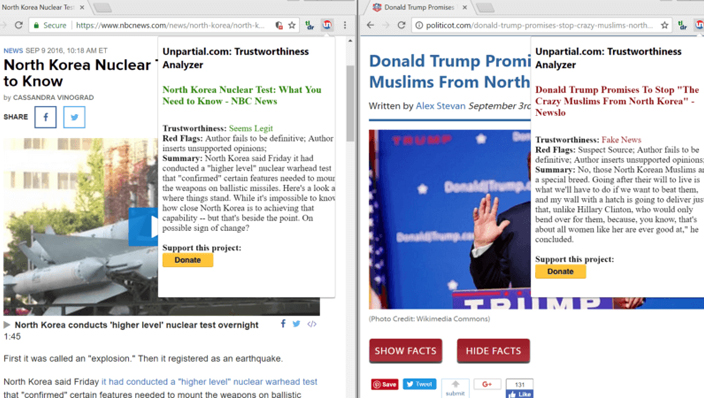
    This week, an AI company called Recognant, based in San Jose, California has released an extension for Chrome that informs users if the news they are viewing on the browser is fake. The AI tool is said to have a function which tests the ā€˜trustworthiness’ of an article or a story.Ā  Recognant has named the AI tool ā€˜Unpartial’, and as said by the developers at Recognant, the primary purpose of Unpartial is to check the ā€˜trustworthiness’ of a story, ultimately telling if the story is fake or not.

    How does the AI work?

    The principal question that arises here is how does it judge whether a story is ā€˜trustworthy’ or not? Well, according to its developers, Unpartial doesn’t check the source or facts of the story but uses generated rules to check the internal validity of the given story. The tool can only work for articles which have more than three hundred words.

    When given an article, Unpartial checks it by cross-checking it with a variety of factors like checking the grammar, the volume of facts, and if the math makes sense. After passing the article through all the generated procedures, it gives its verdict of whether or not the article is false. The extension, if needed, can be accessed by clicking on the UN button on the Chrome toolbar. The ratings by Unpartial go from ā€˜Seems Legit’, which means the article is trustworthy, to ā€˜fake news’, which means fake story. The extension also dubs articles as ā€˜seems sketchy’ or ā€˜super shady’.

    How this extension delivers value?

    Recognant says that it focuses on making AI that is used mostly for NLP (Natural Language Processing) and the software they have developed have been used by multiple organisations like cancer research organisations, to collect knowledge on cancer and various ways to advance their research. It has also been used by several Non-Profit Organizations to find out which online ads are marketing human trafficking.

    Developers at Recognant developed Unpartial because they believed that misleading news and articles can have adverse effects on the society and can prove harmful as they provide wrong information about things, which lead people to believe in false theories. If a website presents false information about cancer treatment or AIDS virus, this will implant false knowledge in the reader’s mind, and that can be bad for people and those around them.

    Developers say that unlike IBM’s Watson, Unpartial is an AI called mind simulation, wherein the AI is programmed with an initial set of rules, and then goes on to test the article using the software’s generated rules.

    Hence, as compared to Watson, which uses neural nets, Unpartial proves to be more efficient in identifying the real stories from the false ones. This is because, in case of mind simulation, you can actually check why an article has been given a ā€˜false news’ tag by Unpartial. In short, this tool provides transparency, unlike neural net.

    What do we think?

    The accuracy of Unpartial is almost spot on, as it was tested by Recognant, by giving Unpartial a hundred thousand articles to go through and judge their authenticity, and the AI got the results correct 99 percent of the time.

    With about 1/4th of users sharing fake news (irrespective of whether they knew at that time or not), this extension is sure to curb the rising menace of fake news and give proper perspective to news as it should be shown online.

  • Secrets Of Successfully Using AI In Your Ad Agency

    Secrets Of Successfully Using AI In Your Ad Agency

    Artificial Intelligence is becoming more and more valuable in all industries. The search marketing and advertising can obtain incredible opportunities to act upon. Especially in PPC, the agencies can redefine their work and success with machine learning and AI.

    Here are all the secrets that can help ad agencies in successfully leveraging AI.

    1. Combine automation with manual work

    Only automated work might decrease the value of the services that you offer. There are definitely some parts of the job that require human intelligence. Hence, you need to combine manual work with the AI automation. This way, you can keep the high value of your service packages and ensure the AI involvement as well.

    1. Collaborate instead of competing

    Studies and research in digital marketing and PPC have presented unique outcomes regarding AI. The experts now know that human factor is still an essential part of deciding the success of AI. Machine learning is like another human being. Just like a person obtains better knowledge by talking to experienced people. Similarly, machines and AI learn better with skilled professionals working behind them. This is why you need to collaborate with AI to enhance the efficiency of advertising strategies.

    1. Hire professional data scientists

    Moving forward towards the AI collaboration, an ad agency should hire skilled data scientists. They are the professionals who can make a clear sense of the data that is provided by machines. It can be said that the data scientists become a complementing factor to the use of AI in the business. They help the bid management experts to move in the right direction according to what AI says.

    1. Test new ideas with AI

    AI presents an excellent opportunity to test new ideas faster and gain conclusions. The predictions provided by AI can help in deciding the future steps for a particular project. The importance of the experienced professionals is visible in this process too. It is an experienced team of professionals that initiate the idea. Then, the testing is conducted with the help of AI that leads to potential results.

    Indulging your team in such tests definitely allows the company to become more confident with the strategies. Plus, you can prioritise the tasks at hand according to the data and results obtained from AI.

    A team of extraordinary professionals and a reliable AI. This is the formula for a perfect Ad agency work environment. The machine takes you very close to the desired results at a faster pace. Then, it all comes down to the experts who complete the rest of the journey with their skills. Hence, you don’t only need AI, but also require a well-experienced team in your ad agency.

    Google and other search engines are pushing boundaries with new AI technologies. Hence, PPC management companies and ad agencies need to integrate these technologies into their daily work too. It will improve the accuracy and pace of the work for sure.