LS Staging

Tag: analytics

  • Weekend Digital Media Round-Up CX as a competitive advantage: Practices that are redefining market leadership strategies, What is the Knowledge Graph? How it affects SEO and visibility, Don’t Break The Funnel: Why OLV Still Matters In A CTV-First World & More…

    Weekend Digital Media Round-Up CX as a competitive advantage: Practices that are redefining market leadership strategies, What is the Knowledge Graph? How it affects SEO and visibility, Don’t Break The Funnel: Why OLV Still Matters In A CTV-First World & More…

    1.CX as a competitive advantage: Practices that are redefining market leadership strategies

    Customer experience (CX) has become a key differentiator in saturated markets, with top enterprises leveraging AI, cross-functional collaboration, and cultural alignment to deliver personalized, consistent interactions. Overcoming fragmented data, siloed teams, and resistance to change is crucial for turning CX into a competitive advantage. [Source: CIO]

    2. What is the Knowledge Graph? How it affects SEO and visibility

    Google’s Knowledge Graph is a massive database that connects entities—people, places, things, and concepts—through semantic relationships to improve search accuracy and relevance. It powers features like knowledge panels, AI Overviews, and semantic search, helping Google understand user intent and deliver more meaningful results. Optimizing for it involves structured data, entity-focused content, and maintaining consistent online presence. [Source: Search Engine Land]

    3. Don’t Break The Funnel: Why OLV Still Matters In A CTV-First World

    Marketers are mistakenly pulling back from online video (OLV) due to new classification standards, despite its continued strong performance. OLV remains essential in bridging the reach of CTV and the conversion power of social, enabling full-funnel campaign cohesion. [Source: Adexchanger]

    4. How Can You Build Customer Dashboards That Drive Experience and Growth?

    Startup customer dashboards are most effective when they tell a story—aligning metrics with customer journey stages to reveal insights and drive growth. By integrating AI, startups can predict churn, segment users intelligently, and surface actionable insights even with limited resources. [Source: CMS Wire]

    5. Generative Engine Optimization, GEO, A Playbook For Online Retailers

    AI assistants like ChatGPT and Claude are reshaping e-commerce by replacing traditional search and homepage browsing with direct, conversational product recommendations. To stay visible, brands must adopt Generative Engine Optimization (GEO), focusing on structured, authentic content that answers real user questions. [Source: Forbes]

    6. AI is rewriting the rules of B2B marketing with a human touch

    AI is transforming B2B marketing by blending data-driven precision with human-centric storytelling, making emotional connection and trust key to big-ticket decisions. Experts from LinkedIn and Sprinklr highlight how AI enables faster, personalized campaigns while emphasizing creativity, transparency, and brand safety. [ Source: StoryBoard18]

    7. From data to decisions: How Indian BI platforms are redefining analytics

    Indian Business Intelligence (BI) platforms are transforming analytics by offering cost-effective, localized, and scalable solutions tailored to India’s unique business environment. Unlike global tools, these homegrown platforms address regional diversity, compliance complexity, and the need for quick, AI-powered insights—empowering even small businesses to make data-driven decisions. [Source: MSN]

    8. Ecommerce: The new R&D lab for India’s consumer companies

    Ecommerce in India is evolving from a distribution channel into a strategic innovation hub, enabling consumer brands to test and refine products quickly and with minimal risk. Quick commerce platforms like Blinkit and Instamart offer real-time feedback, helping companies like Marico validate new offerings before scaling. [Source: Forbes India]

    9. How AI Is Shaping Business Strategies For 2025?

    AI is set to become a core driver of business strategy in 2025, enhancing operations, customer experience, and decision-making through technologies like generative AI, predictive analytics, and hybrid cloud integration. Companies embracing these innovations will gain a competitive edge, while those that resist digital transformation risk falling behind. [Source: Business World]

    10. Rethink Reach to Unify Your Linear and Streaming Advertising Strategies

    Marketers are shifting from simply counting impressions to measuring reach as a performance metric that drives engagement and revenue. By unifying data across linear TV and streaming, advertisers can eliminate duplication, uncover missed audiences, and optimize campaigns for greater impact. [Source: Adweek]

  • Optimizing Keywords for Success in Marketplace Dynamics

    Optimizing Keywords for Success in Marketplace Dynamics

    Introduction:

    In the ever-evolving landscape of online marketplaces, where a diverse array of sellers and buyers converge, mastering keyword research is not just an SEO tactic; it’s the secret weapon that unlocks explosive growth. As the battleground for brands and sellers shifts to these vibrant digital platforms, understanding the intricacies of keyword research becomes paramount for marketplace mastery.

    Understanding the Maze:

    Unlike traditional e-commerce, online marketplaces cater to a multitude of sellers and buyers with varied goals. Crafting detailed buyer personas is the key to unraveling the unique needs, search habits, and preferred language of your ideal customers. Aligning your keyword choices with these insights becomes the cornerstone of attracting the right shoppers to your virtual store.

    Keyword Essentials for Marketplace Masters:

    Know Your Audience: Know your audience inside out by crafting detailed buyer personas. Understand their needs, search habits, and language nuances. Aligning your keyword choices with their specific journeys and buying motivations ensures your content resonates effectively, capturing the attention of your ideal customers and guiding them toward conversion.

    Hit the Sweet Spot: Navigate the competitive online space by prioritizing keywords with a high search volume and manageable competition—this is the sweet spot for prime visibility. Tools like Helium 10ABA (Amazon Brand Analytics) are indispensable for uncovering these hidden gems. With strategic keyword selection, your content stands out, capturing attention amidst the digital noise and ensuring optimal visibility for your target audience.

    Long-Tail Treasures: Leverage the power of specific long-tail keywords, not only do they attract highly qualified leads further along in their buying journey, but they also offer a chance for lower competition, resulting in higher search rankings. Tools like Helium10 can help uncover these hidden gems.

    Competitor Analysis Mastery: In the pursuit of marketplace dominance, scrutinizing competitors becomes paramount. Dive deep into their top-ranking keywords. By identifying gaps and drawing lessons from their successes, you extract valuable insights. This strategic analysis not only refines your approach but unveils new keyword opportunities, allowing you to navigate the competitive landscape.

    Strategies for Marketplace Domination:

    Enhanced Visibility and Reach: Strategic incorporation of relevant keywords enhances content visibility and extends advertising reach, maximizing the impact of your campaigns.

    Content Gap Analysis: Analyze existing content to identify gaps and improve areas. Fill voids with targeted content that guides buyers seamlessly toward checkout, boosting conversions.

    Trendspotting Prowess: Stay ahead by monitoring industry trends and conversations within your marketplace community to identify emerging search terms.

    Arming Yourself with the Right Tools:

    Marketplace-specific tools: Utilize platform-specific tools like Amazon Seller Central’s Keyword Research Tool like ABA for valuable insights.

    Comprehensive suites: Opt for tools like Helium 10 or SEMrush for broader market analysis, competitor tracking, and keyword research across platforms.

    Becoming a pro at marketplace keyword research is an ongoing journey. Grasp who your customers are, employ smart strategies, and use the right tools to turn your online presence into a bustling hub of commerce. Crafting top-notch content tailored to relevant keywords and in sync with market trends is the key to unlocking success.

    Regularly reassess your keyword strategy, analyze performance data, and adjust to changing trends. By staying agile and relying on data, your marketplace will consistently attract both buyers and sellers. Embrace your inner keyword explorer, uncover those hidden search gems, and witness your marketplace thrive in the ever-evolving landscape of e-commerce!


    Introduction:

    In the ever-evolving landscape of online marketplaces, where a diverse array of sellers and buyers converge, mastering keyword research is not just an SEO tactic; it’s the secret weapon that unlocks explosive growth. As the battleground for brands and sellers shifts to these vibrant digital platforms, understanding the intricacies of keyword research becomes paramount for marketplace mastery.

    Understanding the Maze:

    Unlike traditional e-commerce, online marketplaces cater to a multitude of sellers and buyers with varied goals. Crafting detailed buyer personas is the key to unraveling the unique needs, search habits, and preferred language of your ideal customers. Aligning your keyword choices with these insights becomes the cornerstone of attracting the right shoppers to your virtual store.

    Keyword Essentials for Marketplace Masters:

    Know Your Audience: Know your audience inside out by crafting detailed buyer personas. Understand their needs, search habits, and language nuances. Aligning your keyword choices with their specific journeys and buying motivations ensures your content resonates effectively, capturing the attention of your ideal customers and guiding them toward conversion.

    Hit the Sweet Spot: Navigate the competitive online space by prioritizing keywords with a high search volume and manageable competition—this is the sweet spot for prime visibility. Tools like Helium 10ABA (Amazon Brand Analytics) are indispensable for uncovering these hidden gems. With strategic keyword selection, your content stands out, capturing attention amidst the digital noise and ensuring optimal visibility for your target audience.

    Long-Tail Treasures: Leverage the power of specific long-tail keywords, not only do they attract highly qualified leads further along in their buying journey, but they also offer a chance for lower competition, resulting in higher search rankings. Tools like Helium10 can help uncover these hidden gems.

    Competitor Analysis Mastery: In the pursuit of marketplace dominance, scrutinizing competitors becomes paramount. Dive deep into their top-ranking keywords. By identifying gaps and drawing lessons from their successes, you extract valuable insights. This strategic analysis not only refines your approach but unveils new keyword opportunities, allowing you to navigate the competitive landscape.

    Strategies for Marketplace Domination:

    Enhanced Visibility and Reach: Strategic incorporation of relevant keywords enhances content visibility and extends advertising reach, maximizing the impact of your campaigns.

    Content Gap Analysis: Analyze existing content to identify gaps and improve areas. Fill voids with targeted content that guides buyers seamlessly toward checkout, boosting conversions.

    Trendspotting Prowess: Stay ahead by monitoring industry trends and conversations within your marketplace community to identify emerging search terms.

    Arming Yourself with the Right Tools:

    Marketplace-specific tools: Utilize platform-specific tools like Amazon Seller Central’s Keyword Research Tool like ABA for valuable insights.

    Comprehensive suites: Opt for tools like Helium 10 or SEMrush for broader market analysis, competitor tracking, and keyword research across platforms.

    Becoming a pro at marketplace keyword research is an ongoing journey. Grasp who your customers are, employ smart strategies, and use the right tools to turn your online presence into a bustling hub of commerce. Crafting top-notch content tailored to relevant keywords and in sync with market trends is the key to unlocking success.

    Regularly reassess your keyword strategy, analyze performance data, and adjust to changing trends. By staying agile and relying on data, your marketplace will consistently attract both buyers and sellers. Embrace your inner keyword explorer, uncover those hidden search gems, and witness your marketplace thrive in the ever-evolving landscape of e-commerce!


  • Unlocking the Power of Google Analytics 4’s New Attribution Model

    Unlocking the Power of Google Analytics 4’s New Attribution Model

    Are you curious about the latest buzz surrounding Google Analytics 4 (GA4)? One of the most talked-about features is its new attribution model. In this article, we’ll explore what makes GA4’s attribution model stand out from its predecessors and how it can help you gain deeper insights into user behavior and optimize your marketing efforts.

    The Challenge of Attribution Models in Universal Analytics (UA):

    To understand the significance of GA4’s attribution model, it’s essential to recognize the limitations of the previous version, Universal Analytics (UA). UA heavily relied on last-click attribution, giving all the credit for a conversion to the last touchpoint before a user converted. This approach didn’t consider the multiple touchpoints a user might interact with before conversion, leading to an incomplete understanding of the user journey. Although UA offered various attribution models, choosing the right one was often a challenge.

    GA4’s Data-Driven Attribution Model:

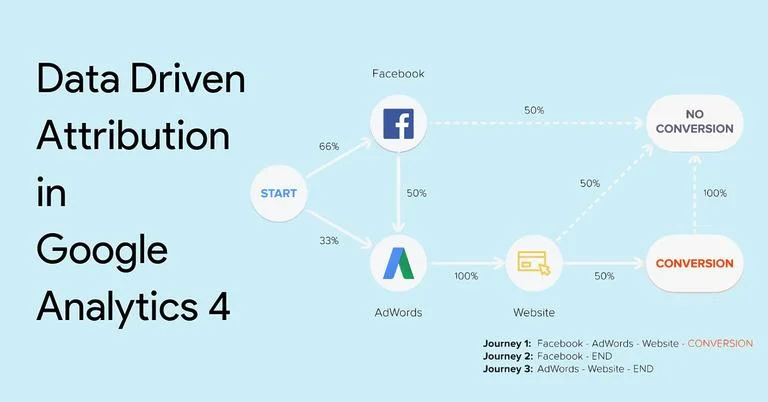
    In contrast, Google Analytics 4 has introduced Data-Driven attribution as the default model, leveraging machine learning algorithms to assign credit. This model considers all user touchpoints and attributes credit based on their relative impact on conversions. The accuracy of this model improves over time as it is data-driven, making it a more robust and long-term solution.

    Key Features of GA4’s Attribution Model:

    Cross-Device and Cross-Platform Tracking: GA4 can track users across different devices and platforms, providing a complete view of the customer journey and attribution. This is possible due to GA4’s user-centric data model, which assigns a unique user ID to each user, regardless of the device or platform they use.

     Machine Learning-Based Attribution: GA4 employs machine learning to analyze user behavior and assign credit to the most influential marketing channels. This approach is more accurate and flexible compared to the rule-based attribution model used in UA.

    Event-Based Tracking: GA4 tracks user interactions as events, offering more granular data than pageview-based tracking. This allows tracking specific user actions and attributing them to the appropriate marketing channels.

    Customizable Attribution Models: GA4 allows businesses to create custom attribution models tailored to their specific needs and goals. This level of customization was not possible in UA, which had a limited set of predefined models.

    Conversion Modeling: GA4’s conversion modeling predicts which marketing channels are likely to drive future conversions based on past behavior, enabling more effective resource allocation and marketing optimization.

    Benefits of Data-Driven Attribution:

    Data-Driven Attribution in GA4 considers the different paths users take to conversions and identifies the most effective marketing channels. This insight empowers businesses to optimize their marketing spend. For example, if a particular channel significantly influences conversions, you can allocate more budget to it.

    Furthermore, Data-Driven Attribution helps understand the impact of non-marketing touchpoints on conversions. For instance, a specific webpage on your website may effectively drive conversions, even if it’s not part of your marketing funnel. This insight guides website optimization for conversions.

    Conclusion:

    In summary, GA4’s enhanced attribution modeling capabilities are a game-changer for businesses of all sizes. By harnessing the power of this tool, you can gain valuable insights into user behavior and conversion patterns, enabling more informed decisions about your marketing spend. Embrace GA4’s new attribution model, and unlock the potential for optimizing your digital marketing strategies. If you’re eager to learn more about GA4, our team of experts is ready to assist you in maximizing the benefits of this powerful tool.

  • Google Analytics Updated with 4 New Powerful Features for Marketers

    Google Analytics Updated with 4 New Powerful Features for Marketers

    Google introduced the App + Web property for its analytics platform in 2019. This property combined the app and web data to provide unified reporting and analysis. The reports generated by this property uses a common set of metrics and dimensions for seamless integration of app and web data.

    While the App + Web property made it easier for the marketers to track their app and web data from a single dashboard, accessing detailed customer information and insights continued to be a hassle. The recent October 2020 Google Analytics update has introduced four new features to help marketers get detailed insights for making smarter decisions.

    Take a look at what these four new features are-

    1. Smarter Insights Using ML

    The machine learning models of Google can now alert marketers about the changing data trends. In other words, Google Analytics can now make use of the website data for identifying products that are in high demand as per the customer needs. With this feature, it will be easier for marketers to take measures and predict future actions of the consumers proactively.

    For instance, the new feature can calculate Churn Probability. This can help marketers by enabling them to focus on customers with a higher purchase probability. In the current scenario where businesses are cutting their marketing budgets, investing in customers who are more likely to make a purchase can help generate more sales even with a limited budget.

    2. Deep Google Ads Integration

    Google Analytics now has improved integration with Google Ads for more efficient cross-platform decision-making. For instance, marketers can now create custom audiences and deliver more helpful and relevant experiences to them every time they engage with their business.

    The improved integration provides marketers a better overall view of their marketing efforts, including Google Search, YouTube video views, email, social media, and other paid Google and non-Google channels.

    3. Customer-Centric Data Measurement

    The majority of the data measurements done by Google Analytics are based on the devices and platforms used by the customers. The recent update has a more customer-centric data measurement approach. It uses unique Google signals and multiple identity spaces for improved ad personalization.

    With this update, it is now possible for the marketers to know if a particular customer discovered their business through a web ad and then completed the purchase through their mobile app. In the longer run, this will provide marketers a holistic view of the entire customer journey and how the customers interact with their business.

    4. Improved Data Controls

    Even the data controls have been considerably changed to make them more granular. This is done to enable marketers to have improved control over how they want to manage and retain the collected customer data. This flexibility can be valuable for advertising as marketers can now decide whether or not they want to use customer data for optimizing ads.

    The current internet trend suggests that cookies or identifiers might get severely limited in the future. With improved data controls, it will be easier for the marketer to adapt to such changes in the future.

    Using the New Google Analytics Features

    The App + Web property, which is now known as Google Analytics 4 property, is already updated with these new features by default.

    Along with the existing properties, marketers can create a Google Analytics 4 property to access these four new features and future updates.

  • Everything That You Need to Know About Google Analytics Data Privacy Update

    Everything That You Need to Know About Google Analytics Data Privacy Update

    Google analytics has been a revolutionary tool to gain insights about user interaction with your website. The insights offered by Google analytics has motivated countless websites to revamp their content and layout, to form a better connection with the visitors.

    However, the analytics service has found itself in one or another controversy over the years, as the data privacy movement gains ground. This has found Google many times, failing to comply with data protection regulations like the General Data Protection Regulation (GDPR) or the California Consumer Privacy Act (CCPA). In a bid to comply with such regulations, Google introduced new updates to meet the regulations at par with the regulations in their latest announcement. This announcement is especially useful to businesses getting traffic from European countries and California.

    With this new update, marketers can now do the following to become more compliant with the GDPR or CCPA regulations;

    1. Disable Analytics Data Collection (from Web or App)
    2. Disable collection of Advertising Data (from Web or App)
    3. Disable Advertising Personalisation (from App and Web)

    Let’s examine the impact of these updates closely.

    Existing Compliant Features and Tools

    Google analytics reminded their users about settings available in their tools that make them GDPR compliant. The users were reminded to make optimal use of facilities like anonymizing IP, privacy controls, data sharing settings, and other features already available with them.

    More Authority Over Data

    The users now have much more authority on what to do with the data generated. The new data retention feature empowers you to decide for how long the individual Google Analytics data is stored until it is automatically deleted. By default, the data will get deleted after a period of 26 months.

    Also, Google Analytics now lets you delete the data of a user if they explicitly ask to delete their information.

    Updated Data Processing Terms

    Data processing terms provide you insights about how the data will be processed and with whom the data will be shared. Google has made considerable changes in its data processing terms to better accommodate European users as per GDPR standards. The updated document secures data privacy and highlights the responsibility of the users to intimate and seek consent from the visitors about the sharing of their data.

    GDPR-compliant Privacy Policy

    Google has made newer additions in its standard contract representing Google Analytics and Google Analytics Firebase as a ‘data processor’. This move is compliant to new norms established by the GDPR. However, the service becomes a ‘shared controller of data’ if you authorize Google Analytics to share your user data with Google Ads.

    While some of these updates make the data collection system a little simpler, some make it a bit more complex for the users to execute. The data deletion mechanism, although empowers the visitors, turns the matter more complex for marketers. Since you can not delete the data for a single user, you need to deploy Google Analytics User Deletion API in your code to delete the data of an individual visitor.

    Long Way to Go

    The introduction of a newer update takes Google Analytics a few steps forward towards compliances set up by GDPR. However, the analytics service still has a long road to cover. Google uses visitor’s data from Google Analytics to make their services better. This can be seen as a privacy breach by many. Also, the agreement between IAB Europe and Google takes the data consent system in the right direction. However, it still misses establishing any reliable framework for handling analytics data.

  • Advanced Data Analytics: Determining Digital Marketing Strategy in 2020

    Advanced Data Analytics: Determining Digital Marketing Strategy in 2020

    The internet is a colossal space with innumerable data sets being produced every second. Brands trying to track customer preferences and buying decisions use big data to find patterns, gain insights and develop actionables based on the conclusions provided by advanced data analytics. Companies can formulate effective and more targeted marketing strategies and consequently, build more business.

    With an increasing number of consumers preferring to express their needs, choices, and demands online through social media, online shopping, online searches for different products and services, it is only logical that brands focus on their existing and potential customers online habits. Although, big data has been extremely relevant in the past few years, the focus areas shift regularly.

    Here are three big yet interrelated ways in which advanced data analytics will determine customer-centric digital marketing strategy in 2020:

    1. Integrated customer data platforms

    So far, Data Management Platforms (DMP) and Customer Data Platforms (CDP) have been working in parallel to build insights for the brand. However, this year will see both these platforms working in tandem, complementing each other to help build an even more nuanced understanding of consumer habits. While DMP collates data from first, second, and third- party channels, the CDP collects first-party data. While both these platforms help build a customer’s profile and help design a more targeted marketing strategy, combining both the platforms and integrating their datasets and insights will lead to a more comprehensive understanding of the customer and enrich the insights.

    2. Artificial Intelligence will lead

    Today, we are being exposed to an increasing number of chatbots on different websites, be it a travel company or e-commerce store. A smart algorithm can now help the chatbot be more conversational and responsive, and help with product recommendations.

    Another promising AI backed digital marketing strategy is in marketing personalisation. We are seeing it happen already- if you searched for ‘blue tooth earphones’ yesterday on your smartphone, just a few hours later you will see recommendations for the best blue tooth earphones on every device you use. AI is sure to advance further this year- algorithms encompassing your past searches, past purchase history, expressed likes and dislikes on online platforms, etc. will guide the AI to provide extremely customised product or service recommendations. It’s like having your personal shopper who knows everything about your preferences.

    Artificial Intelligence has significantly reduced costs for companies, and it will continue to do so this year. Customer Relationship Management is now run by AI inputs, reducing the need for human intervention. The automation of CRM and other data-heavy or repetitive-task heavy processes will continue to increase productivity and efficiency. Targeting valuable customers, existing and potential, will become easier and lead the company to generate more sales. Essentially, AI will analyse the CRM data and help streamline the efforts of the brand to focus more on fruitful efforts that need to be replicated instead of wasting resources on the less fruitful endeavours.

    3. Focus on multi-point attribution

    Usually, marketers think of ‘attribution’ as the first-touch or last-touch point between the customer and the brand. First-touch is when the customer first became aware of the brand and last-touch being when the customer finally makes the purchase. However, in 2020, digital marketing strategists will need to focus on all the steps involved between the first-touch and the last-touch. Instead of a two-point process, the whole interaction will be viewed as a flowchart. With multi-touch or multi-point attribution, advanced data analytics will help with insights on how each element in the process helped push or deviate the customer from making the purchase. Instead of attributing the sale 100% to just one element (first-touch or last-touch), advanced analytics will show the contribution of each element. Here, marketers and advertisers will understand the impact of each element, rather than disregarding these links. The analysis will bring greater accuracy to what works and what doesn’t, and aid in designing marketing budgets.

    Data is king, and the sooner digital marketers acknowledge this monarchy, the better for their brands’ growth.

  • The Analytics Industry is going through an acquisition spree: What does it mean for Marketers?

    The Analytics Industry is going through an acquisition spree: What does it mean for Marketers?

    Data Analytics, Big Data, Predictive Analysis, Machine Learning, AI are some of the buzzwords that are being discussed by marketers all over the world in 2019. Companies around the globe – big and small – are realizing the importance of data, and investing in it more than ever before. There are plenty of offline data waiting to be transformed into the digital world, thereby providing marketers with key insights.

    Data analysis plays a huge role across multiple industries – health, banking, retail, e-commerce, media, education, industry, manufacturing, marketing, and many more.

    But, the surprising trend here is that despite the stupendous growth of data analytics, the number of companies in the field of data analysis is rapidly shrinking. The global analysis market is poised to reach a staggering 106 billion USD from 2019 to 2023. Despite this huge increase in market growth, industry insiders have noted a surprising trend – the decrease in several companies in the analytics market.

    The Reason – With growth comes consolidation. The bigger players in the field are acquiring smaller firms and start-ups, to expand their service offerings and to provide additional value to their clients.

    Here are a few examples that substantiate this trend – Cision, a global cloud-based communications and PR firm, has recently acquired several smaller firms like Visible Technologies, Vocus, Viralheat, and TrendKite. Salesforce purchased Datorama in a deal worth reportedly $800 million. Most recently, the company purchased Tableau for a whopping $15.7 billion, its biggest deal ever.

    Why all these Acquisitions?

    Today, digital marketers are pushing forward to include big-data in their tasks. They have better control over their data and improved access thanks to cloud-based solutions. All forms of marketing – social, content, email, PR, and others rely heavily on user data, and marketers are looking for robust data analysis solutions, that leverage market intelligence and analytics. For a long time, available data analytics solutions were built for specific usage – say to be used by the IT dept or marketing dept but not both.

    With the increased adaptation of data analytics, marketers and other users require enhanced solutions that offer flexibility and usability. There is a vast demand for niche services, and it takes plenty of time for big players in the field to build these services from scratch.

    Hence, bigger players purchase smaller analytics companies that serve specific niches. Acquisition works out safer for the bigger players than organic expansion since they can provide customers with the required services, in minimal time.

    What happens to the smaller acquired firms?

    The acquisitions that are happening in data analytics isn’t about shutting down the competition. Rather, it’s about boosting capabilities, helping bigger players emerge as a one-stop shop for marketing analytics. There are several possible outcomes. The acquired companies can continue to remain autonomous and do business as usual. For example, consider the acquisition of the traffic app Waze, by Google. Waze managed to retain its brand and autonomy, even after the acquisition.

    Another way forward is that parent company folds the services of the acquired company into its portfolio. An example of this is the purchase of Bizible by Marketo, where Marketo uses Bizible’s analytics data to provide an enhanced version of its CRM.

    The last outcome is that the acquired company will get shut down completely. However, this has been rare in the analytics industry until now.

    What does this mean for Marketers?

    It’s time for marketers to consolidate your data analysis needs. Start reviewing the services offered by the bigger players and find out if your needs are met. Else, you need to start planning to shift to other providers.

  • Quantify User Engagement Using Google Analytics’ Event Tracking

    tracking @LogicserveDigi

    Business offerings can be oversimplified as Services, Products (Digital or otherwise), or the Brick and Mortar model. Whatsoever is being offered, establishing an online presence, and building your brand is no longer optional, in other words, this should be your primary strategy. The first step being, to have a website that is exclusive to your business. This website becomes your official storefront, a virtual presence for your business.

    Once a website is up and running, the next logical step is to analyse its performance based on user engagement to determine, if the website (virtual presence) has actually resulted in conversions (Business opportunities, new clients). Assuming Google Analytics is already set up on the site, and data is periodically collected, we venture ahead

    There comes a time when the conversion rate might have reached a plateau, or a new campaign has failed to result in desired conversion rate? Basic reports may not provide the much needed insights. Enter Google Analytics- Event Tracking.

    An Event, in GA-terms is typically identified as

    • A Click
    • A download – text / media files
    • A specific page’s views
    • Media Play, Pause, Stop
    • There may be others, but these are the most popular ones to be tracked

    The tracking data would provide valuable insights into your visitor behaviour, and possibly with a slight change in position of the element, change in action flow, could cut down bounce rates, and influence the conversion rates for better.

    Here are the logical sequences of steps that need to be followed to successfully add the event tracking code to your website, and collect the data at Google Analytics

    1. Determine the elements you wish to track
    • Click – Link / button
    • Media-play : Audio, Video
    • Downloads – Media, files, ebooks etc

    Understand the different parameters used in Event tracking, before deciding to code.

    Google-Analytics1 @LogicserveDigi

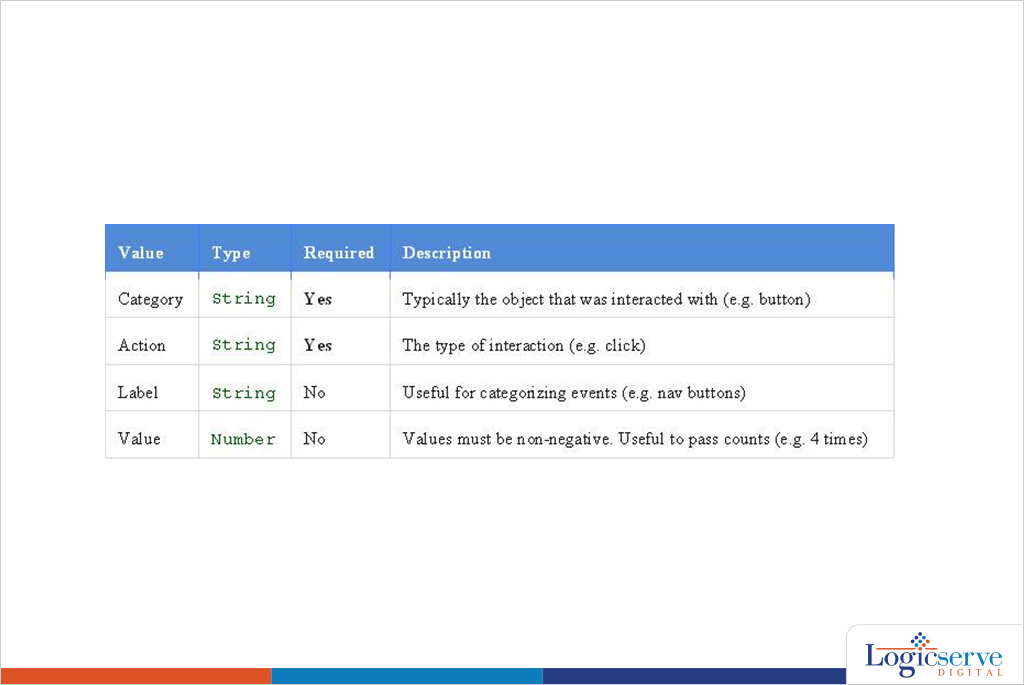
    An event consists of four values that you can use to describe a user’s interaction:

    Google-Analytics-2 @LogicserveDigi

    Source: Google Universal Analytics Documentation

    1. Set up meaningful names for the different parameters used in Event-tracking
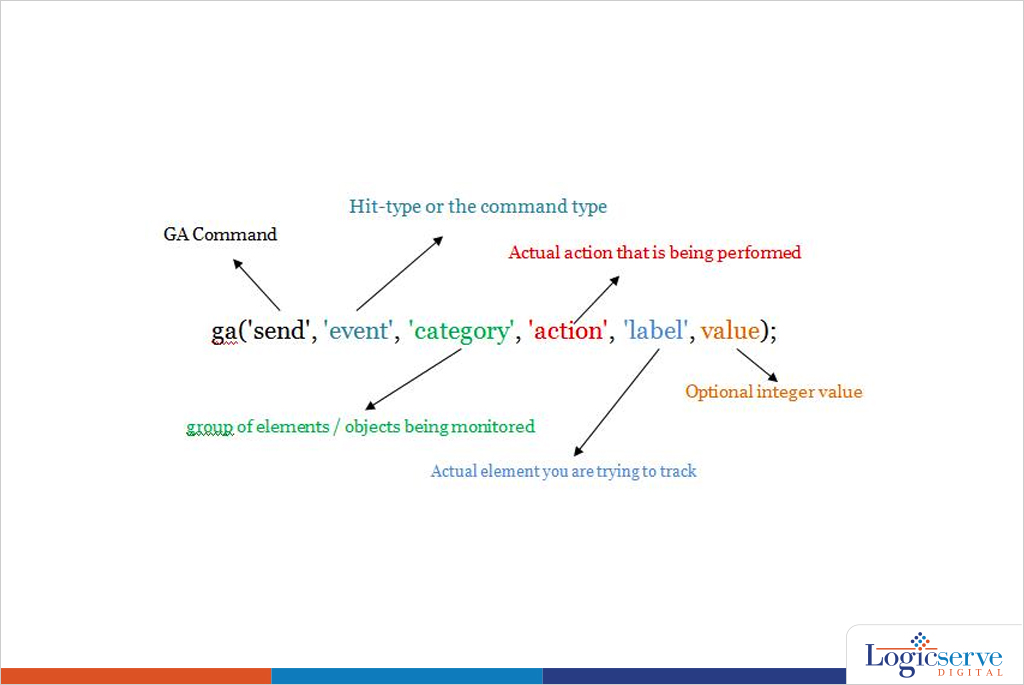
    2. Ga (send: This is the Google Analytics Command. Do not mess with this. Let it be.
    3. Event: This is the hit-type, or the command-type. Do not mess with this either, let it be.
    4. Category :This represents the group of elements / objects being monitored
      Eg: Videos, Audios, Ebooks, Portfolios etc
    5. Action:This represents the actual action that is being performed, Could be a Click / Play/ Pause/Stop/View /download ..whatever that makes sense in your report.
    6. Label [optional]:You might want to pay special attention to this parameter. This represents the actual element you are trying to track.A good example would be EbookTitle / Blogpost-title / Page-title/ Videoname/Audio name This way, when you look at the report, you know which elements are being productive, and the ones which are being counter-productive to your efforts.
    7. Value [optional]:If you are tracking affiliate links, then, this is an extremely important parameter. Because, this associates a number with the event.Most Affiliate links are measured for the no. of clicks, and the affiliate paid accordingly. In other words, each click at an affiliate link carries a certain currency. By specifying a value to the event, you get to associate the tracking with potential earnings.
    1. Eg of Codes to track different type of events
      • ga(‘send’,’event’, ‘Videos’, ‘Play’, ‘Gone With the Wind’);
      • ga(‘send’,’event’, ‘Downloads’, ‘PDF’, ‘/salesForms/orderForm1.pdf’);
      • SEER’s guide on the naming conventions is a good start for DIY enthusiasts
    1. Integrating the code with the elements in the website
    • To Track Contact Form Submit
      – <form name=”input” action=”submit.asp” onsubmit =”ga(‘send’,’event’,’form’,’submitted’,’contactform’)”>
    • To Track button click
      – <button type=”button” onclick =”ga(‘send’,’event’, ‘button’, ’clicked’, ’GetQuote’,, ’true’);”>Get Free Quote!</button>
    • To Track a File download
      <a href=”downloadpath-freeEbook.pdf” onClick=” ga(‘send’,’event’, ‘Resources’, ‘download’, “SEO free guide”, pdfValue, true]);” target=”_blank”>SEO Is Great Whitepaper</a>
    1. RECOMENDED: Set up GOALS in the GA dashboard. Goals are reports that show the performance based on the data collected via the ga(‘send’,’event’
      • Login to GA dashboard > Admin
      • Select Account > Property > Goals
      • New Goal>Custom > Next steps
      • Enter Goal Name : Use something that is easily recognisable
      • Select Event
      • Add values that are relevant to this goal
      • Category <as used in the code >
      • Action <as used in the code >
      • Label <as used in the code >
      • Value<as used in the code >
      • CREATE GOAL

    Sit back and wait for some time for the tracking data to come in. Ideal wait would be one week to see a pattern. Analyse and action accordingly to maximise marketing efforts

    LogicSpeak:

    Setting up an EVENT TRACKING code is easy, and a DIY job for enthusiasts. However, should you feel intimidated to implement this yourself, email your developer or hire a competent agency that specialises in GA with your list of events that need to be tracked and analysed. You should be set up in a week, and will have a possible strategy to implement in 15 days time. Quantifying user engagement is vital to measure the direct influence of your marketing efforts, and Google Analytic’s event tracking allows you to do just that with your website.


    Previous Post: Social Media Starter Pack for Your Business

  • How to use Analytics for tracking PPC performance

    How to use Analytics for tracking PPC performance

    PPC Analytics @LogicserveDigi

    To track the performance of your business, it is important to track your conversions. By using Google Analytics, tracking and measuring the source of conversion becomes super easy. When using Google Analytics, all you need to do is define a goal and cite a URL that tells the source of that particular click.

    Google Analytics URL – Creation and Tracking

    To ensure your tracking URL is built, use Google Analytics URL builder and make sure your URLs are tagged with the campaign tracking parameters. It is not as tough as it sounds. All you have to do is simply fill up the form and give your campaign details along with inserting the URL of the landing page.

    The URL so created should only be used in your campaign further and not the standard one. The next step would be to ensure what command you want it to check. For e.g. in case of an e-commerce business, tracking shopping carts should be your goal or command. This way Google Analytics will count the number of visits to the order confirmation page and give you the correct data.

    Tracking of the campaign

    Once you’re done with the goal setting, Google Analytics will start tracking the goal performance and will attribute it to the respective sources. This process will help you to create easy reports to track the performance of your campaign. The custom reports in Google Analytics are easy to read and comprehend and helps you track your digital source accurately.

    To precisely manage your PPC account, tracking should be on your top priority. With the help of Google Analytics you can identify unique visitors or first time visitors from a particular source, bounce rate (relative data of people who visited and immediately left your site) and identifying the top landing pages of your site over a period of time. With the help of Google Analytics you can also measure the amount of time a visitor spent on your site.

    Campaign tracking on other search engines

    To ensure that traffic and conversion tracking is implemented correctly, you have to guarantee that your campaign across all the major PPC search engines is working fine. To double check, take a lead tracking report to ensure conversion data is accurately available in each search engine that is being used.

    Also, don’t forget to double check whether the codes have been installed properly on the landing pages and on overall website. Ensure that no conversion path or the landing page goes unchecked by you. Make sure the Google conversion tracking services are completed so that you have an instant access to your conversion statistics at all times.

    LogicSpeak:

    Analytics do offer viable tracking systems for your online marketing campaign. They can be relied upon to deliver provided you or your PPC account manager sets them up in perfect order as suggested by them.

    Previous Post: What you need to know about guided search in Pinterest