
Defining the buzz word Customer Journey Map?
To phrase it in simple terms, it’s a visual representation of the customer’s experience. It should accurately reflect the entire experience right from the moment a customer makes contact with your brand, to the moment they complete a purchase (and sometimes even after sales experiences). A CJM should include customer emotions – both positive and negative.
A CJM helps teams understand how different customer touchpoints interact with each other, the time required, and how the customer’s emotions vary throughout the experience.
Both Apple and Starbucks are pros in using a highly detailed model to visualize the customer experience. For instance, Starbucks starts the customer experience right from the moment a potential customer thinks about purchasing a cup of coffee.
Using Customer Journey Mapping for Success –
- Look beyond data-driven principles
- Create personalized content for digital experiences
- Focus on the emotions & motivations
- Focus on the overall experience, not just the journey
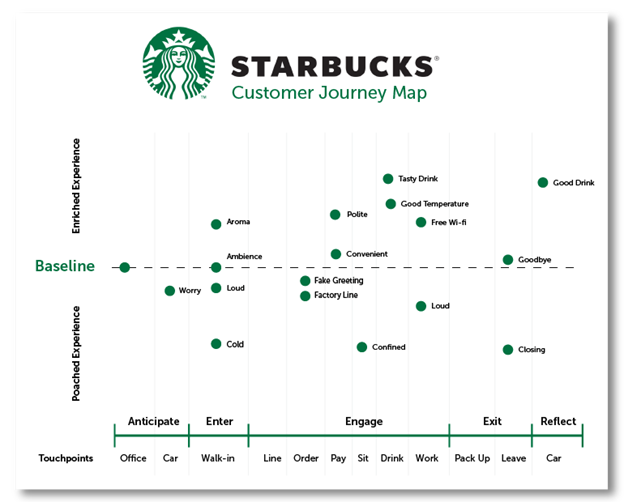
As you can see, this map not only includes all possible emotions of the customer and various touchpoints; it also offers a baseline for what the brand considers as “an enriched customer experience.” This helps the Starbucks employees ensure that each customer gets the best possible experience at all times, thereby enhancing the brand’s value.
It’s essential that you consider all touchpoints and customer perspectives when mapping out the customer journey. Make sure to consider the emotional journey of touchpoints to figure out the right course of action.
Let’s understand the role of emotions in a Customer Journey
Emotions hold the key to either make or break a customer experience. Emotions make customers decide whether they want to buy or not buy from a particular brand. Most importantly, customer emotions determine whether they want to remain loyal to a brand.
The emotions a customer experiences while interacting with a brand can be divided into four different clusters:
|
Emotion Cluster Type |
Emotions Experienced |
Value |
|
| Advocacy Cluster | Happy, Pleased | Drives long-term value | |
| Recommendation Cluster | Safe, Focused, Trusting, Valued | Influences short-term spend | |
| Attention Cluster | Interesting, Energetic, Indulgent, Exploratory | ||
| Destroying Cluster | Irritated, Hurried, Neglected, Unhappy, Stressed, Disappointed, Frustrated, Dissatisfied | ||
Identifying these twenty emotions that influence customer experience may not be easy at first. However, once you build a detailed CJM and understand the emotional engagement behind each touchpoint, then you can understand whether these emotions drive or destroy value for your brand.
You can then work on building an emotional experience that is planned and deliberate and not leave it to chance.
The Bottomline
You would have heard the saying – conversion is king in digital sales. Most marketers and brands focus on closing a sale and converting a customer into a buyer, that they forget the most indispensable part of the journey – the customer experience.
Booking.com is a great example of data-driven design. They do a lot of A/B testing to see how people best convert to booking flights and hotels on their platform.
Through their tests, they’ve discovered that adding “Urgency Messaging” drives people to book more. Urgency messaging is something like “Hey this hotel has just 4 rooms left, book soon”. That’s nice, however, over the years, booking.com has added one urgency message after another, to the point where now it looks more like a shady used car lot than like a serious place to book hotels. Most recently, it has started showing you hotels you can’t even book, just to drive home that point that “people are booking hotels here at booking.com so you should too”: And I’m sure it works to improve conversions by 0.4%. But if you look at the whole experience, it’s really starting to degrade. That’s the type of result you get when you myopically optimize your product based on data points and single-digit improvements to conversion, without considering the overall experience.(source: Medium.com)
While it’s true that conversion rates help you determine whether a campaign, product, service, or app is successful, digital marketers have to look beyond the conversion numbers. You need to focus on the broader customer journey, so that you can continue increasing conversion rates, over the lifetime of the customer.
Remember that for customers clicking “confirm order,” is just a single step of the journey. All other aspects of the brand – the overall experience – is what turns them from a one-time customer to being loyal to your brand, for years to come. As a digital marketer, focus on providing customers with an enriched experience, and the rest will fall into place automatically.
Logicserve Digital is a leading Digital Marketing & Digital Consulting services company with offices spanning across India. We partner with clients all over the world to create perfect digital journeys. As Certified Adobe Partners we are growing in what we do and how we do it. We help in determining the feasibility and end-to-end requirements needed for enterprise-level CX initiatives at an early stage.
Our Services:
Adobe Target for Personalization –
Making every experience relevant and personal is the sign of an experience business. Adobe Target is a personalization engine that lets you test and optimize with machine learning across mobile apps and the web.
- Take omnichannel personalization to the masses.
- Stop guessing with A/B and multivariate testing.
- Improve every experience with AI-powered automation and scale.
Adobe Analytics
- Reports & Analytics: Reporting on key digital metrics and dimensions as well as scheduling custom reports and dashboards for delivery. Ad hoc Analysis: Advanced analysis tool with rich segmentation capabilities and multi-dimensional breakdowns
- Analysis Workspace: Robust, flexible canvas for building, curating, and sharing custom analysis projects, using various tools such as freeform and cohort analysis
- Report builder: Excel integration for custom reporting and analysis directly in Microsoft Excel
- Mobile App Analytics: App-centric user interface with various mobile marketing capabilities (in-app messaging, push notifications, geo-targeting, etc.)
- Data workbench: Advanced data discovery tool for analyzing customer data across multiple channels (web, point-of-sale, kiosk, call center, IVR)
Adobe Campaign for Customer Engagements
- Email marketing – Good cross channel campaigns are built on email.
- Customer journey – We know your customer’s journey matters. See the whole picture of that journey to know your customers and how they get to you.
- Omnichannel marketing – Customers matter more than channels. So, build cross-channel campaigns that talk to your customers when and where they want.
To know more about enhancing marketing lifecycles, please feel free to get in touch with our Customer Experience Expert – Mr. Ashish Duggal at +91 98200 55843 or write to him at ashish.d@logicserve.com