LS Staging

Blog

  • E-E-A-T Guidelines 2025: How to Build Google-Friendly Content

    E-E-A-T Guidelines 2025: How to Build Google-Friendly Content

    In a world where everyone’s publishing content, how does Google decide what to trust?

    It’s no longer just about keyword placement or backlinks. Today, credibility, relevance, and real-world experience matter just as much – if not more.

    That’s where Google’s E-E-A-T framework steps in.

    Whether you’re a brand in healthcare, finance, or just trying to build long-term visibility online, understanding how E-E-A-T works is critical to your content strategy.

    So, what is E-E-A-T?

    E-E-A-T is a parameter for Google SEO and stands for:

    • Experience
    • Expertise
    • Authoritativeness
    • Trustworthiness

    First originally introduced as E-A-T, Google added Experience in 2022 to reflect the growing importance of first-hand knowledge. It’s a lens used by Google’s search quality evaluators to assess how reliable and helpful your content really is – especially in sensitive categories like money, health, and safety.

    Let’s unfold how each component works for your content.

    Experience

    It’s about having been there and done that.

    If someone writes a skincare product review, Google wants to know whether have they actually used it? If a blog offers parenting tips, is it written by someone who’s raising kids themselves???

    Google now prioritizes content written from real, lived experience – not just curated facts. Think: product demos, case studies, tutorial walkthroughs, or anecdotal insights.

    Expertise

    Expertise is about demonstrating deep knowledge in a particular domain.

    For high-stakes topics like legal advice, financial planning, or medical information, formal education and credentials matter. For lifestyle content or niche interests, demonstrated passion, consistency, and accuracy can often be enough.

    It’s about knowing your stuff – and showing it clearly.

    Authoritativeness

    Google looks at your reputation both online and within your industry. It checks whether –

    • Are other trusted sites linking back to your content?
    • Do influencers or domain experts reference your work?
    • Are your authors known in their field?

    Authority is built over time – but it starts with creating content worth talking about and sharing.

    Trustworthiness

    Perhaps the most crucial piece of all – can your content be trusted?

    Trust comes from factual accuracy, site security (https), transparent author info, and policies that respect users. If your content misleads, plagiarizes, or lacks citations, it’s likely to be flagged by Google – and abandoned by users.


    Why E-E-A-T Matters for your SEO Strategy

    Here’s the catch: E-E-A-T isn’t a direct ranking factor. You won’t find it as a toggle in your SEO tool.

    But it shapes how Google evaluates your overall site quality – especially in what it calls “YMYL” (Your Money or Your Life) areas. And in a landscape flooded with AI-generated or copycat content, it’s what helps real, trustworthy content rise to the top.

    So a Strong E-E-A-T will:

    • Increases your visibility on high-intent search queries
    • Enhances credibility with your audience
    • Attracts backlinks and organic mentions
    • Future-proofs your site against algorithm shifts

    How to strengthen your website’s E-E-A-T in short

    Here are simple, actionable ways to enhance your content credibility:

    Add First-Hand Experience

    Showcase real reviews, personal anecdotes, project snapshots, or customer outcomes.

    Highlight Author Bios

    List qualifications, achievements, or relevant experiences. Especially important for blogs discussing money, health, or legal issues.

    Build Your Reputation

    Earn backlinks, get featured in respected publications, and encourage user reviews.

    Secure Your Site

    Use HTTPS, make your design clean and professional, and provide clear contact info.

    Use Quality Sources

    Cite data, industry reports, and recognized institutions. Link out with intention.


    In conclusion: Content that builds Trust wins in the long run

    Google’s E-E-A-T isn’t a checklist. It’s a mindset shift.

    It encourages brands to stop thinking like marketers – and start thinking like trusted advisors.

    So, if you want content that ranks, converts, and creates loyal users, focus on authenticity. Highlight lived experience. Back up your claims. And put people first.

    Because when people trust your content, the algorithm follows.

    To streamline your website to E-E-A-T the competition, feel free to connect with us.
    Get in Touch

  • Weekend Digital Media Round-Up: Why Linear TV and Streaming Work Better Together, How to use GA4 predictive metrics for smarter PPC targeting, Demand Gen Vs. Lead Gen: What Every CMO Needs To Know & More…

    Weekend Digital Media Round-Up: Why Linear TV and Streaming Work Better Together, How to use GA4 predictive metrics for smarter PPC targeting, Demand Gen Vs. Lead Gen: What Every CMO Needs To Know & More…

    1.Why Linear TV and Streaming Work Better Together

    ​Combining linear TV and streaming creates a more effective advertising strategy by balancing reach and precise targeting. A case study showed that relying solely on streaming increased costs, highlighting the importance of a dual-channel approach for better performance and efficiency. [Source: Adweek]

    2. How to use GA4 predictive metrics for smarter PPC targeting

    Google Analytics 4 (GA4) predictive metrics can enhance PPC targeting by translating raw behavioral data into actionable insights. These metrics help identify high-value users, optimize ad spend, and improve ROAS by predicting user behavior like purchase likelihood and churn risk. [Source: Search Engine Land]

    3. Demand Gen Vs. Lead Gen: What Every CMO Needs To Know

    Demand generation and lead generation are distinct strategies with different goals and impacts. Demand generation focuses on creating awareness and interest, while lead generation aims at capturing contact information for sales. Balancing both strategies is crucial for long-term growth and effective pipeline development. [Source: Search Engine journal]

    4. Meta brings ads to WhatsApp—will it reshape how brands engage consumers?

    Meta’s introduction of ads on WhatsApp’s Updates tab could revolutionize brand engagement, emphasizing personalized and respectful campaigns. While brands are cautiously optimistic, success will depend on balancing privacy concerns and delivering real value to users. [Source: Afaqs]

    5. Retargeting: How brands stay top of mind after you bounce

    Retargeting is a digital marketing strategy that uses display advertising to re-engage people who have shown interest in a brand but haven’t converted into a sale. It involves tracking user behavior, segmenting audiences, and delivering personalized ads across various platforms to boost conversions and ROI. Retargeting is a subset of remarketing, which uses broader strategies and data types. [Source: Search Engine Land]

    6. AI Isn’t A Trend—It’s The New Marketing Foundation

    AI has become the core of modern marketing, moving from the edge to the center due to its ability to solve real business problems efficiently. Economic pressures are driving this shift, with AI enabling faster, smarter decisions and providing clarity in volatile markets. Venture capital is also influencing this trend by prioritizing proven, high-performance solutions. [Source: Forbes]

    7. Strategic Marketing for Leaders: Equipping Professionals to Lead in the AI Age

    Professionals aiming for leadership roles in marketing need to stay relevant by integrating AI and data-driven approaches. IIM Calcutta’s programme equips them with tools like predictive analytics and Generative AI to lead in an AI-first business landscape. [Source: The Economic Times]

    8. Advanced agentic use cases for Digital Asset Management

    Autonomous AI agents are revolutionizing digital asset management by taking over tedious tasks and enabling intelligent automation. These agents go beyond simple automation, offering capabilities like advanced visual recognition, contextual understanding, and cultural localization, making them indispensable for modern enterprises. [Source: Search Engine Land]

    9. AI Is Rewriting the Value of Expertise—and Customer Experience Will Feel It

    AI is transforming professional services by reducing the time and cost of specialized tasks, pushing firms to rethink their pricing models and delivery methods. Trust and transparency are becoming crucial as AI makes expertise more accessible, requiring service providers to differentiate themselves and build strong client relationships. [Source: CMS Wire]

    10. How to build a traffic-first strategy in a fragmented search world

    Ranking well on Google doesn’t guarantee clicks anymore due to AI-infused search features. Brands need a unified SEO strategy that targets every SERP surface to drive real traffic and visibility. [Source: Search Engine Land]

  • Weekend Digital Media Round-Up: From Influence to Intelligence: The Rise of AI-Driven Creator Commerce, Answer Engine Optimization (AEO) — What Brands Need To Know, Turn real-time data into smarter customer journeys & More…

    Weekend Digital Media Round-Up: From Influence to Intelligence: The Rise of AI-Driven Creator Commerce, Answer Engine Optimization (AEO) — What Brands Need To Know, Turn real-time data into smarter customer journeys & More…

    1.From Influence to Intelligence: The Rise of AI-Driven Creator Commerce

    Creators are evolving into strategic commercial collaborators, leveraging AI to optimize product selection, automate audience engagement, and drive revenue. Economic pressures are pushing creators to adopt AI for efficiency, making sharper decisions and aligning with seasonal trends. Retail leaders must support creators with AI-powered tools and transparent data to thrive in this new landscape. [Source: Total Retail]

    2. Answer Engine Optimization (AEO) — What Brands Need To Know

    ​Answer Engine Optimization (AEO) is transforming how brands interact with consumers by structuring content for large language models (LLMs) like ChatGPT. Brands need to create dynamic, conversational content that LLMs can understand and reference, moving away from static, keyword-based SEO. This shift emphasizes authentic, helpful, and authoritative content to ensure brands are visible in AI-driven conversations. [Source: Forbes]

    3. Turn real-time data into smarter customer journeys

    Marketers are leveraging Customer Data Platforms (CDPs) to unify customer data, streamline operations, and create real-time profiles that drive growth. This approach helps replace disconnected tools, orchestrate smarter customer journeys, and prove ROI across channels. Join the live panel discussion to learn more about these strategies. [Source: Search Engine Land]

    4. Ecommerce advertising: Strategies to drive online sales

    Ecommerce advertising is crucial in today’s digital economy, allowing businesses to showcase products where customers spend most of their time online. This guide covers the basics, strengths, and limitations of current ecommerce platforms, along with strategies and tactics to drive online sales effectively. [Source: Search Engine Land]

    5. Omnichannel retail advertising: Connect with shoppers across every touchpoint

    Omnichannel retail advertising is essential for creating a consistent and connected experience for shoppers across various platforms. By leveraging multiple channels like display, video, connected TV, and audio, marketers can engage customers at every stage of their buying journey, enhancing conversion rates and building long-term loyalty. AI-powered technology helps optimize these efforts by delivering personalized ads to the right audience at the right time. [Source: Marketing Tech]

    6. How To Save PPC Campaigns From Poor Conversions & Wasted Budget

    Struggling with poor conversions and wasted budget in PPC campaigns often stems from lead leaks after the click. Meagan McLoughlin from CallRail shares practical tips to improve lead-nurturing and management strategies, including an exclusive look at VoiceAssist, an AI-powered assistant for handling inbound calls. [Source: Search Engine Journal]

    7. Beyond ChatGPT: What AI agents really do (and why it matters for customer experience)

    Autonomous AI is revolutionizing customer experience by not just responding but acting—planning, reasoning, and executing tasks across departments. This transformation enables brands to move faster, serve smarter, and scale customer impact without increasing headcount. The guide from Snowflake explores the unique aspects of AI agents, successful use cases, and considerations for deployment. [Source: Seach Engine Land]

    8. Small and Smart: How AI is powering SMEs in India’s e-commerce boom

    AI is revolutionizing India’s e-commerce sector by optimizing operations and enhancing customer experiences. It improves search capabilities, inventory management, and logistics, making shopping more efficient and personalized. Experts highlight AI’s role in transforming user behavior and driving higher operational efficiencies. [Source: The Economic Times]

    9. AI in Customer Experience: Powerful Use Cases You Shouldn’t Ignore

    AI is transforming customer experience by automating repetitive tasks, providing real-time contextual support, and personalizing interactions. Companies like Daily Harvest and Verizon are leveraging AI to enhance customer satisfaction, improve operational efficiency, and uncover valuable insights. [Source: CMS Wire]

    10. SEO KPIs to track and measure success in the age of AI

    Tracking and refining SEO strategies is crucial in the age of AI. Key performance indicators (KPIs) help measure SEO success by connecting marketing objectives to SEO reporting. Focusing on core metrics and integrating AI insights ensures a strategic approach to SEO in a rapidly changing landscape. [Source: Search Engine Land]

  • In-House vs. Agency: Making the Right Marketing Build for Growth

    In-House vs. Agency: Making the Right Marketing Build for Growth

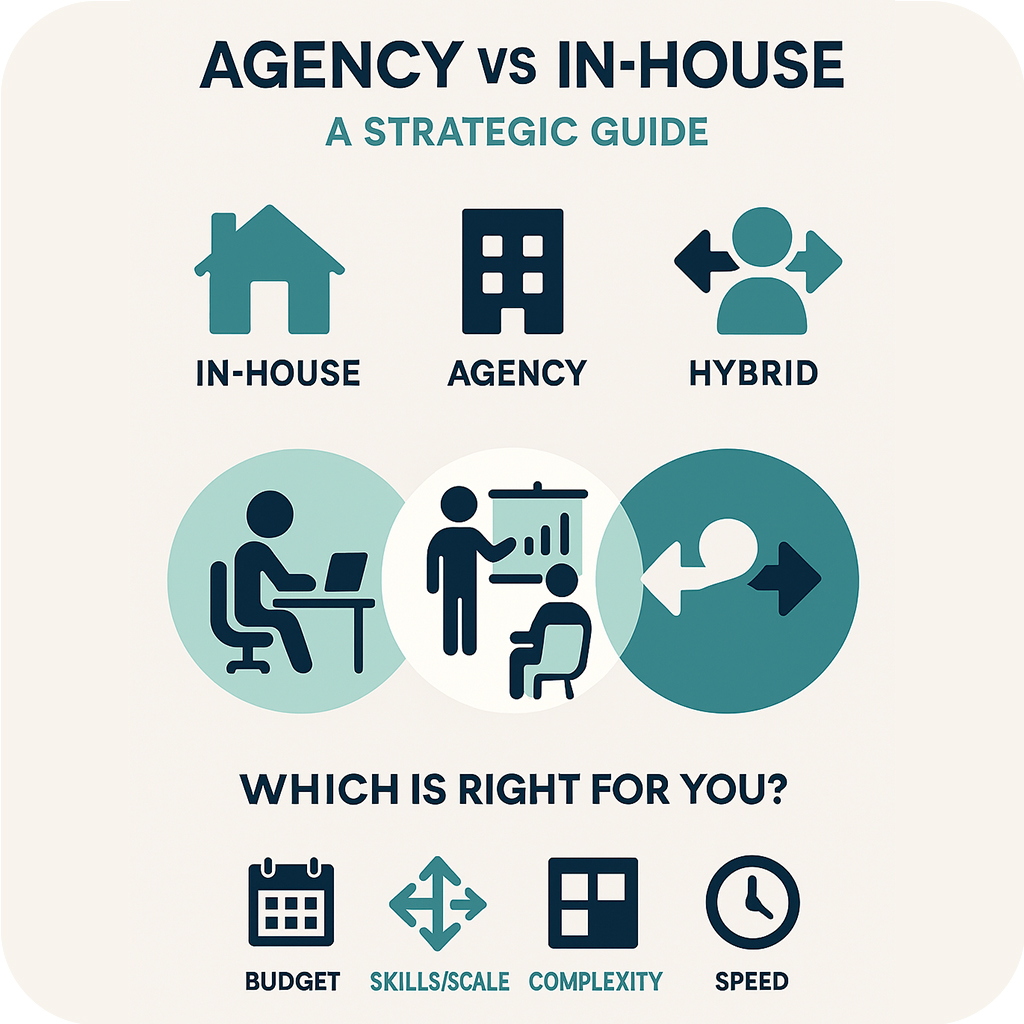
    As businesses scale in today’s always-on digital landscape, one of the most strategic questions marketing leaders face is: Do we build in-house or partner with an agency?

    This isn’t just a budget call – it’s a growth decision. The model you choose impacts how fast you go to market, how deeply you understand your audience, how much you can scale, and how creatively you execute.

    And the truth is, there’s no universal answer. It depends on your goals, team bandwidth, marketing complexity, and where you want to focus your energy.

    In this article, we break down the in-house vs. agency debate — not as opposing sides, but as tools in your larger marketing arsenal. Plus, we explore the increasingly popular hybrid model that blends control with scalability.

    What does going ‘in-house’ really mean?

    Choosing to go in-house means building a dedicated team – writers, designers, media planners, analysts – who live and breathe your brand.

    Where it shines:

    Deeper brand immersion: Your team owns the voice, vision, and values.

    Speed of execution: Approvals are faster, decisions are more agile.

    Cost-efficiency (long term): Particularly for brands with high-frequency or always-on campaigns.

    Closer cross-team integration: Marketing can plug directly into sales, product, or leadership workflows.


    Watch out for:

    Skill gaps in niche areas like CRO, programmatic advertising, or advanced analytics

    Hiring & retention costs – especially in a talent-competitive market

    Burnout when small teams juggle too many hats

    Echo chambers, without fresh outside perspectives


    What does partnering with an agency bring?

    When you hire an agency, you tap into a team with specialized expertise across campaigns, clients, and categories. It’s plug-and-play firepower.

    Where it shines:

    Access to deep expertise without needing to hire full-time

    Scalability on demand – ramp up or down with campaign needs

    Fresh thinking that challenges your internal assumptions

    No infrastructure overhead – tools, platforms, training already included

    Watch out for:

    Higher project-based costs

    Less operational control, especially on quick pivots

    Steeper learning curve to understand your product or market nuance

    Shared attention, since agencies manage multiple clients


    What’s the Right Fit?

    Ask these 5 key questions

    Choosing the right model isn’t just operational — it’s strategic. Here are five questions to guide the decision:

    1.What’s your available budget?

    In-house requires upfront investment; agencies offer flexibility with variable costs.

    2.Do you need specialized skills or scale?

    Go agency for things like video, PPC, google analytics. In-house works for content or organic social.

    3.How complex is your marketing ecosystem?

    Multiple products, geographies, or customer segments may benefit from external expertise.

    4.How quickly do you need to move?

    In-house teams typically turn things around faster — if they have the bandwidth.

    5.Is your marketing consistent or campaign-based?

    Always-on? Build in-house. Episodic? Partner with an agency.


    OR DO BOTH?

    THE RISE OF THE HYBRID MODEL!

    For many fast-growing brands, the answer isn’t ‘either-or’- it’s both.

    The hybrid marketing model gives you the best of both worlds:

    • In-house teams manage brand, messaging, and long-term strategy
    • Agencies handle execution-heavy lifts, innovation sprints, or skill-specific needs


    Example structure:


    Marketing Model Best For Key Advantage
    In-House Long-term brand building, high-volume needs, social listening, brand strategy Brand alignment and speed
    Agency Projects, launches, paid media, specialist skills Expertise and scalability
    Hybrid Scaling brands needing flexibility Balance of cost, control, and creativity


    This modular approach allows you to stay lean, stay fast, and stay future-ready.

    There’s no one-size-fits-all approach. Your ideal marketing structure depends on your current stage, team capabilities, business goals, and marketing volume.

    In conclusion: Build the team that builds your brand

    Whether you’re a high-growth startup or a legacy enterprise rethinking your digital stack, your marketing structure matters. It shapes your agility, your creativity, and your results.

    So don’t just ask “agency or in-house?”

    Ask “What’s right for right now – and where we want to go?”

    Then build accordingly – with clarity, conviction, and partners who share your ambition.


    Ready to Build the Right Marketing Team?

    Whether you’re scaling up, launching a new campaign, or figuring out how to balance in-house and agency efforts—we’re here to help

    Talk to us

  • Weekend Digital Media Round-Up: AI Search Is Reshaping Consumer Behavior And Brands Must Adapt, how multimodal discovery is redefining SEO in the AI era, Predictive AI in Customer Experience: What Works Today & More…

    Weekend Digital Media Round-Up: AI Search Is Reshaping Consumer Behavior And Brands Must Adapt, how multimodal discovery is redefining SEO in the AI era, Predictive AI in Customer Experience: What Works Today & More…

    1.AI Search Is Reshaping Consumer Behavior And Brands Must Adapt

    Generative AI platforms like ChatGPT and TikTok are transforming consumer behavior by shifting from keyword-driven queries to AI-curated answers. Brands must adapt to this new AI-driven search landscape by optimizing their content for visibility and performance across multiple interfaces, including AI agents and bots. [Source: Forbes]

    2. How multimodal discovery is redefining SEO in the AI era

    ​The SEO industry is evolving with multimodal discovery, integrating voice, visuals, and AI insights to meet new user expectations. Google is shifting from reactive queries to proactive AI-powered discovery, emphasizing originality, structured data, and multimodal content to stay relevant in search results. [Source: Search Engine Land]

    3. Predictive AI in Customer Experience: What Works Today

    Predictive AI is transforming customer experience by enabling proactive engagement, which improves satisfaction and reduces churn. Companies like Allstate and Nike are seeing significant benefits from AI-driven personalization and customer targeting, leading to higher efficiency and customer loyalty. [Source: CMS Wire]

    4. How AI Is Quietly Rewriting The Rules Of Customer Engagement

    I and automation are transforming customer engagement by enabling businesses to respond quickly and personalize interactions. Companies that integrate these technologies can optimize operations, enhance customer experiences, and achieve sustainable growth. [Source: Forbes]

    5. Paid Media Reporting For Ecommerce: Navigating Attribution Across Paid

    Global advertising expenditure has surpassed $1 trillion for the first time, with digital channels like search and social media expected to account for 72.9% of total ad revenue by the end of the year. Major platforms such as Google, Meta, Amazon, and Alibaba are projected to capture over half of global ad revenues in 2025. [Source: Search Engine Journal]

    6. The Rise Of Proprietary Commerce: How To Win With Owned Data, Content And Communities

    Brands should focus on Proprietary Commerce by owning their data, content, and communities to avoid dependency on external platforms. This approach includes leveraging first-party data, creating original content, and building loyal communities to ensure sustainable growth and control over their business. [Source: Forbes]

    7. 4 reasons retail media is the new creative playground

    Retail media is evolving from a transactional space to a creative playground, offering brands new opportunities to engage customers throughout their journey. CMOs and agency partners are increasingly recognizing its potential to drive both sales and imagination. [Source: The Drum]

    8. Why Unified Commerce is Powering Retail Growth

    Retailers are modernizing payment systems to meet evolving customer expectations, focusing on digital wallets and self-checkout solutions. Despite challenges like implementation costs and staff training, these innovations aim to enhance convenience, security, and personalized shopping experiences. [Source: Total Retail]

    9. SEO Sidekick: The Rise of Answer Engine Optimization

    Answer engine optimization (AEO) is transforming content discovery by prioritizing direct answers over traditional keyword-based search results. Forward-thinking marketers are leveraging AEO to gain significant traffic and competitive advantages, as AI-driven search behavior becomes more prevalent. [Source: CMS Wire]

    10. From mundane to magical: How AI is powering the Next-Gen marTech stack

    AI is revolutionizing the MarTech stack by driving data-informed decisions, predictive insights, and hyper-personalized experiences. It enhances traditional automation with machine learning and real-time models, helping marketers transition from reactive to proactive strategies. [Source: Adgully]

  • Weekend Digital Media Round-Up: Digital Audio Is the Missing Piece to Your Video Campaigns, Digitalisation and AI Skills Are No Longer Optional – They Are Essential for Business Success, Forget What You Know About Search. Optimize Your Brand for LLMs & More…

    Weekend Digital Media Round-Up: Digital Audio Is the Missing Piece to Your Video Campaigns, Digitalisation and AI Skills Are No Longer Optional – They Are Essential for Business Success, Forget What You Know About Search. Optimize Your Brand for LLMs & More…

    1.Digital Audio Is the Missing Piece to Your Video Campaigns

    Digital audio is crucial for video campaigns as it engages audiences even when visuals are out of sight. Podcasts on video platforms are growing, offering new opportunities for cross-channel campaigns. Adding digital audio to video strategies enhances reach and engagement. [Source: Adweek]

    2. Digitalisation and AI Skills Are No Longer Optional – They Are Essential for Business Success

    Digitalisation and AI are crucial for business success, requiring a shift in leadership mindsets. Skillnet Ireland, under new CEO Mark Jordan, continues to support Irish businesses in upskilling, focusing on digital transformation, leadership, and sustainability. [Source: Irish Tech News]

    3. Forget What You Know About Search. Optimize Your Brand for LLMs

    Consumers are increasingly using Large Language Models (LLMs) like ChatGPT for product recommendations, shifting away from traditional search engines. Marketers must now optimize their strategies for AI recommendation engines to maintain brand visibility and relevance. [Source: HBR]

    4. The Future Of Enterprise AI: Fine-Tuning For Trust And Impact

    Fine-tuning AI models with proprietary data can transform them into systems that understand a company’s culture and operations, enhancing efficiency and personalization. Despite the potential, only 9% of production models are fine-tuned, highlighting a significant opportunity for businesses to improve AI integration and orchestration. [Source: Forbes]

    5. Analyze competitor content, keywords, and SERP features to boost your visibility in generative AI search results.

    Competitive audits are essential for optimizing AI SERP visibility. By analyzing competitor content, keywords, and SERP features, you can enhance your own content’s visibility in generative AI search results. Regularly updating and experimenting with your strategy ensures you stay ahead in the evolving AI landscape. [Source: Search Engine Land]

    6. What Is Multimodal AI and Why Retailers Should Care

    Multimodal AI allows users to interact through text, voice, or images, enhancing personalization and convenience. Long-memory AI enables brands to recall past interactions, creating seamless and context-aware customer experiences. However, increased personalization requires stronger privacy safeguards and responsible data handling. [Source: PYMNTS]

    7. Redefining Customer Experience: AI Adoption And Change Management Go Hand In Hand

    AI adoption is transforming customer service by offloading administrative tasks to automation, allowing representatives to focus on complex requests and empathy. Effective change management and training are crucial for integrating AI tools and optimizing customer interactions. [Source: Forbes]

    8. Meta Ads for lead gen: What you need to know

    Meta Ads can be a powerful tool for lead generation across various industries. By choosing the right ad formats and optimizing for lead quality, businesses can effectively capture high-quality leads and improve their marketing efforts. [Source:  Search Engine Land]

    9. The AI search boom: why advertisers must embrace the next evolution of search

    AI-powered search is transforming how consumers find information, offering personalized, conversational results that meet users where they are. Advertisers must adapt to this shift to stay relevant and engage the next generation of digital consumers. [Source: TechRadar]

    10. The future of B2B authority building in the AI search era

    AI is transforming B2B authority building by prioritizing clear, structured content that earns trust at first glance. B2B marketers must adapt their strategies to build visibility, measure performance, and collaborate across channels in this new AI-driven search landscape. [Source: Search Engine Land]

  • Beyond Rankings: Embedding SEO into an Integrated Full-Funnel Demand Generation Framework

    Beyond Rankings: Embedding SEO into an Integrated Full-Funnel Demand Generation Framework

    Introduction

    In today’s hyper-competitive digital landscape, businesses can no longer afford to look at SEO (Search Engine Optimization) as just a top-of-funnel tactic. SEO has evolved into a crucial component across the entire marketing funnel — from attracting new audiences to nurturing leads and driving conversions.

    This blog will explore how SEO plays a pivotal role at every stage of the full-funnel marketing strategy and how brands can maximize its impact.

    Understanding the Full Marketing Funnel

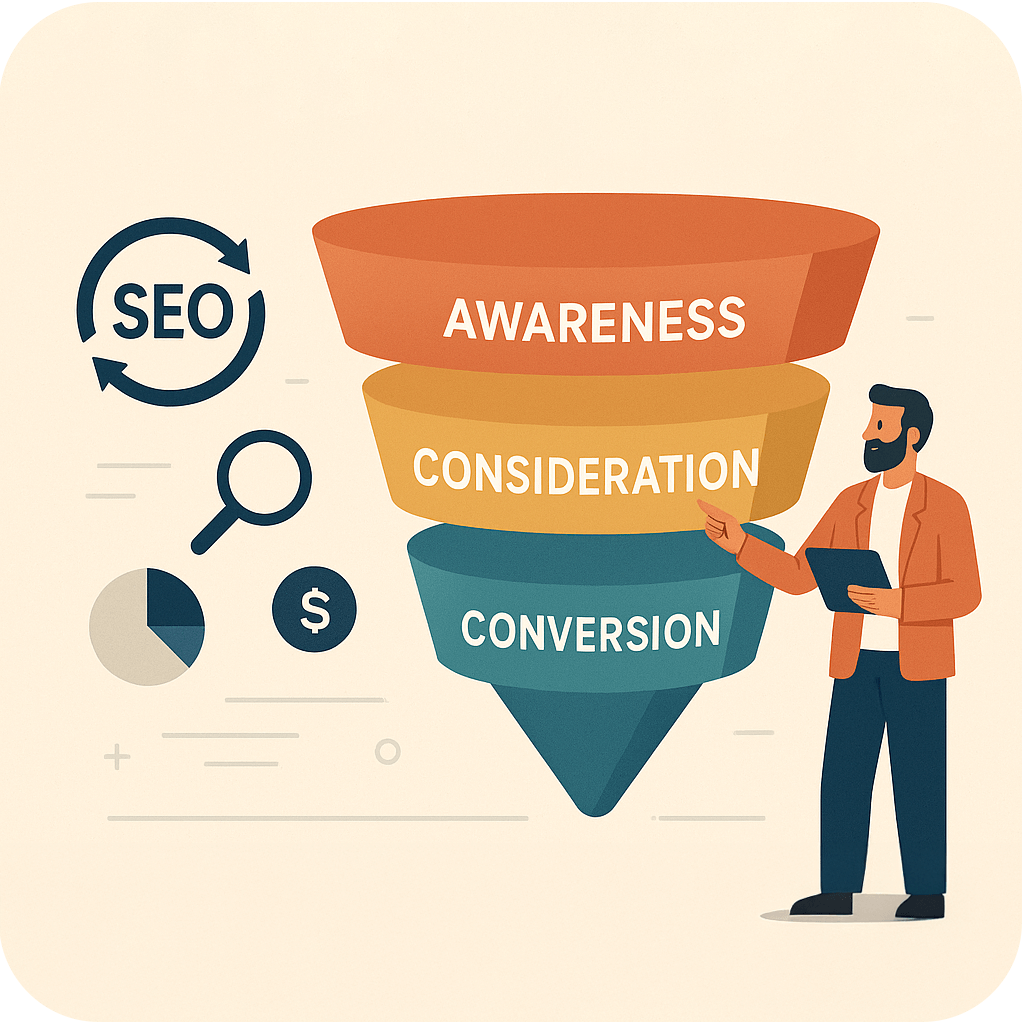
    Before we dive in, let’s break down the three main stages of the marketing funnel:

    1. Top of Funnel (TOFU) → Awareness
    2. Middle of Funnel (MOFU) → Consideration
    3. Bottom of Funnel (BOFU) → Conversion

    Each stage represents a different phase of the customer journey, and SEO can fuel each phase with targeted strategies.

    1. SEO at the Top of the Funnel: Building Awareness

    At this stage, your goal is to attract users who might not yet know your brand but are searching for solutions, answers, or inspiration.

    Keyword Focus: Broad, informational, and question-based keywords (e.g., “best travel destinations 2025” or “how to plan a family vacation”)

    Content Types: Blog posts, guides, infographics, educational videos, and SEO-optimized landing pages

    SEO Tactics:

    • Optimize for featured snippets and “People Also Ask” boxes
    • Focus on long-tail keywords
    • Create shareable, high-quality content
    • Build backlinks from reputable sources to boost domain authority

    2. SEO at the Middle of the Funnel: Driving Consideration

    Here, potential customers know they have a need — now they’re comparing options. SEO can help position your brand as a trusted expert.

    Keyword Focus: Comparison, solution-specific, or product-category keywords (e.g., “best travel agency for Europe tours” or “LS Digital case studies”)

    Content Types: Case studies, comparison pages, webinars, whitepapers, detailed service pages

    SEO Tactics:

    • Optimize internal linking to guide users to related MOFU content
    • Use schema markup (like FAQs and reviews) to enhance search result visibility
    • Improve on-page SEO with persuasive copy and clear CTAs

    3. SEO at the Bottom of the Funnel: Boosting Conversions

    At this final stage, users are ready to act — and SEO can help remove last-minute friction.

    Keyword Focus: Branded, transactional, or purchase-intent keywords (e.g., “book LS Digital consultation” or “travel package deals 2025”)

    Content Types: Optimized product/service pages, reviews, testimonials, clear CTAs, landing pages

    SEO Tactics:

    • Ensure fast page load speed and mobile optimization
    • Add clear, trust-building elements (reviews, certifications, security seals)
    • Optimize local SEO if relevant (Google My Business, local keywords)


    Why SEO Must Be Integrated Across the Funnel

    Many marketers still treat SEO as a “traffic driver” only — but its real value lies in supporting the full buyer journey. A strong SEO strategy ensures you: – Attract new visitors – Engage and educate leads – Convert prospects into loyal customers

    This holistic approach not only increases conversions but also builds long-term brand equity.

    Final Thoughts

    Integrating SEO into your full-funnel marketing strategy isn’t optional anymore — it’s essential. By aligning your SEO efforts with each funnel stage, you can capture intent-driven traffic, nurture leads effectively, and ultimately drive meaningful business growth.

    If you want help building an SEO strategy that works across all funnel stages, feel free to reach out!

    Ready to elevate your SEO game? Let’s connect and craft a full-funnel SEO strategy tailored to your brand’s goals. reach out to our team today!

    Get in Touch

  • Weekend Digital Media Round-Up: Broad Targeting To Precision Marketing: How AI And ML Are Transforming Travel Marketing, Data Vs. Findings Vs. Insights In UX, How Agentic AI and Human Collaboration Are Enhancing CX & More…

    Weekend Digital Media Round-Up: Broad Targeting To Precision Marketing: How AI And ML Are Transforming Travel Marketing, Data Vs. Findings Vs. Insights In UX, How Agentic AI and Human Collaboration Are Enhancing CX & More…

    1.Broad Targeting To Precision Marketing: How AI And ML Are Transforming Travel Marketing

    AI and ML are revolutionizing travel marketing by enabling hyper-personalization at scale. Marketers can now create tailored campaigns based on real-time data, breaking down internal silos and enhancing guest experiences. [Source: Forbes]

    2. Data Vs. Findings Vs. Insights In UX

    ​Data consists of raw observations, findings identify patterns, and insights provide actionable recommendations. UX designers must argue for statistical significance to ensure their insights are reliable and impactful for business strategy. [Source: Smashing Magazine]

    3. How Agentic AI and Human Collaboration Are Enhancing CX

    Agentic AI is revolutionizing retail by acting autonomously to enhance customer experiences through chatbots and virtual assistants. Retailers are leveraging AI for personalized shopping, automated checkout, and improved customer service, creating a competitive edge and fostering human-AI collaboration. [Source: Total Retail]

    4. Marketing to Gen Alpha: How brands can win over the next generation

    Gen Alpha, born between 2010 and 2024, is brand-aware and influential. Brands should focus on interest-based content and community-driven discovery to connect with them and their millennial parents. [Source: Marketing Dive]

    5. From SEO to Generative Engine Optimization (GEO): Why the new era of search belongs to AI and how to stay visible

    Generative Engine Optimization (GEO) is emerging as the new strategy for brand visibility in AI-driven search, replacing traditional SEO. GEO focuses on making content quotable by AI systems like ChatGPT, emphasizing relevance and credibility over keyword rankings. Brands must adapt to this shift to stay influential in the evolving digital landscape. [Source: Tech Startups]

    6. Why GenAI And Visual Search Are The Future Of Fashion Retail

    Generative AI and visual search are revolutionizing fashion retail by offering personalized shopping experiences and enhancing customer engagement. Glance’s app uses GenAI to suggest clothing based on user selfies, creating a unique and tailored shopping experience. Visual search technology is also gaining popularity for its ability to show visually similar products. [Source: Forbes]

    7. Reliably Detecting Third-Party Cookie Blocking In 2025

    AI-assisted shopping is transforming retail by enhancing and personalizing the consumer experience through tools like voice assistants, chatbots, and predictive analytics. Brands integrating AI into customer interactions are seeing significant benefits, but they must also address risks such as biased data and trust issues to succeed. [Source: Smashing Magazine]

    8. How AI-assisted shopping will shake up the retail landscape

    AI-assisted shopping is revolutionizing retail by enhancing personalization and customer experience through tools like voice assistants, visual search, and augmented reality try-ons. Brands integrating AI into their strategies can optimize pricing, predict needs, and create seamless omnichannel experiences, but must also address risks like biased data and trust issues. [Source:  The Drum]

    9. How Can You Create Winning Content In The Age Of AI And CX?

    Creating winning content in the age of AI and customer experience involves blending machine intelligence with human empathy to produce high-quality, personalized content. Leveraging AI-driven insights and advanced segmentation can help businesses understand their audiences better and build stronger relationships. It’s crucial to start with a clear strategic vision before implementing new technologies. [Source: Forbes]

    10. Revolutionizing Business Intelligence: The Role of AI in Shaping the Future of Data Engineering and Data Science

    AI is revolutionizing data engineering, data science, and business intelligence by automating data workflows, enhancing predictive modeling, and improving data quality management. These advancements are streamlining processes, reducing manual efforts, and enabling more informed decision-making. [Source: Analytics Insight]

  • From Impressions to Impact: Your 2025 guide to a high-converting Social Media Strategy

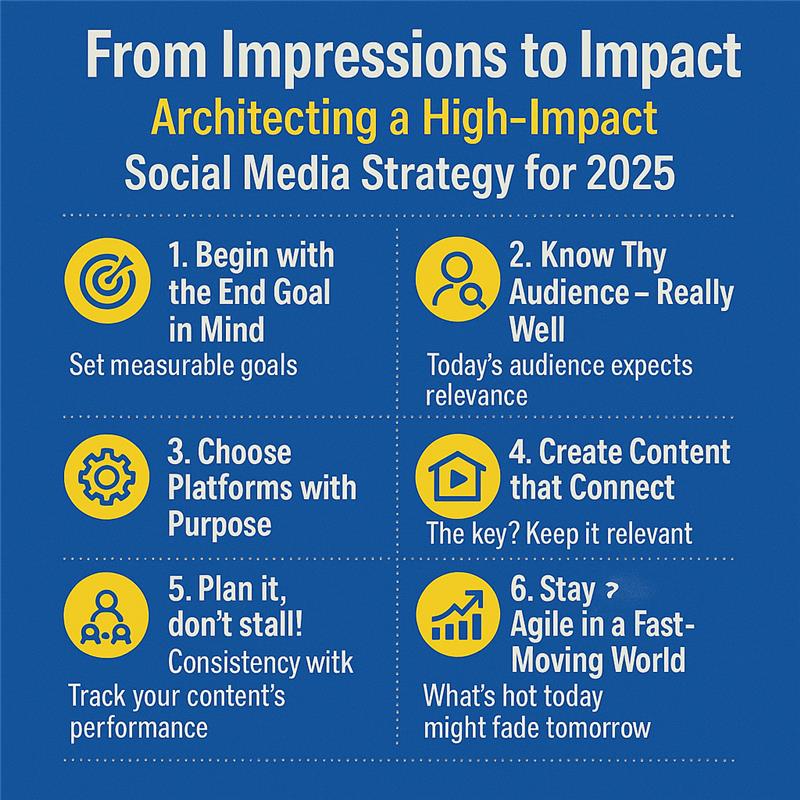
    From Impressions to Impact: Your 2025 guide to a high-converting Social Media Strategy

    In 2025, brands find themselves at a digital crossroads. While gaining social media impressions is easier than ever, converting those insignificant views into lasting value remains the real challenge. With evolving platforms, new algorithms, and shifting consumer behaviours, brands must embrace a structured, insights-driven approach to truly make their social efforts count.

    Here’s how to architect a social media strategy that doesn’t just speak – but converts!

    1. Begin with the End Goal in Mind: Set Measurable Goals

    Every effective strategy starts with clarity. Define smart goals that align with your business objectives. Whether you’re aiming to increase qualified leads, boost engagement, or drive e-commerce sales, measurable targets give your team focus and your strategy direction.

    Pro tip: Avoid vanity metrics. Instead of chasing likes, track metrics tied to action – click-through rates, conversions, and cost per acquisition.

    2. Know Thy Audience – Really Well

    Today’s audience expects relevance. Go beyond demographics to understand their interests, pain points, and behaviours. Use social listening tools, audience polls, and platform insights to uncover what your audience is truly engaging with.

    When your content feels like it was made ‘just for them’, your brand becomes more relatable – and far more clickable.

    3. Choose Platforms with Purpose

    Not all platforms are created equal. A strong strategy involves picking platforms where your audience lives and where your brand naturally fits.

    • B2B? Focus on LinkedIn.
    • Gen Z engagement? Explore TikTok and Instagram.
    • Visual storytelling? Pinterest and YouTube might be your best bet.

    Spread your efforts too thin and you risk losing traction. Be strategic with your presence.

    4. Create Content that Connects

    In 2025, content isn’t just king – it’s your voice, your handshake, and your elevator pitch. A successful strategy embraces a diverse mix of content formats: carousels, short videos, reels, memes, and even UGC (user-generated content).

    The key? Keep it relevant, authentic, and timely. Don’t be afraid to break the mould of brand consistency if the story you’re telling resonates more loudly that way.

    5. Partner Smartly with Influencers

    Influencers are the new-age storytellers. But reach alone isn’t enough. The right influencer aligns with your brand values and speaks credibly to your audience.

    Micro- and nano-influencers often drive higher engagement and conversion rates due to their loyal, niche followings. When authenticity shines, trust builds – and conversions follow.

    6. Plan it, don’t stall!

    Consistency builds recognition. A content calendar ensures you’re regularly showing up for your audience – without scrambling last minute. Use it to schedule posts, align with seasonal trends, and maintain a consistent brand voice.

    7. Measure. Optimize. Grow. Repeat.

    Track your content’s performance with precision. Monitor:

    • Engagement rates
    • Click-through rates (CTR)
    • Follower growth
    • Conversion rates
    • ROI per platform

    Then, use this data to double down on what’s working – and ditch what’s not. Real-time insights lead to real-time improvements.

    8. Stay Agile in a Fast-Moving World

    Social media trends move at lightning speed. What’s hot today might fade tomorrow. To stay relevant, brands must listen, learn, and pivot quickly.

    From AI-generated content to AR filters, being early to test and adopt emerging tools keeps your strategy future-forward.

    Conclusion: Build Connection Before Conversion

    In 2025, attention is short but loyalty runs deep – if you earn it. A high-impact social media strategy isn’t just about content delivery. It’s about building authentic relationships that lead to real-world business impact.

    By focusing on strategy, storytelling, and smart optimization, your brand can turn every impression into an opportunity – and every click into a customer.

    Make every click count. Start your high-impact 2025 social strategy today!


    Get in Touch

  • Designing for Conversion: UX-Led Web Strategy to Turn Clicks into Customers

    Designing for Conversion: UX-Led Web Strategy to Turn Clicks into Customers

    In today’s digital economy, where attention spans are short and options are endless, simply attracting visitors to your website isn’t enough. The real value lies in converting those clicks into meaningful actions – purchases, sign-ups, inquiries. That’s where a user experience (UX)-led web strategy comes into play. When thoughtfully executed, it acts as a silent guide, leading your visitor smoothly down the conversion path.

    The Journey Starts with Empathy

    Every effective UX strategy begins with a deep understanding of who your users are and what they need. It’s not just about how your site looks, but how it makes people feel when they interact with it. What are their goals? Where do they hesitate? Why do they leave without taking action?

    Using tools like heatmaps, session recordings, and feedback widgets can reveal telling insights – such as which areas users click most, what grabs their attention, and where they drop off. This data doesn’t just inform design – it fuels it. Empathy, supported by analytics, forms the foundation of conversion-centric UX.

    Designing the Path of Least Resistance

    Think of your website as a guided tour. The best tours are effortless – your audience shouldn’t need to think about where to go next. Every button, link, and interaction should be purposeful.

    Simplify navigation. Highlight primary calls-to-action. Reduce form fields. Optimize load times. These may seem like small changes, but collectively, they can lead to measurable lifts in engagement and conversion rates. A mobile-first design approach is no longer optional either – mobile responsiveness is table stakes for delivering seamless experiences across devices.

    Trust: The Unsung Hero of UX

    No matter how intuitive your site is, people won’t act if they don’t trust you. Good UX is a trust-building exercise. It’s in the details – clear return policies, customer reviews, privacy assurances, and design consistency.

    A clutter-free layout with clear messaging helps reinforce your credibility. Use testimonials or case snippets where appropriate. These subtle signals add up to create a sense of reliability and professionalism that nudges users closer to conversion.

    Relevance Drives Results

    In a sea of digital noise, personalization cuts through. The more relevant your content feels to each visitor, the more likely they are to engage. Tailoring product recommendations, headlines, or even banner images based on user data and behaviour can significantly improve the relevance and effectiveness of your site.

    In today’s digital economy, where attention spans are short and options are endless, simply attracting visitors to your website isn’t enough. The real value lies in converting those clicks into meaningful actions – purchases, sign-ups, inquiries. That’s where a user experience (UX)-led web strategy comes into play. When thoughtfully executed, it acts as a silent guide, leading your visitor smoothly down the conversion path.

    The Journey Starts with Empathy

    Every effective UX strategy begins with a deep understanding of who your users are and what they need. It’s not just about how your site looks, but how it makes people feel when they interact with it. What are their goals? Where do they hesitate? Why do they leave without taking action?

    Using tools like heatmaps, session recordings, and feedback widgets can reveal telling insights – such as which areas users click most, what grabs their attention, and where they drop off. This data doesn’t just inform design – it fuels it. Empathy, supported by analytics, forms the foundation of conversion-centric UX.

    Designing the Path of Least Resistance

    Think of your website as a guided tour. The best tours are effortless – your audience shouldn’t need to think about where to go next. Every button, link, and interaction should be purposeful.

    Simplify navigation. Highlight primary calls-to-action. Reduce form fields. Optimize load times. These may seem like small changes, but collectively, they can lead to measurable lifts in engagement and conversion rates. A mobile-first design approach is no longer optional either – mobile responsiveness is table stakes for delivering seamless experiences across devices.

    Trust: The Unsung Hero of UX

    No matter how intuitive your site is, people won’t act if they don’t trust you. Good UX is a trust-building exercise. It’s in the details – clear return policies, customer reviews, privacy assurances, and design consistency.

    A clutter-free layout with clear messaging helps reinforce your credibility. Use testimonials or case snippets where appropriate. These subtle signals add up to create a sense of reliability and professionalism that nudges users closer to conversion.

    Relevance Drives Results

    In a sea of digital noise, personalization cuts through. The more relevant your content feels to each visitor, the more likely they are to engage. Tailoring product recommendations, headlines, or even banner images based on user data and behaviour can significantly improve the relevance and effectiveness of your site.

    Want to make your website bring in more customers?

    Let’s talk about how we can help improve it.

    Get in Touch