LS Staging

Blog

  • Weekend Digital Media Round-Up How To Enhance Your Digital Marketing With AI, AI as a festive enabler: smarter interfaces, accessibility, regional-language adoption, How Top Brands Are Driving Growth With Unified Commerce  & More….

    Weekend Digital Media Round-Up How To Enhance Your Digital Marketing With AI, AI as a festive enabler: smarter interfaces, accessibility, regional-language adoption, How Top Brands Are Driving Growth With Unified Commerce & More….

    1.How To Enhance Your Digital Marketing With AI

    AI is transforming digital marketing by enabling real-time data analysis, hyper-personalized campaigns, and scalable content creation. Rather than replacing marketers, it acts as a strategic partner, allowing them to focus on creativity, strategy, and building authentic customer relationships. [Source: Forbes]

    2. AI as a festive enabler: smarter interfaces, accessibility, regional-language adoption

    AI is transforming India’s festive digital experiences by making platforms more intuitive, inclusive, and language-friendly. From smarter search and payment flows to voice assistants and regional-language support, these innovations are helping users across demographics engage more easily and meaningfully online. [Source:  ET Edge]

    3. How Top Brands Are Driving Growth With Unified Commerce

    Top brands are embracing unified commerce by integrating AI, first-party data, and cross-channel collaboration to simplify the complex modern shopper journey. Rather than chasing every new tech trend, they focus on building consistent, data-driven experiences across touchpoints—both online and offline. [Source: AdWeek]

    4. In graphic detail: How AI is going to shape influencer marketing next year

    AI is rapidly transforming influencer marketing, pushing creators to adapt to new tools and strategies. As brands increasingly rely on automation and data-driven insights, the industry is bracing for a shift in how content is created and monetized, raising questions about authenticity and consumer trust. [Source: DigiDay]

    5. Anticipatory AI: How ChatGPT Pulse is Redefining Brand Engagement and Consumer Trust

    Anticipatory AI, exemplified by ChatGPT Pulse, is revolutionizing marketing by shifting from reactive messaging to proactive, predictive engagement. It enables brands to anticipate consumer needs and deliver hyper-personalized experiences—while emphasizing the importance of trust, transparency, and ethical data use. [Source: AdTech Today]

    6. Your Brand Is Being Cited By AI. Here’s How To Measure It

    AI assistants like ChatGPT, Copilot, and Perplexity are reshaping how brand visibility is measured by surfacing content in conversational interfaces before users even click. SEO now extends beyond rankings to include tracking mentions, impressions, and citations within these generative platforms—forming a new “answer layer” above traditional search. [Source: Search Engine Journal]

    7. The Psychology of Hyper-Personalization

    AI-driven hyper-personalization can enhance consumer trust and loyalty when it aligns with psychological needs like autonomy and relatedness. However, it also raises privacy concerns, and without transparency and control, it risks feeling intrusive and damaging trust. Brands must balance personalization with ethical data use to build lasting emotional connections. [Source: Psychology Today]

    8. Building a Framework for Authentic Real-Time Brand Strategy That Works

    Real-time brand strategy demands cross-departmental alignment, thoughtful planning, and authentic engagement rather than just reacting quickly to trends. Success comes from knowing when to act, when to pause, and how to build trust through meaningful partnerships and creative risk-taking. [Source: AdWeek]

    9. AI, Compliance and Customer Trust: 3 Pillars of Modern Personalization

    Marketing leaders are reimagining personalization by focusing on transparency, compliance, and ethical data use, driven by tighter privacy laws and advanced AI. With a 30% budget increase in 2025, personalization is evolving into real-time, AI-orchestrated customer journeys, demanding integrated human-AI teams and adaptive governance models. [Source: CMS Wire]

    10. Google updates Search and Discover with collapsible ads, AI features, and more

    Google is introducing collapsible ads and AI-powered features to its Search and Discover platforms. Users can now hide sponsored results for a cleaner experience, while new tools like “What’s New” and AI-generated previews help users stay updated on trending topics and sports news. [Source: Tech Crunch]
  • Weekend Digital Media Round-Up The Future Of AI Market Research: Two Powerful Paths Are Emerging, The One-Dial Illusion: Why CX Leaders Keep Crashing on ROI, Evolving The Advertising Landscape: Measuring And Maximizing CLV & More….

    Weekend Digital Media Round-Up The Future Of AI Market Research: Two Powerful Paths Are Emerging, The One-Dial Illusion: Why CX Leaders Keep Crashing on ROI, Evolving The Advertising Landscape: Measuring And Maximizing CLV & More….

    1.The Future Of AI Market Research: Two Powerful Paths Are Emerging

    AI is transforming market research by enabling faster, scalable insights through two key approaches: AI-powered human interviews and synthetic respondents. While synthetic models offer speed and cost-efficiency, human input remains essential for emotional nuance and validation—making a hybrid strategy the most effective path forward. [Source: Forbes]

    2. The One-Dial Illusion: Why CX Leaders Keep Crashing on ROI

    CX leaders often rely too heavily on single metrics like NPS or CSAT, which can mislead strategic decisions. True ROI comes from tracking four key dimensions—growth, efficiency, risk, and trust—over time, using longitudinal data to reveal whether customer experience efforts are compounding value or eroding it. [Source:  CSM Wire]

    3. Evolving The Advertising Landscape: Measuring And Maximizing CLV

    Advertising has evolved from impression-based and click-driven models to AI-powered strategies focused on maximizing customer lifetime value (CLV). By leveraging AI, businesses can better target high-value customers, personalize engagement, and drive long-term profitability through smarter budget allocation and deeper customer relationships. [Source: Forbes]

    4. If You Want Your Brand to Be Discovered, You Have to Harness AI — Here’s How

    AI is transforming how consumers discover brands, shifting from traditional search to direct recommendations via tools like ChatGPT. To stay visible, businesses must invest in Answer Engine Optimization (AEO), secure strategic press coverage, build affiliate programs, and optimize their digital presence for AI platforms. [Source: Entrepreneur]

    5. The synthetic scroll has arrived with Meta’s Vibes and OpenAI’s Sora — marketers are watching nervously

    Meta’s launch of the Vibes feed and OpenAI’s release of the Sora app signal a shift toward AI-generated, hyper-personalized content in social media. While tech experts are intrigued, marketers and creators are expressing concern over the implications for authenticity and control. [Source: DigiDay]

    6. Technology: AI Influencer Trend: The Virtual Gold Rush Defining the New Creator Economy and Brand Blueprint

    AI influencers like Lil Miquela are reshaping the creator economy by offering brands a fully controllable, scandal-free, and scalable alternative to human celebrities. These CGI-driven personas generate millions in revenue, attract luxury partnerships, and appeal to Gen Z through aspirational storytelling and hyper-realistic visuals. [Source: Insight Trends World]

    7. Sora Marks OpenAI’s Leap Into Social Media—and Into a Reality Crisis

    Sora 2 is transforming social media by blending generative AI video creation with interactive features like “cameos,” allowing users to appear in each other’s clips. While it’s gaining popularity rapidly, surpassing TikTok and Instagram on app charts, it’s also raising concerns around copyright, deepfakes, and authenticity. [Source: Observer]

    8. How To Build SEO Strategies Around Real Customer Behavior

    Effective SEO today goes beyond keywords—it’s about understanding real customer behavior, intent, and context. By analyzing how and why people search, marketers can create content that aligns with user needs, improves engagement, and drives conversions. Tools like Google Analytics, heatmaps, and customer service data help uncover these insights and guide strategy. [Source: Search Engine Journal]

    9. Influencer Marketing Is Your CTV Strategy Secret Weapon

    Influencer marketing and Connected TV (CTV) are no longer competing strategies but complementary forces in modern video advertising. By integrating creator-generated content (CGC) with CTV, brands can build trust and scale reach through cohesive storytelling across platforms. [Source: AdWeek]

    10. How to measure and maximize visibility in AI search

    AI visibility is becoming crucial as search shifts from traditional rankings to direct answers from models like ChatGPT and Google AI Overviews. To stay competitive, brands must optimize content for mentions and citations in AI responses, focusing on quality, expertise, and technical accessibility. [Source: Search Engine Land]

  • Weekend Digital Media Round-From Transactions To Intelligence: The Future Of Retail Transformation, AI is making your website irrelevant, How AI is rewriting the rules of search and shopping – by the numbers & More…

    Weekend Digital Media Round-From Transactions To Intelligence: The Future Of Retail Transformation, AI is making your website irrelevant, How AI is rewriting the rules of search and shopping – by the numbers & More…

    1.From Transactions To Intelligence: The Future Of Retail Transformation

    Retail is evolving from transactional to intelligent, driven by AI, generative technologies, and multi-agent systems that personalize customer experiences and optimize operations. Success lies in strategic implementation—breaking data silos, piloting wisely, reskilling teams, and building trust through governance—to create human-centered, tech-enabled ecosystems. [Source: Forbes]

    2. AI is making your website irrelevant

    AI is fundamentally changing how users discover and evaluate brands—often before they even visit a website. With tools like Google’s AI Overviews and GPT-style models sourcing answers from forums, videos, and reviews, traditional web traffic is declining, making it crucial for businesses to optimize content for both humans and machines. [Source: Fast Company]

    3. How AI is rewriting the rules of search and shopping – by the numbers

    Generative AI is transforming how people shop online, with 68% of global shoppers using tools like ChatGPT instead of traditional search engines. While marketers recognize the shift, many are struggling to adapt due to fragmented tech stacks, unclear measurement strategies, and slow adoption of AI-focused optimization techniques. [Source: DigiDay]

    4. Instagram Introduces Reels-First Trial On Mobile App For Indian Users

    Instagram is piloting a Reels-first layout for its mobile app in India, where users land directly on the Reels tab upon opening the app. This test aims to boost engagement by simplifying navigation and emphasizing short-form video, especially given India’s vibrant Reels community. [Source: Mashable]

    5. How Quick Commerce is Changing Travel Marketing. Plus: Skift Global Forum East Returns

    Air India has partnered with Zomato to integrate its Maharaja Club loyalty program, allowing users to earn points on food deliveries. This move reflects a broader trend where Indian travel brands are collaborating with quick commerce platforms to tap into a convenience-driven customer base, following similar efforts like IndiGo’s tie-up with Swiggy. [Source: Skift]

    6. Why Your Brand Should Be Top Priority In The AI-Driven Advertising Era

    Generative and agentic AI are transforming advertising, with brands like BMW, Cadbury, and Coca-Cola using them to create personalized, large-scale campaigns. While AI boosts creativity and efficiency, the article emphasizes that authenticity, transparency, and strategic human input remain essential for building consumer trust and brand loyalty. [Source: Forbes]

    7. Why experiential is central to winning consumer trust in the age of AI

    In an age where AI can fabricate nearly everything, experiential marketing stands out as a powerful tool to build genuine consumer trust. Real-life brand experiences—like live events and immersive activations—create emotional connections that digital content alone can’t replicate, making them essential in today’s authenticity-starved landscape. [Source: The Drum]

    8. How OpenAI and Stripe’s latest move could blow up online shopping as we know it

    OpenAI and Stripe are revolutionizing e-commerce by integrating instant shopping directly into AI chat experiences, allowing users to go from idea to purchase in seconds. This move challenges traditional online shopping flows and even tech giants like Google. [Source: Fortune]

    9. Dinosaurs, Asteroids and AI: Which Kind of CMO Are You?

    AI is reshaping marketing leadership, with only 5% of enterprise AI pilots showing measurable success, pushing CMOs to evolve or risk obsolescence. The article emphasizes that true transformation requires fluency, strategic orchestration, and new metrics—not just tools or enthusiasm. [Source: CMS Wire]

    10. How AI Elevates the CMO’s Role in the Golden Era of Marketing 

    AI is transforming the role of the Chief Marketing Officer (CMO) from brand steward to strategic growth architect. By integrating AI into marketing workflows, CMOs can drive personalized customer engagement, optimize performance, and lead enterprise-wide innovation while balancing human creativity and machine intelligence. [Source: AdWeek]

  • Why Digital Transformation Strategy Should Align With Your Business Goals

    Why Digital Transformation Strategy Should Align With Your Business Goals

    In today’s business landscape, digital transformation isn’t a luxury – it’s a boardroom agenda. But here’s the catch: simply adopting new tools doesn’t guarantee success. Too often, companies chase shiny technologies without asking the fundamental question – how does this help our business grow?
    The real power of digital transformation lies in its alignment with business goals – growth, efficiency, customer delight, and resilience. When transformation is tied directly to strategy, technology stops being a cost center and starts becoming a growth engine.

    Alignment Matters, and here’s why –

    Transformation without alignment often leads to scattered systems, rising costs, and underused tech investments. On the other hand, when digital initiatives are mapped to business objectives, companies unlock:

    • Efficiency gains through automation and smarter workflows
    • Deeper customer relationships powered by data insights
    • Faster innovation and adaptability in changing markets

    Simply put, alignment ensures every digital rupee spent fuels the business strategy – not just the IT budget.


    Step 1: Start with Business Goals

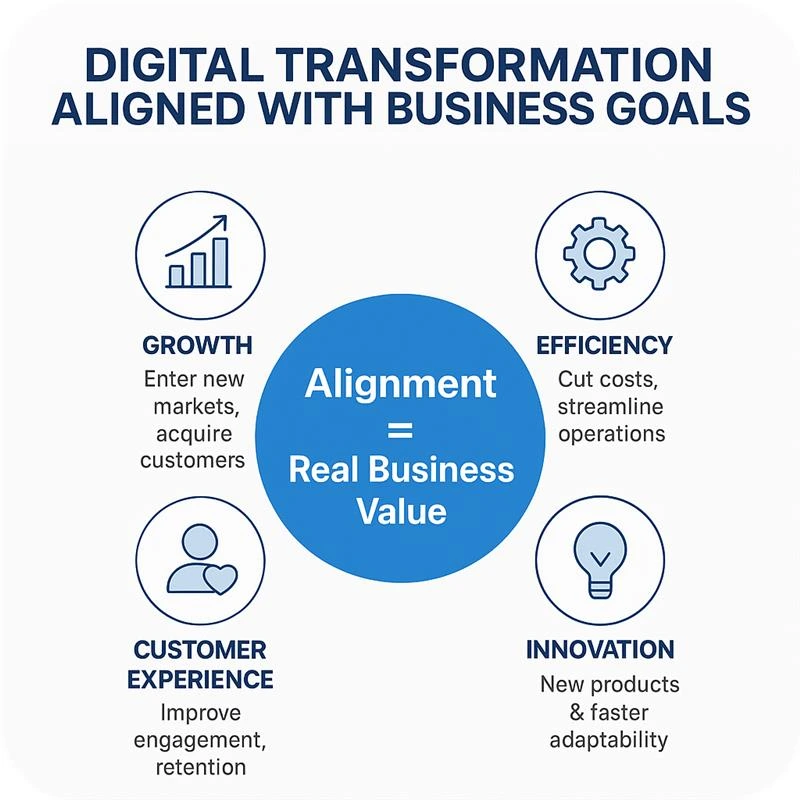
    Before choosing platforms or partners, leaders need clarity on what matters most. Goals usually fall into four buckets:

    • Growth: Entering new markets, acquiring more customers
    • Efficiency: Cutting costs, streamlining operations
    • Customer Experience: Improving engagement and retention
    • Innovation: Developing new products or leveraging data

    Only with this clarity can digital initiatives be mapped to support the right outcomes.


    Step 2: Build Strategy Around Goals

    A well-structured digital transformation roadmap connects ambition to action:

    • Goal-to-initiative mapping – Every project must tie back to business objectives
    • Measurable outcomes – Use KPIs that track progress clearly
    • Phased rollouts – Minimize disruption and encourage adoption
    • Leadership alignment – Ensure buy-in from across the C-suite


    Step 3: Bridge IT and Business

    Transformation fails when IT works in isolation. To succeed, technology and business must speak the same language. This means:

    • Cross-functional governance teams
    • Shared accountability for outcomes, not just delivery
    • Metrics that resonate with both technical and business leaders

    When IT becomes a strategic partner instead of a support function, transformation becomes a growth lever.


    Step 4: Keep Alignment Ongoing

    Business priorities shift. Markets evolve. Technology changes. Which means alignment isn’t a one-time exercise – it’s a continuous discipline. Leaders should:

    • Review goals regularly and adapt roadmaps
    • Keep digital architectures agile and scalable
    • Invest in people through upskilling and adoption training
    • Foster open communication between business and tech leaders


    FAQs at a Glance:


    Typically 6–18 months to see alignment pay off.

    OKRs (Objectives and Key Results), Balanced Scorecards, Digital Maturity Models.

    Deploy ROI and strategic impact scoring.

    A culture of agility and collaboration is non-negotiable.

    Regular reviews, flexible tech, and transparent communication keep alignment steady even in volatile times.


    In Conclusion

    Digital transformation isn’t about adopting the latest tool – it’s about making technology work for your business goals. When strategy leads and tech follows, transformation creates measurable impact: faster growth, smarter efficiency, and stronger customer connections.

    It’s time to stop transforming for transformation’s sake. Instead, align first – because alignment is where real business value begins.

    Ready to align your digital transformation strategy with real business impact?


    Let’s Connect

  • Weekend Digital Media Round-It’s not AI or ads – it’s AI AND ads, Redefining Brand Engagement In The Age Of AI, The Ultimate Guide to Agentic Commerce & More…

    Weekend Digital Media Round-It’s not AI or ads – it’s AI AND ads, Redefining Brand Engagement In The Age Of AI, The Ultimate Guide to Agentic Commerce & More…

    1.It’s not AI or ads – it’s AI AND ads

    AI isn’t replacing advertising—it’s transforming it. While some ad formats and roles may evolve, the core function of advertising remains vital, especially in a world where AI agents influence consumer decisions. Ultimately, AI will eliminate inefficiencies, not the need for advertising itself. [Source: The Drum]

    2. Redefining Brand Engagement In The Age Of AI

    Generative AI is transforming how consumers discover and engage with brands, shifting from traditional search engines to AI-powered tools like ChatGPT. As trust in AI grows, brands must adapt by creating emotionally resonant, AI-friendly experiences and forming strategic partnerships to stay relevant in an increasingly agentic AI-driven marketplace. [Source: Forbes]

    3. The Ultimate Guide to Agentic Commerce

    AI agents are transforming ecommerce by autonomously handling product discovery, comparison, and purchasing, marking a shift where the buyer is no longer human but code. While businesses are seeing productivity gains, consumer trust remains low, making governance, secure payments, and structured data critical for adoption. [Source: Tech Republic]

    4. CX Leaders: Integration, Not Budgets, Define Your Next Advantage

    Marketing and CX teams are increasingly investing in AI and insights technology, but only 38% have successfully integrated data into decision-making processes. The real challenge isn’t budget—it’s fragmentation and lack of systematization, which limits the impact of these tools. Organizations that prioritize integration and leadership alignment are seeing faster cycle times, stronger ROI, and higher internal satisfaction. [Source: CMS Wire]

    5. How marketers can make connections Across the AI Generation Gap

    AI is deeply integrated into everyday tools, but awareness and engagement vary by generation—Gen Z and millennials are more intentional users, while older generations often use it passively. Despite widespread use, trust remains a challenge, with most users verifying AI outputs and expressing concerns about privacy or philosophical alignment. [Source: AdWeek]

    6. What CIOs need to know about responsible AI and the future of work

    AI expert Simon Greenman emphasizes that CIOs must proactively adopt responsible AI practices to build trust, ensure compliance, and prepare for a future of human–AI collaboration. He highlights the transformative role of generative AI across industries and urges leaders to focus on ethical implementation, digital trust, and strategic integration into daily workflows. [Source: CIO]

    7. AI in UX Design: How Artificial Intelligence is Shaping User Experiences

    Artificial Intelligence is revolutionizing UX design by enabling real-time personalization, automating repetitive tasks, and enhancing accessibility. It empowers designers with smarter user research, rapid prototyping, and data-driven insights—amplifying creativity rather than replacing it. [Source: UX Magazine]

    8. The origins of SEO and what they mean for GEO and AIO

    SEO’s origin story reveals how debates over naming—like AIO (Artificial Intelligence Optimization) and GEO (Generative Engine Optimization)—mirror past linguistic and conceptual challenges. Despite evolving technologies, the core idea of “optimization” remains central, though consensus on new terms is elusive due to grammar issues and differing interpretations. [Source: Search Engine Land]

    9. Google Answers SEO Question About Keyword Cannibalization

    Google’s John Mueller clarified that multiple pages ranking for the same keyword isn’t inherently problematic and shouldn’t be labeled as “keyword cannibalization.” Instead of chasing this vague concept, SEOs should focus on improving content quality, internal linking, and user relevance to address actual ranking issues. [Source: Search Engine Journal]

    10. Want Real AI Impact in Digital Experience? Fix Your Data Silos

    AI in digital experience platforms is being held back not by technology, but by fragmented and siloed customer data. True innovation lies in building unified data strategies and governance frameworks that enable seamless data flow—allowing AI to deliver personalized, dynamic experiences across platforms. [Source: CMS Wire]

  • Weekend Digital Media Round-How brands and retailers are preparing for GEO, ‘the future of SEO’, Voice and Immersive Interfaces: Preparing Your Product for the Future of UX, How To Build A UGC Marketing Machine That Actually Drives Sales & More…

    Weekend Digital Media Round-How brands and retailers are preparing for GEO, ‘the future of SEO’, Voice and Immersive Interfaces: Preparing Your Product for the Future of UX, How To Build A UGC Marketing Machine That Actually Drives Sales & More…

    1.How brands and retailers are preparing for GEO, ‘the future of SEO’

    Generative Engine Optimization (GEO) is gaining traction as brands adapt their content strategies for AI-driven search tools like ChatGPT and Google Gemini. By focusing on structured data, conversational formats, and AI-friendly content, companies aim to stay visible in the evolving search landscape. [Source: Modern Retail]

    2. Voice and Immersive Interfaces: Preparing Your Product for the Future of UX

    Voice and immersive interfaces are rapidly becoming essential in UX, excelling in multitasking, accessibility, and spatial tasks where traditional interfaces fall short. The article urges designers to adopt a voice-first mindset and rethink user interactions to be more natural, intuitive, and inclusive. [Source: UX Magazine]

    3. How To Build A UGC Marketing Machine That Actually Drives Sales

    User-generated content (UGC) is proving to be a powerful alternative to traditional ads, driving higher trust and conversion rates by showcasing real customer experiences. Brands that treat UGC as a strategic system—using data-driven creator selection, tagging, performance tracking, and iteration—are seeing significant improvements in ROI and customer acquisition. [Source: Forbes]

    4. The Acceleration of Voice AI: Where Customer Service Goes From Here

    Voice AI is rapidly transforming customer service, evolving from basic IVR systems to sophisticated, human-like conversational tools powered by generative AI and large language models. With real-time agent assist, hyper-personalization, and automated post-call assessments, it’s boosting efficiency, customer satisfaction, and reducing operational costs—setting the stage for broader adoption across industries. [Source: CMS Wire]

    5. How To Measure Brand Marketing Efforts (And Prove Their ROI)

    Brand marketing plays a crucial role in driving digital visibility and business outcomes, especially in an AI-driven search landscape. The article outlines how to measure brand impact across the funnel—awareness, consideration, conversion, and loyalty—using both qualitative and quantitative metrics to prove ROI and align efforts with business goals. [Source: Search Engine Journal]

    6. Your team’s marketing skills are already obsolete

    Marketing teams must evolve beyond traditional skills to thrive in today’s fast-paced environment. Success now hinges on integrating computational thinking, signal detection, and cultural fluency into adaptive systems that continuously optimize campaigns. The shift demands marketers who can fluidly navigate strategy, data, and audience ecosystems. [Source: Fast Company]

    7. Quantum computing is coming for your data. Here’s how to stay secure

    Quantum computing poses a serious threat to current encryption methods like RSA and ECC, potentially exposing sensitive data through future decryption. To stay secure, enterprises must urgently adopt post-quantum cryptography, monitor quantum key distribution advancements, and create long-term strategies for quantum readiness. [Source: CIO]

    8. From reactive to proactive: How AI protects and amplifies executive brands

    AI is transforming executive online reputation management (ORM) from reactive damage control to proactive brand amplification. By leveraging tools for content creation, SEO, and real-time monitoring, leaders can shape their digital presence strategically and safeguard their credibility before crises emerge. [Source: Search Engine Land]

    9. The Nervous System for AI: Why Every Product Manager and Designer Needs an Agent Runtime Environment

    AI agent projects often fail due to fragmented systems and lack of proper infrastructure. The key to success lies in implementing an AI agent runtime environment a foundational layer that enables memory, orchestration, compliance, and scalability, turning isolated pilots into resilient, ROI-driven solutions. [Source: UX Magazine]

    10. Future-proofing the enterprise: Cultivating 3 essential leadership skills for the agentic AI era

    To thrive in the agentic AI era, leaders must develop three critical skills: becoming Agent Architects who design and oversee AI workflows, Innovation Orchestrators who amplify human creativity alongside AI, and Ethical Stewards who ensure responsible and transparent AI deployment. These capabilities are essential for future-proofing enterprises and maintaining competitive advantage in a rapidly evolving landscape. [Source: CIO]

  • Weekend Digital Media Round-Up The Agentic Web: How AI Agents Are Shaping the Web’s Future, YouTube makes its biggest pitch yet to advertisers: India’s ‘new TV’, How AI is impacting the SEO strategist role & More…

    Weekend Digital Media Round-Up The Agentic Web: How AI Agents Are Shaping the Web’s Future, YouTube makes its biggest pitch yet to advertisers: India’s ‘new TV’, How AI is impacting the SEO strategist role & More…

    1.The Agentic Web: How AI Agents Are Shaping the Web’s Future

    AI agents are rapidly transforming the web into what experts call the “Agentic Web,” where autonomous systems interact with websites to achieve user goals. Spearheaded by innovators like Tim Berners-Lee and supported by W3C initiatives, this shift builds on protocols like MCP and projects such as NLWeb and WebMCP, though much of the infrastructure is still in early development. [Source: The News Stack]

    2. YouTube makes its biggest pitch yet to advertisers: India’s ‘new TV’

    YouTube is positioning itself as India’s “new TV” by unveiling AI-driven tools, urban-rural audience targeting, and connected TV innovations to attract advertisers. With growing rural internet penetration and high ROI compared to traditional TV and OTT, brands are increasingly shifting their media spends to YouTube for better engagement and efficiency. [Source: Financial Express]

    3. How AI is impacting the SEO strategist role

    AI Overviews have reshaped the SEO landscape, pushing strategists to rethink their roles and adapt to new metrics like impressions over clicks. While some companies are pulling back from SEO, experts see opportunity in leveraging AI to guide strategy and enhance visibility in evolving search environments. [Source: ItBrew]

    4. How Smart Brands Orchestrate Authentic Experiences That Convert

    Retailers are shifting from superficial personalization to authentic, data-driven experiences by leveraging AI and continuous experimentation. This “virtuous cycle” of personalization and testing helps brands build trust, deepen engagement, and foster long-term customer loyalty. [Source: My Total Retail]

    5. Redefining Progress: What CX Leaders Can Learn From Analog Reinvention

    Innovation in customer experience (CX) isn’t just about speed or novelty — it’s about creating lasting, meaningful interactions. Drawing inspiration from analog technologies like LPs, landlines, and linear TV, the article emphasizes designing CX with depth, reliability, and shared engagement to build trust and loyalty. [Source: CMS Wire]

    6. Why the Future of Influence Sounds Like Audio

    Influencer marketing is evolving, with audio emerging as a powerful medium for deeper, more authentic brand connections. Podcasts and platforms like SoundCloud allow creators to build community and trust, offering brands a chance to engage audiences beyond social media through immersive storytelling and cultural relevance. [Source: AdWeek]

    7. How to produce a better PPC QBR for your stakeholders

    Effective PPC QBRs should prioritize clarity, audience alignment, and actionable insights to drive strategic growth. By focusing on business goals and forward motion, agencies can transform routine reviews into impactful planning sessions. [Source: Search Engine Land]

    8. Why AI Adoption is Critical for Digital Transformation

    AI is now essential for digital transformation, helping businesses automate tasks, improve decision-making, and personalize customer experiences. Companies that embrace AI gain a competitive edge, boost efficiency, and unlock innovation for long-term growth. [Source: Analytics Insights]

    9. The rise of the agentic economy: How autonomous AI is reshaping the future of work

    Autonomous AI agents are transforming the workplace by evolving from simple tools to proactive teammates capable of executing complex tasks independently. This shift is redefining job roles, boosting productivity, and creating new business models, while emphasizing the need for human-centric skills and ethical oversight. [Source: CIO]

    10. The State Of SEO 2026: How To Survive

    SEO professionals are adapting to AI disruption by choosing between automation, human authority, or hybrid strategies, with original content still driving the strongest results. Despite concerns about AI reducing website clicks, investment in E-E-A-T and AI training is helping teams maintain strong performance and secure budgets for 2026. [Source: Search Engine Journal]

  • Weekend Digital Media Round-Up Approaching Digital Transformation With a Marketing Mindset, The dawn of the “Godlike” enterprise: How AI is redefining business strategy, Advertising in the Age of Emotion & More…

    Weekend Digital Media Round-Up Approaching Digital Transformation With a Marketing Mindset, The dawn of the “Godlike” enterprise: How AI is redefining business strategy, Advertising in the Age of Emotion & More…

    1.Approaching Digital Transformation With a Marketing Mindset

    Digital transformation shouldn’t be confined to IT—marketers play a vital role in shaping immersive, customer-centric digital experiences. By adopting a marketing mindset, businesses can enhance brand awareness, foster loyalty, and create engaging virtual touchpoints that mirror in-person interactions. [Source: MarketingProfs]

    2. The dawn of the “Godlike” enterprise: How AI is redefining business strategy

    Deepak Bhosale of Asian Paints envisions businesses evolving into “Godlike Enterprises” powered by AI—autonomous, predictive, and deeply personalized. He emphasizes modular AI agents managing tasks like marketing, while still valuing human empathy and creativity as irreplaceable. [Source: ET Brand Equity]

    3. Advertising in the Age of Emotion

    Digital advertising is evolving from keyword-based targeting to emotion-driven strategies, where understanding how content makes people feel is key. Advances in AI now allow advertisers to align brand messages with the emotional states induced by content, making placements more impactful and resonant. [Source: AdWeek]

    4. How legacy CPG brands can crack the social-first marketing code

    Legacy CPG brands are rapidly shifting to social-first marketing strategies to better connect with Gen Z, driven by the decline of traditional TV and the rise of platforms like TikTok. Companies like Unilever and PepsiCo are investing heavily in influencer partnerships, AI-powered content creation, and acquisitions of socially native brands to stay culturally relevant and competitive. [Source: Marketing Dive]

    5. Maturing AI, business impact, and agents galore: How the CAIO role has evolved over the past year

    Chief AI Officers (CAIOs) are now focusing less on just developing AI tech and more on driving real business impact. Over the past year, their roles have evolved to include managing mature AI systems and exploring the potential of AI agents in enterprise settings. [Source: Fortune]

    6. AI Agents Are The New Personal Shoppers In Online Fashion

    AI-powered fashion agents like Gensmo are transforming online shopping by offering deeply personalized styling experiences, simulating try-ons, and tailoring suggestions based on lifestyle and preferences. This shift is helping retailers reduce return rates and boost conversions, while also redefining the relationship between consumers and fashion platforms. [Source: Forbes]

    7. Rethinking the IT organization for the agentic AI era

    Agentic AI is prompting CIOs to rethink IT structures, emphasizing human-AI collaboration, agile team evolution, and embedded governance. As AI agents reshape workflows and responsibilities, IT must shift from infrastructure management to orchestrating intelligence across the enterprise. [Source: CIO]

    8. Marketing: An Art or a Science?

    Marketing is neither purely art nor science—it’s a social science that blends creativity with data to shape human behavior and build lasting brand relationships. The most effective strategies center on customer needs, delivering value, trust, and long-term growth through meaningful engagement. [Source: Nairametrics]

    9. The CMO Survey: Marketing leaders rise to direct digital transformation for their firms

    Marketing leaders are increasingly being tasked with spearheading digital transformation, with 73% leading such efforts in their firms. As their visibility grows, so does the pressure from CEOs and CFOs to prove marketing’s long-term value, especially as digital marketing now takes up 58% of budgets. [Source: Forbes India]

    10. The CMO & SEO: Staying Ahead Of The Multi-AI Search Platform Shift

    AI-driven search is rapidly transforming the digital landscape, with platforms like ChatGPT, Claude, and Perplexity reshaping how users find and interact with content. CMOs must now optimize across multiple AI engines, focusing on structured data, brand authority, and cross-team integration to stay visible and influential in this evolving multi-AI search world. [Source: Search Engine Journal]

  • Weekend Digital Media Round-Up The $1 Trillion E-Commerce Gap: Why Brands Are Losing Loyal Customers In The Last Mile, How enterprise AI is quietly rewriting brand-building in India, From Mobile To Living Room: How CTV Is Reshaping India’s Advertising Landscape & More…

    Weekend Digital Media Round-Up The $1 Trillion E-Commerce Gap: Why Brands Are Losing Loyal Customers In The Last Mile, How enterprise AI is quietly rewriting brand-building in India, From Mobile To Living Room: How CTV Is Reshaping India’s Advertising Landscape & More…

    1.The $1 Trillion E-Commerce Gap: Why Brands Are Losing Loyal Customers In The Last Mile

    Brands are losing over $1 trillion annually due to poor post-purchase experiences, especially in the last mile of delivery. While front-end e-commerce is optimized, gaps in shipping, communication, and returns are eroding customer loyalty and retention. Leading brands now treat logistics as a core part of customer experience, using branded tracking, proactive support, and seamless returns to build trust and drive repeat business. [Source: Forbes]

    2. How enterprise AI is quietly rewriting brand-building in India

    Enterprise AI is transforming brand-building in India by integrating generative AI into backend systems, enabling real-time personalization, predictive modeling, and dynamic campaign optimization. This shift is redefining marketing from a one-way broadcast to a continuous, data-driven loop, with brands investing in intelligent infrastructure to drive long-term value and measurable ROI. [Source: PitchoNet]

    3. From Mobile To Living Room: How CTV Is Reshaping India’s Advertising Landscape

    Connected TV (CTV) is rapidly transforming India’s advertising landscape, shifting focus from mobile to smart TVs. At IAMAI’s CLICK 2025, industry leaders highlighted how CTV blends digital precision with the emotional impact of television, offering deeper engagement, measurable ROI, and innovative formats like shoppable ads. [Source: Marketing Mind]

    4. Why do marketers ditch the very assets that make their brands famous?

    Marketers are increasingly abandoning iconic brand assets like mascots and logos in favor of minimalist rebrands, often at the cost of brand recognition and loyalty. The article highlights Cracker Barrel’s failed attempt to modernize by removing its long-standing mascot, sparking backlash—even from public figures. [Source: The Drum]

    5. How AI and automation are changing our driving experience

    AI and automation are revolutionizing driving by enhancing vehicle safety, streamlining accident response, and transforming claims and repair processes. As cars become more complex and connected, the industry is investing heavily in technology to ensure faster recovery, improved transparency, and safer journeys. [Source: World Economic Forum]

    6. Voice of the Customer Needs a Reset: Enter AI

    Traditional Voice of Customer (VoC) programs are failing due to survey fatigue, delayed feedback, and lack of emotional context. AI offers a transformative solution by enabling real-time sentiment analysis, predictive insights, and personalized feedback, turning VoC into a proactive and strategic tool. Organizations that adopt AI early gain a competitive edge by anticipating customer needs and enhancing experience continuously. [Source: CMS Wire]

    7. 100 Most Used AI Apps in 2025 : What’s Trending and What’s Not

    AI apps in 2025 are transforming daily life, with top trends including emotional companionship platforms, creative coding tools, and productivity enhancers. Big tech and Chinese innovators are driving global influence, while the ecosystem stabilizes around established players like ChatGPT and Midjourney. [Source: Geeky Gadgets]

    8. Rethink Reach to Unify Your Linear and Streaming Advertising Strategies

    Marketers are shifting from measuring raw impressions to evaluating reach as a performance metric that drives engagement and revenue. By unifying data across linear TV and streaming, advertisers can avoid duplication, uncover missed audiences, and optimize campaigns—potentially unlocking \$141 billion in lost revenue annually. [Source: Adweek]

    9. A Week In The Life Of An AI-Augmented Designer

    UX designer Kate experiments with integrating AI into a week-long design sprint, using tools like ChatGPT and Figma Make to accelerate tasks from research synthesis to prototyping. While AI boosts speed and creativity, Kate learns that critical thinking, empathy, and human judgment remain essential to meaningful design. [Source: Smashing Magazine]

    1o. From Efficiency To Emotion: How Brands Are Using AI To Scale Creativity

    AI is transforming digital advertising by enabling brands to create personalized, scalable content across formats and languages while maintaining emotional resonance. Industry leaders at CLICK 2025 emphasized that while AI boosts efficiency and experimentation, human judgment remains essential for authenticity, relevance, and storytelling impact. [Source: Marketing Mind]

  • The Power of Media Planning & Buying

    The Power of Media Planning & Buying

    The Power of Media Planning & Buying

    When it comes to advertising your product or service, spending money is easy. But making every penny count? That takes strategy. Now that’s where media planning and media buying come together – two parts of one engine designed to move your campaign from a good idea to a great one and eventually a profitable result.

    Together, they decide who to target, where to show up, and how much to spend – ensuring that every media decision is tied to real returns. Let’s break it down.


    1. Media Planning: The Strategy Blueprint

    Think of media planning as laying the foundation. It answers questions like:

    • Who are we trying to reach?
    • Where do they spend their time?
    • What’s the ideal budget split across channels/platforms?
    • When should we go live?

    Good media planning relies heavily on audience insights – what they watch, scroll through, or listen to. It also factors in platform trends, timing, and budget allocation. At its heart, planning ensures that you don’t just show up – you show up where it matters.


    2. Media Buying: The Execution Engine

    Once the plan is in place, media buying brings it to life. This is where your brand actually secures space – whether on TV, radio, social media, search engines, or outdoor hoardings.

    Buyers negotiate, optimise, and monitor performance. They secure better rates, ensure your ad appears in premium slots, and adjust tactics in real-time – especially on digital platforms. In short, they make sure you get maximum exposure for minimum waste.


    3. Why the Magic happens when they sync!

    Media planning and buying work best when they work together. One without the other is like having a GPS without a car – or a car with no direction.

    Together, they ensure:

    • Precision targeting: Reach the right audience at the right moment.
    • Smarter spending: Secure optimal placements without blowing the budget.
    • Agility: Adjust campaigns mid-flight based on real time live data.


    4. Tracking what Matters

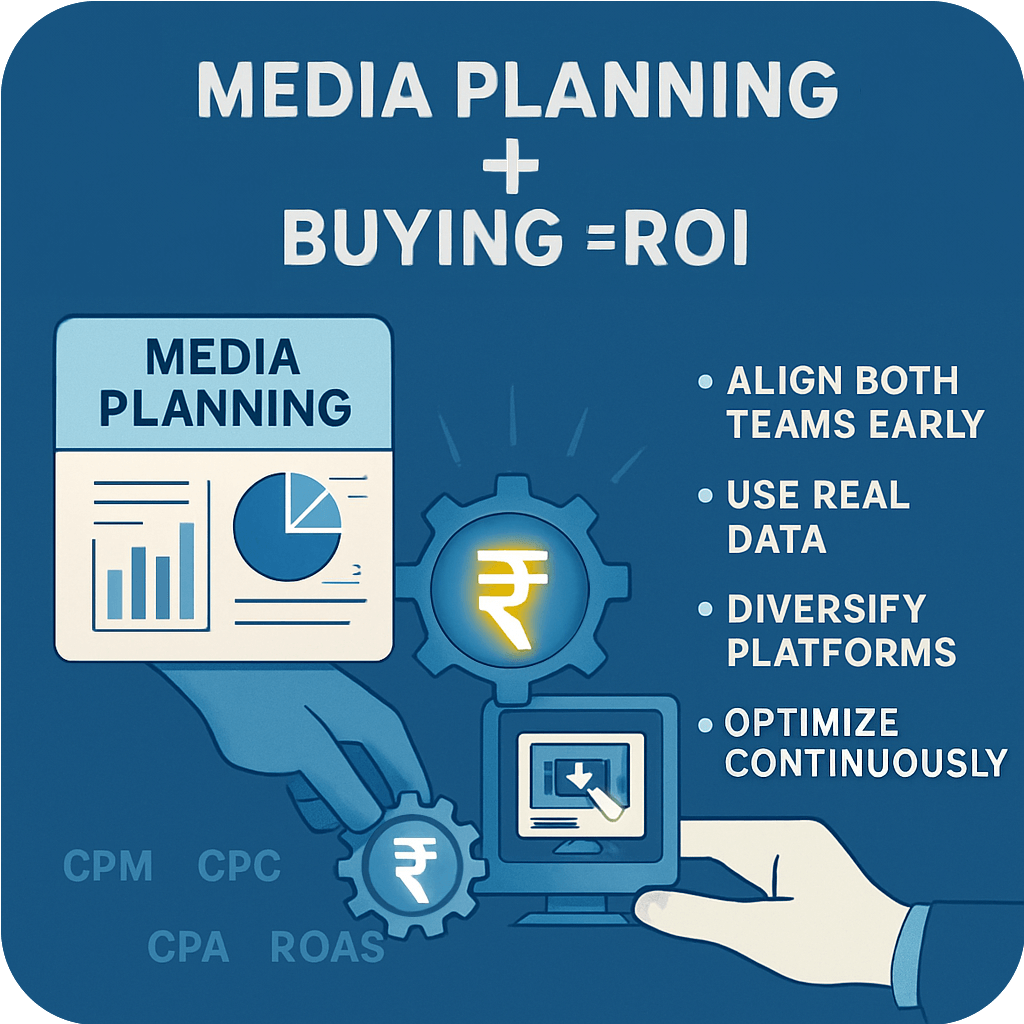
    ROI doesn’t come from guessing—it comes from measuring. Key performance metrics include:

    • CPM (Cost per 1,000 impressions): Evaluate reach cost across platforms
    • CPC (Cost per click): Useful for digital campaigns
    • CPA (Cost per acquisition): See what it takes to earn a customer
    • ROAS (Return on ad spend): The ultimate number – how much you earned per rupee spent

    These numbers guide future planning and refine media buying decisions with every campaign.


    5. Best Practices to Max Out Your ROI

    Here’s how to ensure your media planning and buying work in sync:

    ✔ Get both teams aligned from the beginning

    ✔ Use real audience data, not assumptions

    ✔ Diversify your budget across formats and platforms

    ✔ Stay flexible – optimise continuously

    ✔ Debrief after every campaign to build smarter strategies


    Final Thoughts

    Media planning tells you where to go. Media buying gets you there. When both are done right, your campaign becomes more than just ad spend – it becomes an investment with clear returns.

    The takeaway? Don’t just run ads. Build strategies. Align teams. Track everything. And most importantly – plan to profit.

    So, are you ready to turn your ad spends into real results? Connect with us, let’s make your next campaign your most profitable yet.


    Let’s Connect