LS Staging

Blog

  • What Is International SEO & Why Does It Matter for Global Brands

    What Is International SEO & Why Does It Matter for Global Brands

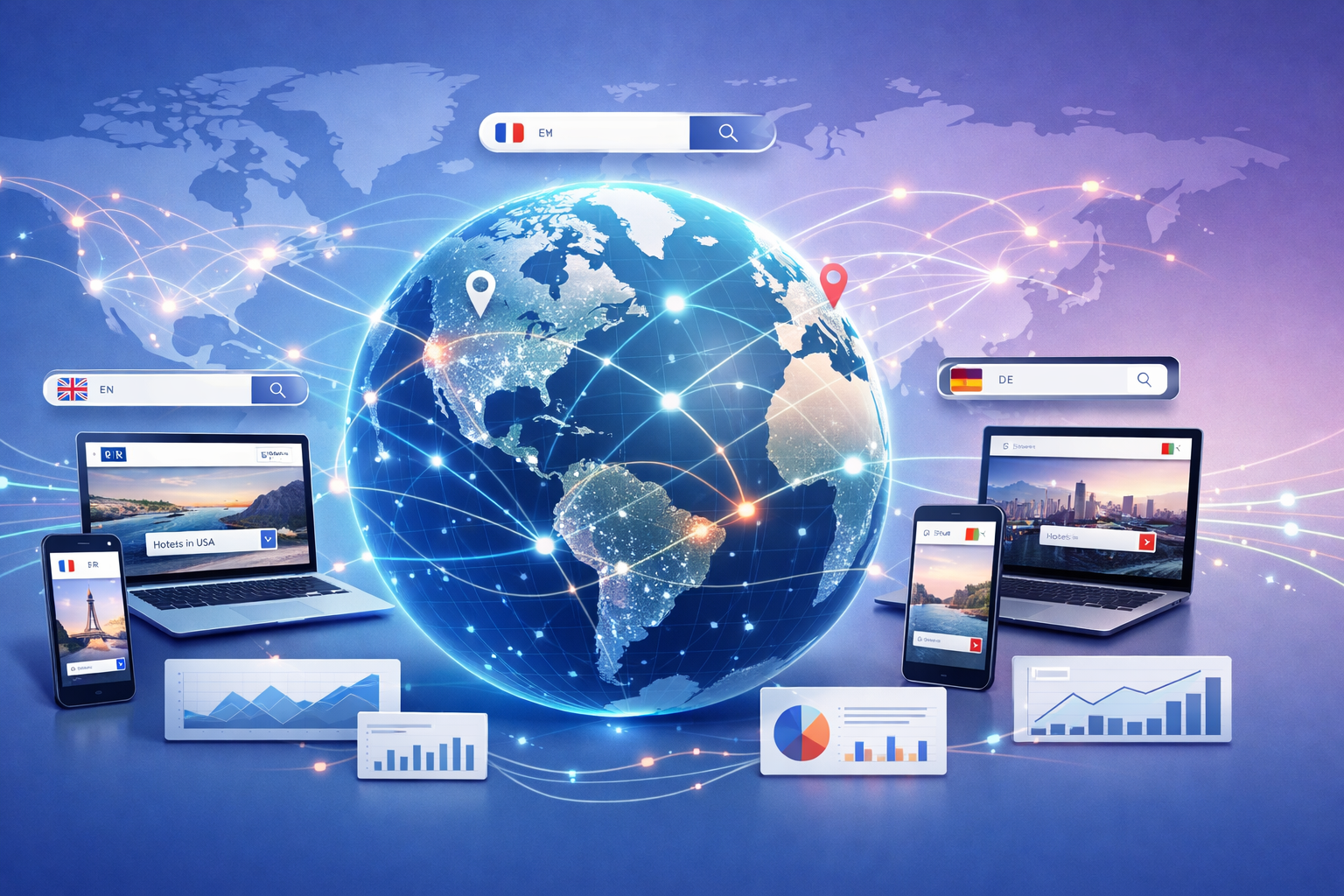
    International SEO is the process of optimising a website so that search engines can identify which countries and languages the business targets, and serve the most relevant version of the site to users across different regions.

    Why International SEO Matters for Global Brands

    Global brands don’t compete on visibility alone, but they compete on relevance.

    Without a proper international SEO strategy, brands risk:

    • Ranking the wrong language page
    • Sending users to irrelevant country versions
    • Creating duplicate content issues
    • Losing trust in high-intent markets


    The Reality of Global Search Behaviour

    • Users search differently by region
    • Keywords vary by language, culture, and intent
    • Google uses geo-signals, not assumptions
    • AI search engines expect clear geographic context


    International SEO ensures your content aligns with how users and algorithms actually search worldwide.

    International SEO vs Local SEO vs Global SEO

    SEO Type Focus Example
    Local SEO City or local area “SEO agency in London”
    International SEO Country + language English (US), English (UK), Spanish (MX)
    Global SEO Broad worldwide presence Brand visibility across regions

    International SEO is the foundation of a scalable global SEO strategy.

    How International SEO Works (Technical + Content View)

    1) Technical Signals (Search Engine Clarity)

    International SEO requires strong technical signals so search engines clearly understand which country or language version of a site to rank.

    2) Content Localisation (User Relevance)

    Localised content ensures users see culturally relevant, linguistically accurate, and region-specific information, not just translated text.

    3) Authority & Trust (EEAT Signals)

    Building regional authority helps search engines trust a brand within specific countries through local links, mentions, and expert signals.

    Benefits of International SEO for Global Brands

    1. Higher Rankings in International SERPs

    Search engines understand who your content is for, improving rankings across countries.

    1. Better User Experience

    Users land on content in their language, currency, and context — increasing trust and engagement.

    1. Stronger Brand Authority Globally

    Consistent, localised presence builds international credibility and EEAT signals.

    1. Improved Conversion Rates

    Localised pages convert better than generic global pages.

    1. AI & LLM Visibility

    Well-structured international SEO helps AI systems correctly reference and surface your brand.

    International SEO Strategy: A Step-by-Step Framework

    Step 1: Market & Language Research

    Start by choosing where to expand based on real demand—because the right market + right language setup determines everything that follows.
    Pointers:

    • Identify high-opportunity countries
    • Map language vs location
    • Validate demand using local keyword data


    Step 2: Choose the Right URL Structure

    Your URL structure tells Google how to separate and rank regional versions—so pick a format that fits your scale, resources, and long-term growth plan.
    Pointers:

    • ccTLD (example.fr) → Strong geo targeting
    • Subdomain (fr.example.com) → Large enterprises
    • Subdirectory (example.com/fr/) → Most scalable
    • Subdirectories often offer the best balance of authority + scalability


    Step 3: Implement hreflang Correctly

    hreflang prevents confusion by guiding search engines to show the right page to the right audience based on language and country.
    Pointers:

    • Tells search engines which language the page is in
    • Indicates which country the page targets
    • Helps serve the correct version to users
    • Incorrect hreflang = wrong indexing + lost rankings


    Step 4: Localize Content (Not Just Translate)

    Translation changes words, but localisation changes meaning and relevance, so the content matches local intent, culture, and expectations.
    Pointers:

    • Keyword intent differences
    • Cultural references
    • Local regulations & terminology
    • Native language tone
    • Translation ≠ Localization


    Step 5: Build Regional Authority (EEAT)

    To rank in new regions, brands need local trust signals so search engines see you as credible in that market, not just globally.
    Pointers:

    • Local expert authorship
    • Country-specific backlinks
    • Regional PR mentions
    • Local case studies & testimonials


    Here is an International SEO Checklist for Quick Reference

    • Country & language mapping
    • Correct URL structure
    • hreflang implemented and validated
    • No duplicate content conflicts
    • Localised keyword research
    • Native-level content quality
    • Internal linking between regions
    • Local backlinks & citations
    • Schema markup (Organisation, FAQ, Article)
    • Clear regional trust signals


    Common International SEO Mistakes Global Brands Make

    • Using auto-translation tools
    • Targeting multiple countries with one page
    • Missing or broken hreflang tags
    • Assuming English works everywhere
    • Ignoring regional search intent
    • Not optimising for AI-driven search


    International SEO & EEAT: Why Trust Matters More Globally

    International SEO isn’t just about ranking in different countries; it’s about proving trust and relevance in every region you target. Search engines and AI-driven answer engines rely heavily on EEAT signals to determine whether a brand deserves visibility, especially when the audience is global, and the content affects decisions.

    How EEAT Applies to International SEO

    • Experience: Local use cases, regional examples
    • Expertise: Native authors or market specialists
    • Authority: Local backlinks & citations
    • Trust: Legal pages, contact details, regional compliance

    Strong EEAT = higher international rankings + AI citations

    International SEO for AEO, GEO & LLMs

    How Answer Engines Evaluate International Content

    AI systems look for:

    • Clear geographic intent
    • Structured content (FAQs, definitions)
    • Accurate localisation
    • Consistent entity references

    Optimisation Tips for LLM Visibility

    • Use explicit country & language mentions
    • Answer questions directly (AEO style)
    • Add FAQ sections
    • Use schema markup
    • Maintain consistent brand entity signals


    Example: International SEO in Action

    For example, a global SaaS brand might use subdirectories like /us/, /uk/, and /au/ to target different regions. It would localize pricing, spelling, and examples for each market, while implementing hreflang correctly so search engines serve the right version to the right users. It would also build backlinks in each region to strengthen authority locally.

    Result:

    • Higher regional rankings
    • Improved conversions
    • Increased AI search visibility

    Why International SEO Is Non-Negotiable for Global Brands

    International SEO is not optional for brands operating across borders.

    It is the foundation for:

    • Global visibility
    • Regional relevance
    • AI discoverability
    • Long-term search authority

    If your brand serves multiple countries, you don’t just need SEO but you need International SEO done right.

    Frequently Asked Questions

    What is international SEO?

    International SEO is the process of optimising a website to target multiple countries and languages in search engines.

    What is the difference between international SEO and global SEO?

    International SEO focuses on country and language targeting, while global SEO focuses on broad worldwide visibility.

    Why is international SEO important?

    It improves rankings, user experience, conversions, and AI visibility across global markets.

    Does international SEO help with AI search?

    Yes. Clear localisation and EEAT signals improve visibility in AI-powered search and LLM responses.

  • All About LLMs: What They Are, How They Work, and How to Optimise for LLMs

    All About LLMs: What They Are, How They Work, and How to Optimise for LLMs

    Large Language Models (LLMs) are no longer just a trend in AI research; they are actively reshaping how people search, consume content, and make decisions online. From ChatGPT, Google Gemini to Claude, Perplexity AI, and enterprise copilots, LLMs are becoming the new interface of the internet.

    Did You Know
    The LLM market is expected to rise to USD 82.1 by 2033
    Source: market.us

    Instead of browsing through ten blue links, users increasingly expect:

    • Direct answers
    • Contextual summaries
    • Trustworthy recommendations
    • AI-generated decisions

    For brands and marketers, this shift presents two realities:

    A massive opportunity for early visibility
    A serious risk of invisibility if your content is not LLM-ready

    This guide covers:

    • What LLMs are (in simple terms)
    • How they work behind the scenes
    • How LLMs are changing search forever
    • The rise of AEO and GEO
    • Practical strategies for optimising content for AI-first discovery


    What is an LLM (Large Language Model)?

    A Large Language Model (LLM) is a type of artificial intelligence that is designed to understand and work with human language.

    It is called:

    • Large because it is trained on an extremely large amount of text
    • Language because it deals with words, sentences, and meaning
    • Model because it is a system that learns patterns from data

    An LLM is an AI system that learns how humans write and speak by reading billions of examples from the internet, books, articles, and conversations.

    Popular Examples of Large Language Models (LLMs)

    These LLM models are trained on massive amounts of text data, allowing them to understand human language, generate responses, and even perform tasks that once required human intelligence.

    Some of the most well-known LLMs include:

    • GPT-4 / GPT-4.1 (OpenAI) – One of the most advanced models, widely used in tools like ChatGPT for writing, coding, and problem-solving.
    • Gemini (Google) – Designed to combine language understanding with advanced reasoning and multimodal abilities.
    • Claude (Anthropic) – Known for its focus on safe, helpful, and conversational AI interactions.
    • LLaMA (Meta) – A popular open model family that supports research and enterprise AI development.
    • Mistral (Open Source) – A fast-growing open-source LLM praised for efficiency and performance.

    What makes these models so powerful is their ability to work across a wide range of real-world applications.

    What is the Impact of These LLM Models

    LLMs are not just experimental tools anymore; they are being used in everyday products and business systems, such as:

    • Smart chatbots and AI assistants that can hold natural conversations
    • Search and answer engines that provide direct, detailed responses instead of simple links
    • Content summarisation tools that quickly turn long documents into short insights
    • Code generation platforms that help developers write and debug programs faster
    • Enterprise automation systems that improve workflows, customer support, and decision-making

    LLMs are transforming how we interact with technology, making AI more accessible, useful, and human-like than ever before.

    How Do LLMs Work?

    At a high level, LLMs work in three core stages:

    1. Training on Massive Data

    LLMs are trained on:

    • Public web pages
    • Books and research papers
    • Forums and Q&A sites
    • Code repositories
    • Licensed and curated datasets

    This training helps the model learn:

    • Grammar and syntax
    • Facts and concepts
    • Relationships between ideas
    • Patterns in how humans communicate

    Important: LLMs do not “store” content like a database; they learn patterns and probabilities.

    2. Understanding Context Using Transformers

    LLMs are built using a neural network architecture called transformers.

    Transformers allow models to:

    • Understand context, not just keywords
    • Track meaning across long passages
    • Identify relationships between entities
    • Weigh importance using “attention mechanisms”

    This is why LLMs can answer:

    “Explain LLM optimisation for SaaS brands in India”

    —not just match keywords like traditional search engines.

    3. Generating Human-Like Responses

    When you ask a question:

    1. The LLM breaks it into tokens
    2. Evaluates context and intent
    3. Predicts the most useful next tokens
    4. Generates a coherent, contextual answer

    The output feels “intelligent” because:

    • It is context-aware
    • It draws from patterns across billions of examples
    • It is optimised for helpfulness and relevance


    How LLMs Are Changing Search Forever

    Search is no longer just about ranking pages but it’s about being chosen as the answer.

    For years, the search journey looked like this: users typed a keyword, Google showed a list of results, and people clicked through multiple links to compare information before deciding what to trust.

    But today, search behaviour is rapidly changing.

    With AI-powered search experiences, users aren’t always browsing — they’re asking questions and receiving direct, summarised responses. The decision is happening instantly, often without visiting a website at all.

    Traditional Search (SEO)

    How it worked:

    • Keyword → Page ranking → Click
    • Users explore multiple sources
    • Decision happens after reading and comparing

    In this model, SEO success meant:

    • ranking on page 1
    • earning clicks
    • keeping the user on your site

    LLM-Powered Search (AEO & GEO)

    How it works now:

    • Question → Direct answer
    • Fewer clicks, more zero-click journeys
    • AI synthesises information across sources

    In this model, the goal is no longer just ranking.

    It’s about

    • being cited
    • being summarised
    • being pulled into the AI’s response
    • becoming the “trusted source” inside the answer itself

    What This Looks Like in the Real World

    Examples of AI-first search experiences already shaping discovery:

    • Google SGE is generating AI summaries at the top of the results
    • ChatGPT browsing responses, pulling content from the web, and rewriting it
    • Perplexity answering with citations instead of links-first browsing
    • Bing Copilot / Gemini surfacing “best answers” before organic results

    What is the Risk and  the Opportunity

    Here’s the uncomfortable truth and that is even if your content is excellent, it may never be surfaced if it’s not structured in a way that LLMs can understand, extract, and trust.

    Because LLM-powered search doesn’t “read” as humans do.

    LLMs scans for:

    • clear definitions
    • structured sections
    • summarisable takeaways
    • authoritative tone
    • factual consistency
    • question-answer formatting
    • trustworthy signals (expertise, sources, clarity)

    Search is shifting from SEO (Search Engine Optimisation) to:

    • AEO (Answer Engine Optimisation)
    • GEO (Generative Engine Optimisation)


    AEO vs GEO vs SEO: What’s the Difference?

    Optimisation Type Focus Goal
    SEO Search engines Rank pages
    AEO (Answer Engine Optimisation) AI answers Be cited as the answer
    GEO (Generative Engine Optimisation) LLMs Be used in AI-generated responses


    Modern optimisation of content requires all three to work together.

    How LLMs Choose Which Content to Use

    1) Clear Topical Authority

    LLMs prefer content that covers a topic deeply, links related subtopics, and consistently proves expertise instead of writing one-off shallow blogs.

    2) Strong EEAT Signals

    Answer engines trust content more when it shows real authorship, genuine experience, accurate facts, and a credible brand footprint.

    3) Structured, Extractable Content

    LLMs rank content higher when it’s easy to scan and extract using headings, summaries, FAQs, and schema-ready formatting.

    4) Entity Clarity

    Answer engines perform better when the content clearly defines who/what it’s about, uses consistent terminology, and strongly connects the brand to the topic.

    How to Optimise Content for LLMs

    1. Write for Questions, Not Just Keywords

    LLMs respond to natural language queries.

    Instead of:

    “LLM optimisation strategies”

    Use:

    • “How do you optimise content for LLMs?”
    • “What is GEO in SEO?”
    • “How do brands rank in ChatGPT?”

    Include these as H2s and FAQs.

    2. Build Pillar + Cluster Content

    LLMs prefer depth over volume.

    Best structure:

    • 1 Pillar page
    • 8–12 supporting cluster articles
    • Strong internal linking

    This signals:

    • Authority
    • Context
    • Coverage completeness

    3. Optimise for EEAT Explicitly

    LLMs evaluate trustworthiness aggressively.

    Include:

    • Author bios with expertise
    • Real-world examples
    • Updated statistics
    • Clear explanations
    • Brand credibility signals

    For brands like LS Digital, this means:

    • Showcasing experience with AI, data, and marketing transformation
    • Demonstrating applied knowledge, not theory

    4. Use Answer-First Formatting

    Structure content like this:

    Question in the form of header
    Direct answer to the question in (2–3 lines)
    Next is an expanded explanation of the header
    Give Examples/context or sources

    This is ideal for:

    • Featured snippets
    • AI citations
    • Voice search
    • Chat interfaces


    LLM-Friendly FAQs

    FAQs help LLMs:

    • Understand intent
    • Extract clean answers
    • Reference your content

    Example:

    kLLMs and answer engines understand content through entities (recognizable brands, tools, concepts, and terms), not just repeated keywords. By mentioning relevant platforms like ChatGPT, Gemini, answer engines, generative search, and AI discovery, you help systems better understand context, relationships, and relevance—ultimately improving GEO (Generative Engine Optimisation) visibility.

    Common Mistakes Brands Make With LLM Optimisation

    • Writing thin blogs with no depth
    • Chasing keywords instead of questions
    • Ignoring author credibility
    • Over-optimising for search engines only
    • Not updating content regularly

    LLMs reward clarity, authority, and usefulness, not hacks.

    The Future of Search Is AI-First

    LLMs are not replacing search engines; they are becoming the interface layer.

    What this means for brands:

    • Visibility ≠ rankings alone
    • Content must educate, not just attract
    • Authority compounds over time
    • Early adopters gain disproportionate advantage

    Brands that invest in LLM-ready content today will dominate AI-driven discovery tomorrow.

    Why This Matters for Marketers & Brands

    LLMs are already influencing:

    • Buying decisions
    • Brand discovery
    • B2B research
    • Product comparisons

    Optimising for LLMs is no longer optional but it’s the next evolution of SEO. For digital-first brands, agencies, and enterprises, the opportunity is clear:

    Create authoritative, structured, experience-driven content that both humans and machines trust.

  • Weekend Digital Media Round- Digital AdEx set to rise 7.41%, but CPMs expected to remain under pressure, Scale vs Precision: Why Digital Advertising Is No Longer an Either-Or Game, LLM consistency and recommendation share: The new SEO KPI & More….

    Weekend Digital Media Round- Digital AdEx set to rise 7.41%, but CPMs expected to remain under pressure, Scale vs Precision: Why Digital Advertising Is No Longer an Either-Or Game, LLM consistency and recommendation share: The new SEO KPI & More….

    1.Digital AdEx set to rise 7.41%, but CPMs expected to remain under pressure

    Digital advertising is projected to grow steadily, signalling continued confidence in the medium. However, sustained pressure on CPMs indicates that inventory expansion and platform competition are reshaping pricing dynamics. This creates a dual reality: growth in spends, but sharper scrutiny on efficiency. For brands, the focus will increasingly shift towards optimisation, outcome measurement and value extraction rather than just scale. [Source: Pitch]

    2. Scale vs Precision: Why Digital Advertising Is No Longer an Either-Or Game

    The long-standing debate between reach and targeting is becoming obsolete. Modern media strategies require a calibrated mix of broad visibility and high-intent precision to deliver both brand equity and performance. Advances in data infrastructure and AI-led optimisation make it possible to pursue both simultaneously. The winners will be those who architect campaigns that unify scale with contextual relevance. [Source: Exchange4Media]

    3. LLM consistency and recommendation share: The new SEO KPI

    Traditional ranking metrics are no longer enough in an AI-driven search landscape. Brands must now measure how consistently they appear across large language models and how frequently they are recommended in generated responses. This introduces a new performance layer focused on visibility within AI answers rather than just SERPs. SEO is evolving into answer optimisation and authority reinforcement. [Source: Search Engine Land]

    4. ‘From Idea To Outcome: Why Marketing Now Owns Growth’

    Marketing is no longer confined to awareness and messaging; it now sits at the centre of growth strategy. With data, performance analytics and technology integration converging, marketing teams influence revenue outcomes more directly than ever before. This shift increases accountability but also elevates strategic relevance. The function is evolving into a measurable growth engine aligned with business impact. [Source: Impact]

    5. ChatGPT ads collapse the wall between SEO and paid media

    AI-integrated advertising formats are redefining how paid and organic search interact. Sponsored responses embedded within conversational interfaces blur the distinction between performance media and content strategy. This convergence demands unified planning, shared data signals and coordinated optimisation. Marketing teams will need to break silos and rethink search as one interconnected ecosystem. [Source: Search Engine Land]

    6. How Brands Can Adapt When AI Agents Do the Shopping

    As AI agents begin researching and purchasing on behalf of consumers, optimisation strategies must adapt accordingly. Product data, transparency, pricing clarity and structured information will influence machine-led decisions. Brand messaging must be both persuasive for humans and interpretable for algorithms. Commerce strategies will need to address both audiences simultaneously. [Source: HBR]

    7. AI didn’t kill SEO. It killed average content.

    Search visibility is becoming increasingly selective, filtering out undifferentiated or generic material. AI models favour insight-driven, experience-backed and context-rich content that genuinely adds value. This raises the bar for editorial quality and strategic storytelling. The shift rewards originality and penalises mediocrity. [Source: Stacker]

    8. From Clicks to Conversations: How MCP Will Redefine the Future of Retail

    Retail is shifting from static browsing journeys to dynamic conversational interfaces. Machine Communication Protocols (MCP) and AI-driven systems could transform how consumers discover, evaluate and purchase products. The emphasis will move from clicks and funnels to dialogue and assisted decision-making. Brands must prepare for commerce experiences that feel interactive and continuous. [Source: My Total Retail]

    9. When Every Company Can Use the Same AI Models, Context Becomes a Competitive Advantage

    AI is reshaping the role of the B2B creative director from traditional idea-generation toward AI-augmented strategy and output management, where leaders now need to orchestrate tools that scale creative work while preserving human insight, judgment and brand voice. This shift demands a blend of strategic oversight, ethical decision-making and collaboration with AI systems, rather than relying on old “best practice” playbooks for creativity in B2B marketing. [Source: HBR]

    10. The authority era: How AI is reshaping what ranks in search

    AI systems prioritise trusted, authoritative and well-structured content over keyword-stuffed pages. Signals such as expertise, credibility and contextual clarity are becoming decisive ranking factors. As a result, brands must invest in thought leadership, structured knowledge frameworks and demonstrable depth. Authority is no longer optional; it is the foundation of discoverability. [Source: Search Engine Land]

  • Weekend Digital Media Round- What actually drives paid media performance (beyond targeting and optimization), UX can no longer exist as a purely ‘user happiness’ function, Beyond speed: How real-time marketing actually enables personalization & More….

    Weekend Digital Media Round- What actually drives paid media performance (beyond targeting and optimization), UX can no longer exist as a purely ‘user happiness’ function, Beyond speed: How real-time marketing actually enables personalization & More….

    1.What actually drives paid media performance (beyond targeting and optimization)

    Paid media performance depends far more on creative quality and human attention than on targeting or algorithmic optimization. Rising ad fatigue and oversaturated digital spaces mean that even sophisticated targeting cannot compensate for weak content. Brands succeed when they prioritize standout creative, understand audience psychology, and use paid media to amplify what genuinely deserves attention. [Source: DMNews]

    2. UX can no longer exist as a purely ‘user happiness’ function

    UI/UX in 2026 is shifting from flashy visual experimentation to intentional, accountable, and outcome‑driven design. Calm interfaces, accessibility as a core craft, and transparent, trust‑building experiences are becoming essential. Designers are now expected to think in systems, leverage AI as an accelerator, and focus on behavior across entire user journeys rather than isolated screens. [Source: MediaBrief]

    3. Beyond speed: How real-time marketing actually enables personalization

    Real-time marketing succeeds only when organizations pair fast, behavior‑based responses with unified data, integrated systems, and aligned teams. While AI tools promise automation, most personalization fails due to poor infrastructure and siloed processes. Companies that get the basics right—clean data, clear workflows, and timely relevance—are the ones seeing real results. [Source: DMNews]

    4. Programmatic’s 19% surge signalling a structural shift in digital media buying?

    Programmatic advertising is rapidly evolving into core digital infrastructure, driven by AI‑powered efficiency, safer premium inventory, and the rise of CTV and OTT. Industry leaders say the real shift is a balance of automation with strong human governance, making programmatic a full‑funnel, audience‑first approach rather than just a performance tool. The projected 19% CAGR reflects a broader structural transition toward transparent, curated ecosystems and outcome‑driven media planning. [Source: Exchange4Media]

    5. The Halo Effect: Your Paid Media Went Offline, Can You Survive Without It?

    Turning off paid media caused a major decline in total traffic, online orders, and revenue, revealing how strongly paid channels amplify organic and direct performance. Organic search did rise when ads were paused, but nowhere near enough to make up for the lost paid and halo-driven traffic. Overall, the business missed out on more than $180K in revenue, showing that paid media doesn’t just drive direct conversions—it boosts all channels, proving brands perform best when paid and organic efforts work together. [Source: Search Engine Journal]

    6. What are the forces driving retail media’s 56% YoY surge in digital ad spends?

    Retail media is rapidly reshaping how brands allocate digital ad dollars, with e-retail platforms turning into full-funnel media networks that combine rich first-party data, shoppable formats and closed-loop measurement to connect discovery with purchase intent. This evolution helped ad spends on e-retail platforms jump about 56% year-on-year, reaching ₹17,601 crore and accounting for nearly a quarter of total digital media spending in India by end of 2025. [Source: Exchange4Media]

    7. Why IPL 2026 is a turing point for mobile advertising

    Mobile advertising around the IPL is evolving beyond just experimenting for budgets to becoming a central part of marketers’ plans, with brands demanding predictable scale, measurable outcomes and interactive formats that align with real fan behaviour on phones rather than just standard video ads. This shift suggests IPL 2026 could be a defining moment where mobile ad spends move closer to traditional TV in value by demonstrating clear performance and engagement metrics [Source: Best Media Info]

    8. How AI is fundamentally changing the role of the B2B creative director

    AI is reshaping the role of the B2B creative director from traditional idea-generation toward AI-augmented strategy and output management, where leaders now need to orchestrate tools that scale creative work while preserving human insight, judgment and brand voice. This shift demands a blend of strategic oversight, ethical decision-making and collaboration with AI systems, rather than relying on old “best practice” playbooks for creativity in B2B marketing. [Source: The Drum]

    9. Why video is the canonical source of truth for AI and your brand’s best defense

    Video content offers richer, higher-fidelity data for AI models than text, making it a powerful way to establish your brand’s identity and factual details so large language models and AI search can reference you accurately rather than hallucinate or fill in gaps. By serving as a clear “source of truth,” authoritative videos help protect your brand from misrepresentation in AI-generated outputs and improve visibility in AI-driven discovery. [Source: Search Engine Land]

    10. Designing For Agentic AI: Practical UX Patterns For Control, Consent, And Accountability

    Designing agentic AI — systems that act autonomously for users — requires UX patterns that prioritise trust, transparency, consent and meaningful user control rather than hidden automation. Practical approaches such as intent previews, adjustable autonomy levels, clear explanations, confidence signals and easy undo options help balance powerful AI capabilities with accountability and user confidence. [Source: Smashing Magazine]

  • Weekend Digital Media Round- Why CMOs Are Rethinking AI Pilots in Digital Commerce, Why the New Artificial Intelligence Is So Powerful, Claude’s Cowork chaos: $285B vanishes as markets question Software’s future &More….

    Weekend Digital Media Round- Why CMOs Are Rethinking AI Pilots in Digital Commerce, Why the New Artificial Intelligence Is So Powerful, Claude’s Cowork chaos: $285B vanishes as markets question Software’s future &More….

    1.Why CMOs Are Rethinking AI Pilots in Digital Commerce

    Many AI initiatives in digital commerce fail to scale because they lack clear business context, customer relevance, and change management. A customer‑journey–driven approach, combined with disciplined idea qualification and pilots designed to either scale or stop, helps organizations turn AI from experimentation into sustained growth. [Source: CMS Wire]

    2. Why the New Artificial Intelligence Is So Powerful

    Modern AI systems have become powerful due to the interaction of multiple mechanisms—neural networks, massive data training, learning methods, attention, and specialized hardware. Together, these create complex causal networs that produce emergent abilities like language understanding, reasoning, problem-solving, and creativity, even though AI still lacks human consciousness or emotions. [Source: Psychology Today]

    3. Claude’s Cowork chaos: $285B vanishes as markets question Software’s future

    Markets were rattled after Anthropic’s Claude Cowork plugins showed AI could autonomously execute legal, sales, and financial workflows, wiping out $285 billion in software market value in a single session. Investors fear AI is absorbing entire workflows rather than just assisting, forcing SaaS and IT services firms to rethink business models built on billable hours and human effort. [Source: Wion]

    4. Google’s Search Generative Experience will transform content

    Google’s introduction of AI-driven generative search is poised to reshape SEO by changing how results are created and consumed, pushing marketers to move beyond traditional keyword strategies and instead focus on more natural, conversational, and snackable content that aligns with how users ask questions and engage with information in an AI-influenced search environment. [Source: The Drum]

    5. YouTube CEO Reveals Your Video Marketing Strategy For 2026

    YouTube’s CEO outlines a shift toward treating the platform as a full entertainment, commerce, and discovery ecosystem, where creators operate like studios and brands must co‑produce content rather than rely on one‑off sponsorships. Shorts are positioned as the primary discovery gateway feeding long‑form, TV‑quality content, with AI and integrated shopping making video marketing more measurable and revenue‑driven by 2026. [Source: Search Engine Journal]

    6. FAQ on martech: How AI agents and composable stacks are reshaping marketing technology in 2026

    AI-driven agents and composable martech stacks are redefining how marketing works, with intelligence embedded across content creation, data, and customer engagement. As buyer‑side AI assistants increasingly replace traditional search and browsing, marketers face pressure to simplify fragmented systems and adapt strategies to stay visible by optimizing content for AI discovery rather than just human clicks. [Source: EMarketer]

    7. How first-party data drives better outcomes in AI-powered advertising

    First‑party data has become critical for AI‑driven advertising, as it helps platforms optimize for profitable outcomes rather than just clicks or conversions. By feeding accurate customer and revenue data into automated campaigns like Performance Max, advertisers can improve conversion quality and return on ad spend—even if costs per click rise. [Source: Search Engine Land]

    8. Digital Fatigue Is Real — ‘Retailtainment’ Is How Brands Win Customers Back

    Retailers are shifting from pure online transactions to experience-driven “retailtainment” as customers grow tired of digital shopping. By using gamification, social shopping, in‑store learning, social commerce, and community events, brands can re‑engage customers, build loyalty, and boost sales by turning shopping into a more social and memorable experience. [Source: Entrepreneur]

    9. EXCLUSIVE: OpenAI Confirms $200,000 Minimum Commitment for ChatGPT Ads

    OpenAI is piloting ads on ChatGPT through a small, tightly controlled beta, asking select advertisers to commit at least $200,000 upfront. The company says the test is meant to understand which ad formats add value for users before expanding advertising options more broadly. [Source: AdWeek]

    10. Future of Marketing Briefing: The word ‘agency’ is costing the ad giants

    Ad industry holding companies are being held back less by economics or technology and more by perception, with the label “agency” no longer reflecting the breadth of what they do. As clients expect broader, consultative and business-led solutions, clinging to outdated terminology is weakening how these giants position their value for the future. [Source: DigiDay]

  • Weekend Digital Media Round- How AI give ability to think about its ‘thinking’, Beyond the click: How brands can influence visibility in AI-generated answers, PrDOOH 2.0: What is the future of programmatic digital out of home & more….

    Weekend Digital Media Round- How AI give ability to think about its ‘thinking’, Beyond the click: How brands can influence visibility in AI-generated answers, PrDOOH 2.0: What is the future of programmatic digital out of home & more….

    1.How AI give ability to think about its ‘thinking’

    Metacognition—thinking about and regulating one’s own thinking—is presented as a missing but critical capability in today’s AI systems. Introducing this ability could allow generative AI to assess its confidence, recognize confusion or contradictions, and adapt its reasoning, reducing risks in sensitive areas like medicine, finance, and autonomous decision‑making. [Source: Fast Company]

    2. Beyond the click: How brands can influence visibility in AI-generated answers

    Online discovery is rapidly shifting toward AI‑generated answers that reduce the need for users to click through to websites, forcing brands to rethink visibility and success metrics. To stay relevant, companies must create structured, authoritative, and up‑to‑date content that AI systems can easily interpret and reuse, while learning to measure influence beyond traditional traffic and click‑based analytics. [Source: The Next Web]

    3. PrDOOH 2.0: What is the future of programmatic digital out of home?

    Programmatic digital out-of-home (prDOOH) is emerging as a major growth driver in advertising, powered by data, automation, and omni‑channel integration. As cookies phase out, DOOH’s reliance on first‑party and location data positions it well to attract premium budgets, improve ROI, and deliver more targeted, creative, and sustainable campaigns. [Source: The Drum]

    4. Add to bot: how AI agents could reshape online retail

    AI agents from platforms like OpenAI and Google are transforming online shopping by letting consumers browse, compare, and purchase products directly within chat interfaces, removing the need for apps or marketplaces. This shift could reduce fees and disrupt traditional ecommerce platforms, with rapid expansion expected beyond the US into regions like Southeast Asia. [Source: TechAsia]

    5. Remixing the Marketing Mix for 2026 and Beyond

    Earned media should lead the marketing mix because it builds trust and has a far stronger influence on brand consideration than paid or owned channels. Data shows that prioritizing earned media not only delivers credibility but also multiplies the impact of paid and owned efforts, making campaigns more effective in today’s complex marketing environment. [Source: AdWeek]

    6. How Do You Compete In Agentic Commerce?

    Agentic commerce shifts competition away from marketing tactics toward data accuracy, product truth, and machine‑readable trust, as AI agents increasingly decide what to buy on behalf of users. Brands that win are those with clean feeds, transparent pricing, and verifiable product information that AI systems can confidently recommend, while marketing‑first shortcuts lose effectiveness. [Source: Search Engine Journal]

    7. Conversational AI will force a rethink of how search is monetized

    Conversational AI is changing how people discover and evaluate information, pushing platforms like Google to rethink how search interactions are measured and monetized. While Google is likely to create new ad models for exploratory AI-driven searches, tools like ChatGPT are moving toward subscription-based productivity and workflow value rather than advertising. [Source: The Drum]

    8. Is the Metaverse Making a Comeback in Agentic Commerce?

    The metaverse didn’t fail—it shifted focus from humans to AI. Instead of consumer adoption, its real value is emerging as a spatial infrastructure where autonomous AI agents can train, negotiate, and transact at machine speed. This evolution positions the metaverse as the backbone of agent‑to‑agent commerce rather than a human‑centric virtual world. [Source: CMS Wire]

    9. Are Indian advertisers rewriting the rules of programmatic outsourcing?

    Indian advertisers are increasingly moving away from fully outsourced programmatic advertising toward hybrid models that keep strategy, data ownership, and measurement in-house while relying on agencies for execution and scale. This shift is driven by the need for greater transparency, regulatory compliance, and tighter linkage between media spends and business outcomes, rather than a loss of confidence in agencies. [Source: Exchange4Media]

    10. What Is Prompt-Driven Analytics? A Practical Guide for CX Leaders

    Prompt‑driven analytics is transforming customer experience by replacing static dashboards with real‑time, conversational insights that business users can access through natural‑language queries. Its success depends on clean, well‑governed data, enabling CX teams to act faster, measure new AI‑driven metrics, and make more informed decisions without waiting on traditional reports. [Source: CMS Wire]

  • Weekend Digital Media Round- The future will belong to those who build applications with purpose, Do brands own the copyright on AI-generated ads, Anthropic, Perplexity AI Interview Explains How AI Search Works& More….

    Weekend Digital Media Round- The future will belong to those who build applications with purpose, Do brands own the copyright on AI-generated ads, Anthropic, Perplexity AI Interview Explains How AI Search Works& More….

    1.The future will belong to those who build applications with purpose

    AI is shifting from being a productivity tool to becoming an intelligent, decision‑making agent that transforms how organisations operate. The piece highlights how businesses must move beyond agility to adopt “agentic systems” that integrate diagnostic, predictive and generative intelligence. Those who build purposeful, application‑layer AI will lead in 2026 and beyond. [Source: MediaBrief]

    2. Do brands own the copyright on AI-generated ads?

    AI-generated ads are rapidly growing, but questions around who owns the copyright—brands or the AI—remain unresolved. Legal experts say protection depends on how much human involvement shapes the output, leaving brands to balance AI creativity with clear human contribution. Many agencies are using tools like Midjourney and DALL·E to speed up ideation while navigating this legal gray zone. [Source: The Drum]

    3. Perplexity AI Interview Explains How AI Search Works

    AI search is shifting from traditional whole‑page ranking to “sub‑document” retrieval, where tiny text fragments fill an LLM’s context window to deliver more accurate answers. Personalization now shapes results, meaning two people can receive different answers for the same query. Traditional SEO still matters, but optimization is increasingly about Answer Engine Optimization (AEO) rather than classic ranking.

    Source: Search Engine Journal

    4. Anthropic, DeepMind, Node.js Leaders Believe Era of Humans Writing Code is Over

    AI leaders from Anthropic, DeepMind, and the creator of Node.js predict that manual coding will soon become obsolete, with AI expected to handle most end‑to‑end programming by 2027. Senior engineers already report relying almost entirely on AI tools, while entry‑level tech roles may shrink as AI accelerates skill development and reduces the need for traditional internships. [Source: Analytics India]

    5. The ad industry isn’t asking for SOPs, it’s asking for certainty

    The piece highlights how India’s advertising and media industry wants Budget 2026 to bring clearer compliance rules, smoother GST/TDS processes, and faster approvals to ease cash-flow pressure. It also calls for stronger support for digital innovation, AI adoption, and skilling, while emphasizing that stable policies and consumer spending power are what ultimately drive ad budgets and industry growth. [Source: BestMedia Info]

    6. The Privacy-Personalization Showdown and the Future of Trust in 2026

    Brands in 2026 are navigating the tension between personalized marketing and rising privacy expectations. Emerging tools like federated learning, synthetic data, zero-party data, and Agentic AI help deliver relevance without compromising user trust. Companies that embrace privacy as a foundation—not a barrier—are positioned to win in a trust‑driven digital economy. [Source: MediaNews4U]

    7. OpenAI to place ads in ChatGPT: Four experts on what it means for brands, budgets, and trust

    OpenAI’s move to introduce clearly labelled ads in ChatGPT is reshaping how brands participate in AI-driven conversations, shifting advertising from interruption to helpful, context‑aware suggestions. Experts highlight major opportunities for brands, but also warn that user trust, transparency, and the risk of dark patterns will determine whether this new ad model succeeds. The shift is expected to significantly influence digital marketing budgets, media planning, and how brands earn visibility in an AI‑first ecosystem. [Source: MediaBrief]

    8. AI for creativity: ‘Brands that ignore it will become obsolete’

    AI is rapidly reshaping marketing, pushing brands to adopt new tools, create hyper‑personalized experiences, and strengthen creative output. Tracy Wood emphasizes that marketers won’t be replaced—but those who ignore AI will fall behind, making prompt‑engineering skills essential. At the same time, ethical use, transparency, and human judgment remain crucial as AI becomes more integrated into customer interactions. [Source: The Drum]

    9. 4 new roles will lead the agentic AI revolution – here’s what they require

    AI-driven workplaces are creating four key emerging roles: AI leaders, agent operators, AI no‑code creators, and workflow analysts. These roles blend business expertise with AI literacy and will evolve from existing teams as organizations shift toward agentic AI. The common theme across all roles is ownership—of outcomes, agent behavior, and continuous optimization. [Source: ZDNET]

    10. 4 AI Shifts That Will Separate CX Leaders in 2026

    AI has become an everyday expectation, so brands now stand out not by using it, but by using it wisely—with good judgment, trust, and deep integration across the customer journey. Companies that combine automation with human understanding, cohesive experiences, and transparent agentic AI will lead the next wave of customer experience. [Source: CMS Wire]

  • Weekend Digital Media Round- Building A Brand Is Not A Strategy, It Is A Starting Point, 2026 will change marketing more than the last five years combined, When knowing omnichannel matters wasn’t enough to make it happen & More….

    Weekend Digital Media Round- Building A Brand Is Not A Strategy, It Is A Starting Point, 2026 will change marketing more than the last five years combined, When knowing omnichannel matters wasn’t enough to make it happen & More….

    1.Building A Brand Is Not A Strategy, It Is A Starting Point

    SEO can’t magically create demand — it captures it. The piece explains how true brand building comes from consistent visibility, helpful content, and long‑term trust signals rather than vague instructions to “build a brand.” It highlights that SEO, content, and digital PR work together to increase mental availability and reinforce brand perception over time. [Source: Search Engine Journal]

    2. 2026 will change marketing more than the last five years combined

    Marketing in 2026 is shifting into a fully unified, AI‑driven system where channels, measurement, and creative work together in real time. AI becomes the transparent engine powering optimization, while silos disappear as brands move toward connected, journey‑based planning. Overall, the year marks a major inflection point where unified intelligence replaces fragmented marketing practices.  [Source: The Drum]

    3. When knowing omnichannel matters wasn’t enough to make it happen

    Companies long understood the value of omnichannel experiences, but most failed because their systems couldn’t actually connect customer data across channels. The piece shows how true success comes from integration—not just collecting data—since unified systems drive higher retention, smoother experiences, and long‑term competitive advantage. [Source: DM News]

    4. The Performance Gap Is Widening in 2026

    Programmatic advertising budgets are rising, but many teams are losing up to 30% of spend due to fragmented tools and siloed execution. Top-performing marketers are pulling ahead by consolidating their tech stacks and investing more heavily in AI across creative, data, and optimization. The gap between unified and fragmented strategies is expected to widen even further in 2026. [Source: Ad Week]

    5. What it takes to be a CMO in 2026 (spoiler: it’s complicated)

    Marketing leaders in 2026 are navigating a complex role that blends AI-driven transformation with the need to preserve creativity and human authenticity. CMOs are expected to act as both tech strategists and brand storytellers while balancing speed, strategy, and accountability. The research shows they must evolve into cross‑functional leaders who unite performance, platforms, and creativity. [Source: The Drum]

    6. Why Paid Search Foundations Still Matter In An AI-Focused World

    AI tools like Google’s PMax can scale campaigns, but they still depend heavily on solid fundamentals—clear structure, strong audience signals, and well‑defined intent—to perform well. Marketers who provide clean data, meaningful audience insight, and aligned intent signals enable AI to optimize far more effectively instead of guessing. [Source: Search Engine Journal]

    7. AI’s Greatest Problem Isn’t The Technology — It’s The Missing Data

    AI failures in enterprises aren’t caused by weak technology but by missing human-centric data that shows how work actually happens. Companies that capture real-time human signals—like collaboration, trust, and recognition—gain a competitive edge, while others relying only on static organizational data fall behind. The message for 2026: AI impact will depend on integrating technology with genuine human context.  [Source: Forbes]

    8. Google launches Universal Commerce Protocol for agent-led shopping

    Google has introduced the Universal Commerce Protocol, a new open standard that enables AI agents to manage the entire shopping journey across platforms. Alongside this, Google is rolling out branded retail AI agents and new ad formats like Direct Offers to boost conversions in AI-driven shopping. The updates aim to simplify checkout, reduce cart abandonment, and give retailers more control as agent-led commerce grows. [Source: Search Engine Journal]

    9. What Contact Center Operations Reveal About Your Customer Experience

    Operational assessments help contact centers uncover hidden inefficiencies, compliance gaps and technology issues that quietly weaken customer experience. Strengthening processes, data practices and agent support leads to faster resolution, better satisfaction and long‑term loyalty. [Source: CMS Wire]

    10. Shejale & Tamboli: Solving the 2026 Signal Crisis

    Brand leaders Prasad Shejale and Vinay Tamboli explain that the real challenge of the post‑cookie era isn’t replacing technology but rebuilding a unified, privacy‑first signal foundation. They argue that strong first‑party data, improved signal quality, and organisational alignment will separate high‑performing brands from those struggling in 2026. CMOs who prioritise measurement and owned data now will gain lasting strategic advantage. [Source: Adtech Today]

  • Weekend Digital Media Round- LLMs contain a LOT of parameters. But what’s a parameter, 7 Digital Marketing Trends to Watch for in 2026, Rebuilding performance for the privacy era & More….

    Weekend Digital Media Round- LLMs contain a LOT of parameters. But what’s a parameter, 7 Digital Marketing Trends to Watch for in 2026, Rebuilding performance for the privacy era & More….

    1.LLMs contain a LOT of parameters. But what’s a parameter?

    Large language models rely on billions or even trillions of parameters—such as embeddings, weights, and biases—that are fine-tuned during training to interpret and generate text. These parameters encode meaning, context, and relationships between words in high-dimensional space, enabling models to perform complex tasks. Recent advances focus on efficiency, using techniques like overtraining, distillation, and mixture of experts to make smaller models outperform larger ones. [Source: Technology Review]

    2. 7 Digital Marketing Trends to Watch for in 2026

    Digital marketing in 2026 will be shaped by seven major trends: short-form video will dominate engagement, AR glasses will open new advertising opportunities, and AI-generated content may reduce trust and sharing. Additionally, Threads is expected to surpass X, algorithm opt-outs could become standard, Reddit may face brand fatigue, and new teen-focused apps are likely to emerge. [Source: Social Media Today]

    3. Rebuilding performance for the privacy era

    LS Digital is focusing on rebuilding performance measurement for the privacy-first era through its SynapseSync platform, built on the DataQuark framework. The initiative aims to help brands shift from fragmented, intuition-based decisions to measurable, intelligence-driven growth, emphasizing first-party data infrastructure and omnichannel measurement for sustainable performance gains. [Source: Adgully]

    4. Personalization now a viable tactic for Bharat, not just metros

    Creative AI and Generative AI transformed marketing in 2025, enabling hyper-personalized, vernacular content at scale and driving real-time campaign optimization. The rise of Agentic AI introduced autonomous full-funnel orchestration, while growing privacy regulations set the stage for a major personalization-versus-privacy challenge in 2026. [Source: MediaBrief]

    5. You Have Six Seconds to Grab My Attention. Are Micro-Moments Your Marketing Edge?

    Winning brands now compete on speed and relevance by leveraging micro-moments—brief, high-intent interactions where consumers seek instant solutions. Success hinges on delivering value in under ten seconds through context-aware, seamless experiences that prioritize usefulness over impressions. [Source: Entrepreneur]

    6. Everybody Is Using AI. Why Aren’t Businesses Seeing Meaningful Returns?

    Most businesses are using AI, but only 5% of generative AI pilots deliver measurable financial impact because the challenge isn’t technology—it’s leadership and workflow integration. Success comes from embedding AI into core decision-making, providing clear context, and redesigning roles to align with measurable outcomes. [Source: Forbes]

    7. How Influencer Marketing Is Changing in 2026

    Influencer marketing in 2026 is shifting from one-off paid posts to deeper, long-term collaborations where creators act as consultants. Brands are investing more in these strategic partnerships as influencer budgets continue to grow. [Source: Vogue]

    8. Why Global Search Misalignment Is An Engineering Feature And A Business Bug

    Google’s AI Overviews have shifted search from localized ranking to semantic synthesis, prioritizing factual completeness over regional relevance. This design reduces hallucination risk but causes “geographic leakage,” where international sources appear for local queries, creating commercial blind spots. Businesses must adapt with Generative Engine Optimization (GEO) by ensuring semantic parity, retrieval-aware structuring, and reinforcing market-specific signals. [Source: Search Engine Journal]

    9. How to earn brand mentions that drive LLM and SEO visibility

    Brand mentions have become a critical factor for SEO and AI search visibility, surpassing traditional backlink strategies. They help LLMs associate brands with relevant topics, improving rankings. To succeed, brands should create referenceable assets, engage in visible platforms, and build relationships for mentions, prioritizing this after technical SEO fundamentals are in place. [Source: Search Engine Land]

    10. AI rewired marketing. Leadership is next.

    AI is rapidly transforming marketing strategies, and businesses that haven’t placed it at the core of their approach are already falling behind. The next big shift will be in leadership, as AI begins to influence decision-making at the highest levels. [Source: Campaign India]

  • Weekend Digital Media Round- The Internet Is Closing: Can Your Customers Still Find You, Is your brand ready for zero-click AI search, How advertising industry is rebuilding its operating system for the AI age & More….

    Weekend Digital Media Round- The Internet Is Closing: Can Your Customers Still Find You, Is your brand ready for zero-click AI search, How advertising industry is rebuilding its operating system for the AI age & More….

    1.The Internet Is Closing: Can Your Customers Still Find You?

    Big Tech’s AI-driven platforms are reshaping the internet into closed ecosystems, limiting brand visibility and customer access. While most businesses focus on efficiency through AI, the real competitive edge lies in creating adaptive, emotionally resonant experiences that maintain identity and trust in these walled environments. [Source: Forbes]

    2. Is your brand ready for zero-click AI search?

    AI-driven search is transforming discovery, with conversational queries and zero-click answers replacing traditional keyword-based SEO. Brands must shift to creating AI-ready content focused on context, intent, and semantic clusters to stay visible across generative AI platforms and voice assistants. Visibility now depends on relevance, authority, and adaptability—not rankings alone. [Source: The Drum]

    3. How advertising industry is rebuilding its operating system for the AI age

    India’s advertising industry is undergoing a major transformation to adapt to AI-driven changes, focusing on trust, transparency, and continuous compliance. The Advertising Standards Council of India is creating an AI-ready regulatory roadmap, shifting from episodic checks to real-time monitoring and collaborative enforcement to balance innovation with accountability. [Source: Exchange4Media]

    4. In Graphic Detail: The state of AI referral traffic in 2025

    AI platforms significantly reshaped referral traffic in 2025, with ChatGPT traffic nearly doubling but still remaining a small share overall. Google’s AI Overviews reduced click-through rates, pushing publishers to rethink strategies for maintaining visibility in AI-driven search environments. [Source: DigiDay]

    5. The New AI Marketplace: How ChatGPT’s Native Shopping Could Rewrite Digital Commerce

    OpenAI’s integration of native shopping into ChatGPT marks a major shift in digital commerce, enabling consumers to browse and purchase directly within AI conversations. This move could disrupt traditional gatekeepers like Amazon and Google, making discovery more intent-driven and conversational, while pushing brands to focus on trust, storytelling, and AI ecosystem integration for visibility. [Source: Search Engine Journal]

    6. 2025: The year in LLMs

    2025 was a transformative year for AI, marked by breakthroughs in reasoning models, coding agents, and multimodal capabilities. Major trends included the rise of tool-driven agents, prompt-based image editing, and Chinese open-weight models challenging global leaders. OpenAI, Anthropic, and Google competed fiercely, while pricing models, security concerns, and environmental debates shaped the industry’s evolution. [Source: Simon Willison]

    7. Stop Debating CX Metrics and Start Fixing What’s Broken

    Trish Wethman, named CMSWire’s 2025 Contributor of the Year, emphasizes that customer experience success depends on turning insights into action rather than obsessing over metrics. She advocates for a systems approach that blends technology with empowered frontline employees, positioning AI as an enabler—not a replacement—for human connection. [Source: CMS Wire]

    8. When AI Became Real in Commerce — and Why Experience Still Won

    AI moved from hype to reality in 2025, transforming commerce from simple transactions to experiential, agent-driven interactions. Justin Racine emphasizes that while AI accelerates personalization and automation, human judgment, emotional connection, and clean data remain critical for success. [Source: CMS Wire]

    9. The Future Of Travel: AI, Chatbots, VR And Agents

    AI, automation, and immersive technologies are revolutionizing travel and hospitality in 2026, transforming everything from booking to in-room services. Key trends include AI-powered customer agents, smart hotel automation, VR-based trip planning, sustainable travel solutions, and biometric systems for seamless experiences. [Source: Forbes]

    10. What Every Company Needs To Know About Cybersecurity In 2026

    Cybersecurity in 2026 has shifted from being a cost center to a core business strategy, with resilience becoming the key metric over breach prevention. AI-driven attacks, identity-based security, and supply chain vulnerabilities dominate the threat landscape, while quantum risks loom large. Organizations that integrate governance, adopt continuous identity verification, and manage AI responsibly will gain a competitive edge. [Source: Forbes]