LS Staging

Category: Social Media Optimization (SMO)

  • War of the Stories – Snapchat vs Instagram vs Facebook

    War of the Stories – Snapchat vs Instagram vs Facebook

    It is a known fact that the two of the biggest social networking companies in the world, Facebook and Snap Inc. are currently involved in a Silicon Valley tech battle, which is referred as ‘The Battle of the Stories.’ It was Snapchat that first introduced the stories feature to Snapchat in October 2013, which allowed the users to upload an endless number of videos or photos that would be visible to the individual’s followers for a period of 24 hours. When Evan Spiegel, the CEO of Snap Inc. turned down the offer by Facebook’s CEO Mark Zuckerberg to buy Snapchat for 3 billion USD; not many would have seen the step as the first step that would beckon the Stories battle.

    After Facebook failed to tap into Snapchat’s audience, in August 2016, Instagram, the popular picture sharing platform, which is owned by Facebook rolled out its own version of Stories, which was almost an exact copy of Snapchat’s feature. It not only took the Snap’s model and introduced its wide users’ base but also continued to evolve and expand the feature by adding new elements like live-streaming. With the addition of the new features, by April 2017, roughly about eight months after the launch, Instagram announced that their stories options had overtaken Snapchat in terms of daily active users.

    To add to the drama in the battle of the stories, Facebook also introduced the stories option to its other products including Facebook proper, Facebook Messenger and WhatsApp with a view to ape the success of Instagram stories and propel Facebook as the leader in all things social media. In the ongoing war of the stories, others too are joining in. While some want to pick a side to join the find, others just want to know, which of these platforms would yield the best results for all their marketing endeavours. So as a marketer if you have been wondering how to make the best use of these platforms, here is what you would need to know.

    Why Stories?

    First and foremost, you need to know what purpose stories serve for the marketers. Well, the stories are mostly used to share the most creative updates in real time, and for marketers and brands it can be a great way to add a little human touch and build a rapport with both their existing and potential customers. Stories can be used to portray the brand transparency and it can also be used as space where you can creatively share your brand’s messages and at the same time connect with your targeted customer group. Marketers can also use the story option to provide the users with an inside view of the businesses and promote brand awareness and loyalty.

    Now that you know how stories can be helpful, you would also want to the right ways to use it. Just like any other social media platform, while posting any content on stories, you need to have a good strategy in place so that you can connect to the most relevant audience and create maximum impact. Here is a little to do thigs or rather thins to consider while creating stories.

    Know which platform is most suitable for you

    It would be best to first do a bit research on the demographics of the users of the different platforms; the average age of a Snapchat users is between 18-24 years, out of which majority of them are females. Also, Snapchat users mostly post fun, casual and creative kind of content. On the other hand, the average user age for Instagram ranges from 19-29 years old. The Instagram users also (mostly) expect pretty, visually-pleasing and clean and sophisticated content. So depending on the audience you are looking to target and the kind of message you want to convey, you need to choose the platform carefully.

    What kind of content are you sharing?

    No matter, the kind of content you choose to share, you need to ensure that the content is in alignment with your already social media brand personality and it should complement the type of content you share on your already existing social pages. Just make sure that the content you share adds context to the kind of posts you share regularly and it doesn’t confuse the audience.

    Is the advertising space a worthy investment for you?

    You may already have a good presence in the social media circle with a huge base of loyal followers but for others buying an ad space on these platforms would be effective to reach out to new audience. Know if it would be worthy putting your money in advertising on these platforms.

    Influencer marketing

    Having a social media influencer to promote your brand has proved to be an effective marketing technique. The stories provide the marketers with a new space to promote their brand and get the most of the power of influencers.
  • Facebook’s Latest News Feed Tweak Curbs the Activities of Individual Spammers

    Facebook’s Latest News Feed Tweak Curbs the Activities of Individual Spammers

    In the purview of the Facebook’s battle against spam links invading the newsfeed of the users worldwide, the social networking giant is being proactive to curb the issue and is now targeting the individual users to post the maximum number of spam links. Recently, Facebook announced that it has noticed and tracked the activities of a small set of individuals who regularly post numerous spammy pages and links publicly. Facebook has identified these spam links to be mostly about news stories that are fake and clickbait articles, which lure the users to click on the link and read more but when they do that, the users actually don’t get what the headline states or the content is completely irrelevant.

    To help the genuine users from being victims of spam links and providing them a hassle-free and seamless user experience, the networking giant is taking drastic measures to curtail the reach of the spammy posts in people’s feeds. However, it is to be noted that Facebook’s rectification step will be applied only to the individual articles that are shared by these spam accounts and it will not affect the domain, pages, photos, videos and check-ins posted by those accounts. In a blog post by Facebook, the networking site said, “Most publishers won’t see any significant changes to their distribution in News Feed.”

    With the latest News Feed tweak put in place by Facebook, only the publishers that get a huge influx of traffic from an account that has been marked as spammers will be affected. Also, all the publishers that have articles, which are linked to the spam accounts may see a drastic curtailment in their reach. This restriction comes as a great relief for the daily users who are regularly fed with the click bait articles with the headlines likes ‘you won’t believe what happened next.’ Every click by the user meant that the link would up in the people’s news feed, and it would appear on the feed even if they did not want to see them or click on it. With the tweak, the users are less likely to see such clickbait articles on their feed.


  • Facebook Introduces 7 Critical Changes to Make it a Real Local Search Player

    Facebook Introduces 7 Critical Changes to Make it a Real Local Search Player

    The leading global search engine, Google has been dominating the search market shares for several years now, and all the efforts by the competitors to steal the market share has been futile. Not to mention, in the mobile search sector, Google with its 95% share holds a monopoly. The only closest competitor and the dark horse in the race is another global platform, Facebook, which has the capacity to be a match to the Google’s massive audience share and resources. Facebook has all the vital components including location data, millions of users from around the world, demographic information, millions of business pages, behaviour data, and social networks to assist the users to search for local products and services and also help the business be found by the local audience.

    Although Facebook has huge potential to pose a serious threat to Google in the local search business, it has not been a very effective competitor. In a research conducted by The Local Search Association on how the customers in 12 different cities with varying population search for the local business, it is reported that the search engines account for 80% usage as compared to 48% usage for all social networking platforms.

    In the past couple of years, Facebook has been steadily working to build a robust search function; below mentioned are seven ways by how Facebook is changing how search works on the platform:


    Facebook is focusing on the effective use of the location

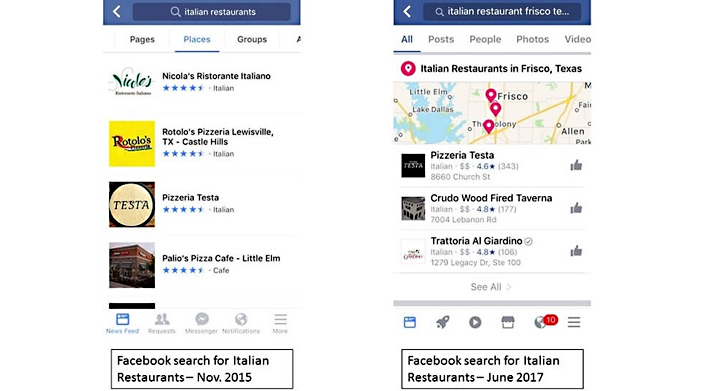
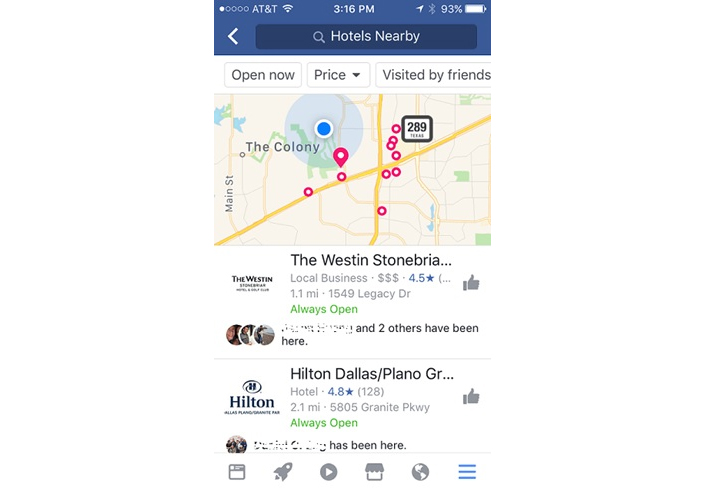
    As documented by Google’s emphasis on proximity and physical address in getting higher local search results, location is the most important aspect of local search. In this purview, Facebook is focusing on highlighting the map at the top of the local business pages in the about us page as well as the home page. In a test conducted by Facebook where the location was not specified by the users, the got results from far off places. However, today, with the improvement in local searches, if you search for restaurants in India, you may get the results of the restaurants within two miles of your current location. Moreover, the results also include the address and the map location. The below image is a comparison of search results in November 2015 and June 2017, which demonstrates the differences in the local listing:


    Priority is given to the place

    With Facebook focusing more on the search result, it is not only using the location more efficiently but also giving much importance to places. Earlier, the places tab was not given any importance by Facebook, however, the tab is highly functional today and it provides the most relevant information for all searches. For example, if a user searches for the best plumbing service Bangalore, the search results show the returned places at the top of the results page and the local business follows next.

    The search results are more specific and robust

    The search results today are not only relevant to the search term but also they provide in-depth information. For instance, if your search for the best lawyer Mumbai, the search result will not only list the lawyers in the vicinity but also would show their address, distance from your current location, their office hours, rating points and even the profile picture. The listing also provides information on the type of lawyer they are and their field of expertise like criminal law, family law or real estate law.

    Improved indexing of information

    One of the major problems that Facebook previously had was with that the indexing of the information was pretty poor. However, Facebook has fixed this problem, which is in line with its focus on improving the local search. The social networking platform has also helped improve the search functionality by adding suggested search terms when the user is trying to search for a particular thing in the search box. The suggested terms frequently pull up the various business categories that Facebook offers to its business users and help them identify the type of business they are into.

    Facebook is testing its beta version of new features including local search and integrating friend posts

    In its bid to make the search unique than Google search, Facebook is trying to incorporate the social media data in its search results. The global social networking giant has been testing with a few users who have mini profile pictures to place the listings of their friends who have either checked in at a certain place or have posted about a particular place or business organisation.

    It is a known fact that the users are prone to trust their friends when it comes to providing reviews. Knowing that a particular person has chosen to subscribe to the services of a certain business, it becomes easier for the users to make their decision. With the huge volume of users on Facebook and the vast information available Facebook could literally change the face of the local search business.


    Facebook is building its database through crowdsourcing

    Facebook, undoubtedly has a huge user base and it is leveraging that manpower for free, just as Google did with its ‘local guide’ plan, which proved to be quite successful. Facebook has been asking its users to provide details about the different places that they have checked into through the Facebook editor. At a time when the user check-in or tries to tag a place, the person will be prompted to answer a series of simple Yes-or-No questions, such as does the place have a parking lot? Is the place open on Monday’s?

    Introducing City Guides

    One of the most popular subjects that most users love to post on Facebook is travel. It has been reported that the social media platforms like Facebook, Twitter, Instagram and Snapchat are helping boost the people’s spending on things like travel, food and entertainment; people love to share with their friends new experiences about their travel adventures and the exotic places they dined at.

    In this regards, the Facebook created city guide to provide people information on the most popular places and the most frequently visited places by people from around the world. One of the distinct features of city guides is that it provides information about the user’s friends who have been to the place they are looking for and when the users tap on the friend, the city guide will bring up a list of the places they have visited. Also, the city guide is designed in a way that it provides information on the local favourites.


    How to be found on Facebook search

    With Facebook introducing all the above improvements to its search functionality, users now have all the reason to spend more time on the platform and consume more content. Thankfully, Facebook has realised the importance of penetrating the local search business, which can greatly help the small businesses to cater better to the audience. So, if you are a business owner, it would be the best time for you to review the About Us Page on your website and look how the information is showing up on the search result and ensure that the page picks up the increasing traffic through Facebook. Here is how you can get started:

    First and foremost review the business profile on Facebook and make sure that the profile is complete including contact information and other vital details about the business.

    Ensure that the local information is accurate and a physical map location show up at the top of the business profile when the page is displayed.

    To describe your business better and get higher traffic, add business categories. Although when you create your own Facebook page, you would be asked to mention just one business category, you can later edit the About section and 2-3 more business categories. This will greatly help in improving the visibility based on the search terms used.

    Activate the buttons on your Facebook profile like call-to-click and appointment schedulers. This will have a significant impact on conversion rate.
    Never leave any sections on the page blank. This may lead Facebook to crowdsource answers. If the question is not relevant to your business, you can answer NO or indicate that the question is not applicable to your business.
    To conclude, Facebook is making some serious in-roads in implementing changes that would improve its local search; especially in melding social media data with local search results. This may put Facebook right at the top as one of the major search players and a leader in the local search business.

  • Understanding Facebook’s news feed algorithm and the way ahead

    Understanding Facebook’s news feed algorithm and the way ahead

    In the recently concluded F8 Developer conference Facebook announced a plethora of new products and tools, which are aimed to improve the user experience of millions of users around the world. Whilst there were more than 60 sessions during the course of the conference, one of the key sessions that happened at the conference from the social media marketing perspective was the Adam Mosseri’s session. During the session, Mosseri, the VO of New Feed at Facebook explained the working of the news feed algorithm and how it dictates what type of content every uses sees on his/her Facebook timeline.

    Today, more than a billion people from around the world get their daily news and other insight from the platform and also FB has been the prime source for the marketers from around the world to get referral traffic. In such a circumstance, knowing the fundamentals of the system works would greatly help you as the digital marketer to get maximum benefit from the social network. In his session, Mosseri also provided details about some of the key initiatives that Facebook is looking to implement in due course. Here is a review of some of the key things Mosseri mentioned:

    Source : Social Media Today

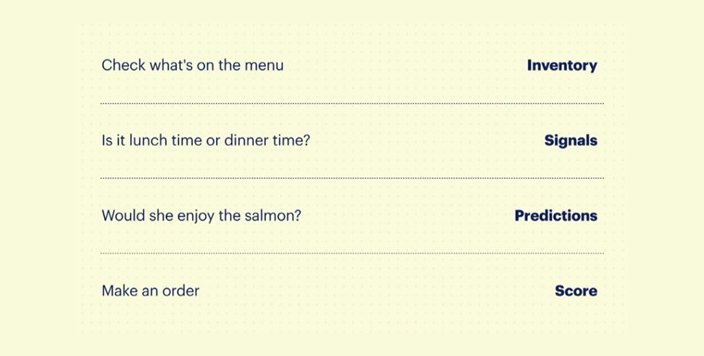
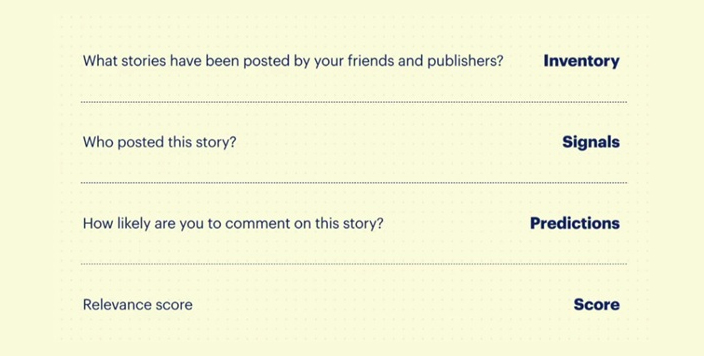
    First and foremost, Mosseri gave a broad overview of the News feed. To explain to the users about how the system works, Mosseri compared the algorithm to every day decision making process and he explained the working of the system with an example of how a man decides to order a lunch for his wife at a restaurant when she is running late. He then equated those steps to the key elements the News Feed algorithm uses when ranking relevant content.

    (see pic below to understand better)

    Source : Social Media Today

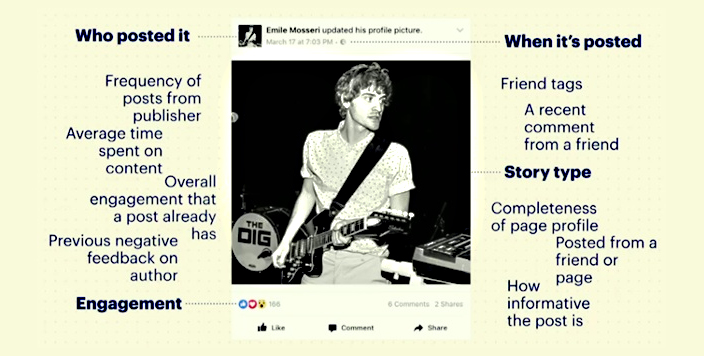
    After equating the steps with the process of the feeds, the then explained in detail how these feeds work and it determines the relevant signals. (see pic below)

    Source : Social Media Today

    To explain the important factors that determine what each user sees, Mosseri used an example from his own Facebook news feed; he showed a post from him brother who’s content he regularly sees and consumes. He explained that the algorithm analyzes several critical factors like who posted the content, the person’s relationship with you, the kind of content posted and what was your response to the similar kind of content posted in the past and how much engagement it has received.  (see pic below)

    Source : Social Media Today

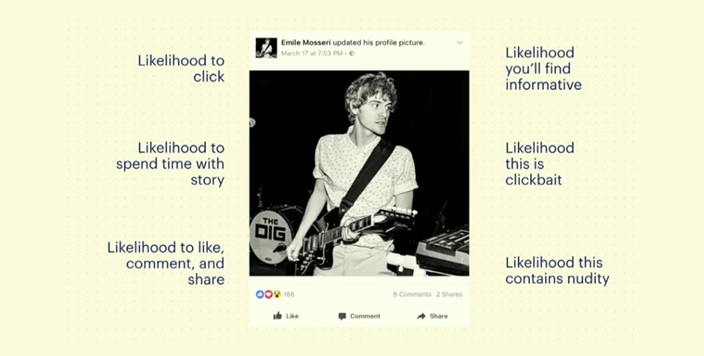
    Based on the analyses of the above factors, the Facebook algorithm then makes a series of predictions. (see pic below)

    Source : Social Media Today

    Mosseri noted that the algorithm then consolidates the predictions int one consolidated score and the scoring is done based on the different preferences of the different individuals. It is because of this core reason that each and every New Feed is completely unique and why different people is presented with different content everyday.

    Taking about the new developments to be implemented in the future, Mosseri explained that Facebook is focused on three main aspects – integrity, partnerships and discovery.

    Speaking about Discovery, Mosseri said that Facebook wants to help uncover relevant information for users. The new discovery feature correlates to the secondary new feed that FB recently tested. This helps you connect with people and pages that you are not connected currently but you would be interested in based on your previous activities.

    Whilst, Mosseir did not throw much light about their next testing, the users can expect Facebook to boost the discovery, which would eventually benefit the publishers and the pages by giving them more exposure to potentially interested users.

    Talking about Integrity, Mosseri said that Facebook is striving to provide better support to the users as well as inform communities through the information they present. The Vice-President also noted that Facebook heavily relies on the community input to detect the potentially offensive and other problematic content and make the reporting process simple.

    Source : Social Media Today

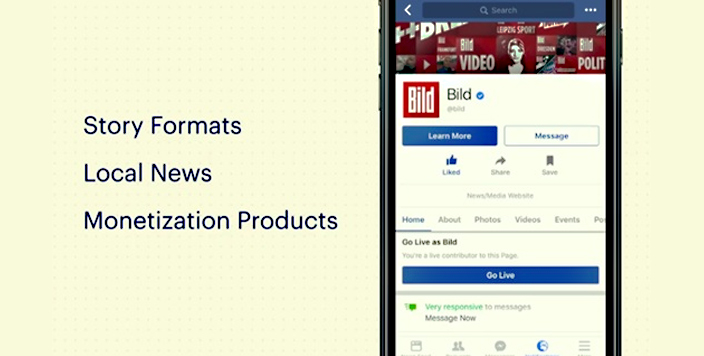
    Speaking about the local news, Mosseri said that Facebook is working with several local publishers across America to collaborate with FB and empower them to distribute better connect that would interest the local folks. In terms of Monetization, Facebook announced that they will implement a new set of measures for instant articles, which would help the publishers alleviate their concerns.


  • Top Marketing Trends Enhancing Customer Expectations in 2017 – Part 2

    Top Marketing Trends Enhancing Customer Expectations in 2017 – Part 2

    In today’s post, we will shed light on few more trends put forward by IBM and its partners that will help you drive multiple initiatives for strengthening customer connections for driving business growth and exploring innovative business opportunities. Here’s a rundown of the marketing trends that are worth paying attention to:

    • Center-brain Marketing Combines Creativity and Tech to Drive Success in a Machine Learning-Driven Future: Marketing was traditionally considered as a right-brain activity; however, marketing is also a left-brain activity that is driven by cognitive technologies, data, and analytics. Marketing will soon be under the control of left-brain people who utilise artificial intelligence and machine learning for making crucial marketing decisions. With the concept of center-brain marketing, both technology and left-brain technical people will function together with right-brain creative thinkers to attain success in a machine learning-driven future.

    Centre-brain marketing transformation makes use of technology, strategy, processes and people to make sure your organization is reaping the benefits of machine learning and left brain analytics while enabling right-brain creativity to generate the kind of revolutionary marketing that can propel the success of customers along with brand preference. Cognitive technologies will drive the future of marketing and companies lacking the right processes and workforce will be overshadowed by higher-performing business rivals. To know more, watch this video:

    • Interactive email will empower new e-commerce opportunities: Email is the ideal platform for e-commerce conversion as it delivers the highest relevance along with well-timed content to your target audiences. Since email requires recipients to click through for completing an action, marketers are now counting on HTML Commerce which will enable marketers to sell directly from within HTML emails. It no doubt, requires some effective coding and the task of populating some dynamic content to cater to individual recipients but it offers outstanding opportunities. You should always keep in mind that your email database is the most crucial asset of your business; therefore, you should come up with smart strategies to drive significant growth for your company.  Watch this video to know more:

    • The astounding growth of dark data is motivating marketers to maximize their existing data: Dark data refers to the unstructured data acquired via different computer networks. It is the data accumulated, processed and stored by organizations for conducting daily business activities but are left unused as the executives are unable to make sense of it due to lack of proper tools. According to data analysts, by the year 2020, the digital universe will be 40 times bigger due to the significant increase of dark data. The marketers find this data explosion quite overwhelming as they are not prepared to tackle the challenges that their business is about to face owing to this outburst of data.

    In 2017, marketers will emphasize more on making sense of the available data instead of capturing more of it. The focus will be on finding buying patterns, insights and behaviours in the available data.

    Leading companies will count on the following five Vs of dynamic data—

    • Volume: to determine how much data needs to be measured.
    • Variety: to determine the variety of data required from different channel and how much of it is actually valuable.
    • Velocity: to determine how fast your customer data travels.
    • Veracity: to determine the accuracy of data.
    • Value: to ensure that you capture useful data and also create more value for your consumers.

    These 5 Vs will inspire marketers to feel less overwhelmed and more confident about their business as they will be prepared to handle big data explosion. To know more, watch this video:

    • Mobile Apps are Changing the Face of Mobile Communication: Behaviour of mobile customers is changing rapidly. Today users download lesser number of mobile apps as they are moving to core apps. Moreover, at present times, brands do not consider apps as mere icons, but utilities that can have a significant impact in the daily lives of customers. To keep up with this trend, app developers are including their services– normally found within their exclusive app environment—through AI assistants, mobile operating systems, and other apps.  For example, Uber is one such app that has been incorporated into Google Assistant, Allo, iMessage, Alexa, etc. To begin with, digital marketers should find out the platforms where their customers prefer spending maximum time. Social media platforms and messaging apps are some of the places digital marketers can consider.  To know more, watch the following video:

    • Smart marketers are pursuing a comprehensive view of customers’ journey to transform customer experience: In 2017, digital marketers will be taking all possible measures to offer customers with outstanding experiences by taking into account the comprehensive view of the customer journey. Smart marketers are leveraging advanced technology to analyse customer journey so that they can identify different issues and work together with their teams to resolve the issues. Moreover, organizations are also trying to comprehend why certain customers take certain actions during their journey with a specific brand. To offer exceptional customer experience, marketers are aligning all the departments of an organization, from billing and shipping to sales and customer service so as to create interactions of superior quality across all channels. Moreover, brands have been also giving priority to customer data for understanding customer journey. Having access to customer data is the best way to get insights about customer journeys.

    Besides these marketing trends, few bonus trends have been put forward by IBM’s partners.

    • Chatbots will gain momentum across industries:  Chatbots can not only modernize transactions but also make the process of consumer interactions more efficient. Chatbots can be deployed across any messaging channel including Skype, WeChat, SMS, Facebook Messenger, and email. This year, marketers will focus more on the distinctive functionalities of chatbots so as to improve the process of interaction with new as well as existing customers.
    • Marketers will focus more on automation and personalization: Marketing automation along with data-driven personalization is currently revolutionizing email marketing. This year, most of the brands will be emphasizing more on targeted messaging for increasing ROI.
    • Performance-driven organizations will incorporate cognition and operationalisation into customer journey mapping: Customer journey mapping is a great way to comprehend customers’ perspectives as it helps businesses to cater to the requirements of their customers. It entails the creation of a visual map of the different ways in which customers connect with businesses all the way through the buying cycle. Moreover, it also motivates companies to achieve their business objectives for individual customers. This year, businesses will shape the customer experience by operationalizing customer journey maps. It means integrating the maps into the CRM platforms used by sales and customer service. Besides this, businesses will also incorporate cognitive capabilities to enhance customer engagement throughout customers’ journey and across the sales, marketing and service departments of an organization delivering that journey.

    Conclusion:

    By inculcating the trends, insights and tactics put forward by IBM and its partners into your marketing strategy, you can successfully go beyond the expectations of their customers. Smart brands follow a holistic approach to enhance customer experience. By analysing your current performance and by identifying the problem points that need improvement so as to delineate a plan of action, you can go a long way in redesigning customers’ journey.

  • Four Essential Content Marketing Tips to Help You Thrive in 2017

    Four Essential Content Marketing Tips to Help You Thrive in 2017

    The New Year is knocking the door and it is high time for content marketers to think about their content marketing strategy for 2017. According to experts, content marketing in 2017 will no doubt flourish, but at the same time, it will become more challenging; thus, brands will need to be more creative with their content marketing strategy in the forthcoming year. In this post, we have compiled four indispensable content marketing trends that you may consider to raise the bar in your business in the coming year.


    By writing compelling content, you can naturally grab the attention of your audience. Thus, before creating content, you should try to understand the needs of your customers to find out the problems faced by them so that you can generate content accordingly to solve their specific problems. For example, you may directly take the opinion of your customers through online polls or discuss with your customer care team to understand what your customers generally ask about. This will help you create convincing content that strikes a chord with your audience.


     You may not be a specialist on the subject matter you are writing about. Therefore, it is advisable to partner with industry experts and influencers to co-create content. This is an effective way of promoting your content as it adds reliability and consistency to your piece. Besides this, when you involve influencers or industry experts in your marketing content, they are likely to share it with their online followers, thus, enabling your content to reach out to a wider audience.


    In the absence of a content distribution plan, even the most innovative and engaging content may stay undiscovered. Therefore, while creating your content marketing strategy, make sure you emphasise on your content distribution plan to generate fresh traffic. Posting your content only on your website or blog is not enough. You should also enhance the social media reach of your content, and involve online influencers to share your content on their networks. The best way is to review the content distribution plan of your competitors and industry players to find out what works for you.

    Infographics are attractive visuals used for simplifying complex data in a convincing manner so as to offer greater precision. In 2017, you can use Infographics as a communication tool, recruiting tool or leads generator by demonstrating the positive facets of your business, such as your sales trends over a specific period or by displaying your survey data and other engaging information. By combining Infographics with well-written text, you can easily penetrate into the minds of your audiences.

    Video marketing too will continue to be a powerful tool for communicating your brand story in 2017. Live video will undergo massive growth in the coming year as Twitter, Facebook Live, YouTube Live, Instagram Stories and Snapchat are embracing live video with open arms. Video Marketing not only brings the highest ROI but also helps brands by illustrating their value proposition and strengthening relationships with their existing and prospective customers. Thus, marketers should keep up with this trend in 2017 to notice marked improvements in their content marketing strategy.

    Content marketing tactics are constantly evolving. Moreover, every brand is different and calls for different content marketing strategy; thus, it is imperative for digital marketers to determine what works well for their brand and what does not, so as to evolve their own digital marketing strategy.

  • How Smartphone Users Engage with Mobile Apps?

    How Smartphone Users Engage with Mobile Apps?

    A survey recently conducted by Google and Ipsos reveals how smartphone users discover, use and engage with apps. Our last post emphasised on the crucial factors that drive smartphone users to discover and use mobile apps. In this post, we will be analysing how mobile app developers keep people engaged with apps.

    How Smartphone users engage with apps

    People install mobile apps to make their life easier. Moreover, if an app helps serve a specific purpose, people are more likely to use them repeatedly. According to the survey, providing users with a wide array of interesting features and personalisation options are two crucial factors that keep users engaged and help build app preference.

    The Role of Value and Convenience in Keeping Users Attracted to an App:

    The most challenging issue is that apps can be immediately abandoned by users after making a transaction or finding the required information about a product or service. The survey revealed that 38% of users mostly download a mobile app when it is necessary to complete a purchase, post which they uninstall the app as their purpose has been served.

    Key Factors

    Thus, it becomes important for app developers to take measures to ensure that their apps are utilized by smartphone users not just once but over and over again. This can be done by adding value and utility to an app so as to avoid getting lost in the quagmire of apps available in the app stores.

    Reengaging With the Brand:

    App users need some motivation to re-engage with the abandoned apps. Since apps are quite useful during the purchase journey of consumers, app developers should take every possible measure to understand the consumers’ purchase journey.
    There are several ways for app developers to win back their app users such as—adding new features to the app, offering attractive discounts, and less data consumption. Some other interesting findings from the survey are as follows:

    Reusing app

    • 36% of users said they would reuse the app if it was redesigned for easier use, whereas 32% users would prefer apps that use less mobile data; and

    • 13% of users opined that they would reinstall apps if the apps offer discount coupons for their next purchase, whereas 17% of users are willing to use uninstalled apps again if the apps offer exclusive offers on products.

    • Another 13% of users would reconsider using an app only if their family and friends start using it.

    Mobile App Engagement Ads on Search Networks:

    Such ads can go a long way in reminding users about the value of an unused app. They remind people to open your app again for making a purchase. For example, if you are planning to buy a leather jacket, you would search for “ladies leather jacket”, and since you already have a shopping app installed on your smartphone that you had used last year to buy a pair of summer jeans, the same app can reach out to you by displaying ads in search results on your smartphone or tablet so as to remind you of its existence and notify you about a discount on leather jackets.

    Deep Links:

    This is yet another way app developers can help users to discover what they are looking for. For example, by incorporating deep links to an ad, mobile app engagement ads can directly link you to the listings within the app for leather jackets for women.

    Stand Out From the Crowd:

    Last but not least, app developers should keep in mind that the market is teeming with countless apps. Therefore, to catch the attention of users, app developers need to design unique apps so that people get enticed to use them time and again.

    By adhering to these guidelines, app developers can keep users engaged with their apps. The findings from the survey conducted by Google and Ipsos MediaCT will not only help app developers to come up with effective app marketing tactics but also to attract and retain customers.

    What steps are you taking to differentiate your mobile app to keep your users engaged? Do share your ideas by commenting below.

  • How Smartphone Users Discover and Use Mobile Apps?

    How Smartphone Users Discover and Use Mobile Apps?

    Mobile apps have become an essential part of our lives. They are downloaded by people almost every day from the two popular app portals— Google Play Store or Apple App Store where users can discover, purchase and download interesting mobile apps for streaming music, tracking fitness, online shopping, cashless banking, and much more. However, app stores are not the only means to find out new apps. Based on some astounding statistics generated by a survey carried out by Google and Ipsos MediaCT, this post will elucidate how people discover and use new mobile apps from app stores to suit their requirements.How Smartphone user discover and use mobile apps
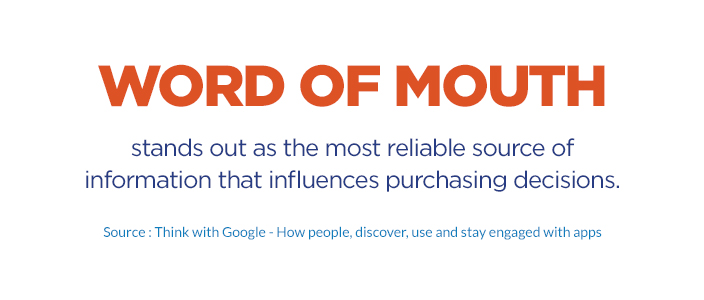
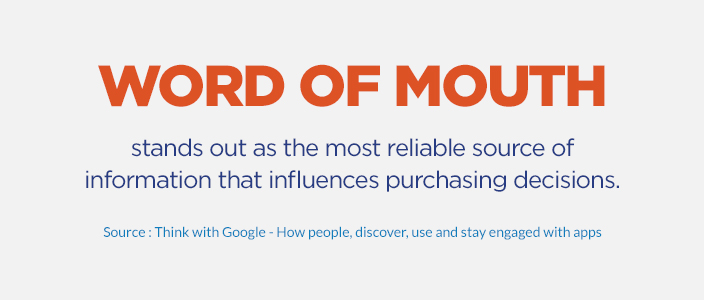
    1. Word of Mouth—The top channel for discovering apps: Word of Mouth stands out as the most reliable source of information that influences purchasing decisions. The study conducted by Google and Ipsos revealed that recommendations by friends and family act as the topmost way of discovering new mobile apps.Word of Mouth

    Since consumers are becoming more cautious about downloading new apps, encouraging users to use a particular app is not easy unless it has been tried and tested by their friends or relatives. According to the survey, 51 percent of users download apps based on recommendations from those they trust.

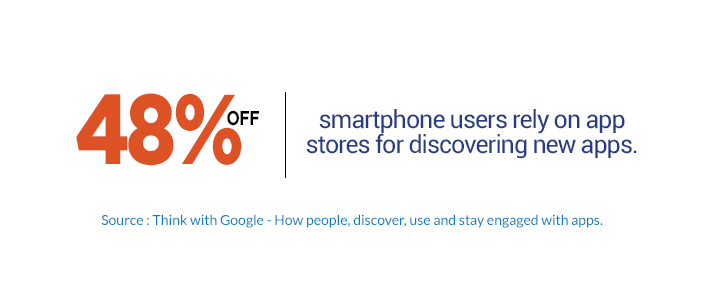
    2. Browsing the App Store — According to the survey done by Google and Ipsos, 48 percent of smartphone users rely on app stores for discovering new apps. Apps stores feature a search function to allow smartphone users to find out new apps that they might have heard about from their friends or work buddies.

    Smart phone users

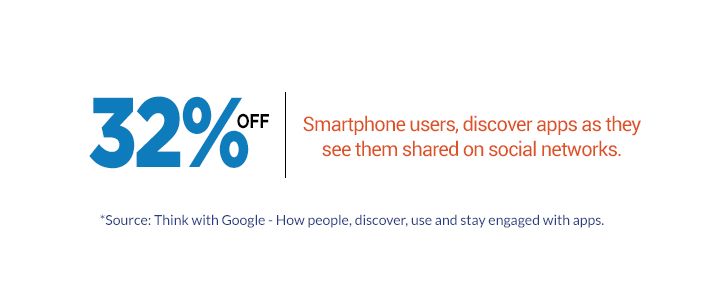
    3. Social Networks/News Portals/ and Blogs — 32 percent of smartphone users, according to the survey, discover apps as they see them shared on social networks. It goes without saying that app developers are making the best use of social media platform to promote their apps. News and updates shared on social platforms such as Facebook, Twitter and LinkedIn not only help people discover new apps but also persuade them to install the app.

    Discover mobile apps

    The survey further states that 32 percent of surveyed users have discovered new apps by reading about them online. There are countless blogs and online portals that provide the latest information about mobile apps to inform readers about some of the most incredible innovations.

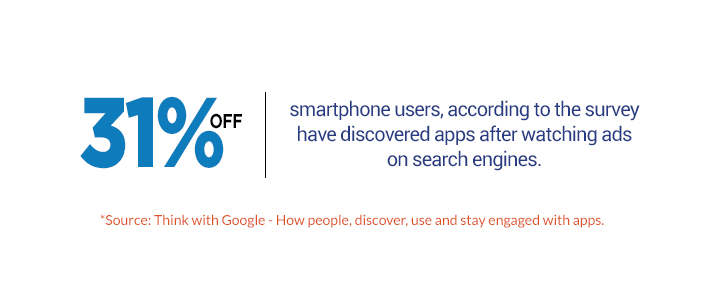
    4. Browsing the search engine — According to Google, one in four mobile apps is discovered by users through ads on a search engine. Thus, search engines are another good source of discovering mobile apps. 31 percent of smartphone users, according to the survey have discovered apps after watching ads on search engines.

    Discover apps

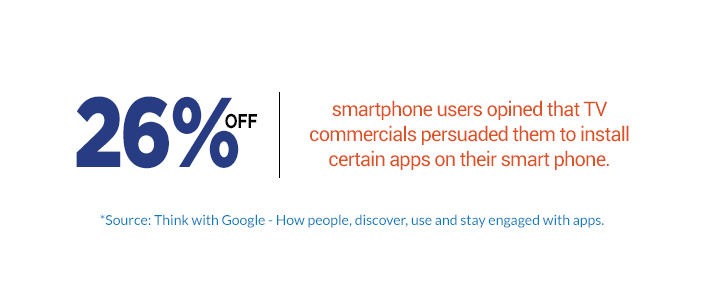
    5. Ads on TV or YouTube — In order to reach more audiences, app developers are increasingly cashing in on TV ads as commercials are a great way to convince users to install mobile apps. 26 percent of smartphone users who were surveyed by Google and Ipsos opined that TV commercials persuaded them to install certain apps on their smart phone.

    App Installation

    Similarly, YouTube ads also play a key role in increasing app installs, as 20% of users stated that they have installed mobile apps after watching its ad on popular video-sharing website YouTube.

    6. Through Search Engines— The survey further reveals that 21 percent of users discover apps through the search engine. Search engines thus act as one of the key drivers of app discovery.


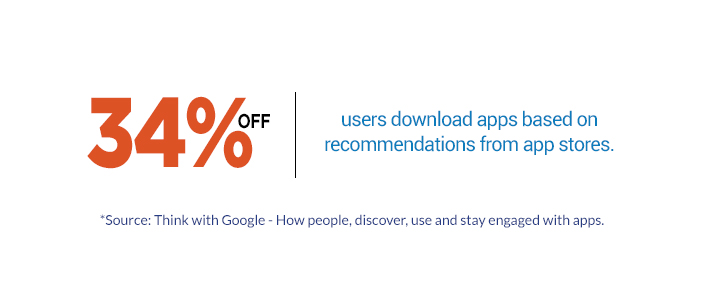
    7. Recommendation from app stores — While downloading an app from an app store, a list of recommended apps pops up based on the apps you have been searching for or the apps that are currently installed on your smartphone. According to the survey, 34 percent of users download apps based on recommendations from app stores. For example, if you are downloading a music app, your app store will present you with a list of several other music apps that you may consider downloading.

    app recommendations

    To reach out to their target customers, mobile apps designed by app developers are submitted on app stores where users can download or purchase the app after discovering them. Analysing the behaviour of users for discovering apps can help mobile app developers to come up with the right strategies for promoting their mobile app. Now let’s discuss the top motivating factors that excite people to install apps.
    What Motivates Users to Install Apps?
    Price is the most significant factor that motivates users to install an app discovered by them. According to the survey by Google and Ipsos, 85% of users are motivated by the price of the app. As far as paid apps are concerned, 50% of users prefer paying for an app only if the app offers the content they are looking for, or there is no free alternative for the app.

    The survey further establishes that 84% of users are motivated by privacy or app security and 71% of users are motivated by the utility as well as the description of the app. Furthermore, 66% of users install apps after determining how much memory an app would be using. Ratings for app install

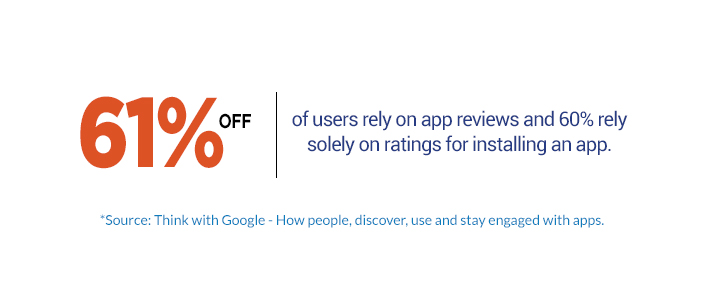
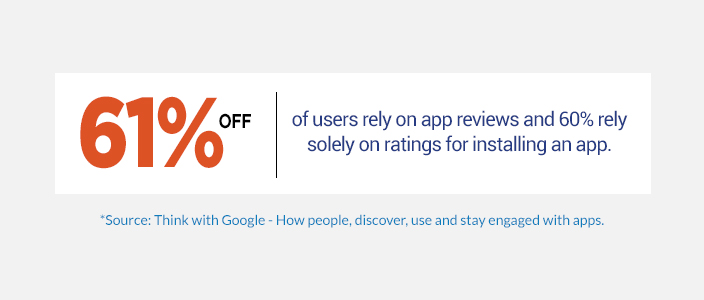
    App reviews and ratings by users serve as another motivating factor as 61% of users rely on app reviews and 60% rely solely on ratings for installing an app. Besides this, 28% of users are motivated to install an app if the app is used by a large number of users or by a majority of their friends and family. Last but not least, 20% of users, according to the survey install an app only after watching videos about the app.
    What Drives People to Use Mobile Apps?
    According to the survey, on an average 35 apps are installed by users on their smartphones. Of all the apps installed by mobile phone users, 52% of the apps are used on a regular basis. Of the 52% apps, 31% are used on a daily basis, whereas 21% of apps are used on weekly basis. The survey further revealed that 61% of people prefer using apps if they are easy to use and navigate. Besides this, 34% of surveyed users opined that they prefer using an app if it helps explore new things, whereas 26% of users value those apps that send them useful notifications regularly.
    Furthermore, 29% of smartphone users, according to the survey prefer personalizing the apps so as to derive the best experience, and 28% of users have a preference for apps that offer a large range of things to explore. Also, 19% of users admitted using an app if it belongs to the brand or company that they use frequently in real life. Some other valuable factors that make an app desirable are— its appearance, relevance, convenience, along with discounts and deals offered by the app.
    Mobile App Engagement— The Biggest Challenge
    The frequency of app usage is again driven by several factors such as immediacy and convenience. If users do not find an app useful or convenient, they uninstall it immediately. Thus, even if a mobile app developer succeeds in getting a large number of users to install their app, the most difficult part is to spice up the apps in creative ways so as to keep users engaged so that they don’t end up uninstalling it.
    So what factors drive a user to abandon an app and what motivates them to use some apps repeatedly? Stay tuned for our next blog post in which we will throw light on these important aspects so that you can develop an effectual mobile-app marketing strategy.

  • Four Brands using Facebook Marketing for their Benefits – Part 2

    Four Brands using Facebook Marketing for their Benefits – Part 2

    Using Facebook Marketing @LogicserveDigi

    Our previous post shared examples of two brands that are making optimim use of Facebook marketing, to establish an audience connect.  Here are the other two you must check, to know what works for them

    1.Fastrack

    Total Fans: 9151208

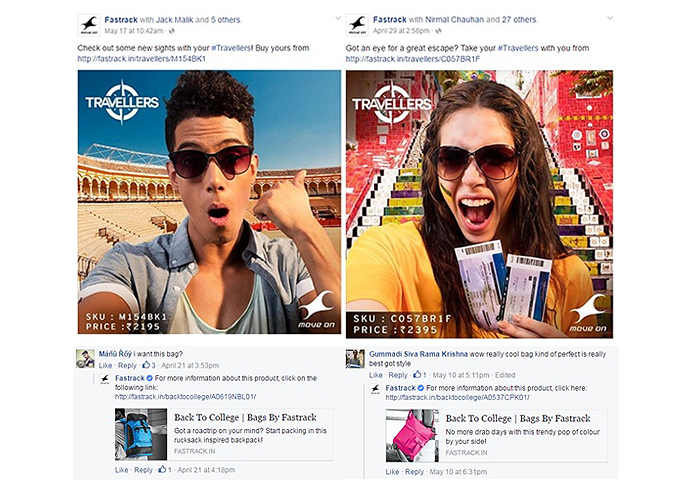
    Fastrack stays true to its tagline “Move On.” An early adopter of social media, Fastrack has managed to deliver quality content, engaging campaigns and build a strong online community. With their experimental and innovative approach, Fastrack has managed to use Facebook for increasing its revenue. Essentially a youth brand with a target audience of 15-25 year olds, Fastrack is a community of over 9 million fans with a monthly engagement of close to 170,000. The current content theme revolves around “Travelers” which is also in sync with its ongoing TVC campaign.

    Facebook Marketing @logicserveDigi

    Fastrack majorly uses Facebook for product promotion and awareness. The brand interacts with its audience through posts and comments resolving queries pertaining to the product. However, almost all interactions lead the user to the website leaving any room for real conversation between the users and the brand.

    2.Kingfisher:

    Total Fans: 7345856

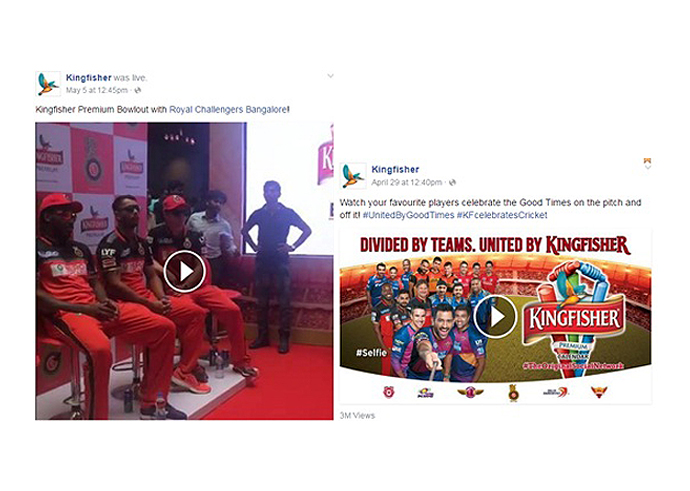
    The King of good times is also the king of social media in the beverage section. Kingfisher’s online community is 6 times bigger than its nearest competitor. As compared to other sectors, alcohol brands have always struggled to grow their community at a faster rate in India. The reason for this could be the culture and the fact that people do not like to publicize their association with alcohol. It is interesting to note how Kingfisher managed to lead this race with a greater margin. Most brands in India rely heavily on Cricket and Bollywood as the main component to connect with the audience. Kingfisher takes a similar route and makes it relevant. The content theme is a mix of party, music, good times and lots of sports. With the ongoing IPL season, the page is filled with real-time posts and videos from the live matches.

    kingfisher social network @LogicserveDigi

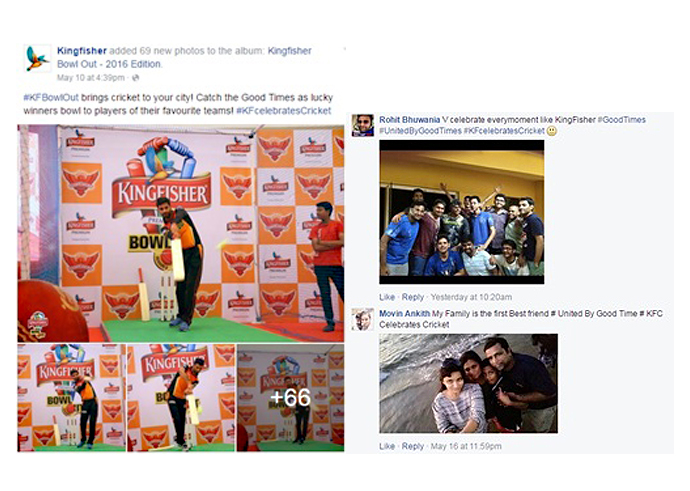
    Simultaneously, Kingfisher also runs offline engagement mapped with online activities. One such ongoing campaign is #KFCBowlOut. As seen on the page, users are also posting their photos from the stadium.

    kingfisher social media @LogicserveDigi

    When it comes to consumer interaction, Kingfisher’s Facebook page receives over 160000 monthly engagements. At this stage, Kingfisher is doing everything right with its content and campaign. Without having to hard sell any products, Kingfisher has managed to create a huge community, effectively engage with them and set a benchmark for other brands in alcohol sector.

    Conclusion:

    Based on above learning, what accounts for a successful Facebook marketing strategy?

    1. Relevant Content – Make sure the content is relevant to the audience as well as the brand.
    2. Interesting Campaigns – Engage the audience in fun and interactive campaigns. Gratify them for their interaction with the brand.
    3. Response Management – Tap into the right conversations and convert them into leads. Every fan is a potential consumer.
    4. Paid Campaigns – None of the above brands managed to build a large community with an organic strategy. At some point, every brand has to have a paid campaign strategy. Reach out to the correct audience and engage them with interesting content and campaigns.


  • Has Twitter already replaced customer service executives to answer queries real time?

    Has Twitter already replaced customer service executives to answer queries real time?

    Customer-Service @LogicserveDigi               Source: Adweek.com

    Gone are the days when you stood in queue for hours waiting for your turn at the customer service desk hoping to have your problem solved. In fact, even long gone are the days when you wrote a brand’s customer service voicing your grievances, and waiting for sometimes weeks at end to hear from them. With the rise of Twitter, which was actually started solely with the purpose of information dissemination, the walls that separated celebrities and brands from their audience have been all but brought down.

    How did this happen?

    Open platform for communication

    Perhaps, the greatest up side to Twitter is how much of an open public platform it is. This in itself pushes a brand to maintain transparency and be conscious and discerning towards its followers. Think about it. What do you do when you’re stuck with something and Google doesn’t throw up too many solutions? You tweet it to the right people, even if that means directly tweeting to the brand! Why? Proceed to the next point.

    Faster dissemination of information and shorter attention spans

    With its character limit of just 140 characters and real time sharing and reporting of data, the rate at which communication takes place and information gets shared on Twitter is unprecedented.  This in turn has significantly reduced the attention spans of people as well as lowered patience levels. When your timeline is refreshed with content every three seconds, the idea of waiting for 48 hours for a response is borderline outrageous. Lagging behind on responses or non-responsiveness will only make a brand lose out in the digital clutter. Twitter is for people who like being on their toes, and tell the world about it all the time. If a brand wants to catch up this kind of audience, it needs to be on its toes too.

    This is the age of digital equity

    Word of mouth, now, happens through social media. Your clout is measured in the number of followers you have and how many retweets can you gather. Moreover, how people feel about a brand through its online presence and interaction dictates their choices, decisions and behavior offline.

    In fact, did you know that 67% users prefer contacting a brand through social media, while 33% of them do it via their phones? As a matter of fact, according to a study by Zendesk, 40% customers switched brands due to the brand’s reputation for better and faster customer service!

    This has not only changed the rate at which brands have to maintain communication with their followers, but also how do they communicate. For a brand to stand out and hit the right chord with its audience, it is mandatory that the brand first humanizes itself. Luckily, there are quite a lot of brands who have nailed this, and have set an excellent precedent for other brands and marketers to follow.

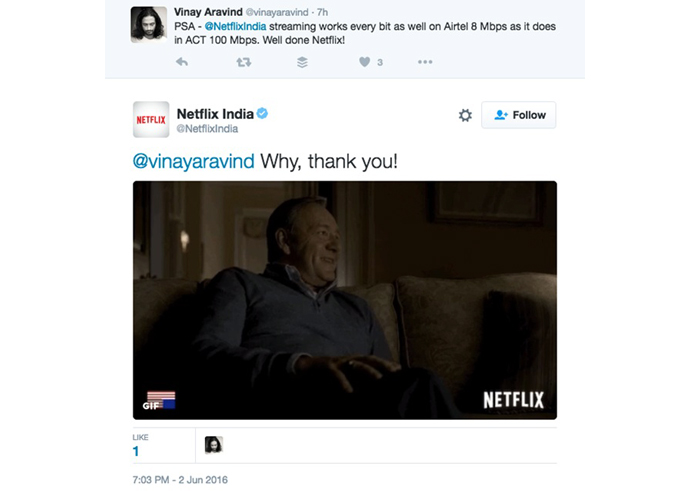
    Netflix India is one great example of quick and creative customer care:

    Netflix @LogicserveDigi

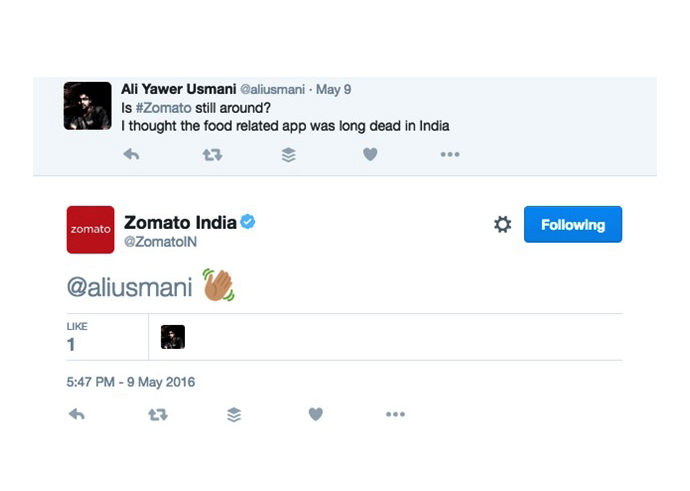
    As is Zomato India:

    Zomato @LogicserveDigi

    Zomato India @LogicserveDigi

    So, what are some of the best practices in nailing customer service through Twitter?

    • Set up a method or a format to follow: how will you tackle a customer? Will you direct the conversation to email or phone?
    • Be prompt! Remember, time is of the essence on Twitter. The more you delay, the more you allow your audience to stew in their grievances, which could only make your situation worse. Ideally, you should respond within 15 minutes. And if there’s a delay in finding a solution, then make sure you convey the same with a specific timeline. 53% users expect a brand to reply within an hour!
    • Personalize! Watch who you’re speaking to. Be the brand that cares. Preset, templatized tweets only add to a customer’s frustration and show a lackadaisical approach on your part. Address the customer by his/her first name, express empathy, and respond relevant answers instead of something generic.

    Zappos @LogicserveDigi

    • Have a dedicated handle strictly for customer care. If you’re a brand whose timeline is busy with a lot of content and activity, you might want to separate the customer care from this chaos. This way, all queries are channelized and your official handle doesn’t look loaded with complaints and queries!
    • Keep private information of customers private. If you have to ask for someone’s number or email id, make them DM your brand’s handle!

    And here are a few don’ts:

    • Never ignore negative feedback. Unless it’s something completely out of context, or someone who’s just trolling for thrills, make sure you own up to your mistakes if you’ve made any. Acknowledge grievances and take responsibility for your actions!
    • Definitely do not ever get into a verbal spat with a customer on social media. There’s no way that’s ever ending well!
    • Don’t make silly errors like a spelling mistake in someone’s name or a complete oversight of the customer’s basic problem.
    • Don’t forget to track your customer, so that they don’t have to repeat their problem to multiple people.

    Like this one:

    Vodafone @LogicserveDigi

    What are your thoughts on Twitter as a tool for customer care? Tell us!