LS Staging

Category: Search Engine Optimisation

  • 7 Uniquely Effective Ways to Earn Backlinks

    7 Uniquely Effective Ways to Earn Backlinks

    Encouraging an external website to show confidence in your work and publish backlinks to your website can seem like an arduous task. However, getting a sizeable number of backlinks to your website is one of the most authentic ways to get more organic traffic.

    Take a look at the 7 strategies you can leverage to get more backlinks and result in higher traffic to your website:

    1. Linking from collaborators

    Whether it is a client you developed creatives for, or a partner organisation that you worked with to develop a product or service, you can request these stakeholders to post a backlink to your website along with a write-up of your work to provide context. Their credentials will boost yours, and the visitors to their website may come to yours.

    2. Publish case studies and statistics

    Let’s take an example- you publish a well-researched article on non-communicable diseases, replete with latest statistics from all leading organisations such as WHO and government websites. The comprehensive information that this article can provide a reader is a valuable resource for any other online platform that also writes about health or any related field. You can reach out to these platforms with your post and request them to incorporate a backlink. It’s a win-win; they get good content while you get new visitors.

    3. Connect on social media groups

    Be it a Facebook group for media professionals or philosophy enthusiasts, you can increase visibility by posting quality comments on different posts, or even create posts. Make sure your post adds value to the conversation or members may simply take you to be a spammer. Add the backlink in the first couple of lines itself as comment snippets may hide content after a few words.

    4. Piggybacking on competitors’ channels

    This one will require you to be extra sharp and quick. Monitor your competitors’ posts on social media and other online forums. Check if there are any posts from potential clients or collaborators with queries directed to your competitors. For example, they could be asking if they service or deliver their products at a certain location. In case your company does, you can reply to their comment with a backlink! Be wary, though; you may get banned or removed from the group if it is owned by your competitor or if it’s against the platform’s guidelines!

    5. Pursue guest blogging

    If you’re an expert at something, leverage your knowledge and standing. Pitch a post idea to a relevant online platform and once approved, you could write a publish-worthy article for the platform with a backlink to your website. Again, a win-win. The platform gets a refreshing article with a new perspective while you get the opportunity to reach out to a newer audience.

    6. Engage in link round-up posts

    Who doesn’t like to read all expert opinions in one place? You could create an exhaustive but shareworthy article about any topic of your own expertise or choice, get experts in the field to provide inputs, and publish it on your website. It could be anything ranging from ‘expert opinion on raising a child with autism’ to ‘Experts tell you how to save more money’. Once the article is published, the experts featuring in your article are likely to share it themselves, and increase the visibility of your website. You can also send the article to relevant online platforms, comment with the backlink on social media posts to keep the visibility high.

    You could also be an expert on a media poll or open conversation; simply add a valuable comment and the platform may feature your reply along with the backlink!

    7. Get an interview

    Nah, we mean be an interviewee. It can be difficult to get your voice out there with so many experts in your field already out there. There’s a unique way to compete with them- subscribe to channels such as ‘help a reporter out’ where journalists and boggers put in a request to speak to whatever kind of sources they need. A good number of these journalists are associated with reputed fourth estate units, and even one mention in their article can get you enough coverage. Their article will publish a backlink to your website, and if you’re lucky, you could even get them to cover you for your work when the time is right.

    Be creative, complement your instincts with established techniques and see the fruit of your efforts- better search engine rankings and more traffic to your website.


  • Don’t be baffled by BERT: Here’s what Brands should know about this Latest Google Algorithm Update

    Don’t be baffled by BERT: Here’s what Brands should know about this Latest Google Algorithm Update

    In October 2019, Google announced a search algorithm update known as BERT that helps the search engine improve the contextual understanding of queries. While Google is known for making frequent updates to its search algorithm, BERT gained prominence as it was estimated that nearly 10% of all search queries would be impacted by it.

    What is BERT all about? 

    BERT is the acronym for Bidirectional Encoder Representations from Transformers. Let’s understand what BERT is with real-world examples. This update helps Google better understand the context of the search query, rather than just relying on keywords.

    Let’s say, a searcher uses the query “visa for travel to the USA from India.” Before BERT, the results could include visa instructions for travelers from the USA to India. It’s the opposite of what the searcher is looking for. It’s because Google used to focus only on the keywords: visa + travel + USA + India.

    With the BERT update, the results are more relevant as the search engine accounts for prepositions like “to” “from” “for” to better understand user intent.

    Google’s Pandu Nayak, the Vice President of search, explains the reason behind this update in a blog post. He states that though Google has improved understanding language complexities over the years, there were plenty of times when the search engine failed to get the context right, especially for conversational and complex queries. With the BERT update, the search engine is better able to decipher natural language questions that are becoming more relevant in this era of voice search.

    BERT Update: The Key Takeaways for Brands, Marketers and SEO Strategists 

    Traditionally search, and SEO strategies were based on keywords. While the relevancy of keywords hasn’t gone away entirely, there are a few tweaks to be done in light of this update.

    • The primary objective of this update is to provide users with relevant and high-quality search results. To meet this objective, brands must focus on developing excellent content that is authoritative, informational, and relevant to the end-user.
    • Long-tailed keywords that use connector terms and hierarchies gain more prominence. Additionally, long-tailed keywords make the content more relevant to natural queries used by voice searchers.
    • While keywords lose a bit of their relevancy, note that a large percentage of the search remains unaffected by this change. Marketers don’t have to do away with keyword-based strategies for now. Instead, marketers can monitor incoming search referral traffic and make changes based on search volume differences.
    • Developing localized content in native languages (instead of translating from English to another language or vice versa) has a better impact on SEO.

    Finally, marketers have to keep in mind; whether it’s BERT or any other algorithm updates from Google, the best SEO strategy is always the same – providing valuable and high-quality content that is relevant to what your audience is searching.

  • Studies Reveal that the Layout and Elements on SERP Determine User Navigation Behaviour

    Studies Reveal that the Layout and Elements on SERP Determine User Navigation Behaviour

    The Google SERP is constantly evolving, and today for any search query, SERP includes several features like – featured snippets, Q & As, rich answers, product carousels, video carousels, top stories and many more. There’s no fixed format. It depends on several factors like – the device used, the search query and intent of the user and more.

    The assortment of results plays a crucial role in determining user behaviour – how they navigate the search results.

    Here, in this post, we walk you through the results of two new studies that determine the impact of the SERP changes on searcher behaviour.

    Study #1:

    A recent study by the Nielsen Norman Group reveals vital insights about how the various elements on the SERP impact user behaviour. The study presents results derived by analyzing over 471 user search queries. It was conducted for three years, starting from 2017 to 2019.

    Here are the key highlights of the study:

    • 74% of searchers looked at featured snippets, product carousels, video carousels, Q&As and other rich-search results.
    • The layout of the SERP determines which links get clicks and whether organic results gain visibility. Additionally, the positioning of visually rich elements like product carousels etcetera, determine whether organic results get clicks or not.

    Image via NNGroup

    • Consider the above SERP page result for the query, “best refrigerator to buy.” Participants of the eye-ball tracking survey first directed their attention to the various rich results like – sponsored shopping cards, featured snippet, sponsored results before they even looked at the first organic result.
    • A few years back, the gaze of searchers followed a linear pattern, as search results were arranged sequentially and contained only one type of results. However, today, the gaze pattern is non-linear as the user’s gaze is influenced by the various visual elements present in the SERP. The Norman study team has dubbed this phenomenon as the Pinball pattern.

    Image via NNGroup

    • Since the results page varies significantly from one query to another, users are forced to assess the entire page, instead of just clicking on the first result as they used to do a few years earlier.
    • While images drew in the attention of a large number of searchers, other elements that gave quick answers like – knowledge panels, featured snippets are increasingly clicked on by a majority of searchers.
    • While the SERP has increased in complexity, surprisingly, the time taken for a searcher to take action remains relatively quick at just 5.7 seconds.
    • One significant difference between search behaviours in 2006 and today is that in 2019, the first result on the SERP received only 28% of clicks. In contrast, this number was 51% in 2006. The study also found that though the first three results received more than half (56%) of all clicks. The results in lower positions also received a higher proportion of clicks compared to a few years ago.
    • Below the fold clicks – The study found that for simple fact-finding queries, only 5% of clicks occurred below the fold. On the other hand, for complex research-oriented queries, 20% of clicks were below the fold. It suggests that businesses that publish in-depth content can attract higher clicks, even if they rank down the SERP.
    • Searchers went past the first page only for 2% of all queries.

    Study #2:

    Another independent analysis by Yext revealed that actions on local business listings like – making a call, asking for directions – have increased to 17% from 10% last year. This study suggests that users are getting quicker at finding what they are looking for from the results page. They are spending lesser time searching and more time engaging with local businesses.

    The Key Takeaways – What do these results mean for SEO experts and marketers?

    The results from the two studies mentioned above indicate that newer features of SERP like rich answers, snippets, video carousels, local business listings, matter just as much or even more than organic search results.

    Marketers need to work on revising their content and SEO strategies by keeping these trends in mind. Optimizing for these strategies will help businesses reach out to their audiences, even as traffic from organic results fall.

  • The Future of SEO in 2020 & Beyond: What’s Changing and What Remains the Same?

    The Future of SEO in 2020 & Beyond: What’s Changing and What Remains the Same?

    The year-end is a great time to introspect and innovate. Not just in our personal lives but also our professional lives. As the end of 2019 draws close, it’s time to revise and revamp your SEO strategies, and prepare for 2020 and beyond.

    Here, in this post, we offer insights into what we think the future of SEO holds and what needs to be done to stay relevant.

     SEO is rapidly Evolving 

    It’s no secret that SEO is fast changing. Techniques that work today can disappear overnight. Google and other search engines are changing the rules of the game rapidly, and the biggest challenge is that you can no longer rely on Google to learn the rules.

    Popular SEO techniques of yesteryears like – keyword volume, link building has become less relevant. Today, to stay ahead of the SEO race, marketers must focus on creativity, cross-collaboration, and innovativeness to design successful and sustainable SEO strategies.

    SEO is not just about increasing page ranks on Google and other search engines. It has evolved to encompass all media operations while driving organic traffic to websites. It’s no more about getting people to your site. It’s about getting them to stay – therein lies the real challenge.

    What’s the Reason behind SEO’s Paradigm Shift? 

    It’s difficult to pinpoint a single cause. Instead, it’s a result of several changes like modern technology, changes in the way users consume content online, the interconnectivity of SEO across platforms, digital marketing, and more.

    To phrase it in a nutshell, the brand must deliver what the searcher is looking. The digital message and image of a brand must resonate with the intent and mindset of the user. Meeting these requirements helps a brand build a sustainable SEO strategy, which works in the long-run.

    What does this all mean for SEO Professionals? 

    Simply put, an SEO expert must be able to deliver the right content to the right user at the right time. 

    Brands that get the right message across to users are the ones that stand tall in today’s hyper-competitive SEO arena. The future of SEO is not about targeting the right keywords or focusing on building relevant links. It’s about understanding user intent. SEO experts have to transform from technologists to psychologists who understand what the user is searching for, can empathize with the user, and better understand their behaviour.

    SEO professionals must have a clear understanding of their target audience – learn the differences between different segments of customers, understand customer intent and behaviour, to create compelling customer journeys that engage and hook in the audience.

    Blueprint for SEO Professionals for 2020 and Beyond

    Here are a few strategies that SEO pros need to work on to stay relevant in the future:

    • Brands need to build a strong message and awareness to get customers to visit the site. Understand consumer needs and wants, their intents, what drives them, and their values. Deliver a complete package – a robust website, quality branding, and useful content – to win loyal customers and build brand equity.
    • Expect a reduction in text-based search and increase in voice and keyboard-less searches. SEO experts have to adapt their content to create creative campaigns that work with new technologies like AI and voice-based searches.
    • The user is at the centre of all online marketing campaigns, and SEO strategies have to be personalized to connect and engage with different sets of target audiences.
    • SEO strategies that think like a machine, but understand human emotions are the future. SEO experts have to cater to both Google’s intelligent bots and savvy end-user.
    • Certain aspects of SEO never fall out of favour like – trust-building by brands and delivering the best experience to the end-user.

    To wrap up, SEO experts have to look beyond search engine rankings and focus on:

    • Conveying a bigger brand story that connects with human emotions and is sincere
    • Inspire new generations of audiences
    • Make companies look humanized in an increasingly mechanized and automated world

    As audiences mature, SEO experts have to transform their fundamental perspectives to create sustainable brands that not only drive traffic but win customer trust and loyalty.

  • YouTube Announces Several Features that Simplify Management of Video Marketing Campaigns

    YouTube Announces Several Features that Simplify Management of Video Marketing Campaigns

    YouTube recently announced the launch of video reach campaign, which will replace separate video campaigns and make it easy for marketers to accomplish their goals on the platform. 

    Today’s consumers are moving faster from one channel to another and researching brands in an innovative and unexpected ways. With the increase in touchpoints, mapping the journey of the modern, tech-savvy customer is highly complicated. This presents marketers with several new challenges.

    In a blog post published in September, the Vice President of Product Management YouTube, agreed that while YouTube offers different solutions to meet varying marketing goals, choosing the right solution takes time and complicates the task of marketers.

    A Single Campaign for all Types of Video Ads

    YouTube intends to overcome this challenge by presenting marketers the Video reach campaigns, which is a more effective and simple way to help brands achieve their marketing goals.

    Rather than using separate marketing campaigns for different video ad formats like 6-second bumper ads, non-skippable, in-stream ads, skippable in-stream ads, YouTube now makes it possible to manage all types of video creatives from a single campaign. Google’s advanced machine learning algorithms will automatically choose the right combination of video formats based on marketing goals.

    To give an example, if the marketing goal is to drive brand awareness, then the Video reach campaign may show 6-second memorable ads that captivate audience attention. On the other hand, if the goal is to get customers to convert, then the machine learning algorithm may show non-skippable, in-stream ads.

    Video Reach Campaign Adopters enjoy Lower Campaign Costs

    YouTube mentions that early adopters of this new feature are enjoying positive results and lowering campaign costs. Lisa Schoder, Head of U.S. Media at Ford, states that “Ford is an early adopter of the Video reach campaign. The automaker is using data and machine learning technologies to increase the effectiveness and relevancy of ads across campaigns while reducing the associated costs.”

    Combine Video Reach with TrueView for Enhanced Results

    YouTube states that  marketers will be able to seamlessly integrate TrueView action ads to the YouTube home feed, and get higher value conversions. By using TrueView ads, marketers can place effective CTAs in their ads that encourage customers to take a specific action.The ability to monitor and integrate TrueView ads to the YouTube home feed will  help marketers drive more conversions with powerful video ads.

    But, it is to be noted that YouTube has not yet mentioned any specific date on when this feature will be available.

    YouTube Masthead now available for TV Screens in Beta

    Apart from the Video reach campaigns, YouTube Masthead will now be available for TV screens. Marketers can purchase the YouTube Masthead for TV screens on a CPM basis and reach their audiences right where they spend most of their time.

    Just like Masthead for desktop and mobile, marketers can purchase cross-screen or single-screen buys and reserve placements on dates that matter the most to them.

    What do these announcements mean for Marketers?

    There’s no denying that the customer journey is getting complex than ever before, and video plays a dominant role in it. It’s a welcome move that YouTube has taken the efforts to simplify video campaigns on its platform.

    Increasing accessibility to advanced machine learning tools and reducing the overall costs of video campaigns works to the benefit of marketers. By utilising these new features and understanding video campaigns better on YouTube, marketers can effectively reach their target audience, right where they are be it mobile or TV screens.

  • The Massive SEO Impacts of Changing Site URLs and Why Businesses Should Avoid It

    The Massive SEO Impacts of Changing Site URLs and Why Businesses Should Avoid It

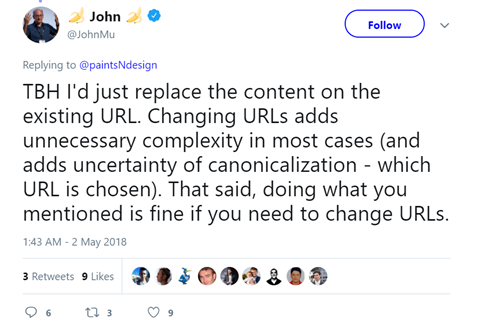
    Webmasters have always advised businesses that they must not change the site URLs unless it’s needed. Even senior Google executives have stressed this often. To give an example, here is what John Mueller, Webmaster Trends Analyst at Google, tweeted on the topic.

    Image via Twitter

    So, how do businesses determine if the change is needed or not? Read on to know more.

    One unavoidable situation where webmasters will have to change the URL is during a company rebranding where the company takes a new name. Other scenarios include major site redesign or migration, where the existing URLs are no longer available.

    Reasons why it’s recommended to avoid URL changes 

    Apart from an SEO perspective, there are plenty of reasons why webmasters have to maintain the URL structure wherever possible.

    Changing the URLs break down bookmarks that site visitors have saved in their browsers. The critical point to note here is that the URL is the direct relationship between users and the site. Changing it could lead to breaking this relationship.

    Additionally, advertisers would have used URLs in offline marketing materials like pamphlets, visiting cards, all of which must be changed.

    While 301 redirects work to redirect users from an old URL to a similar new URL, they don’t work when the site has undergone complete restructuring. If there is no direct page to send the user to, then the users are likely to get lost.

    With all these said, the number one reason to avoid changing URLs at all costs is that it impacts SEO rankings negatively. All the links earned by the site over the years is lost, and it takes a considerable time for Google to index the new pages and include them in organic search results.

    Links are still one of the top-ranking factors used by Google. Both the quality and quantity of the links play a crucial role in determining the relevancy and trustworthiness of a site. A site redesign could lead to loss of links, thereby decreasing the site’s SEO ranking.

    Ways to Reduce SEO Impacts while Changing URLs

    While it’s not possible to retain the SEO ranking as it is during a change in the URL, some best practices can help in reducing the impacts of the change.

    Webmasters who are changing the URL structure of a site should maintain a current and future sitemap. All existing pages should be redirected to a similar page using 301 permanent redirects. However, webmasters must be cautious while using 301 redirects. Redirecting an old page to a new page that doesn’t have a similar topic may lead Google to reduce the value of the new links.

    Redirecting all pages to a top-level page or homepage is also not the right move, as Google could devalue these links. Devaluation of links means that the site loses a portion of the link profile, which impacts SEO rankings negatively.

    Not just internal links, but external links must be updated to reflect the new site structure. Paid campaigns, off-site advertising, social media advertising have to be changed to include the new links.

    The Key Takeaway

    Changing the URLs of a site leads to loss of site ranking, which causes a drop in traffic. However, webmasters can overcome this loss in rankings by following a strategic site migration plan. What matters here is how long does it take for a business to overcome this temporary setback.

    This depends on the nature and the size of the business. Small businesses that do not have significant traffic influx can recover quickly from changing the URL structure, while bigger businesses may feel the impact for a longer time.

    If a URL change is unavoidable, webmasters have to ensure that they follow a proper migration plan with the right URL re-mappings.

  • Content Accuracy is Not Yet a Google Ranking Factor

    Content Accuracy is Not Yet a Google Ranking Factor

    Content accuracy has always been a point of contention among SEO experts, webmasters and content strategists. While some firmly believe that content accuracy plays a role in determining page rankings, others are on the opposite side of the camp, stating that accuracy is not a ranking factor.

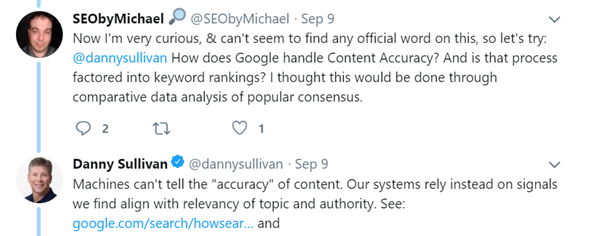
    Recently, this debate cropped up again on Twitter. Danny Sullivan, a veteran journalist who founded Search Engine Land and later joined Alphabet in 2017 as a public liaison for search, was posed this query.

    One of Sullivan’s Twitter followers asked him the following question, “How does Google handle content accuracy?” In response, Sullivan tweeted from his personal account saying that Google’s machines are not yet sophisticated to identify the accuracy of the content. Rather, their machines and algorithms rely on signals for topic relevance and authority, to decide the ranking of the content.

    Here’s the Twitter reply from Danny Sullivan:

    Image via Twitter

    Content Authority not be confused with Popularity

    In continuation with the conversation on Twitter, Sullivan was further asked whether content authority meant content popularity. He responded, saying that content authority should not be mistaken for popularity, as popularity will have no place for new queries that constitute nearly 15% of Google’s daily search volume. Also, content popularity is too simple a signal, and Google doesn’t rely on it to rank web pages.

    The Emphasis on Content Authority by Google

    In April 2017, Google announced the launch of Project Owl to improve the quality of search results. This project stressed more on authoritative content that enjoyed better ranking. Additionally, this project allowed users to send their feedback to Google regarding its auto-complete search suggestions and the featured snipped answers that were listed on the first page of search engine rankings.

    This was Google’s first step to combat the spread of fake news and misinformation on the internet. In November of 2017, Google, along with Facebook, Twitter, and Bing, agreed to use the trust indicators of The Trust Project to aid the prevention of spreading of misinformation and fake news.

    Earlier this month, Google updated its Search Quality Rater Guidelines with an aim to vet out news sources as well as creators of YMYL (Your Money Your Life) content. These guidelines have been modified to allow raters to provide content that has the potential to spread hate, the lowest ratings.

    The Debate Continues on Twitter

    Sullivan’s reply sparked plenty of replies with some users disagreeing with his answer and some agreeing to it. Some stated that today, machine learning tools could assign levels of accuracy to content. Machine learning can assess the accuracy of almost all content that doesn’t relate to personal experience.

    However, others thanked Sullivan for clarifying the issue that content accuracy is not a ranking factor as of now.

    What’s the Takeaway?

    There’s no doubt that content accuracy plays a crucial role in determining its impact on the end-user. However, content accuracy is not one of the top Google ranking factors. Page authority and relevance are likely the top two signals that Google’s algorithms use to rank content.

  • Google Introduces an Update to Help Travelers Discover Affordable Options for Flights and Hotels Booking

    Google Introduces an Update to Help Travelers Discover Affordable Options for Flights and Hotels Booking

    Whether you are heading to your dream vacation or just looking for business hotels to meet clients, the chances are that Google is your first stop. Google Flights and Google Hotels are handy tools that help you find the best travel deals. Google recently announced via a blog post, that it has introduced new features to these tools, to help travelers plan their ideal holiday for the upcoming spring break.

    Using Google Insights to find average flight ticket prices and hotel deals

    This is an excellent tool from Google for vacationers who have no prior experience of making travel bookings. The insights tool provides you the history of flight price trends on the chosen routes. You can quickly check out, whether the price for a route you are searching is high, low or average for your preferred dates. This way, you can plan your travel dates accordingly to get the best deals on flight tickets.

    Image via Google Insights

    Apart from flight ticket price history, the insights tool also helps you find out the cities that offer best hotel deals for popular vacation times like spring break.

    Image via Google Insights

    Additionally, Google has added a couple of new features that are aimed to help budget travelers.

    Get Ideas from Google for Travel Locations within Your Budget

    Most travelers are willing to explore new places, as long as it meets their budget. If you belong to this category, then the latest feature from Google Flights will excite you. You can use the world map to find out all destinations that you can fly to within your budget.

    For example, let’s say your home airport is New York City, and your travel budget is $400. Use the price slider to set the filter for the search as ‘flights under $400.’ You can use this filter to search for all flights available from your departure airport within your budget. You can either search for specific dates or use flexible dates.

    Image via Google Flights

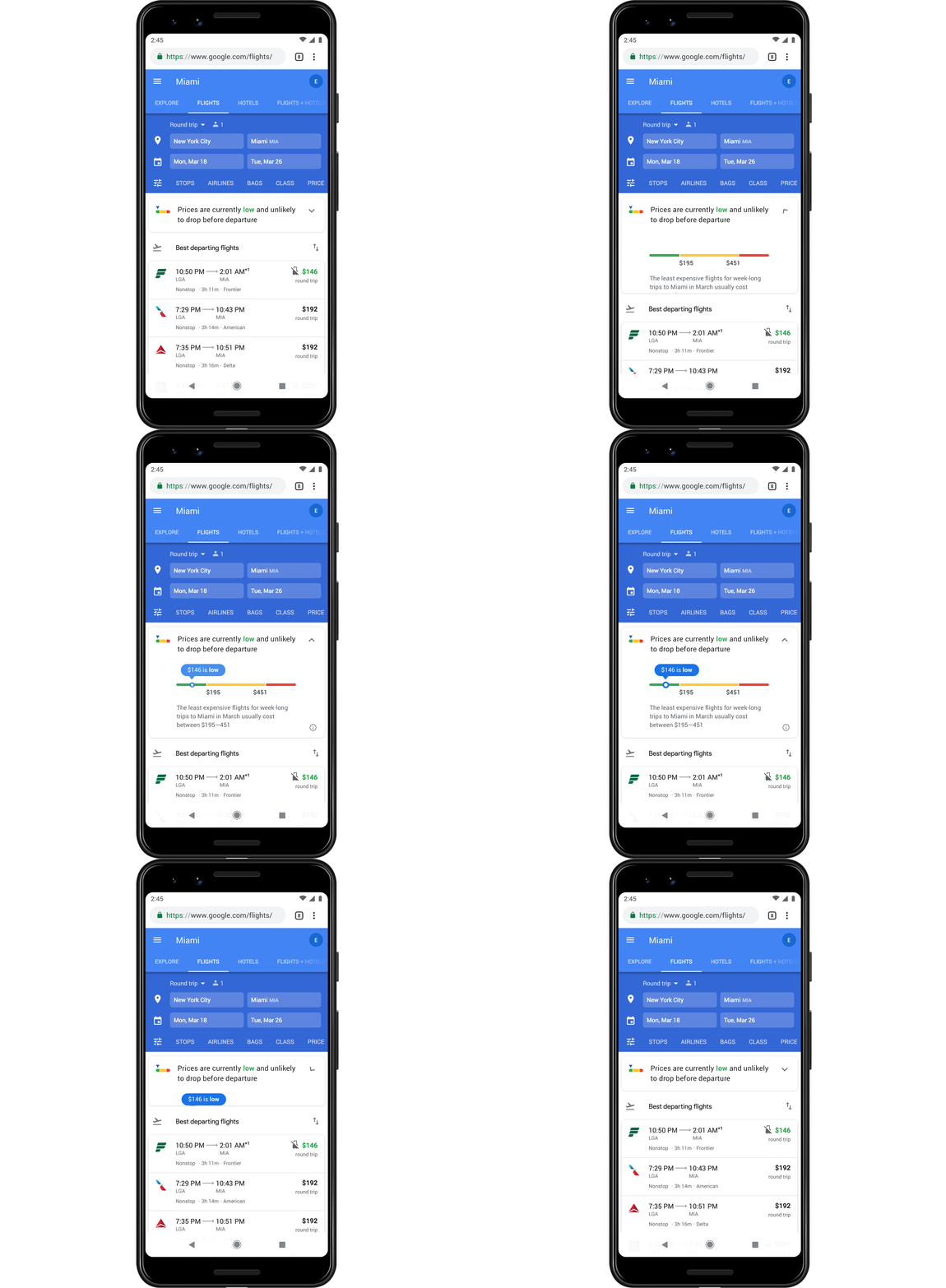
    Check the flight ticket price insight for your preferred route

    Once you choose your destination and start your search for flights, you can now see a price insight. This is a new feature Google has added. Earlier, price insights were only reserved for specific holiday dates like spring break, New Years, December Holidays, Thanksgiving and so on.

    You can now find whether the prices you are seeing are high, low or typical. Additionally, if the prices get any lower or if it’s predicted to increase, Google will alert users, so that they can lock in the tickets at the best prices.

    Image via Google Blog

    Find hotels that suit your specific needs

    Now, that you’ve decided on your flights, Google also helps you find accommodation. Usually, Google Hotels shows up the list of all available hotels in your destination for your preferred dates. Now, you can refine this search list, using Google’s new ‘Deals’ filter.

    Image via Google Travel

    This filter is powered by Google’s advanced machine learning tools to help you find hotels that offer rates that are significantly cheaper than the average rack rate for that hotel and similar hotels in the neighborhood.

    You can also know more about the hotels on the filtered list, using the accompanying photos and guest reviews that are curated to match your needs using machine learning.

    Search for Hotels near points of interest on Google Maps

    You can now search for hotels near specific points of interest/landmark/tourist attraction directly from Google maps. For instance, if you search “Hotels near Disney Springs,” on Google Maps, you can find a list of hotels, room prices, and walking and driving distance from the hotel to your preferred point of interest.

    Use these new traveler-friendly features from Google for your next booking and enjoy a great travel experience. Happy Traveling!

  • Google Opens up Access to Google Merchant Center Results for Non-AdWords Retailers in the US

    Google Opens up Access to Google Merchant Center Results for Non-AdWords Retailers in the US

    With nearly 40000 searches every second, Google is indeed the most popular search engine. When users search for products using Google, the search engine generally displays sponsored content (Google Ads) above the organic search results.

    Image via Google

    To get your products displayed in the coveted Shopping Display Panel, e-commerce websites are required to upload their product data to the Google Merchant Center (GMC). Google recently announced that it’s making a few changes to the GMC. Here, in this post, you can find all about these recent changes.

    What’s New?

    The information available in Shopping Ads is now accessible to all e-commerce retailers for free. E-commerce sellers can now directly submit the information to Google. They no longer have to add schema markup to their site for doing the same.

    What’s Google Merchant Center (GMC)?

    GMC aka Google Merchant Center is a central dashboard where online e-commerce sellers can upload their product and store data, so that Google searchers can access the latest information about your products, directly on their search results page.

    The biggest benefit of the GMC was that all information displayed on it was updated in real-time so that users get accurate information during searches.

    Earlier, the data from the GMC was primarily to the benefit of Google AdWords users and not available to other e-commerce sellers. Online retailers had to use the schema markup of their sites to display the relevant information along with the right product images. The information displayed on the Shopping Display Panel included product price, availability, user ratings and more.

    How does the Latest Update Impact You?

    Recently, Google announced that it’s opening up the GMC for all online retailers, irrespective of whether they use AdWords or not. This works to the benefit of online retailers who are non-AdWords users. You can submit your product data to Google in real-time, thereby making your products eligible to be viewed in organic and image search results on Google.

    This is an excellent news for online retailers as it gives them better control over how their products are displayed on Google search results. Google further stated that products displayed on the Google shopping ads panel would be ranked based on their relevance to user queries online. Relevance is calculated using several factors like search history, the location of the searcher and so on.

    Online retailers can now submit the information directly to Google and not just by using the schema markup of their site.

    Three key benefits for Online Retailers via this Update:

    • You don’t require an AdWords account to upload your product information on Google
    • It’s free of cost
    • You can submit your product info directly to Google, giving you better control of your product display

    Is this Update Available for All?

    Right now, Google Merchant Center has extended this facility only to online retailers in the US. However, it’s expected that Google will roll out this change in other countries in the next few months.

  • Writing for Search Engine Bots Vs. Writing for People – Which Approach Works in 2019?

    Writing for Search Engine Bots Vs. Writing for People – Which Approach Works in 2019?

    When it comes to content writing, there are two distinct approaches to take. One – write for search engine bots, filling your content with keywords. Two – write for your readers, offering them value, while making your content click-worthy and share-worthy.

    Both these strategies have a common goal – to boost the visibility of the content and to pull in more traffic. But, which of these two approaches work? Find out here.

    The End of the Black and White Hat Techniques

    For years, SEO specialists and digital marketers have been trying to win the attention and favor of search engines by employing various techniques commonly known as white hat and black hat strategies.

    Simply put, black hat was for those who aimed for quick results, by using not-so-scrupulous techniques like hidden texts, keyword stuffing, content spamming, link farming and so on. On the other hand, white hat played by the rules of search engines, meaning results took longer to materialize. Effective keyword usage, internal linking, generating relevant backlinks were some of the popular white hat strategies.

    While white hat strategies are more ethical, the point here is that search engines have come a long way and have seen significant evolutions. The complicated Google algorithms of today penalize both black hat and white hat strategies. That is because Google doesn’t want to be manipulated anymore. When you employ these strategies, you are likely to get your site to lose its ranking or even de-indexed.

    Focus on Your Audience

    Content marketing today is all about the end readers. As a content writer, you need to ensure that you are providing your audience with value, giving them what they are looking for. You need to ensure that your audience connects with your content. It’s no longer, just about satisfying search engine bots to boost your rankings.

    It’s all about high-quality, well-written relevant content that appeals to the end reader.

    What about Search Bots?

    Search engines today have highly-sophisticated algorithms that use advanced technologies like machine learning, AI and more. This means Google and all other search engines can easily identify well-written high-quality content that provides users with the relevant information, from content that was written to trick search bots.

    It’s no longer about keyword stuffing to pull in the attention of search bots. It’s all about high-quality content that offers value to readers, thereby winning the attention of search bots and ranking higher. To put it in a nutshell, if you write good content that satisfies your target audience, Google will reward you. The reverse (content written for search bots) isn’t true.

    What Qualifies as Good Content for Google?

    Check out Search Quality Evaluate Guidelines published by Google to find out what qualifies as good content, from Google’s point of view. This document is the Bible for content writers. It gives you a clear idea of how Google’s bots evaluate and rank different contents. It doesn’t just point out what is good content but also explains why content is considered bad.

    Here are some pointers that help you create Good High-Quality Content:

    • Start by defining the purpose of your content. Identify the focus topic, your target audience and the intent (what you wish to achieve).
    • Do your research. Before, you start writing spend time analyzing the topic, understand what is it about and then give your opinions/views on it.
    • Edit and use correct grammar. Use the right punctuations, grammar and try to keep the content to the topic.
    • Make it informational, educational and relevant. You need to ensure that your content satisfies the purpose. Does it provide readers with the relevant info? Does it answer their questions?
    • Always cite sources. Remember that statistics are just a string of numbers if you don’t have the relevant sources to support it. Make sure to cite the sources.

    As you can see, you can easily satisfy both your readers and search engine bots with high-quality, relevant, and engaging content. This is certainly the approach to take for content writing in 2019.