LS Staging

Category: Search Engine Marketing

  • 5 Steps to SEM Success in the Era of Machine Learning

    5 Steps to SEM Success in the Era of Machine Learning

    It’s no secret that AI and machine learning have made it challenging for SEM marketers to create new advertising strategies that work. In a recent conference at the SMX Advanced seminar held in Seattle, the keynote speaker, Nicolas Darveau – Garneau, Google’s Chief Search Evangelist listed the ways to optimize SEM campaigns in the era of machine learning and AI.

    Here, are the five steps outlined by Darveau – Garneau to help marketers outsmart the machine learning and other smart tools.

    1. Combined Measuring

    Instead of looking at customer interactions and data in separate platforms and modes, marketers have to combine data from across channels to get the bigger picture. Standalone data has to be integrated holistically, to get a clear idea of the customer profile and position in the funnel.

    Darveau – Garneau recommends marketers to measure ROI on each campaign and pool it together across ROI in all Google tools. This will help marketers to spot opportunities quickly and make the best use of it, across campaigns.

    2. Fix the Right Goals

    In his address, Darveau – Garneau illustrated this point using an analogy he picked from car insurance companies. He stated that though different car insurance companies sell similar products, each company has hugely varying goals. For instance, company A may focus on capturing the maximum number of leads, while company B might focus on selling the maximum number of policies. While company C may be focused on selling only premium policies.

    It’s essential that businesses identify their unique goals, using their market value and niche audience. Once you have identified the unique goal of your business, you can use machine learning tools, to help you target ideal customers who match your specific goals.

    3. Track the Right Metrics

    Darveau – Garneau stated that metrics vary depending on the goals being targeted. Hence, it’s essential for all businesses to know the right metrics they should be targeting to evaluate the performance of a specific campaign.

    For instance, the objective of your campaign may be boosting brand awareness, while the objective of your competitor may be increasing conversions. You cannot use the same metric to measure the efficiency of both these campaigns. Identify the right metric and then feed it to your machine learning tools to get the complete picture of the campaign.

    4. Focus on Long-term Goals

    Darveau – Garneau states that brands that focus only on short-term goals are missing out on key opportunities. When you focus on short-term goals, you aim only for acquisition. Marketers must focus on other key elements like – loyalty building, loyalty optimization, customer retention, brand value if they want to remain successful in the long run.

    5. Spend more for Acquiring the Best Customers

    It’s not just about increasing leads but pulling in high-quality leads, which adds to the customer lifecycle value. Darveau – Garneau suggests that brands use machine learning to pinpoint the ideal audience. He further stated that the extra time, resources and effort you put in to generate high-quality leads is totally worth it.

    The Takeaway:

    There’s no way that marketers can reverse or stop the progress of machine learning. It’s here to stay. Instead of fighting against it, SEM marketers should learn how to harness their capabilities for their advantage. And, they must learn it quick, if they wish to thrive and taste success in the automated digital landscape of the near future.

  • Customer Acquisition Vs. Customer Retention – 5 Best Practices to Increase Revenues

    Customer Acquisition Vs. Customer Retention – 5 Best Practices to Increase Revenues

    One of the most heavily debated issues in marketing circles is – customer acquisition vs customer retention. Here, we discuss the acquisition vs retention to help you choose the right approach for your business.

    The Growth Equation

    To fully understand acquisition (getting new customers) versus retention (getting old customers to come back and build loyalty), you need to understand your brand’s growth and revenues.

    Here’s an equation to compute that:

    Monthly Growth Revenue = (No. of new customers acquired in a month * Average spend for each new customer) + (No. of returning customers in a month * Average spend for each returning customer) + (No. of resurrected customers in a month * Average spend for each resurrected customer)

    You need to understand this growth equation to decide, which category of customers matter the most for your business. Here are some best practices to help you make the most of customer acquisition and retention.

    1. Identify what “Customer” means to your Business

    Very often, businesses overlook the crucial step of defining what customers mean to their business and how to translate it to set the goals of their search campaigns. The definition of a customer varies from business to business. For instance, some enterprises define customers as someone who purchased in the last month, while others define customers as visitors who bought at some point.

    For example, two customers purchased from you in the last month. One customer searches for your product using your brand name, while the other customer searches using a generic term. So, should you treat both these customers similarly or use different marketing strategies to acquire them? These are some aspects to consider while defining customers.

    2. Understand the Purchase Path of Customers

    To understand whether the amount you spend on acquiring or retaining a customer is worth it, you need to know your customer’s purchase path. Only when you are aware of their purchase pattern, you can justify the heightened costs of acquiring the customer.

    Remember that most customers interact with your brand using multiple channels like – direct, search, email, affiliates and more. So, it’s essential to have a multi-channel attribution model to monitor and track performance across channels.

    3. Create Tailored Campaigns to Support Different Audience Segments

    Once you have identified your customers and tracked their purchase paths, segment your ad campaigns for each category of customers. Use features like RLSAs (Remarketing Lists for Search Ads) and Customer Match, etc.

    Here are a few examples of how you can segregate audiences:

    • New and un-cookied customers (prospects) – This list consists of audiences who are un-cookied and have never purchased from you ever before.
    • New and cookied customers – This list includes customers who have visited your site, but have not made a purchase with you in forever or within a specific period, say in the last 180 days.
    • Returning customers – This includes audiences who have purchased within the last 180 days or so.

    You can also further divide customers into dormant, high-value, high lifetime value, first-time buyers and so on.

    4. Define Unique Goals for each Audience Segment

    Once you have segregated audiences, the next step is to assign a goal for each audience bucket. The goal should be aligned with the campaign. Also, remember that there is a direct relationship between customer return and revenue. If you are solely focused on returning customers, then the return revenue will be restricted.

    Generally, it costs more to acquire new customers than to retain existing customers. It costs 5x more to acquire new customers than to retain existing ones, according to a market survey.

    5. Track KPIs for Success

    Here are a few questions you must ask yourself as you evaluate your marketing campaigns: are we hitting return goals? Are new customers similar to your ideal customer profile? Are you increasing the total number of new customers acquired, while boosting profit levels? Have you managed to reduce the cost of returning customers? And so on.

    Which one to Focus – Customer Acquisition vs Customer Retention?

    It all depends on your growth equation. You must consider available resources, time and goals and decide what is best for your business. Remember that while it may make sense to focus on customer retention now, a few months down the line, once you have stabilized existing customer relationships, you may shift your focus to customer acquisition.

    Finally, to build a profitable business, you must focus on both and make incremental tweaks to your marketing strategies every few months, depending on available data.

  • Google Rolls Out Three Brand New Features, Including Video for Responsive Display Ads

    Google Rolls Out Three Brand New Features, Including Video for Responsive Display Ads

    Google recently announced via a blog post, that they are introducing three new features for Responsive Display Ads that will improve the functionality of the ad network, providing marketers with new reporting capabilities.

    Responsive Display Ads have overtaken standard ads as the preferred ad format for the Google Display Network. As you know, these ads can be used in both your conventional Ad marketing as well as for smart Ad displays.

    To generate a responsive display ad, marketers have to upload – images, logos, headlines, descriptions and video to the Display Network and Google automatically generates responsive ads that work across all devices.

    Here are the top benefits of Responsive Display Ads:

    • Ad Optimization – When you use responsive display ads, Google’s machine learning tools use advanced algorithms to determine the best combination for your assets, based on your ad’s performance over time.
    • Better Reach – Responsive display ads use several types of assets like headlines, logos, images, and even videos. Google automatically adjusts the size of your ad to fit the available space best. This means your Ad reaches a broader audience than before. For instance, it may be displayed as a dynamic text ad on one device, whereas it can be displayed as banners on another site.  
    • Makes Ad Management Easy – Using responsive display ads, managing your ad campaigns is easier than ever before. You can quickly manage different ad portfolios, segregate ads into various groups, thereby helping to improve your marketing.

    Google is now rolling out three new features for Responsive Display Ads. Let’s take a closer look at these features being introduced.

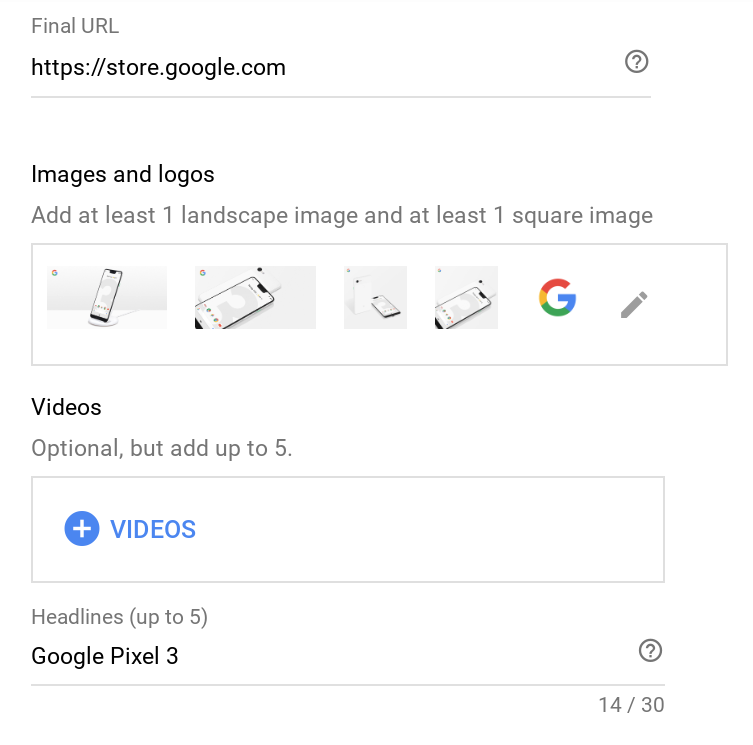
    1. Include Video Assets


    Image via Google

    You can now include videos as assets while creating Responsive Display ads. This new feature ensures that your ad has an expanded reach. When you use videos as an asset, Google automatically displays videos when machine learning tools predict that videos will perform better.

    You can select up to five different videos to be included in your responsive display ad. You can include URLs to five different videos from your YouTube channel.

    Using Ads with video assets remains the same. The process for ad creation, optimization and testing are as usual.

    2. Combinations Report


    Image via Google

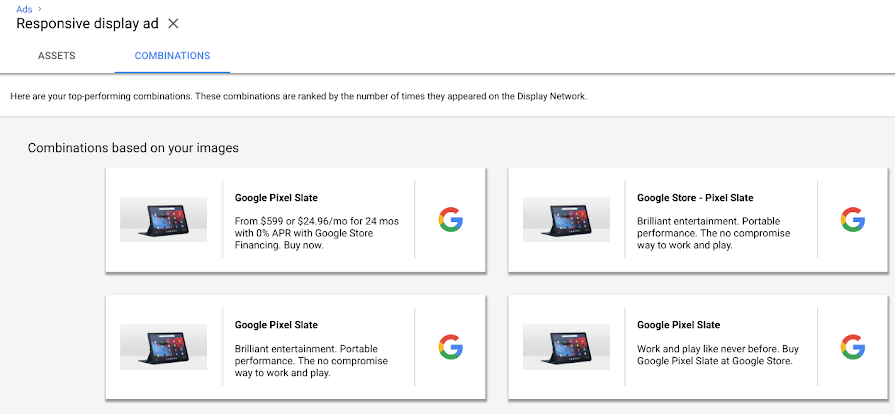
    Google has introduced a new combinations report that provides added insight into the performance of your ads. This report helps you to test the effectiveness of different asset combinations so that you can easily find out the top-performing combinations.

    The combinations report shows the list of asset combinations that are being automatically generated in your responsive display ads campaigns and helps you find out the individual performance levels. The report has a separate section allocated to various asset combinations like – text, images, dynamic feeds, headlines, and videos.

    To check out this report in your Google Ads account, head to “View Ad Details,” under the Ads tab, and choose “Combinations.

    3. Ad Strength Scorecard

    Image via Google

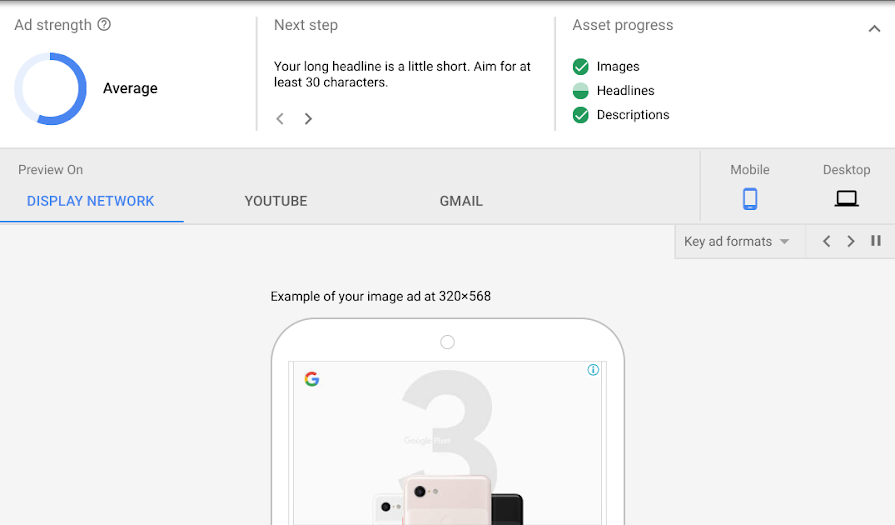
    The final feature, this helps you to figure out the strength of your ad before it goes live. The ad strength is displayed as a visual scorecard, with ratings like “Average, Good, Poor and so on.” Google monitors the strength of your assets like unique headlines used, complete and relevant descriptions, image quality and other factors to determine the strength of your ads.

    Additionally, you can also find further recommendations to improve the score of your ad, by clicking on the “Next Steps,” section.

    Which of these three new features are you likely to use as a digital marketer?

  • A Paradigm Shift in the Ad Industry: From Cookie-Based Remarketing to People-Based Targeting

    A Paradigm Shift in the Ad Industry: From Cookie-Based Remarketing to People-Based Targeting

    Just a few years ago, cookie-based remarketing was the biggest trend among marketers. It helped advertisers and marketers retarget customers effectively and helped to close the deal.

    However, the biggest problem with cookie-based ads is that they are getting increasingly irrelevant and ineffective, thanks to the popularity of mobile apps, and other walled networks like Facebook, Google, and Amazon.

    Studies report that over 66% of mobile devices that are in use don’t accept cookies. That presents a significant loss in traffic volumes. Additionally, today users access the internet across devices – smartphones, desktops, laptops, tablets and more. Apart from devices, they are also using different browsers (Firefox, Chrome, Safari, and others) for each device, making cookie-based ad targeting irrelevant.

    So, what does this mean for marketers?

    Cookie-based advertising is fading fast. This is where people-based targeting comes into the picture. As the name implies, people-based targeting helps you track an individual across devices, browsers, and apps.

    Here, let’s show you two significant initiatives that are currently being deployed for people-based targeting: the IAB Tech Lab’s DigiTrust and the Advertising ID Consortium.

    Though both these methods are different, they have a similar goal – avoid relying on cookies, and ultimately improve the speed and relevancy of ads.

    The Advertising ID Consortium: What it is and what does it do?

    The Advertising ID Consortium came into existence in 2017 and was initially founded by AppNexus, MediaMath, and LiveRamp. Initially, the project aimed to avoid the hassles of cookie syncing. However, now the mission of the project has extended to include the creation of a “people-based” identity that works across devices.

    LiveRamp is an identity resolution provider that has created a solution known as IdentityLink. This connects large datasets that contain information about millions of users to create an anonymous profile, based on a person’s interactions in the online and offline world.

    Right now, the Consortium focuses on just a few cookies, and the identifiers in these cookies are available to the exchange partners of the consortium. Participating companies can connect the identifiers and track a user across channels.

    DigiTrust from the IAB TechLab: What it is and what does it do?

    DigiTrust is a non-profit ad platform that is a part of the IAB (Interactive Advertising Bureau) TechLab. While it participates with the Consortium, it uses its own ecosystem.

    It issues a cookie that can be read by participating organizations using the DigiTrust API. Additionally, this cookie can be issued by websites, thereby allowing the cookie to be considered as first-party. The DigiTrust cookie contains an identifier for the user, along with the user’s preferences and consent.

    DigiTrust states that it is 100% accurate in identifying a particular user. This rate is much higher than what is possible with cookie matching.

    Audience Reach

    Currently, nearly 50 platforms are participating in the DigiTrust initiative. On the other hand, the coverage of the Consortium is limited to a dozen ad platforms, right now.

    What does this mean for the future of ad retargeting?

    According to studies by Forbes and Forrester Research, people-based marketing is the future of digital ads. Instead, of targeting specific devices, the focus will be on targeting people across devices, browsers, and platforms. With the move away from cookie-based remarketing, marketers will be able to reach a person across platforms and devices.

  • Single and Exclusive Search Advertising Platform for Bing and Yahoo Ads

    Single and Exclusive Search Advertising Platform for Bing and Yahoo Ads

    With this latest partnership agreement, Yahoo ads will now be available via the Bing Ads platform, providing advertisers and marketers with a single, integrated platform.

    Microsoft recently announced that the company is updating their partnership terms with Verizon media to provide advertisers with more convenience. The new partnership will further strengthen ties between these two companies.

    Verizon Media Group, previously known as Oath, is a huge conglomerate that owns AOL and Yahoo, among several other brands. And, the partnership between Microsoft and Yahoo had existed for over a decade and can be traced back to 2009, when the two companies came together for the first time.

    What are the terms of this new partnership?

    As per the latest announcements, Microsoft owned Bing Ads will be the exclusive search advertising platform for the entire list of brands owned by Verizon Media Properties, including the popular Yahoo and AOL, among other brands.

    Earlier in 2015, when Yahoo was independently owned and not under the Verizon umbrella, Yahoo retained the right for up to 49% of search ads on its platform via Gemini. The remaining 51% of ads flowed through Bing Ads.

    Now with the new announcement, all ads on the Yahoo platform will be via Bing Ads. It is to be noted that previously Yahoo had signed a three-year deal with Google in 2015. With the new announcement, Google and other search platforms will have no share in the Yahoo search inventory.

    Apart from Yahoo, the new announcement ensures that all search inventory on the other Verizon owned properties like – Aol.com, AOL Mail, Yahoo Mail, TechCrunch, Huffington Post, and others will be exclusively routed via Bing Ads.

    How does the new partnership impact native ads?

    Microsoft is introducing new ad placements on its platform MSN. Oath Ad Platforms, which was earlier known as Gemini, will have exclusive third-party access to the new native ad inventory introduced on MSN.

    Additionally, the Microsoft Audience Network which caters to native ads will have access to inventory on all Verizon owned properties. You can monitor native ad performance on Verizon Media properties using the syndication traffic channel on Bing Ads UI.

    If you are wondering what happens to the once popular AOL platform, it’s worth noting that Bing Ads took over AOL search from Google, back in 2015. Bing continues to power the organic search results and ads on the AOL platform.

    What does this mean for advertisers and marketers?

    Search ad buyers can now reach Yahoo’s audiences using the Bing Ads platform. Microsoft reports that with this move, it plans to increase ad clicks by 10 to 15% in the US.

    Apart from the increase in click volumes, Microsoft also expects to provide advertisers with other tracking and reporting features like – audience targeting using Microsoft Graph, and ad optimisation powered by data from MicrosoftAI and LinkedIn data.

    When is the transition set to occur?

    The transition from Yahoo ad networks to Bing Ads will occur from 15th March to 31st March of this year. By the end of the transition period, 100% of search volumes on Verizon Media owned properties will be handled exclusively by Bing Ads.

    What are the measures advertisers should take to handle the transition?

    • Keep your ad budgets in Oath ads during the transition period, to avoid loss of volumes.
    • From March 15, copy ads on your Oath platform to Bing.
    • During the transition, ads will continue to be served on both platforms. So, ensure that you closely monitor bids, budgets, and traffic.

    On 31st March, the Oath Ad platform will stop supporting paid search traffic completely. Continue your campaigns from the Bing Ads platform.

  • Google Takes a Bold Step Against Comparison Shopping Services

    Google Takes a Bold Step Against Comparison Shopping Services

    In a report from Sky News last month, Google has brought down the incentives substantially for retailers who benefited from deploying untrue and fake websites on price comparison for eCommerce products. This means that Google will incentivise advertisers to create price comparison sites that would be displayed on the search engine’s Shopping Box.

    It has been noticed that this move is rather a response to the penalty of €2.4 billion slapped on Google last year by the European Commission. This fine was attributed to Google’s Anti-competitive practices on the digital space.

    A background into Comparison Shopping service

    The Comparison Shopping service came into being since June 2018. The European Commission has mandated the search engine giant to provide comparison shopping services with the same chance as Google Shopping to display ads on the SERP or search engine results pages.

    Once the service was in effect, Google purportedly allowed advertising agencies to create comparison shopping sites which permitted them to tactically position ads which appeared in Google Shopping. This was done in an attempt to benefit from the incentives offered by Google, by creating fake comparison shopping sites. There have been many sites which didn’t meet the relevance factor and some didn’t even have a proper website once users were re-directed from the SERP to the site.

    Evidences and Confessions

    An ad firm, Shoptimised, admits that their comparison site was never created with the intention of serving customers. Another Ad agency happened to spill the beans to Sky News and confessed that they built a shopping service for their clients for one reason only – to avail of the incentives from Google, and not particularly to add value to a customer’s shopping experience.

    It has been revealed that Google reportedly presented a staggering sum of £32,000 to those companies who would choose to advertise through a Google-endorsed comparison shopping service. Not just that, but Google also made available a 20% off on ads to sweeten the deal all the more.

    All this has led Google to be under the constant vigilance and pressure of the European commission ruling.

    The After-effects of the Fine by European Commission

    In the light of the pressure imposed by European Commission, Google has now drastically cut the incentives offered to such Google-certified services by as much as 85%. This is because of the criticism Google happened to face ever since this serious matter has come to light.

    Google had to lower the rebate (a partial refund to someone who has paid too much for utility, tax etc.) on advertising spend from 30% down to a pitiable 5%, which was made effective from November 1st this year. This sudden reduction in incentives has left a bad taste in mouth for the ad agencies as it didn’t fit with the ROI expected from the ad.

    Companies did not assume that Google’s incentive invitation would soon come under the direct vision of the European Commission, and has eventually led to their utter dismay.

    Various claims of fake comparison shopping sites have been lodged with the European Commission. Though Google stands its guard on the fact that the actions taken by them by lowering incentives have put their actions in due compliance of the Commission’s order.

  • 6 tips to be more effective with Google and Bing ads UI

    6 tips to be more effective with Google and Bing ads UI

    Marketers are often looking for ways to extract the maximum potential out of the ad serving platforms they have invested in. Since the demand is for stretching the value of every dollar invested in paid marketing, it makes perfect sense to compile a list of tips and tricks that can help them achieve this objective without losing the efficacy of the advertising.

    Here is our list of some of the best tips to get more out of your Google Ads and Bing Ads UI:

    A) Google Ads

    • Overviews Page

    The Overviews page is a definite improvement as compared to the older version. It sports a host of new features. Some prominent ones include the capacity to take action from the cards itself. Some key actions that can be performed at this level include the ability to add search queries and, edit, or clone the ads. With this feature, card-level optimisation can be carried out in quick time.

    • Keyword Planner

    It can be used to assess what Google determines your click-through rate to be. When you pull up the ‘Get Search Volume And Forecasts’ report in Keyword planner, you are essentially uncovering a rough estimate of the expected CTR.

    • KPI Dashboards

    The Reports Editor view can be transformed into an insightful KPI dashboard that allows marketers to compare performance at different times. This way, drastic changes can be easily visible, and corrective actions can be taken to remedy any negative movement in numbers.

    B) Bing Ads

    Here are a few nifty tips to harness the most out of the Bing ads UI that is typically displayed on the admin panel.

    • Bing Ads Editor

    This is a useful starting point when you are transitioning from Google Ads UI to Bing Ads. This module helps marketers to export most of the settings from Google to Bing. All settings can be addressed in bulk at the time of the campaign import.

    • Negative keyword conflict report

    Negative keywords are a great way to ensure that your brand is made visible only to the most relevant search queries. With the UI, you can set negatives for both – phrases as well as exact match. The report tells you which negatives are stopping your ads from appearing for a particular keyword.

    • Google Display Network settings

    There are various areas that advertisers can explore to improve Bing ads efficacy. We would like to point out the HTML5 Validator in particular. This validator allows publishers to upload their creatives to Google and get results on possible problems that can prevent correct ad serving.

    These tips are a great way for advertisers to gain better visibility with highly targeted ad delivery. With these tips, marketers can be more productive using the paid marketing platform to extend the revenue generation capabilities of their brand. Do write to us and let us know in case of any other handy tips that you would like to share with us.

  • Native Ad Test in Google Discover Gets Visual Revamp

    Native Ad Test in Google Discover Gets Visual Revamp

    Marketers knew it as ‘Google Now’ in its earliest avatar; then it was re-christened to ‘Google Feed’. Now, the third wave of change has come across the platform and is known as ‘Google Discover’. Today we will cover how the ads being displayed on this platform have undergone substantial changes to give it a fresh look.

    A background of the platform rebranding

    The 20th anniversary in September 2018 event at Google saw a flurry of updates made. One such update covered Google Feed, which had 800 million active users at that time. Google has taken cognisance that the platform was becoming a revenue base for many third party advertisers considering the massive traffic on the platform. Hence it had gone ahead and renamed Google Feed to Google Discover. The mobile version of Google Home page will have this new change implemented.

    At the core of the update were some important changes like an improvement on the design layout and addition of new user controls along with new functionalities. Each new item started showing a topic heading (which was as good as a search query). There was also an additional emphasis on video content on the mobile version.

    You may ask – “Why is this coverage important”? The answer is simple. Efforts have been made to ensure that the new ad delivery interface appearance and layout matches the overall rebranding outcomes so that they work in sync for a user.

    What is the new look?

    Google had been conducting tests to best leverage the previously untapped source of mobile ad inventory. For this, it was testing native ads on Google Discover (or its earlier version – Google Feed)

    It focuses on a content card for each ad with three key elements – the heading, the image, and the description of the ad. Just like the PPC ads of Google search engine, the ads in the mobile version are depicted by an ‘ad’ marker to differentiate it from organic content that is displayed on the user’s feed. The look mimics the news cards content layout that is popular with mobile views. The ad label positioning next to the headline is the same as text ads we are accustomed to seeing in Google search results. The new look also sports the advertiser name in the topic header.

    Many marketers have confirmed that Google Discover is a previously unexplored revenue driver for them. With Google’s recent move to improve the visual appeal of the platform interface, it shows how serious Google is to bring more advertisers to have a look at this platform and display ads. It opens up yet another advertising medium within the Google ecosystem to permit the advertisers to reach users on both mobile and desktop.

    For its broader impact, we need to wait and see how the advertisers worldwide will embrace the new platform and the new look of the native ad delivery mechanism. But one thing that becomes amply clear from the small beta testing is this – the platform is a high volume traffic magnet. By advertising on this platform, both advertisers and Google will expect it to be a win-win proposition for them.

  • Google Comes Up With Two Brand New Feature Updates

    Google Comes Up With Two Brand New Feature Updates

    As the most popular and largest global network, Google has again managed to grab eyeballs and how! The platform has come up with brand new advertisement formats for advertisers as well as retail store owners. By leveraging these innovative ad formats, marketers will have the opportunity to reach out to potential consumers. Termed as ‘Shoppable Image Ads’ and ‘Shopping Showcase Ads’, these two formats are tailor-made for brand advertisers. They can simply leverage ‘Google Image Search’ or ‘Google Search’ and gain access to an extensive customer pool.

    Decoding the updates

    ‘Shopping Showcase Ads’ contains video that’s used to display the advertisers’ video assets. Since this new update is a part of ‘Google’s multi-image shopping’ style, it helps advertisers link videos to images within similar search networks. Google states that advertisers will now have the opportunity to extend video footprints by placing such content prominently on landing pages.

    What’s new in ‘shopping showcase ads’?

    Whenever users click on the link, they will be directed to the landing page hosted by Google that essentially features the product descriptions as well as promotions. The entire advertisement video will play and that too right at the top, thus displaying the list of offerings from the brand’s product feed. Here are some of the highlights Google has to share about this particular format:

    • Brand-specific: This particular feature can be used for broad category promotion as well as brand publicity.
    • Top-of-funnel marketing: Compared to average and general click-through rates, this particular format proved to be a stronger vehicle for bringing in customers. The traffic rate derived by users is almost 3.6 times higher than the average.
    • Increased conversion credit: With the first click, advertisers can earn 20% more credit than before.

    Comprehending Shoppable Image Ads

    Whenever a potential consumer looks for images on websites or ‘Google Image Search’, it is the ‘Shoppable Image Ads’ that can capture their attention. This particular ad format features product images with price tags. You will come across a ‘sponsored’ tag on these units as well as a ‘shopping’ icon will appear in the left corner. Customers can also view these updates on 3rd party sites and the format will come up with a range of product listing advertisements. Check out some of the notable updates by Google in this context:

    • Get products upfront: Eager and enthusiastic shoppers always check images before finalising their purchase process. This particular update will help them do that in a better and innovative way.
    • Expecting more mileage: As of now, not many are using this particular update by Google. However, the platform expects the numbers to pick up rapidly and numerous marketers will be leveraging the format quite soon.

    Google has been rolling out exclusive features and innovative updates for quite some time now. As two popular promotional channels, both these ad formats will help advertisers make the most of their resources. Shopaholics always look for the right inspirational avenues when it boils down to gaining inexplicable shopping experiences. With Google’s updates, marketers, as well as prospective customers, have some great news to enjoy!

  • Tips to Enable Digital Attribution Across Channels and Devices

    Tips to Enable Digital Attribution Across Channels and Devices


    There is no secret behind the fact that the legacy of attribution solution is limited. The digital path of a consumer gets more and more complicated as it constantly intertwines with other platforms and channels. This has kept the attribution providers from evolving and adapting to the current requirements of survival.

    This is actually a white sheet from Branch Metrics. For those of you who do not know this, Branch Metrics is a linking and business analytics platform that offers tools for independent mobile application companies. It generates smart deep links that enable the passage of data through applications which thereby facilitates conversion tracking. It also enables user engagement through targeted communications.

    In statistical terms, it provides deep links for over 6 billion monthly users across the globe and is a trusted solution for over 30,000 apps which rely on inter-platform and inter-channel attributions like – Airbnb, HBO Now, Pinterest, Tinder, Starbucks, and many others.

    There are a lot of things this white sheet from Branch Metric covers, like:

    1. An overview of web and app attribution just as they have developed.
    2. Challenges faced by today’s web and app attribution.
    3. The shortcomings of fingerprinting and cookie-based attribution methods considering how easily they could be manipulated by cybercriminals.
    4. An introduction to the various benefits of people-based attribution which is popular in the industry.

    There is a wide variety of models of attribution which are used by agencies all over to provide insights into the analysis and measurement of attribution. We enlist the most commonly used methods of attribution:

    1. Last click attribution

    In this model of attribution, it attributes the source of conversion to the last page or the organisation where the user clicked before the conversion occurred. Though this method can be problematic, it is one of the most commonly used methods.

    1. Post View attribution

    Post view, in ways more than one, comes across as the inferior version of last click attribution model, but it uses the very same principle. It gives conversion credit to the last person who showed the ad to the customer.

    1. Equal attribution

    Equal attribution takes into consideration every involvement that has led to the final sale. Though this is a good model in the sense that it brings equality to the process, it does not consider the idea that certain aspects of conversion have more weight than the others.

    1. Fractional attribution

    This is integrated and gives credit to a variety of different sources by allowing it to contribute to the conversion. This method determines duplicate attributions and this way it removes those factors that have not really contributed to the conversion. Thus, allowing the system to assign a higher weight to certain steps which played a significant role in the final conversion.

    Enabling attributions across multiple platforms would only make user experience all the more lucid and beneficial without having the hassle of endless verification processes and also at the same time having the assurance that the transactions you make online are safe and secure. This is a leap in terms of digitisation and it is about high time that we break free from the tradition chains of cookie-based attributions.