LS Staging

Category: Other SEO News

  • Google Brings Its Dart Programming Language to App Engine

    DART PROGRAMMING @LogicserveDigi

    At the I/O developer conference which was held earlier this year, one of the remarkable announcements was the news when Google announced that it has plans which indicated that it wanted to support the Dart programming language on app engine.

    This news created a lot of buzz as people all over the world got interested in the same. Those who are not aware of what Dart programming language is can have a glance at the following details.

    Get Familiar With Dart

    Dart is actually an open source web programming language developed by Google. The primary aim of this language was to completely replace the use of JavaScript as the bridge language which is mostly used when people are programming on the open web platform.

    It was unveiled in October, 2011 and ended up receiving mixed response. Ever since the announcement was made, people have been waiting for the execution of the plan. It did take longer than expected; however, now Google has finally allowed developers to run the Dart server side application on Google app engine.

    An Overview Of Google App Engine

    Google app engine is a cloud computing platform which was designed for helping developers host different kind of web applications using Google managed data centers. The app engine helps in automatically allocating a lot of resources to the web application such that it can handle the growing demand of the developers.

    When you are using Google app engine, it is free to use up till a certain amount of resources. When your consumption exceeds that level, you will have to pay a certain fee for the same.

    Can Dart Become More Popular?

    With the use of Dart, it is likely that web developers are going to enjoy a lot more comfort and Google is hopeful that its programming language will be adopted by a larger number of people now. Mainly, it is JavaScript that will be the leading competitor of Dart and so this language will primarily run in the browsers. However, there are reports that the main idea was to make a general purpose programming language which could be used extensively.

    Google has also announced that despite bringing in a lot more features and functionalities, they are committed towards improving the language. This is the reason, they have promised that in the time to come, they will continue to work upon Dart support such that they can improve the ease of use and offer better and smarter features.

    Currently, this service is available in beta and based upon the type of response they will get, the changes shall be incorporated accordingly. If Google Dart manages to become hugely popular, we can see a fresh and a new wave in the field of web development. So far, JavaScript has been the common standard which everyone has been sticking to.

    It remains to be seen as to whether Google will manage to make a dent in the popularity of JavaScript and popularize Dart programming language to an extent that it will look promising.


    Previous Post: Underused Google Features In AdWords That Really Work

  • Why Marketers Should Pay Attention to Mobile

    pay-attention-to-mobile @LogicserveDigi

    It is becoming more and more evident that the business potential of mobile and the mobile web can no longer be ignored. Online marketers can continue to neglect this only at their peril. A major search engine like Google recognized this couple of years back when they redesigned the search features on both mobile and tablets through their mobile first campaign. These changes have been replicated to the desktop, totally debunking the earlier assumption that the mobile platform generally follows what happens on the desktop. The updated version of Google Maps is evidence of this shift from Google.

    Google’s extensive study and report

    Google did not bring these changes by accident. They first released a report in 2012, which talked about how users navigate the web through multiple screens and also carry out transactions on them. The report ended with 8 conclusions, one of which clearly mentioned that the smart mobile platform was going to play a major role in the years to come, its penetration is going to increase and no business can afford to stay away from its influence.

    That conclusion was borne out of two data points. The first one related to the high searches from mobile phones (about 65%) and the second was the fact users would reach for the first available screen to find out more about anything they see interesting on television or hear from the radio and that is the mobile screen (about 34%).These were enough to convince Google that depends such a lot on advertising for its revenues to immediately take steps to make optimum use of the mobile platform for advertising.

    Changes initiated by Google

    Consequently in July 2013, Google coaxed Adwords advertisers to move to its “enhanced campaigns” initiative. This was viewed by the industry as euphemism to prevent Adwords advertisers from separately placing their bids on mobiles, tablets and the desktop. Google had not been making money on its CPC and analysts assumed that was due to advertisers not willing to pay same rates for clicks they got on mobiles and tablets that they were willing to pay for desktops.

    Google has been more than proved right. Sales of smart phones and tablets have been increasing exponentially in the last couple of years lending credence to their theory. Page views from such devices have been increasing and that has been steadily cutting into the desktop share. It is but natural for search marketers to view these developments and track them closely. After all, the desktop search blueprint is increasingly being influenced by the design on the mobile screen. The small screen SERPs do look radically different and can influence user psychology as well as behavior.

    What it now means for the user

    It is clear that the phase of ‘mobile disruption’ is well and truly upon us. Google too is busy designing SERPs that fit the “mobile first” initiative. These can also be broken up into answer boxes and other cards that will be compatible across gadgets of varying screen sizes. The magnitude of search volume on non-desktop gadgets will continue to go up sharply and the consumer is going to reach for his mobile for his searches.

    LogicSpeak:

    The world of m-commerce has arrived especially with search engine major such as Google paying more attention to “Mobile First”. If you are yet evolving or have evolved in the world of e-commerce, it makes sense to move towards a blend of compatibility of both the worlds to stay well in the race. Being available across mobile screen ensures more visibility and enhanced business prospects too!!


    Previous Post: What You Need to Know About NoFollow Links

  • What You Need to Know About NoFollow Links

    LSD-Blog--No-Follow-Links @LogicserveDigi
    Whatever other gods may or may not strike terror in the hearts of webmasters and SEO professionals, Google’s webmaster guidelines are treated with the sort of reverence that is usually reserved for stuff written in old religious texts.
    The meaning and role of Google’s rel=”nofollow” attribute is pretty important as it has to do with Google’s all-important PageRank algorithm. Manipulating PageRank is a big no-no in the Googleverse and a big violation of Google’s quality guidelines.

    PageRank Matters

    This might be known but worth repeating. Google assigns a PageRank to every page based on hundreds of factors and one of them is in-bound links — the more in-bound links point to a website, the better its PageRank. Well, inevitably this created a scope for manipulating the PageRank of a website by creating many artificial in-bound links to a site in a process called ‘link spamming’ resorted to by ‘black hat’ SEO professionals.
    For example, you might post a ton of comments on blogs where you post a link to a particular site and if every such instance of a link were to add link juice to the site, then Google’s PageRank metric would get fairly manipulated by unscrupulous folks in a wrong manner. Hence, Google introduced the rel=nofollow attribute which has syntax as shown below.
    <a href=”https://www.mysite.com/”rel=”nofollow”>my site</a>
    So, to ensure the integrity of the PageRank metric, Google Webmaster guidelines suggest the use of the rel=nofollow attribute in certain cases. These include:

    • Untrusted content — When you link to a web page whose content you don’t want to vouch for. These might include when users post comments on blog posts with a link to their site. Once you use nofollow, spammers will hopefully get discouraged as they will stop benefiting from their comments once their comments are all nofollow-ed. Once Wikipedia suffered from this problem of people posting links in Wikipedia references just to get PageRank, they made all their reference links nofollow. This was a broad brush solution which probably should be more nuanced such as letting trusted Wikipedia editors post links that are dofollow rather than nofollow.
    • Paid links — When you are posting links on your sites as part of a paid scheme, then you should specify that it’s a paid link so that Google’s ranking algorithm does not get manipulated in an unfair manner. It makes sense to use rel=nofollow in such cases.
    • Log in pages — There is no point in having Google crawl a log-in page or registration page on your website. Hence, it makes sense to use rel=nofollow for those pages. This way of controlling precisely where your link juice flows inside the website is an instance of PageRank sculpting.

    Those who indulge in link spamming run the risk of incurring the wrath of the Google god and once Google decides to punish a site indulging in unethical practices, Google might well remove such a site from its index. So, webmasters beware!!

    Links in Comments

    Since a lot of spam happened in the old days in the comments sections, a blogging platform such as WordPress now automatically turns every link in the comments into a nofollow link. But of course if you do comment moderation on your blog, you can choose to make comments dofollow links if you know that the people who post comments are themselves experts who link to meaningful stuff.
    To see whether rel=nofollow has been used on a webpage and where, you can opt for any of a bunch of plugins available for different browsers like Firefox and Chrome. Also, you can just go to HTML page by right-clicking on any web page and then choosing “view source” where you can use CTRL + F to find “nofollow.”

    Use Nofollow Wisely and Sparingly

    Of course, there is no need to go overboard with the nofollow attribute and make every outbound link on your site a rel=nofollow link. You might think you are preserving link juice by doing this but there’s going to be a really small PR benefit, if any to your site by doing this. Instead, you should only use rel=nofollow when you are not sure of the quality of the site you are linking to.
    Just as you would love to get an inbound link from the New York Times or the BBC, you should not hesitate to have dofollow links to those domains when there is a relevant link.
    So, obsessing over PageRank sculpting is a waste of time to a great extent. Instead of worrying about nofollowing unimportant internal pages and external links just to consolidate PageRank, you should give more attention to getting other good quality websites to link to your site so that your PR gets a boost.
    Like Matt Cutts of Google has put it, it’s like the difference between spending $100 that you have wisely versus working on getting $300. Rather than focusing on spending the $100 wisely, most people might wish to focus on earning $300.
    So, the way to be sensible in using the rel=nofollow attribute is to use it when not using it might mean violating Google’s webmaster guidelines but not to go overboard and nofollow every link on your page.
     
    Previous Post: Sales Copywriting for your Brand’s Social Media Profiles

  • Google Authorship May be Dead,  But, You are Still Writing. Aren’t You?

    Google Authorship May be Dead, But, You are Still Writing. Aren’t You?


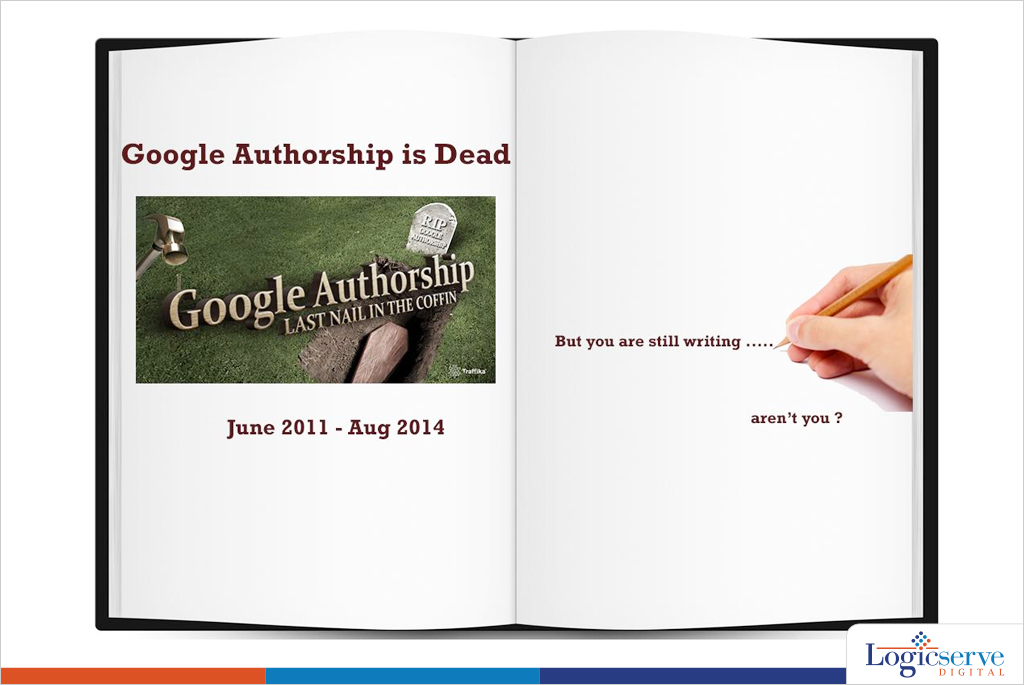
    So much has been written about Google Authorship in the last week compared to the time this was introduced in June 2011. Had this been the frequency of “authorship posts” before Aug 2014, Google Authorship would not be dead afterall.

    It is official – Google Authorship no longer exists.

    John Muller’s Offical post on Google Plus

    I will be coming back to this statement in a while, so hang on to that thought and read ahead
    Google Authorship is dead @LogicserveDigi

    What makes one an Author?

    All of us write, but does that qualify each one of us as an “Author”? Guess not. We write for different reasons. But “To Write” is the only reason for Authors to write for, while the rest of us write for the sake of keeping up with social norms.

    Authors invest time, effort, memory & wisdom of the experience gained over the years to come up with a truly original piece of writing, a.k.a “content”. Every content he/she creates is an extension of self, and hence so much dear. So, it is only understandable that due credit reaches the author. Monetary benefits apart, the credit an author looks for is being recognised for his/her work.

    • To see her work published (online / offline)
    • To have her name associated with the published work (if she is not ghost-writing)
    • Thanks to blogs, webzines, and other online publishing options, one is able to publish under their name.
    • But that is not all, Status updates on Social media (FB, Twitter, Google+, Linkedin, Quora, the list is endless) is also associated with one’s identity. So technically, is the author of that content as well?

    What is Authorship? Is it important?

     Associating the identity of the person with content is authorship.

    This is a good thing. One gets to claim his writings as his own. Plagiarisers & contents scrappers beware. But then, there are those who cheat and steal content with absolutely no shame whatsoever. So to combat such content piracy, authorship to a work is extremely important

    Why did Google launch authorship?

    Same reason as above. It is important. (at least, that is what they thought in the june of 2011)

    It is important to associate content with its creator, so that when the content is retrieved via search results, the author gets her due credits by seeing her name alongside the title. Given the “visual appeal”, should the author have a photo associated with her profile that also showed up on search results.
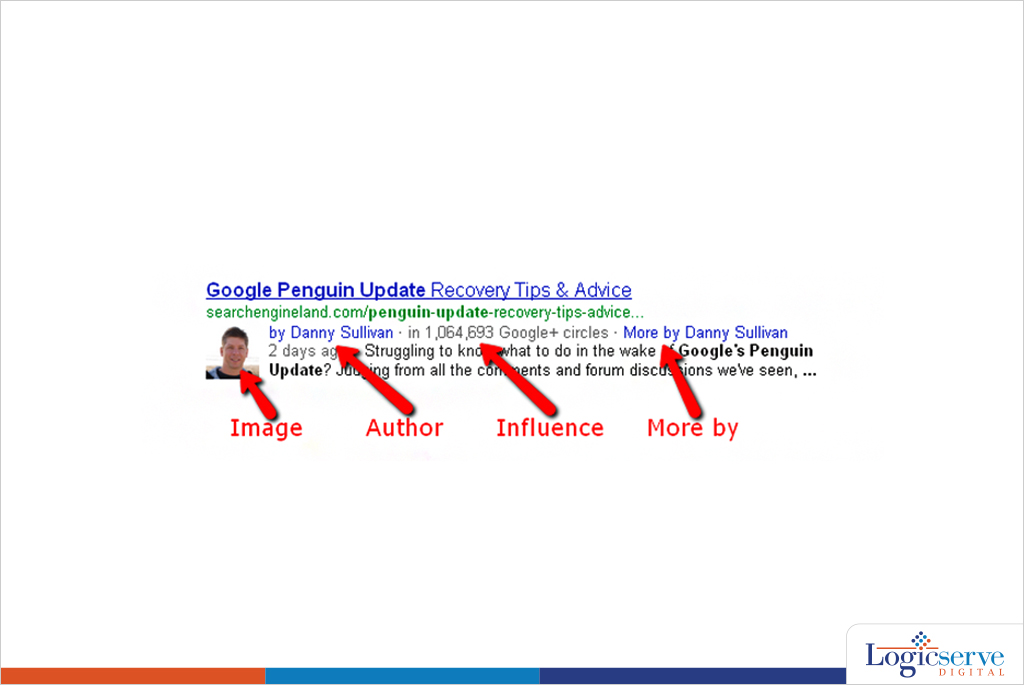
    Update recovery @LogicserveDigi

    How was it received by the online community?

    Bloggers, savvy content providers, columnists who wrote across multiple websites were all gung-ho about the authorship initiative. This was an opportunity to establish authority over their written work, which came with the bonus of “likely surge in traffic”. Gives a visual appeal, and it kind of gives that gentle nudge to click the result with author image, compared to one that does not have an image –at least that is what the authors thought would happen.

    How many actually implemented the authorship markup?

    Tech savvy bloggers were the early adopters. DIY enthusiasts came next. But then, that is pretty much. Truth be said, not many… read negligible.

    Joel Klettke of iACQuire has rephrased the results of the study in simple terms.

    Eric Enge and Mark Traphagen shed some light on the woeful adoption of the “rel=author” tag in their latest post.They sampled 500 authors across 150 different platforms and found that:

    • 50 of publishers had no author page whatsoever
    • 241 of the authors had no profile at all
    • 108 of the authors had a profile, but no link to the publishing site
    • 151 of the authors had a profile with one or more links to the publishing site

    A staggering 70 percent of authors weren’t even trying to implement authorship

    Enge and Traphagen went on to analyze 20 of the sites that DID have author pages and found:

    • 13 of the 20 sites attempted to implement authorship markup
    • 10 of the 13 attempts had errors
    • Despite this, 12 of the 13 attempts received rich snippets in Google SERPs

    Those findings mirror past studies that found:

    • Less than 3.5 percent of the Fortune 100 used rel-author,
    • Only 20 percent of U.S. news publications had marked their content up,
    • Even among the tech savvy, only 52 percent of the top 50 tech blogs had hopped on board, and…
    • Hilariously, only 7 percent of Google’s own blogsused Google+.


    Why such low adoption rate?

    Didn’t people want to see their faces/logo in the search results? Are we being modest?
    Neither.

    • The instructions were too complicated for an average user.
    • Not actively promoted to increase awareness in the community

    So, many did not implement because they just didn’t know about this. Many tried and failed, and moved on with other priorities that mattered. Many just didn’t care and probably anticipated that this will be scrapped like Google Wave, Google Buzz.

    Here is an entire graveyard for Google projects that were discontinued.

    Why exactly did Google decide to pull the plug?

    Honestly, we only know as much as John Muller has shared on his G+ profile. Are these reasons exact or not, one can only speculate.
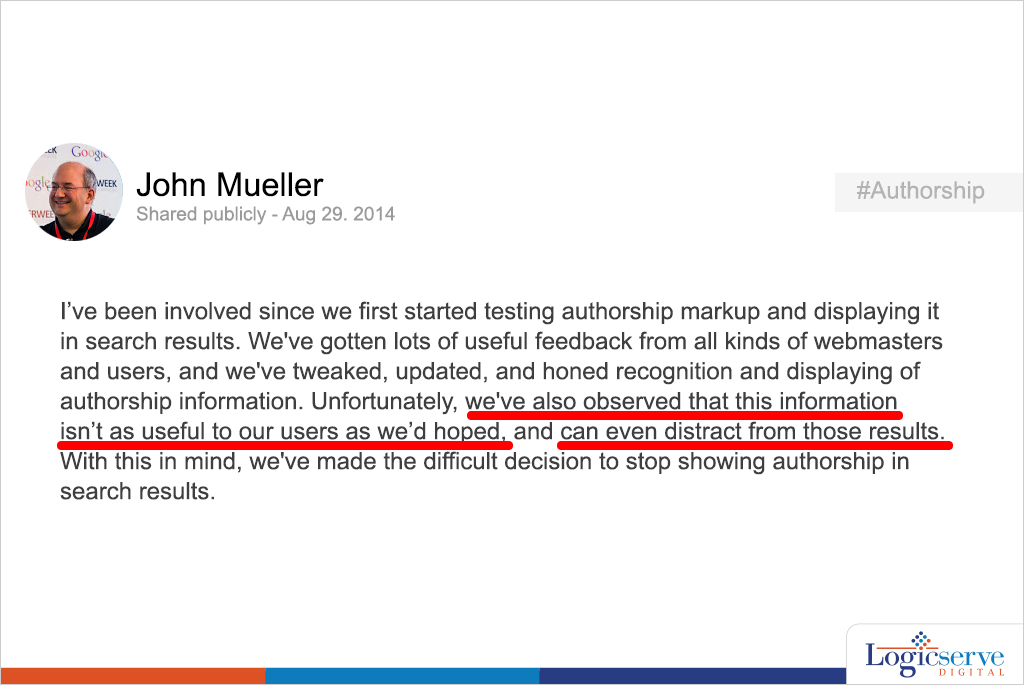
    Mueller announcement @LogicserveDigiSpeculations run amok regarding this decision.

    • “Not as useful as thought it would be”
      • Useful as in how the search results are ranked?
      • Useful as in how the search results are perceived?
      • …hard to say.. hmm
    • “Distract from results”
      • Distract where to ?
      • What do we have in a search result page to get distracted towards?
      • … clicks on paid ads.. perhaps….hmm

    Maybe, users get so focused on the search results; they get distracted from clicking the Advts on the Search result page – as Rand Finshkin (Moz Founder) speculates via this knee-jerk tweet. Jayson DeMers, a regular contributor at the Forbes Magazine has interviewed 7 industry experts is a must read if you are authorship-obsessed.

    What will happen to my SEO efforts put in from 2011-2014?

    Help ! I am having a panic attack.

    Relax, take a breath. Panic will get you nowhere.

    Assuming that you have built your SEO around legit channels (quality content, relevant key words, contextual teasers in social media, linking to quality websites, a decent author bio at all your contributor sites) you do not have to worry. You will be ranked appropriately and very very unlikely to lose traffic on account of Google Authorship.

    Yet, is it better to leave the authorship settings (rel=author) as it is, and include in all future content as well. Who knows, Google being Google, they might not be using this data for now, but could be studying the user behaviour in stealth.

    However, if your SEO strategy is set up with Google authorship at the nexus, then it is a slight cause of worry. Check your Analytics, you might notice a dip in your site traffic between 24-30th June 2014. This is when kill-the-authorship initiative began, Google dropped authorship photos from search results .

    But as I said, this is only a minor setback. With quality content already in place (again, assuming that you are serious about what you write and does not belong to the class of content-stealers), a few hours on legit SEO practices, you should be able to regain lost rank in just a couple of weeks. This is a small thing to pay for the long term benefits that lies in repositioning yourself in the search result page. Reading David Worral’s Google Authorship is not the the holy grail of SEO might help with the panic attack and get back your wits.

    So, what next?

    There is nothing that we can do about this, but move on.

    We as authors / writers can fret all we want, but that is not going to change anything around the authorship programme. This would only pin us down with frustration, which would eventually percolate into our writing as well. Trust me; you certainly don’t want this to happen. Your written work is your extension of self, and you don’t want to appear shabby and unkempt. So, Move on !!!

    Logic speak:

    Go back to good old ways of writing quality content, linking to appropriate quality websites, and use intelligent teasers in your social media posting to drive users to your website. Google Authorship may be dead, but you are still writing. So write and publish wherever it is appropriate. Don’t worry about the bots. People hire people, bots don’t.


  • Difference Between Content Marketing and Content Strategy

    Difference Between Content Marketing and Content Strategy

    Difference-between-content-marketing-and-content-strategy @LogicserveDigi

    Content Marketing has taken forefront within an organization or a brand’s content strategy plan but this is exactly what is mystifying largely to the existing content managers. To a certain extent, they are at loss for the skill set required seems to have altered. In reality, they are different and still related.

    With a fine line dividing the two which at times gets blurred, it becomes crucial to understand what each of them actually includes and refers to. Though both relate to ‘content’, marketing refers to spread of reach of content to readers base – expanding as well as relevant. After all, it is the readers who are or likely to be the customers of the product or service offered by the brand or the organizations.

    On the other hand, content strategy involves creating (used again here as well) of content which is more impactful and impressive to the readers while relating to the brand or organization’s offerings and services.

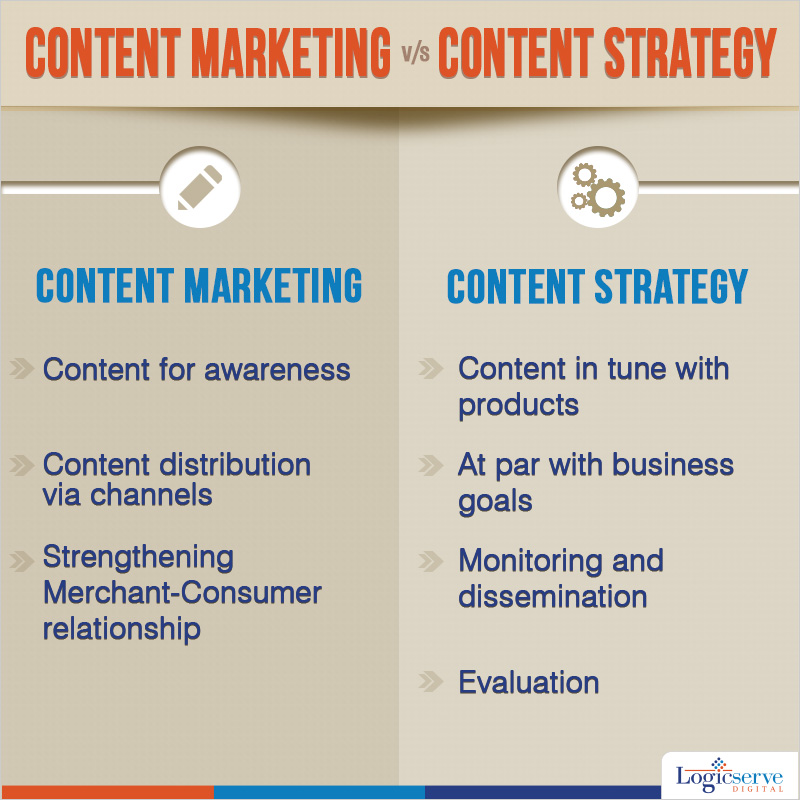
    Content Marketing revolves around

    • Creation of Engaging and Enticing content for enhanced awareness
    • Distribution of Content through viable channels for better outreach and ROIs
    • Strengthening of Merchant – Customer relationship

    Content Strategy revolves around

    • Planning & Creation of Content in tune with products and services offered
    • Creation of Content on par with market dynamics and business goals
    • Monitoring the dissemination of content and its response when in use
    • Evaluation of Content performance during and after its discontinuation along with its preservation

    The content strategy involves the creation planning and productions of content related to the business while the content marketing exactly knows which content will convert potential demand into sales. Hence, the fusion of the two is very much required for an effective business pitch, which is very essential for sales and business expansion to a desired level.

    The role of a content strategist is not limited to creation and publication but extends up to its effective management too. At this stage, it would be right to say that content is a valuable asset used to attract prospective customers. As aptly stately by Rachel Lovinger, “Content strategy is to copywriting as information architecture is to design.”

    Drawing attention to current examples of content strategy and marketing are the promotion of electronic gadgets, smartphones and more. The specifications and the UI features relate to product knowledge which are converted into content in form of user manuals, how to use guidelines, blogs, features, articles, videos and more is developed under content strategy. On the other hand, content marketing involves the distribution of the same across various channels targeting relevant audience for the correct leverage.

    LogicSpeak :

    For success in any online business venture, content marketing is very essential but planning and creation of content comes under the purview of content strategy. Though different, strategy and marketing of content have to be well planned and phased out initiatives of any business. Most digital marketing agencies offers content marketing as well as strategy services which can be utilized by their customers.

    Previous Post: SEO Copywriting

  • SEO Benefits of Guest Blogging

    SEO Benefits of Guest Blogging

    Benefits of Guest blogging @LogicserveDigi

    Doing well in SEO requires too many things to work well together. One of the most important things that make the SEO benefits tick is Guest Blogging which is the latest trend. As the name suggests, guest blogging is the act of posting your work in someone else’s website/blog.

    The post can be a piece of art, some part of the blog or may even be original research article on a relevant site or blog. There are many benefits that can come out of frequent guest blogging and anyone looking to boost the SEO campaign should know understand these benefits which is of utmost importance

    Builds Relationships in the Blogging Community:

    This point lies at the centre of the benefits that guest blogging offers. When you start posting on other blogs you are exposed to a new readership and at the same time, you will notice that the reach of your brand expands. The feedback you get from these new readers might help your overall blogging style. In addition, on the technical side, you get a back link to your website. It won’t take a lot of explanation to grasp how backlinks to your website would help your search ranks. It’s a symbiotic relationship. The blog in which you post as a guest author, also gets bumped up because of the back link that you may provide by advertising the post on various social media outlets.

    Increase in Social Media Shares:

    With an increased readership, the number of social media shares would certainly be more than usual. The more important thing is that you would be shared in a different social media circle with the guest blog, which would increase your social media reach.

    Adding Authority to Your Voice:

    If you manage to post a quality article in a reputed source, the advantages to your brand would be enormous. Initially, you may not find many visitors to your website but over a period of time as you continue to post relevant and engaging articles, the readers may begin to show interest in your writing. Being consistently good is the key here. Guest blogging thus gives you the voice which maybe missing in your blog website

    Set a limit to your guest blogging activities:

    Guest blogging will diversify your readership base and in turn will help you discover business opportunities, which you would not have known, existed because of limited readership. But, if done in haste, you may find an awkward inclusion being backfired. If you are an experienced blogger with even a gamut of reputation, you may receive plenty of unsolicited requests to guest blog. DO NOT BLOG ANYWHERE.

    The key here is to understand that only relevant guest posts help the SEO. It is always the same rule: Content is the King. Moreover, the only way to make that work is by posting on the websites that are in your ‘blogosphere’.

    LogicSpeak:

    Guest blogging is a very important component of your SEO success. With the right guest posts, you may be able to convert many of the readers, who would not have otherwise read your work.

    Previous Post: Difference Between Content Marketing and Content Strategy

  • SEO Copywriting: Drive Traffic & Conversions

    SEO Copywriting: Drive Traffic & Conversions

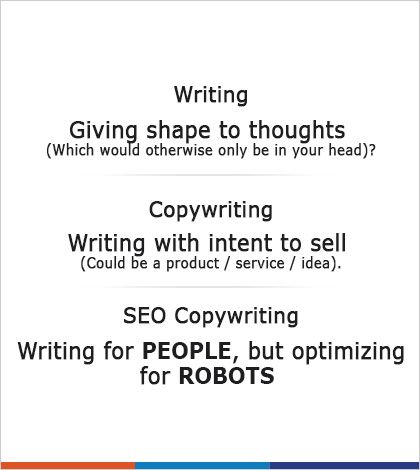
    It will be people who would eventually buy, but you need the Search Engine bots to nudge them your way. So SEO Copywriting can be defined as

    copywriting1Gone are the days when business websites we optional. Enter Google, and affordable broadband services, every business must have a website, irrespective of the nature of their business. People no longer reach out to “Yellow Pages” the book, instead, instinctively Google to locate a certain product or a service. The irony is, “Yellow pages” too is listed on Google.

    The Logic behind SEO Copywriting

    • Consumers are looking for solutions.
    • Businesses are offering solutions…and have a website / blog that says it all.
    • They are unlikely to find each other on their own.
    • Search Engines pitch in- and pair them up exactly when they are asking for it.

    —THIS IS WHAT SEO EXACTLY DOES TO YOUR BUSINESS–

    Now that we have established that it is an absolute necessity to have a website, AND, also looked into the logic of how search engines acts as matchmaker between consumer and the business provider … it is time to harness the power of this knowledge.

    Quality trumps all the time, SEO is no different

    Until recent past (2013) crafting an SEO content means to stuff your content with keywords. But Google caught on, and this method was discredited. Indiscriminate keyword stuffing had resulted in some sites getting banned. Google switched its strategy from Quantity to Quality to thwart off keyword stuffing and harness authority of content.

    But how do you tell a robot to assess “Quality”? Isn’t it relative?
    Can Robots do that?
    Well. Google has logic (& therefore an algorithm >Program > code) for everything.

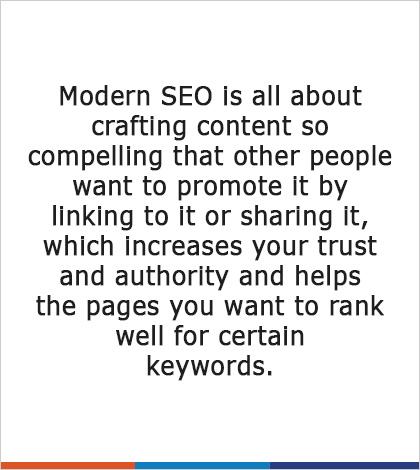
    Google believes, if others are talking about your product (on websites, Social media, etc) then you must be good enough. In other words, your product / service should be so compelling that it should generate the desire to “I like this so much – that -let me tell the world about it”. This act in turn translates into building trust and authority (on/about your business) and more members want to connect with you. As this trust grows, so does your page rank. As your page rank soars, you automatically get the top slot on Google results.

    Sonia Simone succinctly puts this as under

    copywriting2

    LogicSpeak:

    While SEO Copywriting is all about creating a compelling, yet persuasive content, one cannot overlook the importance of keywords. You can still make your SEO content keyword rich by strategically placing them within the content. The idea is, it should make sense with the content and not stick out like a sore thumb. This way your SEO Content satisfies the robots and the people coming in to read.

    Previous Post: Top 10 Social Media Tools

  • What You Need to Know About Creating and Scaling Quality Content

    What You Need to Know About Creating and Scaling Quality Content

    Scaling quality content @LogicserveDigiWith more than half the globe’s population having access to the internet, the nature of content has changed fundamentally. More and more consumers are getting information and forming opinions about brands from digital content sources rather than offline content sources such as newspapers and magazines.

    This poses challenges for businesses and marketers. Those who have observed this trendline and where this is going are already focused on creating quality content to meet the requirements of their target audience.

    Whether it’s a B2B or B2C organization, they’ve all joined the content bandwagon. This nevertheless creates a problem of plenty — some 92,000 new articles published on the internet every day. Add to that the millions of blog posts on millions of WordPress and Blogger blogs.

    Quality Content is the Key

    How to stand out in this avalanche of new content? The basic and minimum requirement is to produce content that is free from grammatical errors and is original. Such content will not only appeal to the readers but will also pass muster with all the content-focused Google algorithm changes the latest round of which was Google Panda 4.0 which was rolled out recently.

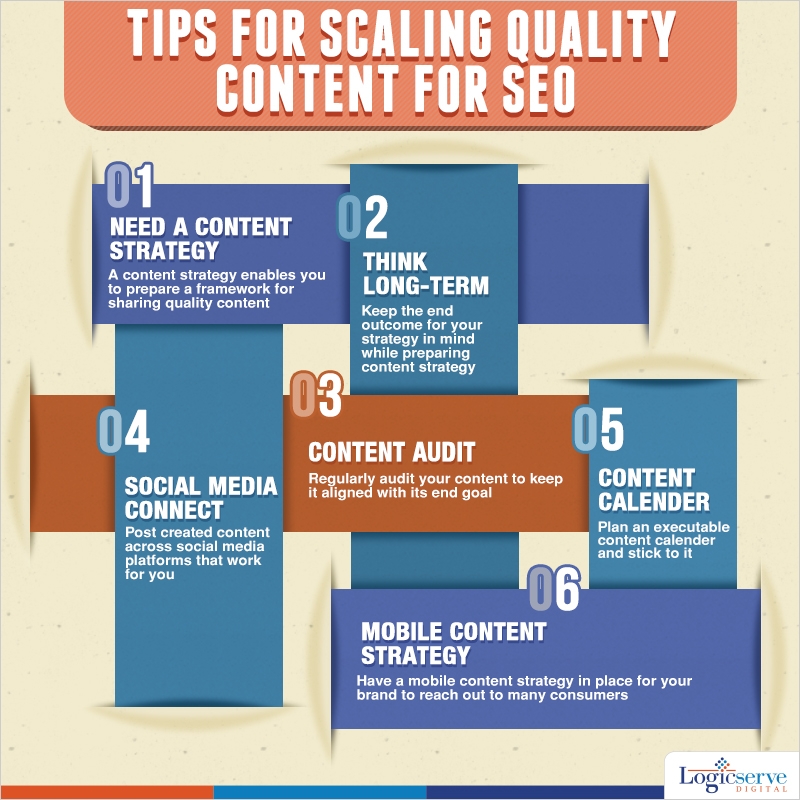
    Everybody Needs a Content Strategy

    If you want to compete in your local city marathon (or the New York City or Boston marathon if you wish), you need to put a strategy in place — you will surely fail if you just decide to sign up for a marathon one fine day without having prepared for the rigors of a marathon.

    Think Long-Term

    Similarly, content marketing is a marathon that requires long-term planning. Determine your content marketing platforms — blogs, email newsletters, social media and so on — and learn as much about your readers as possible (what percentage of them use mobile devices and their age-wise and financial break up and so on). Having this knowledge ensures that you will generate the content that will appear to your target demographic.

    Content marketing is distinct from in-your-face sales or advertising. Content marketing is not about selling stuff. You need to keep that in mind for your content strategy to succeed. Using the marathon metaphor again, a marathon is different than a 100 meter sprint. If you start running at the top of your capacity, you will run a very fine 100 meter sprint but won’t be able to even complete a marathon.

    So as you measure the ROI of content marketing efforts, remember not to focus on pure sales numbers. Content marketing will likely take longer to convert leads as it’s designed and focused primarily to pull potential customers into the marketing funnel.

    Part of having a long-term strategy is to be persistent and consistent with your content strategy. This means you need to have a solid plan — spanning months if not years — for your content marketing initiative. Of course you can keep measuring the reach and impact of each piece of content marketing — each blog post and email newsletter and so on — on a daily basis or as appropriate.

    Content Audit

    To maintain a regular pipeline of content, make sure to audit all your departments to get a sense of what content your company and its different departments have and how much of that is current and how much is outdated. Once you make the audit, you will get to know if there are any missing areas in terms of content that needs to be filled — some products that don’t have brochures or a need to create an FAQ, etc.

    Content Calendar

    Then comes an editorial calendar that should have inputs from every department of the company. Having a calendar has multiple benefits including avoiding any duplication in efforts, a unified location where all content-related effort is tracked and getting the maximum impact out of your content effort.

    Content Planning

    To make the optimum utilization of your time and resources, content creation and content marketing should happen as part of a detailed plan. This ensures synergy in efforts — such as those between the marketing, corporate communication and content marketing. Similarly, you need to have a plan for how to distribute the content in the most effective manner across different content platforms — sometimes long-form content will appeal to your consumers and readers while at other times, shorter forms and byte-sized content will do the trick.

    The Critical Role of Social Media

    Every brand has a presence on Facebook by now. But clever brands will go beyond just bland Facebook posts. Businesses need to be present on multiple social media platforms to reach the widest audience possible and their social media content strategy needs to take account of who their audience is. Facebook pages are great for sharing pictorial content — and never forget to include the right-sized picture with every Facebook post — but that content is only visible to those who already like the page. Twitter posts, on the other hand, are visible to everyone who is on Twitter. Pinterest and Instagram are similarly must-use platforms for brands whose products are targeted to women consumers who tend to frequent these platforms preferentially.

    How to Create Viral Content

    As you seek to create stellar content that stands out in the clutter, you can take inspiration from different sources including current events — whether it’s an ongoing football World Cup or the Olympics or the Super Bowl. Keep in mind your audience as you seek to tie your content to current and trending topics. Social media platforms such as Facebook and Twitter will help you know what the “trending topics” are and these tend to change rather often too and they tend to reflect the interests of the users of those social media platforms. Quora and Hootsuite are also places where you can get ideas for creating content for your blog.

    Refer to competitors’ websites in your domain and see what are the popular topics and posts on their blog. That can give you an idea or a starting point for a blog post of your own. Remember that every piece of content cannot go viral. You have to keep at it — it takes 10,000 hours of practice to become good at something as Malcolm Gladwell put it. Similarly, it will take a while to develop a unique corporate identity or voice and to develop an emotional connect with the readers.

    Sometimes, it’s okay to take a position on a controversial topic — remember how Tim Cook advised a shareholder to sell Apple stock if he didn’t feel comfortable with Apple’s focus on human rights or environmental activism or other social missions. You too can decide to “stick your neck out” — if it can be called that — and declare that indeed you and your company believes humans have caused climate change.

    Mobile Content Strategy

    You got nothing if you don’t have a mobile strategy — in fact some are going so far as to have a “mobile first” strategy. It depends on your business vertical how much you need to focus on having a mobile content strategy but it’s pretty much an indispensable part of an overall content strategy.

    If you are a B2C organization, you should have come to terms already with the fact that your website must be mobile-friendly — if you don’t want to lose a ton of business. Even Google has tweaked its algorithms — Google Hummingbird — to be better prepared to answer long-tail queries and natural language or spoken queries. This is designed to meet the needs of mobile users. Since Google is adapting to a world where mobile internet users have already overtaken or will soon overtake desktop internet users, so should you.

    What you need to do in terms of having a mobile content strategy is remember that many of your readers will be reading your blog posts and email newsletters and other content on mobile devices. So, you need to have a few short blog posts that only has a bullet points and highlights and links to a longer post which is of course essential for SEO as Google tends to give more weight to articles longer than 2,000 words.

    The key to effective mobile content is large fonts, lots of images and videos that users can watch while making their commute to the office via the subway or other public transport. For mobile users with typically short attention spans, content that is easy to grasp is appealing. You should try to keep your content at the level of an eighth-grader — this is not to be condescending to the reader of course but just acknowledging the reality that all of us with busy lives may not quite be up for dry or academic prose that reads like a scientific or literary journal extract. The Fleisch-Kincaid readability score helps in this regard and it’s built right into Microsoft Word — so, you might want to put your content through that metric and see if you need to reduce the number if it appears to be too high.

    Content Curation is Good

    Don’t be afraid or shy about repurposing content or pointing your readers to top-quality content that is not generated by you. You can profitably use tools such as Curata to help you with content curation and you can use content curation in your email marketing or blogging.

  • Google Trends – Must for Studying online market trends

    Google Trends – Must for Studying online market trends

    Cover image_Google Trends

    Enhance your online visibility by seeking out past trends through Google Trends. Considered to be a very useful feature which offers past data across select parameters, Google Trends provides you key insights and data that can be leveraged for SEO purposes.

    At the outset, you can view the most popular searches in the Hot Searches and Top Chart sections while if you are out to locate some special or more specific data then, Google Trends allows you to select from four parameters as per your requirement –

    • Web Search, News Search, Product Search, You Tube Search
    • 2004 – Present – Year wise, Monthly, 90 days, 30 Days, Past 7 days
    • Category wise search – Arts & Entertainment – Autos & Vehicles – Beauty & fitness – Books & literature – Business & industrial – Computers & electronics – Finance – Food & drink – Games
    • Across the World – Country/region wise search

    Your search can extend up to 5 search terms or groupings. Also, you can include up to 25 search terms in each group. Remember to use the “+” sign for adding additional search terms in a single group as this could indicate Google to include them while searching for the main search term.

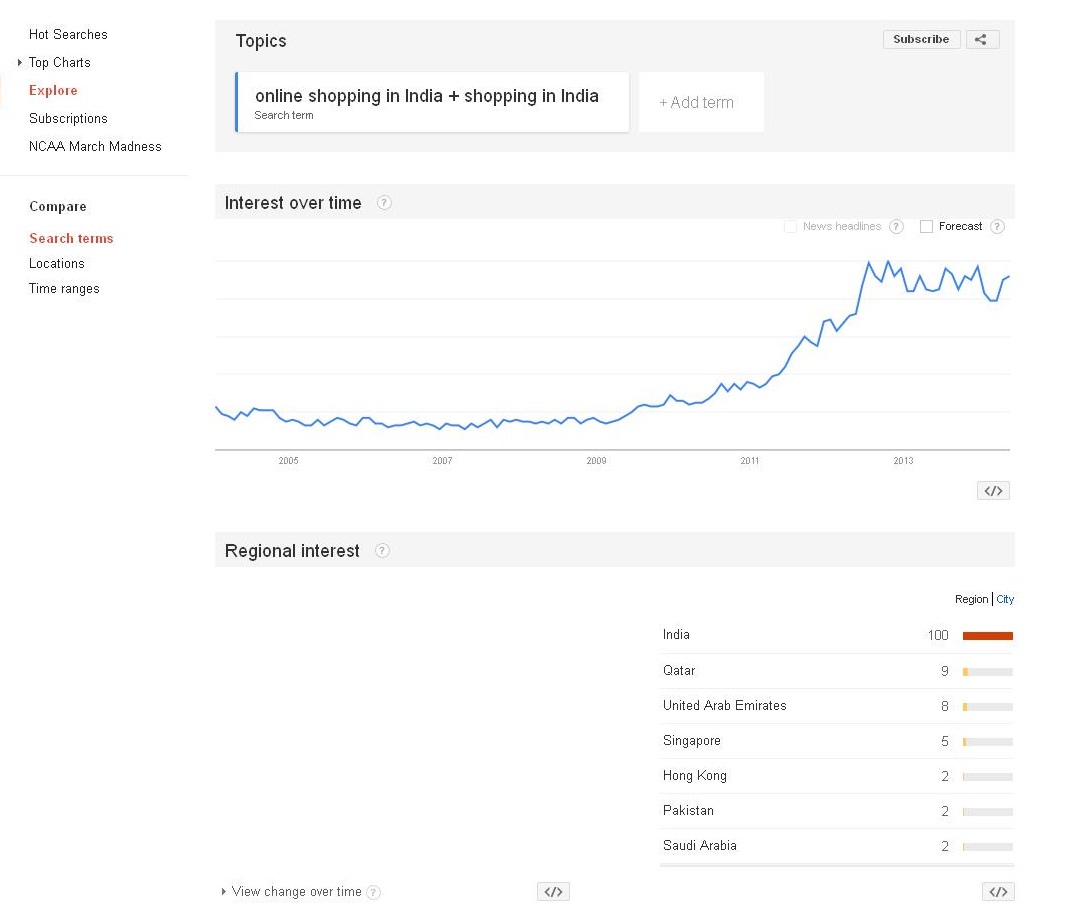
    We have searched for two related keywords – online shopping in India + shopping in India.


    1

    As you can see the 2nd section of the image, you can even ascertain the extent of online shopping in India across various cities of India as well. If you have selected time ranges parameter, you will be able to view the forecast of that particular trend.

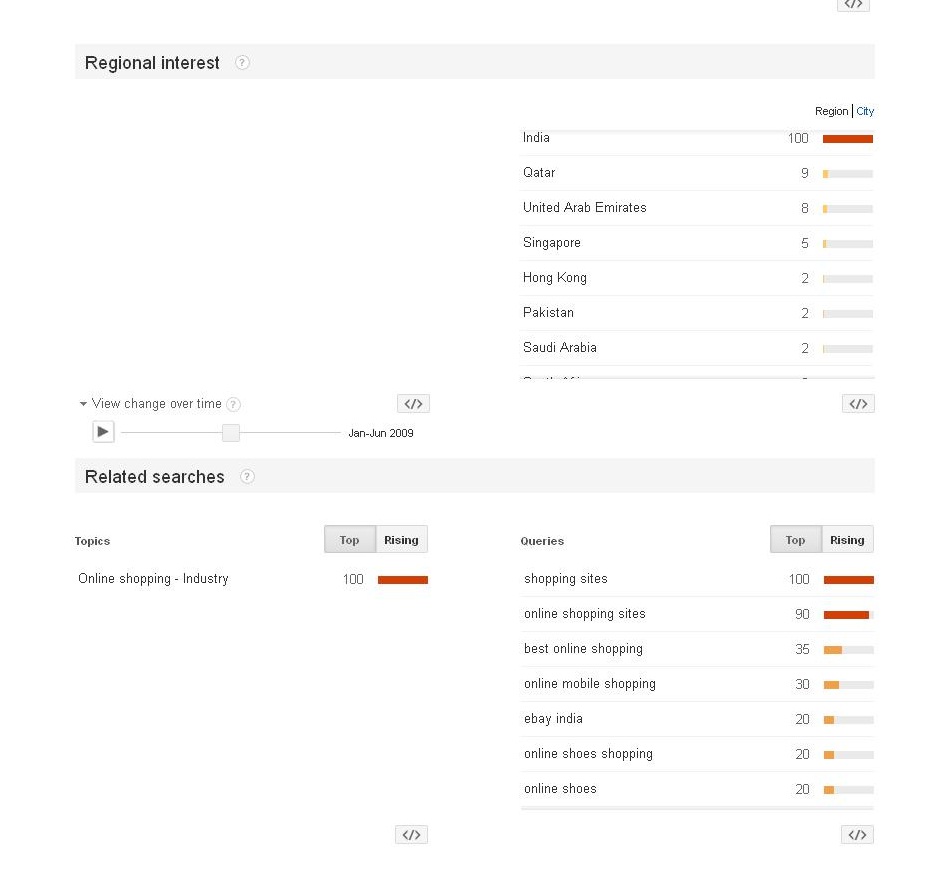
    2

    Proceeding to the third section, you can get a fair view of related search queries too which could help understanding the search patterns of the viewers.

    Taking this further, Google Trends works well with the Keyword planner to offer you a generalized point of view of the keyword/phrase you are looking out for. Through this search exercise you can even estimate the amount of interest likely to be displayed by the visitors in the future. This could prove quite revealing for online marketers and ecommerce portals who wish to optimize their online business strategies. Not restricting this to just keywords, you can have also check out search by geographical locations in case you wish to expand to newer locations as well.

    How to capitalize the data received from Google Trends at the next level –

    If you have a business related to a trending topic then you can upload a blog or a news article on the same lines or even tweet about it. Chances of your content being highly visible are great provided you it is of good quality and interesting to read. That’s not all, you can even attract links before you know it.

    If you have the bandwidth, you could even upload a couple of short videos and films on your topic and try to seek viewers and traffic through YouTube as well. For more ideas on videos, do conduct a search in YouTube in Google Trends. Remember, you need to optimize your video right by inserting interesting titles, right tags and even descriptions for more visibility. It does pay if you or your product is a brand all by itself but nevertheless, do give it a try.

    LogicSpeak:

    Google Trends does offer expansive insights into the search trends offering you new vistas to explore especially for the attracting online traffic. Being adaptable and dynamic does help in ensuring that you stay way ahead of the competition and are better equipped to take your business to the next level.

    Previous Post: Why You Need Schema Markup

  • Why You Need Schema Markup

    Why You Need Schema Markup

    Schema Mark Up @LogicserveDigi

    Some things catch on like wildfire — iPhones or Gangnam Style. Others take time. Implementation of schema.org markup has grown slowly since Schema.org was launched in mid-2011.

    What is Schema?

    Schema is microdata and one of many. It is applied to the content on a page to define what sort of content it is. Schema elements and attributes are directly added to the HTML of a web page. Schema is a way of categorizing and specifying content on a web page.

    So, specific terms can be defined as entities using the appropriate HTML code. Each entity will have various different properties. Some examples of entities include: books, persons, recipes, events, organizations, etc. Similarly, a book entity will have properties such as author, publisher, and other meaningful details. A recipe entity will have properties including nutrition information, name, description and ingredients.

    This is primarily meant for the benefit of the search engine crawlers. Indeed, schema.org is an initiative founded by search engines: Google, Bing, and Yahoo.

    Why Should I Care?

    For web developers, the role of schema markup is likely to grow in importance and hence they should care about it. With the growth of semantic search, the role of schema markup will likely increase and more websites will implement schema markup.

    The introduction of the Google Hummingbird updates shows the direction in which Google wants to move. Add Google Knowledge Graph and Google Carousel to the equation and the competition between Google and Bing to offer better results for local movie and restaurant searches, and it’s clear why more and more websites will start adding schema markup to their HTML.

    Benefits of Schema Markup

    SEO Benefits

    SEO is dead. Long live SEO.

    Well, of course SEO is alive and well. Only the nature of SEO has changed and search engines like Google have got smarter at detecting black hat SEO techniques such as link stuffing. Schema markup is a great white hat SEO technique that can be and should be adopted.

    When you use Schema markup to properly categorize words and phrases on your site’s HTML that helps the search engine crawlers to better interpret the content on your pages. This in turn helps your website beat other websites in the organic search results. Getting a good position in the search engine result page (SERP) organically beats placing paid search marketing any day.

    So for long-term SEO benefits, use of Schema markup is definitely recommended.

    Search Ranking Benefits

    According to a study by Searchmetrics, pages with Schema markup rank four places higher compared to pages without Schema markup. The study also found that the websites related to Movies, Offers and TV series were most likely to have implemented Schema markup. Fewer than 1% of websites integrate Schema markup. But the Google search results show Schema markup-derived information for more than 36% of keyword queries.

    Rich Snippets Benefits

    When sites have Schema markup, Google shows rich snippets in the search results when content from those websites is shown in the search results for relevant keywords. So you get additional details related to the search phrase and these additional details will include stuff such as show timings when the search is about movies and ratings for restaurants and nutrition, cooking time or calorie information when the search is related to recipes.

    One of the reasons for the low integration of Schema markup into websites till now has probably got a lot to do with the fact that this is a manual process and Schema markup needs to be added to each entity on each page.

    This is rather labor intensive — especially if a site is a large one with hundreds or thousands of pages. It’s easier to integrate Schema markup with a new website while it is being developed.

    LogicSpeak:

    As the Web becomes more and more semantic and search engines try to answer search queries that are phrased more like real questions rather than keyword searches, the need for structured data such as Schema markup will only increase.

    As we start seeing more and more of wearable devices like Google Glass and Samsung Galaxy Gear, the role of Schema markup will only increase since these devices use semantic search. The use of Google Knowledge Graph and Google Carousel will keep on expanding to include more search categories and since they all use structured data such as those with Schema markup, the value of Schema markup will keep on rising.

    So, integrating Schema markup with a website has many benefits with no downsides.