LS Staging

Category: Other PPC News

  • SEARCH COMPANION ADS – An efficient way to expand targeting options on GDN

    Google as the largest search engine is constantly on toes to develop and offer advertisers ground-breaking ways to turn up in front of the customers. Now, it has come up with a new method which targets users based on their intent, called as Search Companion Marketing or SCM on the GDN (Google Display Network).

    THE IDEA!

    The idea behind SCM is to make targeting users easier by showing ads based on the intent of the search. This is made possible by showing image and text ads on the GDN to users that put a search query on search engines such as Google, Yahoo and Bing.

    On the GDN, advertisers can choose to target keywords that are highly relevant and reach the users efficiently. For an extensive Display Ad campaign, advertisers can smoothly transition from their Display Advertising to Search Companion Ads.

    For example, a user types a query, say, “Biryani recipe”. When the search engine displays the result, he clicks on any of the organic links that are a part of the GDN. The user will see several ads about the nearby restaurants that specialize in Biryani, or the history of the Biryani and so on. Depending on which link the user chooses to click, Google AdWords will analyze your intent and signal the most relevant ad to the said intent.


    How to implement SCM in Google AdWords?

    You first need to create a campaign with keywords by targeting the GDN, to get started with SCA. Next, you need to contact the Google Representative to enable the SCM feature.


    What makes SCA’s different from Display Ads?

    Search Companion Marketing is about ‘remarketing’ which is more concerned about the search query of the users instead of the advertisers pages or links or forms. The user is remarketed only for the period of the online session.
     

    search companion ads


    Key takeaways:

    • If you have adequate conversions to get Google tracking and optimization, SCM can work efficiently for lead generation with enhanced CPC bidding
    • Advertisers who focus on lead generation can use SCA optimally
    • SCA displays ads to the searchers who have already expressed interest in the advertisers’ ad, so it flawlessly ranks them higher in the conversion funnel.
  • How To Use Advanced Segments In Google Analytics

    How To Use Advanced Segments In Google Analytics

    Advanced Segments in Google Analytics become essential tools if you wish to gain deep insights into visitor behavior. With Advanced Segments, you can go way beyond what is available by default from GA.

    Benefits of Advanced Segments

    Here are a few questions that Advanced Segments will help answer:

    • How the website visitors are geographically distributed over time?
    • How many visitors use mobile devices to visit the website?
    • What are the demographic characteristics of website visitors?

    Of course, you will get answers to many more questions too, depending on how you use Advanced Segments.

    So what should Advanced Segments for Google Analytics be used for? Well, here are a few suggested segments that you should definitely use:

    • Segmentation by Referrer/Traffic Source
    • Segmentation by Visitor Type
    • Segmentation by Visitor Action
    • Segmentation by Value

    Of course, these are only a few of the suggested segments — there are many more depending on your unique requirements.

    How to Use Advanced Segments

    Let us see how to create and then turn on an advanced segment.

    • With the Reporting tab highlighted on the Google Analytics web page, click on the down arrow as shown in Pic 1.

    Advanced-analytics-segment-1           (Pic 1)

    • From the resulting drop down menu, click on the “+ Create New Segment” button as shown in Pic 2.

    Advanced-analytics-segment-2(Pic 2)

    • Give a name to your segment by typing it into the “Segment Name” box as shown in Pic 3.

    Advanced-analytics-segment-3(Pic 3)

    • We have named this segment “Test Segment”. You have to decide the metrics on which you want to segment the traffic. For example, you can segment by the conditions of a visit. To do this, click on the Conditions button as shown in Pic 4.

    Advanced-analytics-segment-4(Pic 4)

    • You can make the appropriate choices in the Source and contains drop down menus as shown in Pic 5 and Pic 6 respectively.

    Advanced-analytics-segment-5(Pic 5)

    Advanced-analytics-segment-6(Pic 6)

    After you have set the appropriate values, you can click on the Save button to save the segment.

    When you click on the down arrow again as shown in Pic 1, you will see a list of all the advanced segments. From this list, you can select the segment or segments you want to turn on. Then click on the Apply button.

    Import from Gallery

    At times, it may so happen that you might not be ready to create your own custom advanced segment in which case you have the option to import a segment using the Import from Gallery button as shown in Pic 7.

    image 7(Pic 7)

    Upon clicking the Import from Gallery button, you get all the ready-to-use segments displayed to you as shown in Pic 8 from which you can choose the segment you wish to use.

    Advanced-analytics-segment-8

    Conclusion

    The ways in which Advanced Segments can be harnessed to gather more information about your website traffic are virtually limitless. For example, you can learn about how much traffic you are getting from social media networks and search engines using custom advanced segments. You can also acquire demographic data about website visitors to the different pages on your website.

    Let us just say that the more you use Advanced Segments, the more stuff you will learn about segments as well as about your website traffic.

    Previous Post: Must know mobile advertising trends

  • Growth and Trends in e-commerce India 2014 – Key factors for e-retailers to concentrate on!!

    Growth and Trends in e-commerce India 2014 – Key factors for e-retailers to concentrate on!!

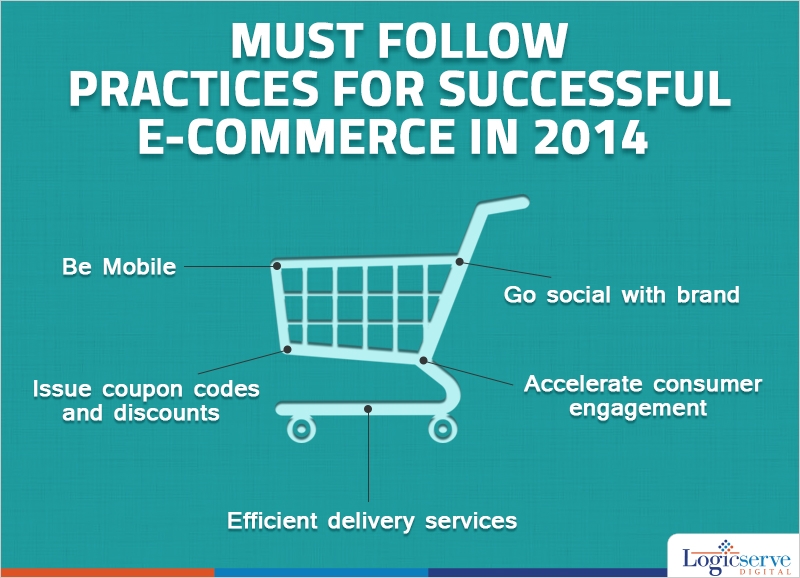
    E-commerce trends 2014 @L

    Apart from metros, people residing in Tier II and Tier III cities are accessing the Internet through their mobile phones to browse and shop online. This growing trend presents every e-commerce site with ample number of opportunities to reach out to consumers.

    While being online is the key factor for growth, here are a few pointers that can help every e-commerce portal post their initial set-up.

    Be Mobile – The availability of 3G services, cheap broadband plans, affordable smartphones and the purchasing power has lead to Indians being highest users of mobile phones across the world. Surprisingly they have begun to access the Internet through the phone for shopping which means your website should be mobile friendly.

    Delivery Services – Flipkart gained popularity amongst nascent Indian online shoppers by offering them free delivery on their purchases. Over the time, free deliveries were restricted to billings above a predetermined amount. With the foray of Amazon and other growing Indian e-retailers, the race to deliver first has got even more competitive as customers can enjoy multiple delivery options. Online retailers have expanded their areas of delivery to include Tier II and Tier III cities along with Tier 1 cities.

    Customer Support and After Sales Service – After-sales is the key once the consumer receives your product. Online retailers have to offer hassle-free options and quality customer support to consumers whereby they can return the goods if they are unsatisfied with them. This generates a feeling of trust amongst customers. Once the level of trust is gained, customers will feel confident about ordering higher value items such as refrigerators, microwaves, other home appliances, and even more expensive jewellery products online.


    Coupon Codes and Discount offers

    Currently, India is witnessing a transition towards online shopping which can be capitalized by offering attractive discounts, bargain offers, freebies and much more to online shoppers. Coupon codes and different deals can be designed in collaboration with specific brands or coinciding with festive occasions. If you are looking for an example, you could browse through www.couponraja.com, India’s premier coupon aggregator on latest coupon deals and offers including some exclusive ones.

    Targeted Customer Segment – The ASSOCHAM report predictably shows how the youth segment (18 to 35 years age group) dominates online shopping in India. The items that get sold and bought online therefore cater to this youth segment. The same demographic is the predominant user of both social media (Facebook, Twitter and Pinterest) and online shopping portals.

    Active Social Media Presence – An Active social media presence extends to more than just creating a page or a profile. It is essential to interact with customers, acknowledge their posts, offer useful tips and guidelines through social media platforms and others help you to build up customer engagement, an absolute must in today’s digital market space. In short, be there and be proactive.

    LogicSpeak:

    While there are 900 million cell phones in India, the number of mobiles connected to the internet is no more than 150 million. As Internet penetration via mobiles grows in India, more and more people will continue to buy gift items, electronic products, accessories, apparel, computers and peripherals online.

    Wondering how engaging is mobile technology vis-a- vis online shopping in the Indian scenario? Well as of now, Android and iOS apps of Couponraja and Compareraja have crossed the 20,000 mark in downloads month after month post their formal launch.

  • Buzz your Emails with Live Trends for Enhancing your Campaigns

    Buzz your Emails with Live Trends for Enhancing your Campaigns

    Email campaign @LogicserveDigi

    Email marketing is one of the oldest and reliable form of marketing. It has delivered exceptional results over a period of time especially if you have a well strategised email marketing plan in place. Email marketing has proved to be cost effective, accurate and very much regulated. In fact, it is extremely dynamic and can be customized as per requirement. We present a few quick to follow tips which bring in the hype and excitement to shop around.

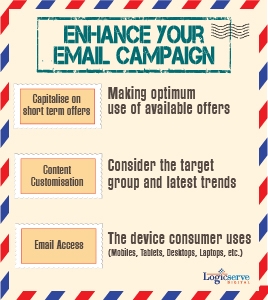
    1. Capitalise on the short term offer – As you send your email stating details of short term offer, add in a digital clock which keeps ticking and displays the time left for the offer to expire urging the buyer to shop and take advantage of the offer before it is gone. Do remember to add in the eligible coupon codes and deals which can be clicked right way for shopping.
    1. Customization – Customizing an email goes a long way in making the reader feel very special. Apart from a personal address to the reader, informing him/her about the products, services, their availability at location nearest to them and how to get there, goes a long way in helping them to decide upon shopping for the same. This means you are offering all the relevant information at the same time for easy and quick referencing. This feature comes most handy when approaching old customers who are already aware of your brand and have enjoyed their experience with you.
    2. Email Access – As you track and monitor your email campaigns, pay attention to the device through which they access. These help you in designing an effective email which is visible across the device without much fuzz. Hassle free and easily viewable email implies more engagement rather than an email which opens after a couple of glitches. These days, you need to pay attention to smart phone devices and tablets which operate more on Android and iOS for better engagement.
    3. Incorporate Current Trends and Trivia – Well, your readers are your consumers whose demand various with the season and its trends. If you can incorporate seasonal trends within your email you very much likely to hit the bull’s eye. For eg, stating forecast of rainy weather conditions and heavy discounts on wind cheaters, while weather forecast of snow fall and shopping deals on winter apparel etc or heaters could be quite engaging and effective too!

    Always, stay updated with real-time trends and zero down upon what the consumers really want or would be ready to spend on.

    LogicSpeak:

    Customised emails with an effective headline means a click and a higher chance of engagement which you definitely would not like to lose upon. After all, through a well planned email marketing strategy, you are approaching potential customers who know you and your brand quite well so you have to deliver to engage. Click here to check out email marketing services.

    Previous Post: Advantages of Custom URL for Google Plus

  • How to understand the ‘Not Provided’ Traffic

    How to understand the ‘Not Provided’ Traffic

    Not Provided Traffic

    In Oct 2011, Google took a decision, which displeased many webmasters. It decided to encrypt the search queries of the users who use Google in the logged in status. So, even if you would see that there’s traffic being directed from Google to your website, you wouldn’t be able to find the search queries they had used. ‘Not provided’ has become the top query that directs traffic to your website. Instead of whining about this, how can one make the most out of this?

    Information on Personalized Search Results

    One of the key information which you can directly get from ‘Not provided’ keywords is the percentage of users who find your page in their personalized searches. Google personalizes the search results based on the past activities of the users. While it can do the same for logged in and nor-logged in users, the level of personalization is more for logged in users. So, if you are seeing that larger proportion of your traffic is coming from users with ‘Not Provided’ keywords, then chances are high that you are appearing at the top of the personalized results of many users.

    The information extraction

    What are the things you expect from the analytics of your website? The most important piece of information that one can derive from the analytics is whether the traffic is coming from branded keywords or non-branded keyword. Branded keywords would be queries which have the name of your website/company in them. Non-branded are keywords in which people were searching for getting your services and they accessed your site. Larger proportion of branded data is important since it means that you are becoming popular. In the initial stages of the development of the website, you would need the non-branded traffic working out well for you.

    With ‘not provided’ keywords, how would you get this information?

    Separating the branded traffic from Non-branded

    You can use the Google Analytics to separate between the branded and non-branded queries by doing the following:

    • Go to the ‘Traffic Sources’ tab.
    • For the keywords, go to the advanced settings and change settings to include only your brand keyword.
    • Record the number of visits, time spent on each visit, and pages seen per visit.

    In order to see the non-branded traffic, all you have to do is change the ‘include’ to ‘exclude’.

    Using on-site analytics

    In order to get more information, you can use the on-site information from the analytics. Though this will be way lesser in content than Google Analytics, but something’s better than nothing. You can know what people are searching in your site, so that you can get a hint of ‘not provided’ keyword which visitors used to get to your site.

    Google tries hard to make users login when they are using Google searches. So, the proportion of ‘not specified’ keywords would keep on increasing. It’s best to adjust your sails against them now, rather than working through the debris later.

    LogicSpeak:

    This was always needed by marketers who have relied on keywords to guide their content strategies. This will work as a value addition for enhancing and focusing on need based content strategy.

    From an SEO perspective, the optimiser will not know the product for which the visitor was surfing the website. Additionally, he/she will not be able to know if the consumer has received the relevant information for which they have been surfing.

    Previous Post: Using videos and images for better marketing

  • The need of Call Tracking for Local PPC

    The need of Call Tracking for Local PPC

    local ppc marketing

    For service based businesses, Pay Per Click Advertising is one of the most cost effective forms of marketing. However, it is very difficult to track certain functions. Most businesses are forced to focus on web forms with CRM integration to track their leads and follow up with potential customers. When leads come in from paid search, they can track them from an analytics platform and goal setup. An additional tool that is often not utilised is call tracking.

    Call tracking is not a new concept which helps to differentiate your search campaigns from other website traffic. Typically, this works by placing a snippet of code onto the website that can alter the phone number when someone enters the site through a paid advertisement. The new phone number is forwarded to an existing phone of the business’s choosing (no additional lines to manage).

    When someone calls in through the call tracking number, there is a lot of data that can be provided for analysis. Some of these features would include phone number of caller, call duration, if phone was answered, time of call, and location of caller (if available). This data can then be used to analyse the effectiveness of paid search efforts and the quality of the phone calls that come in through different marketing campaigns.

    Additionally, a company could have multiple call tracking numbers based on the different search engine campaigns they run. For instances; separate tracking numbers for Google and Bing. This would allow to see which engine delivers more calls and which drives more quality traffic to the website. In addition, call tracking can help you better understand aspects of campaign performance that web analytics alone cannot. Given below are few pointers.

    • Preferred method of communication — Depending on the industry, audience and product or service, leads may be more inclined to call than fill out a form. Understanding your audience’s preferred communication method is key to adjusting calls to action on PPC landing pages, and other marketing initiatives, to improve conversion rates.
    • Landing pages — If your landing page is designed to generate web form submissions, but instead drives more calls, it may be an indication that the page content is confusing, the main call to action is not obvious or the web form is too involved. Making adjustments and tracking the number and type of conversions over time can help maximise performance.
    • Call recording — Most call tracking solutions offer the option to record phone conversations. From a PPC campaign perspective, these recordings can be used to better understand the type of questions leads are consistently asking, so you can adjust the content on your landing pages accordingly. Lead volume generated by your PPC campaign is often the most important metric for evaluating success. By simply tracking online conversions through web analytics, you may be missing a significant portion of lead data.
    • Tracking online conversions is easy with PPC and web analytics programmes, such as Google Analytics. This tool associates online conversions directly with a campaign, ad group, ad and keyword. Unfortunately, as soon as someone picks up a phone, this useful lead intelligence is lost.
    • To effectively gauge PPC campaign success you need to see all pieces of the lead-conversion puzzle, whether activity occurs online or off. Without a complete understanding of conversion rates and cost per conversion no matter where they take place, making edits to a campaign may do more harm than good.
    • To track offline conversions, you may want to consider a call tracking solution. Call tracking captures lead information for all phone calls received from PPC and associates them with the appropriate campaigns, ad groups, ads and keywords.
    • Call tracking involves more than simply recording the number of calls received. It’s part of a sophisticated marketing methodology that gives users accurate, real-time campaign effectiveness figures.
    • Call tracking allocates a distinct phone number, local or toll-free, for each unique source you want to track. Reports can be as general as calls from all search engines or as specific as calls from one unique paid search term.
    • When a visitor arrives on your site, the software conducts a search to determine which phone number is associated with the visitor’s origin. That phone number is then dynamically added throughout the site and cookied within their browser, so even if they return at a later time, they will continue to see the same number until the cookie is deleted.
    • As soon as a visitor makes a call to this tracking number, the program logs call time, PPC campaign information, available ID information, geographic location and the last web page visited, among other things.
    • A complete lead picture shows how each campaign, ad group, ad and keyword is performing, helping advertisers more effectively identify best- and worst-performing elements to efficiently shift budgets and update or delete under- performers.

    LogicSpeak:

    For effective improvement of your campaign performance and maximising your ROI, you need to track both online and offline conversions. This requires the integration of both web analytic and call tracking. Call tracking for local Pay Per Click ads enable you to understand your consumer base better along with the overall effectiveness of your campaign.

    Previous Post: The ultimate Pinterest guide to grow in your business

  • How Social Networking Sites Can Help You Write Your PPC Ads

    When it comes to writing PPC ads, every word is important. In order to generate a lot of clicks, your ad has to be right. A PPC Company can help you with this, but it can take a while to come up with a winning formula. Once you do you though, it can mean a boost in website hits and the potential to increase profit.

    A PPC Company will know about social media marketing, but it’s a good idea for those who aren’t familiar with the concept to learn more about this side of internet marketing a little bit more, as it could be very beneficial.

    Many people see social networking sites like Facebook and Twitter as places solely for chatting to friends. This is only partly true though, for these sites can now be used when writing ads for your business campaign – as it is a great way to get an idea of how your product is being perceived by others. For instance, by searching the Twitter site you can see all the questions that have been asked about your product or service, or the subject matter in general. You can then answer these questions in the ads you pay for. This way your answers will be relevant to issues regarding the interests of your targeted demographic.

    Another way in which you can use Twitter to help with your ad’s, is to keep an eye on what’s trending. Although many trend topics might not be relevant to niche products, you might be able to get a better idea of the buzz around certain products. This may turn out to be useful to you, especially if you strike while the iron’s hot. Another idea is to take a look at which ad’s are coming up at the side of Twitter and Facebook. The Sponsored Tweets and Facebook Ads by others can give you a good idea of what’s working, and more importantly what’s not working. For example, if you keep on seeing the same Ad, the reason is most likely to be that it is not performing well. On the other hand, you can see which link addresses or copy work best.

    Twitter is also a fantastic way to test out possible PPC combinations without wasting money. You simply enter them as a status update, then wait to see which variations encourages the most hits through your website. You must be consistent with them though in order to measure their real success. Alternatively, you just go ahead and them what they think directly. Tweeting your followers and drumming up conversation is always a guaranteed solution to get answers to a lot of your questions. You can always ask them to take part in a survey too, for a more visual way to see what people think.

    Previous Post : How Important Is Social Media For Internet Marketing?

  • Opt for a Mix of SEO and PPC Strategies to Enjoy a Visible Web Presence

    Well, online web presence for any business online is essential for which you do need to invest your time, money and efforts in promoting it through a website, online marketing tools and social media activities. If you are new entrant then it is best you take your time to decide on your online marketing strategy and budget.  At the same time do look out for expert and affordable online marketing agencies which offer genuine advice as well services on these strategies.

    Beginning with the basic tenets of SEO and PPC, most of them do have the same objective of increasing traffic to your website which will lead to more sales and growth of your business.  Both these practices perform along with the search engines to enhance your business.

    PPC involves planned marketing strategy over a definite period of time using limited resources while you can monitor its performance at any point of time.  With effective bid management, a PPC management can deliver definitely positive results in very short periods.

    On the other hand, SEO involves working the way around your website through suitable on page and off page practice which lead to high visibility of the website when searched for along with increasing web traffic.

    All these practices do seem to be quite easy to manage and undertake if you are quite online person. But at times managing it along with your business seems to be a tough job, for you will find it difficult to dedicate enough efforts towards it.  Apart from PPC campaigns and SEO Trends, it is essential to be acquainted with latest SEO trends and practices for you need to modify your campaigns as their algorithms to achieve the desired web traffic.

    By allocating these tasks to a digital marketing agency that is well versed with Pay Per Click campaigns along with SEO practices, you can rest assured of enjoying a higher ROI and notable traffic generation.  Once you have decided to go ahead with a digital marketing agency, it remains to be seen as to which marketing practice you wish to implement along with the duration and budget of the entire initiative. PPC Campaigns do deliver higher traffic in the initial stages but over a period of time, it is the SEO campaigns which are known to deliver sustainable traffic over a longer period of time.  Another important aspect, you need to bear in mind is that most digital marketing agencies undertake every online move pertaining to your website and business with prior consultations.

    There has been a general tendency for business owners to keep changing their priorities from SEO and PPC campaigns after they get dissatisfied with the short term results. But by doing so, it is the business which gets affected for the rankings and traffic generated by SEO tends to falter, the same being the case with PPC campaigns.  It is advisable that business owner agree upon a mix of SEO as well as PPC campaigns enabling to witness a steady traffic and increasing ROI over a sustainable period of time, after all the online market is here to stay.

    Previous Post : Marketing Strategy of LinkedIn