LS Staging

Category: Mobile Marketing

  • The Future of Email Marketing is not Just Mobile-First but Interactive too

    The Future of Email Marketing is not Just Mobile-First but Interactive too

    It’s no surprise that in 2019, the time spent on mobile devices has increased significantly as compared to desktops and laptops. As a business owner, if you aren’t convinced yet of mobile-friendly email design, here are some compelling statistics to persuade you.

    • The global Email Benchmark Report of 2018 reveals that nearly 56% of all emails are now accessed through the mobile device.
    • A study by Deloitte states that an average mobile user checks his/her phone 47 times in a single day. The number jumps even higher to 75, for people between the ages 18 to 24.
    • Another study by Dscout reveals that smartphone users interact (clicks, swipes, taps, type, etc.) with their mobile devices 2617 times a day! That’s a massive amount of screen time.

    It’s no surprise that mobile-first is no longer an option but a mandatory choice. What more, businesses that don’t adopt a mobile-friendly design don’t just miss out on sales, but lose out on valuable customers. A market study conducted by Litmus and Fluent revealed that nearly 45% of customers unsubscribe from promotional emails if the emails don’t display properly on their smartphone. And, once a user is gone, it’s a huge challenge to get them to re-subscribe.

    Now, that you’ve understood the critical importance of keeping your emails mobile-friendly, here are some best practices to follow.

    1. Keep the Mails Short

    102 – This number should be engraved in your mind. If an email is more than 102kb, then Gmail will clip it and ask users to download the rest. Users are unlikely to read a message that isn’t downloaded in full. They would consider it as spam, broken or simply delete it.

    Mobile browsing is all about convenience and speed. When you make users take an extra step, they are likely to feel annoyed. Thus, keep your emails light and crisp.

    2. Single Column Triumphs

    Single column layouts are the best ways to present content for mobile devices. When you use more than a single column, users will have to adjust their screen settings to read the mail completely. As mentioned above, this needs users to put in extra efforts.

    Also, remember that most readers browse emails on the go – while commuting to work, walking to lunch, etc. When you use single columns, it’s easy for readers to browse emails single-handedly using their thumbs alone, thereby increasing potential engagement.

    3. Remember you are Aiming for Taps and Not Clicks

    While this is obvious, most email designers miss out on this crucial element. While designing CTA buttons, make sure that it has sufficient space to make it easy for users to tap on it. Avoid placing several options right next to each other. Provide some breathing room for users to avoid frustration, and avoid tapping on wrong links.

    4. Time your Emails Right

    A general rule of thumb to follow here is – make sure your emails follow the sun. Instead of sending your emails at the same time to all your recipients, schedule emails according to varying time zones.

    You don’t want your users to be woken up by the annoying buzz of an incoming email. Also, you don’t want your emails to get lost in inboxes, by the time your user checks their mail. Track data to find the best time to send emails and schedule emails accordingly.

    5. Enlarge Fonts and Make CTA Prominent

    Small text that can be read on desktops is not easily read on tiny mobile screens. Hence, ensure that you use fonts larger than that you use for traditional fonts. Another trick here is to highlight the key parts of the message with larger fonts to help capture user attention.

    Finally, you want your readers to take certain action after reading your emails. So, make sure to keep CTAs prominent. Use large, thumb-tappable buttons that are easy to spot and easy to tap on.

    The Future is Mobile

    The recent announcement of  AMP for emails from Google has got digital marketers excited. The AMP offers rich features and enriching experiences for the inbox. Right now, Gmail is the only inbox where users can receive AMP messages, with interactive experiences. However, it’s sure to come to other inboxes in the next few months.

    The future is mobile, and it’s getting interactive. Mobile email designers should up their game to stand out.

  • Why Retention Is Better Than Acquisition As A Mobile Marketing Tactic?

    Why Retention Is Better Than Acquisition As A Mobile Marketing Tactic?

    Businesses across the globe are fast re-engineering the metrics they monitor to target mobile marketing efficacy. Gone are the days when app installs were considered a truly transparent metric of an app’s performance on the app store. With reports stating that 1/4th of the app downloaders use the app only once, there is little to no value in going after app downloads as a performance metric for mobile apps.

    If you are looking to score high on the user retention strategies, then here are some ways in which you can achieve it:

    1. In-app messaging made effective

    In-app messaging makes it easier to notify the user of an action carried out. With such helpful notifications, the overall user experience will not dip. In fact, it is proven to elevate retention by as much as 300%. Useful in-app messages like sure price alert on taxi apps can provide a lot of value to the users.

    2. Focus on 1st three days

    Research shows that most of the app users abandon an app within the first few days of downloading it. On average, an app loses a whopping 77% of users in the first three days of install. For a marketer, the focus should be on crafting a stellar user experience from the minute a user downloads an app. From guided tutorial and app tours to tips to use the app better, these small steps go a long way in keeping the interest high around your mobile app.

    3. Reward usage

    By integrating rewards, mobile app users are enticed to visit the app again and again. With some smart thinking, rewards and loyalty points can be incorporated into a mobile app for better engagement and a higher number of visits.

    Take the Zynga Poker app for example. It not only has a weekly leaderboard, but also every hand played allows the user to progress to the next level and go up on the leaderboard based on the money won. In parallel, it also allows users to collect more points and win chips. Such measures provide an impetus for users to visit daily just to progress ahead.

    4. Target lapsed users with remarketing

    Many lapsed users do not have any activity on a mobile app. A good way for marketers is to target such lapsed users with the help of remarketing. This way, they can employ other forms of marketing interactions outside the mobile app – emails, social media, or search engine ads. One key thing here is to avoid going generic and leverage insights into past behaviour and preferences, to make it personalised.

    Evidently, going after retaining existing user base is proving to be far better than getting new users on-board, at least from a revenue point of view. This is why we need to shift focus and get mobile engagement performance metrics monitoring right on track, by concentrating our energy on providing a highly personalised, timely, and meaningful experience to the existing mobile users.

  • Expanded Text Ads: What has changed and how it helps

    Expanded Text Ads: What has changed and how it helps

    expanded-text-ads @LogicserveDigi

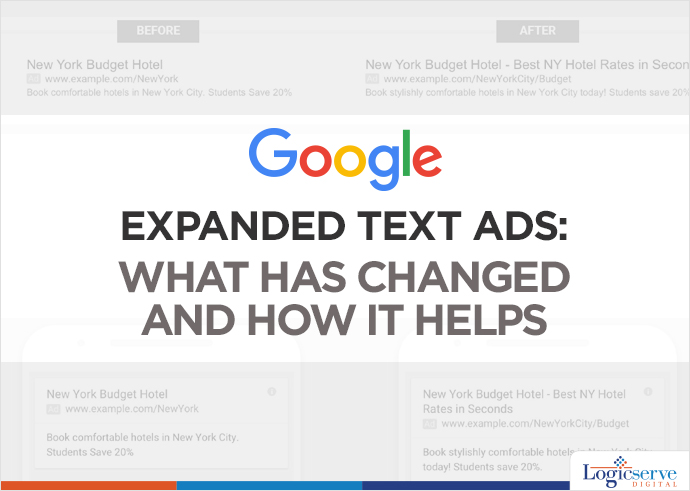
    The long awaited expanded text ads have finally arrived, but are we ready? Google has designed these ads considering both, the advertisers and the mobile-first world users in mind. So, what exactly has changed and how can it help us? Before, we answer this question let’s first understand what are expanded text ads.

    What are expanded text ads?

    Consider yourself as an artist who is painting on 1”x1” canvas for 15 years. Suddenly, someone hands over twice the size of the canvas. Would you fill up the extra space with more clouds and land? An ingenious artist would use up the space to bring up a stunning and all comprehensive landscape. Likewise, the expanded text ads gives you the freedom to flex your creative PPC muscles by exceeding the character limit.

    Here’s is what has changed –

    Expanded Text Ads: Exceeding character limit @LogicserveDigi

    Image Courtesy: Google user content

    • Two headlines and more characters

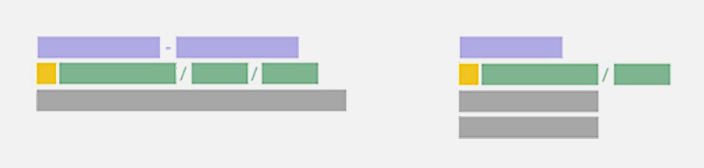
     Instead of 25-character headline, we now have two headlines with 30 characters each i.e., 60 characters!  It is a wonderful opportunity to have a desired call-to-action. Both headlines will appear on the single line (as shown on the left hand side of the image). However, the second one might come after a line break or Google might even truncate the second line, if required. Languages such as Japanese, Korean and Chinese having double-width characters are allowed to have 15 characters. This addition is sure to add up to the effectiveness of the ad.

    • Expanded description

    Remember the canvas; its size has increased by 14%! The 70-character limit for the description has been extended to 80-character. Often we find it impossible to utilize the 35 character in description line 1, and forced to move the long phrase or word to the next description line. This extension in character limit for description comes as boon for us, isn’t it?

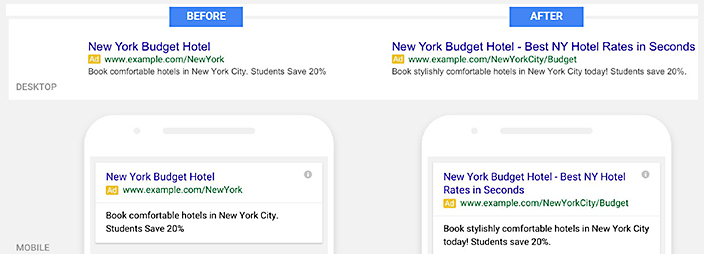
    Check out the below given image for more clarity. In the standard text, we have less character limit for description line, however in the expanded text ad we have much better call to action due to extended character limit on a single line.

    Expanded Text Ads Description:Character Limit @LogicserveDigi

    Image Courtesy: Wordstream

    • URL customization

    No need to enter a display URL to match the final URL domain. Adwords will pick the domain from your final URL and show it as your display URL.

    For instance,

    Your final URL is www(dot)example(dot)com/megastore/all-inclusive/deals, your display URL will be, www(dot)example(dot)com

    Well, you have another option of having path fields with 15-character limit. It will be a part of your ad’s display URL, positioned after the website’s domain.

    For instance,

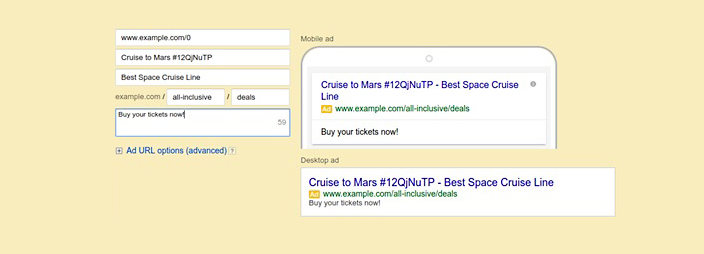
    Your final URL is www(dot)example(dot)com/megastore/all-inclusive/deals, and you might like to have path text to be all-inclusive and deals. So, your display URL will be www(dot)example(dot)com/all-inclusive/deals

    This is how the ads will look in Adwords interface.

    Expanded Text Ads Present and Former Text Ads @LogicserveDigi

    Image Courtesy: Google Developers

    Google recommends using path text, as it will give the users a better idea of where they will land on your website.

    Learnings:

    The major benefit of expanded text ads is the increase in CTR (Click-Through-Rate).  It makes sense, as your ad will have more space in search engine results with detailed information and call to action.

  • Mobile App Metrics that Marketers Must Know

    Mobile App Metrics that Marketers Must Know

    Important Mobile App Metrics @LogicserveDigi

    The mobile world has been flooded with a lot of apps for some time now. However, not all apps have been successful in retaining their popularity among users. Reports show that more than 25% of the users stop using the app and close to 90% even delete the app from their phone.

     These facts have compelled developers of apps to look at areas that define customer engagement so that the app has a longer life. They are looking at mobile metrics more closely than ever before to try and understand what makes an app tick.

    You are well aware that to improve something, you have to be able to measure it. Mobile metrics refers to the bunch of parameters that distinguish certain apps from the others. Tracking such metrics meticulously will help you define and acquire the marketing success you want out of this important medium.
    So which are the mobile metrics that you should be aware of? They are as under:

    1. The active user metric through push notifications that encourage users to become participants. Each notification sent by you should make the users engage with you more and more. They should use your app daily and more frequently. The push notifications app thus becomes a strong tool for engagement. You can even get better results from it by tweaking the language, targeting keywords and delivering it at opportune times of the day to your users. It needs to be mentioned here that it is not the number of push notifications but the quality that is of importance.
    2. Customer Life Time Value or CLTV presents you with your app earnings from any single user over the period of his usage. It also indicates the potential earning you can get when he or she refers the app to other users.
    3. The customer acquisition price or cost incurred on all sales, marketing activities to gain a user. Whether you are using organic or paid channels for acquisition, you have to take those costs into consideration and keep a track of it.
    4. The revenue per user is yet another metric that will tell you the effectiveness of your marketing as well as advertising campaigns.
    5. The session length of the app is another indicator of the productivity and preference of users. Typically a music app will have a longer session as compared to a social networking one. Your effort has to be targeted to increase the session length.
    6. The install rate or the clicks that are required on the ad towards getting the app installed is another metric you need to be aware of.
    7. Similarly, the uninstall rate is a factor that needs monitoring so that you are able to remove any bugs and carry out fixes to solve the problems faced by users that are compelling them to uninstall.
    8. The time taken for an app to launch. If this takes long, it is unlikely to be popular amongst users.

    The above mobile metrics are sufficient to enable you to monitor and make informed decisions about how to effectively engage with your users.


    Previous Post:- Digital Marketing Tips for the Start-ups

  • Must know mobile advertising trends

    Must know mobile advertising trends

    Mobile marketing @LogicserveDigi

    With 1.3 billion Facebook users and more than 500 million Twitter users, marketers are increasing their focus on online advertising to reach the billions of customers who are always online. While 81% of people in the 25 to 34 age group in the U.S. own a smartphone, 70% of teens do so and about half of the people who are 55 and older own a smartphone. No wonder about 751 million Facebook users access the social network from a mobile device one time or the other while nearly 200 million FB users access it exclusively from a mobile device. Nearly a quarter of Americans connect to the Internet only from a mobile device.

    Geographies

    The Asia Pacific region has the most mature mobile advertising markets represented by Japan and South Korea, two nations that have had historically high adoption rates of handsets.

    However, North America and Europe will see enormous growth in mobile advertising simply because of the huge advertising budgets of the companies located in these two continents. As the developing economies of China and India grow, so will the sales and penetration of smartphones in these two nations leading to a simultaneous growth in mobile advertising. Russia and Brazil are a couple of other countries that will witness good growth rates of mobile advertising, particularly in 2015 and beyond.

    Types — Display Ads Vs. RTB

    Among the different mobile advertising options, display advertising is a preferred format of digital marketers. It’s expected to hit $74.4 billion in 2016 with an annual growth rate of 21% per year. Programmatic buying such as Real Time Bidding (RTB) is helping the growth of display advertising. Social media platforms such as Facebook and Twitter are benefiting from the growth of RTB and enjoying growth rates of 29% per year. RTB is expected to keep growing and reach $8.69 billion by 2017, according to eMarketer, constituting 29% of total digital display ad spending. Other studies by IDC shows that RTB is expected to reach $20.8 billion worldwide by 2017. For example, programmatic advertising in the U.S. is expected to grow from $2 billion in 2012 to $14.4 billion in 2017 maintaining a scorching pace of growth of 48% per year. Western Europe and Japan will also see similar growth in RTB as a form of display advertising.

    Mobile advertising is witnessing six times faster growth rates compared to desktop online advertising. And in the U.S. in particular, RTB on mobiles is expected to reach $1 billion in 2015 and $3 billion in 2017. The Weather Channel gets 600 to 700% higher click through rates on mobile display ads compared to desktop ads.

    Mobile Video Ads

    Mobile video ads are growing fast and becoming a significant part of mobile advertising. Tablet users are the ones who tend to watch longer videos. Mobile video ad expenditure amounted to half a billion dollars in 2013 which was 13% of the total digital video ad market.

    With the rise in popularity of mobile video ads, marketers are coming up with clever product promotion videos. Think of viral videos such as the Game of Thrones and House of Cards mash-up which was a promotional campaign; another marketing video which went viral was 20 strangers kissing and yet another was a fake job ad for the toughest job in the world which was a marketing video for an e-greeting card company on the occasion of Mothers Day.

    SMS

    This is an effective advertising format over mobiles as 90% of text messages are read within three minutes of delivery and 95% of mobile users can be reached by brands using SMS advertising. A February 2013 report by Mobile Marketer says that 42.3% of consumers prefer SMS deals over bar-code scans or push message coupons.

    Mobile Search Ads

    Since 70% of searches on mobiles lead to action within one hour, search ads on mobile platforms are more effective than search ads on desktops.

    Mobile couples also enjoy higher rates of redemption compared to print coupons.

    Click To Call

    Lots of smartphone users perform local search on their smartphones. Up to 95% of smartphone users have looked up local information over the internet using their smartphones. Out of them, 61% proceeded to make calls to the business establishment. Hence, click to call features should be prominently displayed in mobile websites as well as in any form of a mobile advertisement.

    LogicSpeak:

    Hence the bottom-line is a continuing growth of mobile devices and mobile ads which will continue for the foreseeable future.

    Previous Post: Tips to Increase Blog Traffic

  • Mobile Ecosystem and Statistics

    Mobile Ecosystem and Statistics

    Mobile eco system and statistics @LogicserveDigi

    The most significant and sudden technological change of the last 20 years has been the rapid growth of the mobile phone. Mobile phones have transformed from being niche devices meant only for the rich to being easily affordable and used by pretty much everyone. The key reason why this has been possible is because of the continuous decline in the cost of processing power and memory which led to the explosion of the PC business first and now powers the relentless growth of mobiles and smartphones.

    A Billion Smartphones

    In a new record, the global smartphone market crossed a billion units in 2013. Smartphones constituted about 55.1% of total mobile phone shipments in 2013 which was up from 41.7% of total mobile shipments that smartphones accounted for in 2012. Global smartphone shipments in the fourth quarter of 2013 were 284.4 million which was up by 24.2% from the 229.0 million units shipped in the fourth quarter of 2012. The dominance of the Android ecosystem continues as Android-based smartphones make up about 75% while Apple iOS powers only about 15% of the smartphones. Samsung with its wide range of high-end and mid-range smartphones is the largest vendor while Apple comes in second with a plethora of other smartphone brands who do solid business in the low-end of the smartphone market in developing nations constitute the rest of the market.

    With the spread of the internet and roll out of 3G and 4G LTE networks, smartphones will be able to do more with the availability of broadband internet.

    Growth of Mobile Internet

    Internet user base is growing across the world with Asia constituting 44.8% of internet users in the world as of the second quarter of 2012. Europe and North America constitute 21.5% and 11.4% of global internet users. Even as the penetration of the internet grows across the globe, the user base of mobile internet users grows faster than wired internet users.

    Just as many people in developing countries such as India used mobiles without ever going through a period of using landline phones, huge numbers of people in the Middle East and Africa access the internet via mobile phones. The eMarketer estimate suggests that 94.0% of internet users in these two geographies will go online via the little mobile phone screen rather than a large desktop screen.

    The percentage of internet users who use their mobiles to access the internet is lower in more developed parts of the world such as North America and Europe where it is 64.3% and 67.8% respectively. The global percentage of mobile internet users this year is estimated to be around 79.1% which will grow to 90.1% by 2017.

    So, more and more web traffic is flowing to and from smartphones and other mobile devices and this has reached 17.4% of total web traffic as of 2013.

    Despite this massive growth, significant swatches of the world’s population in poor countries in Africa, Asia and Latin America continue to remain without access to the internet. Tech entrepreneurs such as Mark Zuckberberg are trying to spread the internet to these areas of the world through their projects such as internet.org.

    Google Hummingbird Update

    The evolving nature of web access has also impacted the nature of web searches. People who use mobile phones are more inclined to use voice search capabilities offered by Google. Google in turn has changed its algorithms continuously and the latest of those changes emphasize natural language search and semantic search which focuses on the meaning of words and their context rather than just being keyword-driven.

    To reach the growing percentage of mobile internet users, websites are being redesigned and revamped to make them more suitable for display on mobile devices. Website search engine optimization (SEO) experts are taking into account the requirements of Hummingbird in conducting site SEO. One of the key aspects of making a website get a good rank in a post-Hummingbird world is to have good content which should be natural and focused on the audience. Other applicable rules include having page URLs that reflect the content on that web page. Also, websites should have simple architecture which will help website visitors and search engines.

    Growth of Mobile Marketing

    Online marketers are changing their marketing strategies to keep up with changing customer habits. Hence, more marketing dollars are being allocated to online mobile marketing and digital marketing that is tailored specifically for the small screens of smartphones.

    Gartner predicts that mobile advertising worldwide will reach $18.0 billion in 2014 compared to $13.1 billion in 2013 and will become as much as $41.9 billion by 2017. According to Gartner, most of the mobile advertising will be display advertising but mobile video advertising will show the largest growth rates.

    In a similar report, eMarketer says that global mobile advertising increased by 105.0% to reach $17.96 billion last year. In 2014, eMarketer predicts mobile ads will rise 75.1% to reach $31.45 billion. Predictably, Facebook and Google get most of this mobile ad spend. These two advertising platforms combined, cornered more than two-thirds of mobile ad spends in 2013.

    Mobiles are becoming more indispensable Than Ever

    For a technology that that is only about two or three decade old, mobile phones have grown in importance as an essential part of our lives. Add the 20-year-old World Wide Web accessible from a mobile screen, and the combination becomes unbeatable.

    What can mobiles do?

    It seems now a days that it would be more appropriate to ask: what cannot mobiles do?

    Short of teleporting humans from one location to another, mobiles have become pretty versatile equipments that go far beyond their primary role of being just a telephone.

    Enabling Financial Inclusion

    With banks offering net banking facilities via dedicated mobile websites, banking customers get the benefit of accessing their bank account conveniently. Since it’s easier to have a great telecommunications network that is useful for many purposes rather than setting up extensive banking networks, banks are obviously eager to connect with their customers via mobile banking facilities. With just a smartphone and an internet connection, people have access to a bank at their fingertips.

    Healthcare Innovations

    The role that mobiles will play in improving the lives of people by helping folks keep track of their own health is immense. This is an area where innovation is happening right now and the future will see much more happening as smartphones evolve into wearable computers with smart sensors that can measure the blood sugar level, monitor the heart rate, pulse and other health parameters of the person wearing the device.

    Right now, smart watches are a niche product that are being targeted to people who frequent gyms and like to keep tabs on their exercise activity. However, soon enough the role of mobiles in healthcare might grow with the possible launch of devices like Apple’s rumored iWatch.

    Mobile Shopping

    Mobiles have become a friend of the smart shopper and people are eager to do shopping from their smartphone screens. Mostly, it’s the e-commerce companies who have fallen behind the rapidly changing consumer tastes and now they are scrambling to come up with mobile-friendly websites and Apps to cater to smartphone shoppers.

    Showrooming remains a popular activity with shoppers and physical stores are finding it a challenge to compete with the low prices offered by online retailers such as Amazon. But with mobiles enabling such on-the-spot comparisons, retailers and e-retailers will need to get smart and come up with attractive offers to draw in consumers.

    Another aspect of showrooming is comparison shopping which is becoming popular with multiple online retailers trying to out-do one another in offering discounts and offers. This has created a market for coupon sites such as Couponraja and Compareraja.

    Previous Post: How to use Analytics for tracking PPC performance

  • Going mobile with Ecommerce

    Going mobile with Ecommerce

    If you have been overwhelmed by the business success of online shopping, here is another dose of adrenalin that will make you excited—its mobile ecommerce. In the age of the smartphone and tablets, you will find that mobile online shopping has gone to a very high level. You can now shop for your favourite things from almost anywhere in the world—provided you have an internet connection.

    Going mobile with ecommerce @LogicserveDigi

    If you do some research on the internet for the scope of mobile ecommerce, you will be startled at the statistics that will throw up on you. Global mobile devices and connections grew to 7 billion from up to 6.5 billion in 2012. The smartphones accounted for 74% of that growth and there were overall 406 million net additions in the year 2013. With such a huge growth, online shopping companies have seen a lot of potential in the business of ecommerce on mobile.

    So, what do the companies need to make customers use their mobile phones? Well, the answer is very simple—they need to provide a free mobile application. By using this free mobile application, the online shoppers don’t need the desktop or laptop to make online shopping requests. Security is also something that most online shopping companies need to take care of. In the US, the number of shoppers using their smartphone for online shopping has gone to 79 percent. This means that there is an alarming demand for a robust online shopping app for smartphones.

    Creating a mobile application for ecommerce is not as easy as it appears. There are several complications that designers and developers are facing in creating ecommerce applications these days. Just creating a mobile app for product display is very easy, but to create an app that will take requests for payments of the selected goods is not easy at all. Customization or resizing of website pages is something that most online shopping websites have to give additional emphasis on. When you view a web page on a laptop or desktop, you can get to see several things, including images and videos. On the mobile phone or smartphone, there is very limited space and making adjustments can sometimes compromise the quality.

    When the aforementioned obstacles of mobile shopping or ecommerce on mobile are overcome, the potential benefits are substantial. In addition to the aforementioned obstacles, marketing for online shopping is also in focus these days. There is a huge revolution happening on the world of shopping and this revolution is happening right at the tips of our fingers. With the latest smartphone, you don’t need to worry about online shopping anymore.

    LogicSpeak:

    If you are planning to buy a mobile phone, it is always recommended that you buy a smartphone that can connect to the internet. Since, this is the prerequisite for mobile ecommerce. Technology is evolving at a very fast pace and we have to stay abreast with the current trends or we will be blown away to oblivion. Mobile ecommerce will be there for quite some time—so be prepared for this revolution.

    Previous Post: Content marketing and SEO: What you need to know

  • How to Choose Between Mobile Apps and Mobile Website

    How to Choose Between Mobile Apps and Mobile Website

    Mobile app versus mobile website @LogicserveDigi

    More than half of visitors to the Web access it via a mobile device. Smartphones are outselling desktop PCs six-to-one. This underscores the need for businesses to cater to the vast mobile-wielding audience.

    Mobile Websites

    To make sure that potential and existing customers have a great browsing (and indeed, online shopping) experience, businesses must have a dedicated mobile website. You can either develop a different website entirely and host it at a different URL (think of the two New York Times websites: nytimes.com and mobile.nytimes.com) or you can go for responsive design which refers to a website design technology that results in websites that look good on different screen sizes by presenting their website content differently depending on the screen size or device on which you access the site.

    Mobile websites certainly make far more sense than mobile apps.

    Here are a few reasons that show why mobile websites make more sense than mobile apps:

    • One Website Versus Multiple Apps

    A single mobile website is all you need to cater to a variety of users browsing with their iPhones, iPads and Android-powered devices. On the other hand, you would need to design and develop (write code) separate apps for the separate mobile operating system platforms from Apple, Google, and Microsoft.

    • Easy to Upgrade

    How easy is it to upgrade a website versus upgrading apps whose code must be modified separately and after modification and testing, the ‘new versions’ of the apps will have to be pushed to the users who’ll need to download or ‘upgrade’ their apps? There is obviously no competition between the two. The mobile website is the clear winner here compared to the mobile app option.

    • Easy to Locate and Share

    With a mobile website, you can make it search engine friendly and customers will discover your website from search engine query results. It will be difficult to stand out in the clutter of a million apps which are there on both the Apple App Store and Google Play.

    Not only are mobile websites easy to locate via search engines, they can be shared easily via social media as well. Like normal websites, you can integrate social media buttons (Facebook, Twitter, Google+, etc.) into your mobile websites that will let users tweet the pages they like or share on Facebook.

    • A Mobile Website Is Also A Mobile App

    If you want App-like functionality in your mobile website, it is possible to have some of that on the mobile website itself. Of course, you cannot get full-fledged App-like experience from a mobile website.

    • Cheap

    Perhaps quite as important for businesses, mobile website development is far cheaper than mobile app development. This is obvious as you only need one mobile website to cater to all mobile visitors whereas you will need at least two apps to cater to the Android and iPhone audience.

    Mobile Apps

    There are a small number of situations where mobile apps do make sense though. If you want to charge users money, then you should come up with an app as it’s easy to charge money for downloading apps.

    Similarly, if you want to give offline functionality, then obviously you will need apps which will work offline once downloaded and installed on a mobile device.

    If you need mobile gaming-like features which require a lot of processing or even access to the phone’s camera, gyros, or accelerometers and so on, then also dedicated apps make sense.

    LogicSpeak:

    The bottom-line is that for most needs and most businesses, a mobile website will do perfectly fine. It will be cost-effective and user-friendly too.

    Previous Post: What every Affiliate marketer should know?

  • Mobile Marketing — The Way Ahead

    Mobile Marketing — The Way Ahead

    Mobile Marketing @Logicserve Digi

    The world is going mobile in a big way. In 2013, mobile devices outsold PCs nearly six times. While roughly 300 million desktop and notebook PCs were shipped worldwide last year, the total volume for mobile devices was 1.8 billion. More and more of these mobile devices will be smartphones with internet connectivity. Mobile marketing, therefore, is a key challenge for marketers and brands if they want to send their message across to their customers who are spending more and more of their waking hours looking at a mobile device screen.

    What are the big mobile marketing trends for 2014?

    Thomas Husson of Forrester Research makes these predictions for 2014:

    • Big Data and Analytics will continue to grow in importance. Marketers who understand the behavior or their customers best will benefit from Big Data. Companies have to get better at understanding the context of user searches and other activities of consumers on their mobile devices. Marketers will have to tailor their mobile ads and product discounts and other offers accordingly.
    • Mobile contextual data will even impact other marketing channels. Smart marketers will develop ways to interpret the data generated by how consumers use their mobile devices to gather better insights about the consumers’ needs and preferences. So, mobile marketing needs to be viewed in combination with other marketing channels.
    • Mobile advertising will mature with the emergence of new mobile-centric ad formats. But user identification will continue to remain a challenge.

    Additional mobile marketing trends include greater personalization of advertising. Grocery stores could analyze a regular customer’s purchase behavior via maintaining a tally of the items purchased using the lists generated during checkout. Advertising can then be tweaked to appeal to individual customers based on their purchase history; for example, their food choices such as organic food, or vegetarian food and so on.

    Also, location-based mobile marketing will make mobile marketing relevant and useful for consumers. Think of a grocery store ad about discounts for the day being shown to a mobile user when the user is physically close to the store. Similarly, a pizza store could show an ad about their special offer for the day when the mobile user is in the vicinity during the hours of the day when the restaurant is open.

    Advertisers will have to learn how to make use of shorter content such as those looping six-second Vine videos or Instagram videos. Mobile ads will continue to use gamification concepts where users accumulate points, badges, and so on. Apart from competing with friends, people also love good deals. Mobile marketers will offer unique and personalized deals that are redeemable from customers’ mobile phones.

    For businesses for whom events (product launches, birthdays and other special occasions) are important, the mobile marketing strategy has to include an ability to target the right audience. Customers should be able to easily add the marketer’s event to their calendar. Loyalty programs offered through a mobile device are perfect since people have their mobiles with them all the time and there is no risk of losing their loyalty cards. Customer referral programs are ideal for the mobile platform since a customer’s contacts are already stored on the mobile device.

    India has a burgeoning user base of mobile users. At last count, there are more than 600 million mobile users and more than 150 million internet users. As smartphone prices come down and breach the $100 mark, more youth will go for smartphones connected to the internet. This presents a golden opportunity for mobile marketing innovation.

    With the growth of online retailers in India, there are thousands and tens of thousands of discount coupons available at any point of time across various retailers such as Amazon India, eBay India, Flipkart, MakeMyTrip, Yatra, Cleartrip, Jabong, Myntra, and others.

    Sites like Couponraja aim to provide “visitors and members the latest coupon codes promotional codes from leading retailers/ merchants in India.” Couponraja has seen tremendous growth since its launch in October 2011 with an active customer base of hundreds of thousands and more than 350,000 subscribers on Facebook.

    Compareraja is a similar site which helps users find the best online deals by comparing prices at different online retailers such as Home Shop 18, Amazon, Flipkart, eBay, Indiatimes, and so on.

    LogicSpeak :

    There will be more innovations such as Couponraja and Compareraja as the penetration of mobiles and smartphones increases in India. Mobile marketing will get smarter and mobile marketers will learn to better target their ads to the intended customer for a win-win situation for both the retailer and the customer.