LS Staging

Category: Google Updates

  • Why Google Certification Matters in Today’s Digital Marketing Space?

    Why Google Certification Matters in Today’s Digital Marketing Space?

    The digital marketing space is a competitive battlefield, constantly evolving with new technologies and strategies. To stay ahead, businesses need a partner with the expertise and knowledge to navigate this ever-changing terrain. That’s where Google Certifications come in. We are thrilled to announce that LS Digital has received Google Digital Guru Certification. Google Digital Guru is an access only platform given to their premiere partners. There are 4 categories in this platform: video, data and technology, DV360, and performance.

    Why Google Certification Matters

    A Google Certification isn’t just a fancy badge – it’s a symbol of proven expertise and up-to-date knowledge in Google’s advertising platforms and best practices. Here’s how partnering with a Google Certified Company like LS Digital elevates your digital marketing experience:

    • Expert Guidance: Combined, our team has over 250 Google Certifications across crucial areas like video marketing, performance marketing, display advertising, data analysis, and technology integration. This translates to expert guidance for you, ensuring your campaigns are tailored to your specific needs and goals.
    • Data-Driven Decisions: Every decision we make is backed by robust data analysis, a hallmark of Google Certifications. This ensures your campaigns are backed by informed decisions and are optimized to maximum performance.
    • Credibility and Trust: Earning Google Certification demonstrates our company’s deep understanding of the tools and techniques that drive results. This translates to increased trust and confidence from potential clients.
    • Staying Ahead of the Curve: Google constantly updates its platforms and introduces new features. This certification is only valid for 1 year, ensuring that we are equipped with the latest knowledge, allowing us to implement cutting-edge strategies for our clients.


    Achieving Google Digital Guru certification equips us with a diverse set of skills vital for excelling in the digital marketing landscape, including:

    • Video Marketing: Learning to create captivating video content that grabs attention and drives conversions.
    • Performance Marketing: Develop data-driven strategies that maximize our return on investment (ROI) through optimized campaigns.
    • DV360 Advertising: Learn to design eye-catching display ads that capture your target audience and boost brand awareness.
    • Data Analysis and Technology Integration: Gain expertise in deciphering complex data sets, allowing you to refine your marketing strategy for optimal results. Stay ahead of the curve by integrating the latest technological advancements into your digital marketing mix.


    Achieving certification for the modules requires meeting two criteria. First, you must pass all assessments within a module with a minimum score of 80%. Second, you need to demonstrate engagement by achieving a video completion rate of at least 85% for all videos in the module. Once you’ve fulfilled both these requirements, you’ll be awarded a Digital Guru Certification, valid for one year.

    In today’s competitive digital marketing landscape, keeping pace with innovation is crucial. Google Certifications offer a valuable path to stay informed and develop expertise in Google’s advertising platforms. Whether you’re an agency or an individual marketer, pursuing Google Certifications is an investment in your professional growth and a testament to your dedication to achieving the best possible results.

  • GA 4 Set to be the Only Source of Truth – LS Digital

    GA 4 Set to be the Only Source of Truth – LS Digital

    The Nightmare of User Privacy:

    It’s no secret that we’re in the midst of a massive transition, and user privacy is at the forefront of everyone’s thoughts. Here is where Google Analytics 4 has made a significant technology leap that will alter the way businesses analyze their traffic.

    Foregoing are the grounds for this leap:

    • Regulatory changes throughout the world have increased the bar for user privacy.
    • Core technology like as cookies, on which measurement systems have relied on for years, are being changed by browsers and other platforms. Furthermore, end-users are expecting greater transparency and control over how their data is utilized.
    • At the same time, the amount of data created by a plethora of business touchpoints and platforms with which consumers engage continues to grow at an exponential rate.

    So, Obviously, A privacy centric ecosystem would be a ‘positive ‘for humanity, but for us digital marketers it is a ‘nightmare’
    Now while this Nightmare of User Privacy haunts us marketers, Google had already foreseen it and introduced ‘GA 4’ Two and half years ago considering User privacy as the center of vision.
    ————————————————————————————————————————

    About the new normal:

    GA 4 is designed to be a platform for everyone- including businesses with either a presence on web or app, for those having exposure on both app plus web, as well as for brands with a hybrid existence.

    The new Google Analytics 4 brings with it a vast spectrum of enriched capabilities:

    • Stiches your app and web data and provides a unified view.
    • Has Machine Learning at the core to give you predictions about target audience’s likelihood to purchase, churn, potential revenue, so that you are better prepared on what’s coming your way.
    • Enables enhanced marketing capabilities with its integration possibility with the entire ad ecosystem of Google (GMP suite).
    • Gives opportunity to query your data and have precision in reporting with the Big Query warehouse.
    • Can be integrated with Salesforce as well as Marketing Cloud
    • Designed to be future-proof even as stringent regulatory changes around the world and the rumored cookie-less culture try to create a gap in your data.
      ————————————————————————————————————————

    About the Migration:

    It is a known fact that GA 4 will take over the analytics’ reins on July 1, 2023, replacing Universal Analytics as a mandatory update for everyone. But wait! Here’s something you need to know: Your Universal Analytics data won’t be migrated to GA 4!
    Therefore, with the clock ticking to defined end date, it is justified to conclude that GA 4 is no longer an option, it’s a compulsion!
    And, like any other Machine Learning model the reporting accuracy of GA4 also depends on the data collected in it, thus the sooner you start the better the data repository.

    What does Google have to say about this?

    “We encourage you to make the switch to Google Analytics 4 as soon as possible to build the necessary historical data before Universal Analytics stops processing new hits.”

    Well, then what does Google recommend?

    “We strongly encourage you to make the switch to Google Analytics 4 as soon as possible. Doing so will allow you to build the necessary historical data and usage in the new experience, preparing you for continuity once Universal Analytics is no longer available.” Also, “Google Analytics 4 is fully equipped to support your measurement needs today and into the future. To take advantage of Google Analytics 4’s measurement continuity, automated insights about the customer journey, and easy activation to improve marketing ROI, finish setting up your GA 4 property today.”

  • Don’t be baffled by BERT: Here’s what Brands should know about this Latest Google Algorithm Update

    Don’t be baffled by BERT: Here’s what Brands should know about this Latest Google Algorithm Update

    In October 2019, Google announced a search algorithm update known as BERT that helps the search engine improve the contextual understanding of queries. While Google is known for making frequent updates to its search algorithm, BERT gained prominence as it was estimated that nearly 10% of all search queries would be impacted by it.

    What is BERT all about? 

    BERT is the acronym for Bidirectional Encoder Representations from Transformers. Let’s understand what BERT is with real-world examples. This update helps Google better understand the context of the search query, rather than just relying on keywords.

    Let’s say, a searcher uses the query “visa for travel to the USA from India.” Before BERT, the results could include visa instructions for travelers from the USA to India. It’s the opposite of what the searcher is looking for. It’s because Google used to focus only on the keywords: visa + travel + USA + India.

    With the BERT update, the results are more relevant as the search engine accounts for prepositions like “to” “from” “for” to better understand user intent.

    Google’s Pandu Nayak, the Vice President of search, explains the reason behind this update in a blog post. He states that though Google has improved understanding language complexities over the years, there were plenty of times when the search engine failed to get the context right, especially for conversational and complex queries. With the BERT update, the search engine is better able to decipher natural language questions that are becoming more relevant in this era of voice search.

    BERT Update: The Key Takeaways for Brands, Marketers and SEO Strategists 

    Traditionally search, and SEO strategies were based on keywords. While the relevancy of keywords hasn’t gone away entirely, there are a few tweaks to be done in light of this update.

    • The primary objective of this update is to provide users with relevant and high-quality search results. To meet this objective, brands must focus on developing excellent content that is authoritative, informational, and relevant to the end-user.
    • Long-tailed keywords that use connector terms and hierarchies gain more prominence. Additionally, long-tailed keywords make the content more relevant to natural queries used by voice searchers.
    • While keywords lose a bit of their relevancy, note that a large percentage of the search remains unaffected by this change. Marketers don’t have to do away with keyword-based strategies for now. Instead, marketers can monitor incoming search referral traffic and make changes based on search volume differences.
    • Developing localized content in native languages (instead of translating from English to another language or vice versa) has a better impact on SEO.

    Finally, marketers have to keep in mind; whether it’s BERT or any other algorithm updates from Google, the best SEO strategy is always the same – providing valuable and high-quality content that is relevant to what your audience is searching.

  • Google Opens up Access to Google Merchant Center Results for Non-AdWords Retailers in the US

    Google Opens up Access to Google Merchant Center Results for Non-AdWords Retailers in the US

    With nearly 40000 searches every second, Google is indeed the most popular search engine. When users search for products using Google, the search engine generally displays sponsored content (Google Ads) above the organic search results.

    Image via Google

    To get your products displayed in the coveted Shopping Display Panel, e-commerce websites are required to upload their product data to the Google Merchant Center (GMC). Google recently announced that it’s making a few changes to the GMC. Here, in this post, you can find all about these recent changes.

    What’s New?

    The information available in Shopping Ads is now accessible to all e-commerce retailers for free. E-commerce sellers can now directly submit the information to Google. They no longer have to add schema markup to their site for doing the same.

    What’s Google Merchant Center (GMC)?

    GMC aka Google Merchant Center is a central dashboard where online e-commerce sellers can upload their product and store data, so that Google searchers can access the latest information about your products, directly on their search results page.

    The biggest benefit of the GMC was that all information displayed on it was updated in real-time so that users get accurate information during searches.

    Earlier, the data from the GMC was primarily to the benefit of Google AdWords users and not available to other e-commerce sellers. Online retailers had to use the schema markup of their sites to display the relevant information along with the right product images. The information displayed on the Shopping Display Panel included product price, availability, user ratings and more.

    How does the Latest Update Impact You?

    Recently, Google announced that it’s opening up the GMC for all online retailers, irrespective of whether they use AdWords or not. This works to the benefit of online retailers who are non-AdWords users. You can submit your product data to Google in real-time, thereby making your products eligible to be viewed in organic and image search results on Google.

    This is an excellent news for online retailers as it gives them better control over how their products are displayed on Google search results. Google further stated that products displayed on the Google shopping ads panel would be ranked based on their relevance to user queries online. Relevance is calculated using several factors like search history, the location of the searcher and so on.

    Online retailers can now submit the information directly to Google and not just by using the schema markup of their site.

    Three key benefits for Online Retailers via this Update:

    • You don’t require an AdWords account to upload your product information on Google
    • It’s free of cost
    • You can submit your product info directly to Google, giving you better control of your product display

    Is this Update Available for All?

    Right now, Google Merchant Center has extended this facility only to online retailers in the US. However, it’s expected that Google will roll out this change in other countries in the next few months.

  • Google Plus Officially Shutting Down: Here’s how to Download, Save and Retrieve Your Data

    Google Plus Officially Shutting Down: Here’s how to Download, Save and Retrieve Your Data

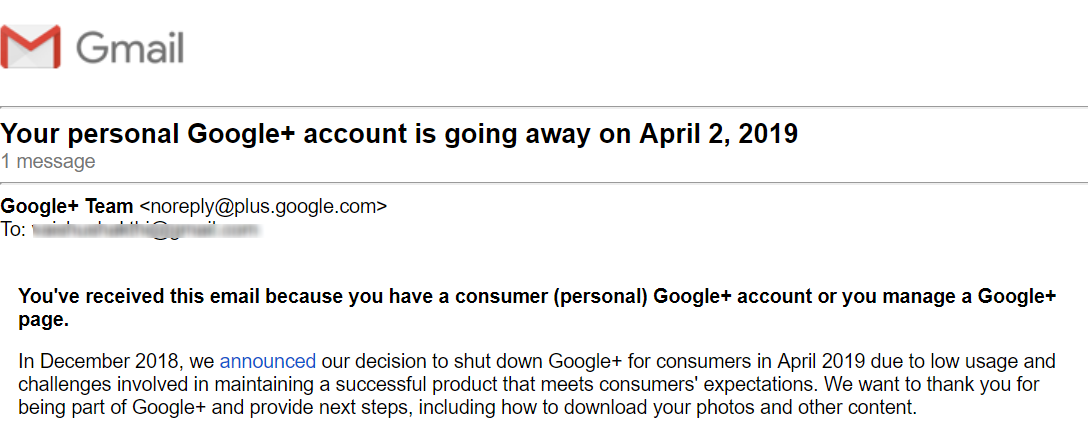
    Google recently sent an email to all users of Google+ (the social media platform of Google) announcing that the platform is officially shutting down on 2nd April 2019. Google announced the company’s decision to shut down the failed social media network in December 2018 via a blog post.

    Why is Google Shutting down Google+?

    In the recent email sent out to customers, Google states that there were several challenges in maintaining a platform that exceeds user expectations and due to low usage, the company has arrived at this decision to retire the social network from Google.

    While that may be the official reason, digital media experts believe that the platform is closing because of a data breach that occurred on it. In March 2018, more than 500,000 accounts on the platform had their personal data illegally shared to third-party developers. This data breach occurred around the same time as the notorious Cambridge Analytica data breach that brought Facebook under intense scrutiny.

    The worst part about this data breach on Google+ is that Google didn’t inform users about it for several months. Though Google claims that none of the data that was leaked was mishandled, it could result in investigations for Google both in the US and Europe.

    Another reason for the closing of the platform is poor usage. Google+ was introduced in 2011 when both Twitter and Facebook were at the top of the social media game. Despite some initial buzz, Google+ never caught on. Though Google+ never went mainstream, it has a niche community of users who prefer an alternative platform that is less crowded.

    How to Retrieve Data from Google+ before it’s Gone Forever?

    If you have saved photos or videos in your Google+ album archive, you won’t be able to access it after April 2nd. However, if you have taken a backup of these photos to your Google Photos, then you need not worry. As the photos from Google+ backed on Google photos won’t be lost.

    If you are a Community Owner or Moderator on Google+ you can download and save your data. From March 2019, you can also download additional data about your community like – photos, body and author details for all community posts.

    If you use Google+ to sign into other apps and sites, the G+ sign in button option will be removed in the coming weeks.

    If you use Google+ to post comments on sites, then you will no longer be able to do so. The option to post comments using Google+ will be removed from Blogger on 4th Feb and from other sites by 7th March. All the comments you posted using Google+ from all sites will be deleted from 2nd April.

    If you are a G Suite customer, your Google+ account for G Suite will remain open. However, Google states that G Suite will be updated soon with a new look and several new features.

    If you are a developer using Google+ sign in or APIs, check out this post from Google to find out how this shutdown will impact you.

    Key Dates to Remember:

    April 2, 2019 – Consumer Google+ accounts and Google+ pages will be closed, and Google will start the process of deleting content from individual Google+ accounts. The process of deletion of customer data will take a while, so you may be able to access some of your data after this deadline, but there’s no guarantee.

    From Feb 4th, 2019 – Users will no longer be able to create new Google+ pages, user profiles, events or communities.

    For more details about the closure of Google+ check out this FAQ section from Google.

  • Google to Integrate 3 New Features in Search Results

    Google to Integrate 3 New Features in Search Results

    In a wave of updates, Google aims to launch not one, but three new features to the search results dedicated to Q&A, FAQs, and How-to content. These are some of Google’s most searched results and the upcoming updates sweeten the experience for the end user all the more. Or will they?

    These upcoming features were announced by Google’s Gary Illyes at Google Dance event in Singapore.

    What are the updates?

    From what the first look reveals, one could safely say that Google will be highlighting its Q&A, FAQ and How-to features, with customised results. An example of this could be that the results will now appear at the top of the page, not unlike how the featured bits of search results are displayed.

    These new search results appear to occupy most of the screen space, owing to the fact that each result has its own drop-down menu. These could be estimated to end up expanding across multiple screens too. This means that you would need to scroll more to know more, as a considerable amount of your page would be occupied by these enriched search results, which Google expects to be a welcome update soon.

    This update aims to put more content out in the search result page itself, saving users the effort of entering the site entirely to know basic information. In case of the Q&A, you happen to see a “more” link, you do not have the full answer, but merely a snippet. The result would be condensed to a bare minimum, as compared to what is shown on the actual webpage.

    Data markup and Google

    However, one of the biggest questions that stares at Google right in the face is, “will Google render these customised rich results on its own or would Google depend on data markup which site owners implement?

    Recently, Google introduced a newer type of data which is structured for marking up tables which are intended to be utilised by news articles and data analysts all across the world. So it is only understood that Google may be deciding to introduce more such types of mark-ups in the future.

    Would this update affect publishers?

    The ease that came with more content displayed on the search result page was that there was less of a need for end users to click through to the actual page. Bearing that in mind, if results are starting to get structure dependent, then how does it even make it worth implementing?

    Considering publishers, if these result types are automatically generated, would publishers be able to opt out of it?

    There are many questions owing to the nature of these rich results that are to come into play soon through Google’s search engine result page (SERP). The answers to a lot of these questions would come in when Google’s search results officially go up with these newer updates.

    Do let us know how these changes will impact your querying and search marketing behaviour. We would love to hear from you.

  • Google A65 – The new age AR headsets in the making

    Google A65 – The new age AR headsets in the making

    Google is known to be the market leader when it comes to new age innovations. Be it search engines, Virtual Reality (VR), Artificial Intelligence (AI), or Augmented Reality; its products have captured the world’s attention. The recently concluded I/O conference too showed a glimpse of the key happenings inside the Google tech labs working on the futuristic technology.

    An emphasis on Augmented Reality (AR)

    One of the exciting highlights of the event was its standalone Augmented Reality (AR) project.  It is a headset that goes by the codename “Google A65” and that it will use new Qualcomm chips.

    The Qualcomm chips used in the Google A65 – QSC603 – are four-core system chips that are also estimated to be a part of the next-gen Microsoft HoloLens. Google A65 is said to be built by Taiwanese computer giants, Quanta. The project is still said to be in its making stages, according to the documents that have been obtained by WinFuture.

    A background about Quanta

    Quanta is the same company that was involved in the making of the esteemed Pixel C tablet, which was launched in 2015. It is said that the QSC603 can power an output video at an unbelievably stunning WQHD (Wide Quad HD) resolution, at display 3D overlays and supports other major graphic interfaces like OpenGL, OpenCL and even Vulcan.

    Highlights of the AR headset

    The headset that Google is coming up with is rumoured to include camera sensors and microphones that allow users to operate the device using the Google Assistant, as reported by CNET. “The headset is supposedly based on custom quad-core internet-of-things (IoT) focused Qualcomm QSC603, supporting up to 2,560 x 1,440 resolution and 1080p and 1030p video capture, 3D overlays, rendering interfaces, Bluetooth 5.1, GPS and the Android neural networks application programming interface (API)”, the CNET report added.

    Google is already in the process of manufacturing AR headsets called the “Google Glass,” that comes in with a heads-up display and camera. Google glass was launched in 2013. However, Google A65 is said to resemble Microsoft’s “HoloLens” in ways more than one. Firstly, the operation style, then the advanced RISC machines (ARM) – powered design and lastly the Qualcomm chipset that we have already mentioned about as being a part of the next-gen HoloLens. These characteristics are very similar to the Microsoft AR product.

    Bearing in mind the advances made by Google in terms of bettering AR, mainstreaming Augmented Reality in the next couple of years does not seem like an impossibility, especially when companies like Apple and Samsung are also leaping at chances to make the most of this.

    There is no confirmed release date for Google A65 (we refer to the codename for now). However, Google assures that this would be made public soon since it is still in its formative stages.

  • Weekend Digital Media Round-up: Double delight for digital India, DoubleClick Bid Manager, Snapchat’s new snap store and more..

    Weekend Digital Media Round-up: Double delight for digital India, DoubleClick Bid Manager, Snapchat’s new snap store and more..


    1. Union Budget 2018: Double delight for digital India

    The NDA government’s last Budget before the Lok Sabha polls has kept up the focus on Digital India by doubling allocation for the programme to Rs.3,073 crore in 2018-19. Finance minister Arun Jaitley acknowledged the emerging technologies in his Budget speech on Thursday by announcing that the Department of Science and Technology will launch a Mission on Cyber Physical Systems. [Source: INDIA TODAY]

    1. Foreign or local, digital services companies equal before tax law

    The Budget has proposed an enabling rule, which broadly says that a MNC could have a business connection in India even without a physical presence in the country. [Source: The Economic Times]

    1. DoubleClick Bid Manager testing features to improve digital & TV campaign coordination

    Google has announced two new features in DoubleClick Bid Manager to help advertisers activate campaigns across multiple screens and bridge digital and live TV efforts. [Source: MARTECH TODAY]

    1. Snapchat’s new Snap Store teases in-app commerce potential

    Today the company opened the Snap Store, which lives in the Snapchat app’s Discover section and lets you buy Snapchat merchandise, like a $20 Dancing Hot Dog Plushie or a $30 Dog Lens T-Shirt. [Source: TechCrunch]

    1. Google lets users ‘mute’ remarketed ads

    The internet giant has updated its ad system so users can mute reminder ads on a per-advertiser basis for 90 days.[Source: net imperative]

    1. WhatsApp hits 1.5 billion monthly users. $19B? Not so bad.

    CEO Mark Zuckerberg announced on the Q4 2017 earnings call today that WhatsApp now has 1.5 billion users and sees 60 billion messages sent per day. That’s compared to 1.3 billion monthly users and 1 billion daily active users in July. [Source: TechCrunch]

    1. Google Assistant Go launched on Play Store: Designed for Android Go phones

    Google Assistant Go is now officially available on the Play Store, and this version of app is compatible for all Android Go smartphones. [Source: The Indian Express]

    1. Alphabet Unveils New Cybersecurity Business ‘Chronicle’ To Prevent Cyber Attacks

    Alphabet, better known as the parent-concern of the world’s biggest network Google has come up with some great news for business owners! The company has decided to help entrepreneurs deal with cybersecurity issues and safety threats.[Source: LOGICSERVE DIGITAL]

    1. Facebook Introduces Branded Content Tags With New Proviso For Misuse

    Facebook has emerged as one of the most compelling, efficient, and dynamic platforms for business marketing. If you plan to catapult your venture to great heights, Facebook will certainly play a crucial role. The company dropped restrictions on ‘branded content’ and rolled out a unique tagging system. [Source: LOGICSERVE DIGITAL]

    1. Instagram now allows businesses to schedule their posts

    Instagram today made a long overdue change to its product that social media managers have wanted for some time – it will allow businesses on Instagram to schedule their posts. [Source: TechCrunch]

    And in an exclusive interview with Ashutosh Asthana, Assistant Editor, Thinking Aloud, our Co-founder & CEO, Prasad Shejale, speaks about the challenges he faced as an entrepreneur and his mantra for success. Click here


  • Alphabet Unveils New Cybersecurity Business ‘Chronicle’ to Prevent Cyber Attacks

    Alphabet Unveils New Cybersecurity Business ‘Chronicle’ to Prevent Cyber Attacks

    Alphabet, better known as the parent-concern of the world’s biggest network Google has come up with some great news for business owners! The company has decided to help entrepreneurs deal with cybersecurity issues and safety threats. Business owners will definitely get better opportunities to identify and resolve such issues. If you are planning to deal with security issues, Alphabet’s offering ‘Chronicle’ will prove to be the perfect support system.

    Previously a part of Alphabet’s X Moonshot Group, ‘Chronicle’ happens to be one of the standalone ventures under ‘Alphabet’. Stephen Gillet happens to be the Chief Executive Officer of the new-found company. Let’s take a look at what Chronicle promises to offer:

    The focal points

    Gillet, who used to work for Symantec before joining as Chronicle’s CEO talks about the new venture. According to him, the business will have two crucial and prime components:

    • A security and cyber intelligence platform for companies across the world. That will help companies to deal with their internal data and ensure security in a smart way.
    • The firm reintroduces VirusTotal, which happens to be an anti-malware tool bought by Google in the year 2012.

    Most of the companies suffer because of security negligence. They are completely unaware of the potential threats and also ignore the blind spots. Chronicle aims to eliminate these gaps, identify the pain points, and ensure optimum data security for many ventures across the globe.

    From the CEO’s Desk

    If the statements circulated by Stephen Gillet are anything to go by, Chronicle promises to be the one-stop solution for data security. He further goes on emphasising the importance of Chronicle in the following way:

    1. Improving speed: The venture will make sure your security teams work comprehensively. As a result, both the speed and performance will increase.
    2. Strengthening the impact: Make sure you strengthen your security’s impact. ‘Chronicle’ will add to your strength thus ensuring optimum data security.
    3. Cost-effective: Chronicle aims at identifying security signals and can also help you work on them. These signals were unidentifiable at the beginning, as the identification process is highly expensive.
    4. Investigating attacks: Security attacks can occur anytime. It’s highly imperative to identify the right sources before implementing the quick fixes. Chronicle makes the investigation process easier than ever. You will find the most crucial resources from the existing data systems and infrastructure.

    Chronicle helps you identify the most crucial information from a pool of data. Your existing security tools will speak a lot about your enterprise infrastructure, and that’s where ‘Chronicle’ will help you out.

    The mechanism

    The entire application works on ML and Alphabet’s infrastructure. You will also get the opportunity to analyse your enterprise’s security data. Cloud integration will follow suit, as that will help ‘Chronicle’ grow and scale up with an enterprise. Or else, it might become difficult to manage and handle critical data sets.

    Foreseeing the future

    On that note, it’s high time we take a look at the future. Chronicle is here to stay and will ensure optimum data security and safety for enterprises across the world. You just need to understand how it works and integrate it into the existing infrastructure.


  • Google’s First Click Free Policy for Journalism Articles to End Soon

    Google’s First Click Free Policy for Journalism Articles to End Soon


    Google had aligned several protocols to ensure the growth of digital subscription for news articles online. One such move was the ‘First Click Free’ policy that mandated the news providers to publish free articles in order to rise up the order on the search engine. The move that was supposed to aid the news publishing houses’ digital growth, backfired for many reasons. As per News Corp (which publishes The Sun in the US), the move meant that if the articles weren’t provided for free, then the site virtually disappeared from the search rankings, proving to be harmful to the overall online marketing strategies of the publishers.

    What is changing?

    As per the ‘First Click Free’ policy, subscription-based publishing needs to comply with Google’s demands of providing the first three articles for free before opening the ‘subscribe for more news’ dialog box. This was the only way they could come up on search engine query results. By ending this move, Google will now allow publishers to decide how many articles they want to provide for free before they show the paywall (the ‘subscribe for more news’ dialog box) to the users.

    What does it mean for news publishers?

    Nielsen’s study reported that around 20% of the readers were fine with to pay for the subscription of premium content published by the known news agencies and publishers, provided it is ad-free. While the market is there, news publishers must strike a fine balance between monetizing their premium content and ranking well on search engines.

    For news publishers, Google’s decision to remove the ‘First Click Free’ policy provides advantages at many levels –

    1 – As subscription-based news access is gaining popularity, news publishers can set their monetization strategies without the fear of distributing it for free.

    2 – The occurrence of fake news will go down as publishers and reporters will be incentivized for working hard, putting in their best efforts, and bringing only factual information as news to the public.

    3 – News publishers promoting premium news content can build a stronger relationship with their readers and craft an enduring brand loyalty

    What it means for the end readers?

    For the content consumers, the move offers a mixed bag of scenarios. On one end, they will now be able to access better-quality content knowing that the publishers will be working doubly hard to retain subscriptions and build loyalty.

    On the other hand, they can no longer get a feel of the website without subscribing to it. However, this is expected to be a minor obstacle, as reputed news publishers would have already proved their mettle with a stellar background. This will provide the impetus for serious readers to go ahead with the subscription without the need to try it out for free first.

    To conclude

    In order to make the monetization strategy truly successful, content publishers will have to elevate the degree of user experience and reader delight they provide to consumers.  The overall browsing on the site should be as clutter-free, seamless, and free of ads. This is the way forward now that Google’s ‘First Click Free’ policy is no longer around.