LS Staging

Category: Google Ads

  • 6 PPC Strategies You Cannot Ignore in 2022

    6 PPC Strategies You Cannot Ignore in 2022

    The COVID-19 pandemic has played a critical role in boosting digital adoption in India. According to a report, 61% of households used the internet in 2021 compared to 17% in 2017. PPC (Pay-Per-Click) ads can be an effective way for brands to present themselves in front of the rising internet population and improve brand awareness, visibility, and conversions.

    But just like any other digital initiative, brands and marketers should keep themselves updated with the latest strategies to make the most of their investment. 6 PPC marketing strategies that can help improve your ROI in 2022 are discussed below-

    1. Leverage First-Party Data

    Amid the rising demand for improved digital privacy and security, Google has decided to phase out 3rd party cookies on Chrome browser by 2023. Apple has already rolled out improved privacy protection for iOS, and Meta is also testing a new privacy control centre across apps. This has brought first-party data to the centre stage in 2022.

    To be precise, brands and marketers should work on strategies that can help them gather, organize, and leverage first-party data. For example, data from marketing activities such as email subscriptions, resource downloads, events, purchases, etc., can be proactively pursued as an alternative to 3rd party data. Professional analytics services can help brands gain valuable insights from such first-party data.  

    2. Mobile-Friendly PPC Ads

    According to the Global Payments Report 2021 by Worldpay FIS, the e-commerce market in India will be driven by mobile shopping, which is expected to grow at the rate of 21% annually for the next four years. This calls for a PPC strategy that is optimized for the mobile platform. Here are some tips that can help you optimize your PPC ads for mobile-

    • Choose the right ad extensions to make the ads more appealing and informative.
    • Ensure that the mobile landing page matches the PPC ad.
    • Use a strong CTA and rotate a few different ad variations.

    3. Ramp-Up Automation with AI and ML

    Artificial Intelligence (AI) and Machine Learning (ML) are expected to play a more critical role in PPC automation. With Expanded Text Ads retiring in June 2022, the two technologies can help brands and marketers test the assets and text copies that offer maximum traction in Responsive Search Ads.

    Google has also recently launched Performance Max campaigns that can complement keyword-focused search campaigns. The new campaign type utilizes machine learning and automation to help advertisers manage PPC campaigns across Search, Display, Maps, Gmail, Local, and Shopping through a single campaign. 

    4. Strategize for Voice Search

    As voice search is a rising trend on handheld devices, optimizing your ads for the same is another leading PPC strategy for 2022. When optimizing your PPC ads for mobile, ensure that you adjust them for voice search.

    Advertisers can view the “Search Terms” or “Search Query” report in the Google ads account to search for voice queries and long-tailed searches. As these are the terms your target audience is already using; your PPC campaigns can be optimized for the same. If you are optimizing your PPC ads for a specific location, focus on high intent phrases such as ‘Local,’ ‘Near Me,’ and ‘Nearby.’ 

    5. SEO Integration in PPC

    Search Engine Optimization (SEO) continues to be the leading rank booster in the digital world. The combination of SEO and PPC can significantly improve the chances of your ads ranking on the first page in Google searches. Integrating two of the most popular digital marketing initiatives can help brands better understand keyword intent and target the right keywords.

    Advertisers can also improve website traffic by targeting the clicks received by top-performing keywords in organic and paid strategies. The conversion and keyword data from PPC campaigns can also be used in SEO for improved organic rankings.

    6. Tap into Alternative PPC Platforms

    While Google is the most successful channel for paid ads, it is essential for advertisers to diversify in 2022. Video advertising on YouTube, Facebook Ads, and Bing Ads are some alternatives that brands can consider this year.

    Then there are short video sharing platforms such as Josh, Moj, MX TakaTak, and ShareChat that have amassed millions of users within a short span of time. If you can produce videos or already have video assets, paid advertisements on these platforms can deliver excellent results.

    Accelerating Your Digital Growth with PPC in 2022

    While several PPC strategies can boost your ROI in 2022, it is essential for brands and advertisers to thoroughly analyze their digital presence to select ones that best match their needs and expectations. A reputable PPC and SEO marketing agency can help brands create customized campaigns for maximum reach and growth.

    As ad and marketing professionals are well aware of all the latest trends in the industry and have vast experience of working with brands across industries, their expertise can guide businesses to take maximum advantage of their SEO and PPC campaigns.

  • Want to Use Google Ads to Reach Your Marketing Goals in 2021? Look Out for These 3 Trends

    Want to Use Google Ads to Reach Your Marketing Goals in 2021? Look Out for These 3 Trends

    If you’re a digital marketer or a brand who wants to capitalize on the vast number of daily Google searches, there is no better way than using Google Ads. It has been proven to be one of the most effective ways to grab the target audience’s attention and improve your bottom line.

    But as the pandemic has significantly impacted the search behavior and forced brands to cut their advertising budgets, maximum reach in the most economical way is what most marketers and brands would focus on in 2021.

    If you’re expecting Google Ads to play a vital role in your digital goals in 2021, these are three trends you should look out for-

    1. Use RSAs

    From the recent revolution in how marketers track cookies to limited access to search data by Google Ads, it is not difficult to understand that marketers would no longer have the data they used to make marketing decisions. As manual tracking and analysis will reduce, Responsive Search Ads or RSAs are expected to grow in popularity.

    Powered by Google’s AI algorithm, RSAs only require marketers to provide some basic ad content and the ad copy, headlines, and CTAs are automatically optimized based on search terms and audience.

    Apart from making the lives of marketers less challenging, RSAs are also known to provide effective results. According to a report by Adzooma, RSAs can provide up to a 53.1% increase in conversion rates.

    2. Optimize Google Ad Campaigns for Voice Search

    The future of search is voice-based. From Google, Cortana, Siri to Amazon’s Alexa, consumers now use voice-enabled devices and home assistants for the online search. Apart from optimizing your website for voice search from the SEO perspective, it would also help if you optimize your ad campaigns for voice-based search.

    One of the most effective ways to do this is to add question-based keywords and long-tail phrases in the ad copies. This is because the majority of our voice searches are questions or simple keywords. Use negative keywords and evaluate the current search terms for the best results.

    3. Consider Video Ads

    Video content is gaining widespread popularity across the world. When compared to text-based ads, video ads have an inherent capability to engage the audience better. According to a Syndacast report, 52% of the marketing professionals agree that video content has the highest ROI.

    The way brands are using YouTube ads, Facebook video ads, Instagram stories, etc., also suggests the increasing reliance on video content. You can consider launching Google Ads video campaigns to show your ads on platforms such as YouTube to further reach and engage with the target audience.

    Achieving Digital Goals with Google Ads in 2021

    All the 2021 Google Ads trends discussed in this post, be it using RSAs, voice search optimization, or video ads, have a similar theme of understanding your target audience and then meeting their requirements and expectations.

    Before you start working on your Google Ads campaign, it is firstly essential to thoroughly define your audience and understand your target market. The expertise of Google Ads professionals can help make your ad campaigns more effective, helping you get closer to your digital objectives.

  • Google to Remove Average Position Metric in Google Ads from 30th September 2019

    Google to Remove Average Position Metric in Google Ads from 30th September 2019

    Earlier this year, in February, Google had announced that the company is planning to retire the average position metric from the Google Ads platform. In a recent post published by the search engine giant, the company has now revealed the deadline for the removal of this metric.

    When will the Average Position Metric be removed?

    The metric will be no longer functional from 30th September 2019 onwards.

    What is the Average Position Metric, and why is it Popular?

    The average position metric has been a permanent fixture in Google Ads reports and is one of the most popular metrics for nearly two decades since the Google Ads platform debuted. As the name implies, this metric denotes the average position of an ad, as it is displayed on Google’s results page.

    For instance, if the average position metric indicates a value of 3, then it means that the ad, for which the metric is used, is displayed on top of the page mostly.

    However, this metric shouldn’t be taken at face value. Since this is an average position metric – the number 3 doesn’t indicate the absolute position of the ad on the results page. For instance, an ad could be displayed in a position as low as 6 for a few impressions, but it could have a higher ranking average metric like 2 or 3. So, marketers had to take this metric with a pinch of salt, but nevertheless, it was one of the most popular metrics in Google Ads.

    Why is Google retiring this Metric?

    Google has stated that the Average Position metric is not as relevant as it was once before. Alternatively, Google has introduced two other new metrics that give marketers and campaign managers a better picture of the prominence of ads than the average position metric.

    What are the New Metrics being Introduced?

    In November of last year, Google introduced two other alternative metrics that were intended as a replacement for the Average Position metric. These two new metrics are:

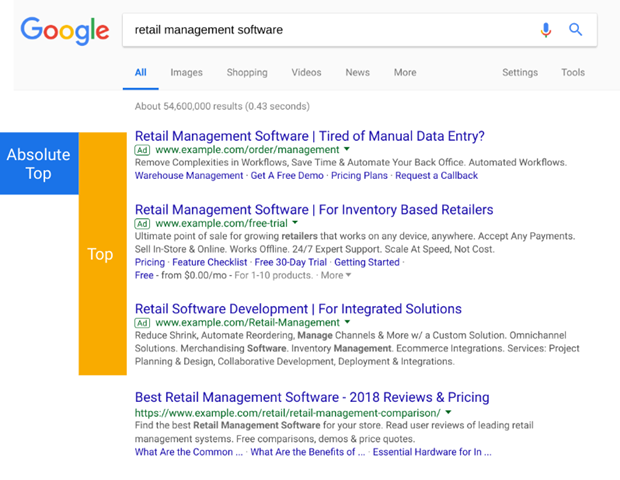
    • Impression Percentage (Absolute Top) – This metric gives the percentage of impressions, for which an ad is displayed on the absolute top of the page (at position No.1)
    • Impression Percentage (Top) – This metric gives the percentage of impressions, for which an ad is displayed on the top of the page (positions No.1 to 3)

    Image via Google

    The above image shows the absolute top and top positions that are measured using this metric. Here’s how to interpret these two new metrics.

    • Receiving 75% on the absolute top metric indicates an ad occupies the top ranking for 75% of the impressions.
    • On the other hand, scoring 75% on the top metric indicates that an ad occupies any one of the top 3 positions 75% of the time.

    How do the New Metrics Impact Google Ad Users?

    Google has announced clearly that it’s retiring the old Average Position metric and it won’t be available after 30th September.

    One of the biggest benefits of the new metrics is that it doesn’t use averages. The biggest drawback of the average position metric is that the results were skewed and it was difficult for marketers to determine the actual position of ads accurately.

    The new metrics give a clearer picture on the actual placement of an ad, rather than the average numbers. This is a crucial advantage for marketers to refine their ad strategies and bids.

    How does this change Impact Digital Marketers?

    Digital marketers have to adopt the two new metrics. Also, digital marketers have to review scripts that use the average position metric and rework on these scripts to ensure that it continues working as intended, without the old metric.