LS Staging

Category: Digital Marketing

  • Data Transfer Project – The Brainchild of Tech Spearheads

    Data Transfer Project – The Brainchild of Tech Spearheads

    Building a framework and open-source it to people has been in the pipelines for a while now. Finally, Facebook, Twitter, Google and Microsoft have partnered to get together and make it happen. And quite to the universal excitement, it has come across quite well.

    Introducing the DTP

    The tech giants came together to bring about something that was only dreamt of. These four tech giants have come together to build a framework that is entirely focused on data portability. This has been, quite simply, named as Data Transfer Project or abbreviated as DTP. DTP is an open source initiative that aims to offer a framework, through which companies can create tools that allow people to transfer data from one platform to another without any hustle. In simpler terms, it means that you would not have to download and upload data over and over again every time.

    Information flow at the core

    The DTP comes with all guns blazing as companies are not holding information about the project to themselves. “Right now, much of the online products and services we use do not interact with each other in a coherent and intuitive fashion,” wrote Damien Kieran, the Data protection officer at Twitter. He wrote this in a blog post while intending to announce the project.

    He says more about the project as he continues, “information that is housed on one platform cannot be easily and securely transferred to other services. This is not a positive collective experience for the people who use our services and we are keen to work through some of the challenges as an industry.”

    Why is the DTP is so anticipated?

    Because it comes with an open source, that is to say, that it is a completely transparent system of processes. To solidify this, Kieran writes in his blog post, “in keeping with our overarching principles around transparency and accountability, this process of information sharing between our companies and the related work streams will be open for all to scrutinise, critique, and to build off.”

    One of the biggest partners of the team that has gotten together to achieve the DTP – Google – adds to the discussion its valued opinion. It says that the organisations which are currently involved into making tools for the DTP are creating tools that can convert any service’s proprietary APIs or Application Program Interface to and even from a small set of data formats which are standardised. This makes the transfer of data across platforms a lot easier using “industry-standard infrastructure and authorisation mechanism, such as OAuth.”

    Last word by Facebook

    One of the most controversial members of this partnership, Facebook, says that the four companies involved are “…committed to building a common way for people to transfer data into and out of online services.”

    Facebook says that the DTP is in its early stages of formation and hopes that more and more organisations and organisational experts get involved with the project.

    The unification of resources to build a more secure and formidable data transfer platform which does not tamper or make essential data vulnerable is the whole motive of the DTP.


  • Smart Ways to Read Buyers’ Digital Body Language for Better Marketing Outcomes

    Smart Ways to Read Buyers’ Digital Body Language for Better Marketing Outcomes

    For digital marketers, their ability to understand customers’ needs plays a significant role in their success. In traditional marketing, with face to face inter-personal interaction, this would have been easy. But in the digital landscape, it becomes a bit difficult.

    Best Buy shows the way

    Retail giant Best Buy found a unique way to know about body signals in the digital medium. They discovered that the best interaction happens when customers talk to the famed ‘blue shirts,’ i.e. the store staff who wear blue uniforms.

    What they did is emphasised more on this aspect in their digital ads. They brought a blue shirt spokesperson to talk about the value proposition of the superstore. They talked about what differentiates the store from others, and how customers’ needs can be met with smart tech integrated with the retail practices.

    It tried to implement this type of messaging and interaction on its big-ticket appliance purchases. For instance, one 30 second video shows a blue shirt staff explaining the concept of fingerprint proof and how it can be used as a factor to make the right decision.

    The takeaway? The online experience needs to mimic the offline store experience as much as possible. This way, customers’ behaviour can be easily determined and sales triggers can be fired for better conversion potential.

    How to read the digital ‘body’ language?

    There are a lot of metrics to be tracked and a lot of data that emanates from these metrics. However, the trick then is to figure out how the data ties up to the actual customer behaviour online. Here are a few tips on how to determine the user behaviour and what actions to take post its accurate interpretation.

    1 – Is the time spent more than the average number?

    If you see a user spending more than the average amount of time, then it means that the user is likely to be more interested in the product or services you are offering. He may not be that well aware of the same and hence may be taking time to know it better.

    At this stage, you now need to present in-depth product knowledge (to satiate the knowledge aspect) and industry authority (to elevate the trust factor). For this, long-form content and whitepapers would do the needful.

    2 – Multiple visits to a site

    If users are frequenting your site, it means that they are yet warming up to your brand value. This is the equivalent of meeting an acquaintance (not a friend) and making small talk. Yes, the key here is to keep content short and introductory. This way, the user is prompted to go deeper into the sales funnel.

    Writing blogs and articles regularly will help you stay in front of their visibility with higher SEO ranking. Their multiple visits will ease them to the next level of engagement.

    3 – Use of interactive content

    When users respond to interactive content, they are termed to be highly engaged. They have built a baseline level of trust in your brand and are willing to spend more time exploring your brand USP. They are actively carrying on the conversation with your brand.

    At this stage, they are almost ready to make a purchase decision but need the last mile reassurance about your credibility. With the use of interactive quizzes, surveys, and Q&A sessions, this stage too can be passed effectively and help the customer move nearer to a conversion.

    With these tips, it becomes easy for you to frame the right marketing plan and implement it at the right time based on your customers’ digital ‘body’ language.

  • Should the best content be on your site or be given away?

    Should the best content be on your site or be given away?


    One of the commonest dilemmas content writers encounter is where does their content belong the best? Would it reap them more benefits if they decided to have the content on their own page? Or would it be wiser to give it away?

    Considering the dominance of SEO criteria in every form of content that goes up these days, there has been a lot of debate regarding where it would be best to place optimised promotional content. And though opinions regarding this vary, they sort of depend on the goals of the webmaster in concern. This eventually makes the debate settle down a bit considering subjectivity and the varied needs of online content developers.

    The rapid proliferation of meaningful content

    Content is now a major aspect of marketing. This has opened floodgates to this profession now as more and more people are starting up with content. Content is gaining acknowledgement fast. As more and more people start off as newbies, they usually are unaware of the benefits that come with the correct placement of content online.

    There are also some who would just like to guest post. They would rather write for columns and editorials for other sites than maintain one for themselves. They do this as maintaining a blog or online journal requires efforts and time. This is an aspect of content not all are willing to comply with.

    Why having it in-house matters?

    Many, however, are of the opinion that if you happen to create quality content, it is preferable to have it on your own site. This makes sense as having quality content would benefit your page and up your SERP ranking. Though the scope of having your page discovered and gaining momentum in the form of web traffic is slower than having your content on other sites, many web content developers prefer their content be on their own site.

    Why having it put out on other sites is better?

    The scales, therefore, tip in favour of having your finest, most optimised content placed on other websites. This adds branches to your content and offers platforms to place your content. This is an effective way of getting your finesse out there. Established platforms have better traffic. This saves you from having to build traffic up from scratch.

    Posting your content on websites that garner steady flow of web traffic renders your website enough link juice to function. You get traction in the least amount of efforts possible. Your website does not have to outperform the big names out there but once you manage to get in enough link juice for your site, you manage to automatically compete against the big names. This gets your site credibility and trust in an organic manner.

    Another benefit of posting on other websites is that, in case of an emergency (like a server issue), your content would be unharmed, and your website’s numbers would stay unaffected.

    Having your content on other website manages to give you the benefits of their website’s credibility and top-notch services without having to shell out hefty amounts of money yourself. In conclusion, the idea of posting content elsewhere has an upper edge over having quality content on your own site.

  • Google A65 – The new age AR headsets in the making

    Google A65 – The new age AR headsets in the making

    Google is known to be the market leader when it comes to new age innovations. Be it search engines, Virtual Reality (VR), Artificial Intelligence (AI), or Augmented Reality; its products have captured the world’s attention. The recently concluded I/O conference too showed a glimpse of the key happenings inside the Google tech labs working on the futuristic technology.

    An emphasis on Augmented Reality (AR)

    One of the exciting highlights of the event was its standalone Augmented Reality (AR) project.  It is a headset that goes by the codename “Google A65” and that it will use new Qualcomm chips.

    The Qualcomm chips used in the Google A65 – QSC603 – are four-core system chips that are also estimated to be a part of the next-gen Microsoft HoloLens. Google A65 is said to be built by Taiwanese computer giants, Quanta. The project is still said to be in its making stages, according to the documents that have been obtained by WinFuture.

    A background about Quanta

    Quanta is the same company that was involved in the making of the esteemed Pixel C tablet, which was launched in 2015. It is said that the QSC603 can power an output video at an unbelievably stunning WQHD (Wide Quad HD) resolution, at display 3D overlays and supports other major graphic interfaces like OpenGL, OpenCL and even Vulcan.

    Highlights of the AR headset

    The headset that Google is coming up with is rumoured to include camera sensors and microphones that allow users to operate the device using the Google Assistant, as reported by CNET. “The headset is supposedly based on custom quad-core internet-of-things (IoT) focused Qualcomm QSC603, supporting up to 2,560 x 1,440 resolution and 1080p and 1030p video capture, 3D overlays, rendering interfaces, Bluetooth 5.1, GPS and the Android neural networks application programming interface (API)”, the CNET report added.

    Google is already in the process of manufacturing AR headsets called the “Google Glass,” that comes in with a heads-up display and camera. Google glass was launched in 2013. However, Google A65 is said to resemble Microsoft’s “HoloLens” in ways more than one. Firstly, the operation style, then the advanced RISC machines (ARM) – powered design and lastly the Qualcomm chipset that we have already mentioned about as being a part of the next-gen HoloLens. These characteristics are very similar to the Microsoft AR product.

    Bearing in mind the advances made by Google in terms of bettering AR, mainstreaming Augmented Reality in the next couple of years does not seem like an impossibility, especially when companies like Apple and Samsung are also leaping at chances to make the most of this.

    There is no confirmed release date for Google A65 (we refer to the codename for now). However, Google assures that this would be made public soon since it is still in its formative stages.

  • iPaaS – All the you need to know about it

    iPaaS – All the you need to know about it

    iPaaS or Integration Platform as a Service is a hosted service by a third-party software vendor, who delivers infrastructure and middleware to handle all the company’s data integration requirements. Generally, data integration happens between cloud applications or between a cloud and on-premise application.

    iPaaS provides a single platform for data integration, which allows to eliminate the need of huge manpower or specialised software to do manual data entry. Another advantage of iPaaS is simplified software multitenancy. Earlier cloud design models a single instance of a running software application, but with software multitenancy, a single instance can use resource sharing.

    Automation of data integration through iPaaS can provide numerous benefits which include;

    • Integrating systems through iPaaS enables to share data between teams ensuring they are working with accurate data. The result is that staff can spend less time questioning ‘which data is right?’ and more time taking action on the right data.
    • An iPaaS automates the integration process, putting data standardisation and governance procedures in place.
    • An iPaaS can connect systems in hours, not days or weeks, resulting in faster time to ROI on a variety of product, marketing and sales efforts.
    • Connecting CRM and marketing automation through an iPaaS can eliminate duplicate records and speed up data flow so sales or marketing follow up is more timely and useful.
    • iPaaS solutions are targeting business users, who need little or no coding experience to use the platform. As a result, accountability for marketing data integration, campaign execution and results flow in a straight line through the marketing organisation.
    • iPaaS solutions are scalable and can manage the growing volume of customer data now being collected by businesses – from SMBs to large enterprises. By automating the integration process, data moves faster into marketing campaigns and sales pipelines, enabling more agile business strategies.

    When evaluating iPaaS solutions, your business needs to answer the below crucial questions. This will help you pick the right type of integration platforms meant to solve your specific business needs.

    1. What is the project requirement? Do we require a single application or an enterprise-wide solution?
    2. What does the application function look like? What is the use case for the iPaaS? Is it to streamline a process or do you have a dynamic infrastructure for your iPaaS deployment need?
    3. Who would be the key users of the iPaaS system? Will they be coders or data scientists? Do all these users sit at central location or users are located in different locations with different skill sets? Do all these users require coding experience to use the platform?
    4. Will the multiple projects be supported by a team of limited IT resources? Is the self-service option available to a group of users?
    5. Does the platform support various connection protocols and data/messaging delivery styles?
    6. Are you transitioning from a legacy system or converting all the platforms to a centralised environment? Are you developing an entirely new system?
    7. What will be the overall cost of the integration platform over time? How many users are required to maintain this platform? What is the amount of training needed for the user to extract maximum benefit from the system via processes like integration flows?

    These questions would let you decide what type of iPaaS would generate the best ROI for your business.

    1. Are you a small business owner or a big enterprise stakeholder? Do you want a scalable system?
  • Google Duplex to have built-in disclosure about its ‘Bot’ status

    Google Duplex to have built-in disclosure about its ‘Bot’ status

    Google’s recent update created quite a stir when it unveiled the AI based Duplex system at the I/O Conference 2018. The system can actually make phone calls in a human voice for tasks like booking a movie ticket or booking a restaurant table. Instead of the reactive chatbot conversation utilised in customer support functions, the Duplex is designed to be more proactive voice assistant to the users.

    However, with this news came a public outcry against the ethical implications associated with Google Duplex. The AI-based system will have voice like capabilities to book an appointment on behalf of the user. This has been criticised as it is prone to hacks and abuse.  Google has been quick to refute these criticisms by saying that a fully working product was not yet developed. They also mentioned that the AI human-like voice will positively identify itself before making these appointments. This in-built disclosure is said to be a hopeful answer to the ethics and privacy concerns shared by people world over after its CEO Sundar Pichai launched the product on stage at the 2018 annual developer conference.

    The concern about the AI based Duplex System

    Google employs Deep Mind’s new WaveNet Audio Generation technique to mimic a human voice and carry out the scheduling tasks over phone calls. It doesn’t identify itself as a human bot and purposefully trick a person on the other line (for example a receptionist at a haircut salon or the restaurant manager) with surprisingly effective human voice, complete with natural ticks like ‘umm’ and ‘aahh’!   

    This caused significant outrage from general audience and the followers of the I/O conference the world over. They feel that such AI systems are being created without appropriate regulation or protocols. Tech critics have gone on to say that the development is not positive and the lack of alarm demonstrated by the audience seems troubling.

    The workaround to this dilemma

    Google has mentioned that transparency in technology is critical. Hence, it will take all steps to ensure that an in-built disclosure is prompted before the conversation. They also said that the demonstration in the conference was an early product demo and is not a full-scale product awaiting launch. Readers would recollect that on-stage, the product demo consisted of a pre-recorded phone call to showcase the product features to the audience.

    Another blog from Google Engineers Yossi Matias and Yaniv Leviathan mentions that Google’s prerogative was always on delivering the best customer experience with this product. They wanted to make it clear about what the call’s intention will be so that users and businesses can recognise the value of the system.  They wrapped up by saying that Google is yet to figure out how to eventually roll it out and has been testing with quite a few experiments to integrate it with its voice technology based Assistant platform.

    What are your thoughts on the Duplex system that makes phone calls on behalf of the users in a human-like voice? Do write in with your comment and let us know.


  • How Voice Technology will Impact Podcasting

    How Voice Technology will Impact Podcasting


    In our personal lives, voice or conversation has always been the primary mode of communication. Right from birth, we are taught to hear and recognise voices. Now with tech advancements, it is no wonder that this “conversationalist” approach is coming to the digital landscape as well. With the rise of voice tech, things are primed for a wide array of use cases in voice technology.

    One such interesting application of voice technology is its use in developing and distributing podcasts. Let’s see some notable work happening in this arena.

    1 – Podible

    It is interesting to note that voice tech market leader Amazon doesn’t lead in this space. It has been observed that the market share of the e-commerce giant has declined from 90% at its peak to roughly more than 50%. A good reason for this is the unsatisfactory AI powering the podcast recommendation algorithms. As a result, user experience remains a lot to be desired.

    This is the challenge that Podible wants to tackle with its beta launch in March this year. It claims to be the only truly AI-centric app platform to give personalised recommendations for podcasts. The underlying principle is simple yet smart. The podcasts are transcribed to text which is then processed by machine learning topic modelling to add topic to ‘Podible Genome’ a huge database that shows how podcasts intersect.

    In order to provide accurate recommendations, Podible looks at the user’s listening history. These may comprise of elements like saved episodes, ‘following’ episodes, and played episodes. Of course, on the anvil, is a more efficient monetisation system to help content creators earn from their collaboration with Podible.

    2 – Voxsnap

    Today, one in six Americans own at least one voice activated smart speaker. This stat is expected to improve dramatically in a matter of just a few years. What this means for businesses is that they need to find a way to transform existing collaterals and documentation into voice products. Well, as they say, there is an app for that!

    Voxsnap announced the launch of its platform that serves to transform text to human voice. Things like blogs, whitepapers, case studies, and articles can now be easily converted to voice and thus help retain users and find new ones using voice tech.

    Listeners can tune in to Voxsnap platform to get access to informative content on a wide range of subjects including finance, technology, health, marketing and even self-improvement. There would be multiple ways to enhance a wide distribution of the voice content. Users can embed the audio into blogs; they can use it as podcasts, use it with Alexa, or even utilise other voice channels to distribute the voice content.

    The reach of podcasts listeners is expected to surge from 67 million in the US in 2017 to 112 million in 2021. This presents a massive potential for businesses to embrace voice tech to the fullest and be ready for the next big tech disruption. If you are wondering whether the ecosystem is prepared for this change then these two use cases show that work is happening (and happening fast) around voice tech space such as podcasting. This, in turn, will help businesses to leverage voice technology to gain maximum yields.

  • GDPR and its impact on Third-Party Data Processors

    GDPR and its impact on Third-Party Data Processors


    Two decades back, no one would have anticipated the amount of digital content we create, consume, share, monetize, and use across the globe. So why should we still follow a 1995-based data protection directive? Keeping in mind this incongruity of laws and the mind-boggling ways in which data is used today, Europe’s policymakers have come up with the General Data Protection Regulation (GDPR), which is to come into effect from 25th May 2018.

    What GDPR means for your third-party data processors?

    Under this, any third-party processor you use has to comply with the new law. Thus, entities or companies that act as ‘controllers’ or ‘processors’ of Personally Identifiable Information (PII) will be liable to comply with the GDPR rules. PII is anything that identifies a person (name, IP address etc.).

    The law will be more pronounced for the controller of data (an entity that regulates or determines how the processed data will be used). Controllers will now have to be more alert when choosing their vendors and dealing with them. Managing them the right way will constitute a major part of the compliance process.

    The process becomes quite a task in a field like MarTech, where there are several applications and vendors working seamlessly to yield digital marketing outcomes. Hence, it becomes all the more important for MarTech companies to look at the overall vendor ecosystem, the tools used, the compliance in place, and how they play out in a ‘large picture’ scenario.

    Third-Party Vendors – How they can gear up for GDPR?

    Third-Party vendors will need to ensure a bare minimum compliance for these aspects –

    1 – Updating the data processing agreements.

    2 – Add GDPR rules to their knowledge repository to ensure organization-wide compliance.

    3 – Keep the customers notified about the changes that will entail in their relationship due to the GDPR coming into force in less than 6 months.

    4 – Keep checklists and templates ready for better operations-level compliance.

    Other data processors like Hubspot and Salesforce have certified with Privacy Shield, and have notified their goal to comply with the GDPR rules.

    Your duty as a controller just became more vital

    As a controller of data, you need to ensure that the vendor you are working with complies fully with the GDPR norms. You need to thoroughly vet new vendors, so that your overall data protection compliance doesn’t set off red flags. You need to ensure that they have the required certifications in place.

    You may also interact with them to understand how they intend to comply with the GDPR laws. The degree to which they have been vocal about their intention in the interaction will tell you about their readiness to comply with this regulation. Check if they have the processes, tools, and practices in place to retrieve old data, or delete data that isn’t conforming to the GDPR regulations.

    Remember that both of you are in it together. Hence a strong collaborative spirit and mutual understanding will help to iron out any issues in the third-party processing of data under the GDPR norms.

  • 5 Trends Digital Agencies Can Look Out for in 2018

    5 Trends Digital Agencies Can Look Out for in 2018

    Social media has changed the way we communicate and conduct business these days. The digital marketers are now pressed with the task of restructuring their marketing initiatives towards targeted advertising, and that too without ever losing their brand uniqueness. At the same time, increased automation in digital marketing has helped marketers in streamlining their daily activities and their interactions with the end-user, keeping it very personalised and aligned with their brand voice.

    Needless to say, 2018 will see a paradigm shift in digital marketing with personalised communication on one end of the spectrum and automation on the other.

    Here are top 5 of the trends that are waiting to happen in 2018.

    1. Videos Will Gain More Traction

    Videos are already so famous and will gain more traction in 2018. In fact, if predictions are to be believed, by 2020 as much as 80% online content will be video-based. However, with increased popularity, it has also become a highly competitive space for the marketers. To create video content that keeps the follower hooked, marketers only have the first 3-seconds to make a difference. The experience of video-viewing should be convenient and enjoyable for all users, keeping in mind that for most of this content, the sound will remain off until a user clicks on it. Hence, the trick lies in keeping it fun, even without the sound. But most importantly, the content should have some value to it.

    1. Consumers are more receptive to realistic content than staged and designed ones

    Airbrushed travel locations and photoshopped models are a thing of the past. What consumers are looking for these days is something more relatable and realistic. With features like Instagram Stories and Snapchat, marketers can include their users in their day-to-day operations, behind-the-scenes etc. Brands that don’t go overboard with editing can expect organic followers and genuine likes on their content.

    1. Liaison with Brand Influencers

    Marketers are working with influencers to get their brand message out to more potential customers in a voice that is trusted by the audience. A celebrity-endorsed product advertising has run its course. It is now time for the industry to find influencers amongst common people who are realistic brand ambassadors of products or services.

    2018 is all about maintaining key influencer liaisons. Marketers should invest time looking for these brand influencers who are trusted by followers and help build a long-lasting relationship with the end users.

    1. Be a Storyteller

    Content marketing is getting fiercer by the day. Your regular copywriting will not make the cut. If you want to grab and sustain your target audience’s attention, then you need storytellers to do the writing for you. Many digital marketers use journalists to tell their brand stories that benefit from not only compelling content, but also well-researched material. Brands will now have to step-up their content game as 2018 will continuously need high-quality, engaging content.

    1. Be Prepared for more Automation

    2018 will see increased use of chatbots to interact with consumer and provide quick support. In fact, millennials have already reported using chatbots in their interaction with many brands. Chatbots shoulder the burden as they free up resources to do other important tasks, such as creating innovative content. Many big brands are already using chatbots in their marketing strategy, so expect to see them make a huge impact in 2018.

    2018, for marketing teams, will be all about keeping the content personal, realistic and relatable. All the mundane tasks will be automated to free up resources who can create engaging, high-quality content for the users.

  • 3 Ways Human-Centric Marketing Approach benefit your business

    3 Ways Human-Centric Marketing Approach benefit your business

    The conventional way of marketing is losing its charm as the millennial customers are redefining customer experience. The modern customer wants to feel being rewarded by expecting brands to understand and care about their specific needs and requirements. Thus, digital marketers across the globe are now moving from conventional marketing approach to a human-centric marketing approach wherein customers are viewed as interactive communicators whose personal views are highly valued so as to develop a strong rapport with the customers. In fact, the success of human-centric marketing approach completely depends on the strength of meaningful relationships with the customers.

    Human-centric marketing approach can benefit your business in several ways. In today’s post, we will shed light on the importance and advantages of adhering to a human-centric marketing approach.

    1. Helps to Identify New Horizons of Growth: In order to incorporate a human-centric approach to your marketing strategy, the first thing you need to do is understand the psychology of your clients and customers, as it helps you to—

    • Be aware of their needs;

    • Identify how your customers perceive if you are meeting or failing to meet their wants;

    • Know what they would prefer you to do so that you can cater to their needs flawlessly by improving your products and services.

    2. Takes Your Brand To New Heights: More and more companies are now focusing on branding to gain a competitive edge in their respective markets. However, unlike yesteryears, branding today is not confined to how you portray your business to the world. Today, branding indicates how your product, services, and mission are perceived by your target customers. In other words, if you emphasize on customer experience at each stage of consumer buying process, it will enhance positive customer perception, thus, helping you reach new heights with your brand strategy,

    path length

    This is the reason why big industry players like Google, Costco, Amazon, and Apple always stand out in customer satisfaction surveys, as they leave no stone unturned to provide a flawless experience to their customers even if they end up losing money on certain transactions. Moreover, these companies take all possible measures to make their customers feel valued. For example, let us take the example of Apple’s tech support station— Genius Bar, designed for enhancing customers’ experience by offering help for Apple products. At the Genius Bar, the employees of Apple not only resolve your issues related to Apple hardware and software but also make you feel like a hero for being an Apple customer. Consequently, you start developing a special liking for Apple products and feel honoured for belonging to Apple family.

    3. Enhances Customer Satisfaction: You cannot develop an effectual human-centric marketing approach without gathering relevant information from your existing group of consumers. If you conduct surveys to understand the concerns of your customers and leverage the results of the survey in a fruitful way, you can easily make your customers feel valued. By making your customers feel special; you can not only build a strong customer base but also gain new customers.

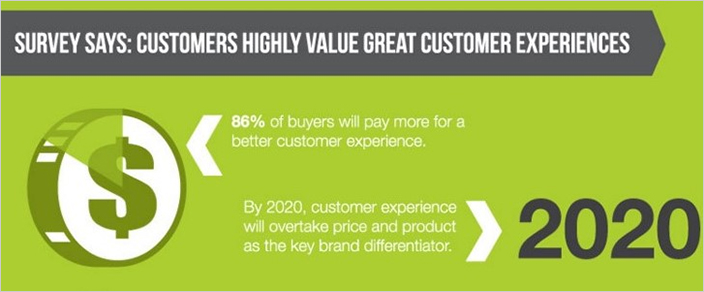
    For example, let us take the example of a survey carried out by a customer-focussed consultancy group named Walker.

    path length

    Image source: Social Media Today

    Offering top-notch products and services is no doubt important for your company’s success, but it is not adequate for building your business. The survey reveals that the most crucial factor that contributes to the success of your business is your customers. Thus, your business strategy should be to encourage your customers by knowing their opinions and executing their ideas to develop your offerings so as to fulfil their desires. This also motivates your customers to develop a strong sense of loyalty and belonging.

    The human-centric marketing approach is the new marketing trend which is making waves in the modern marketing landscape. Thus, if you do not want to lose your customers, you should find out unique ways and means of making your customers feel valued and rewarded.

    Source: Social Media Today