LS Staging

Category: All

  • Why Digital Transformation Strategy Should Align With Your Business Goals

    Why Digital Transformation Strategy Should Align With Your Business Goals

    In today’s business landscape, digital transformation isn’t a luxury – it’s a boardroom agenda. But here’s the catch: simply adopting new tools doesn’t guarantee success. Too often, companies chase shiny technologies without asking the fundamental question – how does this help our business grow?
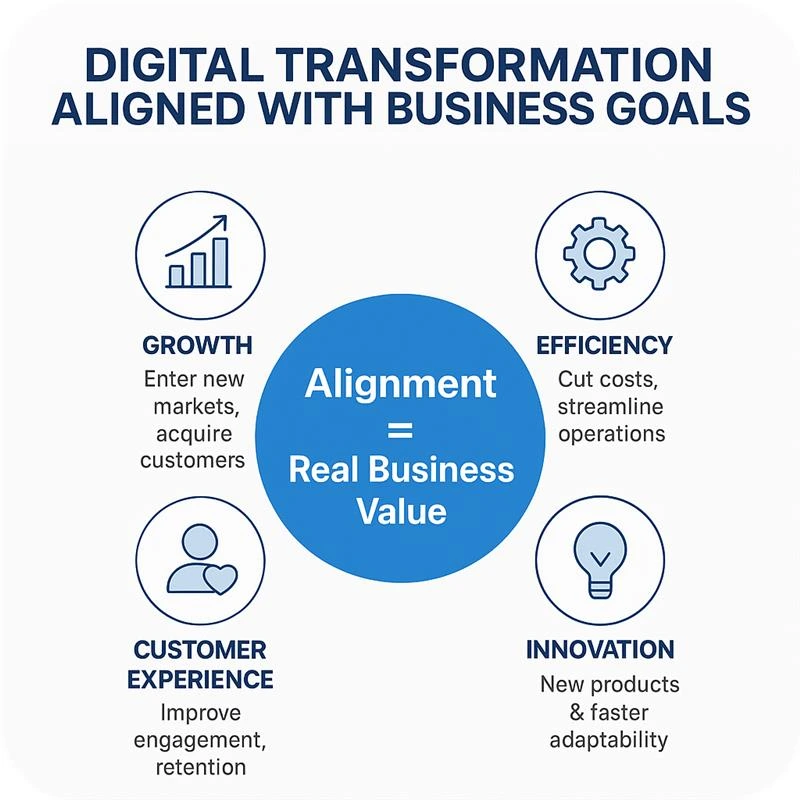
    The real power of digital transformation lies in its alignment with business goals – growth, efficiency, customer delight, and resilience. When transformation is tied directly to strategy, technology stops being a cost center and starts becoming a growth engine.

    Alignment Matters, and here’s why –

    Transformation without alignment often leads to scattered systems, rising costs, and underused tech investments. On the other hand, when digital initiatives are mapped to business objectives, companies unlock:

    • Efficiency gains through automation and smarter workflows
    • Deeper customer relationships powered by data insights
    • Faster innovation and adaptability in changing markets

    Simply put, alignment ensures every digital rupee spent fuels the business strategy – not just the IT budget.


    Step 1: Start with Business Goals

    Before choosing platforms or partners, leaders need clarity on what matters most. Goals usually fall into four buckets:

    • Growth: Entering new markets, acquiring more customers
    • Efficiency: Cutting costs, streamlining operations
    • Customer Experience: Improving engagement and retention
    • Innovation: Developing new products or leveraging data

    Only with this clarity can digital initiatives be mapped to support the right outcomes.


    Step 2: Build Strategy Around Goals

    A well-structured digital transformation roadmap connects ambition to action:

    • Goal-to-initiative mapping – Every project must tie back to business objectives
    • Measurable outcomes – Use KPIs that track progress clearly
    • Phased rollouts – Minimize disruption and encourage adoption
    • Leadership alignment – Ensure buy-in from across the C-suite


    Step 3: Bridge IT and Business

    Transformation fails when IT works in isolation. To succeed, technology and business must speak the same language. This means:

    • Cross-functional governance teams
    • Shared accountability for outcomes, not just delivery
    • Metrics that resonate with both technical and business leaders

    When IT becomes a strategic partner instead of a support function, transformation becomes a growth lever.


    Step 4: Keep Alignment Ongoing

    Business priorities shift. Markets evolve. Technology changes. Which means alignment isn’t a one-time exercise – it’s a continuous discipline. Leaders should:

    • Review goals regularly and adapt roadmaps
    • Keep digital architectures agile and scalable
    • Invest in people through upskilling and adoption training
    • Foster open communication between business and tech leaders


    FAQs at a Glance:


    Typically 6–18 months to see alignment pay off.

    OKRs (Objectives and Key Results), Balanced Scorecards, Digital Maturity Models.

    Deploy ROI and strategic impact scoring.

    A culture of agility and collaboration is non-negotiable.

    Regular reviews, flexible tech, and transparent communication keep alignment steady even in volatile times.


    In Conclusion

    Digital transformation isn’t about adopting the latest tool – it’s about making technology work for your business goals. When strategy leads and tech follows, transformation creates measurable impact: faster growth, smarter efficiency, and stronger customer connections.

    It’s time to stop transforming for transformation’s sake. Instead, align first – because alignment is where real business value begins.

    Ready to align your digital transformation strategy with real business impact?
     

    Let’s Connect

  • The Power of Media Planning & Buying

    The Power of Media Planning & Buying

    The Power of Media Planning & Buying

    When it comes to advertising your product or service, spending money is easy. But making every penny count? That takes strategy. Now that’s where media planning and media buying come together – two parts of one engine designed to move your campaign from a good idea to a great one and eventually a profitable result.

    Together, they decide who to target, where to show up, and how much to spend – ensuring that every media decision is tied to real returns. Let’s break it down.


    1. Media Planning: The Strategy Blueprint

    Think of media planning as laying the foundation. It answers questions like:

    • Who are we trying to reach?
    • Where do they spend their time?
    • What’s the ideal budget split across channels/platforms?
    • When should we go live?

    Good media planning relies heavily on audience insights – what they watch, scroll through, or listen to. It also factors in platform trends, timing, and budget allocation. At its heart, planning ensures that you don’t just show up – you show up where it matters.


    2. Media Buying: The Execution Engine

    Once the plan is in place, media buying brings it to life. This is where your brand actually secures space – whether on TV, radio, social media, search engines, or outdoor hoardings.

    Buyers negotiate, optimise, and monitor performance. They secure better rates, ensure your ad appears in premium slots, and adjust tactics in real-time – especially on digital platforms. In short, they make sure you get maximum exposure for minimum waste.


    3. Why the Magic happens when they sync!

    Media planning and buying work best when they work together. One without the other is like having a GPS without a car – or a car with no direction.

    Together, they ensure:

    • Precision targeting: Reach the right audience at the right moment.
    • Smarter spending: Secure optimal placements without blowing the budget.
    • Agility: Adjust campaigns mid-flight based on real time live data.


    4. Tracking what Matters

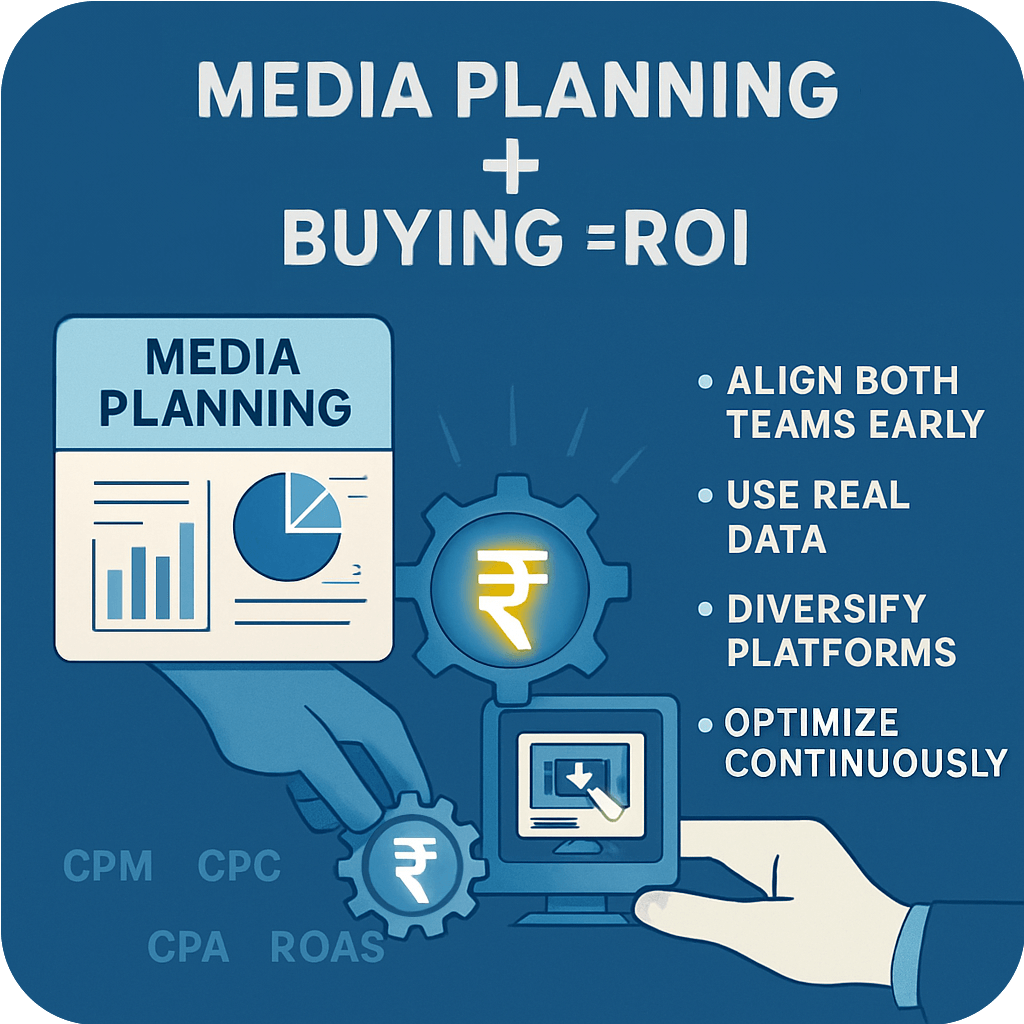
    ROI doesn’t come from guessing—it comes from measuring. Key performance metrics include:

    • CPM (Cost per 1,000 impressions): Evaluate reach cost across platforms
    • CPC (Cost per click): Useful for digital campaigns
    • CPA (Cost per acquisition): See what it takes to earn a customer
    • ROAS (Return on ad spend): The ultimate number – how much you earned per rupee spent

    These numbers guide future planning and refine media buying decisions with every campaign.


    5. Best Practices to Max Out Your ROI

    Here’s how to ensure your media planning and buying work in sync:

    ✔ Get both teams aligned from the beginning

    ✔ Use real audience data, not assumptions

    ✔ Diversify your budget across formats and platforms

    ✔ Stay flexible – optimise continuously

    ✔ Debrief after every campaign to build smarter strategies


    Final Thoughts

    Media planning tells you where to go. Media buying gets you there. When both are done right, your campaign becomes more than just ad spend – it becomes an investment with clear returns.

    The takeaway? Don’t just run ads. Build strategies. Align teams. Track everything. And most importantly – plan to profit.

    So, are you ready to turn your ad spends into real results? Connect with us, let’s make your next campaign your most profitable yet.


    Let’s Connect

  • GA4 vs. Adobe Analytics: Which Is the Right Fit for Your Business?

    GA4 vs. Adobe Analytics: Which Is the Right Fit for Your Business?

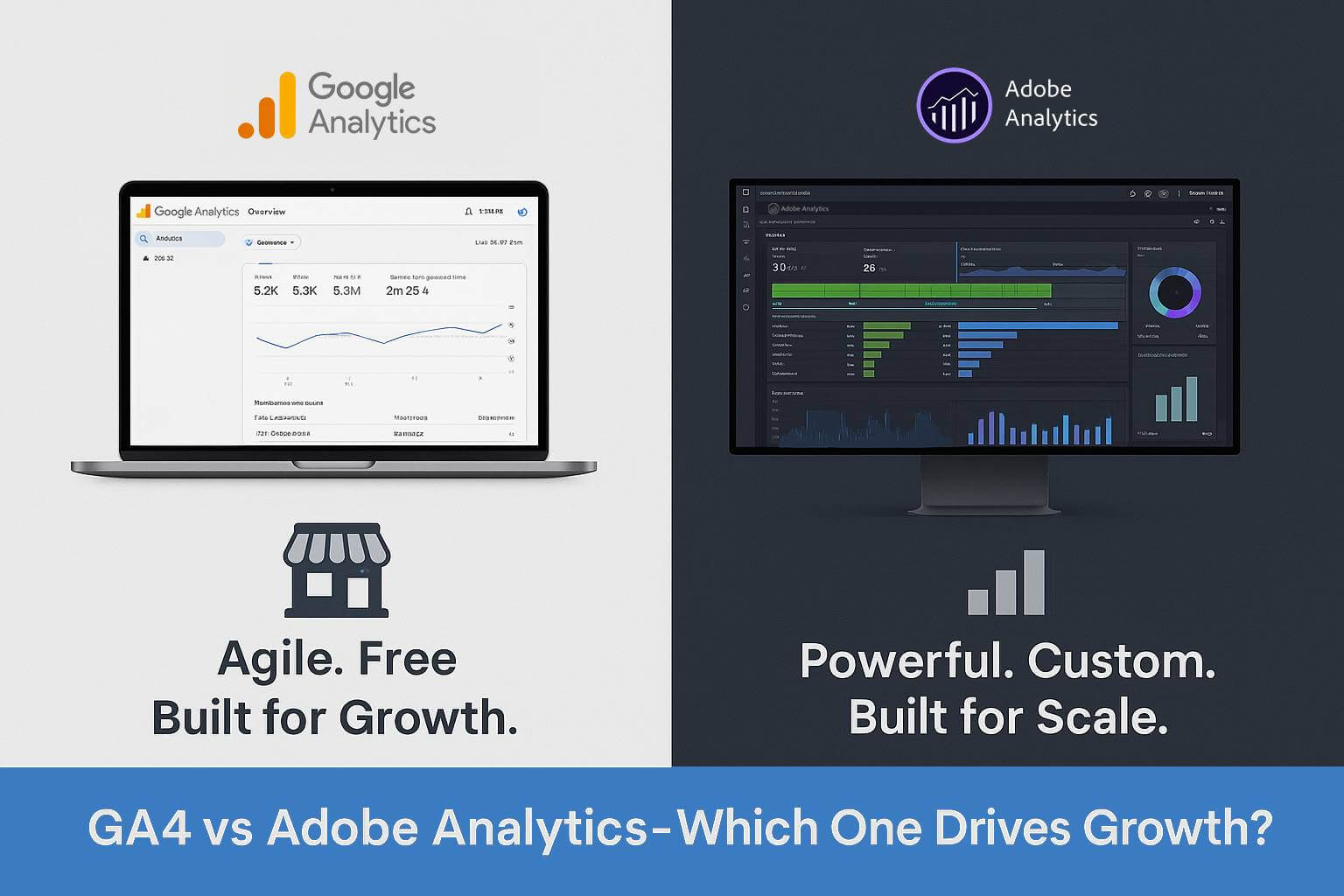
    In the age of data-driven everything, choosing the right analytics platform can shape the way your business grows. But with two major contenders – Google Analytics 4 (GA4) and Adobe Analytics – the question isn’t just which is better? It’s which is better for you?

    Each tool offers powerful capabilities – but they serve different levels of marketing maturity, goals, and team structures. So, let’s break it down.


    What they are (in simple terms)

    Google Analytics 4 (GA4)

    GA4 is Google’s free, privacy-forward analytics platform. It’s event-based, cross-platform (web + app) – integrates deeply with Google Ads and BigQuery, and perfect for small to mid-sized teams who want to track performance across the user journey without heavy setup. And most important of all, is free to use (with a paid GA360 version for enterprises).


    Adobe Analytics

    Adobe Analytics is a high-end, enterprise-grade solution built for companies with complex data needs. With deep customization, real-time data visualization, and integration with the Adobe Experience Cloud, it’s a beast – but one that needs skilled hands.


    Feature Face-Off: Where they differ


    Feature GA4 Adobe Analytics
    Cost Free (GA4), Paid (GA360) Premium, high-cost enterprise tool
    Ease of Use Beginner-friendly Complex; requires training
    Data Model Event-based, user-centric Custom variables (eVars, props)
    Data Sampling Sampling in free version No sampling—always full data
    Reporting Basic dashboards, limited customization Advanced, drag-and-drop workspaces
    Attribution Basic models Custom, multi-touch attribution
    Integrations Google Ads, BigQuery, Looker Adobe Target, Campaign, Audience Manager
    Support Large community, many free resources Dedicated consultants, premium tech support


    Choose GA4 if you’re…


    -A startup or mid-sized business

    -Already using Google Ads, YouTube, or Search Console

    -Looking for a cost-effective solution that grows with you

    -Operating without a full-time data analytics team

    GA4 makes it easy to:

    • Track cross-platform performance
    • Monitor conversions and user paths
    • Stay GDPR-compliant
    • Tap into predictive insights (like churn probability)


    Best fit: D2C brands, publishers, SaaS startups, lean marketing teams


    Choose Adobe Analytics if you’re…

    A large enterprise with multi-channel campaigns

    Working with dedicated analysts or developers

    Prioritizing unsampled data and real-time tracking

    Ready for custom dashboards, micro-segmentation, and A/B testing insights


    Adobe Analytics gives you:

    • Fully customized, layered reports
    • Robust attribution modelling
    • Deep audience segmentation
    • Seamless tie-in with personalization tools like Adobe Target

    Best fit: Retail majors, BFSI, telecom, airlines, large marketing orgs


    Final Thoughts: It’s not a battle – It’s a Fit Check

    There’s no universal winner here. Think of GA4 and Adobe Analytics as different vehicles.

    • GA4 is your agile city car: smart, efficient, easy to manoeuvre
    • Adobe is your enterprise SUV: built for scale, loaded with tech, but requires more to maintain

    What matters most is what you plan to do with the data—and whether the tool matches your marketing roadmap.

    Need help picking the right analytics stack?

    Whether you’re just getting started with GA4 or planning to scale with Adobe, we’ll help you choose, set up, and optimize the platform that fits your goals.

    Let’s Connect

  • Turn Likes into Leads: The Smart Way to Do Social Media Optimisation

    Turn Likes into Leads: The Smart Way to Do Social Media Optimisation

    We’re all familiar with the ultimate advice – “Consistency is the key on Social Media.” But what happens when consistency doesn’t translate into conversions?

    Now here’s where Social Media Optimisation (SMO) steps in.

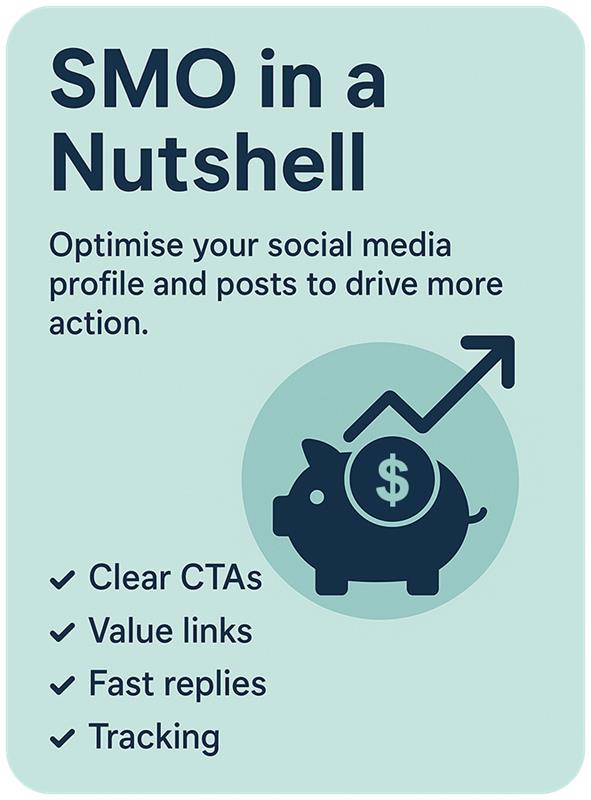
    SMO isn’t about posting more. It’s about structuring your presence so that every post, profile update, or interaction nudges someone closer to action – whether it’s a sign-up, inquiry, or purchase.

    Let’s break down how brands today can turn likes into leads on platforms such as LinkedIn, Instagram, and Facebook.


    Why SMO Matters for Lead Generation!

    Think of your social feed as a storefront. Without the right lighting, layout, or signage, even the best product might go unnoticed.

    SMO helps you:

    • Capture attention with clarity
    • Deliver value through content
    • Guide users towards conversion – subtly and strategically

    And the best part? You don’t need to post more – you need to post smarter.


    LinkedIn: Where Authority meets Action

    This platform isn’t just for recruiters. LinkedIn is where decision-makers scroll with intent. Which means, if you’re a B2B business, your optimisation game needs to speak their language.


    Profile tweaks that build Credibility:

    • Use a crisp headshot and branded banner
    • Craft a headline that solves a problem, not just lists your title
    • Add a call-to-action (CTA) in your About section like “Let’s connect to explore collaboration”


    Content That Drives Conversation (and Leads):

    • Share thought leadership posts, case studies, and customer success stories
    • Include CTAs like “DM us to know more” or “Download our guide”
    • Try PDF carousels or native documents as mini lead magnets


    Quick Wins:

    • Pin high-value content to your featured section
    • Join discussions in your niche
    • Keep hashtags focused (3-5 max)


    Instagram: Visual funnels that Convert

    This is your space for storytelling and micro-conversions. Especially useful for D2C brands, creators, or service-led businesses.


    Optimise your Bio:

    • Add a link-in-bio tool (Linktree, Beacons, etc.)
    • State who you help and what problem you solve—in 150 characters


    Post formats that prompt action:

    • Use Reels to answer FAQs or demo your product
    • Carousels are great for explaining services or customer pain points
    • Caption CTAs like “DM us to know more” or “Save this for later” do wonders


    Leverage stories for lead collection:

    • Use Highlights for testimonials, pricing, and FAQs
    • Run Lead Ads or promote your top-performing posts
    • Engage in DMs after polling or quizzes – those warm leads are gold


    Facebook: Retarget and Reconnect

    Facebook might not be the shiny new thing, but for local businesses, retargeting, and community-led marketing, it’s still a conversion powerhouse.


    Get your page in shape:

    • Use a CTA button like “Book Now” or “Send Message”
    • Fill out the About section with contact details and URLs


    Content ideas that nurture:

    • Post video explainers or blogs with lead forms
    • Go live for demos or interviews—then pin the replays
    • Share gated content (ebooks, guides) and track downloads


    Turn Ads into Actions:

    • Facebook lead ads pre-fill forms, reducing drop-offs
    • Set up retargeting for users who interacted with your Instagram or site


    Your SMO Checklist for All Platforms

    No matter where you post, ask:

    • Is there a clear CTA in your bio or caption?
    • Are you linking to value-driven content (like playbooks or downloads)?
    • Are you responding to comments and DMs promptly?
    • Are you measuring performance based on conversions, not just likes?
    • Are your social and CRM/email journeys connected?


    In Conclusion: Don’t just post – Optimise with Purpose

    You’re already showing up online. Now, make it count.

    When you approach social with intentionality – optimising not just your content, but also your bios, links, and CTAs – you don’t just increase engagement. You improve lead quality.

    Because the goal isn’t visibility. It’s action.


    Need a tailored SMO playbook that fits your audience and goals?

    Let’s start the conversation

  • E-E-A-T Guidelines 2025: How to Build Google-Friendly Content

    E-E-A-T Guidelines 2025: How to Build Google-Friendly Content

    In a world where everyone’s publishing content, how does Google decide what to trust?

    It’s no longer just about keyword placement or backlinks. Today, credibility, relevance, and real-world experience matter just as much – if not more.

    That’s where Google’s E-E-A-T framework steps in.

    Whether you’re a brand in healthcare, finance, or just trying to build long-term visibility online, understanding how E-E-A-T works is critical to your content strategy.

    So, what is E-E-A-T?

    E-E-A-T is a parameter for Google SEO and stands for:

    • Experience
    • Expertise
    • Authoritativeness
    • Trustworthiness

    First originally introduced as E-A-T, Google added Experience in 2022 to reflect the growing importance of first-hand knowledge. It’s a lens used by Google’s search quality evaluators to assess how reliable and helpful your content really is – especially in sensitive categories like money, health, and safety.

    Let’s unfold how each component works for your content.

    Experience

    It’s about having been there and done that.

    If someone writes a skincare product review, Google wants to know whether have they actually used it? If a blog offers parenting tips, is it written by someone who’s raising kids themselves???

    Google now prioritizes content written from real, lived experience – not just curated facts. Think: product demos, case studies, tutorial walkthroughs, or anecdotal insights.

    Expertise

    Expertise is about demonstrating deep knowledge in a particular domain.

    For high-stakes topics like legal advice, financial planning, or medical information, formal education and credentials matter. For lifestyle content or niche interests, demonstrated passion, consistency, and accuracy can often be enough.

    It’s about knowing your stuff – and showing it clearly.

    Authoritativeness

    Google looks at your reputation both online and within your industry. It checks whether –

    • Are other trusted sites linking back to your content?
    • Do influencers or domain experts reference your work?
    • Are your authors known in their field?

    Authority is built over time – but it starts with creating content worth talking about and sharing.

    Trustworthiness

    Perhaps the most crucial piece of all – can your content be trusted?

    Trust comes from factual accuracy, site security (https), transparent author info, and policies that respect users. If your content misleads, plagiarizes, or lacks citations, it’s likely to be flagged by Google – and abandoned by users.


    Why E-E-A-T Matters for your SEO Strategy

    Here’s the catch: E-E-A-T isn’t a direct ranking factor. You won’t find it as a toggle in your SEO tool.

    But it shapes how Google evaluates your overall site quality – especially in what it calls “YMYL” (Your Money or Your Life) areas. And in a landscape flooded with AI-generated or copycat content, it’s what helps real, trustworthy content rise to the top.

    So a Strong E-E-A-T will:

    • Increases your visibility on high-intent search queries
    • Enhances credibility with your audience
    • Attracts backlinks and organic mentions
    • Future-proofs your site against algorithm shifts

    How to strengthen your website’s E-E-A-T in short

    Here are simple, actionable ways to enhance your content credibility:

    Add First-Hand Experience

    Showcase real reviews, personal anecdotes, project snapshots, or customer outcomes.

    Highlight Author Bios

    List qualifications, achievements, or relevant experiences. Especially important for blogs discussing money, health, or legal issues.

    Build Your Reputation

    Earn backlinks, get featured in respected publications, and encourage user reviews.

    Secure Your Site

    Use HTTPS, make your design clean and professional, and provide clear contact info.

    Use Quality Sources

    Cite data, industry reports, and recognized institutions. Link out with intention.


    In conclusion: Content that builds Trust wins in the long run

    Google’s E-E-A-T isn’t a checklist. It’s a mindset shift.

    It encourages brands to stop thinking like marketers – and start thinking like trusted advisors.

    So, if you want content that ranks, converts, and creates loyal users, focus on authenticity. Highlight lived experience. Back up your claims. And put people first.

    Because when people trust your content, the algorithm follows.

    To streamline your website to E-E-A-T the competition, feel free to connect with us.

    Get in Touch

  • In-House vs. Agency: Making the Right Marketing Build for Growth

    In-House vs. Agency: Making the Right Marketing Build for Growth

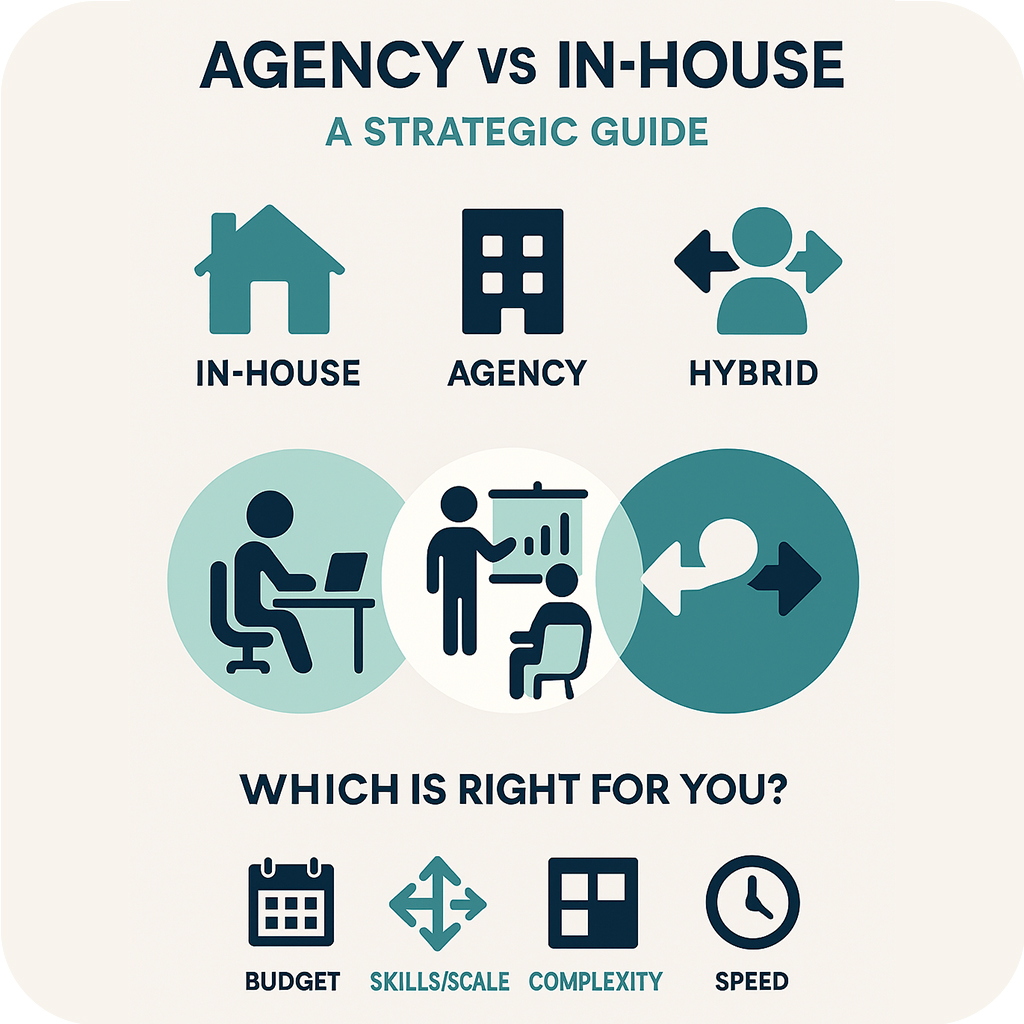
    As businesses scale in today’s always-on digital landscape, one of the most strategic questions marketing leaders face is: Do we build in-house or partner with an agency?

    This isn’t just a budget call – it’s a growth decision. The model you choose impacts how fast you go to market, how deeply you understand your audience, how much you can scale, and how creatively you execute.

    And the truth is, there’s no universal answer. It depends on your goals, team bandwidth, marketing complexity, and where you want to focus your energy.

    In this article, we break down the in-house vs. agency debate — not as opposing sides, but as tools in your larger marketing arsenal. Plus, we explore the increasingly popular hybrid model that blends control with scalability.

    What does going ‘in-house’ really mean?

    Choosing to go in-house means building a dedicated team – writers, designers, media planners, analysts – who live and breathe your brand.

    Where it shines:

    Deeper brand immersion: Your team owns the voice, vision, and values.

    Speed of execution: Approvals are faster, decisions are more agile.

    Cost-efficiency (long term): Particularly for brands with high-frequency or always-on campaigns.

    Closer cross-team integration: Marketing can plug directly into sales, product, or leadership workflows.


    Watch out for:

    Skill gaps in niche areas like CRO, programmatic advertising, or advanced analytics

    Hiring & retention costs – especially in a talent-competitive market

    Burnout when small teams juggle too many hats

    Echo chambers, without fresh outside perspectives


    What does partnering with an agency bring?

    When you hire an agency, you tap into a team with specialized expertise across campaigns, clients, and categories. It’s plug-and-play firepower.

    Where it shines:

    Access to deep expertise without needing to hire full-time

    Scalability on demand – ramp up or down with campaign needs

    Fresh thinking that challenges your internal assumptions

    No infrastructure overhead – tools, platforms, training already included

    Watch out for:

    Higher project-based costs

    Less operational control, especially on quick pivots

    Steeper learning curve to understand your product or market nuance

    Shared attention, since agencies manage multiple clients


    What’s the Right Fit?

    Ask these 5 key questions

    Choosing the right model isn’t just operational — it’s strategic. Here are five questions to guide the decision:

    1.What’s your available budget?

    In-house requires upfront investment; agencies offer flexibility with variable costs.

    2.Do you need specialized skills or scale?

    Go agency for things like video, PPC, google analytics. In-house works for content or organic social.

    3.How complex is your marketing ecosystem?

    Multiple products, geographies, or customer segments may benefit from external expertise.

    4.How quickly do you need to move?

    In-house teams typically turn things around faster — if they have the bandwidth.

    5.Is your marketing consistent or campaign-based?

    Always-on? Build in-house. Episodic? Partner with an agency.


    OR DO BOTH?

    THE RISE OF THE HYBRID MODEL!

    For many fast-growing brands, the answer isn’t ‘either-or’- it’s both.

    The hybrid marketing model gives you the best of both worlds:

    • In-house teams manage brand, messaging, and long-term strategy
    • Agencies handle execution-heavy lifts, innovation sprints, or skill-specific needs


    Example structure:


    Marketing Model Best For Key Advantage
    In-House Long-term brand building, high-volume needs, social listening, brand strategy Brand alignment and speed
    Agency Projects, launches, paid media, specialist skills Expertise and scalability
    Hybrid Scaling brands needing flexibility Balance of cost, control, and creativity


    This modular approach allows you to stay lean, stay fast, and stay future-ready.

    There’s no one-size-fits-all approach. Your ideal marketing structure depends on your current stage, team capabilities, business goals, and marketing volume.

    In conclusion: Build the team that builds your brand

    Whether you’re a high-growth startup or a legacy enterprise rethinking your digital stack, your marketing structure matters. It shapes your agility, your creativity, and your results.

    So don’t just ask “agency or in-house?”

    Ask “What’s right for right now – and where we want to go?”

    Then build accordingly – with clarity, conviction, and partners who share your ambition.


    Ready to Build the Right Marketing Team?

    Whether you’re scaling up, launching a new campaign, or figuring out how to balance in-house and agency efforts—we’re here to help

    Talk to us

  • Beyond Rankings: Embedding SEO into an Integrated Full-Funnel Demand Generation Framework

    Beyond Rankings: Embedding SEO into an Integrated Full-Funnel Demand Generation Framework

    Introduction

    In today’s hyper-competitive digital landscape, businesses can no longer afford to look at SEO (Search Engine Optimization) as just a top-of-funnel tactic. SEO has evolved into a crucial component across the entire marketing funnel — from attracting new audiences to nurturing leads and driving conversions.

    This blog will explore how SEO plays a pivotal role at every stage of the full-funnel marketing strategy and how brands can maximize its impact.

    Understanding the Full Marketing Funnel

    Before we dive in, let’s break down the three main stages of the marketing funnel:

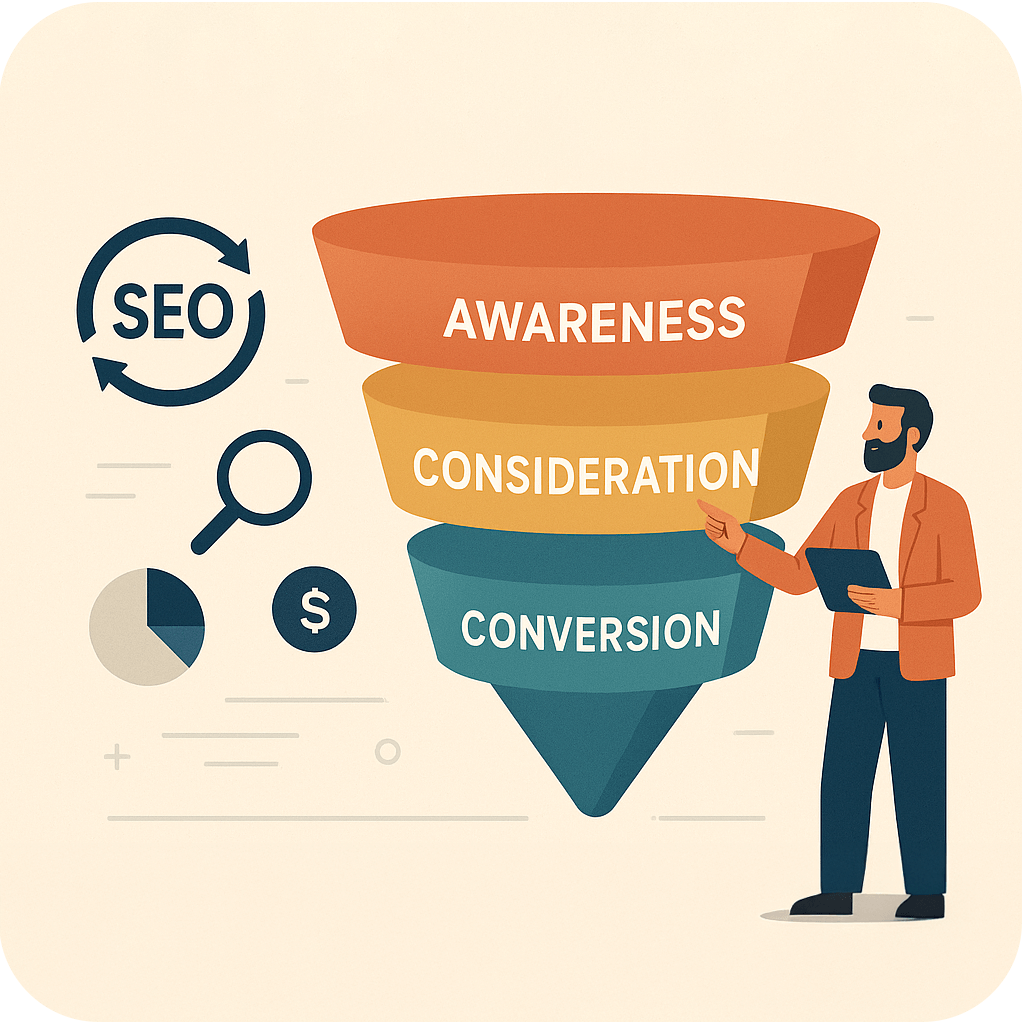
    1. Top of Funnel (TOFU) → Awareness
    2. Middle of Funnel (MOFU) → Consideration
    3. Bottom of Funnel (BOFU) → Conversion

    Each stage represents a different phase of the customer journey, and SEO can fuel each phase with targeted strategies.

    1. SEO at the Top of the Funnel: Building Awareness

    At this stage, your goal is to attract users who might not yet know your brand but are searching for solutions, answers, or inspiration.

    Keyword Focus: Broad, informational, and question-based keywords (e.g., “best travel destinations 2025” or “how to plan a family vacation”)

    Content Types: Blog posts, guides, infographics, educational videos, and SEO-optimized landing pages

    SEO Tactics:

    • Optimize for featured snippets and “People Also Ask” boxes
    • Focus on long-tail keywords
    • Create shareable, high-quality content
    • Build backlinks from reputable sources to boost domain authority

    2. SEO at the Middle of the Funnel: Driving Consideration

    Here, potential customers know they have a need — now they’re comparing options. SEO can help position your brand as a trusted expert.

    Keyword Focus: Comparison, solution-specific, or product-category keywords (e.g., “best travel agency for Europe tours” or “LS Digital case studies”)

    Content Types: Case studies, comparison pages, webinars, whitepapers, detailed service pages

    SEO Tactics:

    • Optimize internal linking to guide users to related MOFU content
    • Use schema markup (like FAQs and reviews) to enhance search result visibility
    • Improve on-page SEO with persuasive copy and clear CTAs

    3. SEO at the Bottom of the Funnel: Boosting Conversions

    At this final stage, users are ready to act — and SEO can help remove last-minute friction.

    Keyword Focus: Branded, transactional, or purchase-intent keywords (e.g., “book LS Digital consultation” or “travel package deals 2025”)

    Content Types: Optimized product/service pages, reviews, testimonials, clear CTAs, landing pages

    SEO Tactics:

    • Ensure fast page load speed and mobile optimization
    • Add clear, trust-building elements (reviews, certifications, security seals)
    • Optimize local SEO if relevant (Google My Business, local keywords)


    Why SEO Must Be Integrated Across the Funnel

    Many marketers still treat SEO as a “traffic driver” only — but its real value lies in supporting the full buyer journey. A strong SEO strategy ensures you: – Attract new visitors – Engage and educate leads – Convert prospects into loyal customers

    This holistic approach not only increases conversions but also builds long-term brand equity.

    Final Thoughts

    Integrating SEO into your full-funnel marketing strategy isn’t optional anymore — it’s essential. By aligning your SEO efforts with each funnel stage, you can capture intent-driven traffic, nurture leads effectively, and ultimately drive meaningful business growth.

    If you want help building an SEO strategy that works across all funnel stages, feel free to reach out!

    Ready to elevate your SEO game? Let’s connect and craft a full-funnel SEO strategy tailored to your brand’s goals. reach out to our team today!

    Get in Touch

  • From Impressions to Impact: Your 2025 guide to a high-converting Social Media Strategy

    From Impressions to Impact: Your 2025 guide to a high-converting Social Media Strategy

    In 2025, brands find themselves at a digital crossroads. While gaining social media impressions is easier than ever, converting those insignificant views into lasting value remains the real challenge. With evolving platforms, new algorithms, and shifting consumer behaviours, brands must embrace a structured, insights-driven approach to truly make their social efforts count.

    Here’s how to architect a social media strategy that doesn’t just speak – but converts!

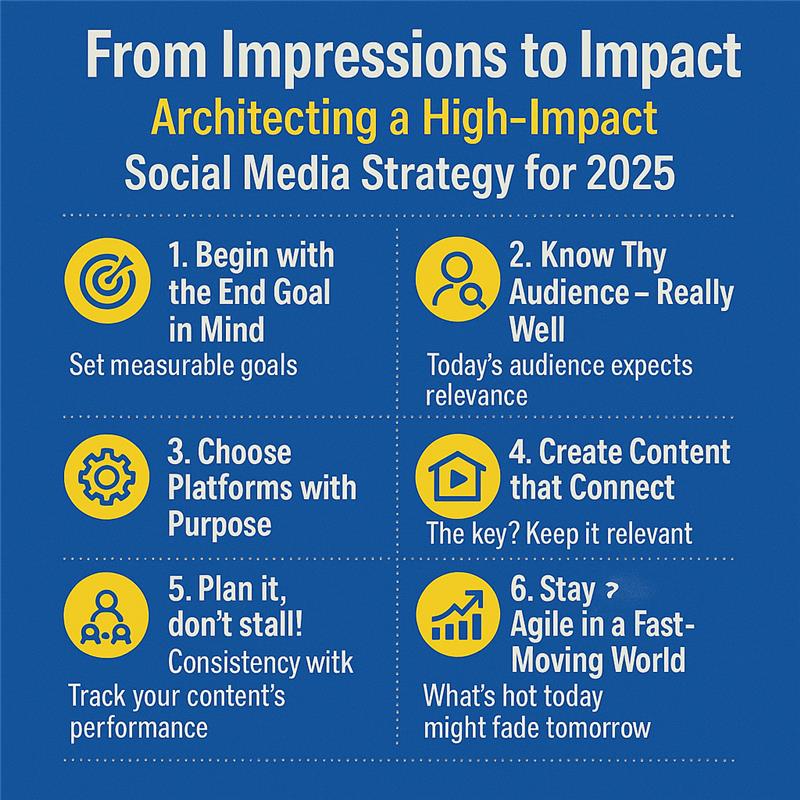
    1. Begin with the End Goal in Mind: Set Measurable Goals

    Every effective strategy starts with clarity. Define smart goals that align with your business objectives. Whether you’re aiming to increase qualified leads, boost engagement, or drive e-commerce sales, measurable targets give your team focus and your strategy direction.

    Pro tip: Avoid vanity metrics. Instead of chasing likes, track metrics tied to action – click-through rates, conversions, and cost per acquisition.

    2. Know Thy Audience – Really Well

    Today’s audience expects relevance. Go beyond demographics to understand their interests, pain points, and behaviours. Use social listening tools, audience polls, and platform insights to uncover what your audience is truly engaging with.

    When your content feels like it was made ‘just for them’, your brand becomes more relatable – and far more clickable.

    3. Choose Platforms with Purpose

    Not all platforms are created equal. A strong strategy involves picking platforms where your audience lives and where your brand naturally fits.

    • B2B? Focus on LinkedIn.
    • Gen Z engagement? Explore TikTok and Instagram.
    • Visual storytelling? Pinterest and YouTube might be your best bet.

    Spread your efforts too thin and you risk losing traction. Be strategic with your presence.

    4. Create Content that Connects

    In 2025, content isn’t just king – it’s your voice, your handshake, and your elevator pitch. A successful strategy embraces a diverse mix of content formats: carousels, short videos, reels, memes, and even UGC (user-generated content).

    The key? Keep it relevant, authentic, and timely. Don’t be afraid to break the mould of brand consistency if the story you’re telling resonates more loudly that way.

    5. Partner Smartly with Influencers

    Influencers are the new-age storytellers. But reach alone isn’t enough. The right influencer aligns with your brand values and speaks credibly to your audience.

    Micro- and nano-influencers often drive higher engagement and conversion rates due to their loyal, niche followings. When authenticity shines, trust builds – and conversions follow.

    6. Plan it, don’t stall!

    Consistency builds recognition. A content calendar ensures you’re regularly showing up for your audience – without scrambling last minute. Use it to schedule posts, align with seasonal trends, and maintain a consistent brand voice.

    7. Measure. Optimize. Grow. Repeat.

    Track your content’s performance with precision. Monitor:

    • Engagement rates
    • Click-through rates (CTR)
    • Follower growth
    • Conversion rates
    • ROI per platform

    Then, use this data to double down on what’s working – and ditch what’s not. Real-time insights lead to real-time improvements.

    8. Stay Agile in a Fast-Moving World

    Social media trends move at lightning speed. What’s hot today might fade tomorrow. To stay relevant, brands must listen, learn, and pivot quickly.

    From AI-generated content to AR filters, being early to test and adopt emerging tools keeps your strategy future-forward.

    Conclusion: Build Connection Before Conversion

    In 2025, attention is short but loyalty runs deep – if you earn it. A high-impact social media strategy isn’t just about content delivery. It’s about building authentic relationships that lead to real-world business impact.

    By focusing on strategy, storytelling, and smart optimization, your brand can turn every impression into an opportunity – and every click into a customer.

    Make every click count. Start your high-impact 2025 social strategy today!


    Get in Touch

  • Designing for Conversion: UX-Led Web Strategy to Turn Clicks into Customers

    Designing for Conversion: UX-Led Web Strategy to Turn Clicks into Customers

    In today’s digital economy, where attention spans are short and options are endless, simply attracting visitors to your website isn’t enough. The real value lies in converting those clicks into meaningful actions – purchases, sign-ups, inquiries. That’s where a user experience (UX)-led web strategy comes into play. When thoughtfully executed, it acts as a silent guide, leading your visitor smoothly down the conversion path.

    The Journey Starts with Empathy

    Every effective UX strategy begins with a deep understanding of who your users are and what they need. It’s not just about how your site looks, but how it makes people feel when they interact with it. What are their goals? Where do they hesitate? Why do they leave without taking action?

    Using tools like heatmaps, session recordings, and feedback widgets can reveal telling insights – such as which areas users click most, what grabs their attention, and where they drop off. This data doesn’t just inform design – it fuels it. Empathy, supported by analytics, forms the foundation of conversion-centric UX.

    Designing the Path of Least Resistance

    Think of your website as a guided tour. The best tours are effortless – your audience shouldn’t need to think about where to go next. Every button, link, and interaction should be purposeful.

    Simplify navigation. Highlight primary calls-to-action. Reduce form fields. Optimize load times. These may seem like small changes, but collectively, they can lead to measurable lifts in engagement and conversion rates. A mobile-first design approach is no longer optional either – mobile responsiveness is table stakes for delivering seamless experiences across devices.

    Trust: The Unsung Hero of UX

    No matter how intuitive your site is, people won’t act if they don’t trust you. Good UX is a trust-building exercise. It’s in the details – clear return policies, customer reviews, privacy assurances, and design consistency.

    A clutter-free layout with clear messaging helps reinforce your credibility. Use testimonials or case snippets where appropriate. These subtle signals add up to create a sense of reliability and professionalism that nudges users closer to conversion.

    Relevance Drives Results

    In a sea of digital noise, personalization cuts through. The more relevant your content feels to each visitor, the more likely they are to engage. Tailoring product recommendations, headlines, or even banner images based on user data and behaviour can significantly improve the relevance and effectiveness of your site.

    In today’s digital economy, where attention spans are short and options are endless, simply attracting visitors to your website isn’t enough. The real value lies in converting those clicks into meaningful actions – purchases, sign-ups, inquiries. That’s where a user experience (UX)-led web strategy comes into play. When thoughtfully executed, it acts as a silent guide, leading your visitor smoothly down the conversion path.

    The Journey Starts with Empathy

    Every effective UX strategy begins with a deep understanding of who your users are and what they need. It’s not just about how your site looks, but how it makes people feel when they interact with it. What are their goals? Where do they hesitate? Why do they leave without taking action?

    Using tools like heatmaps, session recordings, and feedback widgets can reveal telling insights – such as which areas users click most, what grabs their attention, and where they drop off. This data doesn’t just inform design – it fuels it. Empathy, supported by analytics, forms the foundation of conversion-centric UX.

    Designing the Path of Least Resistance

    Think of your website as a guided tour. The best tours are effortless – your audience shouldn’t need to think about where to go next. Every button, link, and interaction should be purposeful.

    Simplify navigation. Highlight primary calls-to-action. Reduce form fields. Optimize load times. These may seem like small changes, but collectively, they can lead to measurable lifts in engagement and conversion rates. A mobile-first design approach is no longer optional either – mobile responsiveness is table stakes for delivering seamless experiences across devices.

    Trust: The Unsung Hero of UX

    No matter how intuitive your site is, people won’t act if they don’t trust you. Good UX is a trust-building exercise. It’s in the details – clear return policies, customer reviews, privacy assurances, and design consistency.

    A clutter-free layout with clear messaging helps reinforce your credibility. Use testimonials or case snippets where appropriate. These subtle signals add up to create a sense of reliability and professionalism that nudges users closer to conversion.

    Relevance Drives Results

    In a sea of digital noise, personalization cuts through. The more relevant your content feels to each visitor, the more likely they are to engage. Tailoring product recommendations, headlines, or even banner images based on user data and behaviour can significantly improve the relevance and effectiveness of your site.

    Want to make your website bring in more customers?

    Let’s talk about how we can help improve it.

    Get in Touch

  • Connected TV: The Future of Digital Media Strategy

    Connected TV: The Future of Digital Media Strategy

    As digital advertising continues to evolve, Connected TV (CTV) has emerged as a key driver of modern media strategies. In a market such as India, where viewers spend over 3.5 hours daily watching television and more than 80% engage with both handheld and television screens, CTV is uniquely positioned to deliver scale, precision and interactivity in equal measure.

    The medium is already demonstrating its value across industries. Brands in automotive, FMCG, BFSI and entertainment are leveraging CTV not only to build awareness but also to drive measurable outcomes. Whether the objective is to deliver personalized communication based on user behavior or to enable region-specific targeting at scale, CTV is transforming the way audiences experience brand messaging.

    What is particularly noteworthy is the shift in perception from viewing CTV as merely a brand awareness channel to recognizing its capability to influence the entire marketing funnel. Campaigns are now delivering high video completion rates, significant uplifts in brand awareness and recall, and clear connections to digital actions and conversions.

    To fully harness the potential of CTV, brands should structure their approach around four key pillars:

    1. Data-Driven Targeting

    CTV allows for refined audience segmentation beyond traditional demographic profiles. By leveraging first-party data, behavioral insights and contextual signals, brands can ensure that the right message reaches the right audience at the most relevant moment.

    2. Creative Optimisation for CTV

    Traditional television advertisements often underperform when directly adapted for CTV. High-performing creatives are concise, immersive and developed with interactivity in mind. For example, the integration of QR codes enables immediate viewer engagement, bridging the gap between screen exposure and consumer action.

    3. Advanced Measurement & Attribution

    The adoption of LS Digital’s CoMMeT (Confluence of Media Measurement & Technology) has helped brands to track the true impact of their CTV investments, linking ad exposure to website visits, app installs, or even offline purchases. BFSI brands like ICICI Bank have successfully integrated CTV with their CRM systems to measure how ad exposure influences customer acquisition and engagement.

    4. Omnichannel Integration

    CTV performs most effectively when it is integrated into a broader digital ecosystem. Campaigns that align CTV with mobile and search channels using strategies such as sequential messaging deliver a more cohesive and compelling brand experience.

    As consumer behaviour continues to shift towards streaming and smart devices, Connected TV is set to become a cornerstone of forward-thinking digital media strategies. Brands that invest early and approach the medium with precision, creativity and integration will be best placed to capture attention, drive performance and shape the future of digital engagement.

    Ready to integrate CTV into your media strategy? 

    Talk to our experts