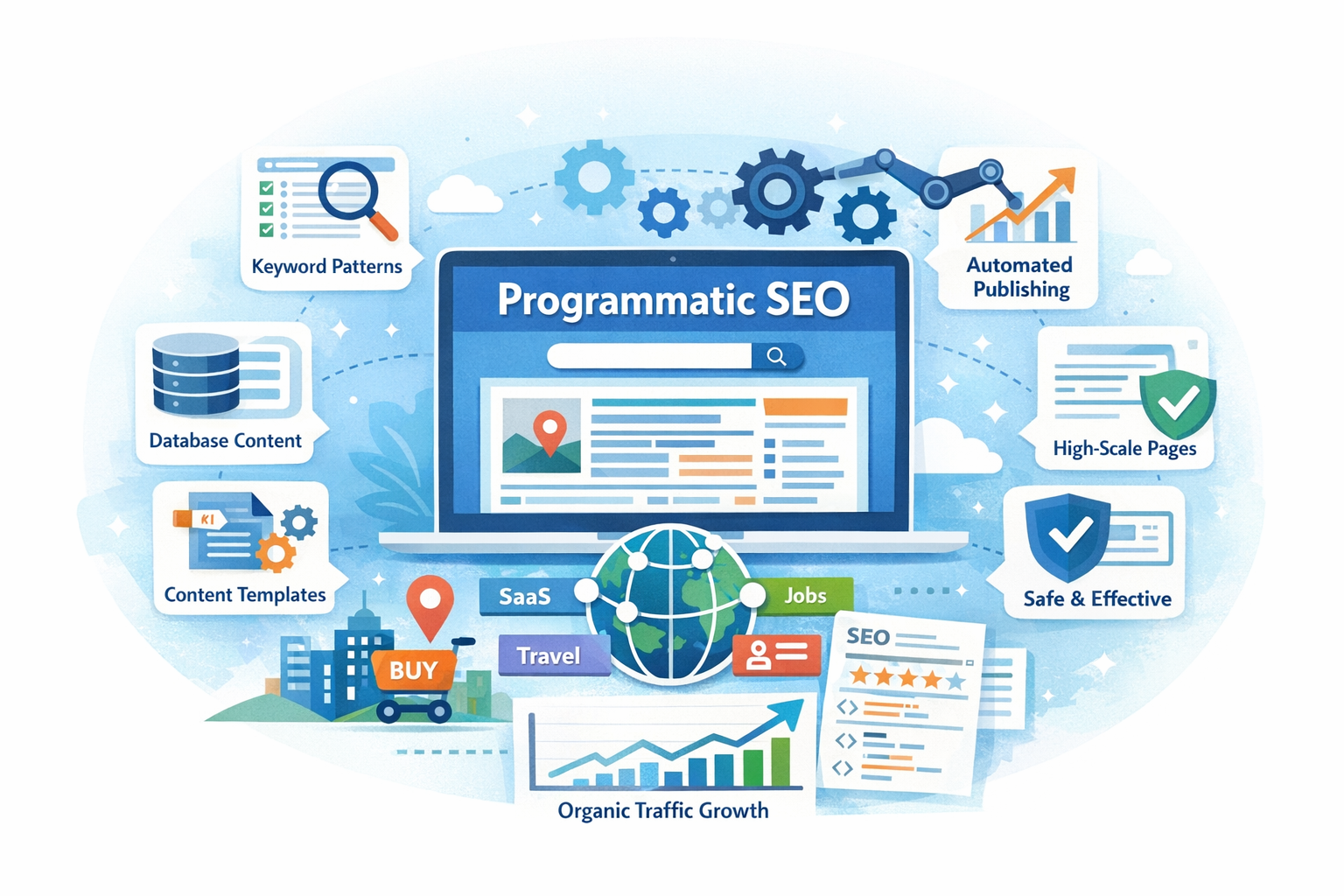
What is Programmatic SEO? A Complete Guide
Programmatic SEO is one of the most powerful strategies modern websites use to generate thousands of high-ranking pages at scale. From travel aggregators to eCommerce marketplaces, programmatic SEO helps brands unlock massive organic traffic through automation, structured content, and data-driven publishing.
In this guide, you’ll learn:
- What programmatic SEO means
- How it works
- Differences between traditional SEO vs programmatic SEO
- Use cases, benefits, examples, and safety guidelines
- How to set up programmatic SEO the right way
Introduction to Programmatic SEO
Search engines today reward websites that provide relevant, scalable, and structured information for users. With millions of long-tail searches happening daily, manually creating content for each keyword is no longer practical.
That’s where Programmatic SEO comes in.
Programmatic SEO helps businesses create hundreds or even thousands of SEO-optimised landing pages automatically without sacrificing relevance or quality.
What is Programmatic SEO?
Programmatic SEO is a strategy where web pages are created at scale using:
- Templates
- Structured keyword patterns
- Database-driven content
- Automation tools
Instead of writing every page manually, programmatic SEO allows you to generate pages dynamically based on search demand.
For example:
- “Best hotels in Delhi”
- “Best hotels in Mumbai”
- “Best hotels in Bangalore”
Instead of writing 500 separate pages manually, you build one template and populate it programmatically.
How Programmatic SEO Works?
Programmatic SEO works through a combination of SEO research, structured content templates, and automation systems to create large numbers of search-optimised pages efficiently and consistently.
Key components include:
1. Keyword + Page Pattern Discovery
You identify scalable keyword structures that can be repeated across hundreds or thousands of pages, such as:
- Services in [City]
- Products under [Category]
- Jobs in [Industry]
- Tools for [Use case] These patterns help capture long-tail search intent at scale.
2. Database-Driven Content
Instead of writing each page manually, content is pulled dynamically from structured data sources like:
- Product catalogues
- Location directories
- SaaS feature lists
- Public datasets This ensures accuracy, consistency, and easy updates across all pages.
3. Template-Based Page Creation
A reusable page format is created that follows SEO best practices, including:
- SEO-friendly headings
- FAQs for long-tail queries
- Schema markup for rich results
- Internal links for better crawlability Each page uses the same template but displays unique data.
4. Automated Publishing
Pages are generated and published automatically using:
- CMS integrations
- No-code tools
- Static site generators
- Custom scripts This allows teams to launch and scale content quickly without manual effort.
Difference Between Traditional SEO & Programmatic SEO
Search engine optimisation has evolved far beyond just writing blog posts and building backlinks. Businesses use two powerful but very different SEO approaches: Traditional SEO and Programmatic SEO. While both aim to improve organic visibility, they work in distinct ways and serve different goals.
Here is a clear comparison:
| Feature | Traditional SEO | Programmatic SEO |
| Content creation | Manual writing | Automated generation |
| Scale | Limited pages | Thousands of pages |
| Best for | Blogs, guides | Directories, marketplaces |
| Keyword targeting | Broad + selective | Long-tail + structured |
| Speed | Slower | Fast publishing |
| Data requirement | Low | High |
- Traditional SEO builds authority through content depth.
- Programmatic SEO builds traffic through content scale.
How to Set Up Programmatic SEO (Step-by-Step Guide)
Programmatic SEO is one of the most powerful ways to scale organic traffic, but it only works when executed strategically. It combines keyword research, data, templates, and technical SEO to create thousands of high-intent pages without sacrificing quality.
Here’s how to learn and implement programmatic SEO the right way.
Step 1: Perform Keyword Research for Programmatic SEO
Keyword research is the foundation of any successful programmatic SEO strategy. Unlike traditional SEO, where you target a limited set of keywords, programmatic SEO focuses on patterns and repeatable search queries.
Instead of looking for single keywords, look for keyword formulas.
Look for keyword patterns like:
- “Top restaurants in [city]”
- “Best [tool] for [industry]”
- “[product] alternatives”
- “Cheap flights from [A] to [B]”
Use tools like:
- Google Keyword Planner
- Ahrefs / SEMrush
- Google Autosuggest
- Search Console data
Step 2: Create a Scalable Content Template
Once you have identified keyword patterns, the next step is to build a scalable content template. This template acts as the backbone for every programmatic page.
A strong programmatic SEO template should include:
- SEO title + meta description (dynamically generated)
- H1 with keyword variation
- Structured subheadings (H2, H3) for clarity
- Unique introductory text using variables
- Data tables, listings, or comparisons
- FAQs for Answer Engine Optimisation (AEO) and Generative Engine Optimisation (GEO)
- Contextual internal links
Each page pulls data from a database or spreadsheet and inserts it into predefined sections.
Example:
“Best CRM software for real estate”
“Best CRM software for healthcare”
Same structure, different intent and data.
Step 3: Use Structured Data and Schema Markup
Structured data helps search engines understand your content better, which is increasingly important for AI-powered search experiences.
By adding schema markup, you increase visibility in:
- Rich results
- Featured snippets
- AI overviews
- Voice search responses
Essential schema types for programmatic SEO:
- FAQ schema – improves SERP visibility and AEO
- Product schema – for tools, software, and eCommerce
- Local Business schema – for city or location pages
- Review schema – for trust and CTR improvement
Schema doesn’t guarantee rankings, but it significantly increases eligibility for enhanced search features.
Step 4: Ensure Content Uniqueness but Avoid Thin Pages
One of the biggest risks in programmatic SEO is creating thin or duplicate content. Google does not reward mass-produced pages unless they provide unique value.
To keep pages helpful and index-worthy, add layers of originality.
Ways to ensure content uniqueness:
- Custom descriptions instead of generic text
- Location-specific insights (trends, tips, regulations)
- Expert commentary or editorial notes
- User reviews or ratings
- Dynamic FAQs based on intent
- Fresh data updates
Even small variations can make a big difference when scaled across hundreds of pages.
Rule of thumb: Each page should be able to stand on its own, even without internal links.
Step 5: Build Internal Linking at Scale
Internal linking is what turns programmatic SEO pages into a connected ecosystem, rather than isolated URLs.
A strong internal linking structure:
- Improves crawlability
- Distributes link equity
- Strengthens topical authority
- Helps pages rank faster
Common programmatic internal linking structures:
- City → Category → Listing
- Country → State → City pages
- Product → Alternatives → Reviews
- Use case → Tool → Comparison
Use dynamic internal links that automatically update as new pages are added.
Example:
- “Best restaurants in Mumbai” links to
- “Italian restaurants in Mumbai”
- “Top fine dining restaurants in Mumbai”
This creates semantic relationships that search engines love.
Is Google Ads Considered Programmatic?
No — Google Ads is not Programmatic SEO.
Google Ads and programmatic SEO are often mixed up because both use automation, but they belong to completely different marketing channels.
What Google Ads actually is
Google Ads is a paid advertising platform. You bid on keywords, write ad copy, and pay every time someone clicks your ad.
Even when campaigns are automated (Smart Bidding, Performance Max, Dynamic Search Ads), they are still:
- Paid placements
- Budget-driven
- Dependent on cost-per-click
Once you stop paying, traffic stops immediately.
What is Programmatic SEO?
Programmatic SEO is an organic search strategy. It focuses on:
- Creating large numbers of SEO-optimised pages
- Ranking naturally in search results
- Driving traffic without paying per click
Automation is used only for content creation and page generation, not for buying visibility.
Why do people get confused?
The word programmatic is widely used in advertising to describe automation, so many assume:
“If it’s automated, it must be programmatic.”
But that’s not true.
The real distinction:
- Programmatic Ads = automated paid campaigns
- Programmatic SEO = automated organic pages
One buys traffic. The other earns it.
Is Programmatic SEO Safe Under Google Guidelines?
Yes, programmatic SEO is completely safe when done correctly.
Google does not penalise automation. In fact, Google has clearly stated that content creation methods, whether human, automated, or AI-assisted, are not the issue.
The issue is quality and usefulness.
What Google actually penalises?
Google penalises pages that exist only to manipulate rankings, regardless of whether they were written by humans or generated automatically.
This includes:
- Thin content with little or no value
- Spam-like, mass-generated pages
- Duplicate or near-duplicate pages
- Keyword stuffing and forced optimisation
- Pages that fail to satisfy search intent
Bad programmatic SEO gets penalised, not programmatic SEO itself.
When Programmatic SEO Is Safe and Effective
Programmatic SEO aligns with Google’s guidelines when it puts users first.
It is safe when:
- Pages are genuinely useful
Each page should help users make a decision, find information, or compare options, not just exist for indexing.
- Content is unique, even at scale
Templates can be shared, but the content within them must vary:
- Different data points
- Different insights
- Different context
Uniqueness doesn’t mean long, but it means meaningful.
- User experience is strong
Pages should:
- Load fast
- Be easy to navigate
- Be readable and scannable
- Work well on mobile
Google increasingly evaluates how users interact with pages, not just what’s written on them.
- Pages satisfy search intent
If someone searches:
- “Best CRM for startups”
They would expect comparisons, pros and cons, pricing or features, not generic filler text.
When pages clearly match intent, programmatic SEO performs exceptionally well.
Use Cases and Examples of Programmatic SEO
Programmatic SEO works best for industries with structured search demand.
Popular examples include:
- Travel Websites
- Hotels in [city]
- Flights from [A] to [B]
- eCommerce Platforms
- Shoes under ₹2000
- Best laptops for students
- SaaS Comparison Pages
- Zoom alternatives
- CRM tools for startups
- Job Portals
- Marketing jobs in Bangalore
- Remote developer roles
- Real Estate Directories
- Apartments in South Delhi
- Villas in Goa under 2Cr
What Types of Websites Benefit Most from Programmatic SEO?
Programmatic SEO is ideal for websites that have:
- Large datasets
- Repeatable search patterns
- Multiple categories or locations
- Directory-style content
Best suited for:
- Marketplaces
- Aggregators
- SaaS companies
- Travel platforms
- Local service directories
Programmatic SEO Ideas for Growth
If you’re looking for programmatic SEO ideas, try:
- Location-based landing pages
- Product comparison pages
- Industry tool directories
- Automated FAQ hubs
- Glossary + definition pages
Key takeaways:
- Programmatic SEO creates pages automatically using templates + data
- It helps capture thousands of long-tail keywords
- It works best for directories, marketplaces, SaaS, and travel brands
- Google supports it when pages are high-quality and user-first
- Programmatic SEO is essential for GEO + AI-first search visibility
When combined with traditional SEO, expert content, structured data, and EEAT principles, programmatic SEO becomes a long-term growth engine.
Frequently Asked Questions
What is programmatic SEO in simple words?
Programmatic SEO means creating many SEO landing pages automatically using templates and structured data.
Is programmatic SEO safe?
Yes, if you avoid thin content and focus on helpful, user-first pages.
How does programmatic SEO work?
It uses keyword patterns + templates + databases to publish pages at scale.
What is the difference between SEO and programmatic SEO?
Traditional SEO focuses on manual content creation, while programmatic SEO focuses on automated scalable page generation.