SEO led lead generation is the process of attracting potential customers through organic search engines like Google and converting them into real business opportunities, such as inquiries, demo requests, sign-ups, or sales.
Unlike traditional advertising, where businesses push messages to a broad audience, SEO works differently. It helps your business appear to people exactly when they are actively searching for a solution. This makes SEO one of the most powerful and sustainable ways to generate qualified leads.
For example, imagine someone searches for:
- “best CRM for small business”
- “SEO agency near me”
- “website redesign services”
These people are not casually browsing. They already have a problem and are looking for a solution. That means they are warm leads. SEO ensures that your website appears at this crucial decision-making stage.
How Does SEO Help in Lead Generation?
SEO helps generate leads by improving your visibility for high-intent searches. When your website ranks for keywords that show strong buying intent, you attract people who are more likely to convert.
Here’s how SEO supports lead generation:
- It drives targeted traffic
SEO focuses on ranking for keywords that your potential customers are actively searching for. This means the traffic you receive is highly relevant to your business.
- It builds long-term trust
When your website consistently appears in search results, users begin to see your brand as credible and authoritative. Over time, this trust increases conversion rates.
- It reduces cost per lead
Unlike paid ads, where you pay for every click, SEO brings organic traffic without ongoing ad spend. While it requires investment upfront, the long-term cost per lead becomes significantly lower.
- It brings consistent prospects
Once your pages rank well, they can continue generating leads for months or even years with proper optimisation.
- It supports scalable growth
As you create more targeted pages and improve your SEO, your lead flow grows steadily without relying entirely on advertising budgets.
SEO does not just increase website traffic, but it also attracts the right traffic.
How SEO Helps Generate Quality Leads
Not all website visitors are valuable. What truly matters in lead generation is quality.
SEO leads tend to be higher quality because users coming from search engines are:
- Already researching solutions
- Actively comparing options
- Closer to making a buying decision
For example, someone who clicks on a social media ad might not be actively looking for your service. However, someone searching “digital marketing services pricing” is already evaluating options. This is why SEO leads often convert better than cold outreach or passive campaigns.
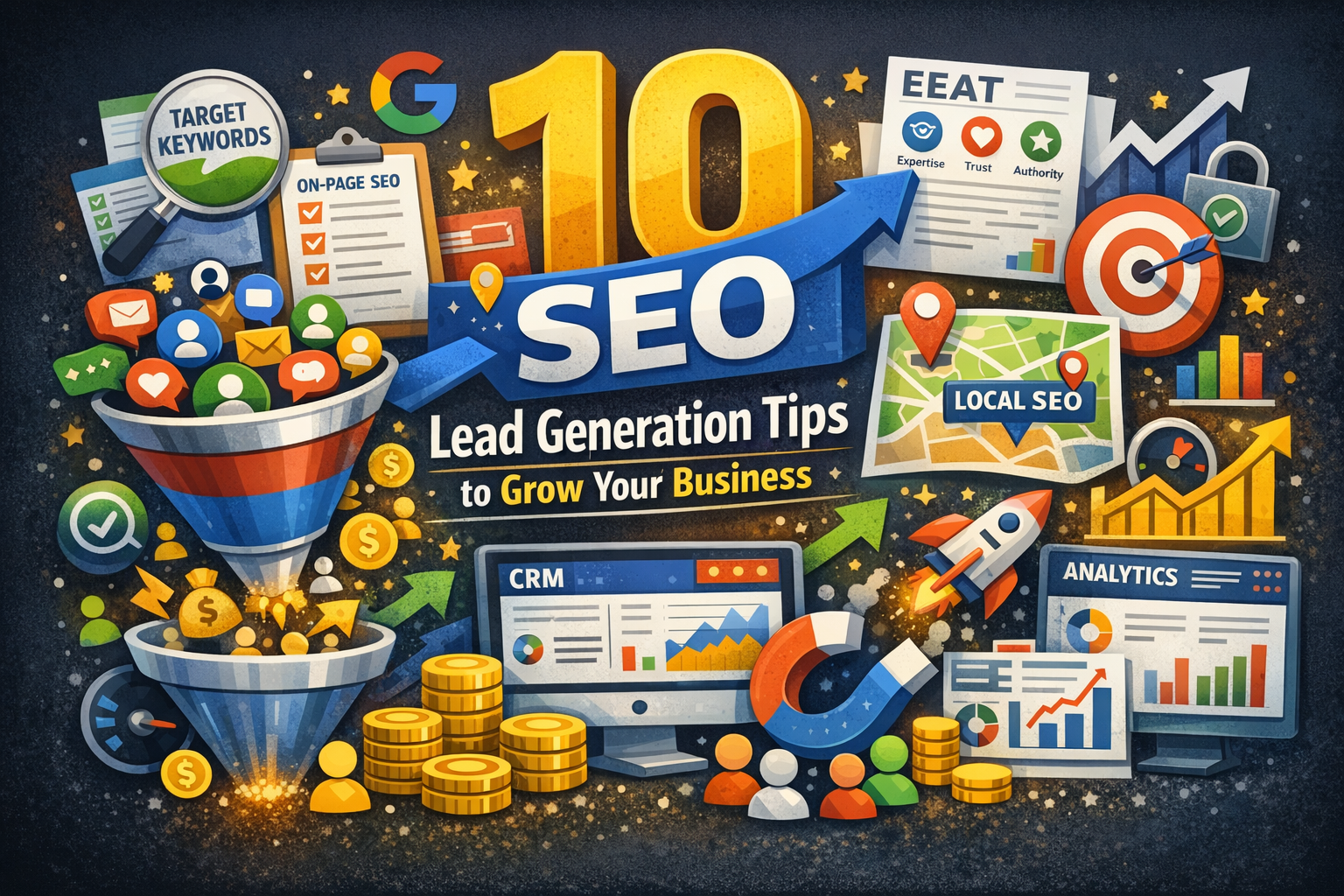
10 SEO Lead Generation Tips to Grow Your Business
Let’s explore the most effective SEO strategies that can help you generate consistent leads.
Tip 1: Target High-Intent Keywords (Not Just High Volume)
Many businesses focus only on keywords with large search volumes. However, traffic alone does not guarantee leads.
Instead, focus on buyer-intent keywords such as:
- “hire SEO consultant”
- “best accounting firm in Mumbai”
- “digital marketing services pricing”
- “software demo request”
These keywords indicate that the user is ready to take action.
There are three main types of keyword intent:
- Awareness– The user wants to learn something.
- Consideration – The user is comparing options.
- Conversion – The user is ready to buy or contact.
For lead generation, transactional and commercial keywords usually deliver better results.
Tip 2: Optimise Content Around Search Intent
Ranking on Google is not enough. Your content must match what the user expects to find.
For example:
- If someone searches “SEO lead generation tips,” they expect a practical guide.
- If they search “SEO agency pricing,” they expect clear pricing information.
- If they search “best CRM tools,” they expect comparisons and recommendations.
Before creating content, ask yourself:
- What problem is this user trying to solve?
- What action are they likely to take next?
When your content aligns perfectly with intent, conversions improve significantly.
Tip 3: Create Conversion-Focused Landing Pages
Blog posts help attract awareness. However, landing pages are what generate leads.
You should create dedicated SEO-friendly pages for:
- Services
- Specific industries
- Locations
- Product offerings
A high-converting landing page should include:
- A clear and compelling headline
- Benefits and value propositions
- Social proof such as testimonials
- A lead form placed prominently
- A strong call-to-action (CTA)
Without proper landing pages, traffic may increase but leads will remain low.
Tip 4: Improve On-Page SEO for Every Lead Page
On-page SEO ensures that both search engines and users clearly understand your content.
Important elements include:
- Including your primary keyword in the title and H1
- Using proper heading structure (H2, H3)
- Writing compelling meta descriptions
- Adding internal links to relevant pages
- Optimising image alt text
- Including FAQ sections for better visibility in search features
Strong on-page optimisation improves rankings and increases user trust.
Tip 5: Strengthen Technical SEO
A website that loads slowly or functions poorly can lose leads even if it ranks well.
Key technical improvements include:
- Improving page speed
- Ensuring mobile responsiveness
- Fixing broken links
- Optimising Core Web Vitals
- Adding HTTPS security
- Removing duplicate content
A better user experience leads to better conversion rates.
Tip 6: Build Authority Through EEAT Content
Google values content that demonstrates:
- Expertise
- Experience
- Authoritativeness
- Trustworthiness
What Does Each Part of EEAT Mean?
Experience
This shows that the content creator has first-hand or practical experience.
For example:
- Sharing real client results
- Explaining what worked and what didn’t
- Describing practical implementation steps
Experience answers the question:
“Has this person actually done this before?”
Expertise
This refers to knowledge and skill in a specific field.
For example:
- Demonstrating deep understanding of SEO strategies
- Explaining technical concepts clearly
- Publishing in-depth, accurate content
Expertise answers:
“Does this person know what they’re talking about?”
Authoritativeness
Authority is about reputation.
It is built through:
- Industry recognition
- High-quality backlinks
- Mentions in trusted publications
- Strong brand presence
Authority answers:
“Is this website or brand recognised in this field?”
Trustworthiness
Trust is the most important part.
Trust signals include:
- Clear contact information
- Transparent pricing
- Honest claims
- Real testimonials
- Proper citations
Trust answers:
“Can I rely on this information and this business?”
Why EEAT Matters for Lead Generation
In lead generation, trust directly impacts conversions.
Even if you rank #1:
- If your website looks weak, users won’t convert.
- If your claims are not supported, users won’t trust you.
- If there is no proof of experience, users hesitate.
Tip 7: Use Local SEO to Generate Nearby Leads
If you are a service-based business, local SEO can be extremely powerful.
Optimise for:
- “near me” searches
- City-specific keywords
- Google Business Profile
Additional strategies include:
- Creating location-specific pages
- Collecting positive Google reviews
- Adding local schema markup
- Maintaining consistent business details (NAP: Name, Address, Phone)
This helps you attract leads from customers who are ready to buy locally.
Tip 8: Focus on Conversion Rate Optimisation (CRO)
Traffic alone does not guarantee results. You must optimise for conversions.
Simple CRO improvements include:
- Adding clear CTAs
- Offering free consultations
- Reducing unnecessary form fields
- Using chatbots or live chat
- Displaying trust badges
When SEO and CRO work together, lead generation improves dramatically.
Tip 9: Offer Lead Magnets
People are more likely to share their contact details when they receive value in return.
Effective lead magnets include:
- Free audits
- Downloadable guides
- Templates
- Industry reports
- Free trials or demos
For example:
“Get a Free SEO Audit Report in 24 Hours.”
This approach converts organic visitors into real leads.
Tip 10: Track SEO Leads with Analytics and CRM
If you do not track your leads, you cannot improve performance.
Use tools such as:
- Google Analytics 4
- Google Search Console
- CRM software like HubSpot or Zoho
- Call tracking systems
Track:
- Form submissions
- Demo requests
- Phone calls
- Organic conversions
- Keyword-to-lead performance
SEO success should always be measured in leads and revenue, not just rankings.
Common SEO Lead Generation Mistakes
Avoid these common errors:
- Focusing only on traffic volume
- Not adding CTAs on blog posts
- Ignoring technical SEO
- Weak landing page structure
- No trust signals
- Not tracking conversions
- Relying only on blogs without service pages
Successful SEO lead generation requires strategy, structure, and optimisation.
How Long Does SEO Take to Generate Leads?
SEO is not an instant solution, but it is sustainable.
Typical timeline:
- 0–3 months: Foundation and indexing
- 3–6 months: Traffic growth
- 6–12 months: Consistent lead generation
- 12+ months: Compounding returns
While competitive industries may take longer, SEO delivers long-term value compared to short-term ad campaigns.
Is SEO Better Than Paid Ads for Lead Generation?
Both SEO and paid ads have benefits.
SEO provides:
- Long-term organic traffic
- Lower cost per lead over time
- Increased brand trust
- Sustainable growth
Paid ads provide:
- Immediate visibility
- Quick testing opportunities
The most effective strategy is to use paid ads for short-term results while building SEO for long-term lead stability.
How Do I Track SEO-Generated Leads?
Track SEO leads by setting up:
- GA4 conversion events
- UTM attribution
- CRM lead source mapping
- Search Console performance reports
This helps identify which pages + keywords drive revenue.
Conclusion
SEO is one of the most reliable and cost-effective ways to generate qualified leads. When implemented correctly, it attracts high-intent prospects, builds trust, and delivers consistent results over time.
By focusing on search intent, strong landing pages, technical optimisation, authority building, and proper tracking, businesses can turn SEO into a powerful lead generation engine that drives sustainable growth month after month.
Frequently Asked Questions
- What types of businesses benefit most from SEO-led lead generation?
SEO-led lead generation works especially well for all businesses where customers actively search online before making a decision, and can benefit significantly from SEO. The key factor is whether your audience uses search engines to compare solutions.
- What is the difference between SEO traffic and SEO leads?
SEO traffic refers to the number of users visiting your website from organic search results. SEO leads, on the other hand, are visitors who take a meaningful action, such as filling out a form, requesting a demo, booking a consultation, or making a purchase.
- How can I identify high-intent keywords for lead generation?
High-intent keywords usually include action-driven words such as “hire,” “buy,” “pricing,” “consultation,” “near me,” “services,” or “demo.” You can identify these keywords using tools like Google Search Console, keyword research tools, competitor analysis, and reviewing customer queries. These keywords indicate that the user is closer to making a decision.
- Should I focus more on blogs or service pages for lead generation?
Both are important, but they serve different purposes. Blogs help attract informational traffic and build authority, while service pages convert users who are ready to take action. For strong SEO-driven lead generation, businesses should use blogs to build awareness and strategically guide users to high-converting service or landing pages.
- How important is content quality for SEO lead generation?
Content quality is critical. Search engines prioritise content that demonstrates expertise, accuracy, and trustworthiness. High-quality content builds credibility with users, improves engagement, and increases conversion rates. Poor or thin content may rank temporarily but rarely generates sustainable leads.
- Can SEO generate leads without paid advertising?
Yes, SEO can generate consistent leads without paid advertising once your pages rank well. However, SEO requires time, strategic planning, and ongoing optimisation. Many businesses use paid ads initially for faster visibility while building long-term organic lead flow through SEO.
- How does technical SEO impact lead generation?
Technical SEO ensures your website loads quickly, functions properly on mobile devices, and provides a smooth user experience. If a website is slow or difficult to navigate, users may leave before converting. Strong technical performance directly improves both rankings and lead conversion rates.